Category Archives: Politics

Breaking News: Senate repeals “Don’t Ask, Don’t Tell”

Rainbow-flag_370x278By Ed O’Keefe
Saturday, December 18, 2010; 4:36 PM

The Senate voted decisively Saturday to repeal the “don’t ask, don’t tell” law, beginning the process of ending a 17-year ban on gays serving openly in the military and reversing decades of official military policy.

cartoonIn the end, the contentious bill passed by a lopsided 65 to 31as 57 members of the Senate Democratic caucus and eight Republicans voted to end the ban.

In a statement, President Obama praised the procedural vote earlier in the day that allowed for Saturday’s historic passage: “I am also absolutely convinced that making this change will only underscore the professionalism of our troops as the best led and best trained fighting force the world has ever known.”

The president will sign the bill next week, the White House said after the final vote.

As recently as this morning, Obama was calling wavering senators to ensure the bill’s passage, a White House official said. Saturday’s successful vote delivered a significant victory for Obama, who promised during his 2008 campaign to end the ban during his presidency.

Supporters of the repeal celebrated Saturday’s votes, drawing parallels to the military’s decision to end racial segregation in the 1950s and the admission of women to military service academies in the 1970s.

“This is the defining civil rights initiative of this decade,” said Aubrey Sarvis, executive director of Servicemembers Legal Defense Network, a group established shortly after Clinton authorized the gay ban. “Congress has taken an extraordinary step on behalf of men and women who’ve been denied their rightful integrity for too long.”

The votes came amid an unusually busy Saturday for the Senate, which is also debating the New START Treaty and an immigration bill, known as the DREAM Act, which failed a procedural vote. Nonetheless, it was a banner day for Senate Democrats and, to some extent, for bipartisanship.

“This is one of the days where you really feel privileged to be in the U.S. Senate,” said Sen. Joseph I. Lieberman (I-Conn.), the bill’s lead sponsor. “There’s been a lot of difficult times the last couple of years because it’s so partisan to get anything done. But here we are, it came together. And it was bipartisan; we wouldn’t have done it without the Republicans. We got something really good done. So I feel good about it.”

Ahead of the historic vote, senators laid out their positions for and against ending the ban.

gaysmilitarycartoon“Today’s a very sad day,” Sen. John McCain (R-Ariz.), a leading opponent of the measure. He blamed elite liberals with no military experience for pushing their social agenda on troops during wartime.

“They will do what is asked of them,” McCain said of service members. “But don’t think there won’t be a great cost.”

But Senate Majority Leader Harry Reid (D-Nev.) saw it differently. “As Barry Goldwater said, ‘You don’t have to be straight to shoot straight,'” he said, referring to the late GOP senator from Arizona.

Sen. Ron Wyden (D-Ore.), who stayed in Washington this weekend for the vote despite needing surgery for early stage prostate cancer, said “I don’t care who you love, if you love this country enough to risk your life for it, you shouldn’t have to hide who you are. You ought to be able to serve.”

The law struck down Saturday marks the end of decades of military policy prohibiting gay men and lesbians from serving openly in uniform. The Defense Department concluded during the Reagan administration that homosexuality was incompatible with military service and nearly 17,000 troops were discharged during the 1980s for being gay, according to a 1992 Government Accountability Office report.

In an attempt to make good on a campaign pledge, Bill Clinton sought a change to the policy at the start of his presidency, but faced stiff resistance from top military advisers, Congress and the American public.

Months later, Clinton signed a law implementing the policy officially known as “don’t ask, don’t tell, don’t pursue,” first proposed by Sen. Sam Nunn (D-Ga.), who opposed allowing gays to serve openly. Citing a shift in public opinion, Nunn said this month that he now supports ending the ban.

DADTThe procedural vote that made the repeal possible passed by 63 to 33. Fifty-seven members of the Senate Democratic caucus and six Republicans — Sens. Scott Brown (Mass.), Susan Collins (Maine), Mark Kirk (Ill.), Lisa Murkowski (Alaska), Olympia Snowe (Maine) and George Voinovich (Ohio) — voted yes. Four senators — Jim Bunning (R-Ky.), Judd Gregg (R-N.H.), Orrin Hatch (R-Utah) and Joe Manchin III (D-W. Va.) — were not present and did not vote.

Supporters of the repeal celebrated Saturday’s votes, drawing parallels to the military’s decision to end racial segregation in the 1950s. Among those celebrating with the jubilant Sen. Lieberman was Eric Alva, who lost a leg to a landmine during the Iraq war. A 13-year Marine veteran, Alva was not discharged under “don’t ask, don’t tell,” but disclosed his homosexuality four years ago and has fought to end the ban ever since.

After a press conference Saturday, Alva pulled Lieberman aside and volunteered to help the Pentagon conduct sensitivity training with troops concerned about ending the ban.

“They’re going to get over it,” Lieberman told Alva, adding, “God bless you.”

Under “don’t ask, don’t tell,” more than 13,000 men and women have been discharged from the military because of their sexuality. The policy was the result of a compromise between Bill Clinton and

Even if the bill is passed this weekend, the ban on gays in the military does not end immediately, and military officials and activists continue to warn that gay men and lesbians serving in uniform should not make public declarations of their sexual orientation until the law is officially repealed.

According to the legislation, the issue would rest entirely with Obama and top military leaders, who must inform Congress in writing that they have reviewed the findings of a Pentagon study regarding an end to the ban and that the Defense Department has drafted the policies and regulations necessary to stop enforcing it. Those changes must not impact troop readiness, cohesion or military recruitment and retention, according to the law.

Once the written notice is submitted, 60 days must elapse before “don’t ask, don’t tell” is officially repealed. During the two-month window, lawmakers are likely to hold hearings to review the Pentagon’s policies and procedures for accepting openly gay and lesbian troops, according to congressional aides familiar with the matter.

The White House and Pentagon will not set a specific timetable on ending the ban, and stress it will occur only after Gates and Mullen believe the military is ready to end enforcement.

dontask_97a78For his part, Gates said this month said he expects Obama “will be watching very carefully to ensure that we don’t dawdle or slow-roll on this.”

The speed of implementation could be influenced by members of the gay community, who warn privately that they will be less generous with their time and money if Obama is seen as prolonging the inevitable repeal.

Aubrey Sarvis, executive director of Servicemembers Legal Defense Network, called on Gates to immediately end investigations of troops in violation of “don’t ask, don’t tell.”

“Until the President signs the bill, until there is certification, and until the 60-day Congressional period is over, no one should be investigated or discharged under this discriminatory law,” Sarvis said.

Gates is not expected to immediately halt the investigations, according to Pentagon official unauthorized to speak for the record.

Close military observers anticipate that the ease of ending the ban will vary widely among the different military branches and that the Pentagon may stagger implementation of the change across the military branches.

Combat Marines are especially concerned about the possibility of serving alongside openly gay colleagues, and Gen. James F. Amos, the Marine commandant, has suggested that allowing gays to serve openly in the military could result in deadly distractions. Several Republican senators cited Amos’s concerns Saturday before voting against the bill.

“There will be plenty more skirmishes on this issue. This issue has been full of them,” said Fred Sainz, vice president of the Human Rights Campaign, a gay-rights group close to the Obama administration and Congressional Democrats. ” We won’t agree with everything the Pentagon has to say, as well we shouldn’t.”

PH2010120905001Obama and military leaders had pressed lawmakers to repeal the ban this year in part to avoid a surprise ruling by federal judges who are hearing cases that challenge the ban’s constitutionality.

R. Clarke Cooper, executive director of the Log Cabin Republicans, said Saturday that “open service needs to be in place,” before his group drops its legal suit challenging the law. In the meantime, “we will continue to push for the constitutional rights of service members by any means necessary,” Cooper said.

Eventual repeal may also allow previously discharged troops who violated the ban to reenlist. Michael Almy, 40, a former Air Force major, is among those eager to once again wear a military uniform.

“I can’t wait to be a part of it again,” Almy said Saturday.

Staff writer Felicia Sonmez contributed to this story.


Gay and homeless: In plain sight, a largely hidden population

Every year, hundreds of gay youths end up on the streets of L.A. County, where they make up a disproportionate share of the people under 25 who are homeless. ‘They haven’t been on the streets for years and years,’ an advocate says, ‘so they don’t look bad.’

By Alexandra Zavis, Los Angeles Times

December 12, 2010

The city hipsters sipping expensive coffee and chatting on cellphones did not give a second look at the two young men cutting across a Hollywood courtyard on their way to bed down in a nearby park.

imageAJ, 23, and his boyfriend, Alex, 21, hide their blankets and duffel bags in bushes. They shower every morning at a drop-in center and pick out outfits from a closet full of used yet youthful attire.

“If I could be invisible, I would,” AJ said. “I feel ashamed to admit that I’m homeless.”

Every year, hundreds of gay youths end up alone on the streets of Los Angeles County, where they make up a disproportionate share of the at least 4,200 people under 25 who are homeless on any given day.

PHOTO GALLERY: On the streets of Hollywood with AJ and Alex

A recent study found that 40% of the homeless youths in Hollywood, a gathering spot for these young people, identify themselves as gay, lesbian, bisexual or unsure of their sexual orientation. Five percent say they are transgender.

imageBut it is a largely hidden population, said Simon Costello, who manages the drop-in center frequented by AJ and Alex.

“They haven’t been on the streets for years and years,” he said, “so they don’t look bad.”

Blending in is part of how AJ and Alex survive on the streets. Police officers are quick to issue tickets, and the streets are full of predators.

In recent weeks, a Times reporter and a photographer spent time with several gay homeless men in their early 20s.

The men agreed to speak openly about their lives, including illegal drug use and other criminal activity, on the condition that their full names not be used. Using public records and other sources, The Times was able to independently verify some details they shared about their family histories.

***

imageGay and transgender youths become homeless for the same reasons as others their age. Many come from families with a history of abuse, neglect, addiction, incarceration or mental illness. But they say their sexual or gender identity often plays a role in the breakdown of their families.

“Queer” was among the more polite names Christopher was called while growing up, before he even knew what the barbs meant.

A slight 22-year-old with a shock of red hair, he said he stood out in his large Latino family in Pacoima, a place he calls “the ghetto of the Valley.”

“My cousins were gangbangers,” he said. “They’re talking about girls and parties … and I knew in middle school that I liked boys and wanted to hold their hands.”

At school, classmates would pelt him with food and milk cartons. To dull the hurt, he turned to alcohol and drugs. He stole money from his grandmother, swallowed his brother’s medication and cut himself with razors.

When he turned 18, he said, his grandmother kicked him out of the family home. She filed a restraining order against him in court.

image“I been hearing about my peers committing suicide because of the teasing and bullying … and of course I understand,” he said, staring at a web of scars on his left forearm. “But then I go, ‘How come that’s not my story? Why didn’t you kill yourself? How did you make it through all that?'”

Christopher said that on his first night without a roof over his head, he shared a drink with two men who took turns raping a girl who had passed out on the side of a highway.

Soon he was selling his body on Santa Monica Boulevard to support a methamphetamine habit. He and his friends used the drug to stay awake, he said, so they would not get jumped. They shared a room and a soiled mattress in an abandoned building. “No plumbing, no electricity,” Christopher said.

***

imageAJ was just 16 when his Vietnamese immigrant father told him to get out of his house, unable to accept his admission that he was gay. Any effeminate gesture, AJ said, would drive his father to beat him.

For a time, AJ moved between the homes of friends and relatives in California and Colorado while he worked a succession of jobs. Some paid well enough for him to get his own apartment. But, he said ruefully, “It has been hard to sustain my sobriety.”

When he was fired from his last job in July, he had no place to go but the streets.

He met Alex at the drop-in center operated by the L.A. Gay and Lesbian Center. Tired of his father’s drunken rages, Alex left his home in El Paso in June and caught a train to Los Angeles with a friend. He thought there would be more opportunities here. After two weeks, his backpack was stolen along with the only possessions he had with him. He still hasn’t found work.
AJ and Alex bonded quickly. Both lost their mothers to drug overdoses and struggled to be accepted by their fathers.

imageOn a recent night, the couple headed to a park, one of their favorite spots to while away time during the hours the drop-in center is closed. The restrooms are open late. Friendly neighbors stop to chat while walking their dogs; once, they ordered pizza for them.

They spread a sleeping bag on the lawn, then pulled out a bottle of cheap gin, which they mixed with diet Mountain Dew. They said they collected store gift cards, which are offered by many institutions as incentives to attend therapy sessions, then traded them in for cash to buy the beverages.

“We’re not alcoholics,” Alex said. But sometimes their life is difficult, he said, “and we have to numb it down.”

Soon they were singing along to songs stored on a cellphone with no service. As they neared the end of the bottle, AJ became by turns angry and despondent. All he could think about was getting high, but he did not have the cash to buy crystal meth.

“Let’s go,” he told Alex. “I want to prostitute myself.”

Alex tried to distract him with a bite of hamburger, but AJ pushed it away and groaned.

Finally, they crawled underneath some bushes to go to sleep. As they curled up in each other’s arms, cheerful chatter wafted over them from a late-night picnic, punctuated by the thwacks of tennis rackets hitting a ball on an illuminated court.

***

imageFor some gay youths alienated from their families, the foster care system provides sanctuary. But too often, said Costello, the L.A. Gay and Lesbian Center’s associate director for children, youth and family services, they bounce between foster parents and group homes until they turn 18. Once emancipated, they have nowhere to go.

Jonathan, a gregarious 21-year-old with a marijuana leaf tattoo on his arm, said he had more than 20 placements between the time he was removed from his parents’ home at 5 and aged out of foster care three years ago.
“I had anger management issues,” he said.

When he was 9, Jonathan said, one of his foster mothers left him alone with two men who raped him.

“I used to hate gay people because of what happened to me,” he said.
But he recently told his best friend that he is bisexual. They were in a cell waiting to see a judge about a pair of tickets they’d been issued for riding a train without paying.

imageJonathan said he has lost track of the number of times he has been arrested. He hangs out in skateboard parks and often sleeps on a rooftop, where he feels safe.

The first thing he does when he wakes up is reach for a marijuana pipe. Staring through the pungent haze from his spot on the pavement early one morning, he had a commanding view of the Hollywood Hills.

“You see those houses on the hill?” he said. “I’m a have one of those one day.”

***

imageGetting off the streets is a challenge for many of these young people. The L.A. Gay and Lesbian Center is one of several Hollywood organizations that assist homeless youths. Among them, there are only about 200 beds available.
Christopher credits the center — and the kindness of a teacher who took him into her home for a time when he was being bullied — with keeping him alive.
But it has not been easy. Soon after he was admitted to a transitional living program operated by the center, he was kicked out for getting into a fight with his boyfriend. Months later, Christopher asked the center for another chance.

“I was so tired … so broken and hopeless,” he said. “I was desperate for something different.”

With their help, he completed a rehab program, passed the high school equivalency test and moved into a sober-living home. He now works part time dispensing frozen yogurt and has a tiny apartment of his own.
“I’m a part of society,” he said. “I couldn’t be any happier.”

imageJonathan says he isn’t sure that he wants to go into transitional housing — too many rules. But he has plans. He would like to go to college, maybe become a doctor or a lawyer so he can help others like himself.

“Things are going to work out,” he said. “Remember this face.”

AJ has promised Alex he will stop doing crystal meth. They are looking for work, but are finding it difficult without an address.

AJ was diagnosed with depression and applied for a bed at a shelter operated by a mental health center. But when two beds became available one morning, the staff had no way to reach him. By the time he checked in with the center that afternoon, the spots had been snapped up.

A few days later, there was good news. Another bed was available. AJ, worried that Alex could not cope alone on the streets, made his boyfriend take the bed. They held hands on the bus and kissed goodnight outside the metal gates.

imageTo be close to Alex, AJ started sleeping under a nearby bridge. There were rats and piles of trash. He spread cardboard on the ground before putting down a blanket. His last $2 went to buy a bottle of vodka. When that was gone, he grabbed another bottle from a supermarket shelf and sprinted out the door.
He tried to bum a cigarette off a passerby, but the man ignored him. Furious, AJ threw down the backpack in which he had stuffed the bottle, then burst into tears as vodka seeped onto the pavement.

Spending a night apart from Alex, “it seems so small,” he said later. “But when you have nothing but each other, it’s huge.”

PHOTOGRAPHS BY: Christina House / For The Los Angeles Times


To Reserve the Right to Execute Gay People

tumblr_la2xii46Ad1qzp9wro1_500

I saw this on Stuff That Makes Me Hard!  How sad is this?

To reserve the right to execute gay people:

The Maddow Blog: A new U.N. resolution [which] condemns the arbitrary execution of whole classes of humanity, from street kids to indigenous groups, was to have included sexual minorities, but a bunch of nations balked at protection for LGBTs. The U.N. General Assembly then approved an amendment that removed them from the list. The vote was 79-70. Here’s the list of countries that want to reserve the right to kill the gay:

Afghanistan, Algeria, Angola, Azerbaijan, Bahamas, Bahrain, Bangladesh, Belize, Benin, Botswana, Brunei Dar-Sala, Burkina Faso, Burundi, Cameroon, China, Comoros, Congo, Cote d’Ivoire, Cuba, Democratic People’s Republic of Korea, Democratic Republic of Congo, Djibouti, Egypt, Eritrea, Ethiopia, Ghana, Grenada, Guyana, Haiti, Indonesia, Iran, Iraq, Jamaica, Jordan, Kazakhstan, Kenya, Kuwait, Lebanon, Lesotho, Liberia, Libya, Madagascar, Malawi, Malaysia, Maldives, Mali, Morocco, Mozambique, Myanmar, Namibia, Niger, Nigeria, Oman, Pakistan, Qatar, Russian Federation, Rwanda, Saint Kitts and Nevis, Saint Lucia, Saint Vincent and Grenadines, Saudi Arabia, Senegal, Sierra Leone, Somalia, South Africa, Sudan, Suriname, Swaziland, Syrian Arab Republic, Tajikistan, Tunisia, Uganda, United Arab Emirates, United Republic of Tanzania, Uzbekistan, Viet Nam, Yemen, Zambia, Zimbabwe

via: The New Yorker


Photos of gay service members make statement about policy


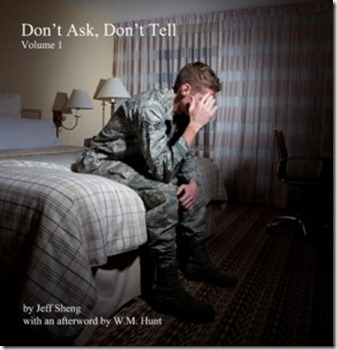
6a00d8341c730253ef0133f5e141ae970b-800wi(CNN) — A soldier and his shadow sit alone on wrinkled sheets. With his knees pressed tightly up against his chest, he wraps his arms around his legs and bows his head.

In another photo, a soldier stands before a mirror. His raised hand covers just enough of his reflection to protect his anonymity.
But it’s not photographer Jeff Sheng from whom these men are hiding their identities.6_photo-2
It’s the military.
Sheng’s “Don’t Ask, Don’t Tell” exhibit, two years in the making, conveys the stories of the gay and bisexual men and women who serve in the U.S. military. And because his subjects are forced to keep their sexual orientations under wraps in order to serve, Shen’s photos are portraits without faces.
The Los Angeles, California-based artist said many of his subjects were grateful for the opportunity to make a statement “without fully revealing themselves and losing their jobs.”
“If this person got outed, they would lose their pension, their retirement benefits — their 20 years of service in the military would be gone,” he said.
6a00d8341c730253ef0133f1b8f56a970b-800wiSheng asked many of those he photographed why they continue to serve despite the inequality.
“I asked, ‘Why do you still serve with this policy in place? Why would you do it?’ ” Sheng said. “And they all looked at me and said, ‘Because it’s serving the country. It’s the most honorable thing that I can think of doing right now in my life.’ ”
20091220RicoSheng is also the creator of “Fearless,” photographs of lesbian, gay, bisexual and transgendered high school and college athletes who are public about their sexual identities. He is working on a project focusing on undocumented Americans.
The “Don’t Ask, Don’t Tell” photos were exhibited last week in Washington at the Human Rights Campaign headquarters, and Sheng said he hopes to bring them next to Chicago, Illinois.
Bryan-finalThe exhibit couldn’t have been unveiled at a more relevant time.
On Friday, the U.S. Supreme Court refused to suspend enforcement temporarily of “don’t ask, don’t tell.” Though a lower court has deemed the law unconstitutional, the controversial policy will remain in effect until the appeals process is complete.
President Obama is on record favoring abolition of the policy but has said he wants the issue to be decided by Congress, not in the courts.
Oliver-finalThe new commandant of the Marine Corps, Gen. James Amos, opposes repeal of the policy. “There is a risk involved,” Amos told reporters in San Diego, California. “I’m tring to determine how to measure that risk. This is not a social thing. This is combat effectiveness.”
Ryan Vincent Downing, a former Air Force captain and one of the 60 service members Sheng photographed, said he has confidence “that people in the military can handle change.” He is no longer in the service and said hiding his sexuality took a toll.
Tristan-and-Zeke-final“I found myself making up lies, and then making up more lies to cover the lies I had told before,” Downing said.
Sheng said he hopes his photographs open eyes to the way the “don’t ask, don’t tell” policy affects closeted service members who are fighting and dying for their country.
“This idea that they’re hiding, in many ways … they can’t reveal who they are,” Sheng said. “[It] has a really profound effect on the way that people see these images and think about the issue.”
JEFF-SHENG-DADT-BOOK-COVER-289x300
This was originally published online by Chuck Conder of CNN on November 15, 2010.


‘Mama Wu’ unlikely hero for homosexuals in China

Wu Youjian, right, chats with another parent of gay child at a recent event at Shanghai Pride, a month-long celebration of gay culture in China's largest city.

Wu Youjian, right, chats with another parent of gay child at a recent event at Shanghai Pride, a month-long celebration of gay culture in China’s largest city.
STORY HIGHLIGHTS

  • ‘Mama Wu’ has earned fame by publicly defending her homosexual son
  • Homosexuals face deep cultural prejudices and pressure to marry
  • About 30 percent of Chinese homosexuals have attempted suicide
  • Although not illegal, homosexual venues regularly shut down in China

Beijing, China (CNN) — When Wu Youjian’s teenage son told her on a spring night in 1999 that he was gay, Wu did something rarely heard of in China.
“I told him, there’s nothing wrong with liking boys and it’s no big deal,” said the 63-year-old retired magazine editor.
Five years later, when her son discussed his sexuality on local television in the southern metropolis of Guangzhou, Wu made another groundbreaking decision. She became what state media calls the first Chinese parent to go on television in support of her gay child.
Zheng Yuantao, 30, knows how lucky he is to have such a mother.
“Many of my gay friends are afraid of going home during holidays, because their parents would ask about girlfriends and press them to get married,” he said.
“I grew up in a very open-minded family,” he added. “I didn’t have too much of a struggle about my sexuality.”
Wu now devotes her time and energy to speaking up for gay acceptance by family and society. Her small frame belies her big role in China’s gay community, where she is affectionately called “Mama Wu.”
She taught herself to use a computer three years ago and now writes a blog that has clocked more than 2.2 million hits. She also tweets frequently, has launched a hotline and founded the country’s first PFLAG – Parents, Families and Friends of Lesbians and Gays – group in her hometown.

“I just followed my instinct and my love for my son,” Wu said.
For other Chinese parents in her situation, however, instinct usually means a deep sense of shame. Many refuse to face the reality and some sever ties with their gay children. Others scheme to break up their children’s relationships. Some may insist on psychiatric treatments, while others may threaten to commit suicide if their children don’t change.
‘Mama Wu’ inspires other Chinese parents of gay children
“In China, we consider carrying on the family line of paramount importance, but we don’t value the happiness of individuals,” said Li Yinhe, a sociologist with the Chinese Academy of Social Sciences.
Societal pressure cooker
Suicide is high among Chinese homosexuals, Li said, with some surveys saying as many as 30 percent of gay youth attempt to take their lives. That trend mirrors the United States, where a spate of suicides by gay adolescents in recent months has shaken the nation.
Most gay men in China still succumb to social pressure and marry women. It once meant heterosexual marriages, often with children, Li said. Now, gay community activists say a small but growing number of young gay men in big cities are tying the knot with lesbians to both placate families and maintain their lifestyles.
Li conducted China’s first comprehensive surveys on gay men. She published her findings in a 1992 book, which Wu credited for shaping her views on homosexuality.
While society at large has loosened up on homosexuality, Li said, family pressure on gay people remains strong because of deep-rooted Confucian ideas and the government’s one-child policy – making Wu’s words and actions all the more powerful.
“No one would listen to an outsider, but she is not – she is a mother whose only son is gay,” Li said. “Others would wonder, if she can handle it so well, why can’t I.”
It’s not all accolades for Wu, however. Vitriolic attacks often dog her online. On a popular video-sharing site, under a clip paying tribute to her achievements, a recent comment accused her of “leading our youth to a place filthier than a brothel” and “hastening the moral death of our already-sick society.”
Wu brushes such verbal assaults aside. Her son, often a target himself along with Wu, understands why.
“It’s not about how many people she can change,” Zheng said. “The important thing is that she is out there helping real people every day.”
Gay venues shut down
Homosexuality is not illegal in China, and in 2001 it was also removed from the country’s list of officially recognized mental disorders. But it remains largely a taboo topic on state-run media.

China mom becomes advocate for gay son
No one would listen to an outsider, but she is not – she is a mother whose only son is gay –Li Yinhe, Chinese Academy of Social Sciences
RELATED TOPICS

Police sometimes shut down gay venues when high profile events are held. Gay rights advocates reported raids on gay clubs, saunas and cruising spots ahead of the Summer Olympics and the annual parliament sessions in Beijing in the past.
Officials have also pulled the plug – often at the last minute – on gay-themed events, including the country’s first gay pageant last January.
Li, the sociologist who also serves as a government adviser, has tried to cement gay rights in Chinese law. She submitted proposals to legalize same-sex marriage in 2003, 2005 and 2006. None have succeeded so far – and she admits her goal probably won’t be realized anytime soon.
“Gays are minorities in society,” she said. “People just don’t think this issue is important enough, compared to national priorities like economic development.”
Wu stresses the social and non-political nature of her activities, highlighting official approval and state media reports in her speeches. Her group also joins the effort in HIV/AIDS prevention, a gay-related cause promoted by the government.
She has picked up pace in spreading the message of acceptance, giving lectures and hosting seminars across the nation.
At a recent PFLAG gathering in Beijing, Wu, sporting a rainbow scarf and speaking in a calm but firm tone, addressed a packed hotel conference room of about 100 people, with her son and his boyfriend in attendance.
Her voice cracked, however, when she mentioned how parental intransigence drove a married young gay man, who had sought her help, to take his life.
“We have to give them hope,” Wu said, quoting iconic gay American politician Harvey Milk.
Wu says she constantly reminds other parents about one basic fact.
“It doesn’t matter if our children are gay or straight – just like it doesn’t matter if they are left-handed or right-handed,” she said. “They are always our children.”
Thousands of blog posts and phone calls later, Wu has compiled her stories in a new book – titled “Love Is the Most Beautiful Rainbow” – and vows to continue her effort.
“I have only one child, but so many call me Mama,” she said.
 
This article was originally written and published by Steven Jiang, CNN on November 16, 2010 1:36 p.m. EST


In Mourning

image

The above image is of a statue known as the “Mourning Angel.”  After Tuesday’s election, that is the way I feel.  Only four of the candidates that I voted for won their elections.  Two were the only Republicans I will vote for, and the other two were unopposed.  I find that terribly saddening.

There were several elections around the country that I found to be quite upsetting, but one in particular I found to be truly tragic.  Congressman Gene Taylor of the 4th Congressional District of Mississippi lost his re-election bid, only because he was a Democrat.  Taylor was probably the most conservative Democrat in Congress, though make no bones about it, he was a Democrat.  For 21 years he has worked tirelessly for his district.  During Hurricane Katrina, when his house was destroyed (his district is the coastal district of Mississippi), he was one of the most vocal politicians about the slow reaction time of the government to help the Mississippi Gulf Coast.  He was a tireless advocate of all of his constituents, and I doubt anyone could find anything disparaging to say about him other than that he is a Democrat.  In my opinion, Mississippi has suffered one of its greatest tragedies in its history.


Election Day

image

November 2, 2010 is a very special day if you live in the United States of America.  It is election day.  Besides white landowners, the ancestors everyone in this country has had to fight to gain the right to vote.  We all now have the right to vote.  Use that right responsibly.  Understand how important this election is.  So many people I know are going to the polls to vote against the Democrats (I live in a staunchly conservative area of the South).  It makes me almost want to cry.  We have finally after decades of Republican Congressmen finally elected a Democrat to Congress in out District, now his job is in jeopardy.  Even very conservative Blue Dog Democrats (much of which I agree with) are going to be replaced with right-wing conservative nut cases who care nothing about the people and only want to remove Pelosi as Speaker of the House and replace her with someone in the Republican party who is even more decisive.  I honestly don’t think Pelosi is the best person to be leading the House of Representatives because of her divisive politics.  Too much of politics is divisive.  Politicians and special interest groups campaign about what they are against.  I would much rather hear what you are for.  Why can’t we have one positive campaign?

This election is also much more than just about who controls Congress.  Control of Congress can be a two year deal and imagewho knows what can happen in the next two years.  It is unlikely that the Republicans will gain a supermajority in Congress and thus any legislation they push through can be vetoed by the President and cannot be overridden.  Thus we will be at a standstill.  We need more moderates in Congress who can work across party lines and get things done.  We don’t need one party who will ram legislation down our throats, even when America is very vocal against it.

As I said, this election is much more than just about who controls Congress. In many of the states we are electing new governors.  It is these governors who will be given the chance to redraw Congressional districts, most of whom will redraw lines to favor their own party politics.  These governors will not only affect the next four years but also the next ten years.

image

I don’t have the answers about politics.  I know there are several of my readers who are much more informed than I am.  I am only a government teacher who tries to teach my students to be responsible citizens.  I am not trying to influence your vote, but I do ask that you vote responsibly.  I hope that you have researched the candidates that you truly know what your candidate is about and what they stand for, not just what they stand against.  Vote smart, vote responsibly, and do what you truly believe is best for your country.


October Is GLBT History Month: Finally

Eleanor Roosevelt
First Lady
b.  October 11, 1884
d.  November 7, 1962
“No one can make you feel inferior without your consent.”
image Eleanor Roosevelt transformed the role of First Lady. She served as a diplomat and was a tireless champion of international human rights.
Roosevelt was born into a wealthy family in New York City. Both her parents died before she was 10; thereafter, she moved in with her grandmother in upstate New York. At the age of 15, she lived in England, where she learned to speak French and Italian fluently.
Soon after her return to New York, Roosevelt met her future husband, Franklin Delano Roosevelt, her father’s fifth cousin. Franklin was attending Columbia Law School. The couple married and had six children, five of whom survived infancy. Franklin took his first leap into politics, winning a seat in the New York State Senate. The family moved to Washington, D.C., when he was appointed Assistant Secretary of the Navy by President Wilson.
Life in the nation’s capital kindled Eleanor’s interests in policy making.  She joined the board of the League of Women Voters in 1924 and became involved in Democratic Party politics. In 1928, after her husband was elected governor of New York, she became actively engaged in domestic and international issues. She wrote a syndicated newspaper column titled “My Day.”
In 1933, Roosevelt became First Lady of the United States, a position she held for 12 years. While she assumed traditional duties, she did not allow them to compromise her ideals. In 1939, she announced in her column that she would resign her membership in the Daughters of the American Revolution, after the group refused to allow Marian Anderson, a black singer, to perform in Washington’s Constitution Hall. “The basic fact of segregation,” Roosevelt wrote, “is itself discriminatory.”
While First Lady, Roosevelt developed an intimate relationship with Lorena Hickock, a journalist who covered the White House. The relationship lasted for the rest of Roosevelt’s life.
Eleanor Roosevelt’s commitment to public service continued after her husband’s death in 1945. President Truman named her a delegate to the United Nations, where she was elected chairwoman of the Commission on Human Rights. In that position, she helped draft the influential Universal Declaration on Human Rights. 
Roosevelt was a member of the Board of Trustees of Brandeis University and delivered the school’s first commencement address. She also authored several children’s books. In her lifetime, she received many civic awards and honorary degrees.
Jalal al-Din Rumi
Sufi Mystic/Poet
b. September 30, 1207
d. December 17, 1273
“Only from the heart can you touch the sky.”
image Jalal al-Din Rumi was a poet, theologian and Sufi mystic. He founded the Order of the Whirling Dervishes, a branch of the Sufi tradition that practicies a gyrating dance ritual representing the revolving stages of life.
Rumi was born in the Persian province of Balkh, now part of Afghanistan. Rumi’s father was an author, a religious scholar and a leader in the Sufi movement—the mystical dimension of Islam.
When Rumi was 12, his father moved the family to escape the impending invasion of Mongol armies, eventually setting in Konya, Anatolia, the westernmost tip of Asia where Turkey is today.
In 1231, after his father died, Rumi began teaching, meditating and helping the poor. He amassed hundreds of disciples who attended his lectures and sermons.
Rumi was married and had one son. After his wife’s death, he remarried and fathered two more children. In 1244, Rumi met a man who changed his life. Shams of Tabriz was an older Sufi master who became Rumi’s spiritual mentor and constant companion. After Shams died, Rumi grieved for years. He began expressing his love and bereavement in poetry, music and dance.
Rumi had two other male companions, but none would replace his beloved Shams. One of Rumi’s major poetic works is named in honor of his master, “The Works of Shams of Tabriz.” Rumi’s best-known work is “Spiritual Couplets,” a six-volume poem often referred to as the greatest work of mystical poetry.
In “Rumi: The Book of Love Poems of Ecstasy and Longing” (2003), Rumi expresses his perception of true love. “Lovers don’t finally meet somewhere. They’re in each other all along.”
Rumi died surrounded by his family and disciples. His tomb is one of the most revered pilgrimage sites in Islam and is a spiritual center of Turkey.
David Sedaris
Writer/Humorist
b. December 26, 1956
“A good short story would take me out of myself and then stuff me back in, outsized, now, and uneasy with the fit.”
image David Sedaris is an award-winning best-selling author whose short stories depict, variously, the life of a young gay man in 20th century America, the experience of an American living abroad and the comedy of family life.
Sedaris, who was one of six children, was born in Binghamton, New York, and grew up in Raleigh, North Carolina. In 1983, he graduated from the School of the Art Institute of Chicago. He began writing and supported himself with odd jobs in Raleigh, in Chicago and eventually in New York. His big break came on National Public Radio, where he read his short stories.
Called the “preeminent humorist of his generation” by Entertainment Weekly, Sedaris is the author of numerous collections: “Barrel Fever” (1994), “Naked” (1997), “Holidays on Ice” (1997), “Me Talk Pretty One Day” (2000), “Dress Your Family in Corduroy and Denim” (2004) and “When You are Engulfed in Flames” (2008), which was number one on the New York Times best-seller list. He edited a 2005 collection of stories called “Children Playing Before a Statue of Hercules,” the proceeds from which benefit a nonprofit writing and tutorial center.
Sedaris is known for his distinctive style, combining elements of memoir, humor and the traditional short story. He is clear that his stories are embellished. “I’m a humorist,” he says. “I’m not a reporter.”
Sedaris is a frequent contributor to the award-winning “This American Life” public radio show. Along with his sister Amy, he is the author of numerous plays written under the name “The Talent Family.” He has been nominated for two Grammy Awards and was named Time magazine’s Humorist of the Year in 2001. In 2008, he delivered the commencement speech at Binghamton University and was awarded an honorary doctorate. 
Sedaris lives in London, Paris and Normandy with his longtime partner, Hugh Hamrick. 
Matthew Shepard
Hero      
b.  December 1, 1976
d.  October 12, 1998
“Every American child deserves the strongest protections from some of the country’s most horrifying crimes.” – Judy Shepard
image As a gay college student, Matthew Shepard was the victim of a deadly hate crime. His murder brought national and international attention to the need for GLBT-inclusive hate crimes legislation.
Shepard was born in Casper, Wyoming, to Judy and Dennis Shepard. He was the older of two sons. Matthew completed high school at The American School in Switzerland. In 1998, he enrolled at the University of Wyoming in Laramie. Soon afterward, he joined the campus gay alliance.
On October 6, 1998, two men—Aaron McKinney and Russell Henderson—lured Shepard from a downtown Laramie bar. After Shepard acknowledged that he was gay, McKinney and Henderson beat and tortured him, then tied him to a tree in a remote, rural area and left him for dead. Eighteen hours later, a biker, who thought he saw a scarecrow, found Shepard barely breathing.
Shepard was rushed to the hospital, but never regained consciousness. He died on October 12. Both of Shepard’s killers were convicted of felony murder and are serving two consecutive life sentences.
Despite the outcome of the trial, the men who took Shepard’s life were not charged with a hate crime. Wyoming has no hate crimes law, which protects victims of crimes motivated by bias against a protected class. Shepard’s high-profile murder case sparked protests, vigils and calls for federal hate crimes legislation for GLBT victims of violence.
Shortly after their son’s death, Judy and Dennis Shepard founded The Matthew Shepard Foundation to honor his memory and to “replace hate with understanding, compassion, and acceptance.” Judy Shepard became a GLBT activist and the most recognized voice in the fight for a federal hate crimes bill.
In 2009, more than a decade after Shepard’s murder, The Matthew Shepard and James Byrd Jr. Hate Crimes Prevention Act (HCPA) was signed into law. HCPA added sexual orientation and gender identity to the list of protected classes, giving the United States Department of Justice the power to investigate and prosecute bias-motivated violent crimes against GLBT victims.
Dozens of songs have been written and recorded to honor Matthew Shepard’s legacy.  Several films, television movies and plays about him have been produced, including “The Laramie Project” (2002) and “The Matthew Shepard Story” (2002).
Jóhanna Sigurðardóttir
Prime Minister of Iceland
b. October 4, 1942
“Egalitarian policies are the best way to unite and empower people.”
image Jóhanna Sigurðardóttir is the first female prime minister of Iceland and the world’s first openly GLBT national leader.
Sigurðardóttir was born in Reykjavik, where she received the equivalent of a high school diploma from the Commercial College of Iceland. Her first job was as a flight attendant for what is now Icelandair. After six years in that position, she became a union organizer with the airline—a move that served as her entree into Icelandic politics.
Sigurðardóttir was elected to Iceland’s Parliament in 1978. Viewed as a rising star, she was named minister of social affairs in 1987. In 1990, she ran for the top spot in her party, the Social Democrat Alliance. She narrowly lost that race, declaring, “My time will come,” which has become a common catchphrase in Iceland.
In January of 2009, following the collapse of the nation’s economy in the worldwide recession, Iceland’s president asked the Social Democrat Alliance to form a new government, which elevated Sigurðardóttir to the office of the prime minister. At the time of her appointment, she was the longest-serving member of Iceland’s Parliament.
Four months later, Sigurðardóttir’s party, along with its coalition partner, won a majority of seats in the Parliament, handing her a strong mandate to lead Iceland’s economic revitalization efforts and to work toward joining the European Union. While focusing on these important tasks, Sigurðardóttir has not forgotten the value of equity in politics. “A society that does not use the intellectual power of its female population fully is not a wise society,” she says.
Sigurðardóttir was married to a man prior to coming out. She and her ex-husband are the parents of two adult children. On June 11, 2010, by a vote of 49 to 0, Iceland’s Parliament approved same-sex marriage. On June 26, 2010, the first day that legislation became effective, Jóhanna Sigurðardóttir and Jónína Leósdóttir were married. 
Pyotr Ilyich Tchaikovsky
Composer 
b. May 7, 1840
d. November 6, 1893
“Music’s triumphant power lies in the fact that it reveals to us beauties we find in no other sphere.”
image Pyotr Ilyich Tchaikovsky is one of the most popular composers in history. His best-known works include the ballets “Swan Lake,” “The Sleeping Beauty,” and “The Nutcracker”;  the operas “The Queen of Spades” and “Eugene Onegin”; and the widely recognized Fantasy Overture “Romeo and Juliet” and “1812 Overture.”
Tchaikovsky was born in Votinsk, Russia, a small industrial town. His father was a mine inspector. His mother, who was of French and Russian heritage, strongly influenced his education and cultural upbringing.
At age 5, Tchaikovsky began piano lessons. His parents nurtured his musical talents, but had a different career path in mind for their son. In 1850, the family enrolled him at the Imperial School of Jurisprudence in St. Petersburg, where he prepared for a job in civil service.
After working in government for a few years, Tchaikovsky pursued his passion at the St. Petersburg Conservatory. After graduation, he taught music theory at the Moscow Conservatory and worked on new compositions. Tchaikovsky created concertos, symphonies, ballets, chamber music, and concert and theatrical pieces. His passionate, emotional compositions represented a departure from traditional Russian music, and his work became popular with Western audiences.
Despite his career success, Tchaikovsky’s personal life was filled with crises and bouts of depression. After receiving letters of admiration from a former student, Tchaikovsky married her. Historians speculate the marriage took place to dispel rumors that Tchaikovsky was gay. The marriage was a disaster and Tchaikovsky left his wife after nine days.
Tchaikovsky began an unconventional relationship with a wealthy widow, Nadezhda von Mek, who agreed to be his benefactor on one condition: they were never to meet face to face. The couple exchanged more than 1,000 letters, until von Mek abruptly ended their 13-year liaison.
The famed composer died suddenly at age 53. The cause of his death, believed by some to be suicide, remains a mystery.
Rufus Wainwright
Singer/Songwriter
b. July 22, 1973
“It’s important for famous people to be an example for gay teens.”
image Known for his unique style and daring artistic endeavors, Rufus Wainwright is one of the most accomplished singer/songwriters of his generation. He has produced six albums and is the recipient of two Juno Awards and five GLAAD Media Awards.
Wainwright’s musical talent was shaped by his folksinger parents, Kate McGarrigle and Loudon Wainwright III. He was born in Rhinebeck, New York, and holds dual United States and Canadian citizenship. After his parents divorced, he spent most of his youth with his mother in Montreal.
At age 14, Wainwright broke into the entertainment world with a song he composed and sang in the film “Tommy Tricker and the Stamp Traveller,” earning him a Juno Award nomination for “Most Promising Male Vocalist of the Year.” That same year, he was sexually assaulted by a man he met at a bar. Deeply disturbed by the attack, he remained celibate for seven years.
In 1998, following the release of his first album, Wainwright was named “Best New Artist” by Rolling Stone. He composes music for theater, dance and opera, and has contributed to numerous film soundtracks, including “Moulin Rouge” and “Brokeback Mountain.” Additionally, he has acted in “The Aviator” and “Heights,” among other films.
As a collaborator, Wainwright has worked on albums with music greats Rosanne Cash and Elton John. John hailed him as “the greatest songwriter on the planet.” His first opera, “Prima Donna,” premiered in 2009 at the Manchester International Festival and was the subject of a documentary film that premiered on Bravo! in 2010.
Despite fame and success, Wainwright struggled with crystal meth addiction, a habit he eventually recovered from in 2002. With two decades of performing under his belt, Wainwright assures his fans that he won’t be retiring any time soon: “I am a self-sustaining, vibrant, long-term artist, and I’m not going away!” 
Mel White
Minister/Activist
b. July 26, 1940
“I’m perfectly happy going on TV now and saying I’m a gay man. I’m happy and proud to say that.”
image Mel White is an ordained minister who left his career as an adviser to prominent Christian evangelists when he came out during the mid 1990’s. White has dedicated his life to gaining acceptance for GLBT Christians.
In 1962, White graduated from Warner Pacific College. He received a master’s degree in communications from the University of Portland and a Doctorate of Ministry from Fuller Theological Seminary in Pasadena, California, where he was also a professor.
Early in his career, White served as a speechwriter for evangelical leaders Jerry Falwell and Pat Robertson. He married a woman with whom he had one son. When he realized he was attracted to men, he tried to “cure” his homosexuality with therapy and exorcism.  Acknowledging that nothing could alter his sexual orientation, White attempted suicide.
White ultimately accepted his sexuality and amicably divorced his wife. In 1993, he publicly acknowledged that he was gay when he was named dean of the Dallas Cathedral of Hope of the Universal Fellowship at Metropolitan Community Churches. Two years later, he published “Stranger at the Gate,” a book that chronicles his struggles as a gay Christian.
In the early 1990’s, White shifted his focus to GLBT advocacy, both within and outside of the church. In 1996, White led a two-week fast on the steps of Congress as the Senate considered and ultimately passed the Defense of Marriage Act. He moved the fast to the White House, where he was arrested. “How can we stand by in silent acceptance while the president and the Congress sacrifice lesbian and gay Americans for some ‘greater political good’?” he asked.
In 1998, White and his partner of more than 25 years, Gary Nixon, founded Soulforce, an organization whose mission is to “seek freedom from religious and political oppression” for GLBT people. Its name comes from “satyagraha,” a term meaning “soul force” used by Gandhi in to describe his civil rights struggle.
White is the author of nearly 20 books, including “Religion Gone Bad: Hidden Dangers from the Christian Right” (2009). His story is featured in “Friends of God” (2007), a documentary film about evangelical Christians.
In 2008, White and Nixon were legally married in California. In 2009, White and his son, Mike, were a team on the 14th season of “The Amazing Race.”
Emanuel Xavier
Poet   
b. May 3, 1971  
“Being Latino and gay gives me much to write about. Anything that oppresses us as artists is always great fodder for art.”
image Emanuel Xavier is a poet, author and editor. He is one of the most significant openly gay Latino spoken word artists of his generation. 
Xavier was born in Brooklyn, New York, the child of an Ecuadorian mother and a Puerto Rican father who abandoned the family before his son was born. When Xavier was three, he was sexually abused by a family member. At 16, when Xavier came out to his mother, she threw him out of the house.
A homeless gay teen on the streets of New York, Xavier soon turned to sex and drugs for money. He became a hustler at the West Side Highway piers and sold drugs in gay clubs. After landing a job at a gay bookstore, A Different Light, Xavier began to write poetry and perform as a spoken word artist.
“Pier Queen” (1997), Xavier’s self-published poetry collection, established him in the New York underground arts scene. “Christ Like” (1999), Xavier’s novel, was the first coming of age story by a gay Nuyorican (Puerto Rican living in New York) and earned him a Lambda Literary Award nomination. Fellow author Jaime Manrique said, “Once in a generation, a new voice emerges that makes us see the world in a dazzling new light. Emanuel Xavier is that kind of writer.”
“Americano” (2002), another poetry collection and Xavier’s first official published work, advanced his prominence within the literary community of color. Xavier edited “Bullets & Butterflies: Queer Spoken Word Poetry” (2005), for which he received a second Lambda Literary Award nomination. 
In 2005, Xavier was the victim of a random attack by a group of young men. As a result of the beating, he lost all hearing in his right ear, but continued to write and perform.
Xavier reflects on the assault in his poem “Passage”:

Had they known I was gay they would have killed me
None of my poems about peace and unity
would have kept me whole

Also an activist, Xavier focuses his work on homeless gay youth. He has organized benefits for many organizations, including The New York Pier AIDS Education Coalition, Live Out Loud, and Sylvia’s Place, a shelter for homeless GLBTQ youth.
Xavier has appeared on HBO’s “Russell Simmons Presents Def Poetry” and “In the Life” on PBS. In 2010, his CD “Legendary—The Spoken Word Poetry of Emanuel Xavier” was released to critical acclaim.


UPDATE: Gay student teacher ‘thrilled’ to get Beaverton job back

On Sunday, October 3, I wrote a post “Teacher Fired For Telling Student He Is Gay” which told of Seth Stambaugh who was fired when he told one of his students that he was gay.  I was horrified when I heard about this, and if you’ve been reading the blog, you know that I am a teacher who is in the closet, but wish that I didn’t have to be.  Some places in America will take longer to be more accepting (I live in such a place), but you expect the Northwest to be more open and accepting.  That is what made this story so discouraging when I first read it.  I was very happy to read an email from a new reader named Phil that informed me that on Thursday of last week, that Mr.. Stambaugh was reinstated in his position as a student teacher.  Parents in the school district wrote the following letter to the school board requesting that he be reinstated:

This is a message from concerned parents whose children are in the classroom at Sexton Mountain from which the Beaverton School District removed our appreciated student teacher, Mr. Seth Stambaugh.

We as parents were grateful that Mr. Stambaugh was going to be an additional educator and mentor to our students this year.  We were pleased that he had begun to develop lesson plans for our children.  We know that he had a positive rapport with our children and that he worked well with his mentor teacher.

Our children are now deprived of that additional educator in their classroom at a time when our school is already struggling with budget cuts to education.  We are deeply concerned about the messages the District’s action, and continued inaction, sends to our children: that some people are more equal than others and identifying differences can lead to expulsion.

We are not pleased that we learned about the District’s summary removal in the news, and not directly from the District or from Sexton Mountain.  We are concerned that the District and the School made such a dramatic and rapid choice that affects the future of our children’s education after speaking to only one or two parents.

The good news is that this is a repairable situation and an opportunity to show our children that when a mistake is made we must take every opportunity to correct it.  We believe that Sexton Mountain, and the Beaverton School District, can be better than this.  The first step is for Mr. Stambaugh to be unconditionally re-instated  to our children’s classroom without delay.

Sincerely,

Concerned Parents

Thankfully, the school board responded positively and reinstated Mr. Stambaugh.  Below is the video of the news story and then the article about his reinstatement.

BEAVERTON, Ore. – A gay student teacher told reporters he was thrilled to have his position back after being dismissed for a conversation about gay marriage.

Seth Stambaugh, a Lewis & Clark Grad School student teacher, had been removed from Sexton Mountain Elementary School following a complaint by a parent, based on a conversation Stambaugh had with a student about his marital status in which he stated it would be illegal for him to marry because he would choose to marry a man.

Stambaugh was reinstated Thursday by the Beaverton School District. His lawyer, Lake Perriguey, said the offer of reinstatement came at an afternoon meeting at Lewis and Clark College.

“This is a huge teachable moment,” Stambaugh said in a press conference Friday. “I’m glad I can be back in the classroom with the students I gained a great rapport with.”

When asked whether he planned to file a discrimination lawsuit, Stambaugh said, “I’d prefer not to.”

Perriguey said, “Mr. Stambaugh is joyous beyond belief. He is celebrating privately with friends and family.”

Stambaugh will resume his student teaching duties at Sexton Mountain Elementary School next Thursday, returning him to his regular Thursday and Friday schedule.

At the time of the incident, Stambaugh was paired with a teacher in a fourth-grade class at Sexton Mountain. He was leading a writing lesson when a fourth-grader asked him if he was married. Stambaugh said no. The student then asked why. Stambaugh replied that it would be illegal for him to get married because he would be choosing to marry another man.

On Sept. 15, the school district informed Lewis and Clark that Stambaugh would not be allowed back as a student teacher at the school. Stambaugh said that he was only told his comments were “inappropriate.”

Earlier this week, 22 parents of students at the school wrote a letter in support of Stambaugh, calling on the district to reinstate the student teacher, whom they said had “positive rapport” with his students.

The two schools released the following statement on Thursday:

The Beaverton School District and Lewis & Clark Graduate School of Education have jointly agreed to offer Seth Stambaugh the opportunity to return to his original student teaching placement at Sexton Mt. Elementary School starting late next week. Lewis & Clark and the Beaverton School District will continue to provide Mr. Stambaugh with a high level of support as we do for all student teachers as they begin to serve students and the greater community. We are moving forward with our common values and principles of equity, respect and inclusion.

Thank you Phil for letting me know about the update on this story.


Remember

tumblr_lakmtnnAo01qaakqko1_500

It does get better.  Never forget that.  Patience is a virtue, and it will pay off eventually, even if there are ups and downs along the way.  At my conservative little school, we had several kids wear purple today.  I would have thought it merely an accident if one of the students had not mentioned why she was wearing purple.  I am very happy to know that some of them believe in acceptance.  Through growing acceptance and the greater visibility of GLBT people, my students are more open of their support of GLBT people, even if the adults at the school are not as accepting, the students grow more so everyday.

Not only did some students wear purple in support of those who recently died, there were also some talking about gay family members today. All of what was said by students today was positive.  Not once did I hear anything negative.  It makes you feel a little better.  But we still can’t forget about those who struggle.  As a teacher, I still strive everyday to make their lives more positive.  To make sure that they are not bullies to others.  So please take a moment to remember those who sadly felt they had no way out and didn’t realize that it does get better.

Billy LucasBilly Lucas, 15. Greensburg, Indiana. Hanged himself Sept. 9 in his family’s barn. He was a freshman at Greensburg High School. Although he never told anyone he was gay, he was constantly bullied including being called “fag,” according to media reports.

Tyler ClementiTyler Clementi, 18. New Jersey. The Rutgers University freshman jumped from the George Washington Bridge after leaving a Facebook message on his page on Sept. 22 saying, “Jumping off the gw bridge sorry.” Dharun Ravi, Clementi’s roommate, and fellow Rutgers student Molly Wei, have been charged with two counts each of invasion of privacy after they allegedly used a webcam in Clementi’s dorm room and livestreamed on Sept. 19 Clementi with another male in a “sexual encounter.”

Asher BrownAsher Brown, 13. Houston. Died from a self-inflicted gunshot wound with his step-father’s gun on Sept. 23. The day he died he told his step-father he was gay. He was bullied for numerous reasons including being Buddhist, short, and not wearing name-brand clothes.

Seth WalshSeth Walsh, 13. Tehachapi, Calif. Hanged himself in his backyard. He was openly gay. Died Sept. 28 after nine days on life support. Friends said he endured years of bullying.

Raymond ChaseRaymond Chase, 19. Openly gay, he was a sophomore at Johnson and Wales. He hanged himself in his dorm room on Sept. 29. No clear reasons for his suicide have been reported.

Zach Harrington

Zach Harrington, 19. Norman, Okla. Harrington killed himself a week after attending a city council meeting where the council eventually decided to recognize October as Gay History Month. However, there were hours of very anti-gay comments made during the meeting and Harrington’s parents believe the “toxic” debate contributed to his suicide on Oct. 5.

Aiyisha Hassan

Aiyisha Hassan, 20. The Metro Weekly reported she was struggling with her sexuality at the time of her death. She killed herself Oct. 5 in her home state of California after attending Howard University in Washington, D.C., from 2008-2009.

It Gets Better

We Give a Damn