If I had this body, I might try to pull off a similar “outfit.” 😂
Vermont Pride is upon us this weekend. While technically Vermont Pride has been going on all week, tonight is the first even I will be going to. Tonight is the Pride Ball. I mentioned this a few weeks ago when I asked for advice about an outfit. I couldn’t find anything I really wanted to wear. That’s not exactly true, I did find a few shirts, but none of them were in my size, or if they were in my size, they were slim fit. Usually, slim fit shirts don’t exactly work well for me. So, instead of something flashy and bold, I will be a bit more low key.
The description says, “Bring your rainbow power and kick off Pride Weekend in Burlington!” I am going to let my rainbow power show in a subtle way. I have a white polo shirt that is trimmed with rainbow colors and a rainbow belt. I’ll wear light colored jeans with my polo and white sneakers with rainbow shoelaces. I’m not a big rainbow kind of guy, so I think this will suffice.
The Pride Center of Vermont will host the Pride Parade and Festival on Sunday; the parade takes place from 12:30-1:00 pm. The Festival will be from 1-4 pm, and then from 4-9 pm, the Burly Bears will end the weekend with the Burly Bear’s Pride Closing Party. However, I’m not sure they will be doing this as they have not posted anything about it on their Facebook page. We’ll see, I’m going with my neighbor who’s a drag show fanatic. (She is like a RuPaul’s Drag Race Encyclopedia.) If she wants to stay for the Burly Bears closing party, then we will. For now, we’ll play it by ear.
I need a tasteful but colorful rainbow themed outfit for this year’s Pride Ball in Burlington. As I’ve mentioned before, Vermont has their big pride celebrations in September not June. This year, it will be the first weekend in September with the Pride Ball on Friday September 3, and the parade and festival on Sunday September 5. The description for the Ball says:
Bring your rainbow power and kick off Pride Weekend in Burlington! The sparkle and shine get elevated even further with a huge drag show.
I’d like to have something that maybe sparkles and shines, but I am rarely one to be too flashy. However, I’d kind of like at least to be colorful without being overly tacky. Any suggestions would be greatly appreciated. I searched Amazon, but mostly they just have t-shirts, and I’d like to wear a button up shirt. I have my two polo shirts (one blue, one white) subtly trimmed in rainbow colors, but I’d like to be a little less subtle without being overboard. I have three weeks to find something.
Usually, I do good at getting outfits for these things, but this time I am at a loss. So much pride merchandise is so incredibly tacky, or they are made for extremely skinny people. I need something that will be relaxing to wear, hopefully will go with jeans (though I don’t mind wearing pants), look somewhat fashionable, and be stylish. Is that too much to ask? Probably, but you guys more than likely have a better sense of fashion than me.
Here is an excerpt from President Joseph R. Biden, Jr.’s June 1, 2021 Proclamation on Lesbian, Gay, Bisexual, Transgender, and Queer Pride Month:
The uprising at the Stonewall Inn in June, 1969, sparked a liberation movement — a call to action that continues to inspire us to live up to our Nation’s promise of equality, liberty, and justice for all. Pride is a time to recall the trials the Lesbian, Gay, Bisexual, Transgender, and Queer (LGBTQ+) community has endured and to rejoice in the triumphs of trailblazing individuals who have bravely fought — and continue to fight — for full equality. Pride is both a jubilant communal celebration of visibility and a personal celebration of self-worth and dignity.
While June is coming to an end, our pride doesn’t have to. All of the celebrations of pride should continue year round. The companies that show support for the LGBTQ+ community with rainbow themed marketing strategies need to continue to advocate for LGBTQ+ equality. Our politicians, community leaders, businesses, etc. need to do tie to to support “our Nation’s promise of equality, liberty, and justice for all.”
This Pride Month, we have recognized the valuable contributions of LGBTQ+ individuals across America, and we have reaffirmed a commitment to advocate for LGBTQ+ Americans as we struggle against discrimination and injustice. This cannot end as the month of June ends. Until LGBTQ+ Americans have full equality and protection under the law, we cannot let up. We still have a lot of work to do. My dream is that one day no LGBTQ+ individual will ever have to fear coming out, we will never have to hide who we are, and our sexuality for all the many interpretations on the sexual spectrum.
queer me shift me transgress me tell my students i’m gay tell chick fil a i’m queer tell the new york times i’m straight tell the mail man i’m a lesbian tell american airlines i don’t know what my gender is like me liking you like summer blockbuster armrest dates armrest cinematic love elbow to forearm in the dark humor me queerly fill me with laughter make me high with queer gas decompress me from centuries of spanish inquisition & self-righteous judgment like the blood my blood that has mixed w/ the colonizer & the colonized in the extinct & instinct to love bust memories of water & heat & hot & breath beating skin on skin fluttering bruise me into vapors bleed me into air fly me over sub-saharan africa & asia & antarctica explode me from the closet of my fears graffiti me out of doubt bend me like bamboo propose to me divorce me divide me into your spirit 2 spirit half spirit & shadow me w/ fluttering tongues & caresses beyond head heart chakras fist smashing djembes between my hesitations haiku me into 17 bursts of blossoms & cold saki de-ethnicize me de-clothe me de-gender me in brassieres & prosthetic genitalias burn me on a brazier wearing a brassiere in bitch braggadocio soprano bass magnificat me in vespers of hallelujah & amen libate me in halos heal me in halls of femmy troubadors announcing my hiv status or your status i am not afraid to love you implant dialects as if they were lilacs in my ear medicate me with a lick & a like i am not afraid to love you so demand me reclaim me queerify me
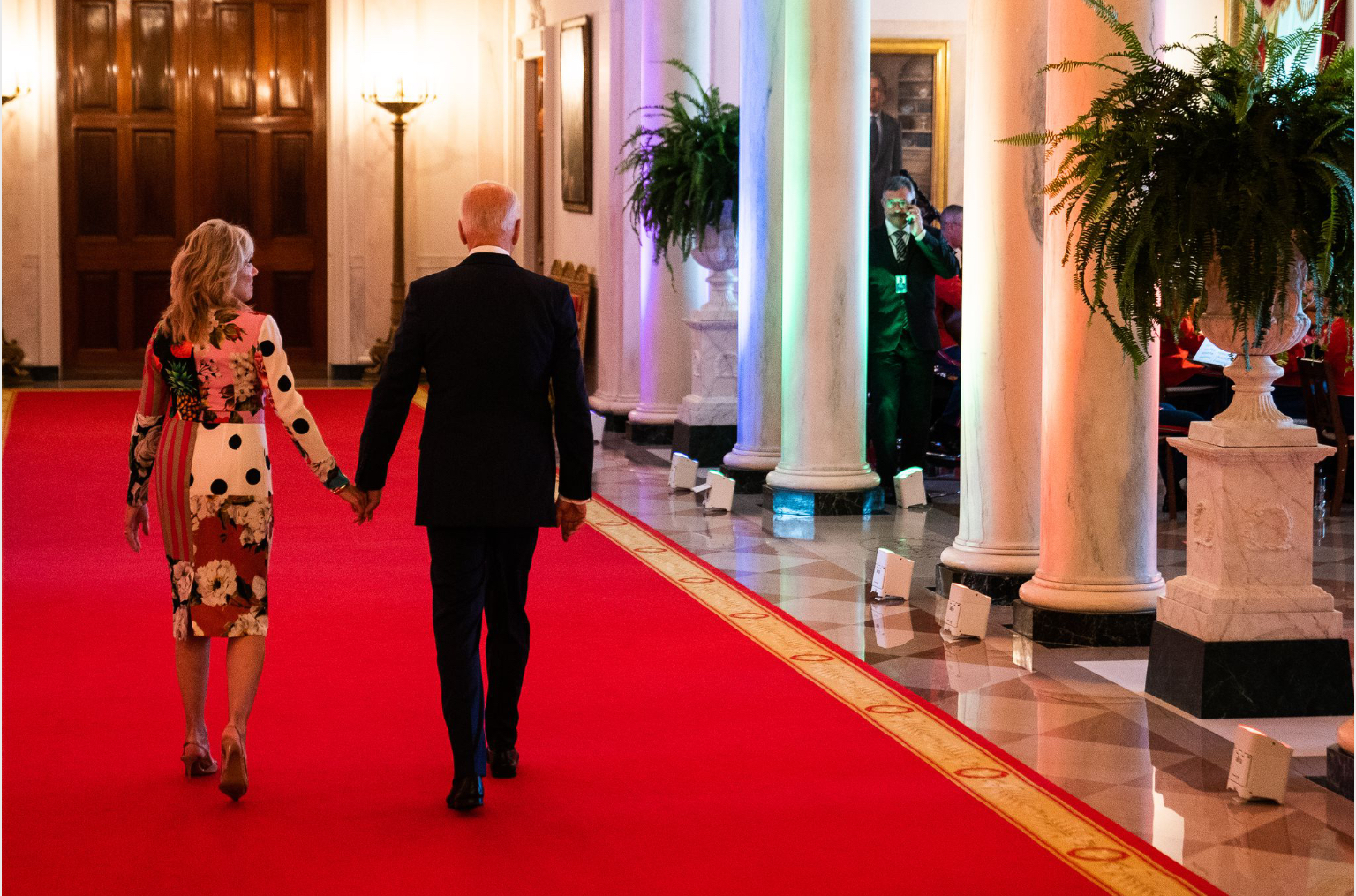
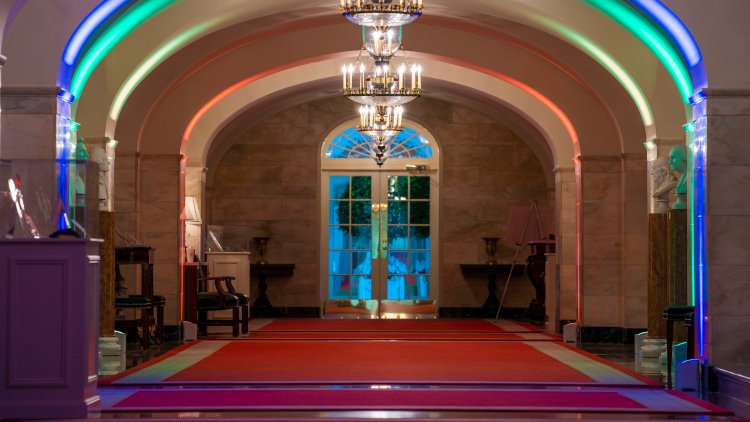
The White House has installed an exhibit dedicated to “celebrating LGBTQ+ Pride Month 2021” on the Ground Floor Corridor. The exhibit is the first physical display of historical items dedicated to the LGBTQ+ community. The items were borrowed from the Smithsonian Institution and in partnership with the Smithsonian’s National Museum on American History.
The exhibit features artifacts from historic LGBTQ+ community figures like Harvey Milk, Marsha P. Johnson, and Jerame Davis, the former executive director of National Stonewall Democrats. Another figure highlighted in the exhibit is Rose Cleveland, who was the sister of the 23rd and 25th President, Grover Cleveland.
“Rose Cleveland, President Grover Cleveland’s sister, served in the role of White House hostess until his marriage in 1886,” the exhibit reads. “For almost 30 years, Rose Cleveland maintained a romantic relationship with Evangeline Marrs Simpson Whipple. The women lived together in Italy from 1910, until Rose’s death from the Spanish flu in 1918.” The exhibit notes that Rose and Evangeline rest “side by side” in Italy today. Correspondence between them was published in 2019 by the Whipple Collection from the Minnesota Historical Society, where they are housed today.
There are artifacts describing major events in LGBTQ+ history such as the Stonewall Riots and the beginning of the AIDS epidemic. Photos shared online show the corridor illuminated in Pride colors, the first known time in history, the Advocate reports.
LGBTQ+ activist, columnist and Philadelphia Gay News founder Mark Segal reported that upon visiting the National Museum this week, personal artifacts of his “from that first Pride in 1970, which we called Christopher Street Liberation Day March” were among those included in a series of items shared with the White House. The items included a flyer given out over 50 years ago promoting the march and Segal’s marshal badge worn that day. “That 18-year-old boy at Stonewall never expected that not only would he be asked to dance with his husband at the White House, but that one of his personal artifacts would be on display there,” Segal wrote. “Fifty-two years ago that was inconceivable to me. Now, it’s a joyous reality.”
The exhibit is curated from the LGBT Pride exhibits currently at the Smithsonian’s American History Museum. One is the “Illegal to be You: Gay History Beyond Stonewall” exhibition on display at the museum since 2019, and planned to close on July 6, 2021. The items I took he ongoing Smithsonian exhibit showcase different aspects of LGBTQ+ American history, activism and the “everyday experience of being queer,” according to curator Katherine Ott. The display includes knives used to lobotomize gay men during the ’70s, lab equipment from 1980s HIV researcher Jay Levy, a full figure skating costume from gay Olympian Brian Boitano, shoes from trans tennis player Renée Richards and cosmetics used by irreverent gay director John Waters.
LGBTQ+ Pride Month was established by President Bill Clinton in June 1999, though back then it was called Gay and Lesbian Pride Month. Clinton said at the time that he signed the 1998 executive order that made it possible for people of any sexual orientation to work in the federal government and to receive security clearances. “Today, more openly gay and lesbian individuals serve in senior posts throughout the Federal Government than during any other Administration,” Clinton’s June 2000 proclamation stated.
The previous twice impeached, traitor’s administration did not even acknowledge Pride Month until 2019, and only half-heartedly then. In the first two and a half years of that administration, the former president took numerous steps to curtail LGBTQ+ rights, from nominating judges aligned with anti-gay hate groups to banning transgender people from the military. George W. Bush declined to recognize June as Pride Month during his eight year administration.
President Barack Obama issued a proclamation every year he was in office. “All people deserve to live with dignity and respect, free from fear and violence, and protected against discrimination, regardless of their gender identity or sexual orientation,” Obama’s June 2015 proclamation read. “During Lesbian, Gay, Bisexual, and Transgender Pride Month, we celebrate the proud legacy LGBT individuals have woven into the fabric of our Nation, we honor those who have fought to perfect our Union, and we continue our work to build a society where every child grows up knowing that their country supports them, is proud of them, and has a place for them exactly as they are.”
On June 25, President Biden declared “pride is back at the White House,” delivering remarks in a day of events intended to mark the contributions of LGBTQ+ Americans. He spoke after signing H.R. 49, which designates the site of the 2016 Pulse Nightclub shooting as the “National Pulse Memorial.” Biden recognized that much work remains to be done to give equal rights and protections to LGBTQ Americans. The president invoked Harvey Milk, the first openly gay elected official in California, and said he was right when he said it “takes no compromise to give people their rights.” He called on the Senate to pass the Equality Act to protect the rights of LGBTQ+ people.
“When a same-sex couple can be married in the morning but denied a lease in the afternoon for being gay, something’s still wrong,” Biden said. “Over half of our states — in over half of our states, LBGTQ+ Americans still lack explicit state-level civil rights protections to shield them from discrimination. As I said as a presidential candidate and in my first joint address to Congress, it’s time for the United States Senate to pass the Equality Act and put the legislation on my desk. On my desk.”
Transportation Secretary Pete Buttigieg spoke before the president was introduced, and both the secretary and Biden gave a shout-out to Buttigieg’s husband, Chasten. “Us even being here proves how much change is possible in America,” Buttigieg said. Also at the Friday afternoon ceremony were members of the Congressional Equality Congress, including Senator Tammy Baldwin and Congressman David Cicilline; one of the highest-ranking openly trans service members, Lieutenant-Colonel Bree Fram; and state legislators.
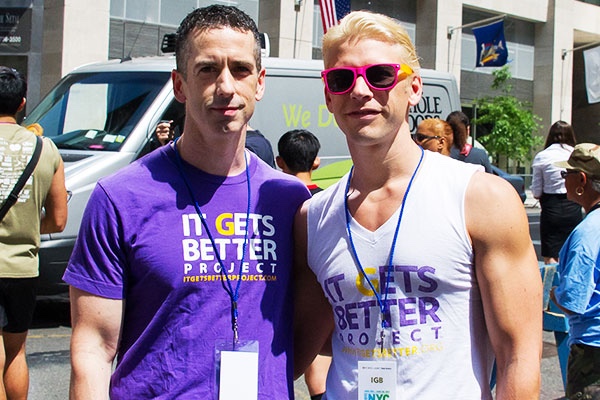
During It Gets Better Project’s 2021 Digital Pride Experience, they got a little surprise visit from the White House: President Joe Biden sent in a message of support for LGBTQ+ Youth.
🏳️🌈 The It Gets Better Project exists to uplift, empower, and connect LGBTQ+ youth around the globe. To learn more and get involved, follow them here:
If you watch RuPaul’s Drag Race (RPDR), then you likely know who Todrick Hall is. I’ve always found him incredibly sexy, and I do like some of his music. Starting with season eight, Hall became a resident choreographer and occasional judge on RPDR. In addition to RPDR, Hall is an American rapper, singer, songwriter, actor, director, choreographer, and YouTuber. He gained national attention on the ninth season of the televised singing competition American Idol, where he made it to the semi-finals. Following this, he amassed a following on YouTube with viral videos including original songs, parodies, and skits. He aspires to be a role model for LGBTQ+ and people of color, and includes his experiences as a Black gay man in his art.
As a singer-songwriter he has released four studio albums, including the visual albums Straight Outta Oz (2016) and Forbidden (2018). In 2020 he released an EP, Quarantine Queen, in response to the COVID-19 pandemic featuring “Mask, Gloves, Soap, Scrub,” and was the international host of Global Pride 2020. On June 8, 2021, Hall released his fourth studio album, Femuline, which was preceded by the singles “Boys in the Ocean” and “Rainin’ Fellas.” The album is inspired by gay pride and features appearances from Chaka Khan, Tyra Banks, Brandy, Nicole Scherzinger and Ts Madison. He’s also released trilogy of EPs titled Haus Party, Pt. 1, Haus Party, Pt. 2, and Haus Party, Pt. 3.
I particularly enjoy two of his songs. One of them is his new release “Rainin’ Fellas,” and the other is his 2019 song “I Like Boys” from his EP Haus Party, Pt. 1.
Randolfe Wicker was wearing a black suit and tie when he participated in what’s thought to be the first U.S. picket for gay civil rights, which took place in New York City in 1964. He wore it when he answered questions on-air in 1965 as one of the first openly gay men to appear on television. And he donned that suit again when he protested New York’s prohibition against serving gay patrons during a “sip-in” in 1966. Wicker jokes that he looked like a preacher for most of the 1960s—but for one of the earliest LGBTQ+ activists, it was a political choice.
Wicker believed that being perceived as respectable would gain LGBTQ+ individuals civil rights. He told Time Magazinethat, “A black suit and tie works wonders anywhere, because if you wear a black suit and tie people will stop and listen to you and consider what you have to say. It was assumed we [gay men] were mentally ill; it was considered that we were certainly criminals, and we were also considered to be morally depraved. But people would still sit and listen to you, and that’s the beginning of a conversation.” But was it?
Wicker was a member of the Mattachine Society (Initially called the Mattachine Foundation), which began as a secret organization in Los Angeles in 1950, with their first Statement of Purpose drawn up in 1951. The group was founded by Communist organizer Harry Hay and other leftists, including Bob Hull, Chuck Rowland, Dale Jennings, Konrad Stevens, James Gruber, and Rudi Gernreich (Jewish Refugee). The Mattachine founders borrowed the initial structure of the organization from the Communist Party, and the leadership, the “fifth order,” was anonymous, so members didn’t even know their names. The Mattachine Society became one of several prominent groups organizing during the period of LGBTQ+ activism referred to as the Homophile Movement.
Thousands of men and women across the country were arrested on charges related to their sexuality each year throughout the 1950s. In California, certain sodomy convictions could carry a maximum sentence of life in prison. And even when the charges resulted in a slap on the wrist from a judge, an accusation could result in the loss of jobs or even homes. But after Mattachine co-founder Dale Jennings was followed and harassed by a police officer, the society mounted a defense—and won the case. Within just a few years, the group would grow to include thousands of members across the country in places like New York City, Chicago, and San Francisco. But, while the Mattachine society believed respectability was the best path to civil rights, the organization’s ties to the Communist Party USA were always a problem for gaining any respectability.
The arguments for respectability politics have continued to be part of civil rights strategy in all areas of civil rights. We saw this during the BLM riots last summer, and we see it in LGBTQ+ individuals who condemn gay pride celebrations for its (sometimes) outlandish aspects. Here’s the problem respectability politics; they don’t work. They are based on a false notion that says if only we behave, if only we play by the rules, if only we are good enough, then the church will love and accept us. But it’s not true. Because even if we tell our detractors that we are celibate, they still think we are having sex. (Trust me, I know this firsthand from my mother.) And even when we quote the Bible to them, they still distrust our reading of it. Even when we dress like them, talk like them, and marry like them, they are still waiting for us to mess up so they can discredit us. And if we play into respectability politics, we are working against liberation. We are saying, “I’m not like the rest of the LGBTQ+ community. I’m one of the good ones.” And by saying that, we allow straight and cisgender people to say it as well, and suddenly the “bad queers” are pushed to the side, or worse, pushed out entirely.
Respectability politics set up a hierarchy that allows straight and cisgender people to hold up the “good gays” and silence the “bad gays.” And who are the bad gays? We are anyone who believes that liberation should be for the whole LGBTQ+ community. We are the ones who get angry or raise our voices about injustice. We are the ones who say that it’s not okay for allies to speak over the LGBTQ+ community. We are the ones who say that there is more than one way to be LGBTQ+ (it’s the reason for the “+”). We don’t have to be celibate, and we can medically transition if that’s what’s right for us. We are the ones who dress the way we want. We act the way we want. We are proud of who we are and every aspect of the gay community. Maybe something is not your cup of tea, but that doesn’t make it wrong. I love drag queens, but I have no desire to be one. I love seeing men in skimpy outfits at Pride, but am I comfortable doing the same? No, I’m not, but if I had their body (or body positivity), then I might be right there with them.
When the people who hate us come for us (and they will), they won’t care if we have conformed to some false heteronormativity. They won’t care that we are white, dress nice, and toe the line. They will look at us as if we are just like all of the other members of the LGBTQ+ community, the ones that you have said you aren’t like. They won’t see the differences between us. They will lump us all together. In that moment, your respectability will not save you. They will still say that you don’t have a place in their churches, you don’t deserve to have civil rights, and it would be better off if you would just go away. Setting up this hierarchy allows people to control us. It also allows people to say who deserves respect and rights. They say only those who toe the line and behave deserve rights. They think you only deserve respect if you are polite and don’t get angry and speak softly, yet it will always be false respect if they ever give it at all. When it comes time to allow us civil rights, they will have a myriad of excuses for why we don’t deserve equal or civil rights.
You can live however you want. You can choose celibacy, singleness, or marriage for yourself; that is not the issue here. But when you demand it from other people or when you set it up so that your choice is the one that is acceptable by the straight and cisgender people, you become part of the problem. Liberation is about liberation for all of us, and if it’s not liberation for all of us, then it’s not liberation at all. When you narrow the rules so that only the “good” get in, you’re not actually working for liberation. You’re working so that someone else’s rules and priorities can define us, and that’s not good enough. We all deserve to be free.
For many years, I cared deeply about acceptance by my family and friends in Alabama. I wanted my parents to see that I am who I have always been and that there is no shame in my gayness. In recent years, I have realized, they will never change their minds. I watched them throw their support behind our former, twice-impeached president when he represented everything my parents taught me not to be. (I even pointed that out to them, but it got me a dial tone on the other end of the line.) They relished in his hate and lies. I realized that if they could turn against all they believed to “better” call themselves Christian; then they would never accept me for being gay. One thing this pandemic has done is that it has kept me away for a year and a half (two years if I go back down at Christmas, which I probably will). At first, I was sad I would miss them last Christmas, but I got over it. I didn’t want their constant judgment and to be forced to “be straight.” I hope and pray that I will have the courage to be who I am when I go back to Alabama to visit my family the next time.
In the LGBTQ+ community, some criticize pride parades because they see them as having an undue emphasis on sex and fetish-related interests. They claim this as counterproductive to LGBTQ+ interests and expose the “gay community” to ridicule. However, traditional media outlets often emphasize the most outlandish and non-representative aspects of the community. The main issue is not whether gay people will be ridiculed for the sometimes outlandish and sexualized aspects of LGBTQ+ pride parades, but that pride parades are visibility. We aren’t going to change anyone’s opinion of us by being “respectable” during pride events. When I was growing up in Alabama, I never remember any pride parades in the state, though Birmingham has had a pride parade since 1989. As pride parades have become more common, in addition to Birmingham, there are celebrations from Huntsville to Mobile. The same is true of Mississippi. I think Jackson had a pride parade when I lived in Mississippi from 2000-2009, but now, pride parades are held across the states.
The fact that there are pride parades in states like Alabama and Mississippi shows that LGBTQ+ visibility has increased in the United States in the past 20 or so years. Pride parades are not just for big cities anymore. When I moved to Vermont, the only pride parade was in Burlington, but now there are celebrations in Montpelier, Rutland, and Bennington. Visibility is the primary goal of LGBTQ+ pride, but it’s also about belonging. Respectability politics is counterproductive to LGBTQ+ visibility. It forces us to hide and pretend to be something contrary to who we are. The variety of expression at LGBTQ+ pride events shows the diversity of our community. It brings out of the margins all of our community to proudly proclaim, “We’re here. We’re queer. Get used to it!” because we aren’t going anywhere. We don’t need acceptance. We don’t need approval. We don’t need permission. We need liberation.
Between the Dragon and the Phoenix By C. Dale Young – 1969-
Fire in the heart, fire in the sky, the sun just a smallish smudge resting on the horizon out beyond the reef that breaks the waves,
fiery sun that waits for no one. I was little more than a child when my father explained that the mongrel is stronger than the thoroughbred,
that I was splendidly blended, genetically engineered for survival. I somehow forgot this, misplaced this, time eroding my memory as it erodes everything.
But go ask someone else to write a poem about Time. Out over the bay, the sun is rising, and I am running out of time. Each and every year, on my birthday,
I wake to watch the sunrise. I am superstitious. And today, as in years past, it is not my father but my father’s father who comes to shout at me:
Whether you like it or not, you are a child of fire. You descend from the Dragon, descend from the Phoenix. Your blood is older than England, older than Castille.
Year after year, he says the same thing, this old man dead long before I was born. So, I wake each year on the day of my birth to watch the fire enter the sky
while being chastised by my dead grandfather. Despite being a creature of fire, I stay near the water. Why even try to avoid what can extinguish me?
There are times I can feel the fire flickering inside my frame. The gulls are quarreling, the palm trees shimmering— the world keeps spinning on its axis. Some say I have
nine lives. Others think me a machine. Neither is true. The truth is rarely so conventional. Fire in my heart, fire in my veins, I write this down for you and watch
as it goes up in flames. There are no paragraphs wide enough to contain this fire, no stanzas durable enough to house it. Blood of the Dragon,
blood of the Phoenix, I turn my head slowly toward the East. I bow and call for another year. I stand there and demand one more year.
About This Poem
“Can the dead visit you? Can a grandfather who died before you were even born come to you? Every year on my birthday, I get up to watch the sunrise. And every year, I feel quite clearly my father’s father is there with me.”—C. Dale Young
Why I Chose This Poem
I chose this poem because I was looking at poems for LGBTQ+ Pride Month on the Academy of American Poets website, and the title of this poem, “Between the Dragon and the Phoenix,” caught my eye. I have a tattoo on my left arm of a dragon and a phoenix. The tattoo is very meaningful for me because it represents a friend of mine who died last year. He had been a friend of mine from about the time I started blogging. He had helped me through some difficult times, and I will forever be grateful for his friendship. In the last few years of his life, he had suffered some major health problems, and he was not able to recover from them.
He lived in Hawaii but was of Chinese descent. We rarely exchanged Christmas gifts, but we always sent each other something for Chinese New Year and for birthdays. One year, I sent him a drawing of a dragon and phoenix in the classic Yin and Yang position. I had an artist friend of mine draw it and I had it framed and sent to him. When his mother saw it, she became very excited as it was nearly the exact same design as had been on her wedding dress many years earlier. Because he cherished that piece of art and displayed it prominently in his house, I had a similar design tattooed on my arm to always remind me of him and his generosity.
Like in the grandfather in “Between the Dragon and the Phoenix,” I feel that my friend is with me always.
My Tattoo
About The Poet
C. Dale Young was born in 1969 and grew up in the Caribbean and South Florida. He received a Bachelor of Science in molecular biology and English at Boston College in 1991 and went on to earn an MFA in English and creative writing and a doctoral degree in medicine, both from the University of Florida.
In his review of Torn, Mark Doty writes, “C. Dale Young’s poems employ sly forms of repetition, touching back to phrases we’ve already encountered as if to guide us along the poem’s winding way. How important—and how fierce—these directions turn out to be as his poems push into their deepest territory: the burden of expectation and guilt, the fiercely pressurized experience that an education in the ‘healing arts’ becomes. … [Young] brings all his strength to bear on the necessary work of art, which is also a means of tending and of stitching, a craft that by its very artfulness implies the possibility of hope.”
Young’s honors include the Grolier Prize and the Tennessee Williams Scholarship in Poetry from the Sewanee Writers’ Conference, as well as fellowships from the Bread Loaf Writers’ Conference, the National Endowment for the Arts, the Guggenheim Foundation, and the Rockefeller Foundation. The former poetry editor of the New England Review (1995–2014), Young currently practices medicine full-time and teaches in the Warren Wilson College MFA Program for Writers. He lives in San Francisco.
In response to Saturday’s Moment of Zen post about the pharmacy guy, VRCooper said, “Girl…We have to send you back to gay school.” I know it was mostly a joke, but I never went to “gay school.” Growing up in rural Alabama in a religious family, I never knew any gay people or anything about gay people until I went away to college and began reading gay books and researching what it meant to be gay on the internet.
Most gay people I know have gay friends. I never had a gay friend (notwithstanding a few short-term boyfriends) with whom I could hang out, go to bars, watch a movie, or go to gay events. I had one gay friend and confidant, who lived about a thousand miles away. We met through my blog and became good friends. We texted each other all the time. I am so much better at texting than being on the phone. Then, my friend died in a car wreck, and I’ve never had another close gay friend. I am a painfully shy person. I’ve always hated talking on the phone because I’ve hated how my phone voice sounds. You can ask Susan. We also became friends through my blog, and it took her forever to convince me to talk to her on the phone. Now, we talk on the phone at least once a day. She’s my closest friend and confidant. I don’t talk nearly as much to my best friend who lives in Texas.
I’ve never made friends easily. I’ve made female friends more easily than male friends, but they are still few and far between. I have a hard time talking to people I don’t know. So, when VRCooper suggested, “Strike up a conversation,” it’s quite a difficult thing for me to do. I feel awkward. The truth is, I need constant encouragement to give me a little courage to be my charming self, and I am a charming and good-hearted person. My friend who passed away was always encouraging me to step out of my comfort zone. VRCooper also said my “tone in writing reeks of defeat.” I know it does because I have zero self-confidence when it comes to men. Once I get to know someone or become comfortable around them, I can talk their ear off, but I am not one to initiate a conversation. When the other person is a man, it is even more challenging getting comfortable with them.
Even when I do make friends, I tend to have a hard time opening up. There are certain things about my personal life I have a difficult time discussing. I had an easier time with my friend who passed away because he was gay. There were things I could talk to him about that my conservative, sheltered upbringing doesn’t allow me to talk about to just anyone comfortably. There was something exceptional about that friendship which is why I was so devastated when he died. It took me a long time to try to be social again. I finally decided that is what my friend would have wanted me to do. I had to try to get back in the saddle which is an apt analogy. I fell off a horse when I was a kid and got kicked in the head. Every time I’ve gotten on a horse since, I find it impossible to get comfortable and enjoy it. However, if I ever had the chance to ride a horse again, I’d hop back in that saddle and try to enjoy it.
Also, I have often found like with any group of people, gay people have their clicks. Before the pandemic, I went to as many gay events in Burlington as I could. Sometimes I had one of my female friends go with me; sometimes, I went by myself. Whether it was First Friday (monthly drag shows and dances) or Burly Bears (the only gathering for gay men in Vermont), I tried to fit in. I tried to make conversation but found it extremely hard. Occasionally, someone would come over to talk to me, and I’d chat and have a good time, but inevitably they went back to their friends. Again, I was left standing there alone with my drink. Soon, gay events will start up again in Burlington, and I will try again. I have also tried to meet local people online for friendship, but no one ever seems to want anything more than sex. It seems impossible to find someone willing to have just dinner or even just meet for drinks.
I know I sound incredibly pathetic, and I know I’m complaining. I just needed to voice my frustrations. But I also want to say I’m trying to do better; I’m trying to be bolder. But it’s not easy. I’ve spent my whole life hiding behind my shyness, and I know it’s time I got over it and be more confident. What better time to do that than during pride month? It’s a time when we celebrate ourselves and boldly proclaim who we are. That’s why I went to the pharmacy on Friday hoping to see the cute pharmacy tech (CPT). I wore my pride polo shirt. It’s subtle, but hard to miss. It was obvious people noticed it. Unlike in the South, where I would have gotten ugly looks and rude behavior, everywhere I went that day, and everyone I saw including the tech at Verizon, the cashier at PetSmart, and yes, the CPT and others at the pharmacy, they all seemed nicer and friendlier.







 Joe
Joe




 The Closet Professor