Category Archives: Pride

Germany and LGBTQ+ Liberation ๐Ÿณ๏ธโ€๐ŸŒˆ ๐Ÿ‡ฉ๐Ÿ‡ช

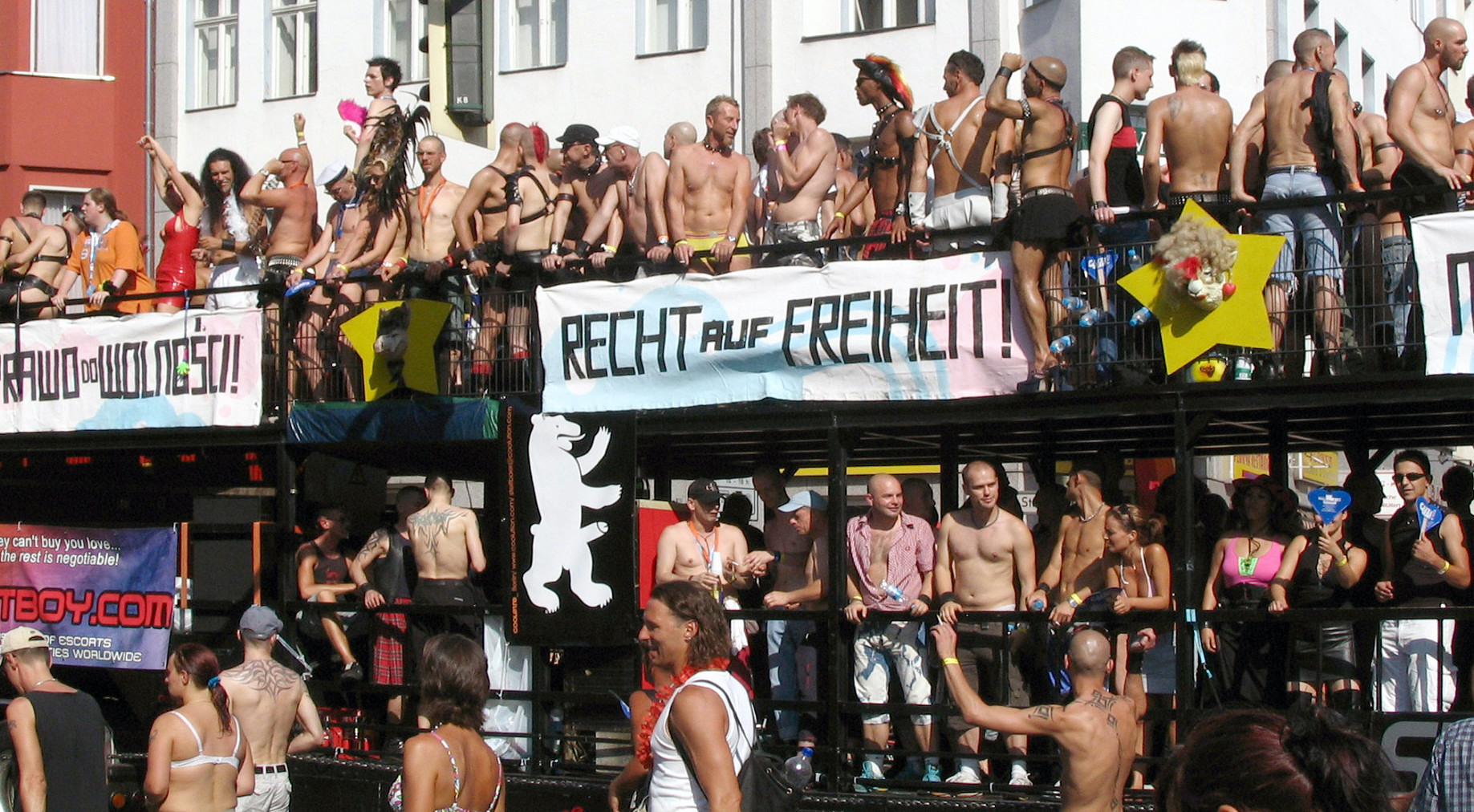
Christopher Street Day 2006 in Berlin

Aside from the street festivals, corporate platitudes, and sex parties, LGBTQ+ Pride is meant to be a living embodiment of LGBTQ+ history. The tradition started in June 1970 as a commemoration of the 1969 riots at the Stonewall Inn, when queer people rebelled against police harassment in New York City. But the history we remember remains myopically focused on the United States. The LGBTQ+ past on display each June is a heroic one with familiar, American milestones: the tragedies of the Lavender Scare and the AIDS crisis offset by the triumphs of Stonewall and marriage equality. This story has even become part of the progressive narratives of American democracy. In his second inaugural address, President Barack Obama declared, โ€œThe most evident of truthsโ€”that all of us are created equalโ€”is the star that guides us still; just as it guided our forebears through Seneca Falls, and Selma, and Stonewall.โ€

This heroic narrative is, of course, incomplete. The U.S.-centric story of LGBTQ+ liberation ignores that sexual minorities abroad have fought just as hard and sometimes faced even greater discrimination. When we look beyond the United States, it becomes clear that liberation is far from the inevitable end of a progress narrative. Rather it is a local, subjective, and ever-changing project. LGBTQ+ rights have come with hard fought battles and the progress can sometimes be very slow.

If we look at some other countries, we see that LGBTQ+ liberation didnโ€™t even start in the United States, and we have often lagged behind. Germany is a particularly compelling place to examine. The term homosexual comes from the German language. The term โ€˜homosexualityโ€™ was coined in the late 19th century by an Austrian-born Hungarian psychologist, Karoly Maria Benkert, who wrote extensively on the subject. In his pamphlets, Kertbeny argued that the Prussian sodomy law, Paragraph 143 (which later became Paragraph 175 of the penal code of the German Empire), violated the “rights of man.”  

In Berlin in 1919, Germany, Doctor Magnus Hirschfeld co-founded the Institut fรผr Sexualwissenschaft (Institute for Sex Research), a pioneering private research institute and counseling office. That same year, Different from the Others, one of the first explicitly gay films, was released. Magnus Hirschfeld had a cameo in the film and partially funded its production. In 1922, Dora Richter became the first transgender woman to undergo gender reassignment surgery in Hirschfeld’s Institute, the first operation of its kind in the world. Then on October 16, 1929, a Reichstag Committee voted to repeal Paragraph 175. The Social Democrats and other leftist parties backed the repeal, while the Catholic Center party and other right-wing parties opposed the repeal. 

Berlin has a long history of gay culture and influence on popular entertainment, and in the 1920s the city was the Gay Capital of Europe. In 1896 the world’s first gay magazine started in Berlin, called Der Eigene (“The Self-Owning”). During the 1920s and 1930s the world’s first gay village was in Berlin’s Schรถneberg. Gay and lesbian bars and nightclubs flourished, as did queer artistic expression through films, music, and print publications. Cabaret singer Claire Waldoff and actress Marlene Dietrich lived and worked in Berlin’s queer neighborhoods during this time. The first gay demonstration anywhere occurred in Berlin in 1922. 

The Nazis’ rise to power prevented the implementation of the vote on Paragraph 175 and ended the gay culture of Berlin. In 1933, the Nazi Party banned homosexual groups. Gay men were sent to concentration camps, and the Nazis burned the library of Magnus Hirschfeld’s Institute for Sexual Research and destroy the Institute. The first use of the pink triangle for gay men in Nazi concentration camps came in 1937. Then in 1945, when Allied forces liberated the Nazi concentration camps by Allied forces, but those interned for homosexuality were not freed and were required to serve out the full term of their sentences under Paragraph 175.

After World War II, Germany was divided by the Cold War and charted two very different paths when it came to gay liberation. In 1949, the country formally split into democratic West Germany and communist East Germany. Yet, of the two, it was the liberal democracy that continued Nazi-era persecution of gay men. Over the course of the 20 years between 1949 and 1969, West German courts convicted more than 50,000 queer men under Nazi statutes that remained on the books. East Germany began to repeal parts of Paragraph 175, and in 1968, Paragraph 175 is largely ignored in East Germany, decriminalizing homosexual acts over the age of 18. West Germany followed in 1969.

Groups of same-sex desiring men who labeled themselves homophiles (a word they thought sounded more respectable than homosexual) cropped up in West Germany in the early 1950s. Unlike similar groups in the United States and other western European countries, however, they quickly faded. By 1960, they had all but disappeared. There was no Stonewall moment in West Germany, nor any memorable stand against the oppressive policing and sexual morality of those early postwar decades.

Instead, West German politicians reformed the laws banning homosexual conduct in 1969 as part of a broader revision of the penal code. After this legislative change, new gay and lesbian bars, saunas, and periodicals soon arose. A radical liberation movement also appeared in those years. But it was strikingly different from its cousin in the United States. Its members opposed the commercial gay scene, viewing it as a barrier to the kind of solidarity that would be necessary to win real social and political change. The groups attacked gay publications, denouncing them as nothing more than โ€œmasturbation templates.โ€

When it came to politics, the movement also diverged from the center-left alliance that arose between LGBTQ+ activists and the Democratic Party in the United States. Over the course of the 1970s, West German activists enjoyed their greatest support from the centrist Free Democratic Party, but activists ultimately had little success pushing their policies in the federal government. They grew cynical about the possibilities of parliamentary politics. As a result, LGBTQ+ West Germans never fully came together behind any of the major parties, even after German reunification in 1990, and they continue to divide their votes across the political spectrum.

During the AIDS crisis of the 1980s, West German history also diverged from the U.S. path. Whereas the Reagan administration stayed silent and let LGBTQ+ Americans perish, the West German government, in particular federal health minister Rita Sรผssmuth, partnered with AIDS self-help groups to circulate information about the disease and safer sex. West Germany never shut down its gay saunas and still managed to bring infection rates down dramatically over the course of the decade. Because of the governmentโ€™s success fighting AIDS, radical groups like ACT UP played a much smaller part in the German activist scene.

If, by the end of the 1980s, West Germanyโ€™s activists were far less politically radical than those in other countries, they had nonetheless managed both to preserve their subculture and find ways to collaborate with politicians and bureaucrats. West German LGBTQ+ activism was not characterized by the same triumphal moments or catastrophic setbacks as the American version, but nonetheless forged a kind of liberation no less real than that in the United States.

Yet this distinctive West German history is largely forgotten, submerged beneath the dominant U.S. narrative โ€” even in Germany. The annual Berlin Pride celebration is known as Christopher Street Day, named for the Stonewall Innโ€™s address. Even by the mid-1980s, activists and historians, dispirited by a lack of parliamentary political victories, had begun to compare West Germanyโ€™s liberation movement unfavorably with that in the United States.

The East German experience with gay liberation was yet more surprising. Although most Westerners assumed such activism could not possibly have been successful in a communist state, by the end of the 1980s, East Germany could realistically lay claim to being one of the most sexually progressive countries on Earth. In the 1970s, gay men and lesbians began to organize together in East Berlin. While the Stasi, the secret police, denied the group the right to organize in public, these tenacious women and men coordinated house parties, steamboat cruises, and birthday dinners. In the middle of the decade, the East German LGBTQ+ communnity met Charlotte von Mahlsdorf, a trans woman who ran a museum in one of East Berlinโ€™s outer neighborhoods. She offered them the museumโ€™s basement to host their activities, and for several years they โ€œbopped and danced like it was 1904.โ€ This arrangement lasted until 1978, when the East Berlin police forbade the group to continue meeting.

But only a few years later, lesbian and gay activists mobilized again, this time under the umbrella of the Protestant Church, the only nominally independent organization in the communist state. Spreading rapidly across the country, they pressured the government to change laws and social policies, such as allowing gay men to serve in the military, repealing a law that set a higher age of consent for gay and lesbian sex, and making it easier for same-sex partners to find housing together. The government tried cracking down on the groups, but to no avail: They continued to grow in size and number. So worried was the Stasi that its functionaries convinced the East German government to accede to activistsโ€™ demands. Stasi officials began circulating memos in 1985 insisting that government bodies address gay men and lesbiansโ€™ โ€œhumanitarian problems,โ€ that is, taking their complaints seriously.

As a result, change came rapidly. The government equalized the age of consent, years before most other countries, including West Germany and the United States. It promulgated a policy allowing openly gay men to serve in the military. LGBTQ+ people were given the right to seek sexual and mental health counseling. The East German government greenlighted the first gay feature film, โ€œComing Out,โ€ which premiered Nov. 9, 1989โ€”the night East Germans breached the Berlin Wall. Local governments began sanctioning LGBTQ+ organizations and staging gay disco nights.

In the years after reunification, these two distinct German paths converged. The principal LGBTQ+ organization in Germany today was founded by East German activists in 1990 and the West German federal states abolished the last vestiges of their antigay statutes as a direct result of East Germanyโ€™s more progressive lawmaking. The West German subculture began to bleed into the Eastern lands, in particular East Berlin, which has become synonymous with queer nightlife in recent decades.

The point is not that East or West Germany achieved a liberation better than that in the United States, but rather that LGBTQ+ life and activism took distinctive forms in different local and national contexts. The American version of LGBTQ+ liberation is not the only history we should pay attention to. Germany led the way for many years before the United States began its LGBTQ+ liberation movement. When America was undergoing the Lavender Scare, East Germany was relaxing laws against homosexuality.
Importance of Pride ๐Ÿณ๏ธโ€๐ŸŒˆ

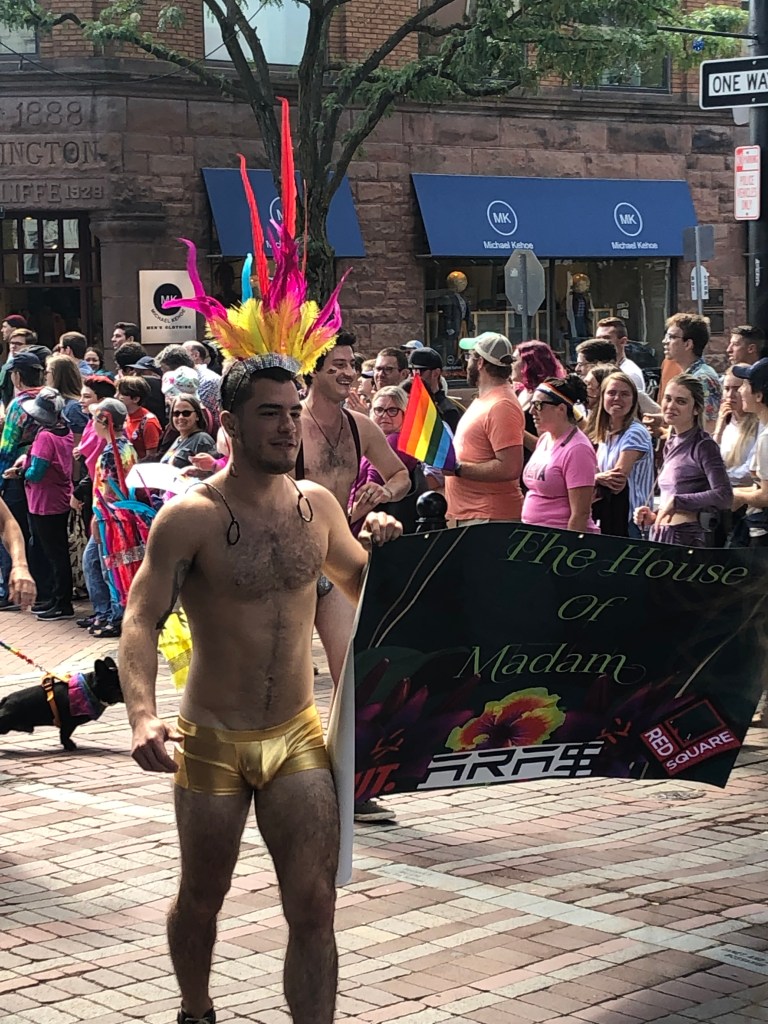
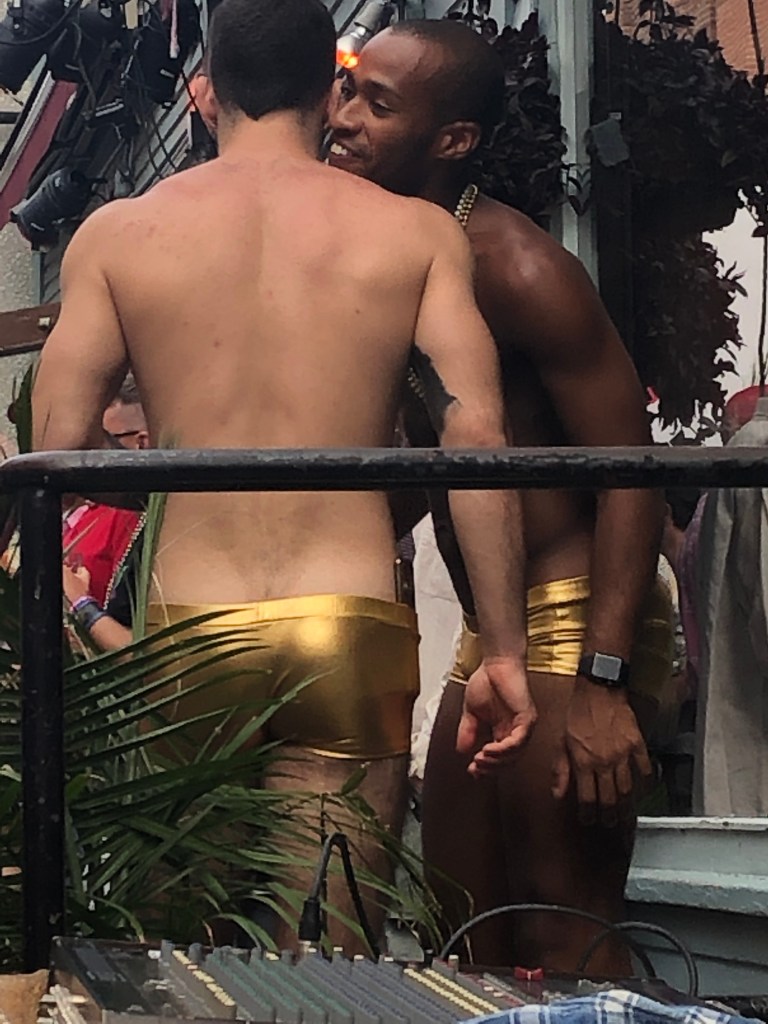
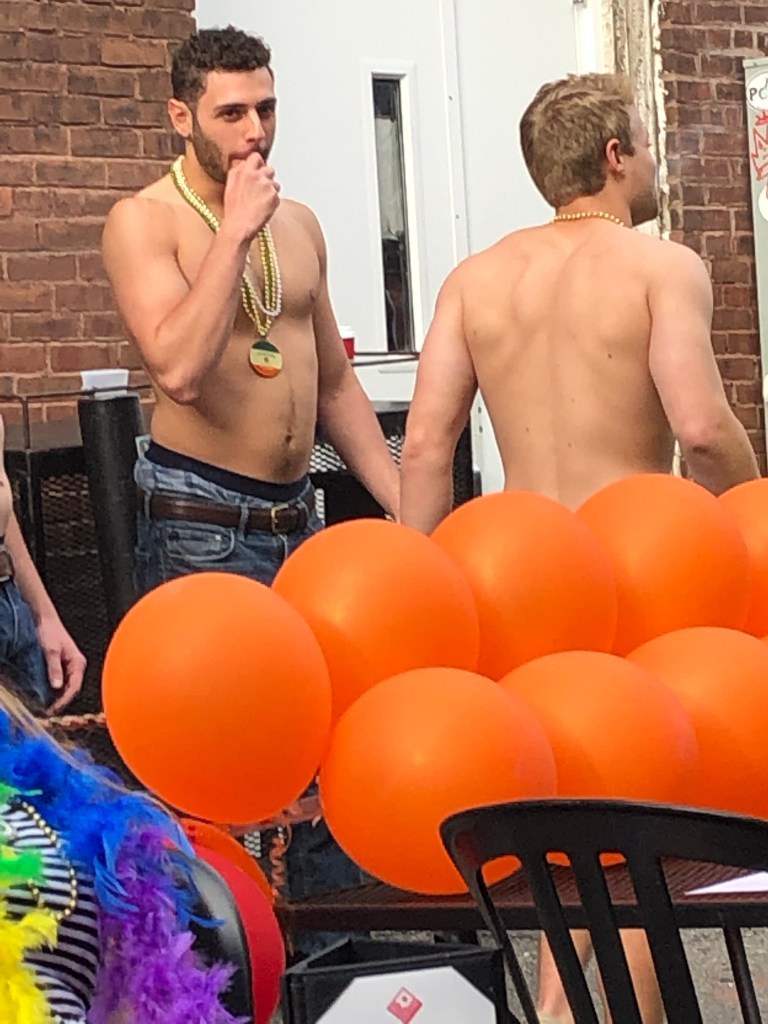
Vermont Pride 2019

June is Pride Month ๐Ÿณ๏ธโ€๐ŸŒˆ. Did I really need to write that? LOL I did so because I wanted to make a point, obviously. I have seen any number of social media posts either deriding LGBTQ+ merchandise or taking to task companies that use pride merchandise or advertising during Pride Month to make money. Some of those companies do support anti-LGBTQ+ politicians or organizations. All of these criticisms have valid points, and a lot of the pride merchandise is tacky. Some organizations seem to only be pro-LGBTQ+ during the month of June, and they support anti-LGBTQ+ efforts the rest of the year. 

Representatives Pramila Jayapa (D-WA) and Alexandria Ocasio-Cortez (D-NY) recently listed (and derided) on social media companies who were celebrating Pride but continue to support anti-LGBTQ+ politicians and organizations. As a general rule, I like Rep. Jayapa, but Rep. Ocasio-Cortez is a different story. In my opinion, AOC is an annoying, pandering, and shallow politician who wants to get attention, but I am getting sidetracked. Yes, these companies need to be told to do better and show support of the LGBTQ+ community all year round, not just in June, but do we want these companies to ignore us completely? We should be happy for the support, and instead of criticizing them, especially coming from non-LGBTQ+ people, we should be encouraging these companies to do better.

Pride itself has its faults: whitewashing, trans exclusion, corporate assimilation, etc., but how many of us grew up seeing absolutely zero LGBTQ+ representation anywhere. If we did, it was either very negative or stereotypical. Most gay representation I was aware of portrayed the LGBTQ+ community as having HIV/AIDS, being sexually deviant and/or promiscuous, and all too often, pedophiles. I always found it interesting that when same-sex couples wanted to get married, conservatives were against the idea, but the same people hated same-sex couples because they saw them as non-monogamous and (gasp) unmarried fornicators.

Most of us did not grow up with any positive LGBTQ+ representation anywhere. Growing up in rural Alabama, I may have known of three or four gay people. I did not know any personally. So, while I understand the criticisms of Pride, I think of what it might mean to a closeted teenager who has never seen a positive representation of the LGBTQ+ community. What would it have meant to me as a teenager to see positive LGBTQ+ representation? If we had been reinforcing positive attitudes all along, would things be different? 

In 1988, a National Opinion Research Center/General Social Survey/University of Chicago poll found that 67.6 percent of Americans opposed same-sex marriage, 10.7 percent of Americans supported it, 13.9 percent of Americans neither agreed nor disagreed, and 7.8 percent didn’t have an opinion. A May 2015 (one month before the historic Obergefell v. Hodgesdecision), a Gallup poll found 60 percent of Americans supported same-sex marriage, 37 percent opposed, and 3 percent had no opinion. Those numbers continue to improve. A June 2021 Gallup poll found that 70 percent of Americans supported same-sex marriage, and 29 percent were against it. Positive change leads to positive LGBTQ+ representation.

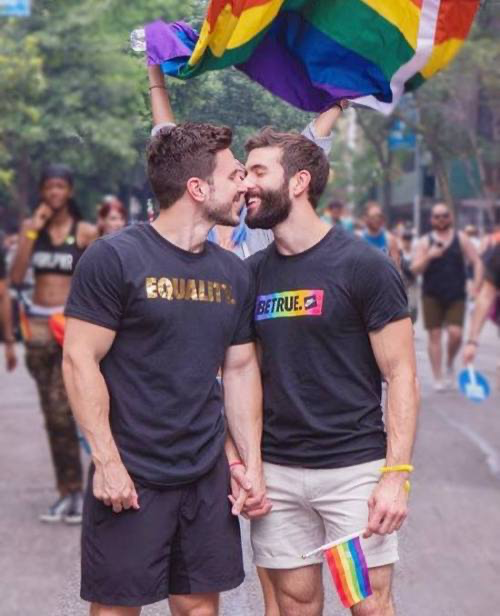
Pride is a celebration of life in the face of oppression and repression. For 335 days a year, we are told that our body is sinful and sick, those who we have sex with and who we love should be kept hidden, our body is weird, and the scars are ugly, our clothing, hair, fat, penis, breasts, arms, legs, or flesh itself is disgusting, vile, and “unnaturalโ€ โ€ฆ For 335 days of the year, we walked around in fear. We hid who we love or our body. We dropped our loverโ€™s hand in public or refused to kiss our lover goodbye in front of our workplace. We feared violence walking home at night or in the broad light of the afternoon sun. Those are all situations many of us dealt with in our lives. We had to hide who we were and are. Pride month is about visibility and freedom from repression.

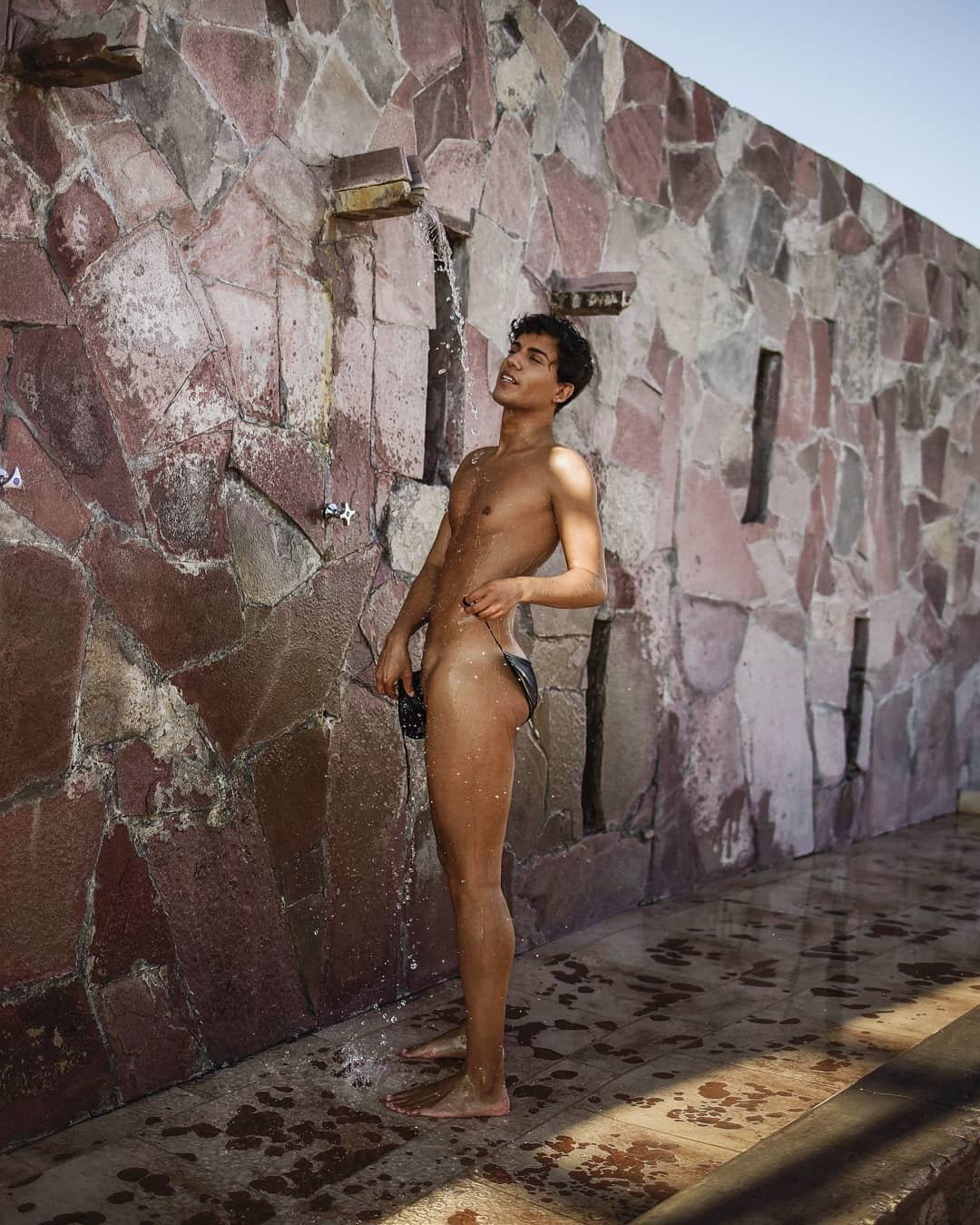
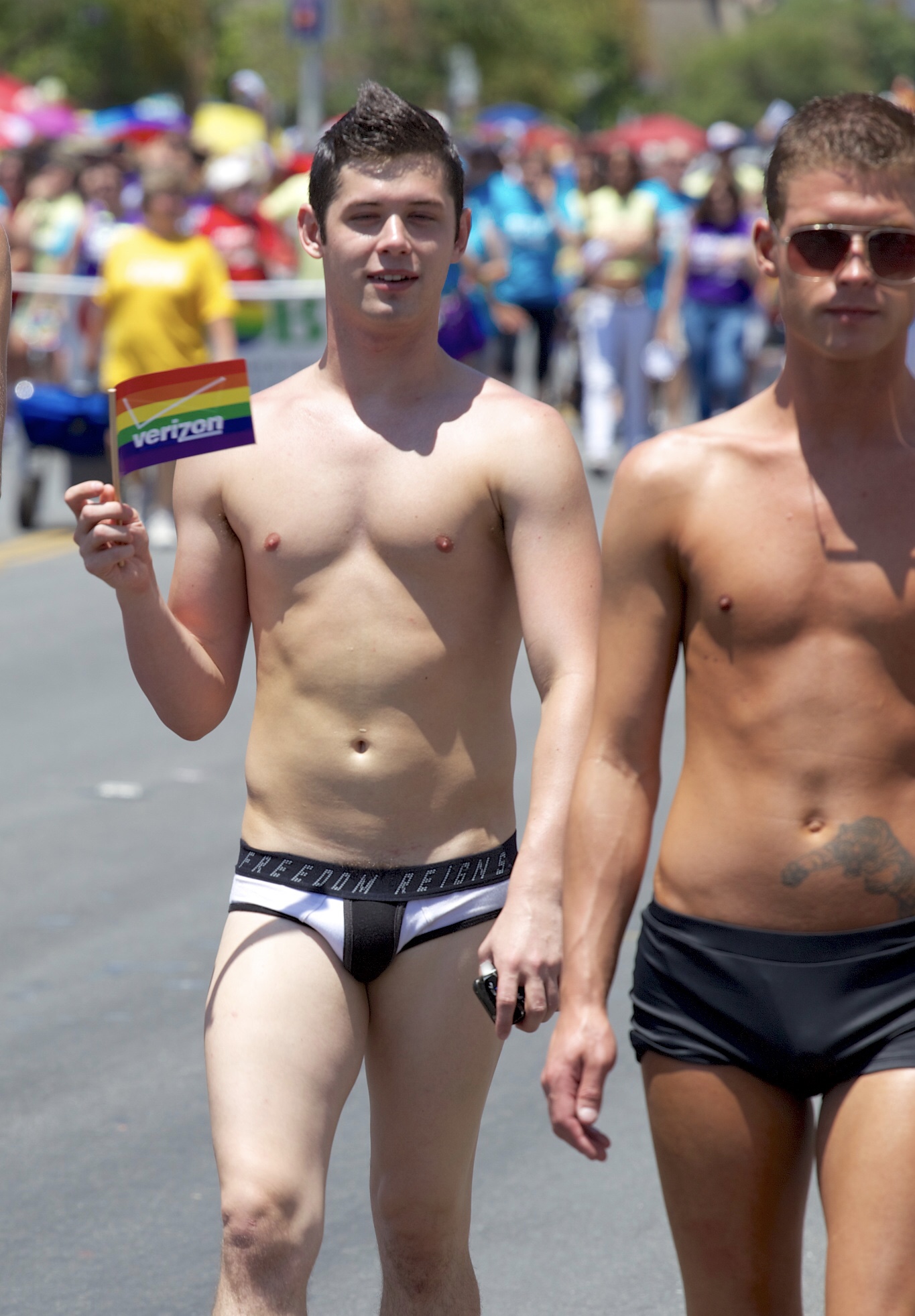
During that month, we usually have one day where there is a pride parade. It took me going nearly 5,000 miles from home to go to my first pride parade. I went to the Pride parade in Paris, France, while on a study abroad trip during graduate school. We arrived in Paris on the day of Pride, and as soon as they let us loose on the city by ourselves, a friend and I headed straight to the parade. I have been to a few since, mainly here in Vermont (we hold ours in September here, not June.) If you’ve ever been to a Pride celebration, you know that the people watching is one of the best parts. The sense of belonging is probably the best part, but people-watching is a lot of fun. There are colorful outfits, elaborate costumes, cute kids, couples holding hands, and more. Thereโ€™s also no small number of people basically wearing nothing, maybe just skimpy underwear or tape over sensitive areas, but that’s half the fun.

For this one month out of the year or even just that one precious day of the pride parade, we can be ourselves without fear of judgment. For one month, we can be a symbol of acceptance and freedom, and we can love, laugh, dance, have sex, and walk around in our underwear if we choose. We have this one precious and special month (and possibly even just a day) when we can celebrate our body, flesh, love, passion, life, and sexuality. We should celebrate, embrace, and love it all. For what it is, and not the commercialization of the celebration. There are companies out there that genuinely support the LGBTQ+ community in many ways.

If you are interested in what companies truly support LGBTQ+ equality, check out the Human Rights Campaign Foundationโ€™s Corporate Equality Index, a national benchmarking tool on corporate policies, practices, and benefits pertinent to LGBTQ+ employees. The HRC website also lets you search for how your federal elected officials stand on legislation that impacts the LGBTQ+ community on their Your Elected Officials page. I, for one, am happy that even the companies that don’t have the greatest track record on LGBTQ+ issues show some rainbow colors and Pride during Pride Month. As far as I remember, no company did this at all while I was growing up.

A few questions for you to either discuss in the comments or to just ponder:

  • How do you feel about the commercialization of Pride? 
  • Is the exposure of corporate sponsorships a good thing? 
  • Should we be openly criticizing companies (or boycott companies who aren’t always the most LGBTQ+ friendly but do support Pride? 
  • Or should we work to make those companies do better LGBTQ+ allies in the future while being happy they do support Pride? 
  • Is it all just commercialism, or does it also have a positive effect on societal views of the LGBTQ+ community and Pride?

Iโ€™d love to know your opinions.


LGBTQ+ Poetry Classics

Love the Light-Giver
By Michelangelo Buonarroti (1475-1564)

To Tommaso Deโ€™ Cavalieri

Veggio co’ bei vostri occhi.

With your fair eyes a charming light I see,
โ€ƒFor which my own blind eyes would peer in vain;
โ€ƒStayed by your feet, the burden I sustain
โ€ƒWhich my lame feet find all too strong for me;
Wingless upon your pinions forth I fly;
โ€ƒHeavenward your spirit stirreth me to strain;
โ€ƒE’en as you will, I blush and blanch again,
โ€ƒFreeze in the sun, burn ‘neath a frosty sky.
Your will includes and is the lord of mine;
โ€ƒLife to my thoughts within your heart is given;
โ€ƒMy words begin to breathe upon your breath:
Like to the moon am I, that cannot shine
โ€ƒAlone; for lo! our eyes see nought in heaven
โ€ƒSave what the living sun illumineth.


Love Returned
By Bayard Taylor (1825-1878)

He was a boy when first we met;
โ€ƒHis eyes were mixed of dew and fire,
And on his candid brow was set
โ€ƒThe sweetness of a chaste desire:
But in his veins the pulses beat
โ€ƒOf passion, waiting for its wing,
As ardent veins of summer heat
โ€ƒThrob through the innocence of spring.

As manhood came, his stature grew,
โ€ƒAnd fiercer burned his restless eyes,
Until I trembled, as he drew
โ€ƒFrom wedded hearts their young disguise.
Like wind-fed flame his ardor rose,
โ€ƒAnd brought, like flame, a stormy rain:
In tumult, sweeter than repose,
โ€ƒHe tossed the souls of joy and pain.

So many years of absence change!
โ€ƒI knew him not when he returned:
His step was slow, his brow was strange,
โ€ƒHis quiet eye no longer burned.
When at my heart I heard his knock,
โ€ƒNo voice within his right confessed:
I could not venture to unlock
โ€ƒIts chambers to an alien guest.

Then, at the threshold, spent and worn
โ€ƒWith fruitless travel, down he lay:
And I beheld the gleams of morn
โ€ƒOn his reviving beauty play.
I knelt, and kissed his holy lips,
โ€ƒI washed his feet with pious care;
And from my life the long eclipse
โ€ƒDrew off; and left his sunshine there.

He burns no more with youthful fire;
โ€ƒHe melts no more in foolish tears;
Serene and sweet, his eyes inspire
โ€ƒThe steady faith of balanced years.
His folded wings no longer thrill,
โ€ƒBut in some peaceful flight of prayer:
He nestles in my heart so still,
โ€ƒI scarcely feel his presence there.

O Love, that stern probation o’er,
โ€ƒThy calmer blessing is secure!
Thy beauteous feet shall stray no more,
โ€ƒThy peace and patience shall endure!
The lightest wind deflowers the rose,
โ€ƒThe rainbow with the sun departs,
But thou art centred in repose,
โ€ƒAnd rooted in my heart of hearts!


A Shropshire Lad, XXXVI
By A. E. Housman (1859-1936)

White in the moon the long road lies,
โ€ƒThe moon stands blank above;
White in the moon the long road lies
โ€ƒThat leads me from my love.

Still hangs the hedge without a gust,
โ€ƒStill, still the shadows stay:
My feet upon the moonlit dust
โ€ƒPursue the ceaseless way.

The world is round, so travellers tell,
โ€ƒAnd straight though reach the track,
Trudge on, trudge on, โ€™twill all be well,
โ€ƒThe way will guide one back.

But ere the circle homeward hies
โ€ƒFar, far must it remove:
White in the moon the long road lies
โ€ƒThat leads me from my love.


Undressing You
By Witter Bynner (1881-1968)

Fiercely I remove from you
All the little vestigesโ€”
Garments that confine you,
Things that touch the flesh,
The wool and the silk
And the linen that entwine you,
Tear them all away from you,
Bare you from the mesh.
And now I have you as you are,
Nothing to encumber youโ€”
But now I see, caressing you,
Colder hands than mine.
They take away your flesh and bone,
And, utterly undressing you,
They tear you from your beauty
And they leave no sign.


The More Loving One
By W. H. Auden (1907-1973)

Looking up at the stars, I know quite well
That, for all they care, I can go to hell,
But on earth indifference is the least
We have to dread from man or beast.

How should we like it were stars to burn
With a passion for us we could not return?
If equal affection cannot be,
Let the more loving one be me.

Admirer as I think I am
Of stars that do not give a damn,
I cannot, now I see them, say
I missed one terribly all day.

Were all stars to disappear or die,
I should learn to look at an empty sky
And feel its total dark sublime,
Though this might take me a little time.


And for the โ€œLโ€ in LGBTQ+:

[In my eyes he matches the gods]
By Sappho (c. 630-c. 570 BCE)

In my eyes he matches the gods, that man who
sits there facing you–any man whatever–
listening from closeby to the sweetness of your
โ€ƒโ€ƒvoice as you talk, the

sweetness of your laughter: yes, that–I swear it–
sets the heart to shaking inside my breast, since
once I look at you for a moment, I can’t
โ€ƒโ€ƒspeak any longer,

but my tongue breaks down, and then all at once a
subtle fire races inside my skin, my
eyes can’t see a thing and a whirring whistle
โ€ƒโ€ƒthrums at my hearing,

cold sweat covers me and a trembling takes
ahold of me all over: I’m greener than the
grass is and appear to myself to be little
โ€ƒโ€ƒshort of dying.

But all must be endured, since even a poor


About the Poets

Michelangelo di Lodovico Buonarroti Simoni, known simply as Michelangelo, was an Italian sculptor, painter, architect and poet of the High Renaissance born in the Republic of Florence.

Bayard Taylor was an American poet, literary critic, translator, travel author, and diplomat. Though he wanted to be known most as a poet, Taylor was mostly recognized as a travel writer during his lifetime. Modern critics have generally accepted him as technically skilled in verse, but lacking imagination and, ultimately, consider his work as a conventional example of 19th-century sentimentalism.

Alfred Edward Housman, usually known as A. E. Housman, was an English classical scholar and poet. His cycle of poems, A Shropshire Lad, wistfully evoke the dooms and disappointments of youth in the English countryside.

Harold Witter Bynner, also known by the pen name Emanuel Morgan, was an American poet and translator. He was known for his long residence in Santa Fe, New Mexico, and association with other literary figures there.

Wystan Hugh Auden, usually known as W.H. Auden, was an Anglo-American poet. Auden’s poetry was noted for its stylistic and technical achievement, its engagement with politics, morals, love, and religion, and its variety in tone, form, and content. 

Sappho was an Ancient Greek poet from the island of Lesbos. Sappho is known for her lyric poetry, written to be sung while accompanied by a lyre. In ancient times, Sappho was widely regarded as one of the greatest lyric poets and was given names such as the “Tenth Muse” and “The Poetess”. Most of Sappho’s poetry is now lost, and what is extant has mostly survived in fragmentary form.

๐Ÿณ๏ธโ€๐ŸŒˆ LGBT POETS FOR PRIDE MONTH ๐Ÿณ๏ธโ€๐ŸŒˆ


Star Trek Crushes

Star Trek: Discovery’s Lt. Stamets (Anthony Rapp) and Dr. Culber (Wilson Cruz)

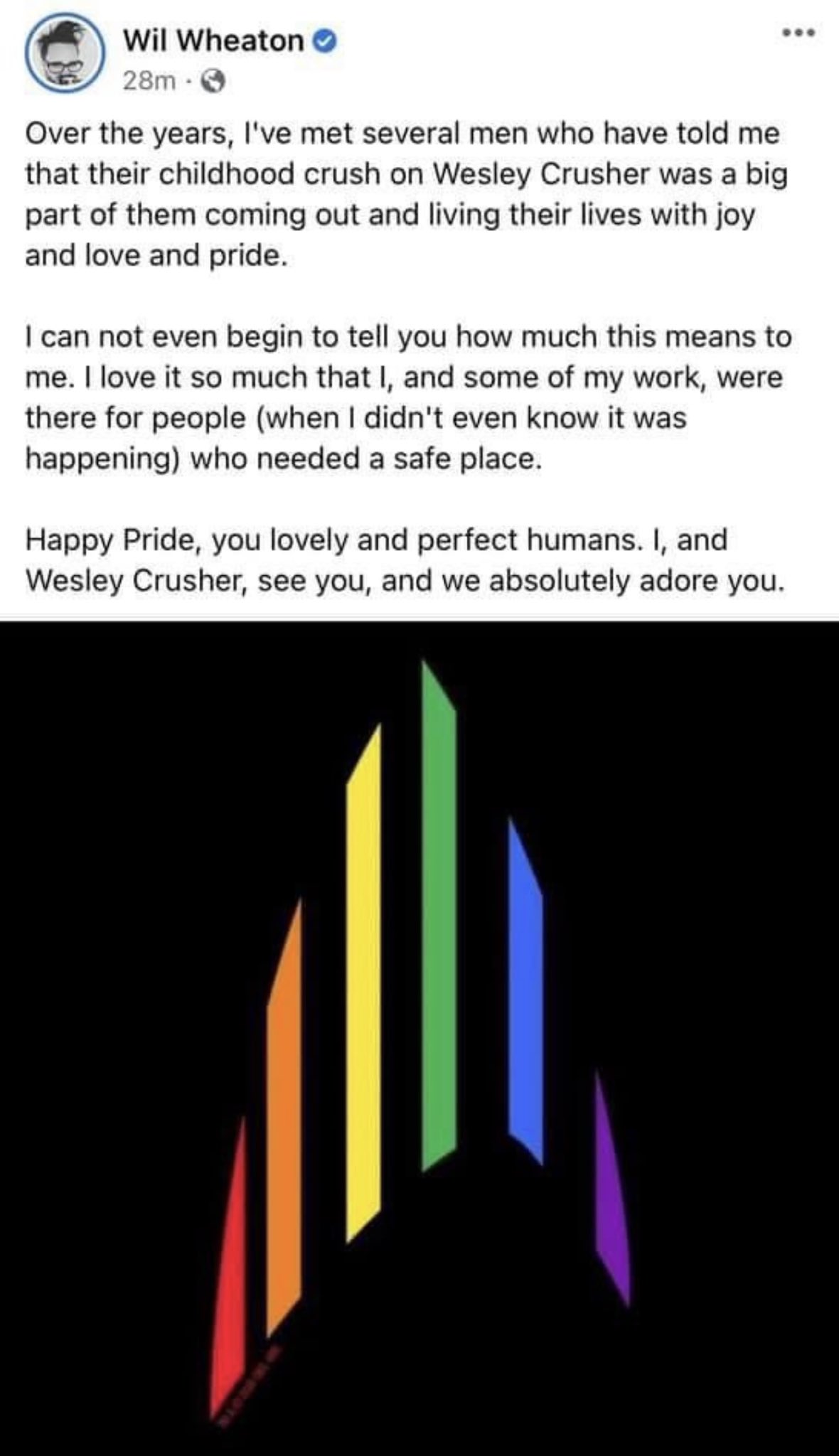
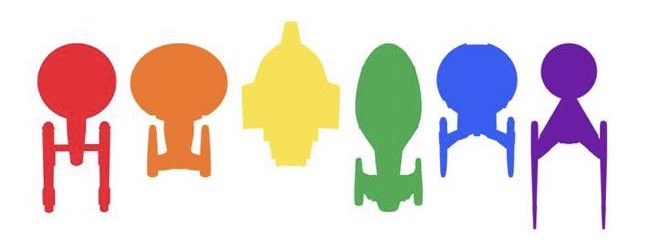
Actor Wil Wheaton, known for his role as Wesley Crusher on Star Trek: The Next Generation, welcomed pride month this weekend by giving a special shout-out to his LGBTQ+ fans. Wheaton, who is now 48, took to Facebook to publicly acknowledge the number of Star Trek fans that had a crush on the actorโ€“or his characterโ€“during the showโ€™s run.

โ€œOver the years, Iโ€™ve met several men who have told me that their childhood crush on Wesley Crusher was a big part of them coming out and living their lives with joy and love and pride,โ€ Wheaton wrote. โ€œI can not even begin to tell you how much this means to me. I love it so much that I, and some of my work, were there for people (when I didnโ€™t even know it was happening) who needed a safe place.โ€

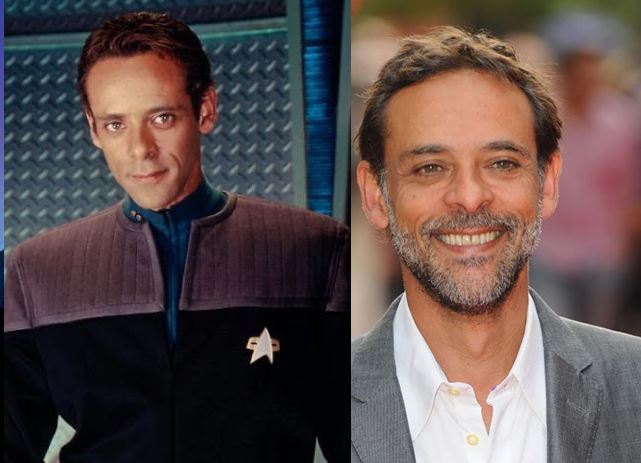
As a Star Trek fan, I certainly had a crush on Wesley Crusher, but the character that really made my heart go pitter patter was Dr. Julian Bashir (portrayed by Alexander Siddig) on Star Trek: Deep Space Nine. Bashir has sometimes been referred to as a twink, although his character began the series in his late twenties. He obviously caught the eye of the stationโ€™s resident Cardassian tailor, Elim Garak (portrayed by Andrew Robinson). Dr. Bashir was always handsome in the series, in particular, I always loved the episode โ€œRivalsโ€ because of the skintight suit Bashir wears while playing racquetball.

Alexander Siddig: Dr. Julian Bashir and Today

I had crushes on other Star Trek characters as well. On Star Trek: Voyager, I had a thing for Tom Paris played by the ever-handsome Robert Duncan McNeill. Enterprise had Commander โ€œTripโ€ Tucker portrayed by Connor Trinneer who seemed to spend half the series in his underwear and boy did he look good in his underwear. With Star Trek: Discovery, we now have actual gay characters, who are all surprisingly played by gay actors, to lust after. I am looking forward to the upcoming Star Trek: Strange New Worlds to see actor Ethan Peck, the grandson of actor Gregory Peck, who will be playing Spock. Peck previously played Spock during the second season of Discovery

Connor Trinneer as Commander โ€œTripโ€ Tucker


Poems by Joseph O. Legaspi

Whom You Love
By Joseph O. Legaspi

โ€ƒโ€ƒ”Tell me whom you love, and Iโ€™ll tell you who you are.” โ€“ Creole Proverb

The man whose throat blossoms with spicy chocolates
Tempers my ways of flurrying
Is my inner recesses surfacing
Paints the bedroom blue because he wants to carry me to the skies
Pear eater in the orchard
Possesses Whitmanesque urge & urgency
Boo Bear, the room turns orchestral
Crooked grin of ice cream persuasion
When I speak he bursts into seeds & religion
Poetry housed in a harmonica
Line dances with his awkward flair
Rare steaks, onion rings, Makerโ€™s on the rocks
Once-a-boy pilfering grenadine
Nebraska, Nebraska, Nebraska
Wicked at the door of happiness
At a longed-for distance remains sharply crystalline
Fragments, but by dayโ€™s end assembled into joint narrative
Does not make me who I am, entirely
Heart like a fig, sliced
Peonies in a clear round vase, singing
A wisp, a gasp, sonorous stutter
Tuning fork deep in my belly, which is also a bell
Evening where there is no church but fire
Sparks, particles, chrysalis into memory
Moth, pod of enormous pleasure, fluttering about on a train
He knows I donโ€™t need saving & rescues me anyhow
Our often-misunderstood kind of love is dangerous
Darling, fill my cup; the bird has come to roost

[ a subway ride ]
By Joseph O. Legaspi

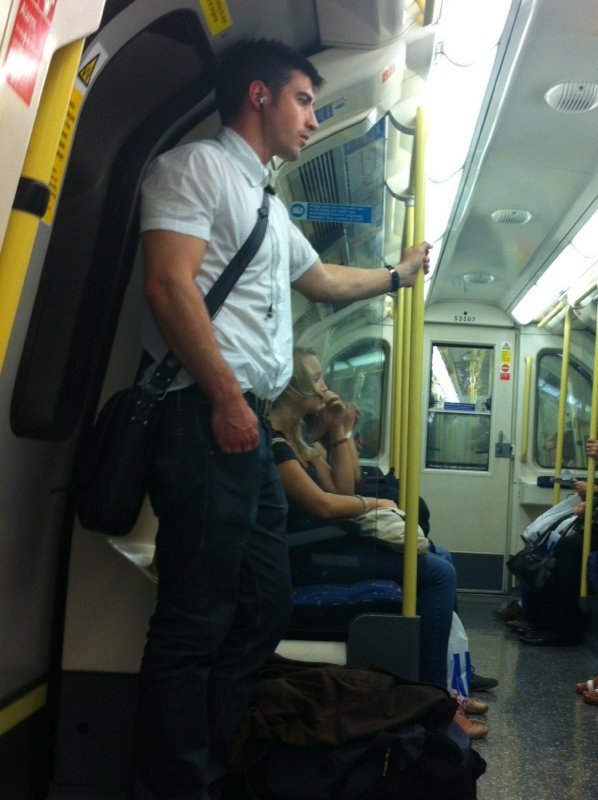
His artfully unkempt strawberry blonde head sports outsized headphones. Like a contemporary bust. Behold the innocence of the freckles, ripe pout of cherry lips. As if the mere sight of the world hurts him, he squints greenly and applies saline drops. You dream him crying over you. For the duration of a subway ride you fall blindly in love. Until he exits. Or you exit, returning home to the one you truly love to ravish him.

V-Neck T-Shirt Sonnet
By Joseph O. Legaspi

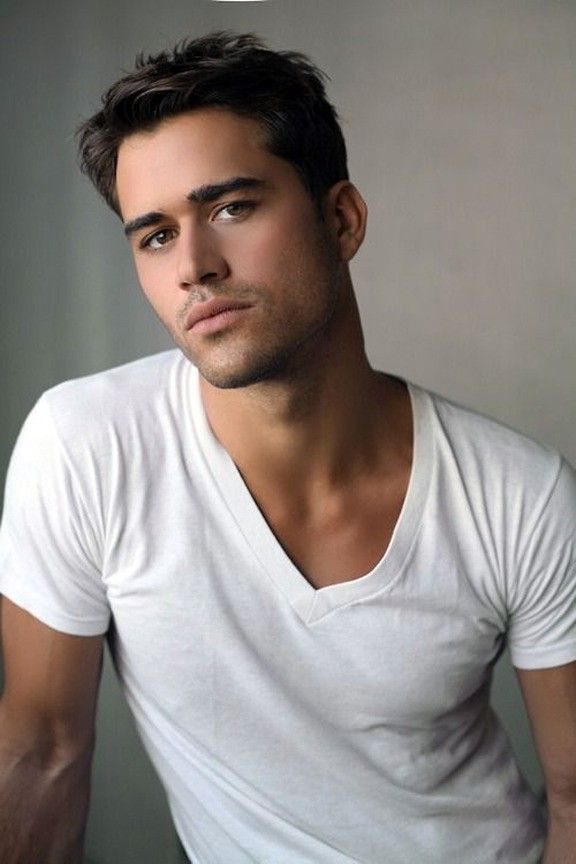
I love a white v-neck t-shirt
on you: two cotton strips racing
to a point they both arrived at: there
vigor barely contained, flaming hair,
collarless, fenced-in skin that shines.
Cool drop of hem, soft & lived-in,
so unlike my father, to bed you go,
flushed with fur in a rabbitโ€™s burrow
or nest for a flightless bird, brooding.
Let me be that endangered species,
huddled in the vessel of the inverted
triangle: gaped mouth of a great white
fish on the verge of striking, poised
to devour & feed on skin, on all.

Vows (for a gay wedding)
By Joseph O. Legaspi

What was unforeseen is now a bird orbiting this field.

What wasnโ€™t a possibility is present in our arms.

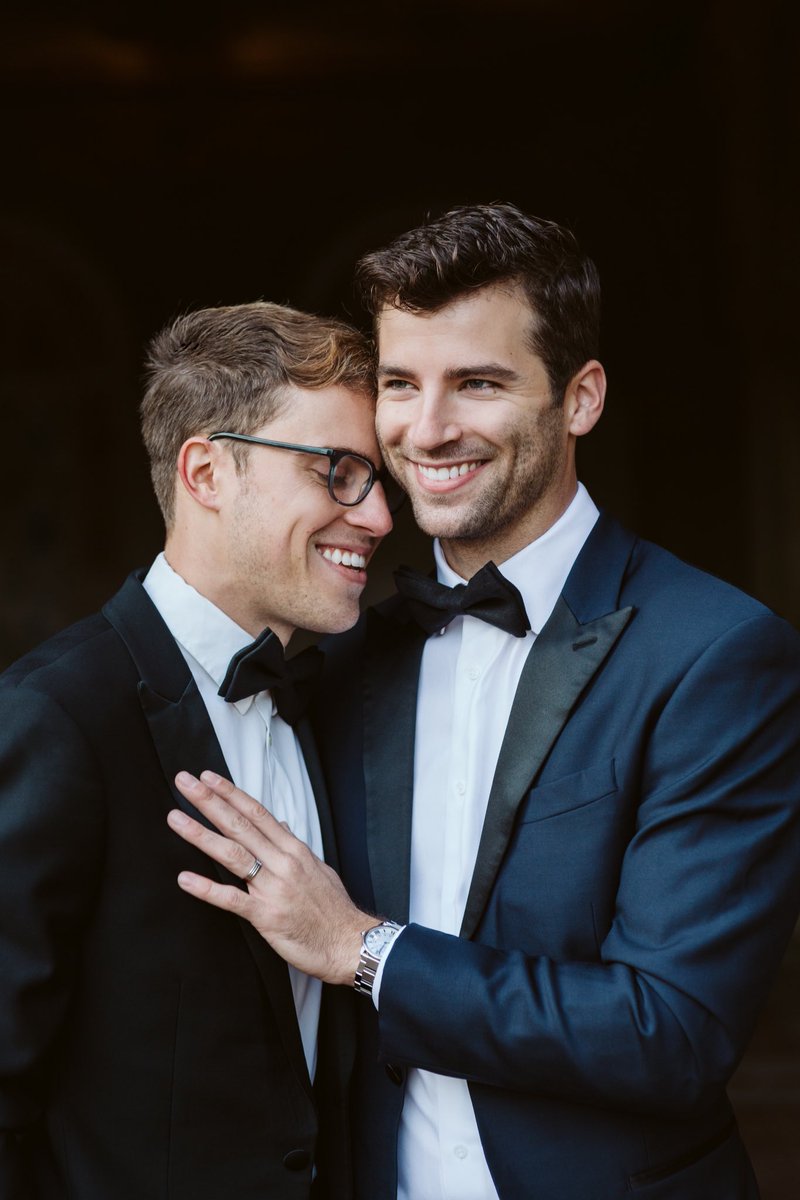
It shall be and it begins with you.

Our often-misunderstood kind of love deems dangerous.
How it frightens and confounds and enrages.
How strange, unfamiliar.

Our love carries all those and the contrary.
It is most incandescent.

So, I vow to be brave.
Clear a path through jungles of shame and doubt and fear.
Iโ€™m done with silence. I proclaim.

It shall be and it sings from within.

Truly we are enraptured
With Whitmanesque urge and urgency.

I vow to love in all seasons.
When youโ€™re summer, Iโ€™m watermelon balled up in a sky-blue bowl.
When Iโ€™m autumn, youโ€™re foliage ablaze in New England.
When in winter, I am the tender scarf of warm mercies.
When in spring, you are the bourgeoning buds.

I vow to love you in all places.
High plains, prairies, hills and lowlands.
In our dream-laden bed,
Cradled in the nest
Of your neck.
Deep in the plum.

It shall be and it flows with you.

Weโ€™ll leap over the waters and barbaric rooftops.

You embrace my resilient metropolis.
I adore your nourishing wilderness.

I vow to love you in primal ways.
I vow to love you in infinite forms.

In our separateness and composites.
To dust and stars and the ever after.

Intrepid travelers, lovers, and family
We have arrived.

Look. The bird has come home to roost.

About the Poet

Joseph O. Legaspi was born in the Philippines, where he lived before immigrating to Los Angeles with his family at age twelve. He received a BA from Loyola Marymount University and an MFA from New York Universityโ€™s Creative Writing Program. Legaspi is the author of the collection Subway (CreateSpace, 2013), Threshold (CavanKerry Press, 2017), and Imago (CavanKerry Press, 2007), winner of a Global Filipino Literary Award. He is the recipient of two poetry fellowships from the New York Foundation for the Arts, and in 2004 he cofounded Kundiman, a nonprofit organization serving Asian American poetry. He works at Columbia University, teaches at New York University and Fordham University, and lives with his husband in Queens, New York.


๐Ÿณ๏ธโ€๐ŸŒˆ LGBT POETS FOR PRIDE MONTH ๐Ÿณ๏ธโ€๐ŸŒˆ


It Has Gotten Better

I saw this video and had tears in my eyes when it was over. This is very much my story. I, too, grew up in the Bible Belt. Iโ€™m not sure what part of Alabama he grew up in, but I grew up in a rural area in the southern part of Alabama. Everyone but me seemed to know I was gay. I got called faggot, queer, sissy, gay, etc., all before I knew what any of it meant. People mocked me for my voice and mannerisms. I couldnโ€™t do much about my voice, but I did change my mannerisms to be less โ€œeffeminateโ€ in the bulliesโ€™ eyes. Those bullies made it all sound like it was the worst thing in the world to be gay, and I โ€œknewโ€ I didnโ€™t want to be gay. It was unthinkable, and no matter what I did, the bullying did not stop until I went away to college. It took me years to accept myself. Just like him, this was in the 1990s. I also was in high school from 1992-1996. While he found theater and it saved his life, I found the internet and began researching, which saved my life. I finally had access to some of the answers I so desperately needed. This blog has also helped me to โ€œfindโ€ myself.

The story of my sophomore year was a bit different from his. My best friend was a girl. (Sheโ€™s now a Trump loving Republican, and we no longer speak.) But back then she was my cover in a way. I guess she was my โ€œbeard,โ€ but it really didnโ€™t seem to change anyoneโ€™s perceptions of me. I was still the intelligent, effeminate teenager whose most of his friends were girls, but never his girlfriend. Instead of hiding my friendship, I tried to hide my true self using that friendship. However, during that sophomore year when I was 16, the bullying got so bad, I took a handful of pills. Iโ€™d been on Ativan for my migraines. The doctor had taken me off of them, but I still had part of a bottle. I took all I had left hoping this would end my misery. Thankfully, it wasnโ€™t enough for an overdose, and I just became violently ill.

I hated high school, just like Iโ€™d hated middle school. I hated all my years at that small private school in Alabama. I remember in kindergarten, my teacher forced me to take a toy truck to the playground and play with the other boys. I preferred to play with the girls. All of this came together to change who I was. I was a well-behaved kid at school, I was not a nice kid to my parents at home. I backtalked a lot and was constantly in trouble for it. I hated my dadโ€™s rule of โ€œDo as I say, not as I do.โ€ At one point, my parents wanted to send me away to a boarding school. I wanted to find one for the academics and opportunities it might provide, and they wanted me out of their hair. They didnโ€™t want to send me to a school for kids with severe behavioral problems, and I didnโ€™t want to go to a military school. We did a bit of research into boarding schools. I wanted to be sent to an all-boys school, which in hindsight would probably had been just as bad as what I was going through. Eventually, they figured out that I wanted to be sent away, and they dropped the idea.

I have struggled much of my life with my sexuality. Iโ€™d say it could be one of the reasons for my migraines, but Iโ€™ve had migraines my whole life, even before I started school. I have had some miserable periods in my life. College and graduate school were different, but I always struggled with having enough money during those years. I was the typical poor college student, which added to my anxiety. Then, as a high school teacher, I seemed to hit rock bottom. I am a good teacher, but I was teaching spoiled rich kids who made my behavioral issues in high school seem minor. I was a good kid except when alone with my parents. My students were hateful, disobedient, and lazy, and I felt like I was more of a babysitter than a teacher. My bad temper came out a lot more than Iโ€™d have wanted. I wish I could have been calmer when dealing with them, but they often brought me to the brink. Teaching at a private school was by far the most difficult and worst job Iโ€™ve ever had. I was not cut out for teaching secondary school. I always did much better teaching college.

Only in the last few years have I begun to fully accept myself. It took moving 1,400 miles away to a mostly solid blue state to be happy, and to get a fairly decent paying job. Mostly these days, I am happy. I do struggle with some health issues (chronic migraines, diabetes, my weight, my brittle teeth), but even those seem to be getting under control. The Botox treatments seem to be working; my diabetes seems to be under control; and Iโ€™ve been losing weight, though I still have more weight I need to lose. My teeth are still a work in progress (I have to go to the dentist for a broken tooth this morning), but hopefully, things will get better in the dental department as well.

The most important thing is that I have accept who I am, and I am proud of my sexuality. Yes, I still have to be in the closet when I go home in an effort to appease my family, but one day, I hope and pray this too shall pass. I live my life as an out gay man here in Vermont, and I am unapologetically gay. Vermont has laws protecting gay people from discrimination, and the university I work for has anti-discrimination policies. I donโ€™t have to put up with homophobia here. Itโ€™s not perfect, and Iโ€™m still getting comfortable in my own skin, but it has gotten better. Isnโ€™t that what we all hope for when dealing with our sexuality?

The It Gets Better Project is a nonprofit organization with a mission to uplift, empower, and connect lesbian, gay, bisexual, transgender, and queer youth around the globe.


Gay Christian Pride

I am acting with great boldness toward you; I have great pride in you; I am filled with comfort. In all our affliction, I am overflowing with joy.

-2 Corinthians 7:4

For those of us who were raised in a strict Christian environment, we had to learn not to hate ourselves and to accept who we are and our sexuality. Some Christians are opposed to the concept of LGBTQ+ pride. They feel LGBTQ+ people should be ashamed of who we are, and any public celebration of LGBTQ+ sexuality is wrong. Those who reject us are those who are straying from the teachings of Jesus. I still believe in the teachings of Christ and believe that God created me just the way I am. I learned to accept myself and be proud of who I am. I am proud to be both gay and Christian.

Christians who know church history can identify with persecution. During the early years of the Christian church, Christians were put in prison and killed for their faith. The civil authorities in the Roman Empire were persecuting people for being Christian. Both Christianity and the LGBTQ+ community share a history of discrimination and persecution. Unfortunately, discrimination and persecution of LGBTQ+ people continue today, largely led by people claiming to be Christian. Some Christians do not understand how much they have in common with the LGBTQ+ community. Instead of working closely together to ensure their mutual human rights are respected, many Christians actively work to keep LGBTQ+ people from having the same rights other members of society enjoy.

The LGBTQ+ community celebrates Pride Month each year in the month of June to honor the 1969 Stonewall Riots in Manhattan. The Stonewall Riots were a tipping point for the Gay Liberation Movement in the United States. In the United States the last Sunday in June was initially celebrated as “Gay Pride Day,” but the actual day was flexible. In major cities across the nation the “day” soon grew to encompass a month-long series of events. Today, celebrations include pride parades, picnics, parties, workshops, symposia and concerts, and Pride Month events attract millions of participants around the world. Memorials are held during this month for those members of the community who have been lost to hate crimes or HIV/AIDS. The purpose of the commemorative month is to recognize the impact that LGBTQ+ individuals have had on history locally, nationally, and internationally.

LGBTQ+ pride promotes the self-affirmation, dignity, equality, and increased visibility of LGBTQ+ people. Pride, as opposed to shame and social stigma, is the predominant outlook that bolsters most LGBTQ+ rights movements. Ranging from solemn to carnivalesque, pride events are typically held during the month of June. Some pride events include LGBT pride parades and marches, rallies, commemorations, community days, dance parties, and festivals. Pride may be considered one of the seven deadly sins, but there is nothing wrong with LGBTQ+ people having self-affirmation, dignity, equality, and increased visibility. In fact, God expects us to have pride, a pride that is justifiable and reasonable, because it is based on what God has done for humanity.

God chose humanity before the world was created. Ephesians 1:4, we are told, โ€œEven as he chose us in him before the foundation of the world, that we should be holy and blameless before him.โ€ God did not wait to see how things would go before choosing humanity. According to Ephesians we were chosen before the world was around, before we had a chance to do anything that would make God favor us. We did not have to act loving, do impressive humanitarian work, wear designer clothes, or make love to the right person to earn God’s love. God’s love for us is not a new, fickle love. His love for all of us, no matter our sexuality, is as old as time. God loved us, just the way we are. We can take pride in the fact that God sought us out and chose us before the world was created. In 2 Corinthians 7:4, we are told that God as โ€œgreat prideโ€ in us.

Isaiah Chapter 44 says God formed us in the womb. It does not say, โ€œGod created heterosexual people in the womb,โ€ but it says that God, โ€œformed you from the womb and will help you.โ€ (Isaiah 44:2) We are not an accident in Godโ€™s eyes. We are not defective like some Christians would have us believe. God formed us in the womb and made us who we are. Galatians 1:15 states the Paul was chosen before he was born, โ€œBut when he who had set me apart before I was born, and who called me by his grace.โ€. Just like Paul, we were chosen to be an LGBTQ+ Christian (if thatโ€™s how you identify) before we were born. We can have pride, because God chose us and picked us to be on children.

Genesis tells humans, again, no matter their sexuality, were created in God’s image. Anything made in the image of God is valuable. We can have pride because we are a valuable masterpiece. God did not make a mistake when he created us with the varying sexualities that exist in this world. Romans 5:8-9 says, โ€œBut God shows his love for us in that while we were still sinners, Christ died for us. Since, therefore, we have now been justified by his blood, much more shall we be saved by him from the wrath of God.โ€ In Greek, the word justify carries the meaning to vindicate, approve, and honor. LGBTQ+ Christians are vindicated, approved, and honored by God, no matter our sexuality, because of Christ’s death on the cross. And nobody, gay or straight, has the right or the authority to put down or condemn people God has vindicated, approved, and honored.

LGBTQ+ Christians have the same reasons to have pride as straight Christians. Gay and straight Christians are equally called before the world was created, are equally formed in the womb by God and are equally redeemed by God. LGBTQ+ Christians can and should have pride in who they are by creation, by birth, and in Christ. To advocate that LGBTQ+ Christians should not have pride is to advocate that LGBTQ+ people feel and express no gratitude to God. When LGBTQ+ Christians are denied LGBTQ+ pride, they are asked to deny their Creator’s role in their creation and birth. It denies Christโ€™s role in our salvation.

Some LGBTQ+ people find pride to be one time of the year when they do not feel alone, isolated, cut-off, rejected, hated, and despised. Pride helps LGBTQ+ people feel they are not a tiny, powerless minority group. Through pride, many LGBTQ+ people find a sense of belonging, a sense of being worthwhile. Society has long taught LGBTQ+ people to hate themselves. By celebrating pride, the LGBTQ+ community can start the long process of overcoming self-hate. Standing side-by-side with God, LGBTQ+ Christians are accepted, loved, connected, and made powerful by God.

LGBTQ+ Christians can find meaning in pride. God wants LGBTQ+ people to stop hating and fearing themselves, because those who live secret lives of pain are not able to fully celebrate their identity in Christ. Through LGBTQ+ pride, God calls LGBTQ+ Christians to live as though the world waits for them, waits for them to passionately praise God, to love as faithfully as God loves and to celebrate life, as they walk hand-in-hand with Christ into eternity.


Moment of Zen: Pride

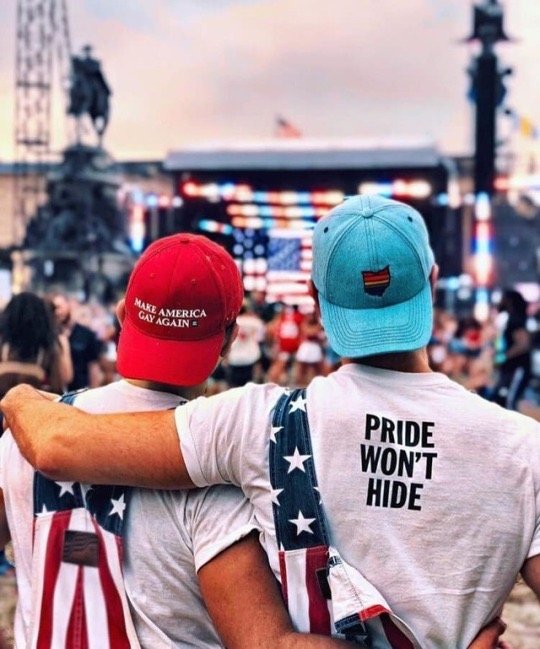
PRIDE WONT (AND CANT) HIDE


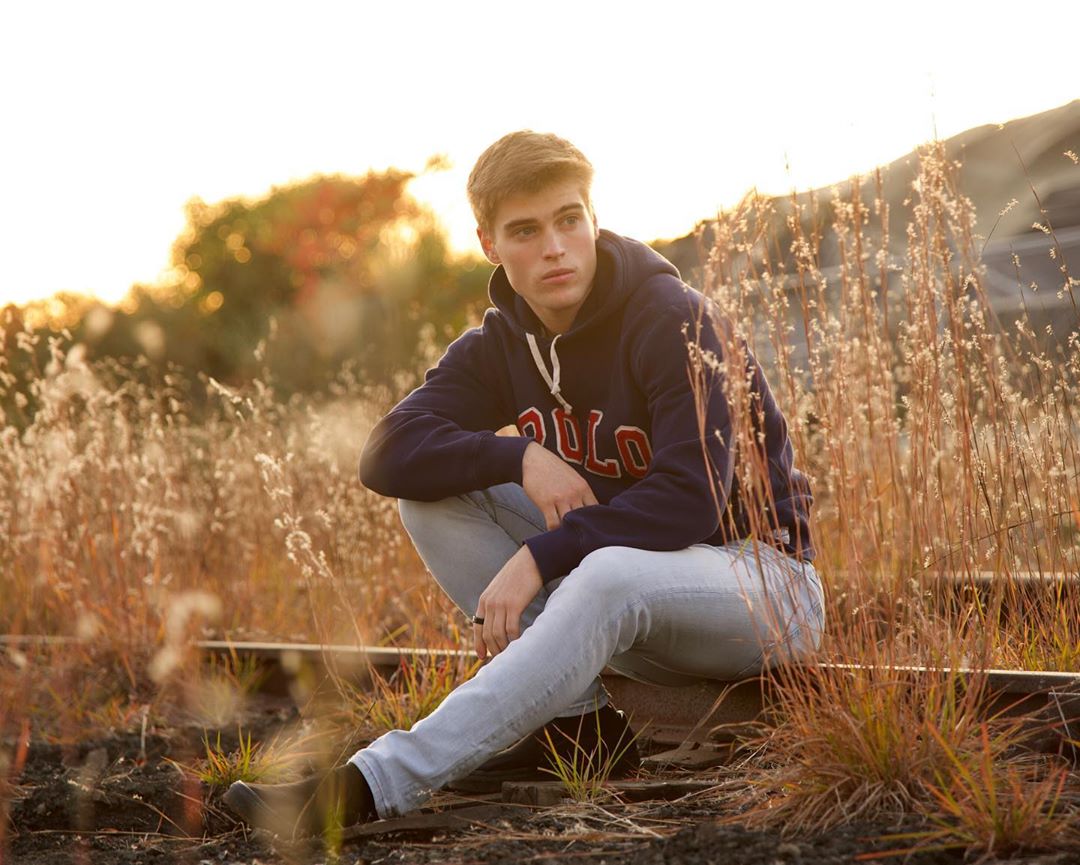
Clothes Make a Man

Shakespeare wrote, โ€œFor the apparel oft proclaims the man.โ€ The quote is from a longer speech by Polonius in Act I, Scene 3, ofย Hamlet. Poloniusโ€™s son, Laertes, is about to depart for Paris, and Polonius has some dear parting words for his son. It’s really just a lot of long-winded advice: listen more than you talk, don’t borrow or lend money, don’t be gaudily dressed, and be true to yourself. Shakespeare might have written the idea (apparel oft proclaims the man), but Mark Twain is credited with the much more familiar phrase. Twain wrote, “Clothes make a man.โ€ Although, Twain added, โ€œNaked people have little or no influence on society.” For modern audiences, it’s easy to forget about issues of class in Shakespeare’s famous play. Yetย Hamletย is very much concerned with what’s appropriate for certain classes to do. Here, Polonius says that appearances count for a lot. It’s how you can tell someone’s rank and status, and that was important in Shakespeare’s time.

But is it in ours? Do clothes still “proclaim” or โ€œmakeโ€ us? We might not think so. We don’t have sumptuary laws (laws imposed by rulers to curb the expenditure of the people) anymore, and we aren’t as interested in social class like they were in Shakespeare’s time. If you think we arenโ€™t, think again. We might not have the social ranks, but we certainly invest a lot in what people wear. Designer labels and celebrity stylists make sure we’re always in the know about what’s expensive and what’s not. Advertisements for designer brands always show beautiful people wearing their clothes in an attempt to make us think we will feel just as glamourous in the same clothes. Do you think Abercrombie & Fitch would have become as popular as they did a decade or so ago if it had not been for their suggestive advertisements and their focus on young, fit, and sexy models? Their brand went so far as to only hire people who looked like their models to work in their stores. They called them โ€œbrand representatives.โ€ The problem was when their CEO came under fire for proclaiming that his brand is only suitable for “the good-looking, cool kids,” and that there are people who do not belong in his clothes โ€“ namely overweight people. A&F has has never regained their previous popularity after these remarks became public.

Perceptions of clothing are actually more far reaching than you might think. Doctors, firefighters, and police officers all wear specific uniforms, so we know exactly who they are in a crowd. Kids with diabetes use medical bracelets to alert people. And a lot of people can find at least one team jersey in their closet to show off their team spirit. So, there you have it. We can tell someone’s job, wealth, favorite team, and even sickness just by looking at him. It turns out clothes do make the manโ€”and womanโ€”even today. Clothes also have a psychological effect on us. It’s been well-establishedโ€”in the scientific literature and real lifeโ€”that what we wear affects how others perceive us. Women who wear more masculine clothes to an interview (such as a dress suit) are more likely to be hired. People dressed conservatively are perceived as self-controlled and reliable, while those wearing more daring clothing are viewed as more attractive and individualistic. We’ve recognized these distinctions since childhoodโ€”we learn what’s appropriate to wear to school, to interviews, to parties. Even those confined to uniform convey their own unique style in an attempt to change how they are perceived by others. There is a growing field in psychology known as “embodied cognition”โ€”the idea that we think with not only our brains, but with our physical experiences. Including, it seems, the clothes we’re wearing.

Just the other day, I was discussing with my boss what he and I will wear for the opening reception of our new exhibit Friday night. Usually, we each wear a suit, but since it will be outside, we were trying to decide if we should be less formal. I still havenโ€™t decided, but I will probably wear a shirt and tie, and have a suit jacket with me, just in case. I just need to go through my shirts and see what still fits well enough for me to wear a tie. Since I have lost some weight, some of my shirts are way too loose on me, but the determining factor will be how they fit in the neck. I have always had a thick neck, so finding a dress shirt I can wear a tie with can be a challenge at times.

Museum receptions aside, I often dress in clothes that make me feel good. I donโ€™t have a body that looks great in everything, but I wear what makes me feel confident and good. My personal rules for fashion extend to undergarments, shoes, and accessories. Most of the time, no one will ever see what underwear I have on, but they make me feel sexy, whether I actually look sexy in them or not. Itโ€™s how they make me feel that is important. The lawyer I used to work for told me that she always wore nice shoes when sheโ€™d be in court because women on a jury often noticed another womanโ€™s shoes. That is probably sexist today, but when she went to law school in the 1970s, she was one of only two women in the University of Alabama Law School. She was used to being judged differently from male lawyers. So, I follow her advice and I like to wear a nice pair of shoes that will match my outfit. I donโ€™t mind paying a little extra for a pair of shoes that look good, but they also have to be comfortable.

Maybe itโ€™s shallow of me to care so much about my outward appearance, but I was always taught to take PRIDE in the way I look. Obviously, if I was very strict with myself about this, I would not have a weight problem, but that is a whole other issue. What do you think your sense of fashion says about you? Do you feel better wearing certain clothes? Do you put comfort ahead of fashion?


Spread Kindness

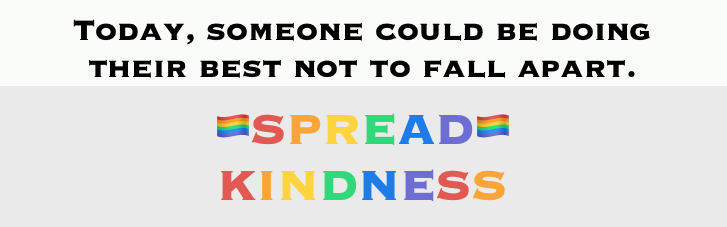
I was in Starbucks waiting on a mobile order the other day, and I saw a sign on the wall that said:

Shortly after I first moved to Vermont, a very close friend died in a terrible car wreck. I was not able to handle it well. The death hit me extremely hard. If you go back in time on the blog to December 2015 and early 2016, you’d probably be able to tell some of the pain I was going through. I bring this up because I decided that along with antidepressants, I needed to see a therapist to try and work through my grief. While I found the therapy to do more harm than good due to the therapist I saw, the therapist did make an interesting point that I think is largely true. I have a lot of hidden pain. This hidden pain came in several different forms. I was closeted most of my life. I hid who I really was from most people in my life. I suffered from depression and anxiety for many years and did not seek help when I should have. I essentially hid the pain associated with my headaches because I feared people would not take my headaches seriously. (More women suffer from migraines than men, so men who have migraines often hide their pain because they feel it makes them weak.) I also often hid my feelings. I didn’t want people to know how sad I was all the time. So, I hid a lot of who I was from the world around me for fear of being judged for who I was. 

I was one of those people who was doing their best not to fall apart on a daily basis. I am also not the only one who hides their pain. I do try my best to be a kind person to those around me. I put on a happy face, even when I don’t always feel like doing so. I always have, and I probably always will. I want to make other people feel better. Wouldn’t we all like the world to be a better place? We live in a time when LGBTQ+ rights (particularly trans rights) are constantly being attacked and threatened. We have made many gains, but the fight is far from over. Voting rights are being attacked because Republicans want to make it harder for more liberal-minded people to vote. Many religious organizations are pushing for exemption from anti-discrimination laws to legally discriminate against those who don’t follow their narrow beliefs. We cannot stop the fight if we want to make the world a better place. 

Mahatma Gandhi said, โ€œYou must be the change you wish to see in the world.โ€ The change Gandhi referred to can be significant changes like civil rights, but it can also be small changes like opening the door for someone, giving a helping hand when you see someone with their hands full, paying someone a compliment, reaching an item off a high shelf for someone, giving up your seat to someone who needs it more, or something as simple as smiling. There are so many little things we can do for those around us to spread a little kindness. I urge you today to send an encouraging text, make a phone call to say, “I’m thinking of you,” smile at a stranger, or do any number of small acts of kindness. You never know when that small act of kindness can keep someone from falling apart. Let your kindness be contagious.

June is Gay Pride Month, and kindness should be a part of who we are. The LGBTQ+ community has faced many hardships. Instead of treating others the way weย wereย treated, we should treat others the way weย want to beย treated. Pride has always been an event for the diverse LGBTQ+ community and their allies to joyously declare their presence. Let that presence include kindness and acceptance. Pride had its roots in a rebellion against the policing of our lives. Being LGBTQ+ once meant we had a mental illness, and the simple act of wearing the clothes of another gender was illegal. The Stonewall Riots in late June 1969 proved to be a turning point for the LGBTQ+ community, but there is still more to be done. We cannot rest on our laurels. Pride celebrations are a festive โ€œunity in diversityโ€ that is a hallmark of Pride that continually evolves and responds to contemporary challenges. Most of us have struggled with coming out and coming to terms with our sexuality. We often hide parts of ourselves. Pride Month is a time when we can all say, โ€œWeโ€™re here, weโ€™re queer, get used to it!โ€