Category Archives: Pride

Love Won!


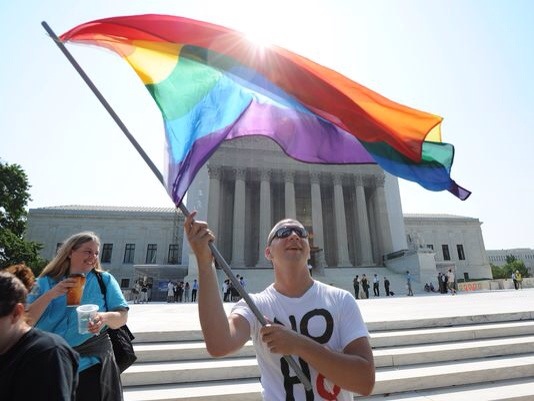
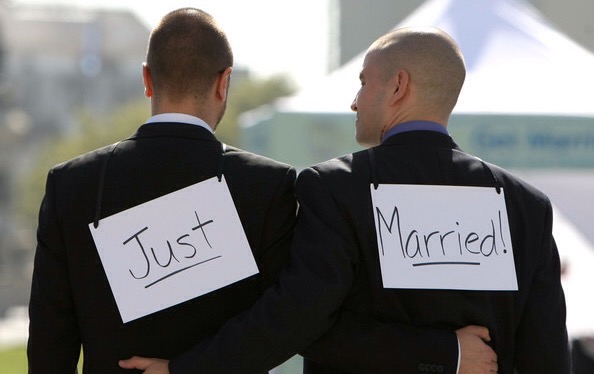
The news just came down from the Supreme Court: Marriage equality is officially the law of the land!

Today is a historic day, first for everyone who can now marry the person they love no matter where they live, but also for all of us who are invested in the advancement of equality. Thanks to today’s decision, same-sex couples will have their marriages recognized in every state and can no longer be discriminated against for wanting to adopt a child — just like any other married couple in this country.

The U.S. Supreme Court ruled 5-4 on Friday that it is legal for all Americans, no matter their gender or sexual orientation, to marry the people they love. The justices found that under the 14th Amendment, states must issue marriage licenses to same-sex couples and recognize same-sex unions that were legally performed in other states. Justice Anthony Kennedy delivered the majority opinion and was joined by Justices Ruth Bader Ginsburg, Elena Kagan, Stephen Breyer and Sonia Sotomayor.

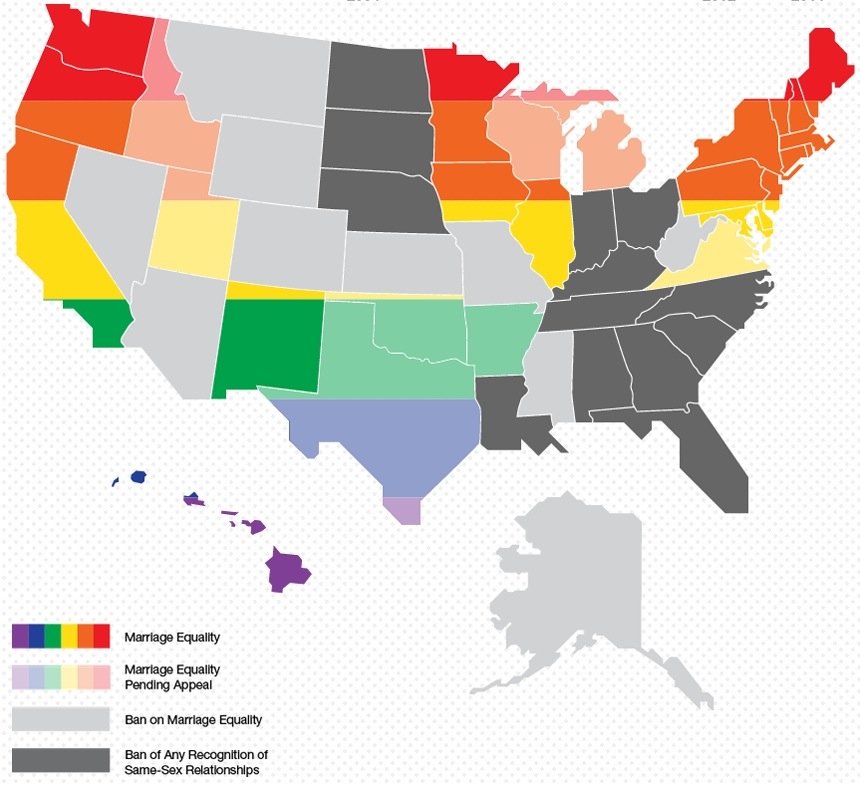
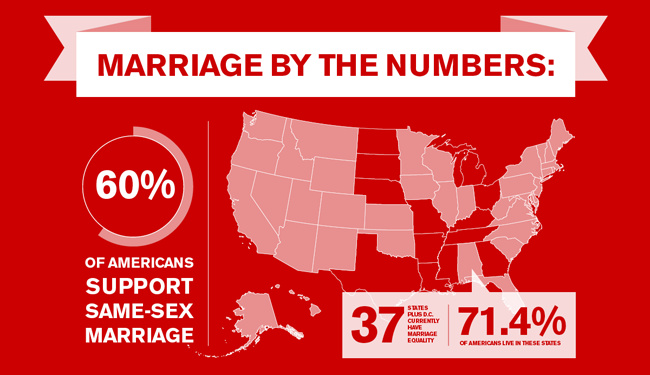
The decision is a historic victory for gay rights activists who have fought for years in the lower courts. Thirty-seven states and the District of Columbia already recognize marriage equality. The remaining 13 states ban these unions, even as public support has reached record levels nationwide. As gay Americans we have waited with bated breath and wondered why the Supreme Court has waited until the final days of the term to issue this seemingly obvious decision. Every major LGBT equality (or, inequality) decision from the Supreme Court–including, Bowers v. Hardwick (it is ok to criminalize sodomy), Romer v. Evans (the you-can’t-discriminate-against-gays-just-because-you-hate-them case), Lawrence v. Texas (it is not ok to criminalize sodomy), Hollingsworth v. Perry (marriage freedom in California), and United States v. Windsor (the Defense of Marriage Act is unconstitutional)–were handed down toward the end (in the case of Romer) or on the very last day of the Court’s term. Lawrence and Hollingsworth were both argued on the same day one decade apart and decided on the same day a decade apart (March 26 and June 26, in 2003 and 2013, respectively). The other cases were decided at around the same time: Windsor was argued the day after Perry and decided the same day. Romer was argued on October 10, 1995 and decided on May 20, 1996, the earliest of the bunch.

In the majority opinion, the justices outlined several reasons marriage rights should be extended to same-sex couples. They wrote that the right to marriage is an inherent aspect of individual autonomy, since “decisions about marriage are among the most intimate that an individual can make.” They also said gay Americans have a right to “intimate association” beyond merely freedom from laws that ban homosexuality. Kennedy consistently used the arguments by the opponents of same-sex marriage against them. He said that same-sex marriages would not diminish the dignity of marriage but increase it. Kennedy said that those who wanted to be married are upholding the dignity of marriage because they want the same respect that opposite-sex marriages have. In answering the traditions of marriage, Kennedy said that there is not an overall traditional definition of marriage because marriage has consistently changed over the centuries. Arranged marriages are no longer the norm, interracial marriages are no longer illegal, and gay equality has become accepted by the majority of Americans. Marriage equality has followed political and social change.

The majority determined that extending the right to marry protects families and “without the recognition, stability, and predictability marriage offers, children suffer the stigma of knowing their families are somehow lesser.” The majority concluded that the right for same-sex couples to marry is protected under the 14th Amendment, citing the clauses that guarantee equal protection and due process. Kennedy said that marriage is a fundamental right of the constitution, which the Fourteenth Amendment’s a Due Process and Equal Protection clauses guarantee.

I am sure that opponents will voice arguments against following the Court and many have already said that they will use civil disobedience to resist the ruling. However, let’s be clear, they Supreme Court did not make the same mistake as in Brown v Board of Education and call for the implementation to be done “with all deliberate speed.” Not is this the 1830s when Andrew Jackson ignored the Supreme Court ruling in Worcester v. Georgia when he said, “John Marshall has made his decision; now let him enforce it!”. I have no doubt that lower courts will be busy as people will be forced to file cases forcing local officials to issue marriage licenses. I have little doubt that this will be the case in Alabama. There are some politicians who will use their hatred of equality to attempt to fight, but they will ultimately fail. LOVE WON!

Turn The Internet Red #LoveCantWait

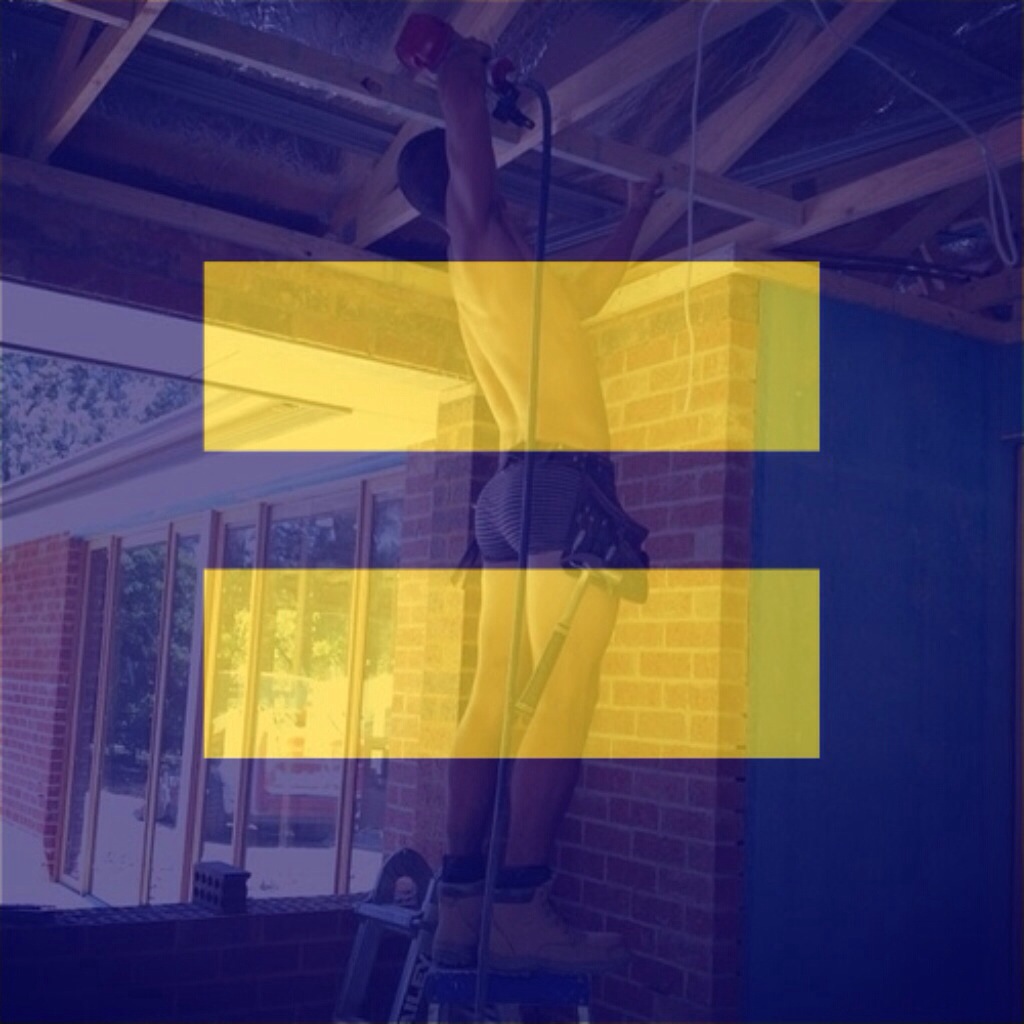
 You may have noticed that my header and profile picture are now tinted red.  On April 28, the U.S. Supreme Court will hear oral arguments in Obergefell v Hodges, a case originating in Ohio. In January, the Supreme Court announced that it would hear Obergefell along with three other cases from Michigan, Kentucky, and Tennessee. The arguments have been consolidated and the case has formally been named Obergefell.

The HRC is hoping to make lightning strike twice and to do so, they need our help. As we await the Supreme Court‘s decisions on two historic marriage equality cases, we have a great opportunity to turn the web red once again in the name of equality and love.


To demonstrate the incredible support for marriage equality, we’re asking everyone to make the red equal sign their social media profile picture once again — NOW through decision day, whenever that is. 

Red

If you participated in our campaign to turn the Internet red for marriage equality back in March, you know how meaningful it was. Missed the March marriage madness? Now is your chance to show your support.

Update your profile picture with a red logo so your entire social network knows that you’re standing on the right side of history. Go to http://www.hrc.org/red to easily convert your Facebook or Twitter profile picture to a blended picture of your profile and the red marriage equality sign.  And then ask your friends and family to join you! And if you’re sharing on Instagram, use the hashtag #time4marriage to participate in our marriage equality photo collage, Picturing Equality.

For the latest and breaking news from the Supreme Court, be sure to stay tuned to www.hrc.org/supremecourt.

The HRC will be launching brand new, innovative engagement tools throughout the month to help us show our support and connect with an expansive community of fair-minded Americans. 


Tolerance and Diversity: Part II 


 Two of my favorite movies about the U.S. Presidency are Dave and a movie that Ethan mentioned in his comment yesterday, The American President. (I’m also a little partial to My Fellow Americans, because how can you not love a movie with Jack Lemmon and James Garner.) But I’m off topic.  I wanted to use the quote from The American President that Ethan used because I think it makes an excellent point:

America isn’t easy. America is advanced citizenship. You gotta want it bad, ’cause it’s gonna put up a fight. It’s gonna say “You want free speech? Let’s see you acknowledge a man whose words make your blood boil, who’s standing center stage and advocating at the top of his lungs that which you would spend a lifetime opposing at the top of yours. You want to claim this land as the land of the free? Then the symbol of your country can’t just be a flag; the symbol also has to be one of its citizens exercising his right to burn that flag in protest. Show me that, defend that, celebrate that in your classrooms. Then, you can stand up and sing about the “land of the free”. 

I’ve always loved that quote and I’m glad that Ethan brought it up.  The American President came out at a time when flag burning was the hot topic of conservatives to rant against.  They even proposed a constitutional amendment to make it illegal.  Now the hot button topic is gay rights, particularly gay marriage and conservatives again are calling for a constitutional amendment to prohibit it.  The reasons amendments like these would never pass is because all of the 27 amendments to the constitution guarantee rights and protect them, none take away rights and legalize discrimination.  Again, I’m a bit off topic, so bear with me.

The point I’m making is that LGBT issues are in the spotlight right now.  We are finally becoming more accepted by American society, especially outside a few pockets of staunch conservatism.  In order to continue gaining ground, we need to make more allies ryan enemies.  We need them not only as friends who can offer love and support but as critical community members to further our cause. As much as we wish to fight our own battles, it is often our allies in the majority who have chosen to fight for the minority cause who can have the greatest impact. They can serve as intermediaries, given the time and space to say and be heard saying the same things that the minority group has been preaching for years. And it is only through changing hearts and minds in the majority that we can reshape the dominant views that we spend hours debating in LGBT circles. 

In “Is the gay community scaring away our straight allies?” by Mason Hsieh as featured in the Huffington Post and brought to my attention by a friend who received it in a diversity email from his employer Walmart, Hsieh suggest five ways to be better to our allies, particularly the new ones.

  1. View alliances as a continuum.
  2. Leave room for political incorrectness.
  3. Remember the big picture.
  4. Take pride in small victories.
  5. Be an ally to your allies.

And I want to take a closer look at these five suggestions, because I think Hsieh makes very valid points.

1. View alliances as a continuum.

Often allyship is painted as all-or-nothing: If you don’t support all our beliefs, you’re not an ally. We must remember that, like any self-identity, allyship is an ongoing process, made up of small, gradual steps. It is a “becoming” process that grows and develops over time, and not always following a linear trajectory.  I have friends who if I had to agree with everything they believe or they agree with all of my beliefs, I’d have no friends at all.  You will not see eye to eye with everyone.  Even countries who are allies don’t always agree on each other’s policies. So why should we think that our allies must support ALL of our beliefs?  Maybe this would be the case in a perfect world, but we all know that this world is far from perfect.

2. Leave room for political incorrectness.

While checking our privilege and engaging in conscientious discourse are great ways to practice thoughtful and inclusive speech and action, we must leave room for political incorrectness. We have to give people, particularly newcomers to the cause, the benefit of the doubt whenever possible and consider making room for political incorrectness in everyday life. There is a difference between fighting homophobia and scrutinizing everything a person says or believes. While the two are not mutually exclusive, the latter can be tiring and lead you further from what you are actually fighting for.  People who are newcomers to our cause can be ignorant to some of the things we find offensive, so we need to be understanding and educate them in a way that doesn’t drive them away.

3. Remember the big picture.

Pick your battles and keep the bigger picture in mind. I find this true of so much in life.  Some battles just aren’t worth fighting and can be handled with a different tactic.  When discussing difficult or touchy topics, give people room to voice their opinions. Let them say their piece, and rather than formulating a retort for every problematic assertion, step back and listen for the bigger picture. What is the most important part of this discussion?  Quite honestly, we do this everyday.  We don’t need a Pyrrhic victory,  we need new allies.  Pick your battles and know when to use more subtle approaches.  True southerners are known for our way of knowing when to be subtle and when to be blunt.  It’s an art that more people should learn.  Besides, both done correctly just makes us more charming, and some activists (and it doesn’t matter the cause) need to learn how to be charming and not caustic.

4. Take pride in small victories.

Minds are not typically changed overnight or through one impassioned debate. Remember that everyone is on his or her own learning curve, and that small steps in the right direction are still steps.  For all the teachers out there, you know how true this is.  We don’t get many victories, but the small ones are worth our weight in gold.  I’m not an out and proud gay activist, mainly because I’m a closeted teacher in a small private school, but I also don’t tolerate derogatory speech in my presence.  It’s a small way that I am helping.  I do my best to teach tolerance, often I use religious lessons (because I can and its something these kids have been taught to respect) to get my point about tolerance across.  It’s a small victory, but it’s a victory.

5. Be an ally to your allies.

Standing up for a community that you are not inherently a part of can be scary and leave a potential ally feeling vulnerable. Welcome newcomers, make room for them in your circles, and remember that alliances go both ways. Support your supporters.


Tolerance and Diversity: Part I


When I think of gay-friendly businesses, Walmart does not immediately come to mind.  In fact for many years, I’ve often thought of them as a great evil for gaining a near monopoly on retail stores in small towns (which is still kind of true, but we do live in a capitalist society).  However, my overall opinion of Walmart has changed in the last six months.  A friend of mine went to work in their corporate office.  He is openly gay, and at first, I was a little worried about him moving from a gay Midwestern haven to Bentonville, Arkansas, smack dab in the Bible Belt.  So before he even moved, I did a little research, and I was quite surprised at what I found out.  In 2014, the HRC’s Equality Index gave Walmart a score of 90 (the same as the very gay-friendly Starbucks).  When one looks at the HRC report, you see that they offer the same benefits to same-sex partners as they do the opposite sex partners. Furthermore, sexual orientation has been included in their non-discrimination policy available in the employee handbook (since 2003, and they include gender identity.  All employees are required to attend LGBT diversity training and even has written guidelines concerning employees who transition genders on the job.  They market and advertise to LGBT consumers and support LGBT organizations.  They also have a PRIDE Resource Group to help LGBT employees.  With all of that, why did Walmart get a 90/100?  It’s because they do not cover transgender benefits in their health coverage. 

Since my friend began working for Walmart, I have increasingly became more impressed by them.  When Arkansas tried a Religious Freedoms Restoration Act like Indiana, Walmart pressured the governor to not sign it.  Instead, the governor sent the bill back and said he’d only sign it if it had the same language as the federal law already in place.  I’m glad Walmart stood up, because as much money as the Walton family has, as many employees as Walmart has, and the impact Walmart has on the Arkansas economy, I doubt any candidate could be elected if Walmart put its might behind opposing them.

With all that I have already mentioned, I have to tell you what impressed me the most.  Each Monday, Walmart send its employees a corporate diversity email covering topics about women, African-American, and LGBT issues.  My friend has shared with me several of these emails, but this week’s email really caught my eye.  Included in the email was a link to a Huffington Post article, “Is the gay community scaring away our straight allies?” by Mason Hsieh.  In the article, which I plan to discuss in more depth tomorrow, it begins with this story:

Hearing straight men identify as allies to the LGBT community always makes my heart melt a little. So when one of my new straight-male friends asked if he could sit in on a QSA meeting, I immediately said yes and took him to a panel on LGBT dating, hoping to show him how cool the queer community is. The discussion was mostly civil, until my fledgling ally worked up the courage to ask one simple question on a topic he was genuinely interested in: “In gay dating, who’s the girl?” This question did not go over well.
Within milliseconds the P.C. police had descended on him, vehemently demanding that he check his straight-cis-male privilege as well as his narrow-minded assumptions about dating and gender roles. He should be ashamed, they said.

Hsieh notes that he understands that his friend did not phrase the question in the most politically correct way, but, honestly, how many of our straight friends have asked us that same question in one form or another?  Straight people always wonder that, just as they often wonder “what do lesbians do in bed?” (Not a question I want to ponder too much, but most of our straight male friends can answer from watching porn.). Hsieh’s point is that why should we get offended by a question that was not meant to be mean spirited.  Just like with my students when they make an insensitive or ignorant remark, I explain to them what was wrong with what they said.  It amazes me the number of people who do not understand that some of the things they say are offensive, so it’s our job to educate them and try to make this a better world.

So I want to ask you two questions.  Does knowing that Walmart makes an effort to be supportive of the LGBT community and to foster a comfortable working environment for LGBT employees, change your preconceived notions of Walmart?  And, I’d like to know your opinions (before I wrote more about Hsieh’s article) about how to handle our LGBT allies who want to help but aren’t always politically correct?  


Blurred Lines

In the early 1950s when the homophile movement (the early name for the gay rifts movement) began, the U.S. government didn’t differentiate between homosexual rights manifestos, gay erotica or dirty pictures. All were considered illegal, and using the postal service to distribute any of them could and did result in long prison sentences.
 
So perhaps it’s not surprising that pornographers, who had years of experience fighting those battles, were often prominent figures in the emerging homophile movement’s leadership. Jim Kepner, founder of the ONE National Gay and Lesbian Archives, was a noted author of gay erotica. Hal Call, one of the first presidents of the Mattachine Society, the pioneering gay rights organization in San Francisco, was an adult film director and owner of the Adonis Bookstore.
 
Chuck Holmes made a fortune as the founder of the Falcon Studios, a wildly successful gay porn studio who was one of the first to switch from film to videocassette in the 1980s.  He later directed his fortune toward philanthropy, funding HIV/AIDS outreach programs, as well as San Francisco Community Center Project, Amnesty International, Global Green, Sierra Club, The Gay and Lesbian Victory Fund and the Human Rights Campaign. He was also active in supporting political campaigns both locally in San Francisco, and at the national level.
In 2002, Holmes’ name was installed over the San Francisco LGBT Center, and public outrage was swift. Detractors called the move, which was in recognition of the late gay mogul’s $1 million bequest to the beleaguered center, “insane.”  The detractors feared it would only fuel right-wing allegations about the gay community’s obsession with sex. What those critics missed, and what continues to missed over a decade later, is the role pornographers like Holmes played in building the gay rights movement we know today.
 
In 2013, Equality Florida’s Tampa Steering Committee presented Jason Gibson, CEO and founder of Corbin Fisher, a leading “amateur” gay porn website, with its Service and Leadership Award.  The award honors an individual whose tremendous support has directly contributed to Equality Florida’s ability to break through to a new level of outreach and effectiveness in the effort to secure full equality for Florida’s lesbian, gay, bisexual and transgender community.
 
Corbin Fisher and Gibson gave more than $120,000 to Equality Florida in recent years, and employees have also contributed video editing and production skills to public service announcements. During the 2008 campaign seasons, Corbin Fisher assisted Equality Florida in developing a mobile voting website and provided legal services to the organization. These contributions continued even after Corbin Fisher moved its base of operations from Florida to Nevada in 2010.  Since arriving in Nevada, Corbin Fisher and Gibson have contributed more than $25,000 to local and national LGBT advocacy organizations, Las Vegas’ arts and culture community, and the city’s new gay and lesbian center. Beyond financial contributions to LGBT groups and non-profits, the company said it encourages activism and philanthropy among staff — all employees of the company are given paid time off to volunteer for charitable organizations, continuing its policy where charitable donations made by individual employees to non-profit groups are matched by the company.
Rather than be a liability, pornographers can provide a strategic advantage to the movement. They not only know the legal restrictions and how to get around them both then and now,  but the early gay pornographers had the money to fight the obscenity battles that cleared the way for greater discussions of sexuality. Pornographers were the advance troops of our sexual revolution.
 
Homophile organizations like Mattachine and Daughters of Bilitis had publications, of course, but their reach was miniscule compared to that of “posing strap” magazines like Physique Pictorial and Tomorrow’s Man. It wasn’t political tracts, but pornography that provided most gay men with their first connection to — and awareness of — a larger gay culture.  The same exists today with the internet, though the GLBT community is presented more in the mainstream media as well.
 
From the early days of gay liberation, porn has been embraced as a vital part of our cultural fabric. The very first issue of The Advocate celebrated a court victory won by two pornographers, Conrad Germain and Lloyd Spinar, who had faced 145 years in prison for sending nudes through the mail, on its front page. Gay sexuality was dangerous and subversive, and any chance to speak it, explicitly or otherwise, was a strike for freedom and visibility.
 
And at a time when mainstream media portrayed homosexuals as pathological, depressive and criminal, porn offered a sunny alternative. We might scoff at porn theaters now, but looking up at that screen, a closeted man could see a promise of gay life that was open and positive, with larger-than-life men who were bold and unashamed in ways he might only aspire to be.
For those who lived outside city centers, that same promise came in the form of mail-order magazines and 8mm loops, which was Chuck Holmes’ business. As the owner of the legendary Falcon Studios, Holmes had the widest reach of the early pornographers, and he was vocal about creating imagery that would make gay men feel proud of their sexuality. For tens of thousands of closeted customers in small towns across the country, those Falcon films were the “It Gets Better” videos of their day.
 
Pornographers contributed in thousands of other ways, of course — by funding the movement directly, by lending resources and distribution, by educating audiences about safer sex during the AIDS crisis, and by lending their mailing lists to fledgling organizations like the Human Rights Campaign Fund. Holmes served on the HRC’s Board of Directors.
 
But as the movement moved more into the mainstream, adult filmmakers were less and less welcome; their contributions pushed back into the closet. Checks, literally and metaphorically, were returned. Despite his tireless work on behalf of gay and progressive causes, only in recent years have pornographers been welcomed with open arms as Jason Gibson has been.
 
Some of you may see this history as a black eye on the movement, something that will hurt us in political fights over issues like marriage. I believe detractors and anti-gay politicians will always find something to hurt us until attitudes across America change enough that homophobic comments will only hurt those who say them.  If we allow our sexuality to be a source of shame, and hide our history to appease our critics, we’re not nearly as out or proud as we think we are.

Don’t Sneak

20140629-222318-80598391.jpg

Yesterday in my Sunday post, I discussed the two types of pride: the sinful selfish pride and the pride we should take in ourselves and be stronger people. LGBT can find meaning in pride. We start to feel able to freely and openly celebrate who we are. We need to stop hating and fearing ourselves, because those who live secret lives of pain are not able to fully celebrate their identity. I also used the following quote:

Maybe our journey in life isn’t so much about becoming anything. Maybe it’s about unbecoming everything that isn’t really you so you can become who you were meant to be in the first place.

It symbolizes that we should take pride in our true selves and not hide or “sneak.” StoryCorps, an NPR segment, marked the anniversary of a pivotal moment for gay rights, the 1969 Stonewall riots. Forty-five years ago, on June 27, gay protesters clashed with police in New York. Now, StoryCorps launched an initiative to preserve the stories of LGBT people called “OutLoud.” Below is one of those stories, and it’s a perfect example of why we should celebrate ourselves.

In the 1950s in rural Washington, a teenage boy learned an important lesson about self-acceptance. Patrick Haggerty, now 70, didn’t know he was gay at the time, but says his father knew what direction he was headed.

The conversation started because as a teenager Haggerty decided to perform in a school assembly. On their way there, he started covering his face with glitter — to his brother’s horror. Haggerty says his brother dropped him off at school and then called their father.

“Dad, I think you better get up there,” his brother said. “This is not going to look good.”

Their father did come. Charles Edward Haggerty, a dairy farmer, showed up at the school in dirty farming jeans and boots. When Haggerty saw his dad in the halls, he hid.

“It wasn’t because of what I was wearing,” Haggerty says. “It was because of what he was wearing.”

After the assembly, in the car ride home, Haggerty’s father called him out on his attempt to hide.

“My father says to me, ‘I was walking down the hall this morning, and I saw a kid that looked a lot like you ducking around the hall to avoid his dad. But I know it wasn’t you, ’cause you would never do that to your dad,’ ” Haggerty recalls.

Haggerty squirmed in his seat and finally exclaimed, “Well, Dad, did you have to wear your cow-crap jeans to my assembly?”

“Look, everybody knows I’m a dairy farmer,” his father replied. “This is who I am. Now, how ’bout you? When you’re an adult, who are you gonna go out with at night?”

Then, he gave his son some advice:

“Now, I’m gonna tell you something today, and you might not know what to think of it now, but you’re gonna remember when you’re a full-grown man: Don’t sneak. Because if you sneak, like you did today, it means you think you’re doing the wrong thing. And if you run around spending your whole life thinking that you’re doing the wrong thing, then you’ll ruin your immortal soul.”

“And out of all the things a father in 1959 could have told his gay son, my father tells me to be proud of myself and not sneak,” Haggerty says.

“He knew where I was headed. And he knew that making me feel bad about it in any way was the wrong thing to do,” he adds. “I had the patron saint of dads for sissies, and no, I didn’t know at the time, but I know it now.”

If more people could understand what Charles Edward Haggerty did over sixty years ago, then we’d have a lot less teenage suicide, we’d have a lot less depression in LGBT people, acceptance would be a given, and there would it longer be the need for the closet.


The Two Types of Pride

20140629-012745-5265136.jpg

Each one should test their own actions. Then they can take pride in themselves alone, without comparing themselves to someone else.
Galatians 6:4

Selfish pride can be defined as “excessive confidence or glorification in one’s self, possessions or nation.” The concept is found in the Bible, along with pride itself, in words such as arrogance, haughtiness and conceit, among others, all of which are opposite of Godly humility. The wrongness of self-centered pride is essentially twofold. On a spiritual level, it inevitably leads to disregard, disrespect and disobedience to God i.e. self-centered pride is primarily what transformed the once-righteous Lucifer into the wicked Satan after he became too impressed with himself: “I will make myself like the Most High” (Isaiah 14:14). On a worldly level, selfish pride very often results in self-destructive behavior because, while a form of self-delusion, it isn’t necessarily as much an overestimation of one’s self as it is a dangerous underestimation of others, hence “Pride goes before destruction, and a haughty spirit before a fall” (Proverbs 16:18).

The Bible warns us about the dangers of pride, by which it means an arrogant, haughty, self-centered attitude that looks down on others and feels no need of God. This kind of pride is wrong in God’s eyes because it can make someone act as if he/she is the most important person in the world. That cuts us off from others; no one likes someone who’s constantly acting as if they’re better or more important than anyone else. A prideful attitude also cuts us off from God, because we think we can get along without Him. But the Bible warns, “The eyes of the arrogant will be humbled and human pride brought low” (Isaiah 2:11).

The Bible also speaks of a good pride, but it differs greatly from selfish pride, what we might call a healthy understanding of what God has given us, and a humble determination to do our best for His glory. This can be good, giving us the confidence we need to meet challenges and undertake new tasks. The Bible says, “Each one should test their own actions. Then they can take pride in themselves alone, without comparing themselves to someone else” (Galatians 6:4).

Be on guard against a self-centered pride that ultimately will destroy you. Instead, see yourself the way God sees you, and humbly accept the gifts He has given you. Most of all, humble yourself at the foot of the cross, and commit your life and your future to Jesus Christ.

As LGBT Christians we should take pride in keeping the faith, even when others tell us we are not wanted. A friend of mine sent me a quote the other day, that I found very inspirational and I believe it is a perfect example of why we should look at pride in a different way.

Maybe our journey in life isn’t so much about becoming anything. Maybe it’s about unbecoming everything that isn’t really you so you can become who you were meant to be in the first place.

Our experienced help shape us, but they don’t define us. Sometime we have to unlearn things or peel away those things that hold us back. We are taught by most ministers that pride is evil, but can we not have a humble pride? We should take pride in God and the life he has created in us. For me this type of pride is about glorifying God. We are made in the image of God, and we should take pride in that. We are a witness to God’s radical love, and his love is everlasting and unconditional. God promises us eternal life, but we must believe and have faith and follow his word (as a member of the churches of Christ, I feel compelled to say “and be baptized” but I know not everyone believes in the necessity of baptism). Our faith is miraculous: as LGBT Christians we are constantly told that we are the living embodiment of sin, but we have kept the faith, because our loving God encourages and guides us to the truth. We are called to transform the world: it is our duty to show others that God’s love is everlasting and unconditional. God journeys with us, and He is with a us at all times, in good or bad. Our experiences teach us how to love authentically and not to listen to those who are naysayers or preach hate. As LGBT Christians, God has freed us from shame for we have nothing to be shameful of, because we have kept the faith. By embracing ourselves, we bring inner peace because we know who we are and we have “unbecome” what others told us to become because we have followed the path of God’s truth. We are unique creations of God. Without that uniqueness we’d all be the same, and God made us all diverse and wonderful people who are filled with the capacity to love.

Some gay people find pride to be one time of the year when they do not feel alone, isolated, cut-off, rejected, hated and despised. Pride helps gay people feel they are not a tiny, powerless minority group. Through pride, many gay people find a sense of belonging, a sense of being worthwhile. Society has long taught gay people to hate themselves. By taking pride in who they are in Christ, gay people can start the long process of overcoming self-hate. Standing side-by-side with God, gay Christians are an accepted, loved, connected and powerful majority!

Gay Christians can find meaning in pride. They are start to feel able to freely and openly celebrate who they are in Christ. God wants that! God wants gay people to stop hating and fearing themselves, because those who live secret lives of pain are not able to fully celebrate their identity in Christ. Through gay pride, God calls gay Christians to live as though the world waits for them, waits for them to passionately praise God, to love as faithfully as God loves and to celebrate life, as they walk hand-in-hand with Christ into eternity.

So take pride in our struggles. We need that good, unselfish pride to show others the true light of God. So as we celebrate the forty-fifth anniversary of the Stonewall Riots with Gay Pride Month coming to an end and next Friday, we celebrate the pride we feel in the independence of the American spirit, we should rejoice with others that God allows us that feeling of warmth in our hearts that is our unselfish pride.

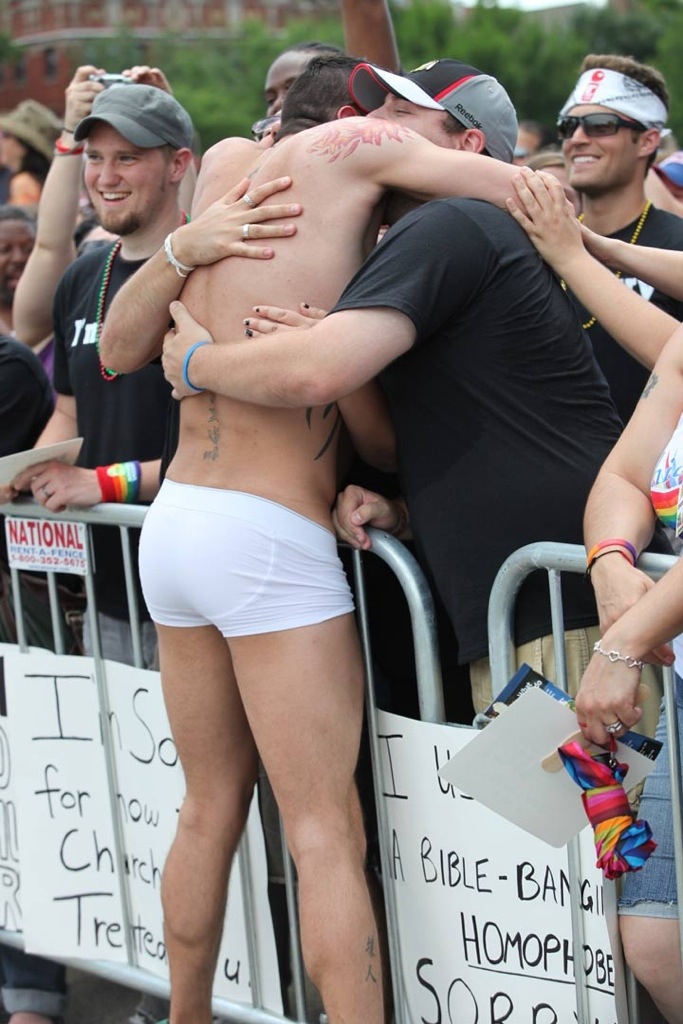
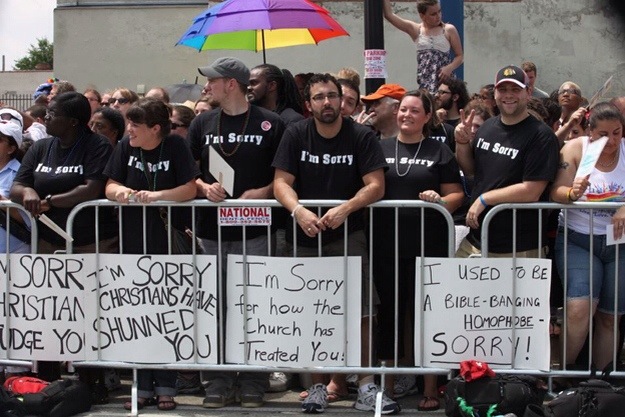
The picture at the top of this post is the reaction to this group of Chicago Christians who showed up at a gay pride parade to apologize for homophobia in the Church.

20140629-012806-5286005.jpg


Two Anniversaries: 45 Years Ago and 100 Years Ago

20140628-220150-79310276.jpg

Forty-five years ago today, in a small tavern in New York City, history was made. The Stonewall Riots not only sparked a movement, but changed history and, eventually, helped millions of people embrace their true identity.
In 2014, marriage equality is sweeping the nation, gay men and women can proudly and openly serve their country and we are leading the charge.

There was a time when LGBT people were forced to hide in the shadows, their way of life criminalized – marriage wasn’t even a consideration. Police would raid gay bars (if they weren’t getting paid off by the owners) and arrest people on the spot if they didn’t have identification, or if they were in drag.

But in 1969, came the biggest moment in the history of the LGBT Civil Rights Movement: the Stonewall Riots in New York City.

On Saturday, June 28, police raided the Stonewall Inn in New York City’s Greenwich Village. This was routine at the time, but this raid would be like no other before. As police they were lining bar-goers up for inspection, all hell broke loose.

“When they came in the door, they were pushing and shoving people,” said Tree, a bartender at the Stonewall Inn who was there when the riots happened. “They actually pushed this guy with a mustache — who turned out to be a lesbian with a mustache — and it took two cops to pull her off the cops.

“[Storme DeLarverie, who recently died at 94] was arrested with a few other people, he continued. “When the cops came in, my friends Fred, Charlie and I kicked the plywood wall out this door. There were like 30 of us out here. Within a few hours, it was 3, 4, 500 people. The cops were afraid to leave the building.”

“We broke the window, broke the wall behind the window, we pulled a parking meter out of the ground and used it as a battering ram to knock the doors in,” he said, pointing at the Stonewall’s now open doors, which wafted a bit of air conditioning and bar smell out on Christopher Street. “But when you start a bar on fire — with the police in it — that’s when the riot squad did come. Because we lit the garbage cans on fire and threw them through the windows.”

The riots became national news the next day, and what was just one night of chaos turned into an organized movement with LGBT groups popping up around the city, and soon, around the country.

“To me, Stonewall is an act from people who were tired of being pushed into the shadows of society, taking a stand for their human dignity,” said Susanna Aaron, a volunteer working for Stonewall’s 45th anniversary. “There was a moment of fury which was these riots at this bar but this community turned it into a real political movement with very clear goals.”

Today, when states are reexamining their gay marriage bans (Indiana just overturned theirs on Wednesday), the Stonewall Riots’ significance in the fight toward equality is recognized even more strongly.

20140628-220235-79355582.jpg

Now, after 45 years, 19 states out of the 50 have legal gay marriage — not even half of the U.S. Will it take another 45 years to unify the country? Some think it’ll be five, but for others the completion of gay marriage is not about time, but a question of being vigilant.

For LGBT Americans, the Stonewall Riots began our march toward equality, but 100 years ago today, the world changed. It’s innocence was lost, never to return.

20140628-220302-79382509.jpg

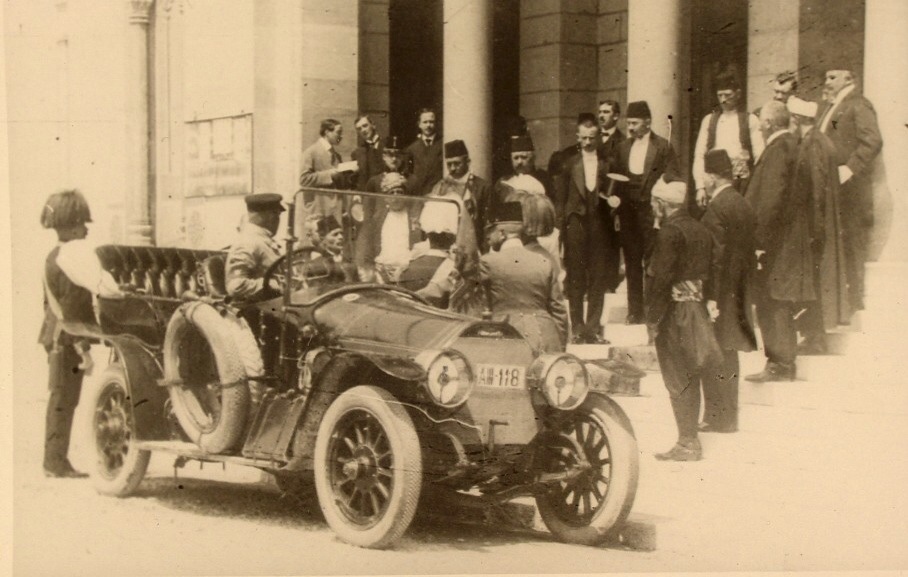
One hundred years ago today in Sarajevo, a Serb nationalist shot to death at point-blank range Archduke Franz Ferdinand, the heir to the throne of the Austro-Hungarian Empire, and his wife Sophie. Their deaths triggered the chain of events that led a month later to the start of World War I — the Great War, a horrifying, bloody four-year conflict that killed some 14 million people, collapsed empires and redrew large parts of the world’s map.

The most fascinating thing to me is that it almost didn’t happen. The main attempt on the archduke’s life had been botched. It wasn’t until a wrong turn on the way to visit the hospital and those injured in the first botched attempt that Gavrilo Princip, the archduke’s killer, walked out of a deli to find the archduke’s retinue stopped in front of the store. He had believed the plan had failed, but took the opportunity to shoot the archduke and his wife. Had the archduke’s car not made a wrong turn, had Princip been delayed in e deli a few more minutes, or had the archduke not been sewn into his uniform (apparently he’d gained a little weight and the sewed on uniform had kept doctors from being able to save him)…the world could have been a vastly different place today.

In Sarajevo, the assassination is being marked with commemorations, concerts and exhibitions. The fault lines of a century ago remain all too real, with the country’s ethnically divided politics still a cauldron of animosities. “Sarajevo is now a symbol of a century of wars in Europe but we are here to talk about peace and reconciliation,” said Joseph Zimet, the head of the organization planning the commemoration.

On the eve of the centennial, Bosnian Serbs unveiled a statue to Princip who is considered a Serbian hero and freedom-fighter. A century after the assassination, the rest of the world would likely consider him — and the underground, radical nationalist network he was operating within — a state-sponsored terrorist. The Austrians back then certainly did, and looked at Belgrade, capital of the young nation of Serbia, as the source of the conspiracy.

What happened next, as Winston Churchill put it, was a “drama never surpassed.” Ferdinand’s death presented leading statesmen in Europe’s great powers both a crisis and an opportunity and led to a dizzying series of diplomatic maneuvers, secret negotiations and political escalations that underlay the explosive opening of World War I. A web of alliances between Europe’s competing empires — a “concert” — led to Russia coming in on the side of the Serbs, Germany countering Russia, and Britain, France and the waning Ottoman Empire also entering the fray.

Sean McMeekin, a professor at Koc University in Istanbul, chronicles the weeks that followed Ferdinand’s murder in “July 1914,” a riveting account published this year of how the war started. McMeekin and a whole tradition of World War I historians argue that even after Ferdinand’s assassination, war was not a fait accompli. Indeed, in Europe and across the pond in the United States, many learning of the archduke’s death were less concerned with the drumbeats of war than the question of Austrian succession.

As we mark the war’s centennial, there will be time yet to explore its legacy and effects. What McMeekin and other historians emphasize, though, was that the war was the creation of a coterie of political elites, each fueled by their own lust for greater power.

No one was guiltless in the build-up. This year, in Britain, there’s already been an animated debate about how to remember World War I. Conservative Education Secretary Michael Gove lambasted “leftist” historians and commentators who cast it as a “misbegotten shambles,” a series of catastrophic mistakes by mustachioed monarchs and cabinet ministers. Instead, Gove argued it was a “just war” against the “ruthless Social Darwinism” of the Germans.

This is a view not shared by many. Germany was punished most in the war’s aftermath, with its Kaiser Wilhelm II — an ambitious expansionist — made out to be the chief villain. But they were hardly alone in their imperial delusions, with the French, the British and most importantly the Russians — whose Czarist leadership still harbored plans to conquer Istanbul, that ancient Rome of the east — all guilty of fanning the flames.

But it’s curious to imagine what would have happened had the archduke survived the assassination. A relative liberal, he had “an almost religious aversion to the idea of war with Serbia,” writes McMeekin, no matter his contempt for the Serbs.

But there were always larger forces in play. An imperialistic arms race in Europe had been building up in the years before. Ethnic nationalism in the margins of fraying empires asked difficult questions of the delicate “concert” of power that was in place on the continent. A reckoning, many argue, was inevitable.

In my opinion the assassination of Franz Ferdinand marks the beginning of the Modern World. We are still dealing with the repercussions of the fall of the Austo-Hungarian and Ottoman Empires. The old imperialistic empires that remained would linger through World War II and be nearly completely gone by the time of the Stonewall Riots in 1969, but we must still deal with the problems of countries that were raped of resources by European (and American) imperialists. The fallout of World War I and the subsequent Paris Peace Conference, particularly the Treaty of Verailles, has had a long lasting effect on the world, and nearly every problem in the world today can be traced back to the events set off by the assassination of Franz Ferdinand.


Finally…

20140618-004058-2458883.jpg

While many states are battling over same-sex marriage, Alabama has only just ruled that prohibiting homosexual sex is unconstitutional. Civil rights organizations in Alabama are cheering a state appeals court ruling that declared part of a state sexual misconduct law as unconstitutional.

Under the statute, consensual oral and anal sex was banned in what the court determined was an act aimed at criminalizing homosexual activities. Furthermore, the statute has been traditionally interpreted to criminalize all sexual practices other than the missionary position between one man and one woman. The portion of the law cited in the Alabama Court of Criminal Appeals ruling includes: “Consent is no defense to a prosecution under this subdivision.” The sixteen page ruling by the Court of Criminal Appeals can be read in it’s entirety by following this link. (It’s well worth reading, and I found it quite interesting. Plus I’d love to know silvereagle’s opinion on this case and the ruling.)

The ruling was unanimous in the case of Dewayne Williams vs. State of Alabama. Williams, a Dallas County, Ala., man, who, although was not convicted in 2010 of first-degree sodomy, was convicted of the “lesser-included offense” of sexual misconduct, according to the ruling. Williams acknowledged he had taken part in the sodomy but argued it was consensual, the ruling states.

Alabama is one of a dozen states that still have laws prohibiting consensual homosexual sex, according to a survey by the Human Rights Campaign, a national group advocating for lesbian, gay, bisexual and transgender rights.

Susan Watson, executive director of the American Civil Liberties Union of Alabama, applauded the ruling. “Aiming to ban consensual sex is flat out wrong,” she said Saturday. “A person’s sexual orientation shouldn’t matter. Consensual sex is consensual sex.”

Ben Cooper, chairman for Equality Alabama, also lauded the ruling and added the law was “settled years ago” under Lawrence v. Texas, a case the Alabama court referenced in its decision. In the 2003 case, the crime for two persons of the same sex to engage in certain intimate sexual conduct was determined to violate the due process clause of the 14th Amendment.

“Each and every person, no matter their sexual orientation or gender identity, is entitled to equal protection under the law,” Cooper said in a statement. “The Alabama court’s unanimous decision overturning the statute is a step in the right direction and makes us optimistic for future and ongoing equal rights through the continued elimination of unconstitutional provisions in our state’s constitution that violate privacy and equal protections.”

Michael Jackson, the prosecutor in the Williams case, said Monday that he understood why the appeals court ruled the way it did, and said the decision would probably be upheld if appealed to the Alabama Supreme Court. But he said the victim is not getting a fair result because the sex in the case he was prosecuting wasn’t consensual.

“He got attacked by another man and he had sex he didn’t want to have,” said Jackson. He said Alabama’s sodomy law still applies in cases of forced sex. For the record, Jackson has no business prosecuting sexual misconduct. As District Attorney for Fourth Judicial Circuit of Alabama, Jackson has often hired female prosecutors based on their ample breasts and how often they will go to bed with him. Jackson himself should be tried for sexual misconduct and sexual harassment. He is a further disgrace to the already disgraceful Alabama judicial system.

The state of Alabama also was denied its request to remove the language on consent from the law and remand Williams’ case for a new trial. The Alabama appeals court explained in its ruling that a remand of the case would violate the double jeopardy clauses of the Fifth Amendment to the U.S. Constitution and the Alabama Constitution and that by amending the statute the Court would be creating and ex post facto law that would further violate the U.S. Constitution.

The question does remain as to whether the sex between the two men, Williams and the unnamed clerk at the Jamison Inn Hotel, was consensual as Williams claims in his defense. However, because the prosecution knew they could not convict Williams of first degree sodomy, which had been struck down by Lawrence v. Texas, they chose an obscure section of the clause which made the question of consent moot. The clause used stated that “Consent is no defense to a prosecution under this subdivision.” Therefore the prosecution cannot have the trial remanded because Williams would be tried twice for a crime in which he has already been convicted.

There are two things that really surprise me about this whole case. First, that Jackson attempted to prosecute Williams in the first place for sodomy, when if he is going to claim that no consent was given, then he should have charged Jackson with rape and assault. Instead, he charged him with sodomy and sexual misconduct. For me this proves, not only Jackson’s incompetence as a prosecutor, but also that there was insufficient evidence that the sex between Williams and the hotel clerk was not consensual.

Second, the other, and actually most surprising thing, considering that Roy Moore is the head of the Alabama Judicial System, is that the all Republican Alabama Court of Criminal Appeals actual made a ruling that made sense and followed the law. Moore’s philosophy of justice is that whatever laws he deems appropriate in his head are the only ones that need to be followed, so for a lower court under his authority to make a ruling that actually follows the law is astounding. Maybe there is hope for Alabama’s Republican controlled judicial system after all.


Building a Better Tomorrow: Project One America

20140613-013504-5704849.jpg

The Human Rights Campaign, or HRC, was in Montgomery, Alabama, last night to discuss the launch of a new gay rights campaign targeting three Southern states: Arkansas, Mississippi, and Alabama. The Project One America, as it’s called, is a three year, $8.5 million dollar effort to secure marriage rights and other protections, such as employment non-discrimination against LGBT people, at the state and local level. I attended the meeting, but my post today is not going to be to talk about all that was discussed there. We were asked not to blog or tweet about issues and personal stories shared at the meeting, so that the meeting could be an open and inviting place to talk. I was a bit disappointed because that is what I had planned my blog topic to be today, so instead I am going to discuss the new HRC program, Project One America, which was behind the meeting last night.

The President of the HRC, Chad Griffin grew up in Arkansas and much of his family is still there. With a Southerner at the helm, the HRC has finally decided to pay attention to the South, which it has largely ignored during much of its existence, except for a source of campaign contributions. When asked if him being a southerner had anything to do with why HRC is launching a campaign in the South, Griffin replied:

No, it doesn’t, but I can certainly tell you that it informed this work. There is no question that my experience growing up as a kid of the South, deeply closeted, growing up Southern Baptist, going to church Sunday mornings, Sunday nights, and usually Wednesday nights too certainly informs my experiences and how I approach this work.

But the reason we are going to these three states specifically is there are a few things that are unique about these states. Number one, these three states are – unlike other states across the country, including the South – three states that have no fully-resourced statewide LGBT groups. So, no full time paid staff that are working day in and day out on behalf of equality.

The second, and really important and unique difference about these three states is that they’re the only three states where there’s no statewide non-discrimination protection, there’s not even a single city or municipality that has workplace non-discrimination, or public accommodation, or housing non-discrimination ordinances or laws.

So, those two things make these three states uniquely situated and, quite frankly, these three states need this work and need this investment. They have been dramatically underresourced, and we intend to change that.

Unlike other states in the South — including Texas, Georgia, Kentucky and North Carolina — these three states lack fully resourced and staffed LGBT statewide equality campaigns. According to a report by Funders for LGBTQ Issues, in 2011-2012, grant funding for LGBT advocacy totaled $10.10 for per LGBT adult in the Northeast. That number was only $1.71 per LGBT adult in the South. In these three states, the numbers are $0.71 per LGBT adult in Mississippi, $0.35 per LGBT adult in Arkansas, and $0.31 per LGBT adult in Alabama.

The HRC has nine launch goals for Alabama:

1. Empower LGBT people (and straight allies) to come out.
2. Raise the visibility of LGBT people and issues with the general public.
3. Create safer environments for LGBT young people.
4. Build partnerships with faith communities, communities of color, business communities, and conservatives.
5. Create a more inclusive workplace for LGBT people
6. Build support for enduring legal protections that ensure LGBT equality.
7. Expand participation in HRC’s Municipal Equality Index in these three states.
8. Create a more inclusive healthcare environment for LGBT people
9. Equip LGBT people and non-traditional allies as spokespeople.

For the HRC to be successful they will have to number one, and first and foremost, change the hearts and minds of Alabamians. They can change hearts and minds by building bridges and by having a conversation with business leaders, with faith and religious leaders, with community leaders, and also with elected officials at the community level and at the state level. The HRC plans to accomplish this by having organizers: community organizers, organizers in the business community, organizers in the faith and religious community. Ultimately, our goal will be to bring about the much needed protections at the local, as well as ultimately at the state level.

A greater presence in the South is something Griffin has talked about since He became HRC President. The Human Rights Campaign is also the single largest organizer in the South. One-third of our members are from the South – which is a surprising number to me. That’s over 500,000 HRC members who are from the South, including over 60,000 just in these three states alone.

So after the Supreme Court made that historic decision just a year ago, it became quite clear that we have two Americas when it comes to equality. We have the ‘haves,’ largely situated along the coast with a couple of bright spots in the middle, and then we have the ‘have-nots’ when it comes to legal equality, and that’s places like Arkansas, Mississippi, and Alabama. So, Project One America is designed to specifically close that gap.

Chad Griffin says that he is absolutely optimistic that the South is, in fact, ready for equality. But he said he wanted to underscore that this is hard work. It will be a lot of work, and it won’t be easy. The South is not going to become a place for LGBT equality overnight, but with the right education, involvement, and momentum, it will happen.