Let not your hearts be troubled. Trust in God; trust also in me.
—John 14:1
Few words in the Bible are better known or more often quoted than these, but for all their timelessness, they were addressed to a very specific situation, the death of Jesus on the cross, and with that, the resurrection of Jesus is implied.
The “Last Supper” is described in John 13:1–17:26. John 14:1 is part of the sermon Jesus gave to his disciple at his last meal with them. Jesus had filled his disciples with foreboding though his demeanor and language during this sermon. He was going to leave them, and that itself was devastating to the disciples. But the disciples would also have to cope with the manner of his departure. They would see him betrayed by one of their own, arrested, and condemned to a death that would not only take him away from them, but would discredit his name and message burying all their hopes with him.
John 14:1 is Jesus’s way of helping his disciples cope with what is to come. It is the trouble in their minds that troubles him, and he addresses it not only with soothing words, but with powerful arguments — arguments they must remember when they see him hanging on the cross, and which we, too, must remember when God leads us where we cannot cope and cannot understand.
The disciples are told they have to trust God even when they cannot see His reasons; and we can be sure that the arguments Jesus presented to the disciples were the very arguments he presented to himself. He, too, “the man, Christ Jesus,” had to trust God, laying down his life (to all human appearance an unfinished life), risking all on the “sure and certain hope of the resurrection.” I think that at times we all present arguments to others to convince ourselves of what we are saying.
Jesus told the grieving Martha in John 11:25–26, “I am the resurrection and the life. Whoever believes in me, though he die, yet shall he live, and everyone who lives and believes in me shall never die. Do you believe this?” Surely, if that were true of those who believed in him, it must first of all be true of himself? Death could not hold the life of the world as He says in John 14:19, “Yet a little while and the world will see me no more, but you will see me. Because I live, you also will live.”
With the message Jesus gives his disciples, we can also take this to heart. The photograph above is from BosGuy’s Thursday “Vintage Gay” post. It is doubtful we will ever know why one of the men wrote on the heart-shaped photograph, “Let not your hearts be troubled,” but I think we can all probably guess. My suspicion is that they were being separated, similar to how Jesus was going to be separated from his disciples after the Last Supper. What is left unspoken is the rest of that verse: trust also in me. Whoever wrote the note seems to be saying, “We will get through this. We may be separated but trust me that we will survive this separation.” We don’t know what the two men were going through, but we can know that Jesus has told us, “Let not your hearts be troubled. Trust in God; trust also in me.”
I am acting with great boldness toward you; I have great pride in you; I am filled with comfort. In all our affliction, I am overflowing with joy.
-2 Corinthians 7:4
For those of us who were raised in a strict Christian environment, we had to learn not to hate ourselves and to accept who we are and our sexuality. Some Christians are opposed to the concept of LGBTQ+ pride. They feel LGBTQ+ people should be ashamed of who we are, and any public celebration of LGBTQ+ sexuality is wrong. Those who reject us are those who are straying from the teachings of Jesus. I still believe in the teachings of Christ and believe that God created me just the way I am. I learned to accept myself and be proud of who I am. I am proud to be both gay and Christian.
Christians who know church history can identify with persecution. During the early years of the Christian church, Christians were put in prison and killed for their faith. The civil authorities in the Roman Empire were persecuting people for being Christian. Both Christianity and the LGBTQ+ community share a history of discrimination and persecution. Unfortunately, discrimination and persecution of LGBTQ+ people continue today, largely led by people claiming to be Christian. Some Christians do not understand how much they have in common with the LGBTQ+ community. Instead of working closely together to ensure their mutual human rights are respected, many Christians actively work to keep LGBTQ+ people from having the same rights other members of society enjoy.
The LGBTQ+ community celebrates Pride Month each year in the month of June to honor the 1969 Stonewall Riots in Manhattan. The Stonewall Riots were a tipping point for the Gay Liberation Movement in the United States. In the United States the last Sunday in June was initially celebrated as “Gay Pride Day,” but the actual day was flexible. In major cities across the nation the “day” soon grew to encompass a month-long series of events. Today, celebrations include pride parades, picnics, parties, workshops, symposia and concerts, and Pride Month events attract millions of participants around the world. Memorials are held during this month for those members of the community who have been lost to hate crimes or HIV/AIDS. The purpose of the commemorative month is to recognize the impact that LGBTQ+ individuals have had on history locally, nationally, and internationally.
LGBTQ+ pride promotes the self-affirmation, dignity, equality, and increased visibility of LGBTQ+ people. Pride, as opposed to shame and social stigma, is the predominant outlook that bolsters most LGBTQ+ rights movements. Ranging from solemn to carnivalesque, pride events are typically held during the month of June. Some pride events include LGBT pride parades and marches, rallies, commemorations, community days, dance parties, and festivals. Pride may be considered one of the seven deadly sins, but there is nothing wrong with LGBTQ+ people having self-affirmation, dignity, equality, and increased visibility. In fact, God expects us to have pride, a pride that is justifiable and reasonable, because it is based on what God has done for humanity.
God chose humanity before the world was created. Ephesians 1:4, we are told, “Even as he chose us in him before the foundation of the world, that we should be holy and blameless before him.” God did not wait to see how things would go before choosing humanity. According to Ephesians we were chosen before the world was around, before we had a chance to do anything that would make God favor us. We did not have to act loving, do impressive humanitarian work, wear designer clothes, or make love to the right person to earn God’s love. God’s love for us is not a new, fickle love. His love for all of us, no matter our sexuality, is as old as time. God loved us, just the way we are. We can take pride in the fact that God sought us out and chose us before the world was created. In 2 Corinthians 7:4, we are told that God as “great pride” in us.
Isaiah Chapter 44 says God formed us in the womb. It does not say, “God created heterosexual people in the womb,” but it says that God, “formed you from the womb and will help you.” (Isaiah 44:2) We are not an accident in God’s eyes. We are not defective like some Christians would have us believe. God formed us in the womb and made us who we are. Galatians 1:15 states the Paul was chosen before he was born, “But when he who had set me apart before I was born, and who called me by his grace.”. Just like Paul, we were chosen to be an LGBTQ+ Christian (if that’s how you identify) before we were born. We can have pride, because God chose us and picked us to be on children.
Genesis tells humans, again, no matter their sexuality, were created in God’s image. Anything made in the image of God is valuable. We can have pride because we are a valuable masterpiece. God did not make a mistake when he created us with the varying sexualities that exist in this world. Romans 5:8-9 says, “But God shows his love for us in that while we were still sinners, Christ died for us. Since, therefore, we have now been justified by his blood, much more shall we be saved by him from the wrath of God.” In Greek, the word justify carries the meaning to vindicate, approve, and honor. LGBTQ+ Christians are vindicated, approved, and honored by God, no matter our sexuality, because of Christ’s death on the cross. And nobody, gay or straight, has the right or the authority to put down or condemn people God has vindicated, approved, and honored.
LGBTQ+ Christians have the same reasons to have pride as straight Christians. Gay and straight Christians are equally called before the world was created, are equally formed in the womb by God and are equally redeemed by God. LGBTQ+ Christians can and should have pride in who they are by creation, by birth, and in Christ. To advocate that LGBTQ+ Christians should not have pride is to advocate that LGBTQ+ people feel and express no gratitude to God. When LGBTQ+ Christians are denied LGBTQ+ pride, they are asked to deny their Creator’s role in their creation and birth. It denies Christ’s role in our salvation.
Some LGBTQ+ people find pride to be one time of the year when they do not feel alone, isolated, cut-off, rejected, hated, and despised. Pride helps LGBTQ+ people feel they are not a tiny, powerless minority group. Through pride, many LGBTQ+ people find a sense of belonging, a sense of being worthwhile. Society has long taught LGBTQ+ people to hate themselves. By celebrating pride, the LGBTQ+ community can start the long process of overcoming self-hate. Standing side-by-side with God, LGBTQ+ Christians are accepted, loved, connected, and made powerful by God.
LGBTQ+ Christians can find meaning in pride. God wants LGBTQ+ people to stop hating and fearing themselves, because those who live secret lives of pain are not able to fully celebrate their identity in Christ. Through LGBTQ+ pride, God calls LGBTQ+ Christians to live as though the world waits for them, waits for them to passionately praise God, to love as faithfully as God loves and to celebrate life, as they walk hand-in-hand with Christ into eternity.
Anxiety in the heart of man causes depression, but a good word makes it glad.
—Proverbs 12:25
In John 16:33, Jesus said, “These things I have spoken to you, that in Me you may have peace. In the world, you will have tribulation; but be of good cheer, I have overcome the world.” This should be the way to a peaceful and tranquil heart, but the fact is, we can sometimes lose sight of what’s essential, and our feelings will betray some of our fears. Friedrich Nietzsche said, “When we are tired, we are attacked by ideas we conquered long ago.” Often when we lay in bed at night, anxiety creeps up on us. It is when we are most tired that we are most susceptible to worry. This happens when worry and doubt take up a place somewhere in our minds, and these feelings won’t stop nagging us about the possible negative outcome that rolls around in our minds.
Try as we might to forget it, sometimes we cannot control it. Our inner demons of self-doubt work on this level. Doubt whispers in our ears to keep us focused on the possibility of disaster that awaits if things go as bad as they could. This is the “anxiety in the heart.” It colors every other thought and action until we can get rid of it by solving the problem or trusting God with the outcome. Sometimes, we cannot control the outcome. As much as we want to control everything, some things are just out of our control. That’s when we must trust that God will get us through.
Think about being in the closet. Much of the time we are in the closet, the anxiety is tied to feelings of self-doubt, insecurity, and even shame because of who we are. All of us in the LGBTQ+ community have a period when we are trying to understand our sexuality. It is during this time when a “kind word” is the thing that can cheer up our hearts. “I accept you” or “It’ll be ok” is an excellent place for someone to start. The kindest words to cheer up an anxious person can be found in Philippians 4:6, “Be anxious for nothing, but in everything by prayer and supplication, with thanksgiving, let your requests be made known to God.”
When I was trying to come to terms with my sexuality, I prayed a lot. I meditated, and I asked God for a sign. I did not get one immediately. Even when I came out, I still had doubts about my sexuality and my relationship with God. However, I studied the Bible, and I studied the passages that so many Christians claim are about homosexuality. I examined the words that modern translations of the Bible translate to homosexuality. I found that what we understand today about sexuality was foreign to the writers of the Bible.
The Word of God became my source of peace. The passages used to condemn LGBTQ+ sexualities gave me the most comfort because I fervently believe that God led me to study those passages. It was His sign to me that He loved me and that true love can never be wrong. I learned that prayer is the best way to deal with a problem. If you are anxious, consider this a kind word to you. If you know someone who is anxious, who is struggling to come out, be a source of encouragement to them, and you will be doing good in the name of Jesus.
Let love be without hypocrisy. Abhor what is evil. Cling to what is good. Be kindly affectionate to one another with brotherly love, in honor giving preference to one another; not lagging in diligence, fervent in spirit, serving the Lord; rejoicing in hope, patient in tribulation, continuing steadfastly in prayer; distributing to the needs of the saints, given to hospitality.
Bless those who persecute you; bless and do not curse. Rejoice with those who rejoice, and weep with those who weep. Be of the same mind toward one another. Do not set your mind on high things, but associate with the humble. Do not be wise in your own opinion.
Repay no one evil for evil. Have regard for good things in the sight of all men. If it is possible, as much as depends on you, live peaceably with all men. Beloved, do not avenge yourselves, but rather give place to wrath; for it is written, “Vengeance is Mine, I will repay,” says the Lord. Therefore
“If your enemy is hungry, feed him; If he is thirsty, give him a drink; For in so doing you will heap coals of fire on his head.”
Do not be overcome by evil, but overcome evil with good.
—Romans 12:9-21
This is the fourth and final part of my continuing series about the message contained within Romans 12:9–21, often labeled “Behave Like a Christian.” Last week, we looked at how we must love even in adversity and how we should remain humble and show humility. This week we will look at the final verses of this passage (Romans 12:17-21; the underlined verses above). This final section tells us how we must not sink to evil’s level by being a vigilante for God and taking revenge upon those who caused us harm. Instead, we must overcome evil by doing good to those who harm us.
In Romans 12:17, Paul wrote that Christians must not repay evil for evil. He expands on that idea to clarify what he is saying. Those who follow Christ are commanded never to seek vengeance themselves, to never “get even.” Whether the hurt comes from fellow believers or unbelievers, revenge is simply not an option for us. Paul gives us a reason for this command. After instructing us to sacrifice ourselves for the good of others, we might expect something similar. Instead, Paul writes that we should refuse to take revenge because God is the ultimate judge in the universe.
Paul quotes from Deuteronomy 32:35, “Vengeance is Mine.” The whole verse says, “Vengeance is Mine, and recompense; their foot shall slip in due time; for the day of their calamity is at hand, and the things to come hasten upon them.” A desire for justice for ourselves and those we care about is not entirely wrong. Paul simply wants us to trust God’s timing and power to deliver justice as He sees fit.
In Hinduism and Buddhism, this is called karma, which is the sum of a person’s actions in this and previous states of existence, viewed as deciding their fate in future existences. Karma means action, work, or deed. The term also refers to the spiritual principle of cause and effect, often descriptively called the principle of karma, wherein intent and actions of an individual (cause) influence the future of that individual (effect): good intent and good deeds contribute to good karma and happier rebirths, while bad intent and bad deeds contribute to bad karma and bad rebirths. Some might question my example of Hinduism and Buddhism to explain something in Christianity, but I believe in spirituality as well as Christianity. Brené Brown, a research professor at the University of Houston who has spent the past two decades studying courage, vulnerability, shame, and empathy, wrote in her book The Gifts of Imperfection: Let Go of Who You Think You’re Supposed to Be and Embrace Who You Are: “Spirituality is recognizing and celebrating that we are all inextricably connected to each other by a power greater than all of us, and that our connection to that power and to one another is grounded in love and compassion. Practicing spirituality brings a sense of perspective, meaning and purpose to our lives.”
Even in Christianity, there is a rebirth. Jesus says in Matthew 12:36-37, “But I say to you that for every idle word men may speak, they will give account of it in the day of judgment. For by your words you will be justified, and by your words you will be condemned.” In Romans 14:10, Paul tells us, “But why do you judge your brother? Or why do you show contempt for your brother? For we shall all stand before the judgment seat of Christ.” On the Day of Judgement, we will all be judged on how we treated others in this life. In Matthew 25:31-36, Jesus says:
“When the Son of Man comes in His glory, and all the holy angels with Him, then He will sit on the throne of His glory. All the nations will be gathered before Him, and He will separate them one from another, as a shepherd divides his sheep from the goats. And He will set the sheep on His right hand, but the goats on the left. Then the King will say to those on His right hand, ‘Come, you blessed of My Father, inherit the kingdom prepared for you from the foundation of the world: for I was hungry and you gave Me food; I was thirsty and you gave Me drink; I was a stranger and you took Me in; I was naked and you clothed Me; I was sick and you visited Me; I was in prison and you came to Me.’
For those who have mistreated their fellow man, Jesus tells them their fate in Matthew 25: 41-46:
“Then He will also say to those on the left hand, ‘Depart from Me, you cursed, into the everlasting fire prepared for the devil and his angels: for I was hungry and you gave Me no food; I was thirsty and you gave Me no drink; I was a stranger and you did not take Me in, naked and you did not clothe Me, sick and in prison and you did not visit Me.’
“Then they also will answer Him, saying, ‘Lord, when did we see You hungry or thirsty or a stranger or naked or sick or in prison, and did not minister to You?’ Then He will answer them, saying, ‘Assuredly, I say to you, inasmuch as you did not do it to one of the least of these, you did not do it to Me.’ And these will go away into everlasting punishment, but the righteous into eternal life.”
If we live with good intent and good deeds, then on the Day of Judgement, we will be told, “Well done, good and faithful servant; you were faithful over a few things, I will make you ruler over many things. Enter into the joy of your lord.” (Matthew 25:21) However, if we live a life of evil intent and evil deeds, God will tell us, “I never knew you; depart from Me, you who practice lawlessness!” (Matthew 7:23)
It’s not always easy to behave like a Christian at all times. Matthew 7:13-14 tells us, “Enter by the narrow gate; for wide is the gate and broad is the way that leads to destruction, and there are many who go in by it. Because narrow is the gate and difficult is the way which leads to life, and there are few who find it.” I believe though it is our intent that is most important. Some may claim their intent is with good intentions, but if they do not show God’s love in their intent, they are using God’s name under false pretenses. We must feel it in our hearts, minds, and souls and let our intent shine to others. Matthew 5:14 tells us, we “are the light of the world. A city that is set on a hill cannot be hidden.” Matthew 5:16 tells us to “Let your light so shine before men, that they may see your good works and glorify your Father in heaven.”
Let love be without hypocrisy. Abhor what is evil. Cling to what is good. Be kindly affectionate to one another with brotherly love, in honor giving preference to one another; not lagging in diligence, fervent in spirit, serving the Lord; rejoicing in hope, patient in tribulation, continuing steadfastly in prayer; distributing to the needs of the saints, given to hospitality.
Bless those who persecute you; bless and do not curse. Rejoice with those who rejoice, and weep with those who weep. Be of the same mind toward one another. Do not set your mind on high things, but associate with the humble. Do not be wise in your own opinion.
Repay no one evil for evil. Have regard for good things in the sight of all men. If it is possible, as much as depends on you, live peaceably with all men. Beloved, do not avenge yourselves, but rather give place to wrath; for it is written, “Vengeance is Mine, I will repay,” says the Lord. Therefore
“If your enemy is hungry, feed him; If he is thirsty, give him a drink; For in so doing you will heap coals of fire on his head.”
Do not be overcome by evil, but overcome evil with good.
—Romans 12:9-21
This is the third part of my continuing series about the message contained within Romans 12:9–21, often labeled “Behave Like a Christian.” Last week, we looked at brotherly love and unconditional love. This week we will look at how we must love even in adversity and how we should remain humble and show humility.
Many of us have been ostracized or suffered discrimination because we are LGBTQ+, especially by people who claim to be Christian. For many of us, family members have been mean, cruel, nasty, or just plain unpleasant to us because of our sexuality. For those of us who are LGBTQ+ and Christian, other Christians and even some in our own community, especially non-religious LGBTQ+, have ridiculed us because we believe in God and/or believe that homosexuality is not a sin. With the increase in religious bullies in America, we are facing increased persecution and challenging times. Even as things seem to be slowly getting better as courts and laws affirm our equality, there comes a backlash caused by ignorance, fear, hatred, and greed by those who believe that they are losing something when we are recognized as equal. It is the same with all civil rights movements for equality. The only way to deal with this backlash is to counter it with an all-loving and accepting Christianity, living by Christ’s example, and responding to persecution in a way that pleases God.
Romans 12:14-16 (the underlined verses above) is not about us. If we believe in Jesus, these verses are for us, but they are not about us. They are about others and how we should think about and act toward those who persecute us. Romans 12:2 says, “And do not be conformed to this world, but be transformed by the renewing of your mind, that you may prove what isthat good and acceptable and perfect will of God.” Paul begins the above passage by telling us, “Bless those who persecute you; bless and do not curse.” While some biblical scholars claim that “those who persecute you” refers to people who don’t believe in Jesus, in my mind, it also refers to those who believe but do not follow the teachings of Jesus because they use perversions of Christ’s teachings to persecute and oppress those who do not believe in their narrow and hate-filled interpretation of the Bible. These Christian bullies lack the ability to love unconditionally which is central to Paul’s teaching to the Romans about how to behave like a Christian.
How should we respond to people who use their hypocrisy and hate to persecute those who do not follow their narrow interpretations of the teachings of Jesus? For some, they leave religion behind, and for others, it is to respond with love and acceptance, which is what Paul is telling us to do when he says, “Bless and do not curse.” Back when I lived in Mississippi, the people of Westboro Baptist Church, with their hateful signs and harassing nature, came to my university’s campus to stage a protest. I always felt that instead of antagonizing them and ridiculing them for their beliefs (which is pure hate and has no resemblance to Christianity), I thought it would have been better to hold a public prayer for them and ask God to show them the error of their ways. With people like that, you cannot show them the same hate and anger, but you must show them compassion and the love of God.
Years ago, I was in Memphis on Beale Street with a friend of mine. A street preacher was harassing people and trying to “call them to God.” He began yelling at us and trying to get our attention as we passed. She asked if they had heard of the Church of Christ. (She was raised Southern Baptist, but she knew I was well versed in the Church of Christ.) He then began to tell us what was wrong with the beliefs of the Church of Christ. I disputed everything he said and eventually asked to see his Bible, and I proceeded to prove my points verse by verse. The man kept arguing. Finally, I told him, “What you need to do is go forth and repent for your sins and be baptized for the remission of your sins.” I wanted him to preach love instead of condemnation. This was not one of my humblest moments, and I admit that I had been drinking quite a bit when this happened. However, I still had a clear mind with just a bit more courage. We continued to our destination, the Hard Rock Café, had a drink there in honor of a friend and then left for the next bar. When we left the Hard Rock Café, there was no sign that the street preacher had ever been there. He had packed up and left. I know that I was more rigid in my faith and more zealous when this happened than I am now. Hubris led me to debate him in the middle of a busy street (it is a pedestrian area). It is not one of my finer moments, but I believe that if we remain calm and do not stoop to our persecutors’ level, we can show God’s love and compassion more effectively, and I did remain calm that night. We must have a gracious disposition that will lead us to ask God to do good to those who refuse to do good toward us.
Paul continues in Romans 12:15 to tell us to “Rejoice with those who rejoice, and weep with those who weep.” How are we supposed to respond to others when they find themselves in either of these categories? We are called to go there with them. Romans 12:5 tell us, “So we, being many, are one body in Christ, and individually members of one another.” We should feel what others feel. For instance, consider our physical bodies. When our ears hear a beautiful and meaningful piece of music, our minds perceive its goodness, our hearts may fill up, our eyes may tear up, our throats may choke up, and often our legs stand up, and our hands come together in applause. One part of the physical body is affected by what is happening to the other parts. In much the same way, one member of the body of Christ cries with another member over a tragedy. And one member rejoices with another member, even when we don’t always feel like celebrating. We must show empathy for all around us.Next, Paul calls us to move away from hierarchy to humility. Romans 12:16 says, “Be of the same mind toward one another. Do not set your mind on high things, but associate with the humble. Do not be wise in your own opinion.” How are believers called to think toward one another? We are called not to be “proud” or “set your mind on high things.” Many people are prone to think they are better than others, but Philippians 2:8 says, “And being found in appearance as a man, He humbled Himself and became obedient to the point of death, even the death of the cross.” Those who have accepted Jesus have nothing to prove. We have no ladder to climb. We can lay hierarchy and vanity aside. We are all equal in the eyes of God. Paul tells us to “not be wise in your own opinion.” Our beliefs are no better than anyone else, just as we are no better than anyone else. God is among all of us, but I believe He takes many forms. In all of them, He is love. Every religion believes in the ethic of reciprocity, which is commonly called the Golden Rule. Luke 6:31 tells us to, “And just as you want men to do to you, you also do to them likewise,” which is what Romans 12:14-16 says at its heart.
Let love be without hypocrisy. Abhor what is evil. Cling to what is good. Be kindly affectionate to one another with brotherly love, in honor giving preference to one another; not lagging in diligence, fervent in spirit, serving the Lord; rejoicing in hope, patient in tribulation, continuing steadfastly in prayer; distributing to the needs of the saints, given to hospitality.
Bless those who persecute you; bless and do not curse. Rejoice with those who rejoice, and weep with those who weep. Be of the same mind toward one another. Do not set your mind on high things, but associate with the humble. Do not be wise in your own opinion.
Repay no one evil for evil. Have regard for good things in the sight of all men. If it is possible, as much as depends on you, live peaceably with all men. Beloved, do not avenge yourselves, but rather give place to wrath; for it is written, “Vengeance is Mine, I will repay,” says the Lord. Therefore
“If your enemy is hungry, feed him; If he is thirsty, give him a drink; For in so doing you will heap coals of fire on his head.”
Do not be overcome by evil, but overcome evil with good.
—Romans 12:9-21
This is the second part of my continuing series about the message contained within Romans 12:9–21, often labeled “Behave Like a Christian.” Last week, we looked at how to love without hypocrisy. This week, we will be looking at brotherly love, or philia and unconditional love, or agape, two of the four ancient Greek words for love. The others are storge (familial love) and eros (sensual, passionate, romantic love).
The New Testament discusses the universal principle of philia in several of its books. One of those passages is Romans 12:10-13 (the underlined verses above). Philia, or brotherly love, conveys the kind of love expressed towards other people as a fellow-human, our neighbors. Brotherly affection can mean the cozy feeling of belongingness. As a gay man, I have often found this belongingness in LGBTQ+ gatherings. I can be very socially awkward around people I do not know, but even the social awkwardness cannot take away the feeling of being among people like me in these settings. I grew up knowing few, if any, LGBTQ+ individuals, so when we gather together, it presents a calm atmosphere of serenity like kinship or friendship.
In the Biblical context, philia is a love seeking the best interest of all men, women, and children and counting them as more significant than oneself. Philippians 2:3 says, “Let nothing be done through selfish ambition or conceit, but in lowliness of mind let each esteem others better than himself.” God loves the flawed and sinful, which we all are. Romans 3:23 says, “For all have sinned and fallen short of the glory of God.” We make sacrifices in our lives, ask for forgiveness, and do good deeds in an effort to atone for our sins and be of service to God. We know this because we know of the love God gave to us. In 1 John 4:19, John writes, “We love Him because He first loved us.” We can only love because we are loved. God shows us the way. Jesus said, “I am the way, the truth, and the life.” (John 14:6) Love is not about that we have loved God but that He loved us. Our ability to show love is due to the love He has shown us.
When asked, “And who is my neighbor?” Jesus told the Parable of the Good Samaritan (Luke 10:25-37). The parable tells of a traveler who is stripped, beaten, and left half dead alongside the road. First, a Jewish priest and then a Levite passed by, but both avoided the man. Finally, a Samaritan happened upon the traveler. Although Samaritans and Jews despised each other, the Samaritan helped the injured man. The conclusion is that the neighbor figure in the parable is the one who showed mercy to the injured fellow man—that is, the Samaritan. Jesus shows that brotherly love is to be shown to all men and women who need help. Everyone needs assistance from time to time, and we are commanded to help in anyway we can. Paul wrote in Hebrews 13:1, “Let brotherly love continue.” In Romans 12:10, we are commanded to “Be kindly affectionate to one another with brotherly love, in honor giving preference to one another.”
Romans 12:11-13 describes who we should show brotherly love. We cannot take a pause or delay our diligence. This means we have to show love at all times. Hate is the enemy of God, and it is one of our greatest sins. We may not like someone, but we should never genuinely hate. This is one of the hardest things to do, but we must love with a fervent, zealous, and passionate spirit. This is the way we need to show we are serving the Lord. We have to rejoice in hope, be patient in tribulation, and continue steadfastly in prayer. Hebrews 11:1 tells us that, “Now faith is the substance of things hoped for, the evidence of things not seen.” If we rejoice in hope, then we are strengthening our faith.
Proverbs 17:17 says, “A friend loves at all times, And a brother is born for adversity.” A friend isn’t afraid to tell us the truth and doesn’t worry about offending us when we are wrong because Proverbs 27:6 tells us, “Faithful are the wounds of a friend, but the kisses of an enemy are deceitful.” The most brotherly thing we can do for a friend is to be honest and tell them the truth when they are wrong so we can all grow and learn something. Insincere flattery gets us nowhere, which is why Solomon wrote in Proverbs 28:23, “He who rebukes a man will find more favor afterward than he who flatters with the tongue” for it is far better to “Let the righteous strike me; it shall be a kindness. And let him rebuke me; it shall be as excellent oil; let my head not refuse it. For still my prayer is against the deeds of the wicked.” (Psalm 141:5).
In 1 John 4, John uses the Greek word “agape” (as a noun) or as a verb “agapaō,” and this is the highest level of all loves mentioned in the Bible. It is much higher than brotherly love. It is the same love that Jesus showed on the cross and spoke of that God loved the world so much that “He gave His only begotten Son, that whoever believes in Him should not perish but have everlasting life.” (John 3:16) The word used for love is “agapaō,” and it is a love that someone has where they are willing to die not only for our loved ones but also for those who hate them and are unworthy. John understood this love because he was there with Jesus during His earthly ministry and observed Him dying on the cross. This must have been what John was thinking about when he wrote in 1 John 4:7-10:
Beloved, let us love (agapaō) one another, for love (agape) is of God; and everyone who loves (agapaō) is born of God and knows God. He who does not love (agapaō) does not know God, for God is love (agape). In this the love (agape) of God was manifested toward us, that God has sent His only begotten Son into the world, that we might live through Him. In this is love (agape), not that we loved (agapaō) God, but that He loved (agapaō) us and sent His Son to be the propitiation for our sins.”
Here we see that God loved us first. God made the first move, and so we should love our fellow humans in a self-sacrificing way, and even if it costs us, we must love.
Let love be without hypocrisy. Abhor what is evil. Cling to what is good. Be kindly affectionate to one another with brotherly love, in honor giving preference to one another; not lagging in diligence, fervent in spirit, serving the Lord; rejoicing in hope, patient in tribulation, continuing steadfastly in prayer; distributing to the needs of the saints, given to hospitality.
Bless those who persecute you; bless and do not curse. Rejoice with those who rejoice, and weep with those who weep. Be of the same mind toward one another. Do not set your mind on high things, but associate with the humble. Do not be wise in your own opinion.
Repay no one evil for evil. Have regard for good things in the sight of all men. If it is possible, as much as depends on you, live peaceably with all men. Beloved, do not avenge yourselves, but rather give place to wrath; for it is written, “Vengeance is Mine, I will repay,” says the Lord. Therefore
“If your enemy is hungry, feed him; If he is thirsty, give him a drink; For in so doing you will heap coals of fire on his head.”
Do not be overcome by evil, but overcome evil with good.
—Romans 12:9-21
I want to do a series of posts about the message in Romans 12:9–21, often labeled “Behave Like a Christian.” I want to explore what Paul says about living a Christian life. In Romans 12:9–21, Paul lists numerous brief, bullet-pointed commands, which, taken together, paint a picture of what a Christ-centered life should look like. Romans 12:9–21 is a beautiful passage that describes what it means to live our lives as Christians. Too many Christians throughout history have ignored these simple commands, and I want to examine these commands and look at what they mean.
Paul begins describing how the behave like a Christian by telling us how to love. Romans 12:9 (the underlined verse above) commands us to love without hypocrisy. In my opinion, hypocrisy is one of the worst sins humanity commits because it brings shame upon God and often leads to driving people away from religion. Religious leaders often commit this sin by condemning the actions of others while committing the same actions in private and sometimes in public.
In ancient Greek theatre (remember Paul was a Greek Jew), actors commonly played multiple roles. To portray different characters in a play required them to wear various masks. So, to “play the hypocrite” in Greek theatre meant to wear more than one mask. The word hypocrisy comes from the Greek ὑπόκρισις (hypokrisis), which means “jealous,” “play-acting,” “acting out,” “coward” or “dissembling.” The word hypocrite is from the Greek word ὑποκριτής (hypokritēs), the agentive noun associated with ὑποκρίνομαι (hypokrinomai κρίση, “judgment” »κριτική (kritikē), “critics”) presumably because the performance of a dramatic text by an actor was to involve a degree of interpretation, or assessment. Over the centuries, the word hypocrite has become synonymous with being “two-faced.” With this in mind, Paul writes, “Let love be without hypocrisy.” In other words, “Love should not be two-faced.” The masks that many wear in public cover what is happening in private.
We know that many LGBTQ+ individuals have fled from organized religion. Many are leaving churches not because they reject Jesus or spirituality, but because of the hatred and hypocrisy Christianity and other religions have come to represent to them. The LGBTQ+ community has witnessed the hypocrisy in religious leaders and others who claim to be Christian. For the majority of people leaving organized religion, including members of the LGBTQ+ community, the religious lives of many Christians appear to be irrelevant and pointless as they pick and choose what they want to use for their oppressive purposes over the actual words that guide Christianity. Therefore, many people have chosen simply to walk away from the Church. This trend will continue until we begin to love without hypocrisy.
The masks people wear to church and use to oppress and damn others do not often match the masks they wear privately at home. They profess one thing, but then do another. Remember what Jesus told the Pharisees in John 8:7, “He who is without sin among you, let him throw a stone at her first.” We saw the hypocrisy of evangelical Christians very clearly during the last presidential administration. Religious leaders flocked to follow a man who represented everything they claimed to be against. Yet, with an ecstatic religious fervor, they held him up as a paragon of virtue and Christianity.
A key to living and loving without hypocrisy can be found in Paul’s admonition, “Abhor what is evil; cling to what is good.” Think about the last time conflict arose between you and another person. Was it not easier to cling to what that person did or said wrong than to dwell on what they did or said right? In conflict, it is in our nature to hold onto what is evil and abhor what is good. We tend to have a long memory reserved for those who have wronged us, and it often clouds our judgment about everything that person has done in the past and does in the future. To love without hypocrisy, we must do the exact opposite, “Abhor what is evil. Cling to what is good.” We cannot dwell on the evil but must try to find the good. We may want to push back on this principle, but let’s remember that even a broken clock is right twice a day. So, regardless of what the other person has said or done to you, there are sometimes still things they have done right. Focus on those things as you seek to bring resolution to those things that are wrong.
Jesus said to her, “I am the resurrection and the life. He who believes in Me, though he may die, he shall live. And whoever lives and believes in Me shall never die. Do you believe this?”
—John 11:25-26
The expression “just have faith, it will work out” is used by people to encourage and comfort someone facing serious problems or stressful situations. But just what is faith as described in the Bible, and does it really work? Faith is one of those words that is commonly used but not always understood. Some of that confusion comes from the many different ways the word faith is used in everyday conversation. The standard definition is:
Faith: (noun) complete trust or confidence in someone or something; a strong belief in God or the doctrines of a religion, based on spiritual apprehension rather than proof.
One common way people use the word faith is to refer to belief in something despite lacking evidence. But that is not what the Bible means by faith. The closest that the Bible comes to offering an exact definition is Hebrews 11:1: “Now faith is the substance of things hoped for, the evidence of things not seen.” Here we see that the central feature of faith—confidence or trust. In the Bible, the object of faith is God and his promises. Faith means putting your trust in God and having confidence that he will fulfill his promises.
The Franciscan friar and teacher Richard Rohr said, “My scientist friends have come up with things like ‘principles of uncertainty’ and dark holes. They’re willing to live inside imagined hypotheses and theories, but many religious folks insist on answers that are always true. We love closure, resolution, and clarity, while thinking that we are people of ‘faith’! How strange that the very word ‘faith’ has come to mean its exact opposite.”
Faith is more than intellectual agreement. Genuine biblical faith expresses itself in everyday life. James writes in James 2:17 that “Thus also faith by itself, if it does not have works, is dead.” Faith works through love to produce tangible evidence of its existence in a person’s life. James is telling us that we can claim to have faith, but if we do not act in a way faithful to Jesus’ teachings, then we do not really have faith. Galatians 5:6 says, “For in Christ Jesus neither circumcision nor uncircumcision avails anything, but faith working through love.” We often hear from the religious right, “Hate the sin, love the sinner,” when they refer to the LGBTQ+ community; however, are they genuinely loving the sinner if they are at the same time damning them to Hell? No, of course, they aren’t. It is a phrase they want to use to give themselves peace of mind for encouraging and propagating hate.
Put another way, the obedience that pleases God comes from faith, and that obedience is love. In 1 Corinthians 13:1-2, Paul says, “Though I speak with the tongues of men and of angels, but have not love, I have become sounding brass or a clanging cymbal. And though I have the gift of prophecy, and understand all mysteries and all knowledge, and though I have all faith, so that I could remove mountains, but have not love, I am nothing.” God’s “Greatest Gift” is described in 1 Corinthians 13, which is one of the most beautiful chapters of the Bible. The chapter ends with 1 Corinthians 13:13 saying, “And now abide faith, hope, love, these three; but the greatest of these is love.”
Romans 1:5 tells us, “Through Him we have received grace and apostleship for obedience to the faith among all nations for His name.” It is more than a mere sense of duty or obligation. There is all the difference in the world between helping someone out of the pleasure of doing so and one who buys them simply out of duty. It is also more than just mere words. A person must truly have love in your heart for all types of people. A person’s race, religion, gender identity, or sexuality cannot be a prerequisite for someone’s love. We must fight every day for those less fortunate. We cannot let those who are evil win just because they do awful things in the name of faith. We also cannot lose our faith because people do things in God’s name that are not in accordance with the teachings of Jesus Christ. We must keep our faith and love God and our fellow humans.
Faith is so important because it is how we have a relationship with God. Ephesians 2:8 states, “For by grace you have been saved through faith, and that not of yourselves; it is the gift of God.” Faith is how we receive the benefits of what Jesus has done for us. He lived a life of perfect obedience to God, died to pay the penalty for our sinful rebellion against God, and rose from the dead to defeat sin, death, and the devil. By putting our faith in him, we receive forgiveness for our sins and the gift of eternal life. Ephesians 3:16-17 says, “That He would grant you, according to the riches of His glory, to be strengthened with might through His Spirit in the inner man, that Christ may dwell in your hearts through faith; that you, being rooted and grounded in love.”
Faith means relying completely on who Jesus is and what he has done to be made right with God. Genuine faith is more than just believing in God alone. It includes acting on that faith in one’s life by serving God and obeying His commandments. Remember that the lawyer/scribe asked Jesus in Matthew 22:36, “Teacher, which is the great commandment in the law?” And Jesus answered:
“You shall love the Lord your God with all your heart, with all your soul, and with all your mind.” This is the first and great commandment. And the second is like it: “You shall love your neighbor as yourself.” On these two commandments hang all the Law and the Prophets. (Matthew 22:37-40)
But there were also false prophets among the people, even as there will be false teachers among you, who will secretly bring in destructive heresies, even denying the Lord who bought them, and bring on themselves swift destruction. And many will follow their destructive ways, because of whom the way of truth will be blasphemed. By covetousness they will exploit you with deceptive words; for a long time their judgment has not been idle, and their destruction does not slumber.
—2 Peter 2:1–3
Conservative Christians are engaged in a desperate political effort to keep America the religious and traditional nation they believe it was decades ago. These very efforts are what are actually accelerating the changes that they are fighting against. Their divisive and hateful politics are driving people away from religion. According to a recent poll from Gallup, the proportion of Americans who consider themselves members of a church, synagogue, or mosque has dropped below 50 percent. It is the first time the number has fallen below 50 percent since Gallup first asked the question in 1937 when church membership was 73 percent.
In recent years, research data has shown a profound shift in the U.S. population away from religious institutions and toward general disaffiliation, a trend that analysts say could have significant implications for politics, business, and how Americans group themselves. In 2020, 47 percent of Americans said they belonged to a church, synagogue, or mosque. The polling firm also found that the number of people who said religion was very important to them has fallen to 48 percent, a new low point in the polling since 2000. For some Americans, religious membership is seen as a relic of an older generation. Gallup’s data finds that church membership is strongly correlated with age: 66 percent of American adults born before 1946 belong to a church, compared with 58 percent of Baby Boomers, 50 percent of Generation X, and 36 percent of Millennials.
Tara Isabella Burton, author of Strange Rites: New Religions for a Godless World, attributes the national decline in religious affiliation to two major trends among younger Americans. First, she points to broader shifts suggesting a greater distrust of institutions, including police and pharmaceutical companies. Some Americans are disillusioned by the behavior of religious leaders, including the Roman Catholic Church’s sexual abuse scandal and the strong White evangelical alignment with the former twice impeached president. The other major trend Burton describes is how people are mixing and matching various religious traditions to create their own. Many people who don’t identify with a particular religious institution still say they believe in God, pray, or do things that tend to be associated with faith. Burton said younger generations that grew up with the Internet have a different kind of relationship with information, texts, and hierarchy.
Shadi Hamid, a senior fellow at the Brookings Institution, argued in a recent essay for the Atlantic that what was once religious belief has been replaced by political belief in many communities. On the political right, conservative Christians focus on Trump as a political savior rather than focusing on traditional questions of morality. Christians in the Republican Party are being less defined by their faith than by a set of more narrow concerns. In a new book Secular Surge: A New Fault Line in American Politics, political scientists David Campbell and Geoffrey Layman of the University of Notre Dame and John C. Green of the University of Akron argue that the religious right’s tight embrace of politics is essentially driving people away from religious affiliation into the arms of secularism.
Over the past several decades, Americans are increasingly likely to identify as having no particular religion. Pollsters call these people “nones,” and they have been growing at a phenomenal rate. According to the Pew Forum, more than a quarter of American adults say they have no religious affiliation. Thirty years ago, that number was about five percent. The trend seems to be for the “nones” to keep growing. The number of white evangelicals is also shrinking. The Pew Forum puts their size at about 16 percent of the population, down from 19 percent a decade ago, which seems to be the reason why white evangelicals were so enamored of Donald Trump. They felt he was protecting them from being overwhelmed by modern life. From their perspective, Trump being a bully was a feature, not a problem.
Campbell and Layman tested the thesis that the right’s willingness to conflate religion and politics was driving people away from faith in general. After asking people about their religious identity, they presented them with a single story where religion and politics were closely linked. Republicans had no problem with talking about God and politics in the same breath. But for Democrats, it was a major issue. When asked again about their religious affiliation, they were found to be 13 percentage points more likely to say they had no religious affiliation. In short, the very people who are pushing religion in politics the most are ensuring that more people are hostile toward religion. That’s a high price to pay for getting three Supreme Court justices.
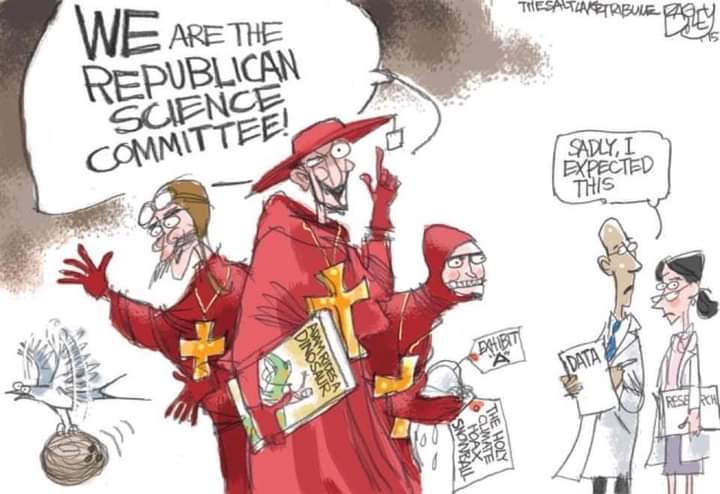
The Republican Party and Evangelical Christians are choosing a form of Christianity that does not follow the teachings of Christ. They have wholly rejected the characteristics of a Christian that Jesus laid out for us in the Beatitudes. Jesus said, “Blessed are the poor in spirit, For theirs is the kingdom of heaven,” but Republicans and Evangelical Christians have repeatedly rejected social welfare programs to help the poor (the Gospel of Matthew refers to the downtrodden, while the Gospel of Matthew refers to those in poverty). Jesus also declared, “Blessed are those who mourn, For they shall be comforted.” Yet, during the COVID-19 pandemic, they have denied the reality of the virus and therefore have dismissed those who mourned the loss of over half a million Americans. They have derided those who wore masks and advocated for measures to mitigate the spread of the virus, rejecting Jesus’ words, “Blessed are the merciful, For they shall obtain mercy.”
Republicans and Evangelicals embraced a bully for president, disregarding Jesus’ teaching that, “Blessed are the meek, For they shall inherit the earth.” They have rejected time and again assistance to those in need, denying them Jesus’ promise, “Blessed are those who hunger and thirst for righteousness, For they shall be filled.” The religious right rejects those who believe in the actual teachings of Jesus that honor love and acceptance. Look at the comments on any progressive Christian’s TikTok, and you’ll the hatred of those who advocate love, who Jesus said, “Blessed are the pure in heart, For they shall see God.” Republicans and Evangelicals preach divisiveness, ignoring the warnings of Jesus, “Blessed are the peacemakers, For they shall be called sons of God.” They feel that they are the persecuted when they are the persecutors, “Blessed are those who are persecuted for righteousness’ sake, For theirs is the kingdom of heaven.”
Jesus warns us against people like the Republican Party and Evangelical Christians who teach hate disguised as religion. In the Sermon on the Mount (Matthew 7:15–20), Jesus warns of false prophets:
Beware of false prophets, who come to you in sheep’s clothing, but inwardly they are ravenous wolves. You will know them by their fruits. Do men gather grapes from thornbushes or figs from thistles? Even so, every good tree bears good fruit, but a bad tree bears bad fruit. A good tree cannot bear bad fruit, nor can a bad tree bear good fruit. Every tree that does not bear good fruit is cut down and thrown into the fire. Therefore by their fruits you will know them.
The Gospels address the same point of a false prophet predicting correctly the rise of people who will use religion against others. Jesus predicted the future appearance of false Christs and false prophets, affirming that they can perform great signs and miracles, for example, in the Olivet Discourse (Mark 13:5–7, 13:21–23) given on the Mount of Olives:
And Jesus, answering them, began to say: “Take heed that no one deceives you. For many will come in My name, saying, ‘I am He,’ and will deceive many. But when you hear of wars and rumors of wars, do not be troubled; for such things must happen, but the end is not yet…Then if anyone says to you, ‘Look, here is the Christ!’ or, ‘Look, He is there!’ do not believe it. For false christs and false prophets will rise and show signs and wonders to deceive, if possible, even the elect. But take heed; see, I have told you all things beforehand.
Many Democrats have been driven away from religion because of how conservatives have used against them. However, an aversion to religion is not solely a positive thing for Democrats. A significant block of Democratic voters, especially Black Democrats, are much more likely to be religious than white Democrats, 40 percent of whom are “nones.” If secular Democrats disparage religion generally, they also risk alienating believers who otherwise agree with them. There are Democrats well positioned to handle that problem. Chief among them is President Biden, a Catholic who attends Mass weekly. Another is Pete Buttigieg, who has made a point of talking about his faith. Biden and Buttigieg prove that progressives don’t have to cede religion to the Republican Party. However, we must remember what Peter said in 2 Peter 2:1–3:
But there were also false prophets among the people, even as there will be false teachers among you, who will secretly bring in destructive heresies, even denying the Lord who bought them, and bring on themselves swift destruction. And many will follow their destructive ways, because of whom the way of truth will be blasphemed. By covetousness they will exploit you with deceptive words; for a long time their judgment has not been idle, and their destruction does not slumber.
For many Americans, right-wing Christians have given Christianity a bad name, enough to drive them from religion altogether. A strong counterbalance from progressive believers would show that the right doesn’t own religion enough to destroy it. We must follow what John said in the First Epistle of John. In 1 John 4:1–3, John warns those of the Christian faith to test every spirit because of these false prophets:
Beloved, do not believe every spirit, but test the spirits, whether they are of God; because many false prophets have gone out into the world. By this you know the Spirit of God: Every spirit that confesses that Jesus Christ has come in the flesh is of God, and every spirit that does not confess that Jesus Christ has come in the flesh is not of God. And this is the spirit of the Antichrist, which you have heard was coming, and is now already in the world.
We cannot allow the religious right to destroy Christ’s teachings. We must fight to reclaim Christianity as it was in the earliest days of the religion. The earliest Christians believed in fellowship and equality among all members. I will always believe that Jesus would have and probably did accept people of the LGBTQ+ community. Many parts of the Bible never made it into the version we see today, and through many translations, the Bible has been used as a tool of hatred and not love. This has driven so many away from their faith when the teachings of Christ should draw people into the faith, not be used to exclude those who don’t fit the narrowminded beliefs of those who use the Bible as a weapon instead of a tool.
There has always been a battle between good and evil, but Republicans, Evangelicals, and the religious right are blurring those lines. I believe that the battle today is a battle between love and hate, between acceptance and rejection, between inclusion and exclusion, and between equality and inequality. Let us fight for LOVE, ACCEPTANCE, INCLUSION, and EQUALITY of all. It is the only way to reclaim religion for God and keep it away from politicians and those who wish us harm.
“The kingdom of heaven is like a mustard seed, which a man took and sowed in his field, which indeed is the least of all the seeds; but when it is grown it is greater than the herbs and becomes a tree, so that the birds of the air come and nest in its branches.”
— Matthew 13:31-32
Canadian politician William Hamilton Merritt had a visualized for a bridge over the Niagara River. The result was the Niagara Falls Suspension Bridge which stood from 1855 to 1897 across the Niagara River and was the world’s first working railway suspension bridge. Merritt gained permission from the governments of Upper Canada and the State of New York to build the bridge, and two bridge companies were formed to build and jointly own the bridge. In autumn of 1847, the companies commissioned Charles Ellet Jr. to construct a bridge at a location, selected by the companies, along the Niagara River. They selected the narrowest point from shoreline to shoreline. The first obstacle was to create a line of communication, followed by a solid line in order to establish a link to the American side, since establishing a link by water was very dangerous. The width of the area of the gorge was 800 feet apart.
One idea was to fly a kite across the river to begin to lay the cable. A contest was held, with a five-dollar prize, to see who could fly a kite across the Niagara Gorge. A 16-year-old American boy named Homan Walsh won the contest on the second day of the competition flying his kite from the Canadian shoreline. All of the other boys tried from the American shore. On January 30, 1848, Homan flew a kite he named Union from one side of the gorge to the other. Someone on the opposite side caught the kite and tied a stronger string to the end of the kite string, and Holman pulled the new, thicker string back across the gorge. The process was repeated with an even stronger string, then a cord, then a thin rope, then a thicker rope, and eventually a steel cable, which crossed the expanse and was strong enough to support workers, tools, and materials. Finally, a sturdy bridge, over which trains and trucks could easily pass, was completed. And it all began with a 16-year-old boy and a string.
In Luke 16:10, Jesus says, “Whoever can be trusted with very little can also be trusted with much, and whoever is dishonest with very little will also be dishonest with much.” Therefore, the little things you have are there to prepare you for bigger things. The key is to trust God while possessing the little things. Jesus told us the little things can make a significant impact on the big picture. For instance, in the parable of the mustard seed in Matthew 13:31–32, He explains, “The kingdom of heaven is like a mustard seed, which a man took and sowed in his field, which indeed is the least of all the seeds; but when it is grown it is greater than the herbs and becomes a tree, so that the birds of the air come and nest in its branches.” As you probably know, the mustard seed is one of the smallest seeds planted in the Middle East. But nurtured in the right conditions, it can grow into something resembling a small tree—even providing a haven for birds. Like the string that was the first building block for a mighty bridge, the tiny mustard seed can become an amazing plant.
In another parable found in Matthew 10:29-31, Jesus said, “Are not two sparrows sold for a copper coin? And not one of them falls to the ground apart from your Father’s will. But the very hairs of your head are all numbered. Do not fear therefore; you are of more value than many sparrows.” Mahalia Jackson sang “His Eye Is On The Sparrow.” She chose that particular bird for a reason. She did not choose a great owl, the woodpecker, or even the robin. She chose one of the smallest birds to prove that if God could watch over something that small, surely, He would watch over us who are so much bigger.
In the Sermon on the Mount, Jesus said, “Look at the birds of the air, for they neither sow nor reap nor gather into barns; yet your heavenly Father feeds them. Are you not of more value than they?” (Matthew 6:26) Do not dismiss the small things in your life. Small things will develop into a harvest of blessings when you allow God to use them for His glory. Faith is like that. Don’t underestimate the power of little things. Jesus took a little lunch from a little boy and fed thousands. With a little jawbone, Samson slew an army. David took a little stone and brought down a giant. With just a little faith, great things can be accomplished.












 Joe
Joe


 The Closet Professor