Do not be anxious about anything, but in everything by prayer and supplication with thanksgiving, let your requests be made known to God. And the peace of God, which surpasses all understanding, will guard your hearts and your minds in Christ Jesus.
—Philippians 4:6-7
This year won’t be my first Thanksgiving without seeing my family. Since I moved to Vermont, I have chosen to go home for Christmas and not Thanksgiving. It’s always been impossible to afford both. However, this year, I won’t be going home for Christmas either. The pandemic is just too bad in Alabama, and I don’t want to take the chance of getting the virus and spreading it to my parents. I think this will be the second time that I have spent Thanksgiving on my own. Since I moved to Vermont, I have spent most years having Thanksgiving with friends or coworkers. Last year, I spent Thanksgiving and my birthday with my friend Susan in Manhattan. It was one of my most memorable Thanksgivings and birthdays. For once, I got to spend those two days with someone who loves me unconditionally for who I am. With my family, it’s always on the condition that I don’t speak about being gay.
This year, the United States (and to a certain extent, the whole world) is in the middle of what disaster-preparedness experts once believed would be a worst-case scenario. A highly contagious virus with unpredictable symptoms (sometimes mild, sometimes fatal) is raging worse than ever in the United States. The curve is not flat, nor is there even a curve. It’s a line that is starting to point straight upward. More than 1,000 Americans are dying every day, on average. Soon that number will likely hit 2,000. Over one-quarter of a million people have died. That number may rise to over 300,000 by Christmas, or more if people gather together from multiple households over Thanksgiving, which will see the United States have thousands of super-spreader events. It doesn’t look like there is a lot to be thankful for this year. However, 1 Chronicles 16:34 tells us, “Give thanks to the Lord, for he is good; his love endures forever.”
I know that few things sound nicer for many of us than sitting around eating with friends and family after so much isolation and worry over this seemingly never-ending year. But from an infectious-disease standpoint, the guidelines at this moment are stark and frank:
Limit activities to those essential to life.
Don’t gather socially.
Don’t travel.
Many doctors, public-health experts, and some civic leaders (though not enough) have begged us in recent weeks to follow these guidelines. They have asked us not to celebrate Thanksgiving in anything resembling the modern American way—with multigenerational gatherings that involve travel and prolonged conversations over an indoor meal. Canada celebrated its Thanksgiving on October 12. In the days and weeks following Canada’s Thanksgiving, coronavirus case numbers immediately started to rise. From November 12-19, Canada reported three of its five highest single-day totals in the entire year, all within the span of a week. Canada’s COVID-19 surge since after Thanksgiving is a warning for Americans.
In any other administration, the Centers for Disease Control and Prevention would issue guidelines to Americans. In a coordinated effort with the president and coronavirus task force to advise and coordinate with governors, mayors, and citizens. Instead, there is a messaging void. The president has spent his time golfing and tweeting about the election being stolen from him, including saying dead people voted when the families of over 250,000 people are mourning the death of loved ones from a virus he has done nothing to control. He has effectively quit being the president and at the same time trying to hang on to the false belief that he won the election. He has broken with his task force and refused to concede or transfer power to incoming experts, leaving them without vital information. The CDC has a barely adequate page of new “considerations” for holiday celebrations that the agency’s officials have neither publicly announced nor explained in news conferences.
If people don’t stay home and have Thanksgiving with only the members of their households, this virus will spread exponentially, and thousands more will die. The truth is that we will likely need to be more vigilant with each passing day this winter, not less. The virus knows no difference between holidays and workdays. Our default should be to treat Thanksgiving as a day when the health guidelines are no different from any other day. As the prevalence of the virus increases, things that were previously low risk become more dangerous. This is why it’s so important to follow the directives of not gathering indoors or traveling. It’s never been advisable during the pandemic to socialize with people outside your bubble who can’t manage to wear masks and keep their distance, but it’s especially ill-advised now.
No family member should put pressure on others to gather. Many people will likely join reluctantly because they do not want to be the ones who are no fun or to keep others in the family from acting indignant or insulted. That’s what my parents are doing by going to my sister’s in-laws for Thanksgiving. Just simply say no. Say that you are thankful they are currently safe and healthy, and you would like to keep it that way. If you don’t, it might be the last Thanksgiving you do see your family. Remember, the risk of such gatherings is not limited to those who gather. Each transmission of the virus can possibly spread to dozens more, and those dozens will spread it to dozens more, and the spread goes on and on. We are all in this together, and we can’t forget that.
Take the opportunity to think about what you love most about the day. Focus on how to re-create that, and even build on it. Maybe learn to cook one of the dishes that someone else usually brings to dinner. Think of the people you actually look forward to seeing, and call them. Think of the people you don’t look forward to seeing, and don’t call them. Maybe most important, this year is an opportunity to bond over the moral certainty of the moment. At its core, Thanksgiving is a day of giving thanks for the blessings of the past year. While there may not be a lot to be thankful for when it comes to 2020, 1 Timothy 4:4-5 tells us, “For everything God created is good, and nothing is to be rejected if it is received with thanksgiving, because it is consecrated by the word of God and prayer.” This year, families, friends, and communities can work together to achieve something meaningful and good: ending the pandemic. All you’re asked to do is eat food at home.
Whatever you do, have hope that next Thanksgiving, if the news of an effective vaccine proves as promising as it sounds, we can go back to whatever traditions draw people to Thanksgiving. We can hope and pray that this is a one-time deal. Next year will be an opportunity to be thankful for the fundamentals of the holiday that we tend to take for granted in normal years.
The righteousness of the perfect shall direct his way: but the wicked shall fall by his own wickedness. The righteousness of the upright shall deliver them: but transgressors shall be taken in their own naughtiness. When a wicked man dieth, his expectation shall perish: and the hope of unjust men perisheth. The righteous is delivered out of trouble, and the wicked cometh in his stead. An hypocrite with his mouth destroyeth his neighbour: but through knowledge shall the just be delivered. When it goeth well with the righteous, the city rejoiceth: and when the wicked perish, there is shouting. By the blessing of the upright the city is exalted: but it is overthrown by the mouth of the wicked. He that is void of wisdom despiseth his neighbour: but a man of understanding holdeth his peace. A talebearer revealeth secrets: but he that is of a faithful spirit concealeth the matter. Where no counsel is, the people fall: but in the multitude of counsellors there is safety. He that is surety for a stranger shall smart for it: and he that hateth suretiship is sure.
— Proverbs 11:5-15
I personally have faith that Joe Biden will make a great president. He has the contacts in Washington to hopefully get things done. Of course, it will be easier if both Democratic candidates win their run-off races in Georgia. However, the first few months will undoubtedly be difficult because he will enter the presidency in the middle of an ever-worsening pandemic and replace a president who refuses to concede or allow for Biden’s transition team to move forward. Republicans are claiming that Trump has the right to move through the court system to delegitimize the election. They claim, “What harm could it do?” The symbolism of a graceful concession is more important than the nuts and bolts of the handoff, especially for a president-elect with Biden’s vast experience, though especially in this pandemic, the nuts and bolts do matter. Hebrews 11:1 defines faith as “the substance of things hoped for, the evidence of things not seen.” Trump is petulantly weakening a divided nation’s faith in its hoped-for and unseen foundational ideals—and of all the terrible things this awful man has done to our country, this could be the worst.
What America is now experiencing is a massive failure of character—a nationwide blackout of integrity—among elected Republicans. From the president, a graceless and deceptive insistence on victory after a loss that was not even close. From congressional Republicans, a broad willingness to conspire in President Trump’s lies and slander the electoral system without considering the public good. Only a few have stood up against Republican peer pressure of contempt for the constitutional order. How could such a thing happen in the Republican Party? It is not an anomaly. It is the culmination of Trump’s influence among Republicans and White evangelical Christians in particular. Their primary justification for supporting Trump—that the president’s character should be ignored in favor of his policies—has become a serious danger to the republic. Trump never even presented the pretense of good character. His revolt against the establishment was always a revolt against the ethical ground rules by which the establishment played. When he mocked a reporter with a disability, urged violence at his rallies, or attacked a Gold Star family, Republicans accepted it as part of the Trump package. And some of his most impassioned defenses came from White evangelicals.
We have a serious problem in this country, and at the heart of that is White evangelicals. Evangelicalism has four distinctive aspects to their faith: conversionism (being “born again”), Biblicism (belief in biblical inerrancy and/or infallibility), crucicentrism (the belief that Christ died as a substitute for sinful humanity), and activism (includes preaching and social action). Two of these have become incredibly dangerous because of their interpretation by evangelicals: Biblicism and activism. Under Biblicism, they ignore all discussion of the Bible begin filled with allegory and metaphors. They believe it is entirely literal. The most significant problem with this is that they ignore the original language and meaning of the Bible, and they pick and choose what parts of the Bible they want to follow and which they would like to ignore. One example is the use of the word “homosexual” in the New Testament. The term “homosexual” is of modern origin, and it wasn’t until about a hundred years ago that it was first used. There is no word in biblical Greek or Hebrew that is equivalent to the English word homosexual. The 1946 Revised Standard Version (RSV) of the Bible was the first translation to use the word homosexual. However, evangelicals latched on to this translation’s use of homosexual for terms that were never meant to mean homosexual as we understand it today. Romans 1:24-27, 1 Corinthians 6:9, and 1 Timothy 1:10 are all used to condemn the LGBTQ+ community. However, these verses referred to temple prostitutes, male prostitutes, and pederasts, respectively. Yet, even though Jesus explicitly condemns divorce in Matthew 5:32 and Luke 16:18, White evangelicals are more likely than the average American to leave a marriage, with 17.2 percent being currently divorced. Despite their strong pro-family values, evangelical Christians have higher than average divorce rates being more likely to be divorced than Americans who claim no religion. White evangelicals also use these beliefs to excuse their discrimination against racial and sexual minorities.
White evangelicals were once seen as America’s pious and moral authority but have now become the least strict chaperone of Trump’s corruption. Under the president’s influence, White evangelicals went from the group most likely to believe personal morality matters in a politician to the least likely group. “We’re not electing a pastor in chief,” explained Jerry Falwell Jr., the disgraced former president of Liberty University. Robert Jeffress, the pastor of the Islamophobic, anti-Semitic, racist, and anti-LGBTQ+ First Baptist Dallas, argued that “outward policies” should matter more than “personal piety.” Ralph Reed of the Faith and Freedom Coalition made his case for Trump’s reelection based on conservative deliverables. “There has never been anyone,” Reed said, “who has defended us and who has fought for us, who we have loved more than Donald J. Trump.” This is politics at its most transactional. Trump was being hired by evangelicals to do a job — to defend their institutions, implement pro-life policies, and appoint conservative judges. The character of the president was irrelevant so long as he kept his part of the bargain. Which, sadly, Trump mostly did.
But now we know what a president without character looks like amid a governing crisis. We see a dishonest president, spinning lie after lie about the electoral system. We see a selfish president incapable of preferring any duty above his own narrow interests. We see a reckless president, undermining the transition between administrations and exposing the country to risk. We see a vain president unable to responsibly process an electoral loss. We see a corrupt president, willing to abuse federal power to serve his own ends. We see a spiteful president, taking revenge against officials who have resisted him. We see a faithless president, indifferent to constitutional principles and his oath of office. There is nothing in Donald Trump that Jesus might find redeemable. If you made a list of everything that Jesus taught, you could make a list of Trump’s character and see the opposite of everything Jesus wanted for humanity.
Two lessons can be drawn from the Republican failure of moral judgment. First, democracy is an inherently ethical enterprise. Yes, politics has a transactional element. But those transactions take place within a system of rules that depend on voluntary obedience. Our electoral system and our presidential transition process have flaws and holes that an unprincipled leader can exploit, which is a good reason to prefer principled leaders. And second, U.S. politics would be better off if White evangelicals consistently applied their moral tradition to public life. Not only Christians, of course, can stand for integrity. But consider what would happen if White evangelicals insisted on supporting honest, compassionate, decent, civil, self-controlled men and women for office. The alternative is our current reality, in which evangelicals have often been a malicious and malignant influence in U.S. politics.
White evangelicals are only 15 percent of the population, but their share of the electorate was 28 percent, making them a disproportionately vocal and influential group within American politics. White evangelicals have, in effect, skewed the electorate by masking the rise of a young, multiracial, and mostly secular voting population. Unfortunately, the White evangelicals’ overperformance also shows why the racist appeal Trump made in this campaign was effective. White evangelicals were fired up like no other group by Trump’s encouragement of white supremacy. Pre-election, 90 percent said they would vote, and nearly half of those voting for Trump said virtually nothing he could do would shake their approval. There was little evidence of differences among White evangelicals by gender, generation, or education. The good news might be that they are, as a group, dying out (median age in the late 50s), and their views are hardly recognizable to many other Americans. Majorities of White evangelical Protestants don’t see the pandemic as a critical issue (they’re less likely than others to wear masks), believe society has become too “soft and feminine,” oppose same-sex marriage, think Trump was called by God to lead, and don’t believe he encouraged white supremacist groups.
The unholy alliance of White evangelicals and Donald Trump is what a purely transactional politics has actually delivered — a lawless leader resisting a rightful electoral outcome. He is endangering American national security by causing chaos and instability in the United States at a time when our economy is on the brink, and a pandemic is raging stronger every day. The only adequate response, as President-elect Joe Biden seems to realize, is a politics of character. Let’s hope that politicians on both sides of the aisle realize they must work with Biden to heal the soul of the nation.
There is a time for everything, and a season for every activity under the heavens: a time to be born and a time to die, a time to plant and a time to uproot, a time to kill and a time to heal, a time to tear down and a time to build, a time to weep and a time to laugh, a time to mourn and a time to dance, a time to scatter stones and a time to gather them, a time to embrace and a time to refrain from embracing, a time to search and a time to give up, a time to keep and a time to throw away, a time to tear and a time to mend, a time to be silent and a time to speak, a time to love and a time to hate, a time for war and a time for peace.
—Ecclesiastes 3:1-8
Yesterday was an emotional day. It’s been an anxiety-filled and stressful week as we awaited the election results. After four scary and disheartening years, we can finally begin to breathe a sigh of relief and let our nation heal. After the election was called for Joe Biden, we saw celebrations all across the United States for the election of Joe Biden. As I told my friend Susan yesterday, “The celebrations seem more like we won a war than victory in a presidential election.” She responded, “I think we did!”
Under the presidency of Donald Trump, we have seen a lot of horrors. We have seen over two hundred thousand die in the United States of a disease that has ravaged the world. We have seen people uprooted because they have lost their jobs or been deported due to the president’s immigration policy. We have seen many attempts to tear down the democratic foundations of this country. We have wept a lot over what the outgoing administration has subjected us. We have mourned the loss of life. We have spent four years searching for a leader who will unite us and embrace all of us. Now is the time to be born anew, to heal, to build on cooperation, to dance, to embrace, a time to mend, a time to love, and a time for peace. November 3rd was our time to speak, and we did. Over 74 million of us spoke loudly to say we want to preserve democracy, and now it is a time to celebrate.
I think many of us feel like we have been “to hell and back.” We have found ourselves “pushed to the limit.” It may be that God is training you, like silver being refined in the fire. We cannot let this occasion go unmarked. We are celebrating, but we have a lot of work still to do to support the president-elect. Jesus told two parables that are related to us in Luke 15. As a group of “undesirables” (tax collectors and sinners) were drawing near to Jesus, the Pharisees and the scribes complained that Jesus received these sinners and ate with these undesirable people. In Luke 15:4-7, Jesus said to them:
“What man of you, having a hundred sheep, if he has lost one of them, does not leave the ninety-nine in the open country, and go after the one that is lost, until he finds it? And when he has found it, he lays it on his shoulders, rejoicing. And when he comes home, he calls together his friends and his neighbors, saying to them, ‘Rejoice with me, for I have found my sheep that was lost.’ Just so, I tell you, there will be more joy in heaven over one sinner who repents than over ninety-nine righteous persons who need no repentance.
Jesus says in this parable that no one should be left behind, and when we are brought together, we should rejoice. Joe Biden has run on this message; a message of healing the soul of our nation. We have suffered under the leadership of Donald Trump, and now it is time to come together and heal. Biden has said numerous times that he will be the president of all Americans. As Kamala Harris said in her victory speech last night:
“You voted. You delivered a clear message. You chose hope, unity, decency, science, and, yes, truth. You chose Joe Biden as the next President of the United States of America. Joe is a healer. A uniter. A tested and steady hand. A person whose own experience of loss gives him a sense of purpose that will help us, as a nation, reclaim our own sense of purpose. And a man with a big heart who loves with abandon.
I have never been so elated over a presidential election in my life. Even with presidents I voted for that actually won, I never felt this way about a president. I have never believed in a president so much. I believe with all my heart that Joe Biden will be a president for all Americans.
It won’t be an easy road for Joe Biden. Donald Trump’s apparent near-win, combined with Republican gains in the House and in state legislatures, tells us all we need to know where the country stands. If Trump hadn’t acted as his own worst enemy during the campaign, it might have been his landslide to claim. But Trump couldn’t pretend to be an adult long enough to assuage fears that his impulsive nature might ruin us. Biden will have to heal the divide that exists in this country. Ultimately, Biden’s victory will be a gift to the country. Biden will be the president that we need. He can make his stand — and his legacy — as the president who brought the nation back from the precipice. Biden is easy to like, and he knows the ropes. He has friends on both sides of the aisle, can broker a deal, raise the level of discourse, and restore dignity to the White House — all those things we’ve missed the past four years. After his third run for president, he has the potential opportunity to go down in history as a good man and the most consequential of presidents. His humility will be a gift to us all.
Now that the nightmare of the Trump presidency is finally coming to an end, we can do as we are told to do in Psalms 47:1, “Clap your hands, all peoples! Shout to God with loud songs of joy!” Let us look forward to four years of a Biden/Harris administration. To quote Joe Biden’s victory speech last night:
It’s time to put away the harsh rhetoric. To lower the temperature. To see each other again. To listen to each other again. To make progress, we must stop treating our opponents as our enemy. We are not enemies. We are Americans. The Bible tells us that to everything there is a season — a time to build, a time to reap, a time to sow. And a time to heal. This is the time to heal in America. Now that the campaign is over — what is the people’s will? What is our mandate? I believe it is this: Americans have called on us to marshal the forces of decency and the forces of fairness. To marshal the forces of science and the forces of hope in the great battles of our time.
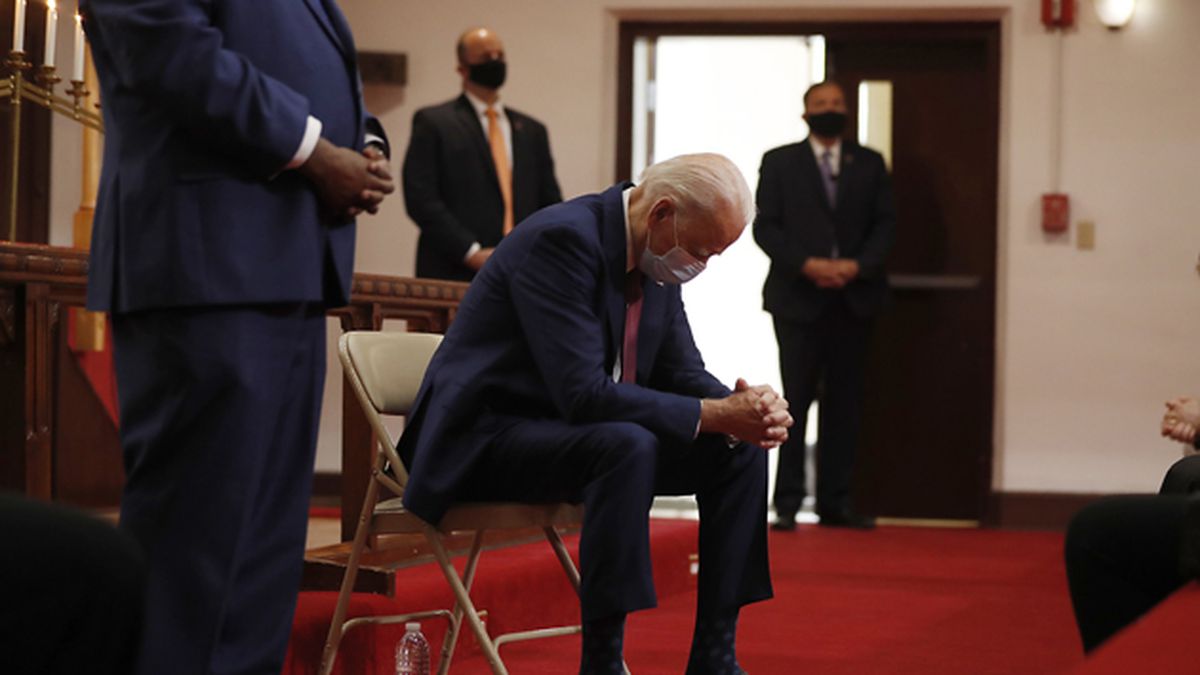
An image the Trump campaign used in an ad to mock former Vice President Joe Biden for praying.
Make no friendship with a man given to anger, nor go with a wrathful man.
—Proverbs 22:24
Whoever walks with the wise becomes wise, but the companion of fools will suffer harm.
— Proverbs 13:20
Leave the presence of a fool, for there you do not meet words of knowledge.
— Proverbs 14:7
The 2020 election will be by far the most consequential in my lifetime. I have watched our country transform drastically over the past nearly forty years- from the AIDS crisis, the digital revolution of the ’90s, 9/11, the subsequent war on terrorism, the financial collapse of 2008, to the election of our first black President. The past forty years of American history have been anything but smooth sailing, yet the moment we’re facing as we approach Tuesday’s election feels unlike any other that I’ve lived through. The future of American democracy seems to be in jeopardy, and our country’s moral heart feels as if it is on life-support.
Over the past four years, the Trump administration has proven to be as fraught with scandal and immorality as one should have expected when electing a reality-TV star to lead the most powerful nation in the world. And with every scandal, every racist tweet, every regressive executive order, many in the United States have grown accustomed to spending five minutes in outrage before moving on to the next unbelievably ignorant utterance to come out of the President’s mouth. Not all of us forget the harm Trump has done to our country. None of us should have had to get used to the constant misdeeds of a president. Not being shocked as Trump continues to be more despicable and outrageous every day should trouble all of us deeply. If this trend continues, I fear that our national conscience will cease to exist, allowing for the worst of our nature to flourish.
For better or for worse, the American President is not only the leader of the executive branch of government but is the figurehead of our nation. In theory, the President is supposed to embody the best of America on the world stage and be a figure that all of the country, regardless of their political affiliation, can get behind. They’re meant to be a leader that can set aside their own self-interest to represent the whole country, especially in moments of tragedy and turmoil. This role has proven to be essential in keeping the social cohesion of our country in our most fragile moments. And Donald Trump and his cronies have shown us what happens when a President doesn’t act in this capacity.
The United States is teetering on the edge of a race war. Federal law enforcement officers in unmarked vehicles were sent in to disrupt and discourage protestors in Portland. Transgender rights continue to be rolled back. A pandemic continues to ravage the most medically advanced nation on earth because our leader has yet again put profit over people. Our economy is on the verge of total collapse. Our allies worldwide now see us as an enemy, and our enemies now see us as an ally. It is not an overstatement to suggest that America in 2020 is beginning to look like a scene out of a dystopian fantasy novel. But friends, this is far from fantasy. This is our new reality under Trumpism.
As a Christian, I resisted at first to put politics in my Sunday posts, and I tried to focus on how we can be better people. However, as election day draws near and the pandemic is worsening, I do think we are fighting for the very soul of our nation. Trump is backed by religious fanatics who want to impose their twisted morality on others. So, I had to ask myself, what would God want me to do with the space I have to communicate with the readers of my blog? By and large, I have tried to use my blog to help make us all better people, seeking to use my voice and meager resources to help make the lives of others better. We have a moral and spiritual obligation to hold our elected officials accountable to doing what is right and just.
I have also become convinced that it is my moral and spiritual duty to encourage others to vote in the 2020 election because it has never been more apparent just how much damage can be done by a single ill-intentioned, unqualified individual in elected office. The majority of the Trump administration has been filled with such people, and they have done irreparable damage to some of the most sacred institutions of our democracy in just four (long) years. Our votes matter, this election matters, and the candidates we support matter, so we must vote our conscience and vote out the man currently in the White House and all the Republicans who have enabled him. Back during the Bush administration, I heard John Ashcroft, Donald Rumsfeld, Dick Cheney, and George W. Bush referred to as the “Four Horsemen of the Apocalypse.” We couldn’t imagine anything worse at the time, but the current administration puts to shame Ashcroft, Rumsfeld, Cheney, and Bush. As a side note, I find it interesting that on the George W. Bush Presidential Center website, the Four Horsemen of the Apocalypse are referred to as Populism, Nativism, Isolationism, and Protectionism. It took us eight years to rid ourselves of all of them. Sadly, the United States is currently experiencing the true Four Horsemen: War, Famine, Pestilence, and Death.
As a Christian, I have been reminded that looking for candidates who believe in the universal moral ideals that Jesus embodied is not only a good thing to do but what we must do. We also have to keep in mind that no candidate will perfectly embody the way of Jesus. We need candidates who believe that loving our neighbors is a core moral goal. They must resist evildoers while realizing that turning the other cheek is a better path forward than retribution and retaliation. We need politicians who will provide and care for the poor because it is the obligation of every society. He or she must believe in creating a future of equity and justice for everyone (even those we disagree with). These traits are precisely what we need to continue to move this country in a direction of true progress.
One of the core texts that summarizes the values embodied by Jesus comes from Luke 4, where He steps into a Synagogue and reads from the prophetic words of Isaiah, declaring that these words embody His mission and calling. The words Jesus read are as follows:
“The Spirit of the Lord is on me,because he has anointed meto proclaim good news to the poor.He has sent me to proclaim freedom for the prisoners, and recovery of sight for the blind,to set the oppressed free, to proclaim the year of the Lord’s liberation for all.”
—Luke 4:18-19
If you read that text and then look at the two candidates’ platforms, Joe Biden is clearly the singular candidate that embodies these values best by far. When holding up Biden’s values and record with that of Donald Trump, there can be not even a hint of doubt over which candidate best represents the values of Jesus. Biden’s platform and record stand for economic justice for the poor, fighting systemic racism, demanding reform for those in prison, arguing for universal healthcare even for those with pre-existing conditions, promoting the value of respectful debate in American discourse, valuing empathy and diplomacy, and protecting first amendment rights. On the other hand, Trump seeks to make the poor invisible, threatens his opponents with prison, is working to kill the Affordable Care Act amid a global pandemic, supports memorializing racists and slave owners, praises authoritarian dictators, and continually threatens the First Amendment rights of Americans.
There is no contest here. Anyone who claims to be a follower of Jesus Christ and allows the values of Jesus to inform their values and morals should have no question as to which candidate represents the better future for our nation. Joe Biden is not perfect, nor has he always made perfect choices in his career, but by and large, his life reflects the way and wisdom of Jesus. On the other hand, Donald Trump has a life-long record of willful, unrepentant sin, greed, and destructive behavior that he has brought with him into the Oval Office and normalized on the world stage.
As followers of Christ, we should care about the morality of our elected officials, especially the President, not just for the benefit of our own self-interests or those of our country but for the good of the whole world. The election is almost upon us. Tuesday is just two days away, and we should understand the gravity of the responsibility we hold and the moral weight of our vote. Matthew 12:36 tells us that we will be accountable to God for “every careless word” we speak. How much more will we be held accountable for a vote cast that promotes everything opposed to the way of Jesus? On Tuesday, it is imperative that every American vote. And from where I stand as a Christian, there is only one candidate with a record and platform deserving of my vote: Joe Biden.
This post was adapted from an essay written by Rev. Brandan Robertson.
In your relationships with one another, have the same mindset as Christ Jesus:
Who, being in very nature God, did not consider equality with God something to be used to his own advantage; rather, he made himself nothing by taking the very nature of a servant, being made in human likeness. And being found in appearance as a man, he humbled himself by becoming obedient to death—even death on a cross! Therefore God exalted him to the highest place and gave him the name that is above every name, that at the name of Jesus every knee should bow, in heaven and on earth and under the earth, and every tongue acknowledge that Jesus Christ is Lord, to the glory of God the Father.
—Philippians 2:5-11 (NIV)
We are told to emulate Jesus in all that we do. A week from Tuesday, on November 3, 2020, those of us in the United States have a choice to make between a moral person and an immoral person to lead our country. There is only one choice that any of us can make and honestly believe in our hearts that we are making the right choice. We must vote for Joe Biden. When Joe Biden seeks to inspire or comfort, he turns to his faith. His speeches are woven with references to God, biblical language, or the pope. When Donald Trump seeks to inspire or comfort, he turns to derogatory language. He lashes out against those who oppose him, whether they are a Democrat or a Republican he believes is disloyal to him. Often, he turns to those who have evil in their hearts (racists, homophobes, conspiracy theorists, etc.). Do you want someone who shows love and compassion or someone who shows hate and contempt? The choice couldn’t be more straightforward.
This is not going to be a long post from me today. I want to post a video by Rev. Brandan Robertson, a noted author, activist, theologian, and pastor, working at the intersections of spirituality and social renewal. He currently serves as the Lead Pastor of Missiongathering Christian Church in San Diego, CA. Robertson received his B.A. in Pastoral Ministry and Theology from Moody Bible Institute, his Masters of Theological Studies from Iliff School of Theology, and is completing his second Masters in Political Science at Eastern Illinois University. He currently resides in San Diego, CA. The Human Rights Campaign named him one of the top faith-leaders leading the fight for human rights. Robertson has worked with political and social leaders worldwide to end conversion therapy and promote LGBTQ+ rights. Robertson currently serves as the co-chair of San Diego Pride’s DevOUT Interfaith Coalition, has served as the national spokesperson of Evangelicals For Marriage Equality, and developed the Evangelical Outreach Program for Faith In Public Life and the Bridging the Divides Program for Interfaith Alliance of Colorado. Here he is discussing why Joe Biden is the only Christian choice for president.
When you go vote, don’t think that just voting for Joe Biden will be enough. You have to vote blue down the ticket. The Republican Party turned away from morality to support Donald Trump. They made a Faustian deal, and now, they need to pay for it. They have abandoned whatever spiritual values or moral principles they may have ever had to obtain knowledge, wealth, and power. They do not deserve our votes. It is time for a blue wave in this year’s election. Too much is at stake, especially with the impending 6-3 conservative majority on the Supreme Court.
“Teacher, which is the great commandment in the law?” And he said to him, “You shall love the Lord your God with all your heart, and with all your soul, and with all your mind. This is the great and first commandment. And a second is like it, You shall love your neighbor as yourself. On these two commandments depend all the law and the prophets.”
Matthew 22:36-40
The 1972 Democratic presidential nominee, Senator George McGovern, once said, “Empathy is born out of the old biblical injunction ‘Love the neighbor as thyself.’” Empathy is woven throughout the Bible. Virtually every instruction God offers regarding the way we are to treat others begins with empathy. Empathy is becoming increasingly derided in the United States as being a characteristic of the weak, especially in the years since one of the most empathetic presidents in history was replaced by a man who has no empathy for anyone or anything. President Barack Obama is quoted as saying, “Learning to stand in somebody else’s shoes, to see through their eyes, that’s how peace begins. And it’s up to you to make that happen. Empathy is a quality of character that can change the world.”
First Peter 3:8 tells us, “Finally, all of you, have unity of spirit, sympathy, love of the brethren, a tender heart and a humble mind.” The “tender heart and a humble mind” that Peter refers to in this passage is the mind of Christ, which is what all Christians aspire to have. But Peter’s call for unity among believers cannot be answered without empathy and understanding. To be one with other people, we must develop a deep understanding of:
who they are
how they became that person
what they know
how they learned it
what they hold dear
why they hold it dear
how they feel
why they feel that way.
According to Peter, oneness is created by treating one another with compassion, love, tenderness, and courtesy—four qualities that lie at the heart of empathy. Astrophysicist Neil deGrasse Tyson said, “Humans aren’t as good as we should be in our capacity to empathize with feelings and thoughts of others, be they humans or other animals on Earth. So maybe part of our formal education should be training in empathy. Imagine how different the world would be if, in fact, that were ‘reading, writing, arithmetic, empathy.’” A training of empathy is what Christianity is all about.
If we are empathetic, we can begin to understand others’ joys and sufferings, and we can either rejoice with their joys or comfort them in their sadness. Romans 12:15 commands us to “Rejoice with those who rejoice, weep with those who weep.” Those who rejoice usually do so because good things are happening in their lives. If we are not careful, other people’s rejoicing can trigger feelings of competition or jealousy. The urge to “top” others with stories of our own successes—or to wallow in envy because we don’t have as much to rejoice over—can be hard to resist. Those who weep usually do so because they have suffered a devastating loss or misfortune. That can create some messy emotional landscapes. It’s nearly impossible to tread into the lives of hurting people without getting our hands dirty and pulled down into their despair. The urge to stay out of the mess—to send our thoughts and prayers from a safe distance—can be hard to resist. But that’s not what empathy is, and that’s not what God calls us to. Empathy is seeing with the eyes of another, listening with the ears of another, and feeling with the heart of another.
John 11:35 is the shortest verse in the Bible, and it shows Christ’s empathy more succinctly than anywhere else in the Bible. The verse simply says, “Jesus wept.” This verse occurs in John’s narrative of the death of Lazarus of Bethany, a follower of Jesus. Lazarus’s sisters—Mary and Martha—sent word to Jesus of their brother’s illness and impending death, but Jesus arrived four days after Lazarus died. Jesus, after talking to the grieving sisters and seeing Lazarus’s friends weeping, was deeply troubled and moved. After asking where Lazarus had been laid, and being invited to come see, Jesus wept. He then went to the tomb and told the people to remove the stone covering it, prayed aloud to his Father, and ordered Lazarus to come out, resuscitated.
Jesus knew He was going to raise Lazarus from the dead. So technically speaking, He knew there was no reason for Lazarus’ loved ones to mourn. He knew that in a matter of minutes, their tears would turn to joy. So Jesus would have been excused for dismissing their grief over something that would prove to be temporary. Yet Jesus didn’t dismiss Lazarus’ mourners’ grief. He didn’t try to talk them out of their grief. He didn’t rebuke them for their lack of faith. Jesus saw people who were hurting, and it made Him hurt, too. He empathized so strongly with those who were mourning that He wept. Jesus showed us there is a nobility in compassion, a beauty in empathy, and a grace in forgiveness. Transcendentalist Henry David Thoreau asked, “Could a greater miracle take place than for us to look through each other’s eyes for an instant?” Jesus had looked into the eyes of the family and friends of Lazarus, and he felt their pain.
The book of Hebrews presents Jesus as a defense attorney of sorts. He represents His followers before God, the Judge. While Satan, the prosecuting attorney, levels charges against us, demanding that God punish our sins, Jesus contradicts his accusations by reminding God that His (Jesus’) blood covers our offenses. Hebrews 4:15 states, “For we have not a high priest who is unable to sympathize with our weaknesses, but one who in every respect has been tempted as we are, yet without sin.” What makes Jesus an especially effective Counselor and Defender is His experience on earth. He expertly represents us before God because He empathizes with us. He knows what it is to be tempted and weak. He understands us because He experienced what we experience and endured what we endure. The author of To Kill a Mockingbird, Harper Lee, once said, “You never really understand a person until you consider things from his point of view,” which is what God did by sending Jesus to live as a human on earth. When asked about how he would choose judges, Barack Obama responded, “We need somebody who’s got the heart, the empathy, to recognize what it’s like to be a young teenage mom, the empathy to understand what it’s like to be poor or African-American or gay or disabled or old – and that’s the criterion by which I’ll be selecting my judges.” God meets these criteria as our heavenly judge because he sent Jesus to live amongst humanity. Jesus and his followers understand that empathy and compassion make our world better.
When we look for leadership, I believe the most important quality is empathy. Oprah Winfrey summed this up with, “Leadership is about empathy. It is about having the ability to relate to and connect with people for the purpose of inspiring and empowering their lives.” With the dueling town halls Thursday night, we saw two opposing events that diverged dramatically in tone. In the words of Savannah Guthrie, Trump’s town hall was like your “crazy uncle” who rages about anyone different from him and has no empathy. In contrast, Biden’s town hall was compared to “watching an episode of Mister Rodgers Neighborhood,” by Mercedes Schlapp, a senior adviser to the Trump campaign, in a tweet. She also misspelled the late Fred Rogers’ last name. By the way, social media was quick to fire back at Schlapp for her attempt to insult Biden via the beloved children’s television host who famously promoted messages of kindness, patience, and friendship. Biden showed empathy for Americans while one guy described “watching Trump was like watching an episode of Twin Peaks.”
Since the beginning of the COVID-19 pandemic, Republicans have shown again and again that they lack empathy for the average American. During this week’s Senate confirmation hearings for SCOTUS nominee Amy Coney Barrett, Kamala Harris pointed out the lack of empathy by Republicans for the American people:
…while tens of millions of Americans are struggling to pay their bills, the Senate should be prioritizing coronavirus relief and providing financial support to those families. The American people need to have help, to make rent or their mortgage payment. Senate Republicans have made it crystal clear that rushing a Supreme Court nomination is more important than helping and supporting the American people who are suffering from a deadly pandemic and a devastating economic crisis. Their priorities are not the American people’s priorities, but for the moment, Senate Republicans hold the majority in the Senate and determine the schedule, so here we are.
On November 3, 2020, we have the chance to elect empathetic leaders. Since January 20, 2017, we have struggled as a country because our leadership in the presidency and the Senate had no empathy. It’s time for empathy to reenter politics in the United States. Make sure that you vote and VOTE BLUE.
Beloved, let us love one another, for love is from God, and whoever loves has been born of God and knows God. Anyone who does not love does not know God, because God is love. In this the love of God was made manifest among us, that God sent his only Son into the world, so that we might live through him. In this is love, not that we have loved God but that he loved us and sent his Son to be the propitiation for our sins. Beloved, if God so loved us, we also ought to love one another. No one has ever seen God; if we love one another, God abides in us and his love is perfected in us.
—1 John 4:7-12
Today marks the 32nd annual National Coming Out Day, a cause for celebration and a time to look back on how far we’ve come. Some look forward to this day to take that big step for the first time and declare who they are to the world. But for many young LGBTQ+ people who are still questioning things, it is a time for quiet reflection and introspective exploration. The day was established to remind society about something positive in the LGBTQ+ community. If more people were aware of out and proud LGBTQ+ individuals living among them, then harmful stereotypes and laws affecting them would hopefully go away. Many hurtful stereotypes have already gone away due to the increased visibility of LGBTQ+ people in society. While LGBTQ+ people and issues are very much at the forefront of American culture today, days like this are still significant.
For every person that is out and proud in their sexual orientation or gender identity, countless others are afraid to share that information. They’re scared to share it because of fear of losing their homes, families, or jobs. Some people don’t come out because they don’t feel like their faith and their sexuality can coexist. Most Christians, myself included, grew up in a church where we were told, at the worst, that gay people are evil and going to hell, and at best (or most hypocritical), were welcome in the church, but not in leadership. Some will even claim they “hate the sin, but love the sinner,” which is a backhanded way of saying that being LGBTQ+ is wrong unless you conform to a heteronormative life. Why would any LGBTQ+ Christian come out in that environment? What does the coming-out process look like for LGBTQ+ Christians, especially when they do not feel safe, affirmed, or supported in their communities? LGBTQ+ Christians can be haunted by feelings of depression, despair, and thoughts of suicide as they try to reconcile their faith with their sexuality. These haunting thoughts are not something that God would want for His children.
Across the United States, LGBTQ+ Christians are coming out of the closet. For many of them, finding acceptance within the church can be a test of faith. Studies show that LGBTQ people of faith are often conflicted. According to a report from the Pew Research Center, many feel unwelcome within most major religions and are much less likely to identify as Christian compared to the general public. For many people who claim to be Christians, “homosexuality” is an issue, when it should not be. It is often considered a matter of “us” versus “them,” or worse, for LGBTQ+, a question of their behavior, not something intrinsic to their identity. A person cannot claim to love someone if they do not accept who that person is. Being LGBTQ+ is not a lifestyle, nor is it a choice. God created us in His image. “Anyone who does not love does not know God, because God is love.” (1 John 4:8) Christians cannot have it both ways, you either love a person or don’t and if you don’t accept a person, you do not love them. And, if you do not love them, then you do not know God. It is a pretty simple and straightforward concept.
I learned pretty early that, as an LGBTQ+ Christian, I am like a unicorn—something people have heard of but never quite seen in person. However, we are here, we are real, and we don’t navigate this journey without our own unique set of problems. I know so many that have lost their relationship with God and/or the church, not because they no longer believed, but because doing the work to free themselves from oppressive things like patriarchy and shame also allowed them to recognize the space that those same concepts occupy within religion. But as a person raised in the Church of Christ, the idea of divorcing myself from my relationship with God and my Christian upbringing seemed unrealistic.
In church, the preachers always say, “don’t just listen to me, study for yourself!” We are consistently taught to read the Bible, so we can truly understand the meaning behind the scripture for ourselves. This concept of studying is indeed the first step toward freeing yourself from religious oppression. To “rightly divide” means to adequately define what the words that you are reading mean. Biblical texts have been used to oppress. We have to deconstruct those texts for their actual meaning and apply those meanings to our lives.
Many lean on the Old Testament’s heavy-handed stories as a reason to take away love, rights, and justice from anyone they do not like. But Christ himself showed that his message was completely different from those negative messages. He loved marginalized people, underprivileged people, and people seen as unworthy by “high class” individuals. He was here for those going through tough times and living their truth even more because those were the ones that, more often, showed true love towards him. The Bible reaffirms that God loves us and created us just as we are.
I took the time to deeply examine what Christ asks of me instead of what church members asked to remember that my choice to have a relationship with Christ is personal. It is not defined by or bound to church or organization. A church is more than just a building or the group of people that gather in that building. Church is perspective and action. My relationship with God makes me feel good. It teaches me about love, charity, hope, faith, joy, strength, and peace. I chose to let those lessons provide me with a path to a more spiritually fulfilled life.
I grew up with people who were often looking down on others, taking notes of all the bad things that they did, and that was especially true of judgmental Christians. The entire church community of Christians where I grew up watched for opportunities to correct, judge, or shame you for living outside of the boundaries they have set. In deciding to study for myself, I had to be willing to take on the burden of releasing fear, shame, and conviction. I would have to believe in myself and not allow myself to be hurt or offended when homophobic Christians rejected me. It’s a tough thing to do because we all hate rejection, but we need to rid our lives of toxic individuals who would reject you for who you are.
Our spirituality is a personal decision and a relationship between God and us. The problems arise when outsiders try to create barriers and rules based on their own biases, prejudices, and ignorance. It takes just a few extra steps to learn that if you allow your heart and mind to step outside of the physical walls of organized religion, you will see that at its root is love and peace. If you have already pulled off the layers of historical oppression, then you have already started the process of defining exactly how to navigate it authentically for yourself.
Brethren, if a man is overtaken in any trespass, you who are spiritual should restore him in a spirit of gentleness. Look to yourself, lest you too be tempted. Bear one another’s burdens, and so fulfil the law of Christ. For if anyone thinks he is something, when he is nothing, he deceives himself. But let each one test his own work, and then his reason to boast will be in himself alone and not in his neighbor. For each man will have to bear his own load.
—Galatians 6:1-4
No Christian should think of themselves as more pious or superior than any other person. We are all children of God, and we are all unique in our way. We are called to love one another with affection; to be kind, compassionate, hospitable, and gracious towards one another—forgiving one another and honoring each other above ourselves. Christians have the uncanny ability to turn on one another at the very time when they are needed most. For many LGBTQ+ individuals, we are most vulnerable when we come out. We never know how someone is going to react. For some of us, we know it’s going to go badly like it did when my mother found out I was gay. For others, we hope they will react with love and kindness. Sometimes, we get the opposite of what we expect, which can be good or bad. For many of us, that means our sexuality is rejected by the person to whom we came out. It is our most vulnerable moment, and all too often, people use the Bible as a reason to reject us. When we need them most, they act the most unchristian.
Legalists and biblical literalists apply the law more harshly toward others than toward themselves. They concentrate on their strengths and others’ weaknesses. Thus the scribes and Pharisees were ready to stone the woman guilty of adultery (John 8:2-11), yet they were insensitive to their breaches of the law by taking advantage of the helpless, the neglect of their responsibilities to their own families, or their persecution of the righteous. In their desire to maintain at least the appearance of severity toward sin, those with a strict interpretation of the Bible during Paul’s time had become calloused and even cruel toward those who had stumbled in their Christian walk. Paul put it this way in Romans 12:3, “For by the grace given to me I bid every one among you not to think of himself more highly than he ought to think, but to think with sober judgment, each according to the measure of faith which God has assigned him.” Excessive adherence to law has no interest in reducing the burdens which we must endure. Instead, it produces limitations and then a refusal to assist those on whom they are imposed. Jesus contrasted Himself with the scribes and Pharisees with respect to burdens.
When correctly carried out, Christian love bears one another’s burdens and can cover a multitude of sins. Christian love seeks to encourage one another towards living true and experiencing spiritual growth, and Paul gives us biblical guidance on what to do when others are in trouble or needs help. First, we are to be sure that we look at ourselves before we judge others. John 8:7 says, “…“Let him who is without sin among you be the first to throw a stone…” I know it is cliché, but we must ask ourselves, “What would Jesus do?” because we should do our best to emulate Jesus which means treating each other in a spirit of gentleness and love.
We should take the time to make an honest analysis of our own lives, instead of merely comparing ourselves to the people around us. Then, we can truly enjoy what we see God accomplishing through us, in real humility. Paul’s use of the word “boast” is not about bragging or a sinful pride in ourselves. It’s about honest measurement of what is right. It is what makes us unique. Frida Kahlo once said, “I used to think I was the strangest person in the world, but then I thought there are so many people in the world, there must be someone just like me who feels bizarre and flawed in the same ways I do. I would imagine her, and imagine that she must be out there thinking of me too. Well, I hope that if you are out there and read this and know that, yes, it’s true I’m here, and I’m just as strange as you.” As LGBTQ+ Christians and our allies, we may seem strange to those who excessively adhere to a literal interpretation of the Bible. When another Christian judges us because we do not fit their image of a perfect Christian, they are not following the teachings of Jesus but are being hypocrites.
And seeing the multitudes, He went up on a mountain, and when He was seated His disciples came to Him. Then He opened His mouth and taught them, saying:
“Blessed are the poor in spirit, For theirs is the kingdom of heaven. Blessed are those who mourn, For they shall be comforted. Blessed are the meek, For they shall inherit the [a]earth. Blessed are those who hunger and thirst for righteousness, For they shall be filled. Blessed are the merciful, For they shall obtain mercy. Blessed are the pure in heart, For they shall see God. Blessed are the peacemakers, For they shall be called sons of God. Blessed are those who are persecuted for righteousness’ sake, For theirs is the kingdom of heaven.
Blessed are you when they revile and persecute you, and say all kinds of evil against you falsely for My sake. Rejoice and be exceedingly glad, for great is your reward in heaven, for so they persecuted the prophets who were before you.
—Matthew 5:1-12 (NKJV)
Kurt Vonnegut, an atheist and a humanist, is not someone I usually look to for religious views. He never showed disdain for those who sought the comfort of religion but instead acknowledged church associations as a type of extended family. Vonnegut proclaimed he was a “Christ-worshipping agnostic” and sometimes called himself a “Christ-loving atheist.” Vonnegut was an admirer of Jesus’ Sermon on the Mount, particularly the Beatitudes, and incorporated it into his principles. In his 2005 essay collection, A Man Without a Country, Vonnegut wrote:
“For some reason, the most vocal Christians among us never mention the Beatitudes (Matthew 5). But, often with tears in their eyes, they demand that the Ten Commandments be posted in public buildings. And of course, that’s Moses, not Jesus. I haven’t heard one of them demand that the Sermon on the Mount, the Beatitudes, be posted anywhere. “Blessed are the merciful” in a courtroom? “Blessed are the peacemakers” in the Pentagon? Give me a break!”
Vonnegut has a very valid point. In 2003, Roy Moore, then Alabama Supreme Court Chief Justice (for the first time), installed a 5,280-pound granite block monument (that broke the floor) of the Ten Commandments in the rotunda of the Alabama Judicial Building in the dead of night (done without the consent or knowledge of the eight associate justices and later caused him to be removed from office for the first of two times). Moore never mentioned the Beatitudes, the basis of Christ’s message, but instead focused on the Ten Commandments. Moore’s actions over the years clearly show that he does not follow the Beatitudes. He prefers media attention to faith. As Governor Kay Ivey’s spokeswoman said last week when asked about Moore filing a lawsuit against Ivey over the mask mandate in Alabama, “It appears this is another attempt to garner some press attention.” Moore is known more for his hate and outrageous statements and actions than for his devout Christianity, which he apparently does not possess.
The United States would be a better place if Christians followed the message of Jesus and did not pick and choose only from the sections of the Bible they want to follow and ignore those they deem inconvenient. Just as Trump supporters pick and choose what they want to believe about him and his policies, the conservative Christian Right picks and chooses what they want to follow of the Bible. Trump is doing the same thing with the Constitution. I have no idea where Trump gets inspiration and comfort, but I don’t believe it is the Bible, or he would be a very different person. He seems to lack all morals, and he is too erratic to have a foundation for his ever-changing belief.
In contrast, when Joe Biden seeks inspiration and comfort, he turns to his faith. His speeches are woven with references to God and biblical language. When Biden spoke to the faith-based anti-poverty group the Poor People’s Campaign, he described the United States under President Trump as a “nation in the wilderness.” Biden told the group, “All of you remind me of how Scripture describes a calling born out of the wilderness. A calling to serve, not to be served. A calling toward justice, healing, hope — not hate. To speak the good news and followed by some good deeds. It’s not just enough to speak the good news, but good deeds.”
This wasn’t a one-off religious reference; this is how Biden routinely speaks. He launched his candidacy by referring to his campaign as a “battle for the soul of the nation.” It was the central theme of his primary run and remains a core belief of his campaign. If elected, Biden would become only the second Catholic president in American history. It’s not a detail he highlights, but people who know him well say his Catholic faith is central to how he sees the world.
Biden carries a rosary in his pocket and attends Mass every Sunday, while Trump plays golf. Trump supporters dismiss Biden’s faith even though he is described by all who know him as a deeply devout person of faith. Ironically, even though we have a president who has shown no sign of being a Christian, especially a deeply devout one, Biden will likely lose the states in the Bible Belt. Biden has framed this election as a clear moral contrast between Trump and himself, but many of Trump’s supporters see Biden as amoral only because he is a Democrat. However, Biden is running perhaps the most overtly devout Democratic presidential campaign since Jimmy Carter in 1976.
During Holy Week this past spring, the campaign released a video in which Biden spoke about faith seeing best in the dark, juxtaposed with images of the coronavirus pandemic. And when he delivered a eulogy for George Floyd and called for racial justice, he spoke of growing up with a Catholic social doctrine that taught him “faith without works is dead.”
Biden’s faith informs his values, and, in turn, his values shape his politics. Biden focuses on faith, rather than religious doctrine; he prays with voters, rather than proselytizes. And yet for some religious conservatives, all of that pales in comparison to the single issue of abortion. Trump has tried to portray Biden as a heathen. Last month the president attacked the Democratic nominee for being a man “against God.” And more broadly, Trump and his supporters have made religion a cultural issue, painting Democrats as the party against religious freedom. The struggle for Trump in defining Biden as a godless man is that Biden’s faith has been in public view for decades.
To heal the United States, we need a president that believes in the tenets of the Beatitudes. We need someone who believes “faith without works is dead.” James 2:14-17 says:
What does it profit, my brethren, if someone says he has faith but does not have works? Can faith save him? If a brother or sister is naked and destitute of daily food, and one of you says to them, “Depart in peace, be warmed and filled,” but you do not give them the things which are needed for the body, what does it profit? Thus also faith by itself, if it does not have works, is dead.
For four years, Trump has relentlessly pursued an economic agenda that rewards wealth over work and favors multinational corporations over small businesses. But middle-class Americans have been largely left out. Trump has not only refused to deliver for struggling working families; he is now pushing for another misguided tax giveaway for America’s wealthiest families. That’s the fundamental difference between Trump and Biden — Trump is focused on further enriching billionaires like himself, while Biden wakes up every day asking how he can help the middle and lower classes in America.
Biden cares about the weakest among us, those who are in the most danger. It is a moral failing and a national shame when children are separated from their parents and locked away in overcrowded detention centers, where the government seeks to keep them there indefinitely. It’s shameful when President Trump uses family separation as a weapon against desperate mothers, fathers, and children seeking safety and a better life. It’s disgraceful when children die while in custody due to a lack of adequate care. Trump has waged an unrelenting assault on our values and our history as a nation of immigrants. Leviticus 19:33-34 says, “And if a stranger dwells with you in your land, you shall not mistreat him. The stranger who dwells among you shall be to you as one born among you, and you shall love him as yourself; for you were strangers in the land of Egypt: I am the Lord your God.” This is a recurring theme for the ancient Hebrews. They were told to remember their treatment/enslavement by the Egyptians and not do the same for foreigners in their territory.
Unless your ancestors were native to these shores, or forcibly enslaved and brought here as part of our original sin as a nation, most Americans can trace their family history back to a choice–a choice to leave behind everything that was familiar in search of new opportunities and a new life. Biden understands that is an irrefutable source of our strength, like the original, though unofficial, motto of the United States says, “E pluribus unum”—out of many, one. Generations of immigrants have come to this country with little more than the clothes on their backs, the hope in their hearts, and a desire to claim their piece of the American Dream. It’s why we have been continuously able to renew ourselves, grow better and stronger as a nation, and meet new challenges. Immigration is essential to who we are as a nation, our core values, and our aspirations for our future. Biden will assure that we never turn our backs on who we are or what makes us uniquely and proudly American. The United States deserves an immigration policy that reflects our highest values as a nation.
The challenges we face will not be solved by a constitutionally dubious “national emergency” to build a wall, separate families, or deny asylum to people fleeing persecution and violence. Addressing the Trump-created humanitarian crisis at our border, bringing our nation together, reasserting our core values, and reforming our immigration system will require real leadership and real solutions. As Deuteronomy 10:18-19 says, “He administers justice for the fatherless and the widow, and loves the stranger, giving him food and clothing. Therefore love the stranger, for you were strangers in the land of Egypt.” As the Hebrews were strangers in Egypt, so were all of us once strangers on this continent. We need someone who will fight for the justice deserved by the foreigners among us today.
Matthew 14:14 says, “And when Jesus went out He saw a great multitude; and He was moved with compassion for them, and healed their sick.” Jesus was the Great Physician. He was a healer and cared for people’s health, both physically and spiritually. In Luke 10:9, Jesus commands his disciples, “And heal the sick there, and say to them, ‘The kingdom of God has come near to you.’” We currently have an administration that is attempting to take away millions of Americans’ healthcare as they attack the Affordable Care Act (ACA). I won’t pretend that the ACA is perfect. It needs reforms, especially in healthcare costs and the control insurance companies have over treatments doctors prescribe to patients. However, we know that there are parts of the ACA that are vitally important. As president, Biden will protect the Affordable Care Act from these continued attacks. He opposes every effort to get rid of this historic law, including Republicans’ efforts and efforts by Democrats. Instead of starting from scratch and getting rid of private insurance, he has a plan to build on the Affordable Care Act by giving Americans more choice, reducing health care costs, and making our health care system less complex to navigate.
For Biden, this is personal. He believes that every American has a right to the peace of mind that comes with knowing they can access affordable, quality health care. He knows that no one in this country should have to lay in bed as I do at night staring at the ceiling wondering, “How am I going to pay for the treatment I so desperately need?” Biden knows there is no peace of mind if you cannot afford the care you need because of a pre-existing condition because you’ve reached a point where your health insurer says “no more,” or because you have to decide between putting food on the table and going to the doctor or filling a prescription.
In Matthew 25:34-36, Jesus says, “Then the King will say to those on His right hand, ‘Come, you blessed of My Father, inherit the kingdom prepared for you from the foundation of the world: for I was hungry and you gave Me food; I was thirsty and you gave Me drink; I was a stranger and you took Me in; I was naked and you clothed Me; I was sick and you visited Me; I was in prison and you came to Me.’” We must help feed the poor among us. Eating well should be a right, not a privilege. We need a government that will help make nutritional and healthy foods affordable to all Americans. Biden believes Americans should have the ability to have secure housing and live in a safe community. Housing should be a right, not a privilege. Tens of millions of Americans spend more than 30 percent of their income on housing – leaving them with nowhere near enough money left over to meet other needs, from groceries to prescription drugs. Americans need someone who cares and who will help make the United States better for all.
Finally, Biden believes that every human being should be treated with respect and dignity and live without fear no matter who they are or who they love. During the Obama-Biden Administration, the United States made historic strides toward LGBTQ+ equality—from the repeal of “Don’t Ask, Don’t Tell” to Biden’s historic declaration in support of marriage equality on Meet the Press in 2012 to the unprecedented advancement of protections for LGBTQ+ Americans at the federal level. But this fight’s not over. Donald Trump and Mike Pence have given hate against LGBTQ+ individuals safe harbor and rolled back critical protections for the LGBTQ+ community. By blocking the ability of transgender individuals to openly serve their country, denying LGBTQ+ people access to critical health care, proposing policies allowing federally funded homeless shelters to turn away transgender people and federally funded adoption agencies to reject same-sex couples, and failing to address the epidemic of violence against transgender people—particularly transgender women of color—the Trump-Pence Administration has led a systematic effort to undo the progress President Obama and Vice President Biden made. With Trump’s latest Supreme Court nominee, the Religious Right is gloating over the possibility of taking away all of the gains made in LGBTQ+ rights. Brian Brown, a co-founder of the hate group National Organization for Marriage (NOM), said in an email that the Supreme Court nomination would “pave the way for the restoration of marriage to our laws and scrapping the illegitimate, anti-constitutional imposition of same-sex ‘marriage’ on the nation.” He went on to say:
It will mean that religious liberty will be restored to its rightful place as a foundational constitutional right, and that the fake “rights” that are constantly demanded by the left – including special rules for homosexuals and the so-called transgendered – will no longer see the light of day.
We need protection of our rights, not someone who will work hard to destroy our freedoms. Trump’s nominee Amy Coney Barrett will be a disaster for our rights. Barrett is also a profoundly conservative thinker. Barrett makes clear that in matters of constitutional interpretation, she would not hesitate to overturn decisions with which she disagrees. On Barrett’s chopping block could be the right of same-sex couples to marry; the existence of affirmative action programs at colleges and universities; the constitutional protections against discrimination based on gender that Ginsburg made the center of her career; the Affordable Care Act, which she has publicly criticized; and environmental protections and other regulatory efforts enacted as part of the congressional power to oversee interstate commerce. Our rights as LGBTQ+ individuals depend on electing Biden as president.
Biden wants to bring about a better United States. Trump has worked for four years to divide this country and tear it down. Trump has ignored the duties of the president and has ignored the fundamental values of democracy and freedom. Biden will answer the call to be the kind of leader the United States needs in a president. He will be guided by his faith to take care of all Americans and bring greater equality to all. He will not use religion to oppress us. He will value democracy and freedom as he has for the past 50 years of service to this nation. We need a man who has faith. We need a man who has morals. We need a man who believes in the tenets of the Beatitudes. We need Joe Biden as president. Remember the Beatitudes in all you do, that includes when you vote in November.
















 Joe
Joe


 The Closet Professor