Category Archives: Religion

Another Year of Becoming

All the days ordained for me were written in your book before one of them came to be.

— Psalm 139:16

Birthdays can stir up a whole symphony of emotions. Some years we celebrate with joy; other years, we feel the weight of who’s missing, what’s changed, or where life didn’t unfold the way we hoped. But whether the candle count excites us or unnerves us, a birthday is always—always—an invitation to grace.

One of my favorite verses for days like this comes from Psalm 139:16:

“All the days ordained for me were written in your book before one of them came to be.”

That verse isn’t about fate or predestination so much as it is about belonging—the reminder that our lives are not accidents, even when they feel messy, lonely, or unfinished. For LGBTQ+ Christians, a birthday can carry an extra layer of meaning: another year of surviving a world that often misunderstands us; another year of claiming our place in the world; another year of living truthfully, even when truth has cost us something.

Birthdays remind us that God’s faithfulness is not measured in milestones. It’s measured in presence.

Another year of God sitting with us in our sadness.

Another year of God celebrating with us in small victories.

Another year of God whispering, You are fearfully and wonderfully made—even when we don’t feel fearfully wonderful at all.

In John 10:10, Jesus says, “I came that they may have life, and have it abundantly.”

Abundance does not mean perfection. It doesn’t mean a life without mistakes or heartbreak. It means the fullness of being truly alive: loving, learning, grieving, healing, laughing, resting, trying again.

Every birthday is a living testament that God isn’t finished with us.

For many of us, the older we get, the more complicated birthdays become. Maybe we think about people who should still be here. Maybe we reflect on choices we made or didn’t make. Maybe we hear that little voice saying we’re behind somehow, as if life is a race with a single finish line.

But God’s voice is different. God’s voice says:

You’re right on time.

You’re still growing.

You’re still becoming.

Your story is not over.

And for queer folks—for anyone who has ever had to fight for the right to live fully—each birthday is nothing short of sacred.

It’s a celebration of resilience.

A celebration of authenticity.

A celebration of the courage it took to get here.

And I’ll be honest: I wrote this devotional today because it’s my birthday. Birthdays always make me reflective—sometimes wistful, sometimes grateful, always a little contemplative. So if you’re reading this and today is your birthday too, or if yours is coming up soon, know you’re not alone in whatever mix of emotions you’re carrying.

Whether this year comes with cake and candles or simply a quiet moment with your thoughts—or a purring companion curled up next to you—may it remind you of this truth:

You are here. You are loved. And God delights in the person you are becoming, year by year, breath by breath.

Happy birthday to everyone who needs to hear this today. And a quiet “happy birthday” to myself, too—grateful for another year of life, love, and God’s gentle presence.



Living Free, Living Kind

“For it is God’s will that by doing right you should silence the ignorance of the foolish. As servants of God, live as free people, yet do not use your freedom as a pretext for evil.”

—1 Peter 2:15–16

Some verses arrive like a steadying hand on the shoulder—quiet, firm, and full of clarity. I came across 1 Peter 2:15–16 recently through my “Verse of the Day” email, and it resonated with me in a way I didn’t expect. It calls us to live as free people, but not reckless ones; to live as God’s own, but not self-righteous; to do right in such a way that the loudest argument we ever make is the grace and kindness flowing through our lives.

As LGBTQ+ Christians, these verses strike a particular chord. For centuries, people have spoken about us with suspicion, ignorance, or outright hostility. But Scripture reminds us that doing good has a power all its own—a power that reveals the truth of God far more than arguments or debates ever could.

Jesus tells us in Matthew 7:12, “In everything do to others as you would have them do to you.” The Golden Rule is one of the clearest expressions of holy living, and it aligns beautifully with Peter’s reminder to “do right.” When we live lives shaped by kindness, integrity, compassion, and mercy—when we refuse cruelty even when it is used against us—we are practicing the freedom God has given us.

I try to live out that kind of freedom: not the freedom to do whatever I want, but the freedom to choose gentleness over anger, empathy over judgment, and grace over bitterness. I’m not always successful—some people make it very hard to be kind—but I try my best to live out God’s love as faithfully as I can.

As a gay Christian, I believe that living in a moral, loving, humane way becomes a quiet testimony—one that says to the world: every person is worthy of God’s love.

And in a time when many still use faith as a weapon against LGBTQ+ people, our goodness becomes a form of resistance, not to win approval, but to reflect Christ’s heart more clearly than any stereotype placed upon us.

Doing right silences ignorance not by humiliating others, but by proving false the stories they once assumed were true.

May we live freely, love boldly, and shine with the goodness that God plants in us—so that our lives themselves become a witness to God’s inclusive love.

No matter how the world labels us, doubts us, or presses us to shrink, God continues to call us into freedom—freedom rooted in goodness, compassion, and love. When we choose kindness in a world that often rewards cruelty, we participate in God’s quiet miracle of transformation. May we remember each day that our lives, imperfect yet sincere, can reveal a glimpse of God’s heart to someone who needs it.


Called Into the Light

“But you are a chosen race, a royal priesthood, a holy nation, God’s own people, in order that you may proclaim the mighty acts of him who called you out of darkness into his marvelous light.”

— 1 Peter 2:9

There is a transformation unfolding within the Church today—a long-awaited moment in which LGBTQ+ Christians are finally stepping out of the shadows and into God’s marvelous light. After nearly two thousand years, we are being seen not as outsiders, but as part of the royal priesthood Peter describes: God’s own people, chosen and beloved. In many congregations, the doors of affirmation have swung open, and the light pouring through them reveals the fullness of God’s love.

We, the people once told to hide our hearts, are now becoming a visible part of the body of Christ. As Jesus said, “You are the light of the world. A city built on a hill cannot be hidden” (Matthew 5:14). That light shines through us—through our authenticity, our resilience, and our love. When we live openly and faithfully, we help the Church itself become that shining city, showing the world that God’s love embraces all who seek it.

Paul’s prayer in Ephesians 1:18 asks that “the eyes of your heart may be enlightened” so that we may truly know the hope to which we are called. That enlightenment happens each time we recognize that God’s light is not limited or conditional—it has always included us. The more we see ourselves as God sees us—holy, beloved, and radiant—the more we are able to reflect that light into the world.

To be called into the light is not only to be affirmed but also to become bearers of hope. We are invited to live as witnesses of God’s inclusive grace, proclaiming through our words and our lives that love is stronger than fear and light always overcomes darkness.

May the eyes of our hearts be opened this week to see the light that has always been shining within us. May we walk confidently as God’s chosen people, reflecting divine love into every corner of the world, until all God’s children stand together in that marvelous light that cannot be hidden.


Roaring Lions and Silent Faith

Discipline yourselves, keep alert. Like a roaring lion your adversary the devil prowls around, looking for someone to devour. Resist him, steadfast in your faith, for you know that your brothers and sisters in all the world are undergoing the same kinds of suffering.

—1 Peter 5:8–9

Across the world today, the roar of the lion grows louder. We hear it in angry speeches, in cruel legislation, and in the deliberate turning away from compassion. In many nations, political movements have wrapped themselves in the language of faith, but have abandoned the teachings of Christ. They claim to defend “Christian values,” yet their actions betray them—stripping away healthcare, rejecting immigrants, targeting transgender people, and punishing the poor.

The recent government shutdown in the United States is just one example. Those responsible profess to follow Christ, yet their decisions starve children and deprive families of basic needs. They wield faith as a weapon while ignoring Jesus’s words in Matthew 25:40–45: “Just as you did not do it to one of the least of these, you did not do it to me.” The true test of faith is not in the power we hold, but in the mercy we show.

Peter’s warning calls us to be watchful—not only for spiritual temptation but for moral corruption disguised as righteousness. The lion prowling in our world today takes many forms: greed, indifference, cruelty, and arrogance. These are the forces that devour empathy and seek to silence compassion. Isaiah spoke against such hypocrisy when he declared, “For my house shall be called a house of prayer for all peoples” (Isaiah 56:7).

In the face of all this, we are reminded of a simple but profound story—Aesop’s fable of The Lion and the Mouse. In it, a mighty lion spares a tiny mouse, and later, when the lion is trapped in a hunter’s net, the mouse returns to gnaw through the ropes and set him free. Strength and power meant nothing without mercy, and the smallest act of kindness became the source of salvation. The story endures because it teaches a truth we so often forget: compassion is never weakness. Mercy, not might, is what ultimately redeems us.

Christ showed us that same truth. He healed the sick without judgment, fed the hungry without question, and embraced those whom society cast aside. True Christianity does not roar; it listens. It does not dominate; it serves. It remembers that every person—rich or poor, gay or straight, cisgender or transgender—is a beloved creation of God.

We must therefore remain vigilant—not against one another, but against the false prophets who twist the Gospel to justify harm. The adversary still prowls, but we resist by standing firm in faith, by loving as Christ loved, and by living with humility and courage. We resist through kindness, justice, and inclusion. The lion may roar, but it is the quiet courage of the mouse—the compassion of Christ within us—that sets the world free.

So let us stay alert and steadfast, answering every roar of hatred with an act of love. Let our faith be steady, our mercy unshaken, and our hearts open to all whom God calls beloved. For in every gentle deed, every word of kindness, and every act of justice, we proclaim that Christ’s love is stronger than fear—and that no roaring lion can ever silence it.


St. Sebastian: The Beautiful Martyr

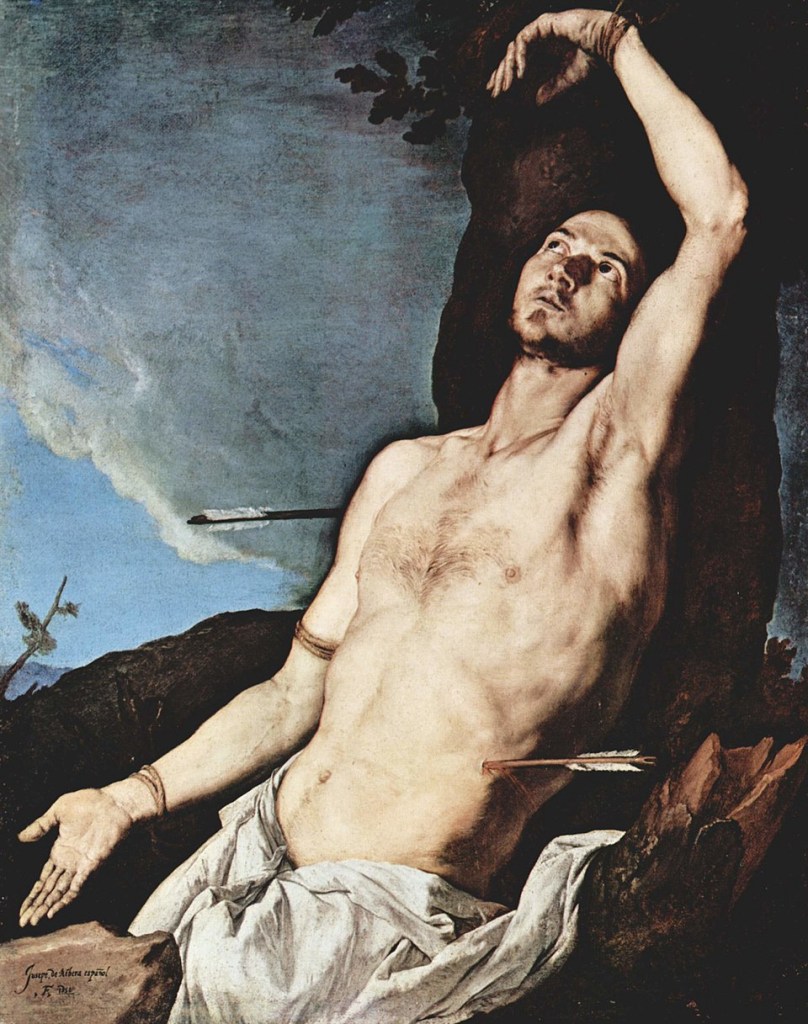
Image: Jusepe de Ribera, St. Sebastian, 1651, Museo del Prado, Madrid — rendered in dramatic chiaroscuro, Ribera’s Sebastian is muscular and mortal, his suffering grounded in flesh rather than idealized beauty.

Few figures in Christian art have captivated artists — and viewers — quite like St. Sebastian. The story is simple enough: a Roman soldier and secret Christian, Sebastian was condemned to death for his faith and tied to a post, shot through with arrows by his fellow soldiers. He miraculously survived, only to be executed later by beating. Yet, through centuries of retelling, the tragedy of his martyrdom has transformed into something far more layered — even sensual.

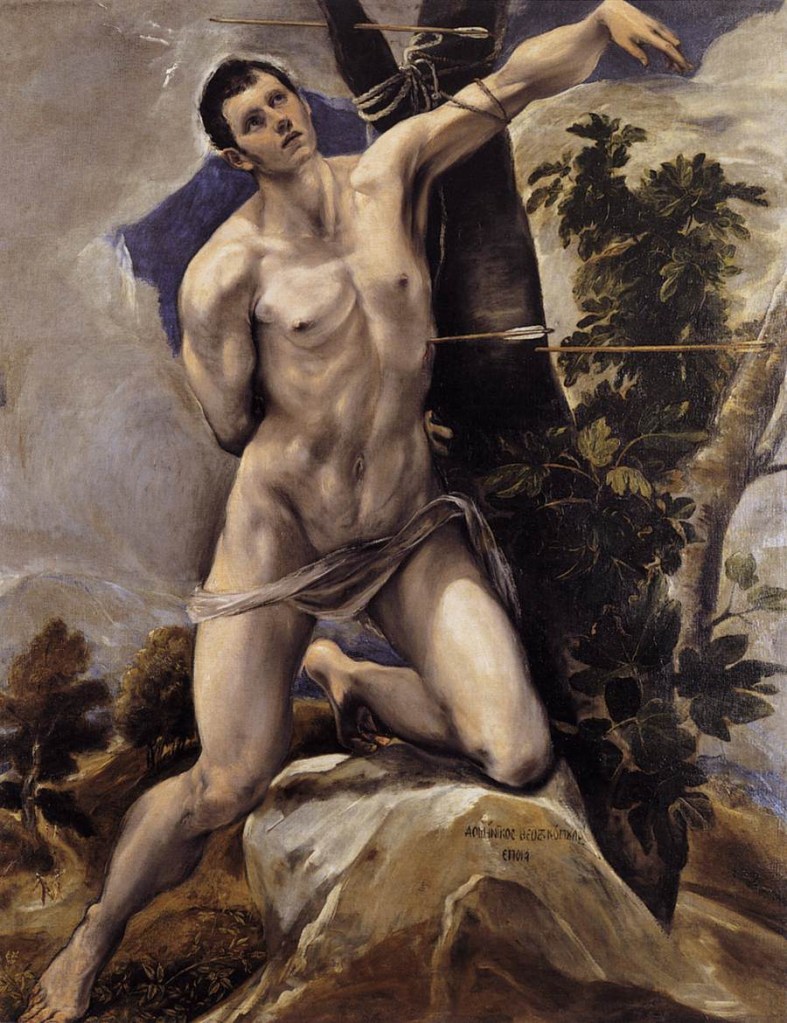
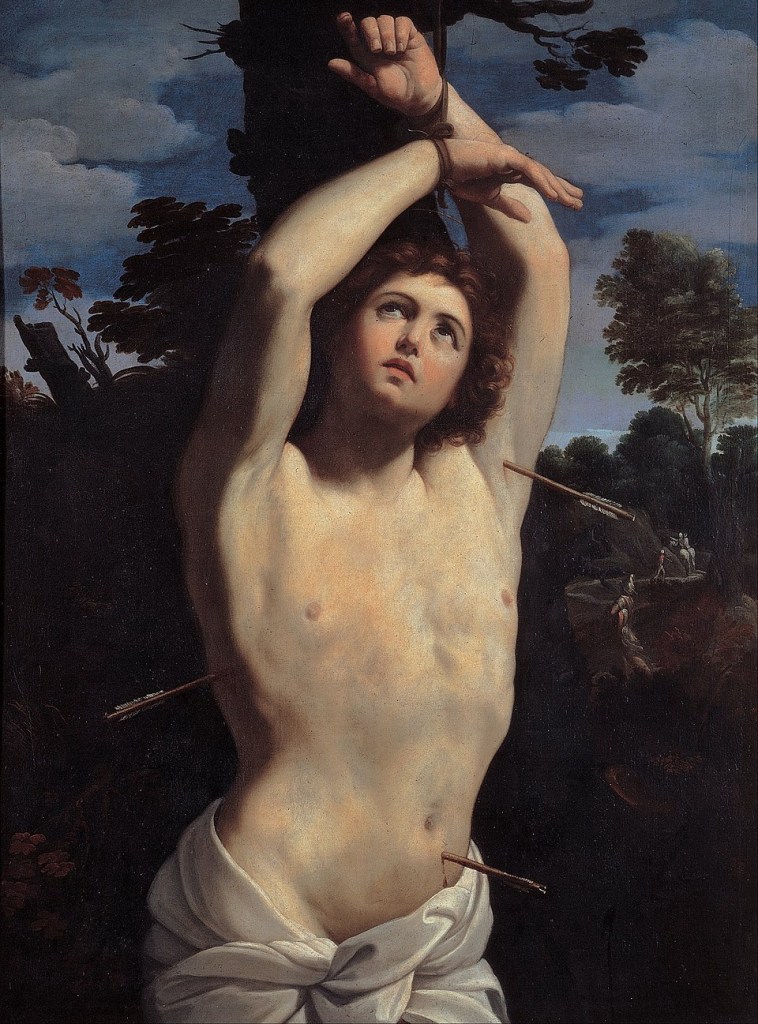
From the Renaissance onward, artists rendered Sebastian’s suffering with remarkable beauty. Painters like Andrea Mantegna, Perugino, and Botticelli turned him into an icon of idealized male youth — strong, nearly nude, his body pierced yet luminous. In later depictions by Guido Reni and El Greco, that same body seems to glow with a kind of erotic spirituality. The saint’s expression — serene, even enraptured — blurs the line between agony and ecstasy.

Image: El Greco, St. Sebastian, c. 1577–79, Cathedral of San Sebastián, Illescas — the saint’s elongated form and upward gaze merge suffering with divine transcendence.
Image: Guido Reni, St. Sebastian, c. 1615, Palazzo Rosso, Genoa — the most famous of Reni’s versions, his Sebastian glows with serene sensuality.

It’s no wonder that Sebastian became, over time, a queer icon — often called the “gay saint.” His imagery offered something radical: a male body displayed with vulnerability, sensuality, and beauty in a religious context. For centuries when expressions of same-sex desire were forbidden, these paintings became coded images of longing. The male form, sanctified through martyrdom, became a vessel for hidden desire.

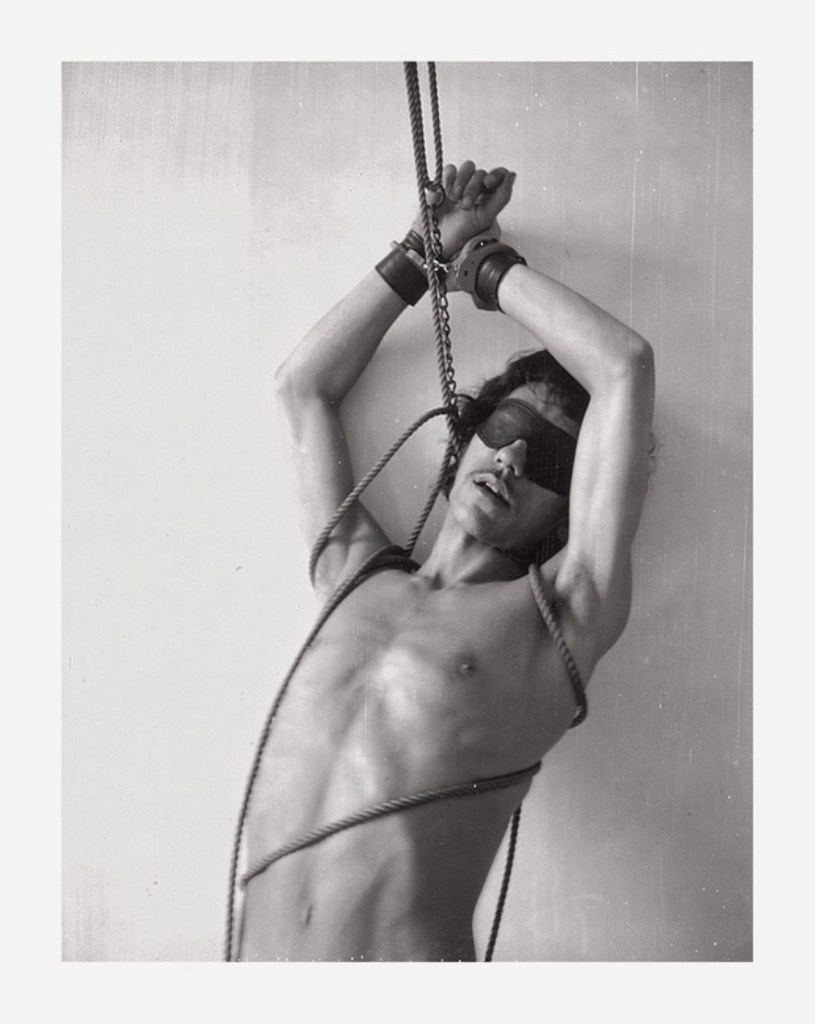
Twentieth-century artists and writers reclaimed him openly. Yukio Mishima, Derek Jarman, and photographers like Robert Mapplethorpe saw in Sebastian not just the suffering of faith, but the suffering — and resilience — of queer existence itself. His arrows became metaphors for persecution and for the piercing, transformative power of desire.

Image: Kishin Shinoyama, Yukio Mishima as St. Sebastian, 1968 — the novelist and playwright reimagines the saint’s agony through a homoerotic lens of beauty, discipline, and death.
Image: Robert Mapplethorpe, St. Sebastian, 1979 — a modern photographic interpretation that turns suffering into defiant beauty.
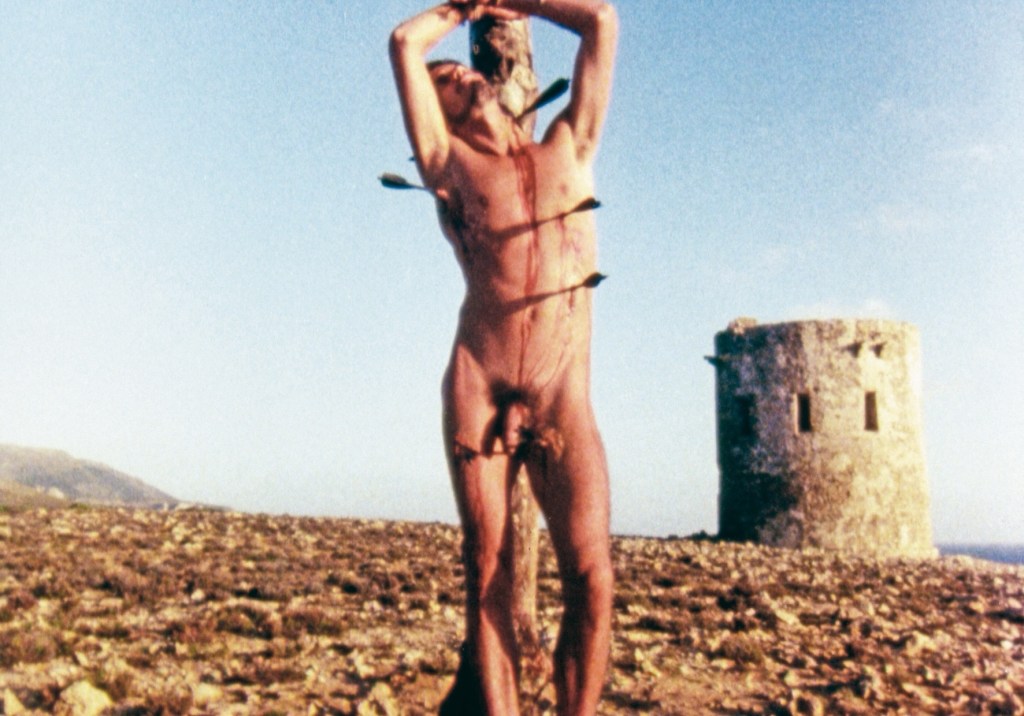
Image: Derek Jarman’s film Sebastiane (1976) — the first feature-length film entirely in Latin, reimagining the saint’s story through an overtly homoerotic lens.

There is, after all, a kind of paradoxical holiness in his image: a man struck down yet made radiant; punished yet beautiful; vulnerable yet defiant. Whether we read him as a symbol of endurance, forbidden beauty, or queer faith, St. Sebastian endures as the saint who invites us to see the divine not in denial of the body, but through it.

About St. Sebastian

Feast Day: January 20

Patron of: Soldiers, athletes, archers, and plague victims

Symbol: Arrows, tied tree or post, youthful male figure

St. Sebastian was a Roman officer in the Praetorian Guard who secretly practiced Christianity. When discovered, he was condemned by Emperor Diocletian to be shot with arrows and left for dead. Nursed back to health by the widow Irene, he later confronted the emperor and was beaten to death for his defiance. His legend spread quickly, and his image became a symbol of endurance, courage, and—through art—a timeless meditation on the beauty and vulnerability of the human form.


Melody in Your Heart

“Speaking to yourselves in psalms and hymns and spiritual songs, singing and making melody in your heart to the Lord;

Giving thanks always for all things unto God and the Father in the name of our Lord Jesus Christ.”

–Ephesians 5:19–20

I’ve known this verse by heart since childhood. In the Church of Christ where I grew up, Ephesians 5:19 wasn’t just a favorite scripture—it was a foundational one. The Church of Christ bases its practice of a cappella worship on this passage, interpreting Paul’s instruction to “sing and make melody in your heart” as a call to pure vocal praise without the accompaniment of instruments. The voice itself is the instrument God gave us, and the melody is meant to come from within.

As a teenager, I was our congregation’s song leader. I wasn’t particularly good at it, but with only thirteen members in attendance on most Sundays, I was the best we had after our older song leader, Mr. Wayne, could no longer lead because of emphysema. In a small rural congregation like ours, everyone had a role. The preacher usually led the first prayer, and my daddy always gave the closing one. I helped him pass the Lord’s Supper and the collection plate.

Our service never changed much: two songs while seated, then the prayer, followed by one song seated and a second song standing before the sermon. After the sermon came the invitation song, then communion and the closing song—usually just the first verse—before the final prayer. It was a rhythm as familiar as breathing.

I still remember my favorite hymns from Songs of the Church:

Amazing GraceRock of AgesSend the LightHow Great Thou ArtOld Rugged CrossBlessed AssurancePrecious Memoriesand I’ll Fly Away.

For invitationals, we sang God is Calling the ProdigalJesus Is Tenderly CallingNothing but the Blood, or Softly and Tenderly.

Our closing songs were nearly always I Know That My Redeemer Lives or Unclouded Day.

I even found an old index card tucked in my songbook recently, one of my services carefully written out:

There were no altos, tenors, or basses in our little church—just us singing from our hearts. The sound may not have been polished, but it was pure. Each voice rose in faith, carrying more sincerity than skill, and that, I believe, is exactly what Paul meant when he told the Ephesians to make melody in their hearts to the Lord.

When I reflect on Ephesians 5:19–20 today, I see more than just a theological argument about instruments. I see the heart of worship itself: that gratitude and melody begin within us. Paul isn’t prescribing what kind of music pleases God; he’s describing why we sing—to give thanks, to speak to one another in faith, and to let joy and hope find expression.

Whether accompanied by an organ or sung a cappella in a little white-clapboard church, true worship comes from a heart that overflows with gratitude. The melody Paul speaks of isn’t confined to vocal cords; it’s the harmony of a thankful soul resonating with God’s love.

And sometimes, when I’m alone and humming What a Friend We Have in Jesus or In the Morning of Joy, two songs that have gotten me through some of my toughest times, I still feel that same peace I knew standing before thirteen faithful souls, leading songs in that small country church where my faith was first formed.

At the end of every service, my daddy always gave the closing prayer. His words never changed much, but they carried deep comfort and familiarity. It was his way of sending us back into the world—asking God’s protection until we gathered again the next Sunday.

Prayer:

Lord, dismiss us as we leave Thy house, bless the ones not with us that they may be with us the next Lord’s Day. Guide, guard, and direct us. In Christ’s name we pray. Amen.


Renewal in the Midst of Aches

Do not be conformed to this world, but be transformed by the renewing of your minds, so that you may discern what is the will of God—what is good and acceptable and perfect.

—Romans 12:2

As I write this, I’m dealing with my usual reaction to the Pfizer COVID vaccine—headache, body aches, chills, and a migraine for good measure. It’s not pleasant, but I know from experience that it will pass, and by tomorrow I should wake up feeling fine. My body is working hard right now to protect me, and in that small reminder of how healing happens, I can’t help but think of Paul’s words to the Romans.

Transformation and renewal—whether of the body, the mind, or the spirit—are rarely comfortable. They require energy, patience, and faith. For LGBTQ+ Christians, that renewal often means shedding the false messages the world has pressed upon us and allowing God’s love to restore our sense of worth. It’s not always easy work, but it is holy work.

So today, as my body does its healing, I’m reminded that renewal often begins in discomfort. If you’re also in a season of weariness or change, take heart—God’s love is already transforming you, one tender act of grace at a time.

May you find peace and renewal today, even in your weariness.


The Cross Has Two Beams

“‘You shall love the Lord your God with all your heart, and with all your soul, and with all your mind.’ This is the first and greatest commandment. And the second is like it: ‘You shall love your neighbor as yourself.’ On these two commandments hang all the law and the prophets.”

— Matthew 22:37–40

In recent years, writers have contrasted two ways of thinking about morality in Christianity: vertical and horizontal.

Vertical morality measures righteousness by obedience to divine rules—what we do “upward” toward God. It’s the language of purity codes, of who’s in and who’s out. It focuses on sin as individual failure: what you drink, who you love, what you wear, how you pray.

Horizontal morality, on the other hand, measures faith by compassion—how we live in relationship with others. It’s the ethic Jesus embodied: touching lepers, feeding the hungry, lifting up the marginalized, and challenging systems of exclusion. It’s the moral vision of the Good Samaritan, who loved a stranger more faithfully than the priest and Levite who passed him by.

Writers like Phil Zuckerman and Randal Rauser have noted that what some call “MAGA Christianity” often confuses holiness with political power. When faith becomes about defending hierarchy rather than serving humanity, it loses sight of the Gospel’s radical equality.

Vertical morality alone lets people condemn LGBTQ+ Christians while excusing cruelty, greed, and injustice. It measures holiness by outward piety rather than inward compassion. As Jesus said of the Pharisees, “They tie up heavy burdens, hard to bear, and lay them on the shoulders of others; but they themselves are unwilling to lift a finger to move them.” (Matthew 23:4)

Jesus constantly redirected attention from vertical rule-keeping to horizontal compassion.

  • “Whatever you did for one of the least of these, you did for me.” (Matthew 25:40)
  • “Blessed are the merciful, for they shall receive mercy.” (Matthew 5:7)
  • “Let all that you do be done in love.” (1 Corinthians 16:14)

The Christian life is not a ladder reaching up to heaven—it’s a table stretching out to our neighbors. God doesn’t ask us to climb higher to prove our worth, but to reach wider to show God’s love.

For LGBTQ+ Christians, this distinction matters deeply. Too often, vertical moralism has been used to shame us for who we are, while ignoring the heart of Jesus’s message: “By this everyone will know that you are my disciples, if you have love for one another.” (John 13:35)

The cross itself is both vertical and horizontal—but the beams meet at love. The vertical reminds us that God’s love reaches down to us and our hearts rise to meet it. The horizontal reminds us that the measure of that love is how far we extend it toward others. When churches focus only upward, they risk becoming sanctuaries of self-righteousness instead of sanctuaries of grace.

True holiness isn’t found in who we exclude, but in how deeply we love.

This week, consider where your faith has been vertical when it might be called to be horizontal. Have we spent more time worrying about being “right with God” than being kind to one another? The beauty of horizontal faith is that every act of compassion—every word of encouragement, every defense of the marginalized—is an act of worship.

The cross has two beams for a reason. The vertical beam reminds us that God’s love flows freely between heaven and earth—unbroken, unwavering, unconditional. The horizontal beam stretches outward, calling us to carry that same love into the world. Together, they form the shape of the Gospel itself: love that reaches both upward toward God and outward toward our neighbor—a love wide enough to embrace us all.


Sanctuary

“You are my hiding place and my shield; I hope in your word.”

—Psalm 119:114

There are times when the world feels anything but safe for LGBTQ+ Christians. Many of us know what it means to hide — to keep silent about who we are because honesty might cost us family, friendship, or even faith community. And yet, the psalmist reminds us that God Himself is our sanctuary. This is not a hiding born of fear, but of peace — the holy refuge we can return to when there is no other refuge, the quiet assurance that we are known and loved completely. “God is our refuge and strength, a very present help in trouble” (Psalm 46:1). When others turn away, God remains steadfast.

When the world’s judgment feels loud, God becomes our shield — not only against the cruelty of others, but against the doubts that creep in from within. His word offers hope, not condemnation. The same God who made us in love still stands guard over our hearts. “Do not fear, for I am with you,” God says in Isaiah 41:10, reminding us that His presence never falters, even when human acceptance does.

I was reminded of this recently when some cousins from Alabama came to visit. They asked where I attended church in Vermont, and I explained that while there are very few Churches of Christ here, I’ve found it difficult to feel at home in any of them. The ones I tried were friendly, but very different from what I knew. So I told them, truthfully, that I do my own devotionals. I didn’t mention that those reflections have reached readers across the world. I simply said that I keep my faith alive in my own way.

Because I believe that God does not require a building or a pulpit to meet us. He asks only that we carry Him in our hearts. For some, a church building is a sanctuary. For others — especially those who have been told they don’t belong — sanctuary is found in quiet prayer, in Scripture, or even in writing words of faith to share with others. Whether we find that stillness in a sanctuary of stone or in the sanctuary of solitude, God is present all the same.

Whether you are in the closet or proudly out, whether you sit in a pew every Sunday or commune with God on a mountaintop, remember this: you have a refuge. You have a shield. You have hope.

God has not forgotten you — He has made Himself your sanctuary.

May we never mistake the world’s rejection for God’s absence. His sanctuary is not limited to four walls or a congregation, but open to all who seek Him with honesty and love. When faith feels lonely, may we rest in the promise that God is both our strength and our shelter — a very present help in every moment of need.


Train Up a Child

“Train up a child in the way he should go, and when he is old he will not depart from it.”

— Proverbs 22:6

When I look back on my upbringing, I can see how deeply this verse shaped me. My parents raised me to be good, moral, and honest. They taught me to love my neighbor and to respect those who deserved respect. They weren’t always strong on Galatians 3:28—“There is neither Jew nor Greek, slave nor free, male and female, for you are all one in Christ Jesus.” They believed, as many of us are taught, that we were somehow better than others. Yet they never taught me hate. On my own, I came to embrace Galatians 3:28 fully, and in doing so I saw how God’s love is meant to break down every wall we build between ourselves.

They did, however, instill in me the message of 1 Corinthians 13:13: “And now these three remain: faith, hope, and love. But the greatest of these is love.” That teaching runs like a thread through my life and faith.

It saddens me now to see them support political leaders who represent the opposite of everything they once taught me. I have told them this many times, but it only makes them angry. Since I came out, they have become increasingly conservative, moving further away from the love and compassion they once instilled in me.

Yet in the paradox of that pain, I have found myself drawn deeper into faith. I cling to Psalm 143:10: “Teach me to do your will, for you are my God; may your good Spirit lead me on level ground.” When those I love seem to turn against what they once believed, I turn back to God, asking Him to steady my steps and to keep me walking in love. And I remember Colossians 1:28: “He is the one we proclaim, admonishing and teaching everyone with all wisdom, so that we may present everyone fully mature in Christ.”

The Bible clearly teaches us equality, but it also reminds us that equality in Christ does not mean we won’t be separated on Judgment Day. In Matthew 25:31–46, sometimes called the Parable of the Sheep and the Goats or “The Son of Man Will Judge the Nations,” Jesus tells us that when He returns, He will divide the righteous from the unrighteous—those who lived out His commands from those who did not. Just before this, in the Parable of the Talents (Matthew 25:14–30), the master praises the faithful servants who used what they were given wisely, saying, “Well done, good and faithful servant.” That is what I hope to hear on Judgment Day.

Matthew 25:31–46 shows us what a righteous nation looks like: one that feeds the hungry, welcomes the stranger, clothes the naked, cares for the sick, and visits the imprisoned. It also shows us what a wicked nation looks like: one that ignores the needs of the most vulnerable. Tragically, the United States today more closely resembles the wicked nation than the righteous one. Jesus’s words in Matthew 25:40 are a clear warning: “And the King will answer and say to them, ‘Assuredly, I say to you, inasmuch as you did it to one of the least of these My brethren, you did it to Me.’”

My parents raised me to value honesty, respect, and love, and though they may have drifted from those lessons, I still hold to them. Scripture affirms that love is the greatest calling, that equality is God’s design, and that true righteousness is measured by how we treat “the least of these.” Nations and people alike will be judged by this standard. I choose to live the faith I was taught at its best, praying that my life reflects Christ’s command to love, so that in the end I might hear, “Well done, good and faithful servant.”