Category Archives: Resources

Courage Is Our Virtue and Freedom Is Our Goal


The UN Combating Discrimination Based on Sexual Orientation and Gender Identity


“As men and women of conscience, we reject discrimination in general, and in particular discrimination based on sexual orientation and gender identity…  Where there is tension between cultural attitudes and universal human rights, universal human rights must carry the day”

— UN Secretary-General Ban Ki-moon, New York, 10 December 2010.

Every day, around the world, individuals suffer discrimination, vilification and violent attack because they are lesbian, gay, bisexual, transgender or intersex (LGBTI). In more than 70 countries, homosexuality remains a criminal offence, exposing gay men and lesbians to the risk of arrest, imprisonment and, in some cases, torture or the death penalty.

While the Universal Declaration of Human Rights and United Nations human rights treaties do not explicitly mention “sexual orientation” or “gender identity”, they do establish an obligation on the part of States to protect people from discrimination, including on the basis of “sex … or other status.” UN treaty bodies, whose role is to monitor and support States’ compliance with treaty obligations, have issued a series of decisions or general comments[1] all confirming that such language is sufficiently broad as to encompass “sexual orientation,” effectively establishing sexual orientation as a prohibited ground of discrimination under relevant human rights treaties. This view has also been endorsed by 17 special procedures (independent experts appointed by the Human Rights Council to monitor and report on various human rights issues), as well as by the UN High Commissioner for Human Rights and the UN Secretary-General.

In a landmark speech on the subject delivered on Human Rights Day (10 December) 2010, the Secretary-General noted that “As men and women of conscience, we reject discrimination in general, and in particular discrimination based on sexual orientation and gender identity. When individuals are attacked, abused or imprisoned because of their sexual orientation, we must speak out…” He pledged to put himself “on the line,” promising “to rally support for the decriminalization of homosexuality everywhere in the world.”

Activities of the human rights office

OHCHR is committed to working with States, national human rights institutions and civil society to achieve progress towards the worldwide decriminalization of homosexuality and further measures to protect people from violence and discrimination on grounds of their sexual orientation or gender identity. While this work is still in its infancy within OHCHR, planned activities include:
  • Privately raising concerns and putting forward recommendations for reform in the context of dialogue with Governments.
  • Monitoring and bringing to light patterns of human rights violations affecting LGBTI persons in public reporting, including reporting produced by OHCHR field presences.
  • Engaging in public advocacy of decriminalization and other measures necessary to strengthen human rights protection for LGBTI persons, including through participation in events, speeches and press statements and newspaper articles.
  • Working with UN partners to implement various public information and related educational activities intended to counter homophobia and violence motivated by animosity towards LGBTI persons.
  • Providing support for the special procedures mandate-holders in the context of their fact-finding activities and confidential communications with Government.
  • Supporting the human rights treaty bodies, a number of which have addressed the issue of discrimination linked to sexual orientation in previous general comments and concluding observations and continue to highlight steps that individual States should take in order to comply with their international treaty obligations in this respect.
  • Providing support for the Universal Periodic Review, which provides a forum for concerns regarding the rights of LGBTI persons to be aired and for recommendations to be developed.
The Office’s work on LGBTI human rights is coordinated from OHCHR-New York.


1. Human Rights Committee (inter alia, Toonen v. Australia, 1994, Young v. Australia, 2003, Joslin v New Zealand, 2002, and X v. Colombia, 2007); Committee on Economic, Social and Cultural Rights (General Comment No. 14 of 2000, General Comment No. 15 of 2002, General Comment No. 18 of 2005); Committee on the Rights of the Child (General Comment No. 4 of 2003); Committee against Torture (General Comment No. 2 of 2008); Committee on the Elimination of Discrimination against Women (General Comment No. 28 of 2010)
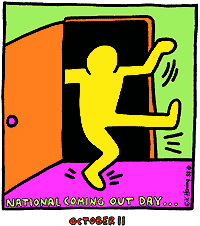
Tomorrow Is Coming Out Day!

Whether you’re lesbian, gay, bisexual, transgender or a straight ally, be proud of who you are and your support for LGBT equality this Coming Out Day!

In the Beginning, There Was a March

On Oct. 11, 1987, half a million people participated in the March on Washington for Lesbian and Gay Rights. It was the second such demonstration in our nation’s capital and resulted in the founding of a number of LGBT organizations, including the National Latino/a Gay & Lesbian Organization (LLEGÓ) and AT&T’s LGBT employee group, LEAGUE. The momentum continued four months after this extraordinary march as more than 100 lesbian, gay, bisexual and transgender activists from around the country gathered in Manassas, Va., about 25 miles outside Washington, D.C. Recognizing that the LGBT community often reacted defensively to anti-gay actions, they came up with the idea of a national day to celebrate coming out and chose the anniversary of that second march on Washington to mark it. The originators of the idea were Rob Eichberg, a founder of the personal growth workshop, The Experience, and Jean O’Leary, then head of National Gay Rights Advocates. From this idea the National Coming Out Day was born.

To this day National Coming Out Day (NCOD) continues to promote a safe world for LGBT individuals to live truthfully and openly.

The People of NCOD

The success of NCOD, which from inception quickly expanded to include participation from all 50 states and foreign countries, is because of the hard work of celebrities, volunteers and activists.

  • Rob Eichberg and Jean O’Leary were the originators of the idea of NCOD
  • Sean Strub and Keith Haring- In 1987, Activist Sean Strub got Haring to donate his now-famous image of a person fairly dancing out of a closet
  • Lynn Shepodd – In 1990, Shepodd, who later became a member of HRC’s Board of Governors, was hired as executive director and obtained tax-exempt status for the organization
  • Geraldo Rivera- In 1991, Geraldo Rivera hosted a coming out day TV program that featured Dick Sargent, a gay actor famous for playing Darren on Bewitched, openly gay California Assemblywoman Sheila Kuehl and Eichberg.
  • Wes Combs in 1994 was named HRCF’s project director for National Coming Out Day
  • Candace Gingrich, half-sister of then-House Speaker Newt Gingrich, became a National Coming Out Project spokesperson and full-time activist in 1995
  • Dan Butler, who played the character Bulldog on NBC-TV’s Frasier, was NCOD spokeperson in 1995
  • Rock musician Melissa Etheridge did a radio public service announcement, reminding people that “Labels belong on records, not on people.”
  • Del. Eleanor Holmes Norton, D-D.C., spoke at the “Come Out Voting” rally in Washington, D.C., Oct. 11, 1996.
  • Fashion photographer Don Flood in 1996 shot past spokespeople Bearse, Butler and Gingrich, along with Olympic diver Greg Louganis, actor Mitchell Anderson, newly minted gay activist Chastity Bono and Sean Sasser, who had appeared in MTV’s The Real World.
  • In 1996, actress Judith Light, pro golfer Muffin Spencer-Devlin and, in her first appearance at a gay rights event, Cher spoke at a Come Out Voting rally in Washington, DC
  • In September 1997 the project brought in its first straight spokesperson, Betty DeGeneres, mother of actress/comedian Ellen DeGeneres.
  • Patrick Bristow (formerly of the Ellen TV show), Dan Butler, San Francisco Supervisor Mark Leno, longtime activist Donna Red Wing, Betty DeGeneres, Gingrich and SF Mayor Willie Brown were featured in a 1998 NCOD event in San Francisco’s Delores Park
  • Chicago-native and founding member of the rock group Styx Chuck Panozzo celebrated a special homecoming in 2001 when he came out at the Human Rights Campaign annual Chicago dinner.
  • On National Coming Out Day, Oct. 11, 2002, a benefit CD featuring the songs of openly LGBT musicians and straight allies was released. Cyndi Lauper, Queen, k.d. lang, Jade Esteban Estrada and Sarah McLachlan are among the artists who donated songs to the album.
  • Etheridge’s name appears on a poster celebrating the 2002 theme along with 18 other openly LGBT artists, including Ani DiFranco, Michael Stipe, the Indigo Girls, RuPaul, Rufus Wainwright and The Butchies

Living Openly

However you identify, HRC and its Coming Out Project hope these guides help you meet the challenges and opportunities that living openly offers to each of us:

Find coming out guides and other resources

Are You a Straight Ally?

Check out A Straight Guide to LGBT Americans to learn about the emotional spectrum that people typically feel after someone comes out to them and find easy ways to learn more and demonstrate your support for LGBT Americans and equality.

Download the guide


Straight But Not Narrow

I came across information for the Straight But Not Narrow (SBNN) organization on SECRETGUYSTUFF’S BLOG. More about SBNN in a moment, but I did want to take a second to say that SECRETGUYSTUFF’S BLOG is one of the coolest blogs that I have come across in a long time.  It’s a blog about “It’s guys talking about guy stuff. You know, the inside stuff, the stuff we want to know about, the stuff we want to discuss, the experiences we want to share, and the questions we can’t ask our moms. So share it, dare it, enjoy it.” From discussions about lubes to masturbation myths to body hair to the various degrees of sexuality. It is a blog about all of the stuff that I wondered about as a teenager and young adult. I eventually found many of the answers on my own, but I wish this blog had been around back then. I still learn a few things here and there, and this blog is a fun way to learn about the secret guy stuff and it is also a bit nostalgic for those of us who have already experienced these points in our lives.  So before I begin to talk about SBNN, I wanted to introduce you guys to SECRETGUYSTUFF’S BLOG.

Straight But Not Narrow is an organization that was started by asking that very question.  There have been a number of great campaigns and charities that have recently emerged to show support to gay youth and teens. However, SBNN noticed one significant niche missing in the efforts. the message to the young, straight male. Its an unfortunate reality that most of the bullying and harassment that gay teens face comes from them. It is for this reason that we are building a campaign that is primarily directed to the young, straight male by using comedy and their peers to positively influence their views on LGBT teens.

SBNN was founded by Avan Jogia.  Avan, an actor, musician, writer, and big picture thinker. His idea, his passion, his voice started it all.

Back to school should be a fun time for everyone. The sad truth is, this can be a tough time for a LGBTQ students. Straight But Not Narrow are rally their troops to do their part in making sure this back to school is awesome for everyone, regardless of sexual orientation.

They are asking allies to make a pledge.  Here’s the pledge:

“I will do my part to make sure this is a great school year for everyone. It doesn’t matter if you are gay, straight, or somewhere in between. Just be you, because it’s all good with me”. I’m Straight But Not Narrow (the last line is optional if, of course, it doesn’t apply to you).

SBNN has also had a series of YouTube videos to get their point across.  Here is one by Ryan Rottman (who I had to look up too, but he is very cute).

Ryan Rottman (born March 17, 1984) is an American actor. He is best known for his role as Joey Colvin on the TeenNick series Gigantic, which premiered October 8, 2010.  Ryan Rottman started his career in 2008 as an extra in the film The House Bunny. Before that he starred in the plays at Texas Tech University. In 2009, he appeared in films The Stuntman and The Open Road. Rottman’s other television credits are Viva Laughlin, Greek, Victorious and the webisode series Valley Peaks.

One of the most fascinating things that I have found while teaching at the conservative little private school where I teach is that I often hear the girls in the school say that they wished they had a “gay best friend.”  It is generally said in response to a homophobic comment from one of the boys in the class and sometimes it is just random.  They don’t know that I am gay, and it is probably better that way (mostly because of school politics), but the students know that I don’t tolerate derogatory language in my class in any form.  Therefore, it often gives me a warm fuzzy feeling when the girls put the guys in their places when they are being insensitive.  I also find it particularly funny that there are a few of the girls who have said that, who I am almost 100 percent sure that their male best friend is actually gay, they just don’t know it yet.  We have a few students at school who either have not yet admitted it to themselves or are still in the closet because of home and school prejudices.  I try my best to teach all of my students acceptance of those things they do not understand.  People are far too often scared of things they don’t understand and that fear turns into prejudices.  It is a sad state of affairs, but it is something that I am working to change.


May-December Romances

The term “May-December Romances” refers to a romantic pairing where one person is significantly older than the other. The age difference is at least a decade, but often more. The phrase comes from the younger person being in the “spring” of his or her life (i.e., May), while the older partner is in his or her “winter” (i.e., December). In the gay community there often seems to be  a focus on youth, but when a gay man is out of their twenties, does age really matter anymore?

Several weeks ago someone requested a commentary on age differences. There are no real moral or ethical implications of dating a person older or younger than yourself. Most people do find an attraction to someone a few years older or younger. However, in this email that I received the man was referring to age differences of 10, 20, or 30 years. He is in his sixties and his partner is in his forties.

The first thing that needs to be determined is if there is an unhealthy reason for not choosing a person of ones similar age. This would be true of the predatory adult who needs to control and manipulate another person and therefore seeks a weaker type of person who sometimes is also younger. This type of predatory person is dangerous and may be violent. Though I don’t know a great deal about their relationship, the man that emailed me seemed very happy with his relationship and did not give any indication that there were any unhealthy reasons for their relationship, and I can’t see any reason that there should be.

I have no experience myself with a May-December relationship, but I know several men who are older than me, that if they lived closer to me, I would be all over them. An intelligent, cultured is the type of relationship that I have always wanted. I have no desire to be a gold-digger or a boy-toy (which I am too old for anyway), but to have a mature relationship that is not all about sex (though sex is a consideration in the equation) is the type of relationship I have always desired. Whether the person is older, younger, or the same age as I am, it is the connection of the minds that means more to me.

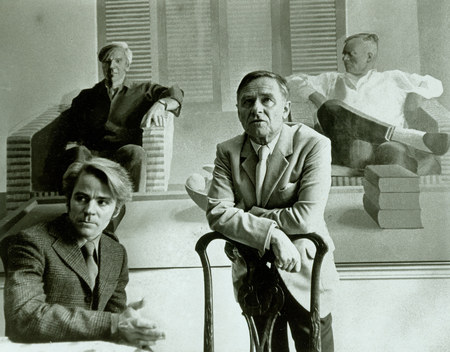
One of the most famous gay May-December romances is probably that of Christopher Isherwood and Don Bachardy. At forty-eight years old and already an esteemed British writer, Christopher Isherwood met 18-year-old Don Bachardy at Will Rogers State Beach in October 1952 and by early the next year, the two had begun an intimate relationship that lasted until Isherwood’s death in 1986. They were a high-profile, openly gay couple whose meeting coincided with one of the most homophobic decades in American history, the era of McCarthyism, when homosexuals were being driven out of the State Department.

Yet to the gay community at large, as well as those who were casually acquainted with the couple, Isherwood and Bachardy seemed to live an enviably idyllic existence in their hillside Santa Monica home, where they entertained the leading figures of the world of arts and letters, and the movie stars that Bachardy once sought out for autographs. For all that seeming perfection, Guido Santi and Tina Mascara’s loving yet clear-eyed documentary, “Chris & Don: A Love Story,” reveals that the couple worked hard and long to achieve their bliss.

Nowhere in this fine, quiet, richly-sourced documentary is the phrase “gay marriage” ever uttered. But then, the relationship at hand spanned three pre-political decades until 1986, when Christopher Isherwood died in L.A. Today, in the same gloriously sunny, cozy Santa Monica cottage they shared, his surviving partner Don Bachardy, a portrait artist, leafs through dozens of often nude sketches made during Isherwood’s last days—and even after his death. It seems perfectly natural, and the film includes even more dazzling visual records—photos and color home movies from Venice in the ’50s and of mingling with the stars back home (including Igor Stravinsky, Truman Capote, Tennessee Williams, Aldous Huxley, David Hockney, and John Boorman). And in a nice nod to Cabaret, which made Isherwood’s fortune, Michael York reads from the author’s letters and diaries. Chris and Don met at ages 49 and 18, respectively, on the beach, where Don and his older brother (also gay) were trolling for sugar daddies. Was that so wrong? Their relationship—and this movie—prove otherwise. Boorman comments, “Isherwood had succeeded in cloning himself.” To which Bachardy, speaking in the third person, agrees: “It was exactly what the young boy wanted.”


Who Decides What’s Right or Wrong?

We all know the Bible appraises self-worth according to strict sets of laws and hierarchies: Go to Hell if you covet the neighbor’s house, kill the neighbor, or take off with the neighbor’s wife.  It runs moral meanings smooth over broken fine lines that fall somewhere between fact and fiction and good and evil. God still hates figs and shrimp, right? It also often hides contradiction and its very own accommodating history under stories that once upon a time were not its own: Remember, Christmas and Easter grew from Pagan roots.


Unfortunately for us, the Bible and people’s interpretations of it can brew misguided thoughts about homosexuality. But it does deserve our attention. Its words read just like modern humans behave: We wake hand-in-hand with dissension; we evolve, yet still keep patterns of judgment close. And we all at some point in time ask, “Where did we come from? What’s the point?”
So where do the gays go from here?
Well, former United Methodist minister and Duke University seminary scholar, Jimmy Creech, suggests that maybe it’s time we re-evaluate what the Bible really says about homosexuality.
In Adam’s Gift: A Memoir of a Pastor’s Calling to Defy the Church’s Persecution of Lesbians and Gays, straight-identifying Creech defends same-sex love against the Church’s dangerous distortion of homosexuality as sin. He digs deep into Biblical texts, mines credible sense from scripture and history, and writes passionately about his decision to reconcile his stance on gay rights and same-sex marriage even though these things ultimately led the Church to revoke his ordination credentials.
What would Jesus do? Jimmy Creech might know.


Does the Bible condemn homosexuality?

No, it’s actually not possible for the Bible to say this in any way. First of all, the writers of the Bible had no understanding of the innate human trait of sexual orientation. Consequently, there were no words for homosexuality, bisexuality and heterosexuality. These words were coined in the late 1800s when the young science of psychology studied human sexuality and discovered that sexual orientation is an innate aspect of human personality. We’ve come to understand these three sexual orientations as equally normal, natural and healthy. There are a few references in the Bible to same-gender sexual acts, though all of them are condemned because of the context in which they are found: violent rape, idolatry, and promiscuity. There is, by the way, no condemnation in the Bible of same-gender loving relationships. However, because of the fear and prejudice against same-gender loving relationships, church leaders have used these condemnations of violence, idolatry and promiscuity to condemn same-gender loving relationships. If the logic used against homosexual sex acts was used in the context of condemned heterosexual sex acts, one could claim the Bible says “heterosexuality is a sin.” But, of course, no one does. 
Another issue at play is patriarchal culture. Men are considered the masters (the Hebrew for husband actually means “lord”) and women are inferior and subservient. Consequently, for a man to have sex with another man as men have sex with women violates the rigid gender roles and threatens the patriarchal culture. Such an act puts the submissive man in the woman’s role which from the biblical perspective is “abominable.” Interestingly, there’s only one biblical reference to women having sex with women (chapter one of Romans), most likely because the writers of the Bible (men) weren’t concerned about that – it didn’t threaten their patriarchal culture. 
The few references to same-gender sexual acts have thus been interpreted and used in ways to justify the persecution of LGBT people. In similar ways, passages in the Bible were interpreted in ways to justify slavery, white supremacy and racial segregation. The Bible denies equal rights to women because of its patriarchy and allowed the persecution and mass murder of Jews. Modern society has rejected the misuse of the Bible to justify these injustices even though each case is a form of abuse. Using the Bible to justify the persecution of LGBT people is no less an abuse and can no longer be tolerated. It’s intellectually dishonest, pure bigotry.

Can you explain how the word “homosexual” is misused in Biblical texts?

In First Corinthians and First Timothy, the Apostle Paul used Greek words that no one else had ever used – either before him or after him.  These words came to be associated with homosexuality in the late 13th Century after Thomas Aquinas condemned same-sex sexual acts in his writings. From then on, the Greek words in these two passages were understood to mean, a “man who has sex with a man.”  Because there was no Hebrew, Aramaic or Greek words (the three languages in which the Bible was written) for a “man who has sex with a man,” the term Sodomite was invented.  It is often found in translations, but has no basis in the languages of the Bible – it’s purely an example of bigotry written into those translations after the fact.
Aquinas was the first church teacher to associate the destruction of Sodom and Gomorrah with same-sex acts.  Before then, the destruction was attributed to the violent inhospitality and greed of the people of Sodom and Gomorrah.  A similar thing happened when the Revised Standard Version of the Bible was published in 1952.  Instead of using “a man who has sex with a man,” or the King James version, “them that defile themselves with mankind,” or Sodomites, the translators chose to use the modern term homosexual – even though there was no basis for it in biblical languages. Consequently, people who do not know this history innocently claim that the Bible says “homosexuals can’t inherit the kingdom of heaven” because First Corinthians says so; and, that “homosexuals” are contrary to sound doctrine. 
While careful study of these passages reveals no condemnation of same-sex loving relationships, the mass of people who read these passages without the benefit of careful study feel justified in condemning homosexuals. The harm that has been done to LGBT people by this scandalous scholarship cannot be exaggerated. 

Do you think Christianity will eventually embrace LGBT people in the future, however near or far?

Yes, mainline Christian communities will fully embrace the LGBT community with equal standing and participation in the nearfuture. Christian communities actually have come a long way toward this goal in a relatively short time. The Unitarian Universalist Association was the first in this country, soon after Stonewall. And now the United Church of Christ, the Presbyterian Church, USA, the Episcopal Church, USA, and the Evangelical Lutheran Church of America have all embraced the ordination of clergy in same-sex committed relationships and marriage for same-sex couples.
Even though the ecclesiastical leadership of the Roman Catholic Church remains adamantly against sexually active LGBT people, more than 74% of Catholic laity support same-sex marriage or civil unions with support for their full civil rights and equal protections. There will be some who will never accept same-sex relationships, but they belong to the past of fear and hatred, not the future of acceptance and equality.
What do you say to non-believers, atheists and agnostics? Do you see religion as something essential and necessary to humanity’s place in the universe?

No, I don’t believe religion is essential and necessary. Religion is an organized or structured expression of the innate wonder and awe human beings have about life, nature and time. This wonder and awe and the beliefs people have about it are not dependent on religious language and concepts. I find common ground with anyone who explores those big questions about life.
Being religious doesn’t guarantee a person will be good, nor does being a non-believer make a person bad. These are just two ways humans approach the mysteries of life. But, I do believe everyone who is aware and sensitive to what’s happening in the world, in their lives and the lives of others, has a keen sense of wonder and awe about it all. What really matters is how we treat each other.

Your memoir, Adam’s Gift, is about the United Methodist Church’s decision to revoke your ordination credentials after you performed same-sex commitment ceremonies. But what do you think the real gift was for you? 

Adam’s gift was the truth about himself – a truth he’d concealed for nearly 50 years of his life. It was a gift because it opened my eyes to a reality I’d not seen before – a persecution of LGBT people in which I unknowingly was complicit. It was his humanity, his dignity and integrity, his gentleness and humility that would not allow me to rely on my conventional stereotypes and prejudice about the gay community. While there was much study and understanding I had to pursue afterward, Adam transformed me in the moment he revealed to me his true personhood and personal history. He gave me his most precious gift: His personal truth. 
How do you feel about Christianity’s position in US politics? It’s sad, but a holier than thou attitude still marginalizes the LGBT community.

It’s not possible to speak of “Christianity” as if it is one set of beliefs and values. Today, Christianity is not a term that has meaning because of the diversity within and among Christian groups. The Christians with whom I’m aligned are progressives. There are large numbers of moderate Christians too. And, there are Christian reactionaries who have found a political home in the Republican Party. The attack on LGBT people by many Christian reactionaries is sincere – meaning, it is an expression of their real fear and prejudice. However, right-wing politicians cynically exploit this bigotry for political ends (Karl Rove and George W. Bush). I believe that the political strategy of exploiting anti-gay bigotry is coming to an end. With marriage equality in a growing number of states, with the repeal of DADT, and the current discussion of the Respect for Marriage bill, the momentum is toward inclusion and acceptance, not exclusion.  Even some right-wing Republicans are saying their party should no longer talk about gay issues. 

How do you think we can change the way other people less understanding think about LGBT people?

People I know who’ve changed their hearts and minds about gay people have done so because they got to know someone who is gay. They didn’t change because of a good argument or debate about the Bible. They changed because they couldn’t reconcile their fear and hatred with the dignity and character of someone they discovered to be gay. Sometimes, this is a new acquaintance whose respect is earned over time.  Sometimes, it’s someone loved for a lifetime. So, the gift Adam gave to me is a gift all lesbian, gay, bisexual and transgender people can give to someone – a parent, sibling, child, neighbor, pastor, friend or colleague. LGBT people should not undervalue the power of their own dignity and integrity. There are, of course, some people whose minds and hearts will never change.
In addition, those of us who are straight must challenge anti-gay bigotry and malice whenever we encounter it and challenge elected officials who perpetuate persecution. An unjust world belongs to all of us, and all of us have an obligation to end the injustice.

Homophobia Associated with Penis Arousal to Male on Male Sex

Recently in a Psychology Today’s Blog post “Homophobic Men Most Aroused by Gay Male Porn” discussed a 1996 study of homophobia by psychologists at the University of Georgia.  Yes, the research is 15 years old, but in light of several recent anti-gay rants in the news, I couldn’t help but be intrigued by Nathan Heflick’s latest post at Psychology Today.  Here is the abstract of the study:

The authors investigated the role of homosexual arousal in exclusively heterosexual men who admitted negative affect toward homosexual individuals. Participants consisted of a group of homophobic men and a group of nonhomophobic men; they were assigned to groups on the basis of their scores on the Index of Homophobia (W. W. Hudson & W. A. Ricketts, 1980). The men were exposed to sexually explicit erotic stimuli consisting of heterosexual, male homosexual, and lesbian videotapes, and changes in penile circumference were monitored. They also completed an Aggression Questionnaire (A. H. Buss & M. Perry, 1992). Both groups exhibited increases in penile circumference to the heterosexual and female homosexual videos. Only the homophobic men showed an increase in penile erection to male homosexual stimuli. The groups did not differ in aggression. Homophobia is apparently associated with homosexual arousal that the homophobic individual is either unaware of or denies.

You can read the full study here (pdf file).  Henry E. Adams, Lester W. Wright, Jr., and Bethany A. Lohr of the University of Georgia make an interesting argument.  Even a man who thought that women want to have sex with their fathers and that women spend much of their lives distraught because they lack a penis is right sometimes. This person, the legend that is Sigmund Freud, theorized that people often have the most hateful and negative attitudes towards things they secretly crave, but feel that they shouldn’t have. If Freud is right, then perhaps men who are the most opposed to male homosexuality have particularly strong  homosexual urges for other men.

The facts of the study are this:  When viewing lesbian sex and straight sex, both the homophobic and the non-homophobic men showed increased penis circumference. For gay male sex, however, only the homophobic men showed heightened penis arousal. Heterosexual men with the most anti-gay attitudes, when asked, reported not being sexually aroused by gay male sex videos. But, their penises reported otherwise.  Homophobic men were the most sexually aroused by gay male sex acts. 

How do you feel about this study?

If you would like to read more about this study, you can check out my suggested readings by clicking “Read More” below.


Resources and Further Reading:


Via, Veritas, Vita

The Way, The Truth, and The Life—John 14:6

Final Thoughts

I hope that I have given us all something to consider whether you are a fellow gay member of the Churches of Christ or of any other denomination or sect of Christianity.  I have not written anything in these posts that I do not firmly believe myself.  I do believe that Jesus is “the way, the truth, and the life.”  My journey to self acceptance was a long and torturous journey.  When I was sixteen, I took a handful of pills hoping that the agony that I felt would finally be over.  I did not know why I was different.  I did not yet at that time understand homosexuality.  I also did not understand the never-ending love that God has for me and all of humankind.  I thank God each and every day for me being unsuccessful on that day nearly twenty years ago.

Once I understood that the feelings I was having probably meant that I was homosexual, I had to come to terms with that.  It was not easy.  I had never once in my life been told that it was okay to be gay.  One of the early books I read while trying to figure all of this out was one called Finding the Boyfriend Within: A Practical Guide for Tapping into Your Own Source of Love, Happiness, and Respect by Brad Gooch.  Who is the Boyfriend Within? Simply put, he embodies “qualities we find attractive in ourselves but often imagine others to possess more fully, as well as … dormant qualities we wish to nurture and grow.”  The main lesson I learned from this was the technique where you basically schedule a date with yourself.  You dress nicely, cook a wonderful meal, and have a romantic evening with just you.  At first, I thought this would be my answer.  I could love myself and be content with a celibate life.

That was not the answer.  I still wanted the love of another man, and I still do want to find that man.  I wanted to feel another man in my arms, to be held by another man, to kiss another man, to make love to another man, etc.  These were all things I longed for, and things I could not give myself.  However, the struggle that I ultimately faced was: What would my family say?  How would God judge me?  So I began to pray and mediate on the subject.  I did what research I could back then, though I am a much better researcher now (thank you, graduate school).  What I came to realize back then was that God will always love me and never forsake me.  Though I won’t claim that God spoke to me like a burning bush in the desert, I do believe that the Holy Spirit allowed my heart to understand.  My faith could/would/will remain strong and never waiver.  It never did and never has.  The question was whether or not I could act on my homosexuality.  And at certain points I have been very promiscuous, which I do not think God smiled upon, but he did forgive me, and that is the most important thing.  God forgives.  God loves. God will not forsake us.

I love what Justin O’Shea had to say in a recent post in his blog Justin Dunes:

Let me tell you, briefly, I hope, what is at the bottom or foundation of me.  I’ve worked on this and as we joke about here “I am a work of art in progress. . . .always becoming.  .”  I hold fast to this.  We are created in the image and likeness of God. Love does such things. . .Love engenders and creates love.  Being a gay man is part of God’s gift to me. . .how I live this out is my gift to God. . . .and to others.. . .because to be real  ‘religion is relationships – God… Justin . . .and everyone else.’
How I love is how I live and vice versa.  I believe too that God has given me all I need to become. . .grow into the man He created me to be.  All I have to do is use what I have been given. . .and. . .as I use and share this I receive more to keep on going. .
 

One of the most important reasons that I was able to come to these same conclusions is through the loving relationships I had with my friends who welcomed my sexuality and never, not once, made me feel bad about it.  My family has been another struggle, one that I hope I will be able to resolve some day.  If you are struggling with sexuality and religion, then know that I am here to help.  I started these posts to reach out to other GLBT Christians and to GLBT members of the Churches of Christ.  I know there are other GLBT members of the Churches of Christ out there, and I do hope that they eventually come across these posts.  We need the strength that friends can supply, we need the strength that God can supply, and we need the strength that our GLBT community can supply.

Thank you for reading, and God Bless You.
I feel like there should be an AMEN in there somewhere, LOL.

Vince Malum Bono

Overcome Evil with Good (Romans 12:21)

What We Should Do As Gay Christians?


How do we move forward from here?  First of all, we must realize that not all heterosexual Christians hate us.  Yes, there are fundamentalists who will always hate us, and not much can be done to stop them.  Their answers are not for us. There is no need to pretend to ourselves and others to be straight.  There is no need to turn to celibacy, especially when we are in a committed relationship.

Dr. Randall Maddox, a professor at Pepperdine University, makes some great points about the Bible and homosexuality.  In an article in the Pepperdine student newspaper, Graphic, Maddox states:

As I understand it, the Bible says nothing about homosexuality as we use the term today.  It neither accepts nor rejects it, and, yes, I am very aware of the biblical passages that appear to address the issue.  To decide what we should do with it, I believe we must look to broader biblical principles that might seem unrelated on the surface. 
This should not be disconcerting, for we have already done this on a number of issues.  Slavery is an issue about which we have drawn conclusions that contradict the accepted practice of all societies in scripture and effectively dismiss some of God’s specific commands.  To condemn slavery requires that we call on scriptures that do not address it, and discount those that do address it by appealing to overriding biblical principles. 
There are many other such questions, past, present and future.  Interracial marriage, whether women must wear veils in church and whether they are allowed to speak, whether men may have long hair, divorce and remarriage, when life begins, genetic engineering and cloning, environmental issues, the pros and cons of a capitalistic economy, globalization, poverty, genocide, and how we should relate to extraterrestrial life if we ever encounter it — all these are examples of issues that are either not addressed in scripture, or are very muddy.  We would shudder if someone suggested we follow the clear scriptural teachings and examples on such things as women’s issues or genocide.  We must not approach any of them simplistically.

For a mathematics professor, he makes a lot of sense.  (Lame attempt at a joke; I never was great at math.) The truth is, our interpretations of the Bible have changed.  We just need to be logical and knowledgeable about the Bible.  If we are able to answer their rhetoric we can make convincing arguments.  Those who do not have faith will find it difficult to debate religion with authority because they do not hold the faith that we have. Even though many non-believers are very knowledgeable about religion, most religious people will not take credence to their words merely because they do not have faith.  Therefore, we have to speak the language of our persecutors and know how to refute them.

So I want to end this post with a few last thoughts from Professor Maddox in his response to another article by Pepperdine Accounting Professor Marilyn Misch, who had written an article stating that homosexuals should remain celibate. (The entire foundation of Dr Misch’s article lies in the following syllogism:  All sexual relations outside of marriage are sin.  Homosexual relations are (by definition) outside marriage.)  Here are Professor Maddox’s final remarks:

[First,] the reality of homosexuality is very difficult to sort out in the context of faith, even if one is forced to face it in a loved one, or in oneself.  Many faith traditions are addressing the question, are at different points on the journey, and are drawing different conclusions as they go.  I am not claiming here to present definitive answers to the biblical questions.  I am merely proposing that Dr. Misch did not present them either. 
Second, it is against my nature to write as I have written here, especially when I realize how incompletely I have addressed a complex issue.  The reason I must write is that I feel for the many readers of Dr. Misch’s article who are struggling with the reality of homosexuality in the context of faith, only to find their situation, indeed their entire selves, reduced by her article to a simplistic and faulty syllogism, implying that their entire sexual and romantic natures are nothing more than an inclination to sin.  Such undiscerning judgment has done much damage to struggling Christians.
This judgment has reduced many people to despair and led to their ultimate suicide.  And it was not because they lacked a support structure to resist temptation; it was because the romantic attraction and, yes, the love they felt for another was called sinful, and absurdly compared to such things as the addiction of alcoholism, the predatory abusiveness of pedophilia, or the birth of a retarded child.  In their hearts these struggling people wondered if their love was really like these tragedies. 
Furthermore, I know of many deeply religious people who threw away their faith, either because the dichotomy produced by simplistic exegesis was the source of irreconcilable internal contradiction, or because they tired of the naïve and undiscerning arguments presented by those who clearly could not understand their situation but claimed to represent God. 
Finally, I do not want us to be polarized by the issue of homosexuality.  Simplistic arguments in black and white can only polarize a community.  Life and faith are much more colorful and complex than Dr. Misch’s article suggests, and there will always be questions to which we do not have completely satisfying answers.  As a mathematician, I find such inconclusiveness disconcerting.  But I believe we must be willing to live with some inconclusiveness, even on matters as volatile as homosexuality, and even when it produces dissonance within our own hearts and disagreements between us. 
We all have much to learn, and much we have never experienced.  I accept that some questions do not have clear answers, and I have learned to live with the dissonance, not because I am content with it or because it allows me to live how I please, but because I am on a journey of faith.  God is leading me somewhere, and I am doing my best to follow.

The next post will be my final post in this series on Religion and Sexuality, and after that, we will return to our regularly scheduled program.


Deus Caritas Est, Veritas Est Amor

God is Love, Truth is Love

If anyone says that “God hates…” then stop them there.  God loves. In one of the articles (Copeland’s “Homosexuality: A Christian Perspective”) that I read in my research, which initially started out promising, the author’ss main thesis ended up being that God gives up on homosexuals that have gay relationships.  My initial reaction what “what the hell?” though I didn’t use hell, I used another four letter word that isn’t appropriate for a discussion of religion.
Copeland, the misguided Church of Christ minister that I mentioned yesterday, wrote that:
Three times in this section we find the expression “God gave them up (over)” (Romans 1:24,26,28). The point is clear: when people choose to reject God, or to recreate Him in their own image, God “gives them up” to “go their own way.” Unrestrained by God in any way, they gravitate into increasing levels of immorality! For some, it involves heterosexual immorality, such as pre-marital sex or adultery. But for others, it includes homosexuality and lesbianism.

I will never understand Copeland’s belief that God gives up on homosexuals.  Of all of the statements that I read in my research, this is THE most ludicrous. However, his statements only became worse:

And what is the consequence of such behavior? The apostle Paul referred to such people as: “…receiving in themselves the penalty of their error which was due.” (Romans 1:27) An illusion to sexually transmitted diseases such as AIDS? We cannot say for certain, but none can dispute that those who are willing to follow God’s Word as to sexual conduct have less to fear about STD’s than those who choose to disregard Him!

Matthew 5: 1-12, known as the Beatituteds is the best refutation of these statements by Copeland.  Read them and consider for yourself:

And seeing the multitudes, he went up into a mountain: and when he was set, his disciples came unto him: And he opened his mouth, and taught them, saying,
Blessed are the poor in spirit: for theirs is the kingdom of heaven.
Blessed are they that mourn: for they shall be comforted.
Blessed are the meek: for they shall inherit the earth.
Blessed are they which do hunger and thirst after righteousness: for they shall be filled.
Blessed are the merciful: for they shall obtain mercy.
Blessed are the pure in heart: for they shall see God.
Blessed are the peacemakers: for they shall be called the children of God.
Blessed are they which are persecuted for righteousness’ sake: for theirs is the kingdom of heaven.
Blessed are ye, when men shall revile you, and persecute you, and shall say all manner of evil against you falsely, for my sake. Rejoice, and be exceeding glad: for great is your reward in heaven: for so persecuted they the prophets which were before you.

These are not the words of Paul or one of the disciples, these are the words of Christ.  Few, if any, Christians would deny that these are the words of Christ.  The “Sermon on the Mount” as found in Matthew Chapters 5-7, are the cornerstones of the Christian faith.  In the “Sermon on the Mount” Jesus laid out for us the plan for salvation and eternal life.  It is our guidebook, and we should take it seriously.

Also, we can use the Epistles of Paul as our guide to the truth of God’s love.  In Ephesians 4:15, Paul says “But speaking the truth in love, may grow up into him in all things, which is the head, even Christ.”  We who profess to be Christians should remember the admonition of the apostle Paul when it comes to sharing God’s Word with those with whom we differ:

“And a servant of the Lord must not quarrel but be gentle to all, able to teach, patient, in humility correcting those who are in opposition, if God perhaps will grant them repentance, so that they may know the truth, and that they may come to their senses and escape the snare of the devil, having been taken captive by him to do his will.” (2 Timothy 2:24-26)

There is no place for a self-righteous, arrogant attitude on the part of those who but for the grace of God would be just as guilty of sins as those we are trying to reach!

In June 2002, Dr. Larry Keene, a founder of the “Church of the Valley” in Van Nuys, California, presented a lecture, “How Our Church Dealt with Gay Christians” at Pepperdine University, a Church of Christ school, where about 300 people attended the Convocation that was sponsored by Amnesty International in cooperation with Pepperdine’s Gay-Lesbian-Straight Alliance (GLSA).  The Pepperdine student newspaper, Graphic, published several articles (letters to the editor) about this lecture.  In one of them, a student, Jared Stuart, wrote an article titled “Pro-Con: Does the Bible accept homosexuality?” In this article, Stuart states that

One young woman rose up with the Bible in her hand and began defending her theological position. It became apparent that the Bible was the theological source of authority for most in attendance. It became even more apparent that many in the audience viewed the Bible as a literal, evangelical and fundamental source of authority.
Their point of view disabled them from seeing a contrasting perspective. They were there to defend the truth. But does the truth really need defending? Does not the truth eventually stand the test of time, and will it not eventually become self-evident within human consciousness regardless of whatever authority stands against it?

Stuart continued by stating:

Throughout the Bible there are equal and opposite points of views for any one subject. This dual perspective allows us to grapple with the very nature of God, and thus respond like he would in our daily lives.
I do not think it was his intention for us to handle the modern issues we are facing by using canonized letters, written among sister churches 2000 years ago, as a source of legal code for today’s events.

And one of my favorite passages from this article, Stuart states:

It is for this exact reason, conversely, that we must not use time-encapsulated passages within the Bible to condemn the practice of homosexuality, an orientation which has existed within nature and society for as long as humans can remember.
Common sense leads a human being to the conclusion that monogamous homosexuality is just as moral as monogamous heterosexuality. Perhaps not as common, but certainly as moral.
When one ceases to view the Bible from a literal, evangelical and fundamental perspective, one does not cease to see Christ as his or her complete Lord and Savior. I would wager to say that one sees him as Savior even more. This is the church’s responsibility and duty — to convey to believers the noble right and awesome task to use the Scriptures wisely.

We may not be able to use the Bible as our final authority on sexual orientation. But as we search for the truth, we can and should use the Bible as our final authority on how we should treat one another along the way. A young Jewish scholar once asked Jesus:

Master, which is the great commandment in the law? Jesus said unto him, Thou shalt love the Lord thy God with all thy heart, and with all thy soul, and with all thy mind. This is the first and great commandment. And the second is like unto it, Thou shalt love thy neighbour as thyself. On these two commandments hang all the law and the prophets. (Matthew 22: 36-40)

We cannot let hate consume our faith.  Too often, ministers preach about what is wrong.  They should be teaching what is right.  As I have said before, one of the great things about my personal minister is that he preaches/teaches about how to be better humans and Christians, not the hellfire and damnation that too many ministers make the cornerstone of their sermons.  Remember, God is Love, Truth is Love, and as Christians, to love God is the greatest of commandments.

My next post will examine what we should do as Gay Christians.


Veritas Vos Liberabit

The Truth Shall Set You Free—John 8:32
What’s the Truth About Homosexuality?

I have a friend from graduate school, who is Catholic, who always said that the only problem he had with homosexuality was that they could only have pre-marital sex. Since gay people could not be married, they could not have marital sex.  Now I do have to give a caveat here:  My friend is from San Francisco and is a married heterosexual, and he was just as much a promiscuous fornicator before his marriage as the rest of us, but because he is now married he believes that he can take the high road.  I’m not faulting him on this, just stating the facts.

Being a member of the Church of Christ, this is really a non-issue because marriage is not a religious sacrament within the church.  Marriages are recognized whether they are performed in the church by  a minister or by a secular authority.  The only true doctrinal differences my friend and I had was over the idea of a Pope and the Eucharist.  He firmly believed, as most Catholics do, that the Eucharist, or the Rite of Transubstantiation, the change, in the Eucharist, of the substance of wheat bread and grape wine into the substance of the Body and Blood (respectively) of Jesus, while all that is accessible to the senses remains as before.  The Church of Christ, as does many Protestant churches, believe that the Lord’s Supper is a merely symbolic act done in remembrance of what Christ has done for them on the cross.  Sorry for the Catholics out there (no offense is meant), but I have always seen the Eucharist/Communion as symbolic and really do not see the difference because Catholics will still say that all that is accessible to the senses remains the bread and wine as before. (A side note, our church does use grape juice instead of wine mainly because we have underage people who are members of the church.  In the past, the lady who always put together the communion would occasionally use her own home-made muscadine wine if she had not been to the store that week to get the grape juice. It was always quite fun to see the look on people’s faces when they realized this substitution.)

With this introduction aside, there is still much controversy going on as to whether homosexuality is genetic or environmental in origin. (If you have been reading these posts, then you know that I believe/know that homosexuality is genetic and natural.) Many theologians believe it should be easy to understand why, for if “God made them that way” then it is not their fault they are homosexual and it must not be a sin to act out their desires. I personally do not need any research that might suggest a genetic origin as a defense. Many Christians believe that it is either environmental or that there is a predominance to be homosexual and thus can be “resisted.”

The Components For Developing A Predisposition To Homosexuality


Tim LeHaye wrote a book called The Unhappy Gays: What Everyone Should Know About Homosexuality.  LeHaye believed that there were components that were the basis for developing a predisposition to homosexuality.  He stated that a person can (and many do) have all these components and still not be a homosexual. As listed and described by LaHaye, these components include:

  • A Melancholy Temperament
  • Inadequate Parental Relationships
  • Permissive Childhood Training
  • Insecurity About Sexual Identity
  • Childhood Sexual Trauma
  • Early Interest In Sex
  • Youthful Masturbator And Sexual Fantasizer
Mark A. Copeland, a sadly misguided minister of Fortune Road Church of Christ in Kissimmee, Florida uses LeHaye’s components for developing a predisposition to homosexuality and uses the following formula:
A Predisposition Toward Homosexuality
Plus
That First Homosexual Experience Multiplied By Pleasurable and Positive Homosexual Thoughts
To Which Is Added
More Homosexual Experiences
Multiplied By
More Pleasurable Thoughts
Equals
A Homosexual
Copeland states that “when one already has a “predisposition” towards homosexuality, exposure to homosexual experiences and pleasurably reflecting upon them can create a powerful attraction difficult to overcome.”  He goes further by stating that “so powerful can these experiences and reflections be that one not even need to have developed a ‘predisposition’ to be drawn into this sort of behavior.
LeHayes and Copeland’s argument is not hard to dispute. Let’s look at these so-called components for developing a predisposition to homosexuality:
  • A Melancholy Temperament:  Yes, I and many others in the GLBT community do have a “melancholy temperament,” which I think of as the genetic tendency for depression. My mother suffers from depression and so do I.  However, Prozac is a wonder drug and has helped me combat this.  Did this have anything to do with my homosexuality? NO!
  • Inadequate Parental Relationships:  I had wonderful relationships with my parents.  I may not have had the best relationship with my father, but what son doesn’t often disagree with their father?  Go back and read my Father’s Day post to see more of our relationship. Did this have anything to do with my homosexuality? NO!
  • Permissive Childhood Training: My parents were quite strict with me growing up.  There was very little if anything that I was allowed to get away with.  My mother was a nurse and being the second child, my early childhood development went easily but was handled firmly by my parents.  I know that some people who were raised too strictly grew up to be quite wild.  Think of any preacher’s kids that you know.  I was not raised that strictly, but strict enough with a set of values that I still cherish.  Did this have anything to do with my homosexuality? NO!
  • Insecurity About Sexual Identity:  I never thought I was a little girl.  I have an older sister, who was my main playmate growing up, but she was very much a tomboy and we explored the countryside around our house.  We climbed trees, played games, etc.  I did not play with dolls, nor did I play with toy trucks either.  I loved G.I. Joe.  How more American boy could you be?  I never dressed up like a girl or put on make-up.  I never did any of those things that are seen as insecurities about sexual identity.  I was a boy, and I loved the fact that I had a penis.  Did this have anything to do with my homosexuality? NO! Well, okay maybe the love of my penis, but that had nothing to do with sexual identity. It juts meant that I was proud to be a boy.
  • Childhood Sexual Trauma: None whatsoever. There is nothing more to say about that.
  • Early Interest In Sex: Not really.  I didn’t even understand about sex until I was a teenager, when my sister explained to me what it was.  I was fairly naïve and did not even really know what homosexuality was until I was in my teens and past puberty. I knew I had feelings for guys, but didn’t know what it meant.
  • Youthful Masturbator And Sexual Fantasizer:  In this instance, does “youthful” mean pre-puberty or post-puberty.  If LeHaye is speaking of puberty onward, then we are all youthful masturbators and sexual fantasizers.  I have only ever known one guy who did not masturbate (but he did have a lot of sex).  He did not masturbate because his father was a Baptist minister, and he had been taught that masturbation was a sin.  Instead, he had lots of sex with different girls and did not consider a handjob as a form of masturbation.  I first masturbated around the age of 13 when puberty was in full swing. (It came as quite a surprise to me when semen [which I had no idea what it was] came out of my penis after my first attempt, but it was a lot of fun and like most young guys, it became a somewhat regular routine.)  Did this have anything to do with my homosexuality? NO!
What We Should Really Be Considering

The Bible is completely silent on the issue of homosexual orientation. And no wonder. Homosexual orientation wasn’t even known until the 19th century.

The discovery that some of us are created and/or shaped in our earliest infancy toward same-gender attraction was made in the last 150 years. Biblical authors knew nothing about sexual orientation. Old Testament authors and Paul assumed all people were created heterosexual, just as they believed the earth was flat, that there were heavens above and hell below, and that the sun moved up and down.

In 1864, almost 3,000 years after Moses and at least 18 centuries after the apostle Paul, the German social scientist Karl Heinrich Ulrichs was the first to declare that homosexuals were a distinct class of individuals. It was a big moment for all sexual minorities. It’s our Columbus discovering the New World. It’s our Madame Curie discovering radium used for Xrays. It’s our Neil Armstrong walking on the moon. It may seem like one small step for the rest of humanity, but it was a giant leap for us.

Ulrichs assured the world of what we who are homosexual already know in our hearts. We aren’t just heterosexuals choosing to perform same-sex behaviors. We are a whole class of people whose drive to same-sex intimacy is at the very core of our being from the very beginning of our lives.

Although the word homosexual was not used for the first time until later in the 19th century, Ulrichs recognized that homosexuals had been around from the beginning of recorded time, that we were “innately different from heterosexuals,” and that our desire for same-sex intimacy and affiliation is intrinsic, natural, inborn and/or shaped in earliest infancy. According to Dr. Ulrichs, what may have looked “unnatural” to Moses and Paul was in fact “natural” to homosexuals.  Therefore, if Paul did not have a concept of homosexuality, how could he have been denouncing it?  The answer is simple, he could not have been.

One of the arguments that Christians use to ignore or denounce homosexuality is that God has given up on us.  I will be discussing this in my next post.