Category Archives: Sexuality

Bathers: Depictions of Victorian Male Nudity

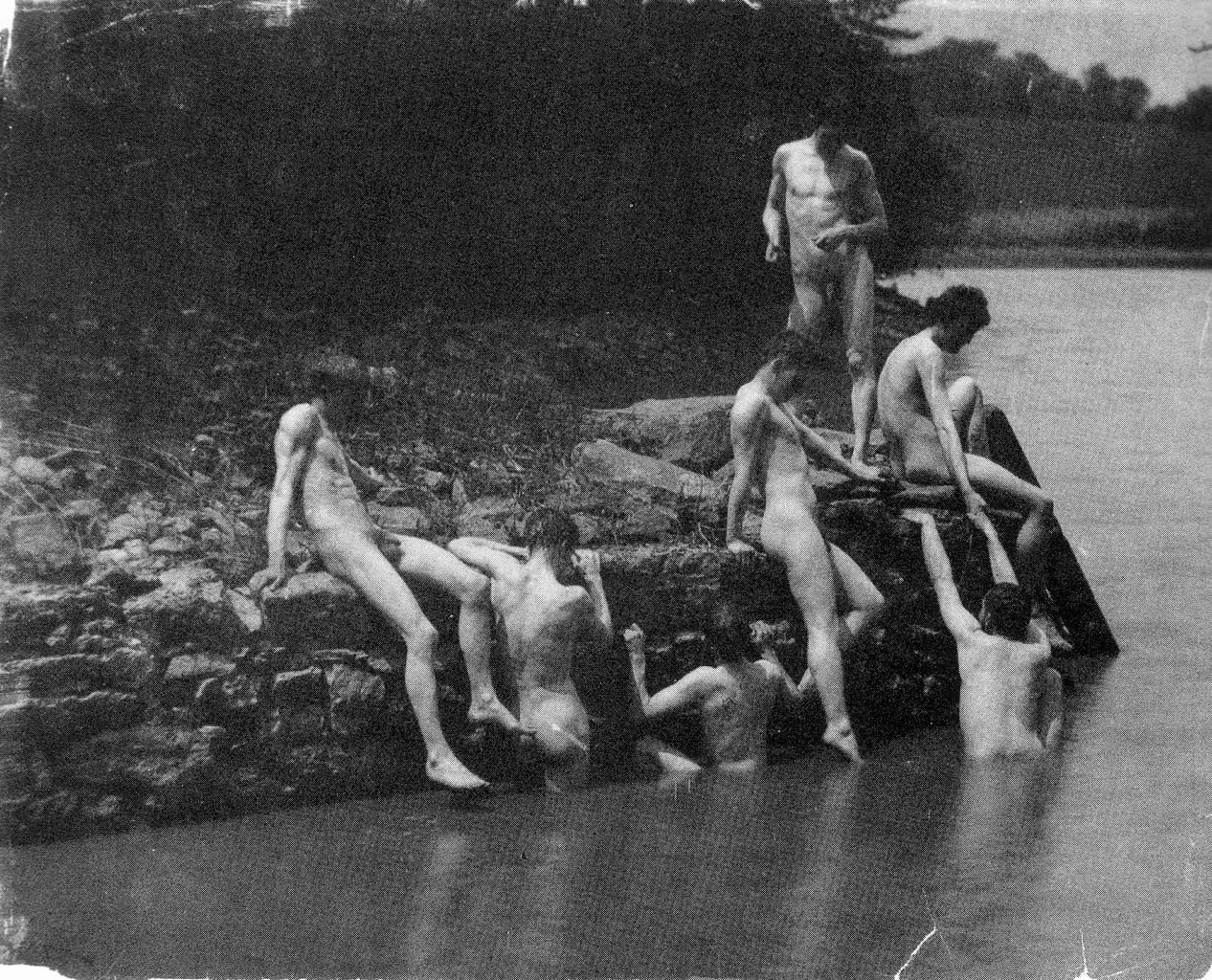
Thomas Eakins’ students swimming naked in Dove Lake, c. 1883–84

Four paintings—The Swimming Hole (1885) by Thomas Eakins, The Bathers (1898–1905) by Paul Cézanne, The Bathing Group (1914) by Henry Scott Tuke, and The Bathers (1885) by John Singer Sargent—each depict figures in or near water, a subject with deep art historical roots. They each depict the one of the few exceptions to the generally prudish Victorian attitude to nudity: swimming naked was widely accepted, and for males was seen as normal, even in public spaces. The other notable exceptions are depictions of nudes in classical, mythological, and allegorical art.

I have been looking at many 19th century artists, particularly American artists, for a class I am teaching, and one thing I have noticed that is remarkably different from Renaissance art is the lack of male nudes. In the Renaissance, some of the most famous pieces of art are of male nudes; Michelangelo’s and Donatello’s depictions of David come to mind. Yet, in 19th century America, few of the art produced are of nude men. However, female nudity abounds. The great American sculptor Hiram Powers’s The Greek Slave (1843) is of a young nearly naked woman in chains. The only depiction I know of Powers that was of a male nude is The Fisher Boy (1857). Both sculptures are of examples of classical and allegorical works.

The Greek Slave (1843) and The Fisher Boy (1857) by Hiram Powers

The four paintings by Eakins, Cézanne, Tuke, and Sargent are exceptions to the lack of male nudity. However, each approaches the theme of male nudity with distinct stylistic and thematic differences. The theme of male bathers has long been a subject in Western art, and like nearly all male nude artwork, the bathers often carry homoerotic undertones. The role of homoeroticism varies depending on the artist’s personal life, stylistic choices, and the cultural context in which they worked. Most of the known gay or bisexual men throughout history were artists. There are a few exceptions, and with nearly all of these historical figures, their sexuality has become a source of great debate. The sexuality of Eakins and Sargent are hotly contested in the art world. The sexuality of Cézanne has questioned for his personal detachment from women, lifelong male friendships, and repeated depictions of male figures in communal settings have led to some speculative interpretations. However, Tuke’s sexuality is not really debated. During the 1880s, Tuke met Oscar Wilde and other prominent poets and writers such as John Addington Symonds, most of whom were Uranian, an archaic term for homosexual men. Tuke’s art is sometimes referred to as Uranian art.

The Swimming Hole by Thomas Eakins

Eakins’ The Swimming Hole is a realist depiction of young men bathing in a natural setting. The composition is carefully structured, with figures arranged dynamically, demonstrating Eakins’ deep understanding of anatomy. He used photography as a reference, contributing to the work’s precision. The painting celebrates the male form, and some scholars suggest a homoerotic subtext, particularly given Eakins’ personal interest in male camaraderie and physicality. Eakins was deeply interested in the male nude, often using his students and friends as models in his photographic and painted studies. The Swimming Hole is notable for its emphasis on the beauty of the male form, with figures depicted in relaxed, intimate, and naturalistic poses. Eakins’ career was marked by controversy, particularly his insistence on using nude male models in his teaching, especially when women were present in class, which ultimately led to his dismissal from the Pennsylvania Academy of the Fine Arts. While Eakins’ sexuality remains debated, his work suggests an intense fascination with the male body that aligns with homoerotic artistic traditions.

The Bathers by Paul Cézanne

Cézanne’s The Bathers presents a more abstracted and structural approach to the human form.. Cézanne’s approach to the male nude was more detached and formal, reducing figures to geometric forms and emphasizing composition over sensuality. He merges the men with the surrounding landscape. His brushwork and color palette are highly expressive, prioritizing form over detail. This painting is part of a series of bathers that played a crucial role in the development of modern art, influencing Cubism and abstraction. Rather than focusing on individuality, Cézanne treats the figures as part of a broader compositional harmony. While his Bathers paintings lack the overt homoeroticism seen in Eakins or Tuke, some scholars have suggested that Cézanne’s awkwardness around women and preference for male companionship may be reflected in his repeated depictions of groups of men in idealized, classical settings. His work was admired by later artists interested in queering traditional artistic forms, though it remains more intellectual than sensual.
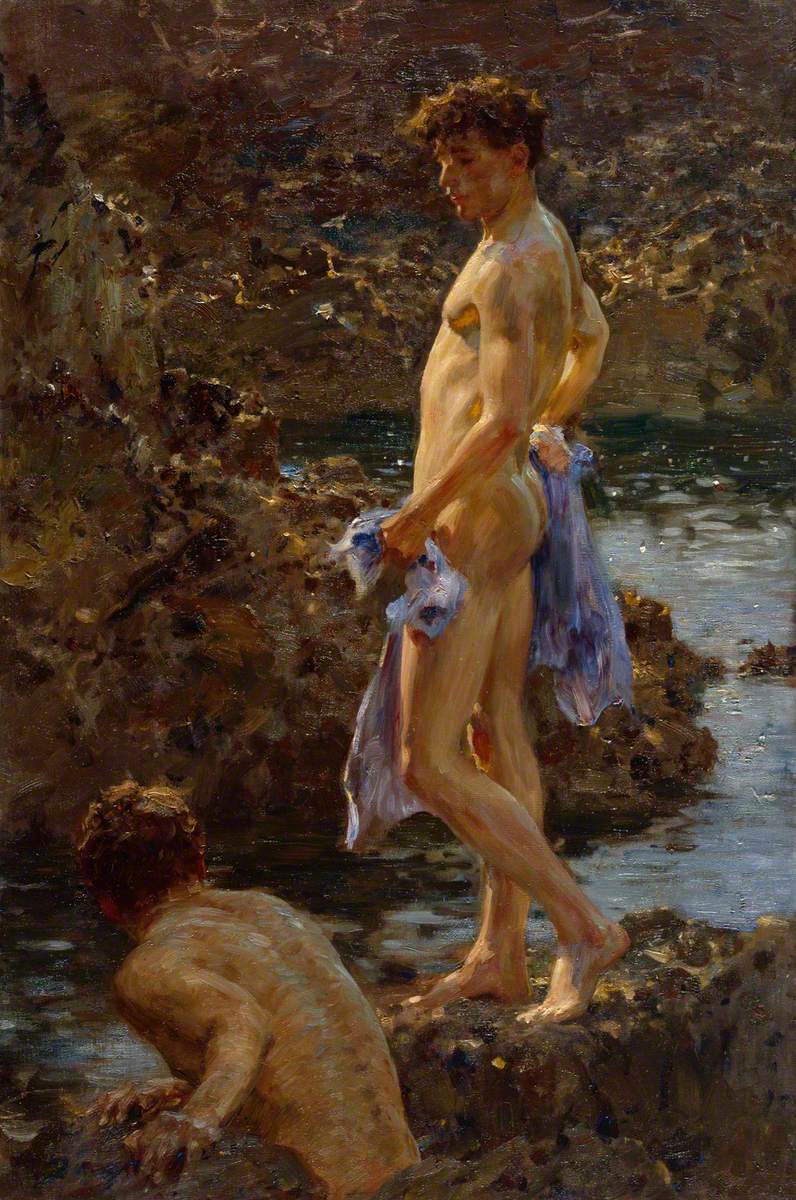
A Bathing Group by Tuke, Henry Scott Tuke

Tuke’s The Bathing Group shares thematic similarities with Eakins’ Swimming Hole, as it portrays young men bathing in a sunlit outdoor setting. However, Tuke’s work has a softer, impressionistic style with warm, glowing light that romanticizes the scene. His focus on adolescent male figures, combined with his use of color and light, creates an atmosphere of nostalgia and idealized youth. The painting reflects Tuke’s broader oeuvre, which often explored themes of male beauty and companionship in idyllic coastal settings. Tuke’s work is the most overtly homoerotic among the four painters. He frequently painted young, athletic men in idyllic seaside settings, often nude or minimally clothed, with a warm, romanticized glow. Unlike Eakins, whose realism could be read as clinical, Tuke’s impressionistic style and soft, golden lighting emphasize youth and sensuality. Tuke was known to have had close relationships with young men, and while his exact sexual orientation remains ambiguous, his work clearly celebrates male beauty in a way that aligns with homoerotic traditions in art.

The Bathers by John Singer Sargent

Sargent’s The Bathers is more atmospheric and impressionistic than the others. It captures figures relaxing by the water, with loose brushwork and an emphasis on light and movement. Unlike Eakins’ rigorous realism or Cézanne’s abstraction, Sargent’s fluid style suggests spontaneity, capturing a fleeting moment rather than a structured composition. His interest in light and fabric is evident, as the painting conveys a sense of leisure and elegance characteristic of Sargent’s work. Sargent, like Tuke, has long been the subject of speculation regarding his sexuality. His portraits of both men and women often exude sensuality, and his friendships with men such as the poet and aesthete Vernon Lee suggest an affinity for male beauty. In The Bathers, Sargent takes a more impressionistic and fleeting approach to the subject, capturing a moment of leisure rather than lingering on the erotic possibilities of the male nude. However, his interest in male figures and fluid, suggestive brushwork align with the aesthetic codes often used to signal homoerotic desire. Sargent’s art is best known for his beautiful depictions of women in their finest clothing, and the majority of Sargent’s depictions of nude men were not discovered until after his death.

Each of these paintings offers a unique interpretation of the bathing scene and their homoerotic subtext reflect the respective artists’ styles, concerns, personal inclinations, and broader artistic movements. Eakins’ and Tuke’s paintings are more naturalistic, while Cézanne’s and, to some extent, Sargent’s approach abstraction or impressionism. Eakins prioritizes anatomical precision, while Cézanne breaks forms into geometric masses. Tuke and Sargent take a softer, more atmospheric approach. Eakins presents the male nude in a studied, naturalistic, and academic way, but his fascination with the subject led to controversy for potentially suggesting homoerotic undertones. Tuke romanticizes youth, while Cézanne constructs a timeless, almost mythological world, and Sargent captures a fleeting, elegant moment. Cézanne abstracts the figures, distancing them from direct sensuality but engaging with ideas of male camaraderie. Tuke openly romanticizes and celebrates youthful male beauty in a manner that strongly suggests queer desire. Sargent is more ambiguous, capturing fleeting moments of male interaction with a sensuous yet reserved touch. While only Tuke’s work seems directly intended to be read as homoerotic, all four artists contribute to a visual tradition in which the male nude serves as both a formal study and a space for exploring desire, intimacy, and beauty.



That Tasted Nothing Like Pineapple

Warning: This post will be more graphic and talk about sex much more than I usually do.

The picture above is often a meme saying, “That Tasted Nothing Like Pineapple.” I’ve been reading a lot of gay romance books lately, and there are a few things that always make me roll my eyes when I read them. 

The first one is when characters have a hands-free orgasm while having anal sex. Many of us know that being the bottom during sex can be a truly wonderful experience, but for me, it’s never been so outstanding that it caused me to have an orgasm with out any stimulation to my dick. Just saying. While I know it’s possible, it certainly doesn’t happen in the frequency it does during m/m romances. I know it’s a plot device to show that the sex is earth shatteringly good, but my goodness, these authors need to lay off on the hands-free orgasm. If a man did it as many times as some of the characters in these books, it’s more likely that they suffer from premature ejaculation instead of mind-blowing sex.

The other thing is that precum and cum is always referred to as tasting bitter. In real life people often describe semen as tasting salty, sweet, bitter, metal, sharp, or sour.  The bitterness or saltiness because it has a more alkaline pH. The sweetness can be attributed to greater sugar content, especially glucose and fructose which give sperm their energy to move. One study suggested that people with diabetes may secrete more sugar into their semen giving it a sweeter taste. A metallic taste is because of the minerals and vitamins it contains.

In my personal experience, and maybe yours have been different, I’ve never experienced a man’s semen to taste bitter. These m/m romance authors mostly say that cum is bitter but also often say that it is salty, and that I can agree with. For me, I’ve usually thought that cum had a gamey or sweet taste, or maybe salty sweet. Precum has always tasted sweet to me. I’ve never considered it to be bitter. The truth is that the taste of semen varies from person to person.

Although many people insist that certain foods change the taste of their semen, there is no conclusive research to confirm this link. Anecdotally, some people believe that fruits, such as citrus fruits and pineapple, may improve the flavor of semen. Foods that produce a strong odor, such as broccoli and cauliflower, may make semen taste or smell worse. Likewise, foods that tend to change the appearance or smell of other bodily fluids, such as asparagus, may also change the taste of semen. One thing that does alter the taste of a man’s semen is hygiene. It is well established that taste and smell are linked, and in consequence, funky body odor can lead to it tasting funky.

With all that being said, out of my own curiosity, I pose the following questions: Does cum have a bitter taste like so many authors claim? I don’t understand why they always describe it as bitter. Why not say cum has a salty sweet flavor? Authors could describe the taste of cum in differing ways, yet they almost universally say it’s bitter.


First Crush

Picture it, August 1989…

It was homeroom, and I was in middle school, seventh grade to be exact when I first saw him. It was the first day of school, and he was the new kid in our class. This incident happened before I fully understood that I was attracted to guys. I told myself it was admiration and a desire to be like the guys I had “crushes” on. I wouldn’t allow myself to think that I could be gay. I dated girls all through school and even the early years of college.

On that day many years ago, someone in my class called me a faggot, queer, or some other derogatory term for sissy or gay. I was constantly bullied and called gay slurs from probably fifth grade. They would mock my voice and exaggerate my mannerism that they thought were sissified. When I think back now, I doubt they knew what gay was or even what they were saying. None of us did. Like me, they just knew it was terrible and reserved for those less masculine than what everything seemed to teach us about what a man should be, and I was not the most masculine of guys. I was tall and, I would say, non-descriptively handsome. I had brown hair, brown eyes, and an olive complexion. I was the smartest person in my class, automatically making me a queer nerd. 

Anyway, a group of guys were calling me names and bullying me when I heard a masculine voice tell them to stop. I looked to see a vision of beauty, not by everyone’s standards, but he was so handsome and my definition of masculine beauty. He was tall, with blond hair, blue eyes, and that pinkish complexion that comes from fair skin guys who don’t tan but burn in the sunlight. He was also as masculine as a middle schooler can be. Without realizing it, I had my first boy crush from that day forward. I basically worshipped this kid. He was my hero and a genuinely good guy. I fell in love, but it was not something I understood. He never had any idea that I had a crush on him, and as far as I know, he never did. We became friends, or really just acquaintances. We didn’t hang out all the time or anything like that, but he was always friendly to me and took up for me when guys were bullying me. He was not a bully, but people still respected him. He was a genuinely nice guy. 

I had all sorts of fantasies about him. I never contemplated being gay until college, although I had fantasized about a number of guys once I’d had my sexual awakening. However, that new kid in seventh grade was the person who almost always fueled my sexual fantasies. Thinking back on it, he probably fueled my whole sexual awakening. I was utterly delusional, though. I had no awareness I was gay. I rarely ever fantasized about girls, and when I did, it was because I thought that was what I should be fantasizing about. However, the fantasies always ended up centering on a guy, not the girl. In fact, by the time I reached climax, no girl was in my thoughts. I had crushes on several guys, and they were always the guys who were nice to me. Being kind was and still is a sure way to my heart.

As we grew older and made our way out of middle school to high school, he became more built and handsome. He was the star jock at our school, playing football, basketball, baseball, and running track. I couldn’t compete with his athleticism and never was very good at sports. I refused to play football but played basketball, track, and golf for our school. I always wanted to play baseball, but my eyesight and coordination were never good enough to see the ball let alone hit or catch it. I think this is part of why I find baseball players so sexy. By our junior year of high school, we were the top guys in our class. I was the smartest; he was the best athlete. He was always very popular, and I was mostly just tolerated. He played sports, and I did all the other extracurricular activities.

During our senior year, the baseball team all got a buzz-cut. We were either at lunch or on break, and someone, probably his girlfriend, said something about how soft his hair felt being cut so short. How I did it, I’ll never remember, but I got up the nerve to ask if I could feel it. I then ran my hand over his head, feeling the soft short hair. It was one of the few times I ever got to touch him. Guys weren’t touchy feeling back then, and no guy would have been seen touching or getting touched by the gay kid. I admit it; the feel of his soft blond hair was my main fantasy that night. It still turns me on to run my hands over the head of a guy with short, buzz-cut hair. When I was in grad school and out to everyone, there was this one guy who I played poker with. He always let me flirt with him even though he was very straight. He had short blond hair. I always loved standing behind him after I’d lost all my chips, of course, and run my hands over his head, but he’s a story for another time. There were a few guys during that time in my life when I flirted unmercifully with a few straight guys who were good sports about it.

Anyway, let’s get back to that first crush. When I lived in Alabama, I’d run into him occasionally. Now, I just keep up with him and his family on Facebook. He is beefier than he used to be but still a fine specimen of manhood. Good Lord, he still makes me weak in the knees. We never forget our first crush, do we?

Who was your first crush?


Pleasure, Sex, Guilt, and God

I know that nothing is better for them than to rejoice, and to do good in their lives, and also that every man should eat and drink and enjoy the good of all his labor—it is the gift of God.

—Ecclesiastes 3:12-13

This may be a questionable post for some of my readers, though I think it is something most of us have struggled with at some point in our lives or still do. And I’m going to be frank in this post, so feel free to skip it if talking about sex and religion isn’t for you…

I was talking to a friend about what God thinks of watching gay porn and/or pleasuring ourselves. While I think we all desire relationships, intimacy, and connection, we still have carnal desires. The word often connotes an action or manifestation of a person’s lower nature derogatorily. Carnal is sometimes applied to any gratification of a bodily desire or pleasure but commonly implies sexual appetite with the absence of the spiritual or intellectual. It also stresses the physical as distinguished from the rational nature of a person. However, why should the word carnal have such negative connotations? 

The primary theme of 1 Corinthians concerns the actions, attitudes, behaviors, and beliefs of spiritual (Gk., pneumatikois) people versus the fleshly or carnal (Gk., sarkinois) people. First Corinthians 3:1-4 says, “And I, brethren, could not speak to you as to spiritual people but as to carnal, as to babes in Christ. I fed you with milk and not with solid food; for until now you were not able to receive it, and even now you are still not able; for you are still carnal. For where there are envy, strife, and divisions among you, are you not carnal and behaving like mere men? For when one says, “I am of Paul,” and another, “I am of Apollos,” are you not carnal?” Paul seeks to teach the Corinthians an understanding of both ways of living.

On the one hand, spiritual living does not mean that a person rejects the material world and engages in practices that make one appear more spiritual to others. Instead, the spiritual person is a mature Christian who knows that all things in life are good, pleasing, and holy if accepted with thanks. True spirituality is shown through love and service toward others rather than through ecstatic experiences.

The carnal person, then, is the opposite of the spiritual person. The carnal person may appear to be quite “spiritual” and religious, but they cannot grasp, understand, or practice the greater truths of Christianity which lead us to lay down our lives for others in love and service to them. The carnal or fleshly person is not necessarily one who gives in to the passions and lusts of the flesh but is rather one who thinks that the chills and thrills of ecstatic religion make them superior to others. God desires us to be happy because happy people will serve him better. Think of the bitter Christians who want to push their own perverted morality on everyone. Their hearts are full of hate, and they are miserable people. Instead of serving God, they are serving their own selfishness and despair.

Too often, we are made to feel guilty about our sexuality, and this goes for heterosexuals, homosexuals, and bisexuals alike. We are told that sex is dirty and wrong; it should only be done for procreation, etc. Growing up, we were given a certain message about gay people that clashed with what was often our growing understanding of our own sexuality. These hate-filled beliefs make many people question their faith and their very lives. The guilt thrust upon us can be devastating and have long-lasting, even eternal, harm to our souls. If we were nurtured instead of damned by others, we could live happy, healthy lives, but those who are bitter, hateful, and judgmental don’t want us to live happy lives. They want us to be as miserable as they are.

When I started realizing I like guys, my desire for relationship, intimacy, and connection also shattered my preconceived notions about what being gay meant. At first, I could not understand my sexuality. All the other guys I knew were talking about girls, and all I could think about was them. Even before I understood I was gay, I dreamt and fantasized about sex with other guys. To put it bluntly, I wanted to not just kiss and hold and be held by another guy; I wanted to have sex with another man. At first, I did not understand all the mechanics of it, but in a way, I did. I seemed to instinctively understand what I wanted to do sexually with a guy. It took me many years to come to terms with being gay and realize how good being gay can be.

For all the talk about love, romance, connection, union, covenant… all great things, to be sure, I want to make sure that we don’t lose track of the carnal pleasures that come with being gay. I used to feel incredibly guilty about masturbation. I hated myself after every time I did it. It did not help that it was almost always to the thought of another guy. I had been taught that two guys being together was wrong and masturbation was sinful no matter your sexuality. When I was in school, guys who jerked off were seen as losers, though I know now that even those who said and acted that way were at home playing with themselves until they reached climax. It was just that no one admitted it. And wasn’t that why we felt such shame at being called fag, faggot, gay, queer, sissy, etc.? We were taught to deny who we are for someone else’s idea of masculinity. 

My ideas of masculinity have definitely changed over the years. I have had sex with men, a few women, and some transgender men before. Obviously, sex with women was not my thing. However, with a few bad exceptions, I have always enjoyed sex with men, whether they be cisgender or transgender. Someone once told me that dating a transgender man made me straight because he was not a “real” man since he was not born with a penis. You may agree or disagree, but the trans men I dated were far more of a man than many heterosexual men I know, especially those who are homophobic and insecure in their sexuality. The truth is that life is more complex than a simple binary understanding of things, especially sexuality and gender.

First Peter 3:8-12 says:

Finally, all of you be of one mind, having compassion for one another; love as brothers, be tenderhearted, be courteous; not returning evil for evil or reviling for reviling, but on the contrary blessing, knowing that you were called to this, that you may inherit a blessing. For

    “He who would love life
    And see good days,
    Let him refrain his tongue from evil,
    And his lips from speaking deceit.
    Let him turn away from evil and do good;
    Let him seek peace and pursue it.
    For the eyes of the Lord are on the righteous,
    And His ears are open to their prayers;
    But the face of the Lord is against those who do evil.”

I think sex and the enjoyment of others make us happier and more accepting of ourselves if we don’t put the stigma of shame to it. Proverbs 17:22 says, “A merry heart does good, like medicine, but a broken spirit dries the bones.” I believe that as long as you are not hurting anyone else or yourself, that God does not have a problem with it. When I was first coming to terms with being gay, I explored porn (I still watch it sometimes); I masturbated to that porn and to fantasies about being with other men; and eventually, I had those experiences with other men. When things went wrong in my life, I used to think God was punishing me for watching or even possessing porn, adult toys, or just being gay. However, a preacher I knew used to say that we are not punished in this life for things we do. If we are punished, it will be in the afterlife. That being said, I see nothing wrong with self-pleasure or the material we use to stimulate that self-pleasure as long as it does not hurt others. I also see nothing wrong with fulfilling our sexual desires if it does not hurt anyone else.

I no longer feel the guilt I once did and don’t regret what I did. At least I don’t regret enjoying myself. We’ve probably all been with someone we regretted being with, but for other reasons. I think it’s a natural part of life, and too many people impose their beliefs about morality on others. The only time I feel bad is when I think of the addictions some of these guys in porn have that draw them to performing in porn to finance. There are too many stories of suicide or overdose by sex workers, and it always saddens me to see such a beautiful life end like that, just as it saddens me when any life ends. There are numerous reasons people begin to do porn. For some, it’s finances; for others, it’s an addiction they want to finance. There are many other personal reasons. I knew of one pay porn star who did porn to fund his transition to being female. However, nowadays, many men do porn because they enjoy showing off, and maybe that’s vanity, but it is also not hurting anyone. 

So, I enjoy having sex with other men or watching porn and jerking off without the guilt I used to associate with it. It has made me much more emotionally and mentally stable by letting go of that guilt; honestly, I think God is good with that. If He’s not, then He is not the God I believe in. I believe in a God that wants us to be happy. Self-torture because we allow someone else to impose their morality on us is not God’s way. It is man’s way. If you feel that sex, masturbation, porn, etc. have gotten out of hand in your life, that it is harming you in some way, or has become an addiction, then find a way to let it go, but if you are not causing yourself or anyone else any harm, then I think you should be assured that God looks down on you and smiles. For God loves us, just the way we are. Ecclesiastes 2:24-25 says, “Nothing is better for a man than that he should eat and drink, and that his soul should enjoy good in his labor. This also, I saw, was from the hand of God. For who can eat, or who can have enjoyment, more than I?”

As gay men, we have to be more vigilant about sex: STIs like syphilis are on the rise and Monkeypox is spreading through the gay community. While PrEP can be very effecting in preventing HIV infection, it is only effective in preventing HIV infection. Just because you are on PrEP does not mean you are invulnerable. When it comes to sex: be sane, be sensible, and be safe. Have fun and enjoy yourself!


Into the Cave

Yesterday, I was reading an article in The New Yorker by Morgan Meis about the discovery of the world’s oldest cave painting. It was a fascinating story of how an archeological team in Indonesia’s island of Sulawesi was exploring a remote valley. There were no roads into the valley, and there was nothing on their maps to suggest a way through the bush and mountain peaks. It sounded like a real archeological adventure into the unknown. Their maps show few signs of habitation in the valley. The team asked for directions anytime they encountered anyone, and they felt as if they were continually lost. Eventually they were able to find a path through a cave that led into this hidden valley, which the archeologists continue to call the “secret valley”—a term they use to protect the caves, which they don’t want to be easily found. The Lascaux cave found in Montignac, France was closed to the public in 1963, because their condition was deteriorating due to the exhalations of the 1,200 visitors per day, the presence of light, and changes in air circulation creating problems that threatened the preservation of the cave. Keeping the Indonesian valley secret is the only way at this time to preserve what the archeological team found.

The area of the secret valley was inhabited by an especially isolated group of Bugis people, an ethnic group of southern Sulawesi who I found to be a very interesting people because they recognize five separate genders. These Bugis claimed never to have seen a single Westerner in their valley. Something I will get back to in a minute. The archeological team began to explore the caves in the area and, a few days later, one of the archeologists entered one of them alone. There he found a spectacular painting of a Sulawesi warty pig, a medium-sized, hairy boar with small pointy ears and short legs. Near the rear of the pig was painted silhouettes of two human hands. The archeologist recognized that the artwork was very old, but just how old, he did not know. Technology was rough in to test the age of the painting using uranium-series dating. The answer was astonishing: the painting of the warty pig was at least 45,500 years old. This makes it the oldest known example of figurative cave art in the world. The cave paintings at Lascaux are estimated at around 17,000 years. The famous animal paintings in the Chauvet cave, of France, previously thought to be the oldest, are dated at around thirty-five thousand years old; the Sulawesi warty pig outdoes them by roughly ten thousand years.

All of this was fascinating, but what struck me about the article was one sentence: “The area was inhabited by an especially isolated group of Bugis people, an ethnic group of southern Sulawesi who recognizes five separate genders.” While the cave paintings are fascinating and add to the history of early humans, I find the concept of societies that accept more than two genders to be interesting, and I knew I had to do more research on this.

The Bugis people are the most numerous of the three major ethnic groups of South Sulawesi, Indonesia, with about 3 million people. Most Bugis are Muslim, but many pre-Islamic rites continue to be honored in their culture, including the view that gender exists on a spectrum. In contrast to the idea of only two genders (male and female), Bugis society recognizes five genders: makkunrai, oroané, bissu, calabai, and calalai. The concept of five genders has been a key part of their culture for at least six centuries. Oroané are comparable to cisgender men, makkunrai to cisgender women, calalai to transgender men, and calabai to transgender women, while bissu are androgynous or intersex and revered shamans or community priests.

Native American societies often recognized three genders: male, female, and two spirit similar to the Bugis concept of bissu. For one to be considered bissu, all aspects of gender must be combined to form a whole. It is believed that you are born with the propensity to become a bissu, revealed in a baby whose genitalia are ambiguous. These ambiguous genitalia need not be visible; a normative male who becomes a bissu is believed to be female on the inside. This combination of sexes enables a ‘meta-gender’ identity to emerge. However, ambiguous genitalia alone do not confer the state of being a bissu. The person must also learn the language, songs and incantations, and have a gift for bestowing blessings in order to become bissu. They must remain celibate and wear conservative clothes.

Bugis society has a cultural belief that all five genders must coexist harmoniously; but by 2019 the numbers of bissu had declined dramatically, after years of increasing persecution and the tradition of revering bissu as traditional community priests. Bissu have mostly survived by participating in weddings as maids of honor and working as farmers as well as performing their cultural roles as priests. Hardline Islamic groups, police, and politicians have all played their part in Indonesia’s increased harassment and discrimination of nonheterosexuals. After independence in 1949, the ancient Bugis kingdoms were incorporated into the new republic and bissus’ roles became increasingly sidelined. A regional Islamic rebellion in South Sulawesi led to further persecution. As the atmosphere became increasingly hostile to nonheterosexuals, fewer people were willing to take on the role of bissu.

According to the Bugis gender system, calabai are generally assigned male at birth but take on the role of heterosexual females. Their fashions and gender expression are distinctly feminine but do not match that of “typical” heterosexual women. Calabai embrace their femininity and live as women, but do not think of themselves as female, nor wish to be female or feel trapped in a male’s body, and they are respected by society. They are supported by family, and men accept them as males, living in feminine embodiment. The calalai are assigned female at birth but take on the roles of heterosexual males. They dress and present themselves as men, hold masculine jobs and typically live with female partners to adopt children.

The concept of five genders is not as fluid as a full spectrum of gender. The Bugis concept is more rigid than many who reject the idea of a gender binary. Along with cisgender males and cisgender females are transgender men and transgender women, nonbinary, genderfluid, genderqueer, and agender individuals, among many other possible definitions. Some experts suggest that there may be 100 genders or more and different cultures may use different identifications for one gender or another. The key, advocates suggest, is not pinning down a definitive list of gender possibilities but to be accepting of everyone’s declared gender.


Call Me Daddy?

When did I become a “daddy”? As I said on Monday, my hair has turned gray and there is much less of it while there is more of me around my midsection. Lately, I have been logging onto the dating apps a little bit more. Inevitably, a younger guy will message me and at some point, he’s going to call me “daddy.” I guess as a gay man, when you get older, there can be a few shocking moments. One of these moments is when you’re chatting with a younger guy, and he says he’s into older guys. And then it hits you: I’m the older guy.

So, what exactly is a “daddy?” Generally speaking, “daddy” is a category that gay men use to define themselves and/or each other. It is not to be confused with a “sugar daddy,” an older man who provides money or gifts in return for sex and/or companionship with a younger man. Other categories for gay men include “otters” (slim hairy men), “bears” (bigger hairy men) and “twinks” (skinny, smooth men). Some people outwardly identify as a “daddy” often on hook-up apps or on alt social media accounts*, and some people describe others that way. In its most stereotypical form, a “daddy” is an attractive older man who takes on a dominant yet paternal role in relationships with men who are usually younger. He is well-groomed, toned, masculine, and often successful. He takes the lead outside the bedroom and (again, so the stereotype goes) is a top in the bedroom. 

Similarly, to concepts like “queer” and “camp”, “daddy” is much debated, and its meanings and representations can be different depending on the person. For instance, not everyone thinks a “daddy” must be mature in age. Also, in today’s world, there is a bit of a change with the standard definition because of the seeming obsession with the “dad bod.” This phrase has been adopted to refer to an “average” guy who doesn’t have a lean, fit physique. He might instead have a paunch, a spare tire, or a middle-age spread. I guess that’s where I fit into being a “daddy” since I don’t have the perfect body. Usually though, a guy looking for a “daddy” associates the type with sexual dominance and penetration. For some, “daddies” are men who physically and mentally dominate while turning on their partner’s submissive side. When guys call me “daddy” it means they want a masculine or dominating person; neither of those descriptions particularly fit me.

In short: daddies tend to be older and, often, on the dominant side. But not always. The trope is an identifier for older men, but also a label that’s often put on them by younger guys whether they like it or not. Depending on the person, it can be a kink fantasy, or a genuine relationship philosophy. I asked one guy why he was interested in an older chubby guy like me when he had a fantastic body and a big dick, and he said, “It’s my fetish.” I can respect that. I have my own fetishes. By the way, what shocked me most about this particular guy is he recognized me from my profile picture and told me that he’s seen me around for the last couple of years and has always fantasized about me fucking him and how he wanted to “suck my cock.” He had no interest in kissing or getting blown himself. He wanted to please me. A dream come true, huh? I asked the guy if I knew him. He implied I’d recognize him but not know his name which is possibly true since I am terrible with names. He begged to get together, and we tentatively set a time. However, “something came up.” He was either telling the truth, or he got cold feet. That happens with “discreet” guys. We’ll see if I hear from him again. Anyway, the conversation caused me to think about my “daddy” status.

I find the concept of being considered a “daddy” interesting. I’ve never fit into other gay categories. I was never a “twink.” I’m not hairy so I’ve never been an “otter” or a “bear.” I’m not feminine or outgoing so I am not a “queen,” nor would I be considered “campy.” I’m not muscular so I’m not a “gym bunny.” I guess you could put me in the category of a “chub,” but I also don’t think that fits very well either. The fact is, I have never fit a gay stereotype. I, therefore, find it interesting that the “daddy” thing seems to be coming up a lot lately. Maybe it’s because my hair has gone nearly completely gray. Who knows? I just know most people would identify me as gay fairly easily.

One thing I do think is true about gay culture is that people are beginning to become more comfortable with being open about their preferences, fetishes, or kinks. A wider societal acceptance of kinks and sexual practices have changed how people communicate with each other online. For starters, it’s part of the reason “thirst” language has become increasingly violent and explicit. “Choke me daddy” is a common phrase seen online these days. Most of the time, the person is not saying they want someone to literally choke them but instead, expressing a desire for a particular person to dominate them. I’m going to choose to believe that “daddy” is used as a compliment even when someone, like me, doesn’t fully fit the stereotype.

* Alt, or alternative, social media accounts are secondary profiles people use in addition to a main account on a social media platform. They are a way of representing the self that deliberately displays a different identity facet and addresses a different audience to what someone considers to be their main account. The term “alt” originated from videogame culture and has been incorporated into social media accounts.


Creating A Sexual Ethic

“Beware of false prophets, who come to you in sheep’s clothing, but inwardly they are ravenous wolves. You will know them by their fruits. Do men gather grapes from thornbushes or figs from thistles? Even so, every good tree bears good fruit, but a bad tree bears bad fruit. A good tree cannot bear bad fruit, nor can a bad tree bear good fruit. Every tree that does not bear good fruit is cut down and thrown into the fire. Therefore by their fruits you will know them.”

—Matthew 7:15-20

As I said in a post last week, “I think sometimes people who grew up like I did in a religious family where sex was a dirty thing and gay sex was unthinkable, we often feel ashamed of exploring our sexuality.” When it comes to sex, many of us have been told what we should and shouldn’t do, especially when it comes to sex. If I’d done everything that I was told not to do, I’d have lived a boring life. As it is, I wish I had become more accepting of my sexuality earlier in life, but now that I have, I am not going to have someone else’s morality imposed on me, when I know they don’t even understand the Bible verses that “shaped” their morality. For those of us seeking to figure out sex within an LGBTQ-affirming Christianity, it can be tempting to look outside of ourselves for the answers. However, I believe religion is a deeply personal belief and experience. It is the group think that has nearly destroyed Christianity. Too many people are giving up on religion instead of searching their soul and looking for answers from God, not from someone telling you what God is saying.

Likewise, developing a sexual ethic that works for you and is in alignment with your personal faith is also a deeply personal experience. That doesn’t mean that it exists in a vacuum, or that you can’t (or shouldn’t) consult others — trusted friends, spiritual leaders, mentors, or the Bible— but what it does mean is that ultimately, the responsibility lies within you. There is a saying, often attributed to Ralph Waldo Emerson, that says, “What lies behind us, and what lies before us are tiny matters, compared to what lies within us.” While the quote likely did not originate with Emerson, there is a lot of wisdom in those words. We must look within to decide what our personal faith and values are, and those include our sexual ethic.

For me personally, I try to follow the Golden Rule: “Therefore, whatever you want men to do to you, do also to them, for this is the Law and the Prophets.” (Matthew 7:12) My ideal sexual partner would be someone who is: honest, thoughtful, caring, and communicative. He doesn’t have to want a relationship as long as we both go into the encounter realizing this. There also has to be some chemistry between us. If there is no chemistry, I will be honest that I am not interested. I do care about others and I try my best to be thoughtful, that goes for whether it’s during an encounter or letting someone down easily. Most men are not known for being communicative, and I may fail on this at times, but it’s not because I am “ghosting” someone, but usually, it is a result of my fear that I am bothering someone or that I might interrupt them when they are doing something. So, I am not the best at follow-up, and I know I need to work on this. However, if I am messaged or texted, I will respond as soon as I can, which is more often than not immediately as long as I see the message.

If you want to develop a sexual ethic that resonates with you, there are a few things we can all do. The first thing we need to do is take stock of our values. Take some time to think about the values that matter to you. If you are not comfortable with something, then don’t agree to it; however, if you are uncomfortable about something like not communicating, then maybe that’s something you can work on. Usually, our personal values should be how we respect and treat others and what is going to make us happiest in a relationship. That could be a one-night experience or something that is more long-term.

Second, think back on the sexual and romantic experiences you’ve had and get in touch with what felt good and what didn’t. We usually have a variety of sexual and romantic experiences so think about everything from holding hands and kissing to penetrative sex (if you’ve had it). And don’t just limit yourself to “traditionally sexual” experiences. You can also meditate on times when your boundaries have been respected or transgressed. When you’ve felt safe and when you’ve felt vulnerable. Try to notice when your desires match or mismatch with your actions or the expectations or people around you. Maybe you don’t experience sexual attraction to anyone and feel pressured to have sex. This step isn’t about coming up with a list of “dos” and “don’ts” (those are often context-specific and shift over time). Instead, this is about picking up on patterns.

Third, we should step outside of ourselves and use each of our experiences to realize our shared values. As we look at our past experiences, we need to look beyond the specifics (“We were drunk,” “there were lots of candles and rose petals”, “we did this thing,” or “we didn’t do that”) and look at how we felt: safe, seen, understood, respected, violated, disregarded, taken advantage of, excited, scared, etc. We should decide if our experience were a positive experience or a negative experience. Not all of our experiences will be completely positive or negative, but there may have been some of both in an encounter or relationship.

Next, we need to articulate to ourselves what our ethics are. So far, we have gotten in touch with our values, reflected on our experiences, and stepped outside of ourselves, and tapped into something bigger. That’s the hard part. Now, we need to put it all together. I don’t mean you need to create a sexual rulebook. It’s nothing that formal, and quite honestly, it may change from time to time according to our continued experiences. Merriam-Webster defines ethics as “a set of moral principles; a theory or system of moral values.” That’s what we’re creating here: a set of moral principles. What’s right and wrong. What’s helpful or harmful. What’s ethical and what’s not. When we create a sexual ethic, it’s not a list of what we want or don’t want to do, and it isn’t going to tell you what you’ll do in any given situation. Instead, it’s a framework that you can refer make to when you need to make sexual choices.

In addition, we need to release judgments. Our sexual ethics are the summary of what we value, how we see the world, what’s right, and what’s wrong. Sometimes we are called to make decisions about what’s right and what’s wrong, and sometimes we are called to celebrate differences. It’s important that we distinguish between “judging something as right or wrong” and “judging something as different than me.” It’s possible for someone who shares my sexual ethics to make completely different sexual choices. You may decide that celibacy is right for you, while you may also be like me and comfortable with casual sex or you may want to only have sexual encounters while in a relationship. Just because we have different sexual ethics does not make them wrong and we should not judge others for their sexual ethics as long as they do not harm others. Release judgment against people who are making different decisions than you would make, even if you don’t understand them, as long as they are acting ethically.

Finally, think of your sexual ethic like the United States Constitution: it’s a foundational document, it’s what we base our decisions on, it should withstand (and transcend) the whims of the moment, but also sometimes you need to change it and that’s OK. Sex is messy. And so is life. You’re going to hit some bumps along the way. You’re going to have an experience that shakes you up or meet a person that challenges everything you thought you knew. My sexual ethic today looks completely different than the one I had 10 years ago and even more different than the one I had just 5 years before that. Our preferences change usually because we broaden our horizons. Don’t feel guilty because you tried something or did something you thought you’d never do, but again, the main caveat is “do no harm.”


A Roll in the Hay

I think sometimes people who grew up like I did in a religious family where sex was a dirty thing and gay sex was unthinkable, we often feel ashamed of exploring our sexuality. I know I’ve often said to people that I was a slut in my twenties, but that is really just sex-shaming myself and being self-deprecating. The truth is, I had fun, and I’m not really ashamed of that. I doubt I’ll ever get married, so if I’m going to have sex, sometimes it’s just a random hook-up. Hell, I hooked up with a guy within days of moving to Vermont. In fact my bed hadn’t even come yet, so we had sex on an air mattress. It was great sex too, and I’d love to get together with him again, it’s just never worked out. I do see him on occasion and he has expressed interest in getting together again. It just hasn’t happened yet.

This brings me to the main topic of this post. A week or so ago a guy messaged me that he was in town and wanted to get together. At the time, I couldn’t, but he said he’d be back this week. We chatted a bit and realized we’d both like to get together, so we made tentative plans for this week. Don’t think this guy was just some random guy off the internet. I knew what he looked like, what his first name was, and why he was in town. With that information, I was able to look him up online, so I knew more about him then he’d probably intended. He’s closeted, or discreet as many guys say these days, and I respect that, even if I wish no one had to be closeted or discreet these days.

Anyway, he’s in town for a big event at the university and wanted to get together. I said sure and was looking forward to it. It wasn’t a major get together, but really just a “fuck and go” as I tend to call it. He only had a limited amount of time before he had another engagement (not another sexual one, I might add), so he came over, we got down to business and had a great time. He said he’d like to see more of me while he’s in town, and I’d like that too. Discreet guys though can be a little skittish, whether it’s because of post-sex guilt, being afraid they might get caught by someone, or any other myriad of reasons. Will I see him again? Yeah, if he wants to. I got what I wanted out of it; he got what he wanted out of it. We had fun! I’d like to repeat the experience.

The thing is, I refuse to feel guilt or shame for hooking up with a guy. I’ve been there done that and wasted too many years doing that. I have a few local guys I get together with occasionally, and if this guy wants to get together when he’s in town (and I think he’s in town a fair amount), then I have no problem with it. You can only do so much by yourself, and while that can be pretty good too, there’s really nothing like having someone else to help you out.


Benefits of Being Fully Vaccinated

I debated whether or not I wanted to write a blog post about this particular subject, but then I decided, why not? Before the pandemic, I had met a guy that I got along with very well. We had a lot of the same interests in science fiction and enjoyed each other’s company. We would occasionally get together for a bit of fun (if you know what I mean), and sometimes, we’d watch a movie, usually we did more than just watch a movie. It was always a lot of fun. I have not been able to see him since the pandemic began. He has some health problems that didn’t allow him to even take the slimmest chance of getting COVID. We have talked a few times over the course of the pandemic, and we always said we would get together again when all of this was over or when we were both fully vaccinated.

Last week, he texted me to tell me that he was fully vaccinated, and I was able to tell him that I too was fully vaccinated. He suggested that we get together last night. Of course, I am writing this before I went over there, but I am anticipating we will have a fun time catching up and maybe even making up for lost time. It feels like things are beginning to get back to normal as more and more people are getting vaccinated. There is light at the end of the tunnel and Vermont is thankfully leading the way.

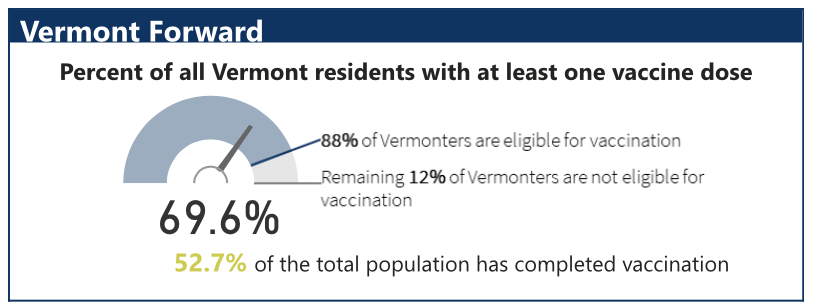
Vermont leads the nation in vaccines with 52.7 percent of the state’s population being fully vaccinated. We have 69.7 percent of the state’s population with at least one dose of the vaccine. New England has done remarkably well, with only Rhode Island and New Hampshire having less than 50 percent of their populations fully vaccinated. Rhode Island is close with 49.9 percent, but New Hampshire appears to be a bit of an anomaly in New England with only 35.6 percent being fully vaccinated. Vermont, Maine, Connecticut, and Massachusetts are the top four states for vaccinations, respectively. Rhode Island is fifth, but New Hampshire is twenty-third.  New Jersey, Hawaii, New Mexico, Maryland, and New York round out the top ten. All of the top ten are Democratic-leaning states. 

In contrast, South Carolina, Idaho, Utah, Wyoming, Tennessee, Georgia, Louisiana, Arkansas, Alabama, and Mississippi make up the bottom ten states with Mississippi having the lowest vaccination rates. The fact is the U.S. vaccination map looks a lot like a map of how states vote in presidential elections, with most blue states vaccinating at levels well above the national average and GOP states bringing up the rear. Sadly, the politics of COVID-19 have been partisan from almost the onset of the pandemic, and polls consistently show that Republicans, particularly men, are more hesitant than Democrats to get vaccinated.


The LGBTQ+ South

“In states where legal climates are less supportive of LGBT people, social stigma toward them is also higher. Social and legal climates are generally intertwined such that supportive laws and social acceptance run hand in hand.”Andrew R. Flores, Williams Institute, a public policy research institute based at the UCLA School of Law focused on sexual orientation and gender identities issues.

When I interviewed for this job in Vermont, they asked me, “You know it’s cold up here?” I responded, just like I’d responded during every interview in the North, “I hate the heat of the South.” When someone asks where my accent is from, and I say, “Alabama,” I always get the response, “That must have been a big change.” I tell them, “I hated the heat and I enjoy the cooler climate of New England. I hated stepping outside and being drenched in sweat within seconds of leaving the air conditioning and stepping into the oppressive heat and humidity.”

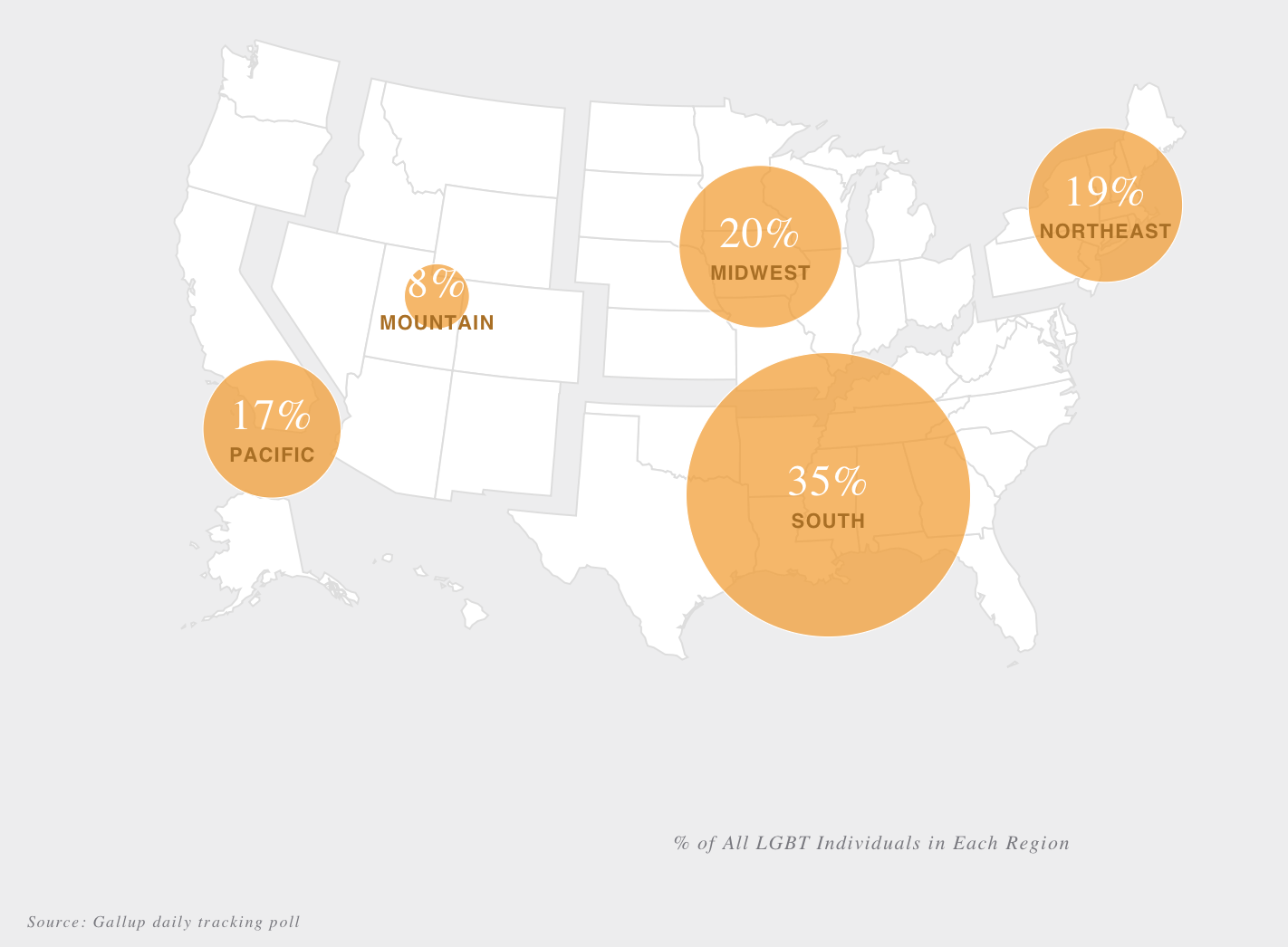
The heat of the South is not the only thing oppressive down there. The Republican Party and the Christian right are also oppressive if you are not white or heterosexual. If you are Black, Hispanic, Asian, or LGBTQ+ of any race, especially those who are transgender, the South can be a particularly unwelcoming place. Yet, even with that said, 35 percent of the United States’ LGBTQ+ population lives in the South, more than any other region in the country. They also make up some of the poorest in the LGBTQ+ population.

The South largely lacks employment protections. Like most states in the U.S., the South is largely at-will employment states; At-will employment is an employer’s ability to dismiss an employee for any reason and without warning, as long as the reason is not illegal (e.g., firing because of the employee’s race, religion or sexuality). No southern states have laws for LGBTQ+ non-discrimination protections. While Bostock v. Clayton County held that Title VII of the Civil Rights Act of 1964 protects employees against discrimination because they are gay or transgender, it is unlikely that these protections will be enforced until courts explicitly expand protections to other statutes. Each application of sex in the law to protect LGBTQ people will require litigation. And the Bostock decision itself includes a worrying deference to religious organizations. As soon as he took office, President Biden issued an Executive Order directing agencies to enforce federal laws that prohibit sex discrimination to include discrimination based on sexual orientation and gender identity, consistent with the Bostock decision. Time will tell how this will affect LGBTQ+ employees in states without explicit non-discrimination protections.

Employment protections are closely tied to economic security and well-being. LGBTQ+ people in the states without protections are more likely to report household incomes below $24,000 than those living in the states where workers are protected. Lower income also means that LGBTQ+ people face more issues with opportunities for better education, jobs, and healthcare. Any LGBTQ+ person in the South has been asked more than once, “If it’s so bad, why don’t you just leave?” The answer is: lack of opportunity. Lower income means decreased ability to move. In other words, it’s easier said than done. This does not mean that all LGBTQ+ people in the South struggle with income or education opportunities. Researchers have hypothesized that LGBTQ+ people may intentionally pursue higher education as a way to buffer themselves against discrimination in the workplace.

Some LGBTQ+ individuals have nice lives in the South. It’s not bad for everyone. However, fear lurks around every turn. If you are in the closet, then you have the fear of being outed. Even with some legal protections like those in Bostock, you still fear losing not only your job, but your family, religious life, friends, etc. when or if you choose to come out. Some LGBTQ+ people live in metropolitan areas and have more freedom and acceptance, but many do not. For those who do not, the South can be like sinking in quicksand. The more you try to help yourself, the more backlash from politicians and religious conservatives. I have been told it has gotten better in recent years, but that doesn’t seem to be the case for transgender individuals. They face increasing discrimination and hardships in the form of new laws targeting their rights, freedoms, and healthcare access. 

I am glad I got out when I did. For the first few years I lived in Vermont, I dreamed of getting a job closer to home and moving back to the South or at least closer to the South. I no longer feel that way. I realized that as long as I lived in the South, I was living in quicksand. Each day I was sinking and suffocating more because of the oppression of the South. Vermont has the highest percentage of any states for LGBTQ+ identification at 5.3 percent. In contrast, Alabama ranks in the bottom 16 percent of states with only 3 percent, tying with Alaska, Arkansas, Montana, and South Carolina who also have 3 percent. Idaho, North Dakota, and South Dakota rank lower. Though not a state, Washington, D.C. has the highest percentage with 8.6 percent of its population identifying as LGBTQ+.