Category Archives: Television

May “The Professor” Rest in Peace

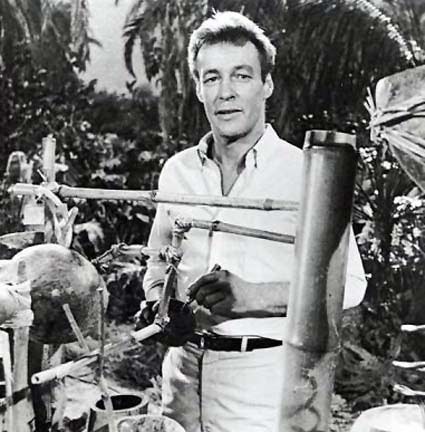
20140116-221002.jpg

Two characters of movie and television inspired me to become a teacher. Those two characters were the Professor from Gilligan’s Island and Indiana Jones. I think there are few historians or archaeologists of my generation who were not inspired by Indiana Jones, and the Professor was just so incredibly smart. On January 16, 2014, Russell Johnson passed away from natural causes. He was best known for playing the handsome Professor Roy Hinkley (usually referred to as “The Professor”), the very knowledgeable polymath who could build all sorts of inventions out of the most rudimentary materials available on the island, but, as Johnson himself pointed out, could not fix the hole in the boat.

Gilligan’s Island was one of my favorite shows as a young kid (ranking with I Dream of Jeanie, Bewitched, and Scarecrow and Mrs. King). On Gilligan’s Island, the Professor was always my hero. The Professor was a good-looking but nerdy academic, an exaggerated stereotype of the man of capacious intelligence with little or no social awareness. Occasionally approached romantically by Ginger (and guest stars, including Zsa Zsa Gabor), he remained chaste and unaffected. Since I was a kid, who didn’t understand why I was not all crazy about girls and had more of a fascination for boys, it seemed like remaining “chaste and unaffected” was the way to go. It would largely remain my philosophy until I was in my twenties. The Professor was my role model in many ways.

Before becoming an actor, Russell Johnson served in the U.S. Army Air Forces during World War II. He was on a B-24 Liberator when it was shot down during a bombing raid over the Philippines in 1945, according to his official biography, and used his G.I. Bill benefits to pay for acting school after the war.

Johnson married Kay Levey on July 23, 1949. Their son, David, ran the AIDS program for Los Angeles, California, until David’s own death from complications of AIDS in 1994. Johnson was a full-time volunteer for AIDS research fundraising since his son was diagnosed. He also had a daughter with Levey, Kim. Kay Levey died on January 20, 1980 in Century City, California. In 1982, Johnson married Constance Dane. Johnson is survived by his wife, Constance Dane, and daughter, Kim Johnson, from an earlier marriage.


Sleepy Hollow

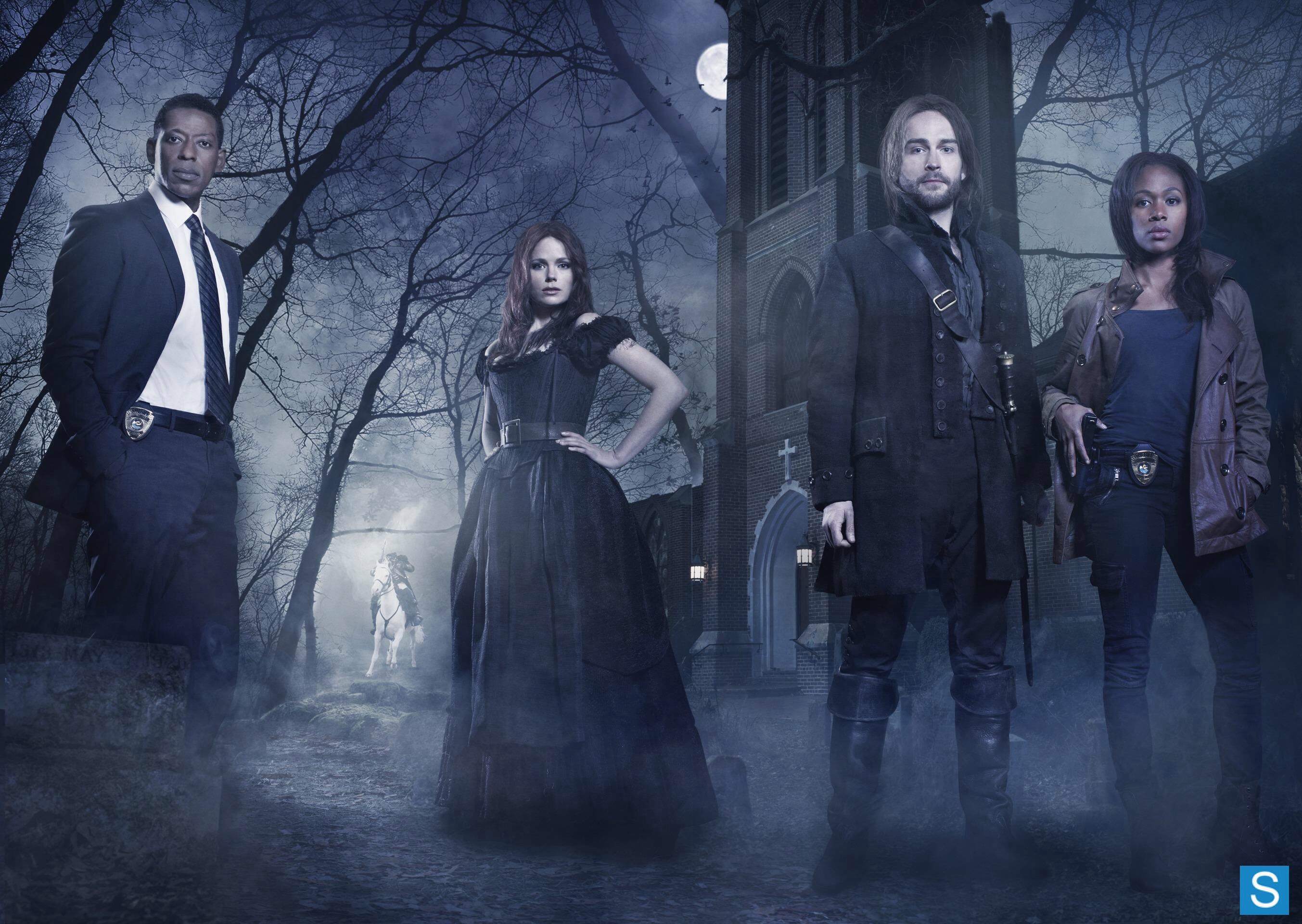
20130922-191808.jpg

Most of us are familiar with “The Legend of Sleepy Hollow,” a short story by American author Washington Irving, contained in his collection of 34 essays and short stories entitled The Sketch Book of Geoffrey Crayon, Gent. Irving is one of my favorite early American authors, and my English students and I just read “The Legend of Sleepy Hollow.” I even showed them the old Disney cartoon, which surprisingly follows the story very closely. It was written while Irving was living abroad in Birmingham, England, and was first published in 1820. Along with Irving’s companion piece “Rip Van Winkle,” “The Legend of Sleepy Hollow” is among the earliest examples of American fiction with enduring popularity.

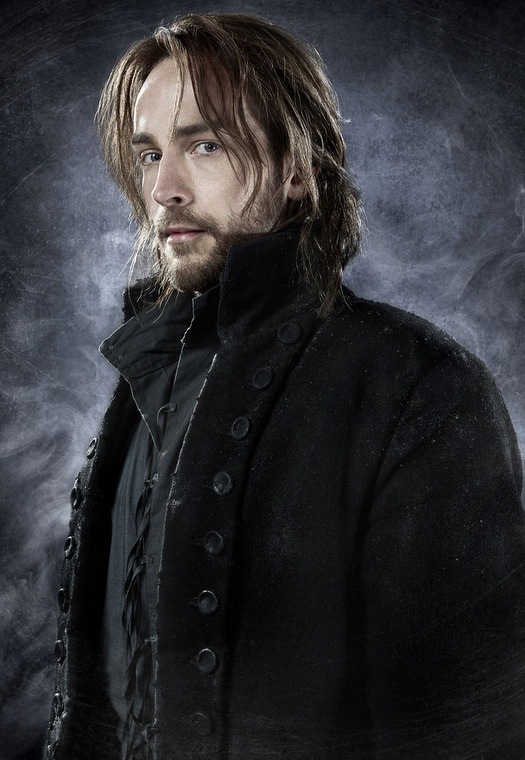
It’s popularity has led to Fox creating a modern retelling in its new series “Sleepy Hollow.” I watched it for the first time last night. I had DVRed it last Monday and just got the chance to watch it. I really enjoyed it.

In the Fox show, Ichabod Crane “dies” during a mission for General George Washington in 1781. He awakens in 2013 Sleepy Hollow, New York, but so does the Headless Horseman, whose head Ichabod chopped off before his perceived death. The horseman begins his nightly killing spree, and Ichabod must partner with Lt. Abbie Mills.

Abbie investigates the horseman after he kills the sheriff (Clancy Brown). While hunting the horseman, Abbie looks into the old case files her late partner (the former sheriff) was investigating and learns of two types of occult groups—one for good, the other evil—which may have summoned the horseman again. If the horseman is not stopped, dark supernatural forces will affect the Earth. This becomes more difficult as the Horseman discovers modern weaponry, which he assimilates into his ritualistic hunt. Ichabod must also adjust to the societal and technological differences of the 21st century.

The headless horseman is revealed to be Death, one of the Four Horsemen of the Apocalypse described in the Book of Revelation.

As Abbie is a black woman, Crane’s worldview from 18th century Colonial America causes some friction with her, and also the people he must now work with. Given the fact that he is, and states he is from, the time of the American Revolution, local law enforcement see him as a madman but useful in hunting the horseman.

20130922-191959.jpg

On the second episode (it nabbed 10 million viewers with its Sept. 16 premiere), Captain Frank Irving (Orlando Jones) and Lieutenant Abbie Mills are trying to make sense of the new mystery man about town, Ichabod Crane (Tom Mison). Meanwhile, Ichabod is trying to wrap his brain around such modern marvels as hair dryer, coffee maker, and indoor plumbing. The TV gives him a good jolt too. Check it out in the following clip from “Blood Moon,” which airs tonight at 9 p.m. I recommend watching it, and if you haven’t seen The first episode, you should try to catch it online before the second one airs.

When Ichabod finally does getting around to putting on his shirt in the episode (Tom Mison is good looking enough by himself for me to watch the show), he and Abbie go on the hunt for a centuries-old vengeful witch who “has been awoken by unknown evils and is on a path of destruction.”

Sounds scary. My only criticism is that I would have preferred that the Headless Horseman continue to use his ax, instead of using modern weapons such as machine guns. However,Tom Mison is worth watching as Ichabod Crane. He may not be the frightened Ichabod of Irving’s original story, but the show takes an interesting twist on the legend.


Schrödinger’s Cat

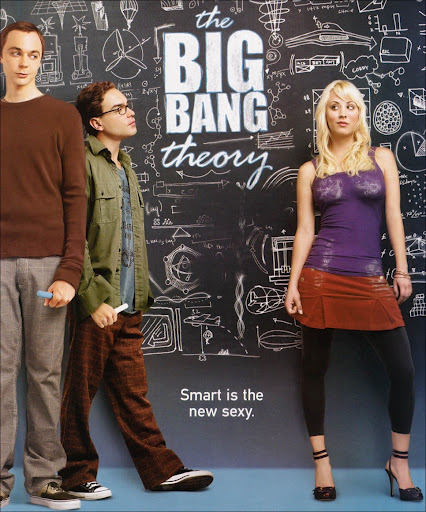
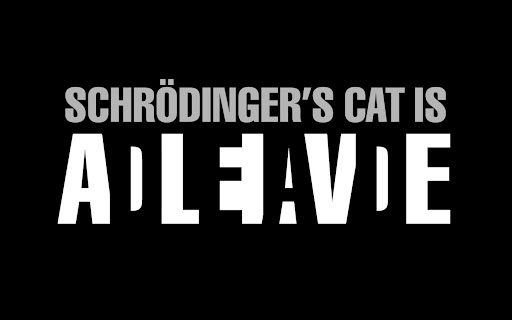
Big Bang Theory is by far my favorite show on TV right now.  It is smart and funny without being mean-spirited or too bawdy.  On one of the earlier episodes, Leonard has asked Penny out on a date.  Neither knows whether or not they should go through with it, and both end up asking the socially inept Sheldon for advice. Sheldon’s answer to their queries is the story of Schrödinger’s Cat.  If you would like to see the clip in which Sheldon explains Schrödinger’s Cat, click this link here.  After seeing the episode several times, I decided that I would do a little research into Schrödinger’s Cat and I came across the following explanatory poem from The Straight Dope.  I hope that you enjoy it as much as I did.

A STRAIGHT DOPE CLASSIC FROM CECIL’S STOREHOUSE OF HUMAN KNOWLEDGE
The story of Schroedinger’s cat (an epic poem)

May 7, 1982
Dear Cecil:

Cecil, you’re my final hope
Of finding out the true Straight Dope
For I have been reading of Schroedinger’s cat
But none of my cats are at all like that.
This unusual animal (so it is said)
Is simultaneously live and dead!
What I don’t understand is just why he
Can’t be one or other, unquestionably.
My future now hangs in between eigenstates.
In one I’m enlightened, the other I ain’t.
If you understand, Cecil, then show me the way
And rescue my psyche from quantum decay.
But if this queer thing has perplexed even you,
Then I will and won’t see you in Schroedinger’s zoo.

— Randy F., Chicago

Cecil replies:

Schroedinger, Erwin! Professor of physics!
Wrote daring equations! Confounded his critics!
(Not bad, eh? Don’t worry. This part of the verse
Starts off pretty good, but it gets a lot worse.)
Win saw that the theory that Newton’d invented
By Einstein’s discov’ries had been badly dented.
What now? wailed his colleagues. Said Erwin, “Don’t panic,
No grease monkey I, but a quantum mechanic.
Consider electrons. Now, these teeny articles
Are sometimes like waves, and then sometimes like particles.
If that’s not confusing, the nuclear dance
Of electrons and suchlike is governed by chance!
No sweat, though — my theory permits us to judge
Where some of ’em is and the rest of ’em was.”
Not everyone bought this. It threatened to wreck
The comforting linkage of cause and effect.
E’en Einstein had doubts, and so Schroedinger tried
To tell him what quantum mechanics implied.
Said Win to Al, “Brother, suppose we’ve a cat,
And inside a tube we have put that cat at —
Along with a solitaire deck and some Fritos,
A bottle of Night Train, a couple mosquitoes
(Or something else rhyming) and, oh, if you got ’em,
One vial prussic acid, one decaying ottom
Or atom — whatever — but when it emits,
A trigger device blasts the vial into bits
Which snuffs our poor kitty. The odds of this crime
Are 50 to 50 per hour each time.
The cylinder’s sealed. The hour’s passed away. Is
Our pussy still purring — or pushing up daisies?
Now, you’d say the cat either lives or it don’t
But quantum mechanics is stubborn and won’t.
Statistically speaking, the cat (goes the joke),
Is half a cat breathing and half a cat croaked.
To some this may seem a ridiculous split,
But quantum mechanics must answer, “Tough shit.
We may not know much, but one thing’s fo’ sho’:
There’s things in the cosmos that we cannot know.
Shine light on electrons — you’ll cause them to swerve.
The act of observing disturbs the observed —
Which ruins your test. But then if there’s no testing
To see if a particle’s moving or resting
Why try to conjecture? Pure useless endeavor!
We know probability — certainty, never.’
The effect of this notion? I very much fear
‘Twill make doubtful all things that were formerly clear.
Till soon the cat doctors will say in reports,
“We’ve just flipped a coin and we’ve learned he’s a corpse.”‘
So saith Herr Erwin. Quoth Albert, “You’re nuts.
God doesn’t play dice with the universe, putz.
I’ll prove it!” he said, and the Lord knows he tried —
In vain — until fin’ly he more or less died.
Win spoke at the funeral: “Listen, dear friends,
Sweet Al was my buddy. I must make amends.
Though he doubted my theory, I’ll say of this saint:
Ten-to-one he’s in heaven — but five bucks says he ain’t.”

— Cecil Adams


Blue? Or Maybe, Gay?

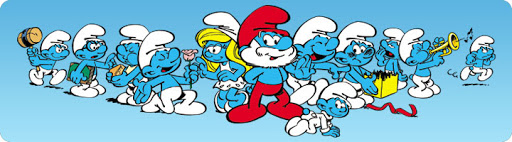
The above title is a play on words: blue/sad and gay/happy, but it also has a different meaning. As some of you may know, the Smurfs movie opens in theaters today. I remember watching the Smurfs on Saturday morning as a kid, it ran on NBC from 1980-1989, my prime years of watching cartoons. But to be honest, I didn’t remember much about them except that they were blue, they substituted the word smurf and various versions of it for other words, and that their nemesis was Gargamel and his cat Azreal. So, being the curious person I am, I looked up the Smurfs on Wikipedia. The article was quite enlightening. From Wikipedia:

The Smurfs (French: Les – Schtroumpfs) is a comic and television franchise centered on a group of small blue fictional creatures called Smurfs, created and first introduced as a series of comic strips by the Belgian cartoonist Peyo (pen name of Pierre Culliford) on October 23, 1958. The original term and the accompanying language came during a meal Peyo was having with his colleague and friend André Franquin in which, having momentarily forgotten the word “salt”, Peyo asked him (in French) to pass the schtroumpf. Franquin replied: “Here’s the Schtroumpf — when you are done schtroumpfing, schtroumpf it back” and the two spent the rest of that weekend speaking in schtroumpf language. The name was later translated into Dutch as Smurf, which was adopted in English.

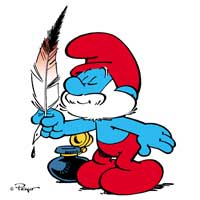
Papa Smurf

I had no idea that the Smurfs had been around since 1958. Moreover, I didn’t realize some of the odd criticisms that the Smurfs has received. Not only were there allegations of the Smurfs representing a communist utopia, with Papa Smurf (the only one to wear red) as a representation of Karl Marx and Brainy Smurf as representing Leon Trostky. Regarding these accusations, Thierry Culliford, son of Peyo and current head of Studio Peyo, said the accusations were, “between the grotesque and the not serious.”

Brainy Smurf

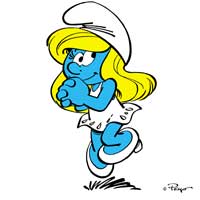
There were other allegations that the Smurfs were homosexual society. Now if you remember the Smurfs, you may ask yourself, what about Smurfette. In the original Belgian versions of The Smurfs, Smurfette did not exist. Hal Erickson said in Television Cartoon Shows: An Illustrated Encyclopedia 1949-1993 that the inclusion of Smurfette was “bowing to merchandising dictates” in order to “appeal to little girl toy consumers.” Jeffrey P. Dennis, author of the journal article “The Same Thing We Do Every Night: Signifying Same-Sex Desire in Television Cartoons,” said that the inclusion of Smurfette in the cartoon version of The Smurfs was likely to serve as an object of heterosexual desire for the other Smurfs and to end speculation arguing that the Smurfs were homosexual. In a response to Dennis’s statements, Martin Goodman of Animation World Network, said that Dennis had not taken into account Erickson’s comments about merchandising. Goodman further argued that capturing the young female audience would increase ratings, so the networks were more likely trying to pander to young girls than trying to defuse accusations of homosexuality; Smurfette was the most frequently merchandised of the Smurfs.

Smurfette

After reading about Jeffrey P. Dennis’s work, I decided to look into him a little more. Jeffery P. Dennis received his Ph.D. from SUNY Stony Brook in 2001 and is currently an Associate Professor of Sociology, SUNY, College at Oneonta. He is interested in the intersection of deviance and criminology with issues of gender, masculinity, and sexuality, especially the historical representation of deviant youth and bullying, harassment, and delinquency among LGBT youth today. Dr. Dennis is the author of Queering Teen Culture (2006), We Boys Together: Teenagers in Love before Girl-Craziness (2007), and many chapters, articles, and research presentations. However, I wanted to look more closely at his article “The Same Thing We Do Every Night: Signifying Same-Sex Desire in Television Cartoons.” Journal of Popular Film & Television. Fall 2003. Volume 31, Issue 3. 132-140.

Though I could not get a look at this article, I did find in Soundscapes—Journal on Media Culture, the article “Queertoons: The Dynamics of Same-Sex Desire in the Animated Cartoon” by Jeffrey P. Dennis, which seems to be remarkably similar, if not the same article under a different name and publication In this article he discusses same-sex relationships in cartoons, though the article is in need of being updated in regards to present-day Fox Network adult-oriented cartoons, such as The Simpsons, American Dad, and Family Guy. The article was quite interesting, but I think he is extrapolating ideas that aren’t intentional by the cartoonists. I want to end by quoting what he has to say about the Smurfs:

Vanity Smurf

[J. Marc] Schmidt finds a “homotopia” in The Smurfs (1969-1986), a group of small blue humanoids named after their primary personality characteristics (“Hefty”, “Brainy”, “Clumsy”), because all but one was male, and because the Smurf named Vanity was a self-absorbed dandy who might be read as a homophobic stereotype. However, male Smurfs never developed exclusive or even close relationships with each other, whereas they often developed goofy crushes on Smurfette. The back story reveals that an evil wizard created Smurfette to introduce discord into the all-male village; more likely the character was introduced specifically to provide an object for the Smurfs’ heterosexual desire and defuse conjectures that they might be “really” gay.

Some of these arguments, I find to be quite humorous. People will read so much in a simple cartoon. I remember with G.I. Joe, and a few other cartoons of the same time, having a moral at the end of the show. “Now you know, and knowing is half the battle.” I just thought that this was interesting and wanted to share. So what do you think? Were the Smurfs a homosexual/communist utopia? Was Smurfette merely a cover-up, i.e. the smurf’s beard?


My Inner Geek

First of all, I am an unapologetic GEEK, and I admit it.  If you’ve read my blog for a while, then you already know that I am a huge fan of “The Big Bang Theory.”  My inner geekiness goes far beyond “The Big Bang Theory” because I am a total Sci-Fi nerd.  I admit it.  It may not be very sexy to most people, but I am going to tell you why it is to me.  I really do love science fiction.  Had I gone to the right grad school and had the right advisor, I might have written my dissertation on the Representation of the Cold War in Science Fiction.  (Star Trek Example: Federation=The United States [with England as the Vulcans], Klingons=Soviet Union, Romulans=Chinese, etc.) It still might make a great book and research project one day if no one beats me to it.  It is not an idea original to me.

I love most things sci-fi: Star Trek, Star Wars, Stargate, and even Starship Troopers.  I love Babylon 5, Battlestar Galactica, and Buck Rogers.  I’m not a big comic book person, though I admit I do love the movies and TV shows that come from them, such as The Fantastic Four, X-Men, Batman, Wonder Woman, Daredevil, The Flash, Flash Gordon (and Flesh Gordon may come into this category, at least as a spoof).  I also have a long standing crush on Superman: Superman (Christopher Reeves), Lois and Clark (Dean Cain), Smallville (Tom Welling), Superman Returns (Brandon Routh), etc.  I also loved The 4400, great show.

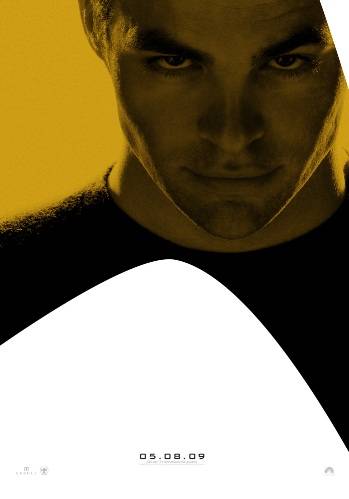
So lets go through a few of the examples and let me explain why I find science fiction appealing (and even sexy). Let’s begin with the Star Trek franchise. The Star Trek captains have all been sex symbols.  Kirk was always the sexy womanizer,.Picard the reserved cultured captain. Sisko was also a bit of a womanizer, though in a reserved damaged sort of way (his wife had been killed in the Borg attack, and he later married a female freighter captain).   Captain Janeway was always a very butch female captain, bordering on lesbianesque.  Of course, you then have Captain Archer who returned to the more womanizing sex symbol type like Kirk.  Now with the new series of movies, we have the absolutely gorgeous Chris Pine as Captain Kirk, and he is surrounded by the best looking of all of the Star Trek casts.  In addition the original Sulu, played by George Takei, is an openly gay man, giving gay Star Trek fans someone to look to.  Of course, Star Trek has had a number of hot male stars:  Wesley Crusher (TNG), Dr. Julian Bashir (DS9), Tom Paris (VOY).  Dr. Bashir was made out to be the first real sex symbol in the new incarnations of Star Trek after the original series.  Enterprise ramped up the sexiness with Trip, who was often seen in his “star trek/space age” underwear.  Enterprise was actually expected to have a gay character, rumored to be the weapons officer Malcolm Reed, but it never materialized with the low ratings the show received.

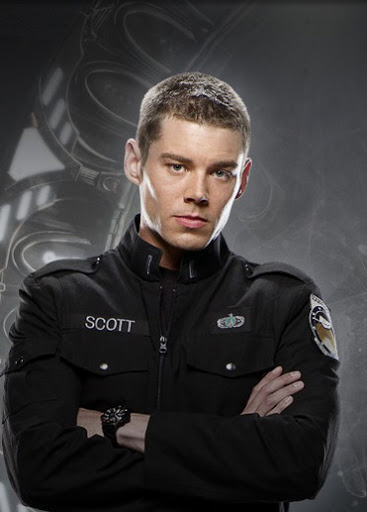
Stargate has also had it fair number of sexy men.  Daniel Jackson was smart, cultured, and always on a moral crusade would have made the most likely gay man in the series, but since it began with him being married, that was unlikely to materialize.  In my opinion, he was always very sexy.  Stargate: Atlantis has Col. Sheppard who could just make me weak in the knees, but it was the short-lived Stargate: Universe that really ramped up the sex factor.  Matthew Scott, played by Brian J. Smith, who has been known for playing several gay-themed characters in the movies Hate Crimes and The War Boys, both of which are highly recommended.  Also, and just because he played the dorky and somewhat awkward character of Eli, I always found him attractive.  The character also had a mother who suffered from HIV contracted when she was a nurse and was attacked by a drug addict.

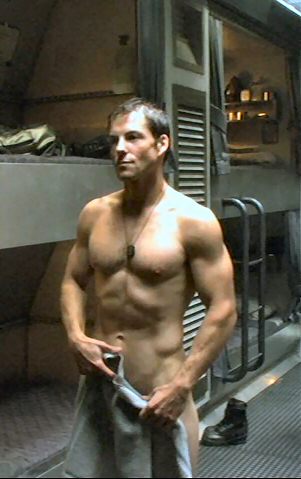
A few other science fiction movies and shows got my blood pumping, such as Starship Troopers  Who could forget Casper van Dien in the shower scenes showing off his lovely behind or the whipping scene, which I found oddly erotic?  Then in the new incarnation of Battlestar Galactica, you have the ever lovely Jamie Bamber, who has a particular towel scene that is amazing to watch. 

Most recently, we have several sci-fi/horror shows that give us just what we want with sexy guys.  True Blood has a host of sexy men, some of whom are gay, and MTV’s Teen Wolf has a host of sexy young guys, including the beautifully (and possibly gay) Colton Haynes (Warning: this link is NSFW).

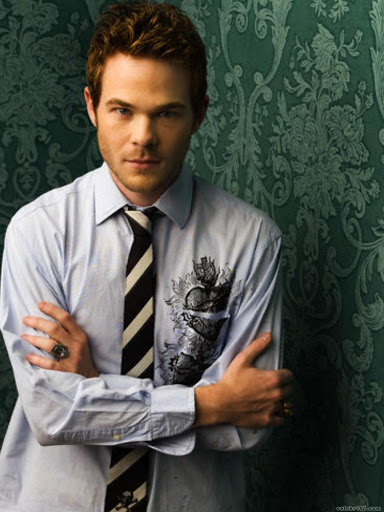
And finally, a science fiction show has an openly gay character.  Warehouse 13 on the SyFy Channel has a new character Agent Steve Jinx, played by Aaron Ashmore, who admitted on last night’s episode that he is gay.  Ashmore also has played at least on other gay character when he played Marc Hall in Prom Queen: The Marc Hall Story. I wonder if they will give him a boyfriend.  All of the other major characters on the show have been given love interests through the course of the show, so I certainly hope that Jinx will be given one as well.

It All Started with the Big Bang…

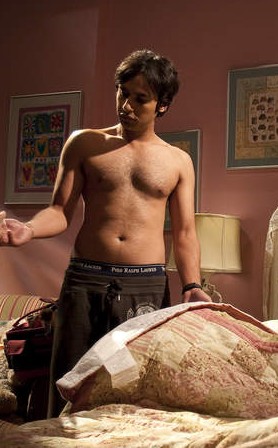
I have to admit that my favorite TV show right now is The Big Bang Theory. I absolutely love Jim Parsons (pictured above with a cute friend). Sheldon (Parsons) and Penny’s (Kaley Cuoco) interactions on the show are just too funny. I have to also say that I find Kunal Nayyarwho plays Raj Koothrappali on the show to be kinda hot.

The title from this post comes from the show’s theme song. I know, I’m a geek (as if, you couldn’t figure it out by this blog, LOL), but I still like the show.

The theme song of The Big Bang Theory is a song from the Bare Naked Ladies called, “The History of Everything.”  I love this song.  What is not to like, except that technically, they built the pyramids before they built the wall.  Listen to the song, and you will know what I mean.