Category Archives: Uncategorized

The Puppy Episode

Ellen senses a kindred spirit in herself when she meets an openly gay woman, named Susan, through Richard, an old boyfriend of hers, who enlightens Ellen to her own sexual identity. Confused by this startling self-discovery, Ellen seeks the guidance of yet another therapist and braces herself for yet another moment of truth of her life.


After a discussion with her therapist, Ellen decides to tell the truth about her true repressed sexual orientation to her friends by inviting them over to her apartment to break the news so she can be at peace. Meanwhile, Ellen’s hopes for a relationship with Susan are dashed when she tells Ellen that she’s not interested, but gives Ellen further confidence to embrace her newfound life.
Fifteen years ago today, Ellen DeGeneres’s character Ellen Morgan came out of the closet while 42 million Americans watched.  During the fourth season of Ellen in 1997, DeGeneres came out publicly as a lesbian in an appearance on The Oprah Winfrey Show.  Shortly afterwards on the April 30, 1997, episode of Ellen title “The Puppy Episode,” her character Ellen Morgan also came out to a therapist played by Winfrey, and the series went on to explore various LGBT issues including the coming out process. 
Thank you Ellen for an inspirational fifteen years.

Earth Day 2012

Each year, Earth Day — April 22 — marks the anniversary of what many consider the birth of the modern environmental movement in 1970.
The height of hippie and flower-child culture in the United States, 1970 brought the death of Jimi Hendrix, the last Beatles album, and Simon & Garfunkel’s “Bridge Over Troubled Water”. Protest was the order of the day, but saving the planet was not the cause. War raged in Vietnam, and students nationwide increasingly opposed it.
At the time, Americans were slurping leaded gas through massive V8 sedans. Industry belched out smoke and sludge with little fear of legal consequences or bad press. Air pollution was commonly accepted as the smell of prosperity. “Environment” was a word that appeared more often in spelling bees than on the evening news.  Although mainstream America remained oblivious to environmental concerns, the stage had been set for change by the publication of Rachel Carson’s New York Times bestseller Silent Spring in 1962.  The book represented a watershed moment for the modern environmental movement, selling more than 500,000 copies in 24 countries and, up until that moment, more than any other person, Ms. Carson raised public awareness and concern for living organisms, the environment and public health.
Earth Day 1970 capitalized on the emerging consciousness, channeling the energy of the anti-war protest movement and putting environmental concerns front and center. 
The idea came to Earth Day founder Gaylord Nelson, then a U.S. Senator from Wisconsin, after witnessing the ravages of the 1969 massive oil spill in Santa Barbara, California. Inspired by the student anti-war movement, he realized that if he could infuse that energy with an emerging public consciousness about air and water pollution, it would force environmental protection onto the national political agenda. Senator Nelson announced the idea for a “national teach-in on the environment” to the national media; persuaded Pete McCloskey, a conservation-minded Republican Congressman, to serve as his co-chair; and recruited Denis Hayes as national coordinator. Hayes built a national staff of 85 to promote events across the land.
As a result, on the 22nd of April, 20 million Americans took to the streets, parks, and auditoriums to demonstrate for a healthy, sustainable environment in massive coast-to-coast rallies. Thousands of colleges and universities organized protests against the deterioration of the environment. Groups that had been fighting against oil spills, polluting factories and power plants, raw sewage, toxic dumps, pesticides, freeways, the loss of wilderness, and the extinction of wildlife suddenly realized they shared common values.
Earth Day 1970 achieved a rare political alignment, enlisting support from Republicans and Democrats, rich and poor, city slickers and farmers, tycoons and labor leaders. The first Earth Day led to the creation of the United States Environmental Protection Agency and the passage of the Clean AirClean Water, andEndangered Species Acts. “It was a gamble,” Gaylord recalled, “but it worked.”
As 1990 approached, a group of environmental leaders asked Denis Hayes to organize another big campaign. This time, Earth Day went global, mobilizing 200 million people in 141 countries and lifting environmental issues onto the world stage. Earth Day 1990 gave a huge boost to recycling efforts worldwide and helped pave the way for the 1992 United Nations Earth Summit in Rio de Janeiro. It also prompted President Bill Clinton to award Senator Nelson the Presidential Medal of Freedom (1995) — the highest honor given to civilians in the United States — for his role as Earth Day founder.
As the millennium approached, Hayes agreed to spearhead another campaign, this time focused on global warming and a push for clean energy. With 5,000 environmental groups in a record 184 countries reaching out to hundreds of millions of people, Earth Day 2000 combined the big-picture feistiness of the first Earth Day with the international grassroots activism of Earth Day 1990. It used the Internet to organize activists, but also featured a talking drum chain that traveled from village to village in Gabon, Africa, and hundreds of thousands of people gathered on the National Mall in Washington, DC. Earth Day 2000 sent world leaders the loud and clear message that citizens around the world wanted quick and decisive action on clean energy.
Much like 1970, Earth Day 2010 came at a time of great challenge for the environmental community. Climate change deniers, well-funded oil lobbyists, reticent politicians, a disinterested public, and a divided environmental community all contributed to a strong narrative that overshadowed the cause of progress and change. In spite of the challenge, for its 40th anniversary, Earth Day Network reestablished Earth Day as a powerful focal point around which people could demonstrate their commitment. Earth Day Network brought 225,000 people to the National Mall for a Climate Rally, amassed 40 million environmental service actions toward its 2012 goal of A Billion Acts of Green®, launched an international, 1-million tree planting initiative with Avatar director James Cameron and tripled its online base to over 900,000 community members.
The fight for a clean environment continues in a climate of increasing urgency, as the ravages of climate change become more manifest every day. We invite you to be a part of Earth Day and help write many more victories and successes into our history. Discover energy you didn’t even know you had. Feel it rumble through the grassroots under your feet and the technology at your fingertips. Channel it into building a clean, healthy, diverse world for generations to come.


Moment of Zen: Founding of Rome

The Founding of Rome 

 According to tradition, on April 21, 753 B.C., Romulus and his twin brother, Remus, found Rome on the site where they were suckled by a she-wolf as orphaned infants. Actually, the Romulus and Remus myth originated sometime in the fourth century B.C., and the exact date of Rome’s founding was set by the Roman scholar Marcus Terentius Varro in the first century B.C. 
 According to the legend, Romulus and Remus were the sons of Rhea Silvia, the daughter of King Numitor of Alba Longa. Alba Longa was a mythical city located in the Alban Hills southeast of what would become Rome. Before the birth of the twins, Numitor was deposed by his younger brother Amulius, who forced Rhea to become a vestal virgin so that she would not give birth to rival claimants to his title. However, Rhea was impregnated by the war god Mars and gave birth to Romulus and Remus. Amulius ordered the infants drowned in the Tiber, but they survived and washed ashore at the foot of the Palatine hill, where they were suckled by a she-wolf until they were found by the shepherd Faustulus. 
 Reared by Faustulus and his wife, the twins later became leaders of a band of young shepherd warriors. After learning their true identity, they attacked Alba Longa, killed the wicked Amulius, and restored their grandfather to the throne. The twins then decided to found a town on the site where they had been saved as infants. They soon became involved in a petty quarrel, however, and Remus was slain by his brother. Romulus then became ruler of the settlement, which was named “Rome” after him. 
To populate his town, Romulus offered asylum to fugitives and exiles. Rome lacked women, however, so Romulus invited the neighboring Sabines to a festival and abducted their women. A war then ensued, but the Sabine women intervened to prevent the Sabine men from seizing Rome. A peace treaty was drawn up, and the communities merged under the joint rule of Romulus and the Sabine king, Titus Tatius. Tatius’ early death, perhaps perpetrated by Romulus, left the Roman as the sole king again. After a long and successful rule, Romulus died under obscure circumstances. Many Romans believed he was changed into a god and worshipped him as the deity Quirinus. After Romulus, there were six more kings of Rome, the last three believed to be Etruscans. Around 509 B.C., the Roman republic was established. 
 Another Roman foundation legend, which has its origins in ancient Greece, tells of how the mythical Trojan Aeneas founded Lavinium and started a dynasty that would lead to the birth of Romulus and Remus several centuries later. In the Iliad, an epic Greek poem probably composed by Homer in the eighth century B.C., Aeneas was the only major Trojan hero to survive the Greek destruction of Troy. A passage told of how he and his descendants would rule the Trojans, but since there was no record of any such dynasty in Troy, Greek scholars proposed that Aeneas and his followers relocated. 
 In the fifth century B.C., a few Greek historians speculated that Aeneas settled at Rome, which was then still a small city-state. In the fourth century B.C., Rome began to expand within the Italian peninsula, and Romans, coming into greater contact with the Greeks, embraced the suggestion that Aeneas had a role in the foundation of their great city. In the first century B.C., the Roman poet Virgil developed the Aeneas myth in his epic poem the Aeneid, which told of Aeneas’ journey to Rome. Augustus, the first Roman emperor and emperor during Virgil’s time, and Julius Caesar, his great-uncle and predecessor as Roman ruler, were said to be descended from Aeneas.
Source of the Image above:
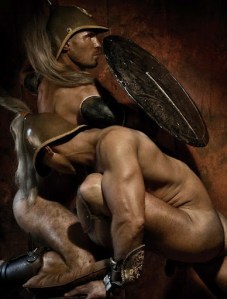
Bacco (version 2) by aurelio MONGE 
Bacchus was the Roman god of agriculture and wine, similar to the Greek Dionysus. 

He was the last god to join the twelve Olympians; Hestia gave up her seat for him. His plants were vines and twirling ivy. He often carried a pinecone-topped staff, and his followers were goat-footed Satyrs and Maenads, wild women who danced energetically during his festivals. 

Bacchus was the child of Jupiter (whose Greek name is Zeus) and Semele, a human whom Juno (whose Greek name is Hera) had tricked into asking to see Jupiter as he really was. Since she was a mortal, she was burned up by the sight of Jupiter in his divine form. So Jupiter sewed the infant Bacchus into his thigh, and gave birth to him nine months later. As a child, Bacchus was tutored by Silenus, who was a great lover of wine and often had to be carried on the back of a donkey. Before he took his place at Olympus, Bacchus wandered the world for many years, going as far as India to teach people how to grow vines. 
––––––––––––––––––––––––––––––––– 
Aurelio Monge ©2011 
This image is copyrighted. If you publish or share, please mention the name of the author and website: 

Gay Marry-Land

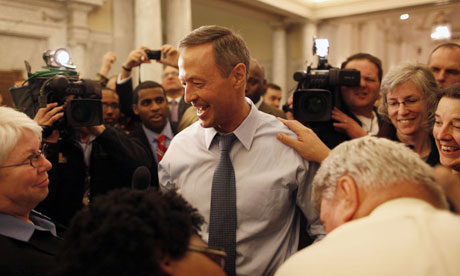
Maryland Governor Martin O’Malley, centre, greets supporters and members of the House of Delegates after the House passed a gay marriage bill in Annapolis, Maryland

Gay marriage is all but legalised in the state of Maryland after the legislature gave its final agreement on Thursday to the law that’s being sent to the governor, who said he expects to sign it sometime this week.

The state senate voted 25-22 for the law. The vote comes less than a week after the House of Delegates barely passed the measure.

Maryland will become the eighth state to allow gay marriage when Governor Martin O’Malley who sponsored the bill signs the legislation. The Democrat made the measure a priority this session after it stalled last year.

Six states allow gay couples to wed Connecticut, New Hampshire, Iowa, Massachusetts, New York and Vermont as well as the Washington capital district. The governor of Washington signed a bill this month that would make that state the seventh.

Opponents in Maryland have vowed to bring the measure to referendum in November. They will need to gather at least 55,726 valid signatures of Maryland voters to put it on the ballot and can begin collecting names now that the bill has passed both chambers.

Some churches and clergy members have spoken out against the bill, saying it threatens religious freedoms and violates their tradition of defining marriage as between a man and a woman.

“The enormous public outcry that this legislation has generated voiced by Marylanders that span political, racial, social and religious backgrounds demonstrates a clear need to take this issue to a vote of the people,” Maryland Catholic Conference spokeswoman Kathy Dempsey said in a statement. “Every time this issue has been brought to a statewide vote, the people have upheld traditional marriage.”

Leaders at the Human Rights Campaign, a group that joined a coalition of organisations to advocate for the bill, said they expect opponents will gather the required number of signatures.

Senator Allan Kittleman, the only senate Republican to vote in favuor of the legislation, said he is proud of his decision and not concerned about political consequences down the road.

“You don’t worry about politics when you’re dealing with the civil rights issue of your generation,” said Kittleman, R-Howard, the son of the late Senator Robert Kittleman, who was known for civil rights advocacy.

Gay marriage remains on hold in California after opponents petitioned a federal appeals court on Tuesday to review a split decision by three of its judges that struck down a voter-approved measure that limited marriage to a man and woman.


Red-Faced Jazz

A U.K.-based radio station’s programmers are understandably red-faced after they inadvertently aired five minutes of a gay porn soundtrack.

Pink News reports that Jazz FM, which focuses on light jazz, standards and occasional blues numbers, aired a recording of what sounded like “two British men in a mostly wordless, but fairly graphic, exchange” on Sunday.

You can listen to a recording of the broadcast here (WARNING: contains graphic language).

Mike Vitti, the station’s head of programming, has issued a statement apologizing for the gaffe: “Unfortunately we had an unauthorized access to the live feed this evening which resulted in a highly regrettable incident. Please accept our profound and sincere apologies for any offence that may have been caused.”

Mike Vitti, station programme director, said disciplinary action would follow.

A spokesman for the broadcasting regulator Ofcom told PinkNews.co.uk that it has “received a small number of complaints and is currently assessing whether the broadcast broke the Broadcasting Code”. If found in breach, broadcasters can receive a fine or the loss of a license although this is thought highly unlikely in this case.

PinkNews.co.uk wrote that a broadcast assistant was watching pornography while the recorded show was being broadcast and that they accidentally transmitted the audio of the porn to the nation because their microphone was erroneously active.


Edwin Arlington Robinson

I recently made my American Literature students read some of the poems of Edwin Arlington Robinson.  I will admit that I was not terribly familiar with him, but we are studying American poetry, and he was one of the poets.  The poems were fairly short and fairly straightforward, meaning that it would be easy for the kids to interpret.  I read the poems and fell in love with them.  Since then, I have gone back and read a few more of Robinson’s poems, and enjoyed them.  The two poems that we read, sort of resonated with me in a special way.

On December 22, 1869, Edwin Arlington Robinson was born in Head Tide, Maine. His family moved to Gardiner, Maine, in 1870, which renamed “Tilbury Town,” became the backdrop for many of Robinson’s poems.  His poems are sketches about different people in the town.  If you have never read the two poems below, I hope that you will read them now, or if you have read them before, I hope that you will enjoy them all over again.

The first poem is Richard Cory:

Richard Cory
by Edwin Arlington Robinson

Whenever Richard Cory went down town,
We people on the pavement looked at him:
He was a gentleman from sole to crown,
Clean favored and imperially slim.

And he was always quietly arrayed,
And he was always human when he talked,
But still he fluttered pulses when he said,
“Good-morning,” and he glittered when he walked.

And he was rich–yes, richer than a king–
And admirably schooled in every grace:
In fine, we thought that he was everything
To make us wish that we were in his place.

So on we worked, and waited for the light,
And went without the meat and cursed the bread;
And Richard Cory, one calm summer night,
Went home and put a bullet through his head.

The two major things in this poem the wealth of Richard Cory and his suicide at the end are not what draws me to this poem.  I am not rich nor do I contemplate suicide.  This poem, which first appeared in The Children of the Night and remains one of Robinson’s most popular poems, recalls the economic depression of 1893. At that time, people could not afford meat and had a diet mainly of bread, often day-old bread selling for less than freshly baked goods. This hard-times experience made the townspeople even more aware of Richard’s difference from them, so much so that they treated him as royalty.  I think what I get out of this poem is how he doesn’t fit in because of something extraordinary about him.  In his case it is his wealth.  In my case, people often see me as smart and don’t often see me as a regular person.  I can tell a dirty joke, drink a beer, and be just as normal as the next person, but sometimes, people see my intelligence and often think, “He’s too smart for me.”  Or maybe because I am gay (or perceived as gay for those who don’t know for sure), people think that I do not enjoy sports, fishing, or other “manly” pursuits.  To truth is, I am just a normal guy who is smart and gay.  Neither of those are the central things about me.  We all have something that distinguishes us, but should that separate us from the crowd.  Maybe sometimes it does, and sometimes we want it to, but all in all, we are just people like everyone else.  Sadly, the people of Tilbury Town did not realize this about Richard Cory.

The other poem is the way I sometimes feel when I am studying particular periods in history.

Miniver Cheevy
by Edwin Arlington Robinson

Miniver Cheevy, child of scorn,
     Grew lean while he assailed the seasons;
He wept that he was ever born,
     And he had reasons.

Miniver loved the days of old
     When swords were bright and steeds were prancing;
The vision of a warrior bold
     Would set him dancing.

Miniver sighed for what was not,
     And dreamed, and rested from his labors;
He dreamed of Thebes and Camelot,
     And Priam’s neighbors.

Miniver mourned the ripe renown
     That made so many a name so fragrant;
He mourned Romance, now on the town,
     And Art, a vagrant.

Miniver loved the Medici,
     Albeit he had never seen one;
He would have sinned incessantly
     Could he have been one.

Miniver cursed the commonplace
     And eyed a khaki suit with loathing;
He missed the mediæval grace
     Of iron clothing.

Miniver scorned the gold he sought
     But sore annoyed was he without it;
Miniver thought, and thought, and thought,
     And thought about it.

Miniver Cheevy, born too late,
     Scratched his head and kept on thinking;
Miniver coughed, and called it fate,
     And kept on drinking.

We may not take it as far as Miniver Cheevy, but I think all people who study history sometimes feel that they were born in the wrong time.  Then again, there have been very few times in history when it was as acceptable to be gay as it in this day and age, but then again who wouldn’t have loved to witness the Olympic Games of Ancient Greece, or traveled down the canals of Venice when the city was in its full glory, or any number of periods or events in history.  Personally, though I would love to visit those time periods, I like my modern conveniences and air conditioning.  Then again, the Roaring Twenties when I could have possibly partied with F. Scott and Zelda Fitzgerald and Tallulah Bankhead or sat on the Seine with the Lost Generation or gone to the Cotton Club in Harlem at the height of the Harlem Renaissance.  Come to think of it, maybe, I was born out of time. I think I would have loved the 1920s (just not the Great Depression that followed).

How many of you have felt that you were born in the wrong time? Or that people didn’t appreciate you for who you are?



And Now for the Answers…

I hope you enjoyed this Presidents’ Day and that you had fun reviewing some of my posts about gay (or not) presidents.  I also hope that you enjoyed the quiz.  Now it is time to see if you got the answers correct.

1. What is the birth state of the most presidents?
Correct answer: Virginia

2. How many U.S. presidencies have there been?
Correct answer: 44

3. Who was the first president to live in the White House?
Correct answer: John Adams

4. Which is NOT true about Lincoln’s Gettysburg Address?
Correct answer: He wrote out the address on the back of an envelope on the train to Gettysburg.

5. Fill in the missing words in the president’s oath of office: “I do solemnly swear (or affirm) that I will faithfully execute the Office of President of the United States, and will to the best of my Ability, —, — and — the Constitution of the United States.”
Correct answer: Preserve, protect and defend

6. True or false: George Washington owned many slaves but decided to free them in his will.
Correct answer: True

7. Who was the only president to serve two nonconsecutive terms?
Correct answer: Grover Cleveland

8. Lincoln was virtually unknown in the Republican Party in 1858 when he challenged the powerful U.S. Sen. Stephen Douglas of Illinois. The two debated seven times between July and October of that year. Which is NOT correct?
Correct answer: As a result of the debates, Lincoln beat Douglas but was only in the U.S. Senate for a short time because he beat him again to become president in 1860.

9. Four presidents were assassinated in office, and four others died from other causes. What killed William Henry Harrison?
Correct answer: Pneumonia and pleurisy

10. What was Woodrow Wilson’s nickname?
Correct answer: The Professor

How well did you do?

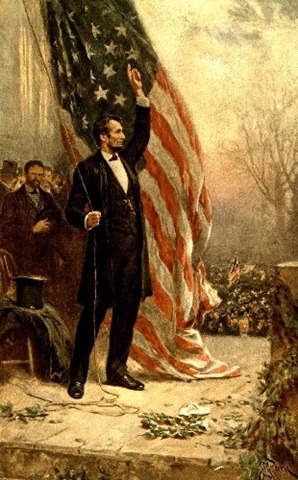
Abraham Lincoln, Gay?

If you want just my opinion on this controversial issue, this would be a very short post, because I don’t think he was gay.  However, there is a lot of controversy over this issue, and I thought I would give a closer look for you guys.

The sexuality of Abraham Lincoln is a subject that is laced with many discrepancies and historical flaws.  GayLincoln The notion that Lincoln was a homosexual also portrays nearly perfectly two of my major pet peeves with historians.  First, much of the argument is taken out of its historical context, and second, the authors who expound on this notion have no historical objectivity.  I will explain these two pet peeves of mine as I relate the supposed homosexuality of Abraham Lincoln.  Mostly, I will explain what is wrong with the theories of Lincoln’s homosexuality.  If you are not familiar with the arguments concerning Lincoln’s homosexuality, please read the suggested readings below.   

6a00d8341c730253ef00e54f3297c08833-640wi In The Intimate World of Abraham Lincoln, C. A. Tripp contends that Lincoln had erotic attractions and attachments to men throughout his life, from his youth to his presidency. He further argues that Lincoln’s relationships with women were either invented by biographers (his love of Ann Rutledge) or were desolate botches (his courtship of Mary Owens and his marriage to Mary Todd). Tripp is not the first to argue that Lincoln was homosexual — earlier writers have parsed his friendship with Joshua Speed, the young store owner he lived with after moving to Springfield, Ill. — but he assembles a mass of evidence and tries to make sense of it.

imageTripp died in May 2003, after finishing the manuscript of this book, which means he never had a chance to fix its flaws. Tripp alternates shrewd guesses and modest judgments with bluster and fantasy. He drags in references to Alfred Kinsey (with whom he once worked) to give his arguments a (spurious) scientific sheen. And he has an ax to grind. Not only did he work with Kinsey, but Tripp was a well-known gay activist and psychologist.  By the way, psychologists who write psycho-history are often the worst type of historians.  They have very little understanding of the craft and they use their knowledge of psychology to interpret historical data.  The same goes for most journalists, who do not have the same standards as historians when it comes to citing their sources. Psychologists who write history too often apply Freudian and Jungian psychology to people who had never had any knowledge of this type of psychoanalyzing. 

In the after math of the Franco-Prussian War in Europe (1870-71), Carl von Clauswitz wrote the military strategy book On War.  Military historians after the publication of On War are able to compare Clauswitz theories to modern warfare because it influenced modern generals and military strategists.  Likewise, the psychological theories of Freud and Jung and the perverted misunderstanding of Einstein’s Theory of Relativity (“everything is relative,” not just E = mc2, as Einstein meant it) greatly influenced 20th century writers, who used this knowledge to form their characters and plot devises. I mention these two instances of influencing theories because Tripp uses modern homosexual behavior to explain Lincoln relationships with men.  He takes the notion out of its historical context. 

imageIntimacy between men was much more common and less sexually laced in the 19th century than it was in the later part of the 20th century.  In 19th century America, men commonly slept with other men. For example, when lawyers and judges traveled “the circuit” with Lincoln, the lawyers often slept “two in a bed and eight in a room.”  William H. Herndon recalled, “I have slept with 20 men in the same room.”  A tabulation of historical sources shows that Lincoln slept with at least 11 boys and men during his youth and adulthood. There are no known instances in which Lincoln tried to suppress knowledge or discussion of such arrangements, and in some conversations, raised the subject himself. Tripp, who was not aware of this large number of Lincoln’s male co-sleepers, discusses only three of them at length: Joshua Speed, William Greene, and Charles Derickson.

image
Joshua Speed

Tripp and other gay activists have an agenda to prove Lincoln’s homosexuality.  He is seen as the father of the Republican Party, an American political party known for its many anti-gay members and platforms.  Their objectivity is shot to hell because they are not attempting to give their readers an intimate look at the private life of Abraham Lincoln, but to discredit the Republican Party.  For me, this takes away much of the credibility of advocates of Lincoln’s homosexuality.  I am no fan of the Republican Party.  I largely find the modern Republican Party to be defined by what it hates and not what it is for; however, the same could be said for the Democratic Party.  American politics is a divisive politics of hate.  If someone writing history is blinded by that hate, they cannot see the error of their historical argument.  They apply modern interpretations to situations that do not warrant modernity.  Yes, the Civil War in America, the mid-19th century was a turning point in the history of America.  It is a period of transitioning from the early republic to the modern era.  Yet, this transition was not even complete by 1877 when Reconstruction ended.  Therefore, modern interpretations of events are null and void.

Suggested Readings:

Same-Sex Marriage

Research has shown that marriage provides substantial psychological and physical health benefits due to the moral, economic and social support extended to married couples. Conversely, recent empirical evidence has illustrated the harmful psychological effect of policies restricting marriage rights for same-sex couples. Additionally, children raised by same-sex couples have been shown to be on par with the children of opposite-sex couples in their psychological adjustment, cognitive abilities and social functioning.

The American Psychological Association. Aug. 11, 2010 press release “American Psychological Association Reiterates Support for Same-sex Marriage”

Roll Tide Roll!!!

Second-ranked Alabama defeats No. 1 LSU 21-0 to win college football’s BCS national championship game in New Orleans.