







Prescott Townsend
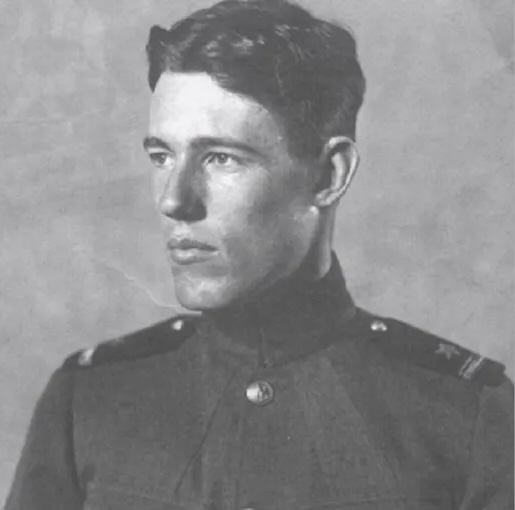
Prescott Townsend (1894-1973) was born into an old, wealthy Boston family. His mother was both a descendant of Myles Standish through her grandmother Susannah Perkins Staples (the sister of Yale Law School founder Seth Perkins Staples) and other Mayflower passengers, and the great-granddaughter of the American founding father Roger Sherman and his wife Rebecca Minot Prescott, through their son Roger Sherman, Jr. Townsend came out as a teenager, and his parents were accepting but told him to be cautious.
He attended the Volkman School, graduated in 1918 from Harvard University, and attended Harvard Law Schoolfor one year. He spent the summer of 1914 in logging camps in Montana and Idaho, and traveled to North Africa and the Soviet Union. After serving in World War I, Prescott lived in Paris for a time, becoming immersed in the bohemian culture of the era. He then “sought to establish an outpost of that culture” in his hometown of Boston and returned to Boston’s Beacon Hill neighborhood, where he began a relationship with theater producer Elliot Paul, with whom he founded the experimental Barn Theatre in 1922.
Paul introduced Townsend to numerous avant-garde creatives, including openly gay writer André Gide. Townsend operated speakeasies, restaurants, and theaters, cultivating a bohemian neighborhood on Beacon Hill’s Joy Street. He also spent time in Provincetown, where he became friendly with playwright Eugene O’Neill and other theater artists. He pioneered the popularity of A-frame houses, building several in Provincetown. He was later a founder of the Provincetown Playhouse, where the works of Eugene O’Neill were first performed.
Prescott was very happy to be a patron of the arts, and artists were very happy to take his money, However, the Great Depression ended all that.
By the 1930s, Prescott Townsend repeatedly addressed the Massachusetts legislature as an acknowledged homosexual man advocating for the repeal of sodomy legislation, urging the lawmakers “to legalize love.” He was indulged due to his family’s wealth and Boston Brahmin status, but he was ignored by lawmakers. While working at the shipyard during World War II, Townsend was arrested in 1943, for participating in an “unnatural and lascivious act.” He did not deny it, and was sentenced to eighteen months in the Massachusetts House of Corrections.
Shortly after, Prescott was officially stricken from both the New York and Boston Social Registers. In the 1950s, he held meetings at his home/bookstore, which he described as “the first social discussion of homosexuality in Boston.” In talks in Boston and Provincetown he promoted his “Snowflake Theory” of human personality and sexuality, stating that the human mind is like a snowflake in that no two are alike, and each has six opposing sides: I/You, He/She, Hit/Submit. He embraced a more in-your-face generation of activists in the late 1960s, marked by the uprising at New York City’s Stonewall Inn in 1969 and at age 76, he attended the first Pride parade in New York on the one-year anniversary of the Stonewall riots.
Toward the end of his life, his two remaining properties on the Hill were on its North Slope, traditionally the side where servants of patrician South Slope residents lived. He accommodated a motley collection of tenants, mostly young gay men, in an eight-unit building at 75 Phillips St. He always advocated for the outsider, the hippies, vagabonds, and runaway homeless queer youth his was a legacy of love, money and uplift.
Townsend died at age 78. He had, for years, been suffering from failing health brought on by Parkinson’s disease, and on May 23, 1973, his body was found in the Beacon Hill apartment of John Murray, who had been caring for him during the final years of his life. The police reported that “when we came in to take charge of the body, Mr. Townsend was found in a kneeling prayer position at his bedside.” Of his entire family, only one sister, a nephew and a great-nephew attended his memorial service at the Arlington Street Church.

Cernunnos
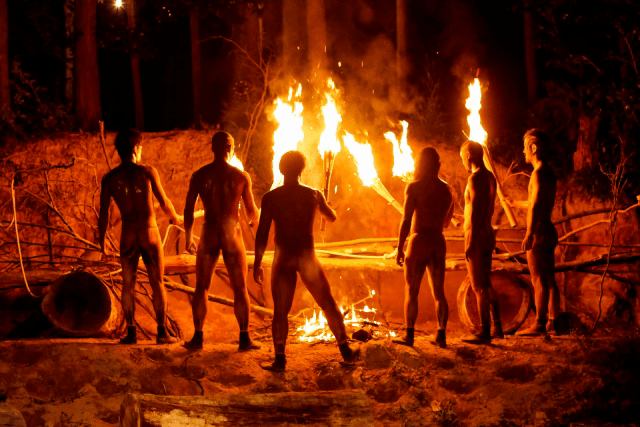
Last June, I went to a weekend escape to Easton Mountain, a gay men’s retreat in Greenwich, NY. One of the activities was a Cernunnos Fire Ceremony. The Cernunnos Ceremony is meant to tap into the energy of the wild ones in the woods that is meant to encourage a person to be free and listen to natures rhythms as a way of healing and self-expression. Cernunnos dates back to the ancient Celtic religion practiced freely in pre-Roman Europe. The picture above is of a modern Cernunnos Fire Festival, which is often performed nude in an effort to break down all barriers between nature and the body.
Cernunnos was a Celtic god who represented nature, flora, fauna, and fertility. He is frequently depicted with antlers, seated cross-legged, and is associated with stags, horned serpents, dogs, and bulls. He is usually shown holding or wearing a torc and sometimes holding a bag of coins (or grain) and a cornucopia. Cernunnos may have been one of the inspirations for depictions of Satan in Christian art and hero figures in the medieval literature of Wales and Ireland.
Cernunnos was perhaps the most important deity in the Celtic religion if we consider the frequency he is represented in ancient Celtic art from Ireland to Romania. Contrary to what many New Age beliefs, few facts are known about the Celtic religion, because there are no surviving native records of their beliefs. Evidence about their religion is gleaned from archaeology, Greco-Roman accounts (some of them hostile and probably not well-informed), and literature from the early Christian period.
The name Cernunnos originated because of a single instance of the name, an inscription and image on the 1st-century CE Nautae Parisiaci monument (see the image in the upper right of the inner cauldron below). It is also true that there were other Celtic gods with horns whose significance and associations remain unknown. It is important to restate that so little is known of Cernunnos that it is possible we are entirely misinterpreting representations of him in Celtic art. As the historian J. MacKillop notes: “our knowledge of Cernunnos is so tenuous that he may not be a divinity at all but rather a shaman-like priest with antlers affixed to his head”

With global warming, dependency on technology, and even modesty, our connection to nature is often lost. As warmer weather is slowly returning to Vermont, I am hoping to have the chance to do more hiking this summer. I wasn’t able to do so last year because of the floods in Vermont that made the local hiking trails treacherous. Hopefully, this summer will be different. I’d love to be able to connect with nature more, and the exercise will be nice too.

Rain, Rain… ☔️

Rain, rain, go away,
Come again another day.
Today begins at least four straight days of rain. The weather app on my phone says that it will only be light rain for parts of the day; however, my local meteorologist says the rain will be heavier and more long lasting. While the forecast calls for scattered showers with heavier rains this afternoon.
Apparently, this means my commute home is expected to be in heavy rain. Maybe, it won’t be so bad. I hate driving in the rain in Vermont, especially this time of year. Vermont is not very good about keeping the lines on the roads painted, and they always fade during winter. They often get repainted in the summer, but for now, it’s hard to see the lines.
The heaviest rain is predicted for Friday when a severe storm hitting the southern United States will reach us. It is doubtful the rain will even come close to the severe storms in the South. We have severe snowstorms in Vermont, but rarely do we ever have severe rain storms. I can count on one hand the number of times I’ve heard thunder or seen lightning up here. In the South, we’d get very heavy rainfall, especially during the tropical storm season, but here in Vermont, it’s usually mostly very light rain.
As long as I can stay home and read while it rains, I don’t mind it. I only get aggravated by rain when I have to be out in it. I’m off work tomorrow, and I have errands to run. I’m hoping there is a break in the rain while I’m running them. The rest of the time we are expected to get rain, I should be able to just stay home and curl up with a book and Isabella.

A Solar Eclipse

A Solar Eclipse
By Ella Wheeler Wilcox
In that great journey of the stars through space
About the mighty, all-directing Sun,
The pallid, faithful Moon, has been the one
Companion of the Earth. Her tender face,
Pale with the swift, keen purpose of that race,
Which at Time’s natal hour was first begun,
Shines ever on her lover as they run
And lights his orbit with her silvery smile.
Sometimes such passionate love doth in her rise,
Down from her beaten path she softly slips,
And with her mantle veils the Sun’s bold eyes,
Then in the gloaming finds her lover’s lips.
While far and near the men our world call wise
See only that the Sun is in eclipse.
About the Poet
Ella Wheeler Wilcox was born on November 5, 1850, in Johnstown Center, Wisconsin. She was a popular writer characterized mainly by her upbeat and optimistic poetry, though she was also an activist. Her poetry collections include Poems of Passion (W. B. Conkey Company, 1883) and Poems of Peace (Gay & Bird, 1906). She died in Connecticut on October 30, 1919.
Reflections on the Eclipse
Where I live in Vermont was in the path of totality for yesterday’s total eclipse. As the moon slowly moved over the sun blocking out its rays, the sky became darker. It was a truly awesome experience.
As I watched the eclipse, I was not only thinking about the beautiful strangeness that is a total eclipse, but I was also thinking about what a total eclipse would have been like for people in history who were not as knowledgeable about astronomy as we are today. It must have been terrifying, especially for people like the Ancient Egyptians or Inca who worshipped the Sun. There would have been religious leaders who better understood the cosmos, but for the average person who just watched as the sun slowly disappeared and day turned to night, it probably seemed like the end was near. Their relief as the sun reappeared in the sky must have come as a great relief, but I can see how many people with primitive knowledge would have believed this event foretold a great disaster.

The Eclipse in Vermont



Authors
Recent Comments
noisilycool3bc985058… on Pic of the Day noisilycool3bc985058… on Moment of Zen: A Room with a… Joe on Ah, Montreal… Joe on Ah, Montreal… iameverywhere1 on Ah, Montreal… Top Posts & Pages



Amazon Associate

As an Amazon Associate I earn from qualifying purchases. So, if you click on a link that takes you to Amazon.com, I may earn a commission.
Trust me, it isn’t much, but every little bit helps.

 Joe
Joe


 The Closet Professor