The Stonewall Riots

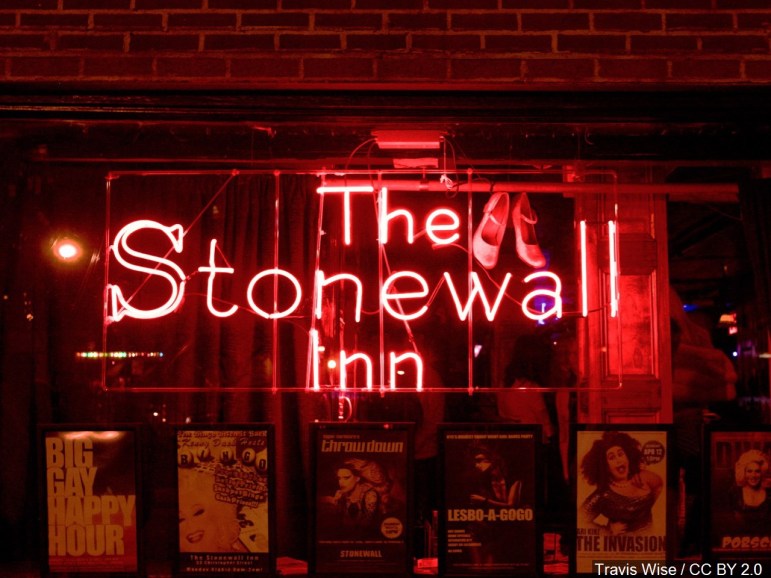
At 1:20 a.m. on Saturday, June 28, 1969, four plainclothes policemen in dark suits, two patrol officers in uniform, Detective Charles Smythe, and Deputy Inspector Seymour Pine, arrived at the Stonewall Inn’s double doors and announced, “Police! We’re taking the place!” The music was turned off, and the main lights were turned on. Raids of gay bars in New York City, particularly Greenwich Village, were not uncommon in the summer of 1969; what made the raid on the Stonewall on the night of June 27 so different was that the patrons of the bar resisted instead of going peacefully. Approximately 205 people were in the bar that night. Patrons who had never experienced a police raid were confused. A few who realized what was happening began to run for doors and windows in the bathrooms, but police barred the doors. The police had a standard procedure for these raids. They lined up the patrons and began checking identification. Any person appearing to be physically male and dressed as a woman would be arrested. This particular raid did not go as planned. Those dressed as women that night refused to go with the officers. Men in line began to refuse to produce their identification.

The New York Post was the first of the New York newspapers to report the raid and the first “melee” that followed the raid. The Post described the scene following the raid on the Stonewall Inn, “a tavern frequented by homosexuals at 53 Christopher St.” The raid was staged because of the unlicensed sale of liquor. On that first night, twelve people were arrested with charges ranging from assault to disorderly conduct because of the impromptu riot that soon ensued. As the police drove away with those in custody from the raid, the newspaper describes how “hundreds of passerby” shouted “Gay Power” and “We Want Freedom” while laying siege to the bar with “an improvised battering ram, garbage cans, bottles and beer cans in a protest demonstration.” More police were sent to 53 Christopher Street, where the disturbance raged for more than two hours.

For the next two days and again on July 3, the New York Times ran small pieces about the “Village Raid.” On June 29, the Times reported that shortly after 3 a.m. on the previous day, the bar had been raided. About two hundred patrons were thrown out of the bar and soon were joined by about two hundred more in protest of the raid. Police seized several cases of liquor from the establishment, which the police stated was operating without a liquor license. The Times reported that the “melee” lasted for only about forty-five minutes after the raid before the crowd dispersed, and thirteen people in all were arrested, with four policemen suffering injuries, one a broken wrist. The June 29 article also stated that the raid was one of three conducted in the last two weeks, and on the night of June 28, “throngs of young men congregated outside the inn. . .reading aloud condemnations of the police.”  

 
The June 30 edition of the newspaper stated that on the early morning of June 29, a crowd of about four hundred gathered again on Christopher Street, and a Tactical Patrol Unit was called in to control the disturbance at about 2:15 a.m. The crowd was throwing bottles and lighting small fires. With their arms linked, the police made sweeps down Christopher Street from the Avenue of the Americas to Seventh Avenue, but the crowds merely moved into side streets and reformed behind the police. Those who did not move out of the way of the police line were pushed along, and two men were clubbed to the ground. Stones and bottles were thrown at the police, and twice, the police broke ranks to charge the crowd. Three people were arrested on charges of harassment and disorderly conduct. The June 30 article also stated that the crowd gathered again on the evening of June 29 to denounce the police for “allegedly harassing homosexuals.” Graffiti painted on the boarded-up windows of the inn stated, “Support gay power” and “Legalize gay bars.” A July 3 article in the New York Times stated that a chanting crowd of about five hundred gathered again outside the Stonewall Inn and had to be dispersed by the police while four protestors were arrested.

On July 3, 1969, The Village Voice published two more substantial articles on the incidents surrounding the Stonewall Inn. Of the two articles, Lucian Trusctott IV’s article is written in a tongue-in-cheek style focusing on the several days of riots that ensued after the first raid. Truscott reports that the crowd, which returned on Saturday night, was being led by “gay power” cheers: “We are the Stonewall girls/ We wear our hair in curls/ We have no underwear/ We show our pubic hair!” The article is mostly sympathetic to the gay cause and quotes Allen Ginsberg, a gay activist, stating, “Gay Power! Isn’t that great! We’re one of the largest minorities in the country–10 percent, you know. It’s about time we did something to assert ourselves.” Truscott is prophetic when he ended his article by stating:  

We reached Cooper Square, and as Ginsberg turned to head toward home, he waved and yelled, “Defend the fairies!” and bounce on across the square. He enjoyed the prospect of “gay power” and is probably working on a manifesto for the movement right now. Watch out. The liberation is under way! 

Gay liberation was underway. 

No one really knows what set off the “flash of anger” that began the riots. Most of the people who were there just said that all of a sudden, the crowd grew angry and either began throwing bottles or trying to free one of the men in drag who were being arrested. Even if it cannot be determined what set off the anger that went through the crowd, it must be asked why that night. Many factors could have contributed to why the people in the Stonewall Inn fought back. It could have been because most of them had reached their breaking point, with the criminalization of their behavior to the Vietnam War that had raged for the last four years in the living rooms of every American with a television. One theory is that with Judy Garland’s funeral earlier that day, the men in the Stonewall Inn were distraught over losing their greatest icon. The heat in New York that summer was probably another factor. Also, the Stonewall raid occurred early in the morning. Usually, raids happened earlier in the evening so that the bar could open back up. The mafia ran the gay bars, and the police were being bribed. The raids were rarely major incidents, nor were the raids expected to be. But the night of June 27, 1969, was different for one reason or another.

Once the crowd began to fight back, the fervor of rebellion and the feeling that a revolution was happening among the gay community swept through the crowd. No longer were gays going to work with the system to make themselves feel more normal. They wanted to be accepted for who they were, not for who the establishment wanted them to be. African-Americans had made great strides in their civil rights struggle, and women were just beginning to make strides for women’s liberation and equality. As pointed out by Alan Ginsberg earlier, gays and lesbians were a large minority in the United States. If they could make themselves heard, this could change everything for them. 

A catalyst had been sparked by the Stonewall Riots, and there was no turning back. From 1969 to today has been a bumpy road in the fight for LGBTQ+ rights. The AIDS epidemic set back the movement as many in the gay community died, but the fight lived on. In 1973, the board of the American Psychiatric Association voted to declassify homosexuality as a mental disorder. Eventually, the Supreme Court overturned sodomy laws and ruled in favor of gay marriage. The movement isn’t over, and we cannot rest on those and the many other small victories. With transgender rights being attacked in so many states, we have to continue to push for LGBTQ+ equality.


Pic of the Day


The Star Dial

The Star Dial
By Willa Cather

Δέδυκε μὲν ἀ σελάννα
καὶ Πληΐαδες
          —Sappho*

When the moon was high I waited,
  Pale with evening’s tints it shone;
When its gold came slow, belated,
  Still I kept my watch alone

When it sank, a golden wonder,
  From my window still I bent,
Though the clouds hung thick with thunder
  Where our hilltop roadway went.

By the cypress tops I’ve counted
  Every golden star that passed;
Weary hours they’ve shone and mounted,
  Each more tender than the last.

All my pillows hot with turning,
  All my weary maids asleep;
Every star in heaven was burning
  For the tryst you did not keep.

Now the clouds have hushed their warning,
  Paleness creeps upon the sea;
One star more, and then the morning—
  Share, oh, share that star with me!

Never fear that I shall chide thee
  For the wasted stars of night,
So thine arms will come and hide me
  From the dawn’s unwelcome light.

Though the moon a heav’n had given us,
  Every star a crown and throne,
Till the morn apart had driven us—
  Let the last star be our own.

Ah! the cypress tops are sighing
  With the wind that brings the day;
There my last pale treasure dying
  Ebbs in jeweled light away;

Ebbs like water bright, untasted;
  Black the cypress, bright the sea;
Heav’n’s whole treasury lies wasted
  And the dawn burns over me.

* He showed up with a seal and Pleiades

About this Poem

“The Star Dial” appeared in McClure’s, vol. 30, no. 2 (December 1907). In “‘The Thing Not Named’: Willa Cather as a Lesbian Writer,” published in Signs, vol. 9, no. 4, (Summer 1984), Sharon O’Brien, adjunct faculty in creative writing at Dickinson College, argues that “[i]n Sappho, [Willa Cather] found a poet who celebrated the delights and agonies of love between women. Cather read Sappho during her college years and in 1907 wrote ‘The Star Dial,’ a poem revealing her identification with this literary and sexual foremother as she assumes Sappho’s voice [. . .]. Evidently Sappho’s poetry formed a bond between Cather and Louise [Pound], for Cather refers to her verse in one of [their] letters; understandably the two young women were drawn to this poet of ‘love and maidens’ where they found their own experience of romantic love mirrored.” Expanding on O’Brien’s argument in his book Sappho: ]fragments (Punctum Books, 2018), Jonathan Goldberg, former Arts and Sciences Distinguished Professor Emeritus of English at Emory University, writes, “Fragment 168B [in Eva-Maria Voigt’s edition of Sappho’s poetry] lies behind the poem: ‘Moon has set / and Pleiades: middle / night, the hour goes by, / alone I lie.’ In Cather’s poem, her speaker waits for a lover who never appears as a dawn arises that would, in any case, have necessitated their separation. Theirs is a secret love; although no gender is explicit, the fourth stanza of Cather’s light-drenched nocturne is particularly sapphic [. . .]. She burns to the end of the poem.”

About this Poet

Willa Cather was born in Virginia on December 7, 1873. Her family moved to Nebraska in 1883, ultimately settling in the town of Red Cloud, where the National Willa Cather Center is located today. She attended the University of Nebraska–Lincoln.

Cather moved to Pittsburgh in 1896 to pursue a career in journalism and work for the women’s magazine Home Monthly. After a few years, she took a break to teach high school English and focus on her creative writing. In 1903, she published her first book, April Twilights (The Gorham Press), a collection of poems, and began writing and publishing short stories. In 1906, she moved to New York City to take an editorial position at McClure’s Magazine, where she worked until 1911, then left to focus again on her creative writing. 

Cather is the author of twenty books and best known for her works of fiction, including Death Comes for the Archbishop (Alfred A. Knopf, 1927); One of Ours (Alfred A. Knopf, 1922), which won the Pulitzer Prize; My Antonia (Houghton Mifflin, 1918); and O, Pioneers! (Houghton Mifflin, 1913).Cather was awarded a gold medal in fiction by the National Institute of Arts and Letters in 1944. She died in New York City on April 24, 1947, and is memorialized at the American Poets’ Corner at the Cathedral Church of St. John the Divine. 


Pic of the Day


Pic of the Day


Secret Place

He who dwells in the secret place of the Most High shall abide under the shadow of the Almighty.

—Psalm 91:1

Many of the newer translations of this passage use the word “shelter” instead of “secret place.” However, I think the King James Version (or in the case above the New King James Version [NKJV]) has a better translation because one need not limit the noun to merely a shelter (Hebrew, “cether”) as a structural entity. “Cether” can suggest construction of a physical nature, here it leans more toward a meaning akin to circumstances of secrecy, safe keeping, or protection. When dwelling in the secret place of God’s providence, faithful believers purposefully invest their trust in the One who promises to be the steward of their ultimate good in all things. 

I did a deeper dive into the word “secret place” or “shelter” for a reason. LGBTQ+ people spend part of their life in the closet. In a heteronormative world, we are seen as different which causes us to hide that part of ourselves until we feel comfortable to come out. You could say, “we dwell in a secret place.” I think Psalm 91 has a special meaning for LGBTQ+ Christians. The psalm is titled in the NKJV as, “Safety of Abiding in the Presence of God.”

Here I want to give you the whole of Psalm 91 (don’t worry, I won’t do a deep dive into all 16 verses):

He who dwells in the secret place of the Most High
Shall abide under the shadow of the Almighty.
I will say of the Lord, “
He is my refuge and my fortress;
My God, in Him I will trust.”

Surely He shall deliver you from the snare of the fowler
And from the perilous pestilence.
He shall cover you with His feathers,
And under His wings you shall take refuge;
His truth
shall be your shield and buckler.
You shall not be afraid of the terror by night,
Nor of the arrow that flies by day,
Nor of the pestilence that walks in darkness,
Nor of the destruction that lays waste at noonday.

A thousand may fall at your side,
And ten thousand at your right hand;
But it shall not come near you.
Only with your eyes shall you look,
And see the reward of the wicked.

Because you have made the Lord, who is my refuge,
Even the Most High, your dwelling place,
No evil shall befall you,
Nor shall any plague come near your dwelling;
For He shall give His angels charge over you,
To
keep you in all your ways.
In their hands they shall bear you up,
Lest you dash your foot against a stone.
You shall tread upon the lion and the cobra,
The young lion and the serpent you shall trample underfoot.

“Because he has set his love upon Me, therefore I will deliver him;
I will set him on high, because he has known My name.
He shall call upon Me, and I will answer him;
I will be with him in trouble;
I will deliver him and honor him.
With long life I will satisfy him,
And show him My salvation.”

Some people would see the “closet” as living a lie, but it is our “secret place” where we dwell in the shadow of God. We are closeted because we are scared and want to be safe. Some people can’t come out because it is dangerous for them. They are abandoned and disowned by their families and are forced to live in the streets, or they are forced to go through some type of religious therapy to make them straight. For many of us, coming out of the closet is a fear that we cannot confront, and we are constantly in fear that we will be found out. 

For many LGBTQ+ Christians who were raised in a conservative Christian environment, it is a struggle to accept ourselves in the face of those who tell us we are unnatural or an abomination. The fear of an eternity in Hell scares us, and we struggle with admitting that we are the way God made us. I have always said that “Christians” who preach hate are not Christians. They are people who use their religion as a way to discriminate and oppress others. If they believed in a universally loving God, then there would be no reason to have to come out and there would be no hate. Universal love and acceptance are a utopian world that we sadly do not live in. However, we live in a society (especially in non-authoritarian countries), where we can fight for that acceptance. It is a constant struggle, but it is a struggle where we “abide under the shadow of the Almighty.”

Psalm 91 tells us that we are safe under God’s shadow. I’ll be honest, I am at odds with my understanding of how God is in our daily lives. When I see good people suffer or die, especially “before their time,” it is hard for me to understand how God can let this happen. I don’t think it’s a question that I or anyone else can answer. However, I know we can take comfort in God’s love for us. When we are closeted, we do so for our safety, and I think God guides us through that safety net. When it’s our time to come out, if we ever do, I think we do so with God’s blessing, but I think we also can live in the closet with God’s blessing. He loves and protects us, though that protection may just be the comfort we take in our beliefs.

For many, believing in God is a comfort. It is our safety net. Believing that God exists gives me the strength to continue day to day. I look to God for guidance, and I pray that I recognize the signs of His guidance. I also believe that for those “who dwells in the secret place,” in this instance the closet, we do so “under the shadow of the Almighty.” God understands that the circumstances for being able to come out are varied, and everyone has their own struggle with coming out. For some, it is easier than others, but for those who it is not easy for, God will shelter them until the time comes to live outside of that “secret place.” There are two things we must understand, no one should be forced out of the closet, and we need to have understanding for those who remain in the closet. That being said, I have an exception to that rule: I have no pity for closeted people who do harm to the LGBTQ+ community just to hide their own sexuality. That is when someone is living a lie that cannot be tolerated by us or by God.


Pic of the Day


Moment of Zen: Sleep


Pic of the Day


A Century

Tomorrow, my grandmama would have been 100 years old. I lost her nearly 10 years ago, and a day never passes that I don’t think about her. I think she was the only person in this world that loved me unconditionally. She taught me a lot of life lessons. One of the many things that she taught me was how to cook. My mother never cared to teach me how to cook. She was only intent on teaching my sister how to cook, who to this day can barely cook a can of soup. My sister did master cornbread, but I doubt anyone could really live on cornbread alone. Anyway, I’m off topic.

Mama tried to teach my sister how to cook so she’d have the “skill” when she got married. My grandmama taught me how to cook because she recognized it was something I loved to do. I can’t remember Grandmama ever using a recipe. She had a box full of them that she’d cut out of magazines or newspapers. The box mostly sat on top of her refrigerator untouched. She cooked by instinct and years of practice. I’ve never known a better cook.

Part of it was the fresh ingredients she grew herself, but another part of it was that she cooked with love. I’m not going to try to be modest here because I’m a damn good cook. I learned to make Grandmama’s recipes from her showing me step by step. I also learned a lot from watching Food Network back when it was about cooking and not food competitions.

If I ever found a man I wanted to marry but he needed convincing, I think if I cooked for him, I’d have a ring on my finger before dessert. When I have cooked for or talked about cooking to non-family members, they all say I’d make a great husband to a lucky man. I think my charm and personality would help, but I’ve yet to find the Mr. Right. Again, I’m off topic.

I miss my Grandmama every day. Whenever I cook, I think of her. For years after she passed away, I’d round the corner in her house or walk through the kitchen and expect her to be there. At first, it made me so sad every time she wasn’t. Eventually, the expectation became less and less, but things remind me of her every day. For example, when I was young, we ate supper with Grandmama and Granddaddy every Wednesday night. She would often cook food she new I loved, but at some point in my life she got convinced that I loved meatloaf. I don’t know where she got that notion from, and I never had the heart to tell her that I hate meatloaf. If I had to eat it, I preferred hers, but it was not a favorite by a long shot. Nowadays, I’ll sometimes make a meatloaf and think of her. I always convince myself that it is something I want, and while, like Grandmama, I can cook a pretty good meatloaf, it also reminds me of how much I dislike meatloaf.

I loved her dearly, and I don’t think I’ll ever stop missing her.