

Jon Gomez by Joan Crisol
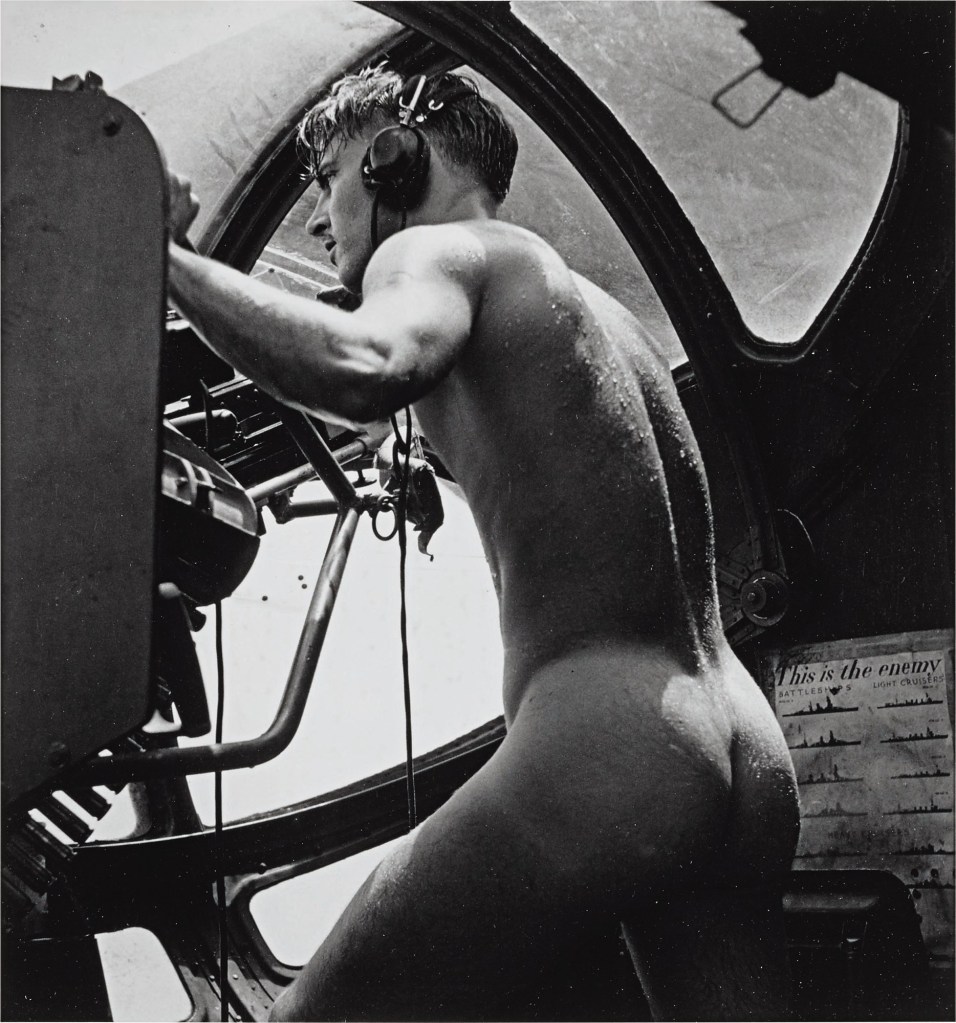
You have probably all seen this photograph by Horace Bristol form 1944. It has been widely reproduced and viewed as a symbol of bravery, loyalty, and erotic masculinity. In October 2020, the photo was included in a Sotheby’s auction of Classic Photographs. Lot 13, “HORACE BRISTOL | PBY BLISTER GUNNER, RESCUE AT RABAUL” sold for $ 27,720, well over the estimate of $ 8,000-$12,000.
“PBY Blister Gunner, Rescue at Rabaul, 1944” is one of the most iconic photos of the Pacific War. But the identity of the “Naked Gunner,” as it is popularly known, remains a mystery to this day. The photo was taken by Horace Bristol (1908-1997), a founding photojournalist for the illustrious Life magazine. In 1941, Bristol was recruited to the U.S. Naval Aviation Photographic Unit, as one of six photographers under the command of Captain Edward J. Steichen, documenting World War II in places such as South Africa and Japan. It is not known if the Bristol ever asked the soldier for his name as he captured his image. Sadly, we will never know. Bristol died in 1997, having kept a discreet silence on the bomber’s identity if, indeed, he ever knew it.
Bristol ended up being on the plane the gunner was serving on, which was used to rescue people from Japanese-held Rabaul Harbor (New Britain Island, Papua New Guinea) when this photograph was taken. In an article from a December 2002 issue of B&W Magazine he remembers:
“…we got a call to pick up an airman who was down in the Bay.
“The Japanese were shooting at him from the island, and when they saw us, they started shooting at us. The man who was shot down was temporarily blinded, so one of our crew stripped off his clothes and jumped in to bring him aboard. He couldn’t have swum very well wearing his boots and clothes.
“As soon as we could, we took off. We weren’t waiting around for anybody to put on formal clothes. We were being shot at and wanted to get the hell out of there. The naked man got back into his position at his gun in the blister of the plane.”
The fearless airman was deployed as part of a rescue campaign known as Operation Dumbo. Dumbo was the code name used by the United States Navy during the 1940s and 1950s to signify search and rescue missions, conducted in conjunction with military operations, by long-range aircraft flying over the ocean. The purpose of Dumbo missions was to rescue downed American aviators as well as seamen in distress. Dumbo aircraft were originally land-based heavy bomber aircraft converted to carry an airborne lifeboat to be dropped in the water near survivors. The name “Dumbo” came from Walt Disney’s flying elephant, the main character of the animated film Dumbo, appearing in October 1941. The campaign saved many Americans and their allies from a watery grave.
The PBY Catalina (a waterbomber) for which the naked man was a gunner, was an amphibious aircraft, recognized and celebrated by American aviators and flight crews for its vast range and endurance. According to the PBY Naval Air Museum, Washington website, the ‘versatile’ aircraft was capable of dropping “torpedoes, depth charges and bombs” while providing defense for their crews from “multiple high-caliber machine guns.” The airborne fleet, designed by Isaac Machlin Laddon and manufactured by the Consolidated Aircraft Corporation, was used all over the world, but particularly in coastal areas, to “patrol for enemy fleets and perform rescues.”
You can see more of Bristol’s photographs if you go to http://www.horacebristol.com.

We’ve been getting a lot of rain lately, and it’s been terrible for my migraines. Yesterday, I had to come home at lunchtime because my head was hurting so bad. I will be seeing my neurologist on Monday, and we’re going to have to have a discussion about this.

Barnes & Noble, 1999
By Jesús I. Valles
I was a boy in a bookstore, “a bathhouse,” I’ll joke
when I am older. But then, I wasn’t. I was in a gallery
of things to be cracked open; all their spines & mine.
I tell you, I was a hungry pickpocket, plucking
what language I could from books & men who stood hard
before me. This is what it means to be astonishing;
to thieve speech and sense from the undeserving.
I tell you, I was a boy and they were men, so all
the words I know for this I made into small razors,
some tucked between my teeth, under my tongue,
and when they said what a good mouth I had,
I smiled, the silver glint of sharp things in me
singing, “I’ll outlive you. I’ll outlive all of you.”
About the Poem
“During a writing workshop, I was asked to write an ode to my younger self. I quickly became envious of that past-me, of the haphazard bravado and willfulness that allowed me to explore my queerness in the aisles and shelves (and bathrooms) of that bookstore where words broke me open, where worlds broke open. In revisiting this site and self, I also found a lasting resentment and latent pity for the adult men who were willing to usher me in this way, for their aging bodies, for that bookstore (which is now a Ross Dress-For-Less), for all our lost selves.”—Jesús I. Valles
Back in 1999, I was in college in Alabama. There wasn’t much of a gay scene, and I was still trying to understand and coming to terms with my sexuality. The only place I knew where gay men regularly congregated, besides the newspaper office at my college, was the local Barnes & Noble. I could peruse the books and the men. I bought my first gay book (Giovanni’s Room by James Baldwin) at that bookstore. I never talked to any of the gay men at the bookstore; I was far too scared and shy to do anything like that. This poem really speaks to me in so many ways. The poem begins with “I was a boy in a bookstore, ‘a bathhouse,’ I’ll joke when I am older.” I’ve also always loved books, so Barnes & Noble combined my love of books with my first baby steps towards understanding my sexuality.
By the way, the other book that I clandestinely purchased at that Barnes and Noble was Finding the Boyfriend Within: A Practical Guide for Tapping into Your Own Source of Love, Happiness, and Respect by Brad Gooch. This book was billed as a guide for gay men searching for greater self-acceptance. Gooch advised his readers to live every day as if they were expecting to entertain a dream lover for tea or dinner. I learned a lot about accepting myself for who I was first. I had to learn to love myself and come out to myself before I could venture into the real world of gay men perusing bookstores.
It might not sound like much, but that local Barnes & Noble helped to change my life and to allow me to accept who I am.
About the Poet
Jesús I. Valles is a queer, Mexican immigrant writer-performer from Ciudad Juárez, Chihuahua, and El Paso, Texas. The recipient of fellowships and support from CantoMundo, Lambda Literary, the Sewanee Writers’ Conference, Idyllwild, Undocupoets, and Tin House, they live on stolen Pequot, Nipmuc, Niantic, Narragansett, and Wampanoag land.

On Saturday night, two friends and I went to a lantern tour in Stowe, Vermont. Stowe is a beautiful little town, though because of the ski industry, it’s one of the most expensive and popular places in Vermont. However, each September and October for over twenty years, there has been a lantern tour where groups walk through town holding lanterns to hear the guide tell about the history of Stowe and a few ghosts stories.
We’d planned to go to dinner before the tour, we tried to get reservations, but this time of year with the fall foliage at its peak, everywhere was booked or had long waitlists. We went to this one Thai restaurant that I hoped we could get into. The food and service is usually really good, but I’ve never seen more than two or three people in there. Not so on Saturday night. There were a few tables open, but when we told him we wanted a table for three, he said, “I only have one cook.” Then he said the most incredible thing I’ve ever heard a restaurant host say. He said, “Just go,” and shooed us out the door. I know he was flustered, and his English is not the best, but any time I’ve been there before, he’s been very nice.
After that, we went into Waterbury to see if there was place to eat there. We’d have loved to eat at Prohibition Pig, but they won’t take reservations and the waitlist was around two hours. Everywhere else had a wait of at least thirty minutes. The lantern tour was at 8 pm, and it was already nearly 6:30. Stowe is about twenty minutes from Waterbury. Finally we gave up and went to the one place we were able to get into: Subway. I had not wanted a sandwich from Subway, but we were hungry and did not want to wait until after the tour to eat.
After we ate, we headed to Stowe for the lantern tour. I had read a lot of good things about this tour, and I like a good ghost story. So, I was excited. I had emailed Tuesday for reservations for Friday night, but was told they were booked. The website said that tours were limited to twenty-five people. When we got to the Stowe Visitor’s Center, we found out that there would be two simultaneous tours. One was led by the man who usually does the tours, and the other was by a woman who I assumed was his wife, who obviously didn’t do the tours on a regular basis. We ended up in the woman’s group along with a screaming child. Apparently, the child was screaming and crying because he wanted to be the person in his group to carry the lantern, but his brother was carrying it. Finally someone gave the kid their lantern, and he finally got quiet.
The tour was all right, but nothing special. The woman didn’t speak loud enough and walked way too fast. What I could hear of the stories she told, they sounded interesting. The best part of the tour though was this guy who was from the Midwest who was in the group with his girlfriend. Well, it wasn’t so much him, although he was handsome enough, but a bit too skinny. However, he had one of the most amazing asses I’ve ever seen, especially on a tall skinny guy. It was much more interesting walking behind him. The tour lasted about an hour, and it was a nice night for a walking tour. It was cool but not too cold. The only hiccup we had along the route was a skunk joined our tour for a bit, but we got away from him without him spraying anyone.

After the tour, we went home. One of my two friends and I plan to take the Burlington Ghost Walk, which I’ve heard is very good. I’m looking forward to hearing about the tales of spooky Burlington. That will be sometime this week or next.

And just as you want men to do to you, you also do to them likewise.
— Luke 6:31
Multiculturalism is the presence, or support for the presence, of several distinct cultural or ethnic groups within a society. It is diversity, and the Bible teaches that God created and loves people from every culture and every ethnic group. From the beginning, God’s plan was that “I will bless those who bless you, and I will curse him who curses you; and in you, all the families of the earth shall be blessed.” (Genesis 12:3). At the end of time, this picture of diversity comes to life in Revelation 7:9 where we read that there was “After these things I looked, and behold, a great multitude which no one could number, of all nations, tribes, peoples, and tongues, standing before the throne and before the Lamb, clothed with white robes, with palm branches in their hands.” God does not use culture or ethnicity as a reason to exclude people from His kingdom. He seems to delight in the diversity of people who bring Him praise.
Paul teaches that we can continue and indulge in cultural practices that do not conflict with God’s law. He exhorts the Colossians, “So let no one judge you in food or in drink, or regarding a festival or a new moon or sabbaths.” (Colossians 2:16) He is telling them that their cultural practices of what foods they eat or the days they choose to celebrate or not celebrate are appropriate to continue and need not conform to another cultural standard. Paul admits to the Corinthians, “And to the Jews I became as a Jew, that I might win Jews; to those who are under the law, as under the law, that I might win those who are under the law; to those who are without law, as without law (not being without law toward God, but under law toward Christ), that I might win those who are without law; to the weak, I became as weak, that I might win the weak. I have become all things to all men, that I might, by all means, save some.” (1 Corinthians 9:20–22) Paul was an expert at taking on whatever cultural practices were necessary to effectively share the gospel. In Athens, Paul referenced the Athenians’ “own poets.” In Acts 17:28, he writes, “For in Him we live and move and have our being, as also some of your own poets have said, ‘For we are also His offspring.’” These examples show that cultural differences can be celebrated and appreciated as displays of God’s creativity in the many diverse ways we glorify God.
Universalism is the philosophical and theological concept that some ideas have universal applications. The living truth is seen as more far-reaching than the national, cultural, or religious boundaries or interpretations of that one truth. As the Rig Veda states, “Truth is one; sages call it by various names.” A community that calls itself universalist may emphasize the universal principles of most religions and inclusively accept others. Nearly all religions and moral philosophies contain the belief in the Golden Rule or the ethics of reciprocity. This falls under moral universalism, which believes that a universal ethic applies universally regardless of culture, race, sex, religion, nationality, sexual orientation, gender identity, or any other distinguishing feature. The idea dates at least to the early Confucian times (551–479 BCE). The concept appears prominently in Buddhism, Christianity, Hinduism, Islam, Judaism, Taoism, Zoroastrianism, and the rest of the world’s major religions. As part of the 1993 “Declaration Toward a Global Ethic,” 143 leaders of the world’s major faiths endorsed the Golden Rule. According to the Humanist Rabbi Greg M. Epstein, it is “a concept that essentially no religion misses entirely,” but belief in God is not necessary to endorse the Golden Rule. The English philosopher Simon Blackburn also states that the Golden Rule can be “found in some form in almost every ethical tradition.”
Romans 12:18 says, “If it is possible, as much as depends on you, live peaceably with all men.” In Romans 12:2, Paul tells his readers, “And do not be conformed to this world, but be transformed by the renewing of your mind, that you may prove what is that good and acceptable and perfect will of God.” No matter what religion or belief system someone has, we were all created to love all people from all cultural backgrounds. We should enjoy and embrace the diversity in this world. At the heart of Christianity, if we hate or discriminate against others, we are not doing God’s will. We must show love and acceptance as Jesus did. Ephesians 4:2-4 tells us, “With all lowliness and gentleness, with longsuffering, bearing with one another in love, endeavoring to keep the unity of the Spirit in the bond of peace. There is one body and one Spirit, just as you were called in one hope of your calling.”
If we argue over non-essentials, then we are not accepting differences in people’s preferences and in what they see as sin and what they see as not being a sin. Who are we to judge our brother over the non-essentials like food, drink, days of worship, sexuality, or anything else where the Bible is silent? In Romans 14:4, Paul asks, “Who are you to judge another’s servant? To his own master he stands or falls. Indeed, he will be made to stand, for God is able to make him stand.” A good rule to live by is one I learned growing up in the churches of Christ: Where the Bible is silent, so must we be. This includes LGBTQ+ relationships. Christ never mentions sexuality, and therefore, we should not be judged by others who think differently than we do. We must realize that they are not following God’s Word.
Romans 2:11 tells us, “For there is no partiality with God.” World history shows that cultures treated women like they were livestock or property, but Jesus valued women and treated them as co-heirs and co-equals, and in God’s eyes, women and men are equal before Him. So too, believers should treat those who are poor, of a different nationality, or in any way are different from us with the same regard as God does. He is no respecter of persons; therefore, there is no partiality with God. Too many people who call themselves Christians forget this. We must learn to accept the faults of others just as God has learned to accept our imperfections. If we want to cast stones, we should be our first target because we have no right to judge anyone else but ourselves. If God accepts us, then we must learn to accept others. To fail to do so is a sin before God because He is no respecter of persons and shows no partiality between men and women, gay and straight, liberal and conservative, etc., over another, nor does God show partiality to any race or ethnicity. If we show partiality, then we are judging them, which is God’s job, not ours.


 | Anonymous on Moment of Zen: Shorts |
 | Steve Davis on Pic of the Day |
 | noisilycool3bc985058… on Moment of Zen: Shorts |
 | iameverywhere1 on The Luxury of No Plans |
 | vandycolt on The Luxury of No Plans |




As an Amazon Associate I earn from qualifying purchases. So, if you click on a link that takes you to Amazon.com, I may earn a commission.
Trust me, it isn’t much, but every little bit helps.


 Joe
Joe
 The Closet Professor