

Moment of Zen: Those Eyes

This is Laurence Coke and he has some of the prettiest eyes I’ve ever seen. I guy with nice eyes always makes me a little weak in the knees. His smile isn’t bad either.






LGBTQ+ History in Colonial Latin America
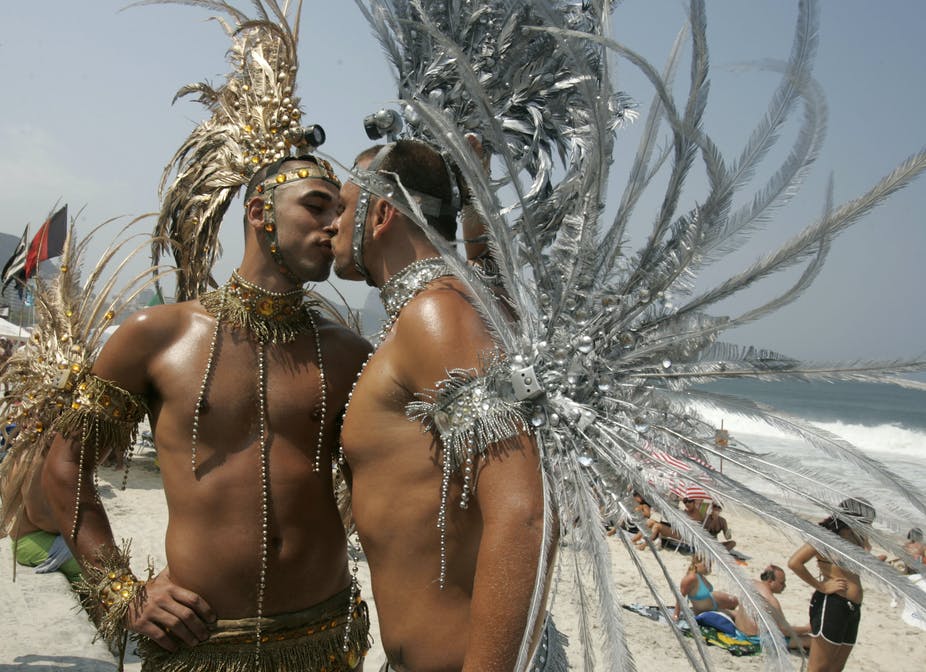
Back in graduate school, I took a seminar on Latin American History. My research project for that class was sexuality in colonial Latin America. It has a fascinating history. I remember that I read, Beyond Carnival: Male Homosexuality in Twentieth-Century Brazil which I found infinitely fascinating. So, when I saw that Dr. Cervini’s Queer History 101 this week was about “Sexuality and the Colonization of the Americas,” I was eager to read it and share it with you.
From Dr. Eric Cervini’s Queer History 101
Even in 2022, we are still seeing an alarming rate of LGBTQ+ content being unjustly censored. In China, an episode of Friends was edited so Ross’s ex-wife wouldn’t be gay. In Hungary, a recent law has banned queer content in schools or kids’ television. And right here in the U.S., dozens of state legislatures have attacked teachers’ ability to teach queer and trans history. But how far back does this phenomenon of censoring queerness go?
Zeb Tortorici, an Associate Professor of Spanish and Portuguese Languages and Literatures at NYU, understands the reality and nuances of this suppression more than most. Tortorici’s body of research focuses on the origins, archiving, and censorship of the queer “obscene” in New Spain, which included Mexico and Central America.
“I was directed toward the obscene,” Tortorici told me, “through my first book, Sins Against Nature: Sex and Archives in Colonial New Spain, which is about the archiving of sodomy.” It was during this research of colonial, same-sex criminal case records that Tortorici noticed the repeat occurrence of the Spanish word obsceno, or obscene. But it struck him as odd. “The word ‘obscene’ in the cases that I looked at,” explained Tortorici, “was particularly grafted upon desires that were less legible than something like sodomy.” So what were these “less legible” offenses?
First, Tortorici pointed me to the 1776 case of Manuel de Arroyo from Pachuca, Mexico. “Arroyo asserted that consuming human semen from another man is not a sin,” he told me. “The assertion of this heretical thought is what Inquisitors referred to as ‘obscene.’” Curiously, the act of oral sex wasn’t the obscene offense, but holding the belief was obscene.
Tortorici also cited a second example, the 1803 case of Juana Aguilar from Guatemala. “They were a so-called hermafrodita, or a hermaphrodite. Their body is described as ‘obscene’ in some records, including medical reports published in the colonial Guatemalan Gazette.” Again, the alleged act of Aguilar being a hermaphrodite wasn’t necessarily obscene, but the description of their body was obscene.
“Obscenity is produced in conjunction with other forms of alterity,” explained Totorici. “It’s not simply something that refers to explicit sexuality or sexual desire in the wrong place or in the public sphere.” For Arroyo and Aguilar, moralistic and cultural opinions were “grafted” onto them in a means that further marginalized them as individuals. The Inquisition’s concept of the “obscene” wasn’t solely about being queer; it was a commentary on diversity and how difference itself was anathema to colonial culture. Thus, being different became criminal.
“Sodomy itself was policed in colonial Spanish, Portuguese American, and Spanish Pacific landscapes,” noted Tortorici, “but women and men were judged and denounced very differently for the crime.” Regardless of the type of court–criminal, secular, ecclesiastical, or inquisitorial–colonial Spanish America, despite an effort to standardize punishments for sodomy, allowed gender biases to influence legal consequences. And, in Tortorici’s research, the proof is in how records were kept.
“I spent from 2003 to 2018 in the archives looking for as many cases dealing with the sins against nature as I could, and I was struck by the fact that almost no cases of female sodomy appeared.” Indeed, Tortorici found only one unambiguous criminal case from 1732: it was about Josepha de Garfias, a woman from Mexico City who was punished for the crime of sodomy. But as far as details goes, that’s it!
“All we have is a one-paragraph summary of Josepha’s criminal case, which basically says that she was convicted of the crime of sodomy with other women,” said Tortorici. Apart from that, all evidence was burned and no record of punishment was kept. A leniency toward a female, same-sex crime all but proves, as Tortorici puts it, “the topic of sodomy was not the the axis of the case itself.”
So, as Tortorici asked me, “What is queer? And what does it mean to think about queerness centuries before the term was ever invented?” As Tortorici suggested, “Maybe what makes something queer is in the ways that it is trying to rupture or challenge identitarian claims and politics.” Queer history, in other words, may be much more expansive than you’d think!
For more of Tortorici’s fascinating work, check out:
- Against Nature: Sodomy and Homosexuality in Colonial Latin America (History Compass, 2012)
- Queering Archives: Historical Unravelings, Eds. Kevin P. Murphy, Zeb Tortorici, and Daniel Marshall (Duke University Press, 2014)
- Sexuality and the Unnatural in Colonial Latin America (University of California Press, 2016)
- Sins Against Nature: Sex and Archives in Colonial New Spain (Duke University Press, 2018)
A few more suggested readings:
- Guy, Donna, Sex & Danger in Buenos Aires: Prostitution, Family and Nation in Argentina (University of Nebraska Press, 1991)
- Green, James, Beyond Carnival: Male Homosexuality in Twentieth-Century Brazil (University of Chicago Press, 1999)
- Bliss, Katherine, Compromised Positions: Prostitution, Public Health, and Gender Politics in Revolutionary Mexico City (Pennsylvania State University Press, 2001).
- Sigal, Pete, Infamous Desire: Male Homosexuality in Colonial Latin America (University of Chicago Press, 2003)

About Eric Cervini
Dr. Eric Cervini is an award-winning historian of LGBTQ+ politics. His first book, The Deviant’s War: The Homosexual vs. the United States of America (a fascinating read), was a New York Times bestseller and a finalist for the Pulitzer Prize. It also won the Publishing Triangle’s Randy Shilts Award for Gay Nonfiction, the NYT Editors’ Choice, and the “Best Read of 2020” at the Queerties.
Cervini graduated summa cum laude from Harvard College and was a Gates Scholar at the University of Cambridge, where he received his PhD. As an authority on 1960s gay activism, Cervini serves on the Board of Advisors of the Mattachine Society of Washington, D.C., a nonprofit dedicated to the preservation of gay American history. His award-winning digital exhibitions have been featured in Harvard’s Rudenstine Gallery, and he has presented his research to audiences across America and the United Kingdom.
He lives in Los Angeles with his drag queen boyfriend and their dog, Moo Bear.
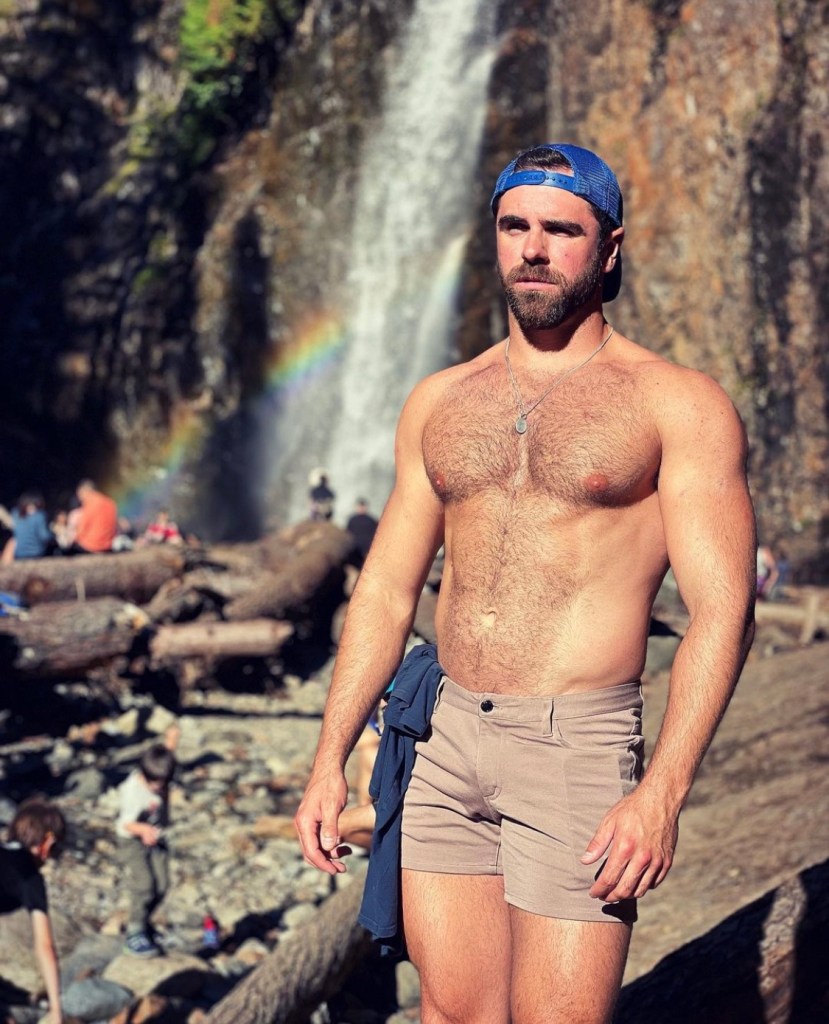
Here’s a bonus picture of Dr. Cervini, just because…

I think more people would enjoy history if their professors looked like Dr. Cervini. I have such a crush on this man.



Hatred

Hatred
By Wisława Szymborska
See how efficient it still is,
how it keeps itself in shape—
our century’s hatred.
How easily it vaults the tallest obstacles.
How rapidly it pounces, tracks us down.
It’s not like other feelings.
At once both older and younger.
It gives birth itself to the reasons
that give it life.
When it sleeps, it’s never eternal rest.
And sleeplessness won’t sap its strength; it feeds it.
One religion or another –
whatever gets it ready, in position.
One fatherland or another –
whatever helps it get a running start.
Justice also works well at the outset
until hate gets its own momentum going.
Hatred. Hatred.
Its face twisted in a grimace
of erotic ecstasy…
Hatred is a master of contrast-
between explosions and dead quiet,
red blood and white snow.
Above all, it never tires
of its leitmotif – the impeccable executioner
towering over its soiled victim.
It’s always ready for new challenges.
If it has to wait awhile, it will.
They say it’s blind. Blind?
It has a sniper’s keen sight
and gazes unflinchingly at the future
as only it can.
It is not an easy thing, to live under a cruel and unjust system of rule. To constantly be on guard, to watch every word you say, to always be afraid, to know that a single mistake could cost you your very life. This is how I felt when I lived in Alabama, especially when I was teaching school. One wrong word, a gesture, the way I walked, and many other things I had to guard against for fear of losing my job because someone found out I was gay. Had they ever found out, I know I would have lost my job within a week, if not within a day. I grew up in rural Alabama where homophobia and racism were very strong. There are areas of Alabama that aren’t as conservative, but much of the state is. It is a state filled with hate and hateful people. However, there are some wonderful and loving people in the state as well.
Wislawa Szymborska was born on July 2, 1923, in Bnin, a small town in Western Poland. Her family moved to Krakow in 1931 where she lived most of her life. She was forced to face a different type of hatred, not once, but twice in her life. Szymborska was unfortunate enough to have lived through both Hitler’s reign of terror and Communist rule. She seems to have been greatly affected by these experiences, as can be seen through her poetry, which frequently deals with such topics as death, loss of self, and war. An excellent example of a poem that tangles with these topics would be “Hatred,” first published in her 1993 book The End and the Beginning.
In “Hatred,” Szymborska looks at the circular nature of hatred, grimly observing that “It gives birth itself to the reasons that give it life.” She then further reinforces this statement by describing these reasons in greater detail, justice and religion and a macabre pleasure-each one guiding the heart toward thoughts of bloodshed and ruin. In the poem, Szymborska writes, “Only hatred has just what it takes.” Only hatred has such a talent for destruction.
This is perhaps, rendered more understandable by the sheer devastation that she describes the fury and hate of war as causing, the endless slaughter and torment. Every word fairly drips with harsh sarcasm as she speaks of the “Magnificent bursting bombs” and “splendid fire-glow.” Perhaps most chilling is the poem’s complete lack of hope for a better future. There are no last minute words of comfort. War remains coldly merciless, for how could it not? It is the tool of hatred, which has “a sniper’s keen sight, and gazes unflinchingly into the future.”
Szymborska studied Polish literature and sociology at Jagellonian University from 1945 until 1948. While attending the university, she became involved in Krakow’s literary scene and first met and was influenced by Czeslaw Milosz. She began work at the literary review magazine Życie Literackie (Literary Life) in 1953, a job she held for nearly thirty years.
While the Polish history from World War II through Stalinism clearly informs her poetry, Szymborska was also a deeply personal poet who explored the large truths that exist in ordinary, everyday things. “Of course, life crosses politics,” Szymborska once said “but my poems are strictly not political. They are more about people and life.”
Well-known in her native Poland, Wisława Szymborska received international recognition when she won the Nobel Prize for Literature in 1996. In awarding the prize, the Academy praised her “poetry that with ironic precision allows the historical and biological context to come to light in fragments of human reality.” Collections of her poems that have been translated into English include People on a Bridge (1990), View with a Grain of Sand: Selected Poems (1995), Miracle Fair (2001), and Monologue of a Dog (2005).
Readers of Szymborska’s poetry have often noted its wit, irony, and deceptive simplicity. Her poetry examines domestic details and occasions, playing these against the backdrop of history. In the poem “The End and the Beginning,” Szymborska writes, “After every war / someone’s got to tidy up.” Wislawa Szymborska died on February 1, 2012, at the age of eighty-eight.
Thank you, Susan, for suggesting this thought-provoking poem.




Authors
Recent Comments
noisilycool3bc985058… on Pic of the Day Joe on Pic of the Day noisilycool3bc985058… on Pic of the Day iameverywhere1 on Pic of the Day noisilycool3bc985058… on Pic of the Day Top Posts & Pages




Amazon Associate

As an Amazon Associate I earn from qualifying purchases. So, if you click on a link that takes you to Amazon.com, I may earn a commission.
Trust me, it isn’t much, but every little bit helps.

 Joe
Joe


 The Closet Professor