Coded

“Gentlemen with Golf Clubs,” 1909, by J.C. Leyendecker

Joseph Christian Leyendecker’s life, career, and love is captured in a new film, Coded: The Hidden Love of J.C. Leyendecker, which I watched the other day on Paramount+. The documentary shows Leyendecker’s enduring influence on American culture and LGBTQ+ representation in advertising, as well as the relationship with his partner, Charles Beach, the muse for Leyendecker’s “Arrow Collar Man.”

Arrow Short Collars, American Advertisement, 1914, by J.C. Leyendecker

The use of men as sexy symbols in advertising would not have existed without the influence of Leyendecker’s art. The German-American artist received training in Paris under the French Art Nouveau movement and imported some of this “Modern Style” to United States. His ad illustrations, which leaned into sexualizing his handsome male subjects, made brands like Arrow shirts fly off the shelves while also defining the image of the early 20th-century American man. Many of his illustrations featured intimate gazes between two gentlemen. Often, if there were two gentlemen and a lady, the two men would be focused on each other and not the woman.

“The Oarsman,” 1916, (Left) and “Man on the Bag,” 1912, (Right) by J. C. Leyendecker

Additionally, Leyendecker painted over 400 magazine covers in his career — over 300 alone for The Saturday Evening Post — essentially creating the design template still in use today. His stock took a plunge along with Wall Street following the Great Depression, when shrinking wallets also meant a return to social conservatism. The public turned away from Leyendecker’s eroticized male forms toward Norman Rockwell, a more traditional illustrator who was mentored by Leyendecker.

Advertisement for Cluett Dress Shirts, 1911, by J.C. Leyendecker

The image below of an Ivory Soap advertisement from 1900 is one of his early pieces before he met Charles Beach; however, it is a great example of the coded messages in many of his works. Can you spot the “code” in this image? Once you see it, you’ll probably never not see it.

“Ivory Soap It Floats,” Ivory Magazine, 1900, by J.C. Leyendecker

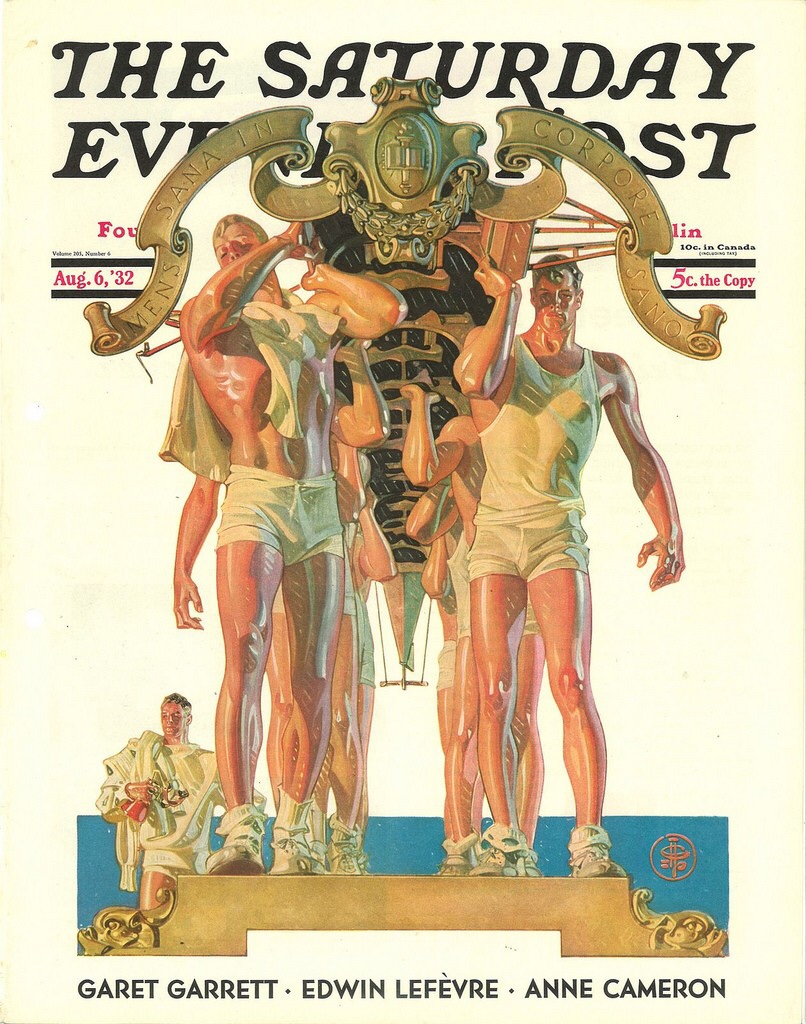
In honor of the (Winter) Olympics beginning this week, I’ll end with this 1932 edition of The Saturday Evening Post. Strangely, the conservative, anti-New Deal, and middle class family orientated publication had what is (to most modern eyes at least) a sexualized ‘gay’ image of the U.S. Olympic Eight on its cover, painted by Leyendecker. This was not the only time that Leyendecker put semi-naked men on a pedestal as you’ve seen in some of his other illustrations.

Pic of the Day


Stopping by Woods on a Snowy Evening

Stopping by Woods on a Snowy Evening
By Robert Frost – 1874-1963

Whose woods these are I think I know.
His house is in the village though;
He will not see me stopping here
To watch his woods fill up with snow.

My little horse must think it queer
To stop without a farmhouse near
Between the woods and frozen lake
The darkest evening of the year.

He gives his harness bells a shake
To ask if there is some mistake.
The only other sound’s the sweep
Of easy wind and downy flake.

The woods are lovely, dark and deep.
But I have promises to keep,
And miles to go before I sleep,
And miles to go before I sleep.


“Stopping by Woods on a Snowy Evening” s one of Robert Frost’s most known poems. It was written in 1922, and published in 1923 in his New Hampshire volume. In a letter to the poet Louis Untermeyer, Frost called it “my best bid for remembrance.”

The poem is simple and straightforward and reflects the thoughts of a lone wagon driver (the narrator), pausing at night in his travel to watch snow falling in the woods. It ends with some of the most memorable lines of any Frost poem, that of the narrator reminding himself that, despite the loveliness of the view, “I have promises to keep, / And miles to go before I sleep.”

Frost wrote the poem in June 1922 at his house in Shaftsbury, Vermont. He had been up the entire night writing the long poem “New Hampshire” and had finally finished when he realized morning had come. He went out to view the sunrise and suddenly got the idea for “Stopping by Woods on a Snowy Evening.” He wrote the new poem “about the snowy evening and the little horse as if I’d had a hallucination” in just “a few minutes without strain.”

In the early morning of November 23, 1963, Sid Davis of Westinghouse Broadcasting reported the arrival of President John F. Kennedy’s casket at the White House. Since Frost was one of the President’s favorite poets, Davis concluded his report with a passage from this poem but was overcome with emotion as he signed off.

At the funeral of former Canadian prime minister Pierre Trudeau, on October 3, 2000, his eldest son Justin, who is the current Prime Minister of Canada, rephrased the last stanza of this poem in his eulogy: “The woods are lovely, dark and deep. He has kept his promises and earned his sleep.”


Pic of the Day


Some Days…

There are days when this picture is a perfect summary of how I feel. Some days, I just want to come home, lay on my couch, bury my head under some pillows, and just hide from the world. At various times in my life, there were more days like this than not. Over the last few years, there were fewer such days, but the pressure of finding a new apartment has really made me anxious and stressed. Depression and anxiety always want me to retreat from the world.


Pic of the Day


The Power of Words

For our light affliction, which is but for a moment, is working for us a far more exceeding and eternal weight of glory, 18 while we do not look at the things which are seen, but at the things which are not seen. For the things which are seen are temporary, but the things which are not seen are eternal.

—2 Corinthians 4:17-18


The Indian writer and painter Rabindranath Tagore said, “The one who plants trees, knowing that he will never sit in their shade, has at least started to understand the meaning of life.” Tagore was a persuasive advocate for Indian independence, though he did not live to see the 1947 milestone achieved. He devoted his years to benefiting future generations. As his quote implies, no legacy is more worthwhile than bettering the world for others.

Paul told the Corinthians the same thing in his second epistle to them. Paul tells them, “For the things which are seen are temporary, but the things which are not seen are eternal.” There are many things that we do that we will never realize the lasting effect they have on others. Maybe you provide an example for a young LGBTQ+ individual who sees you as a role model, and without knowing it, you provide them with a positive example of acceptance. You might give someone encouragement and tell them how much you appreciate the good job they did or how helpful they were. That can give someone a confidence that you may never see. All of you have probably planted a seed in someone’s mind that changed their life for the better, whether that was through showing someone acceptance or giving them confidence. That seed may grow into a mighty tree, but you may never see it or realize it.

The opposite can also be true. We also have to be careful with the legacy we leave behind. You may never know when you have said something to another person that it might effect them in a negative way. You may not have meant to, and if that’s the case, you may never know you did it. When I was a teenager, I worked hard to have perfect grades, to be involved in as many things academically as possible, and I was proud of my accomplishments. A lady once told my mother that I “sure was full of myself.” Meaning that I thought a lot of myself and implying that I was a braggart and conceited. When my mother told me that, I was devastated. I had only answered what the woman had asked me. It destroyed my confidence for a long time. If I “tooted my own horn” would others think badly of me. I felt as if I needed to downplay a lot about myself, and that led to me not being confident in my accomplishments. It took a long time for me to be confident again, and I’m still not always as confident as maybe I should be.

Under present social conditions, with the continuous increment in hate speech, be it targeted on grounds of race, ethnicity, gender, sexual orientation or religion, we need to consider what we say before we say it. How will what we say effect others? People often speak very comfortably and impulsively without realizing if certain words or the way we use them have an inherent negative meaning attached to them. If such a case causes a miscommunication then it may lead to disastrous consequences. so, thinking before speaking is a necessity for people to be a better person.

Fran Lebowitz, known for her sardonic social commentary on American life, is quoted as saying, “Think before you speak…read before you speak.” The continuous negativity in speech has ended up subjecting humankind to a vicious toxic circle, one that cannot be done away with until we speak consciously and think before we speak. The writer William Arthur Ward said, “Before you speak, listen. Before you write, think. Before you spend, earn…before you criticize, wait.” While words have the miraculous power to heal, they also have the power to topple the world. Voltaire said, “Everything you say should be true, but not everything true should be said.” We live and breathe in words. Sometimes words make us smile, sometimes they make us cry, sometimes they pierce through us to an extent that we never forget the hurt they caused. The Irish missionary and writer Amy Carmichael, gave this advice, “Let nothing be said about anyone unless it passes through the three sieves: Is it true? Is it kind? Is it necessary?”


Pic of the Day


Moment of Zen: Sexy Selfies


Pic of the Day