Black Cat

Black Cat
By Rainer Maria Rilke – 1875-1926

A ghost, though invisible, still is like a place
your sight can knock on, echoing; but here
within this thick black pelt, your strongest gaze
will be absorbed and utterly disappear:

just as a raving madman, when nothing else
can ease him, charges into his dark night
howling, pounds on the padded wall, and feels
the rage being taken in and pacified.

She seems to hide all looks that have ever fallen
into her, so that, like an audience,
she can look them over, menacing and sullen,
and curl to sleep with them. But all at once

as if awakened, she turns her face to yours;
and with a shock, you see yourself, tiny,
inside the golden amber of her eyeballs
suspended, like a prehistoric fly.

About This Poem

Have you ever feared a black cat crossing your path? This is from ancient superstitions where people thought this meant bad luck. For many cultures and historical settings, black cats were actually meant for positive things. So, to try and dispel these myths about black cats, National Black Cat Appreciation Day was created to be celebrated on August 17 every year. Today, pop culture loves black cats. There’s the sarcastic Thackery Binx in Hocus Pocus, Salem, in Sabrina, the Teenage Witch, and Pyewacket in the classic Bell, Book, and Candle, and we can’t forget the classic cartoon black cat, Luna in Sailor Moon. Black cats are seen as loyal companions, and this is what they were seen as for a lot of cultures in history too.

So, who’s to blame for this negative black cat spin? Superstition! But mostly because during the Middle Ages, people (mainly the Catholic Church) saw witches as shape-shifting black cats and the damage was done. From then on, black cats were seen as evil entities for years and years to follow. The Rilke poem “Black Cat” follows in this vein. The poem was originally published in Rilke’s 1923 collection Duino Elegies. Rilke began writing this collection in 1912, but it remained unfinished for a decade before being completed and published.

So why this poem today? Since 2011, cat lovers around the world have celebrated Black Cat Appreciation Day on August 17th. It is a day to celebrate and appreciate the black cats in your life. Today, I celebrate my little companion, Isabella, a beautiful, sleek black cat. Black Cat Appreciation Day was created by a man named Wayne H. Morris, in honor of his late sister, June, who passed away at age 33, a few years before the first official Black Cat Appreciation Day. This date was chosen as a memorial of June’s passing. June deeply loved her own black cat, Sinbad, who lived to be 20 years old. Sadly, Sinbad was reunited with June two months after her passing.

Black cats are often the least adopted and most overlooked cats in animal shelters, resulting in many of these wonderful animals being euthanized when they can’t find a loving home. Because they are less likely to be adopted from shelters, they need a special holiday in their honor to bring awareness to this issue, and to encourage people to adopt these amazing animals. Black cats are often misunderstood and overlooked because of their coat color and the superstitions surrounding them. Also, many shelters will not allow adoptions of black cats in October because people adopt them for Halloween and then discard them afterward. The life of a black cat in shelters can be very sad because there are several stupid and silly reasons why people looking to adopt a cat are less likely to adopt black cats.

  • They have long been associated with bad luck, misfortune, and witchcraft. Even in our modern times, there are still people who believe these silly superstitions. You would be surprised to learn how many people still believe that black cats bring bad luck or cause misfortune to anyone who crosses their path. Many religious people also fear them because of their association with witchcraft. These superstitions are not only silly and untrue but are also harmful to beautiful black cats who are in search of forever homes.
  • Another reason why people may be less inclined to want to adopt a black cat is that they consider dark solid coats to be “boring,” and prefer a flashier tabby, calico, or other uniquely marked cats. This is an unfair assessment, as black cats are beautiful creatures with luxurious black coats. They look like majestic miniature black panthers roaming around your home and are just as beautiful and charming as any other cat. Besides, black matches almost anything, so you will always look fashionable next to your black cat friend.
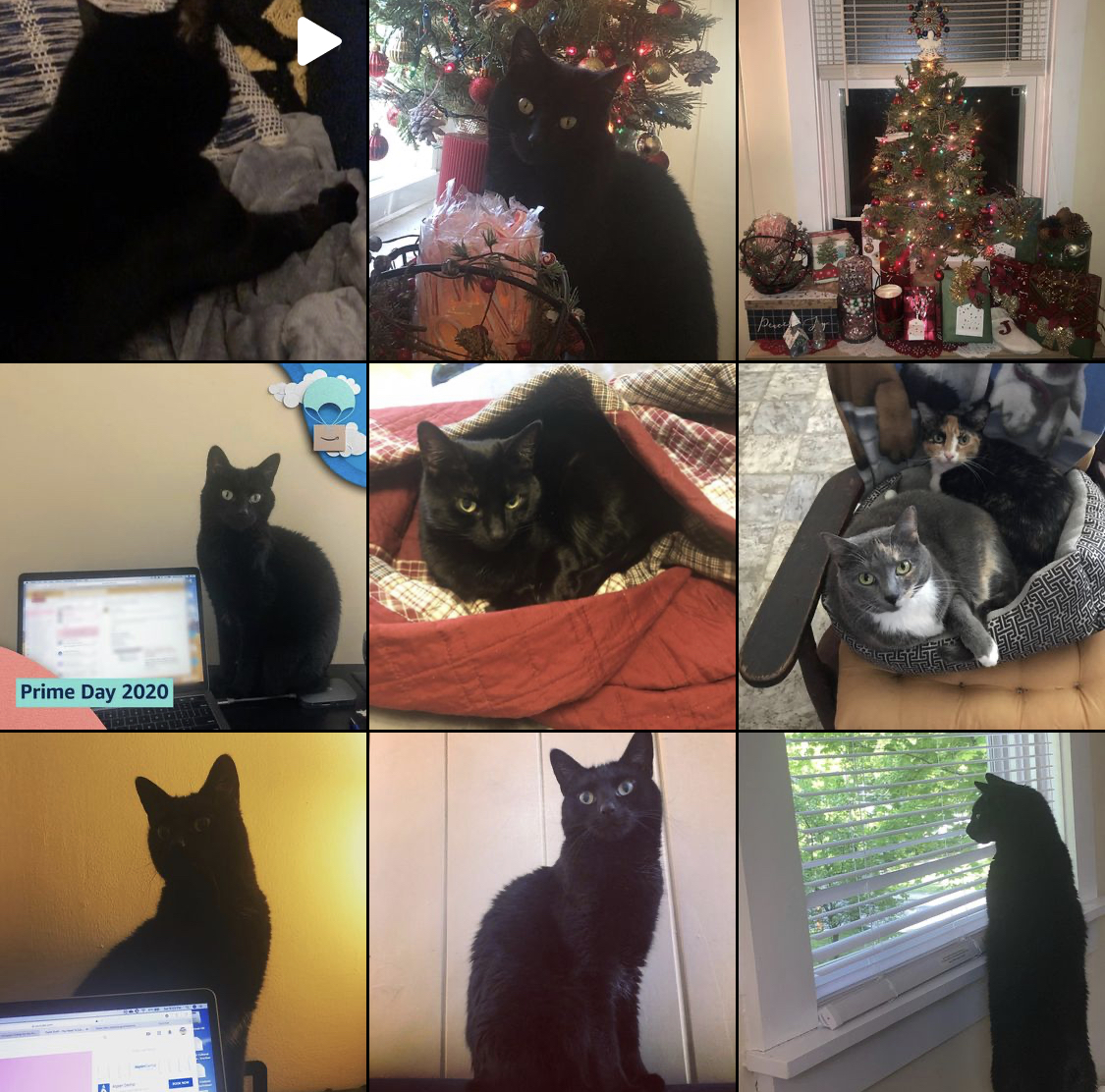
  • In our social media-obsessed world, some people also shy away from adopting black cats because they believe that they don’t show up as well in pictures. Many people today want pets that they feel they can show off on the internet. Black cats can be just as photogenic as any other cat. Just look at Isabella, she often is a great subject for pictures. With the proper lighting, background, and photography technique, your cat will look stunning on your Instagram feed!
  • Many prospective pet owners use the internet to find their new furry friends, so they are likely to overlook animals that are not photographed well. Because black cats are a bit harder to photograph than pets with lighter coat colors, they may be overlooked by prospective owners browsing online adoptable pet listings. It is important for shelters to photograph the adoptable pets in their best light to help them to find their forever homes.
Black cats are beautiful creatures that make a wonderful addition to any home. In some countries, including England, Scotland, and Japan, they are considered good luck. In Japan, it is believed that a single woman who owns a black cat will have many suitors. In England, they are commonly thought to bring good luck to anyone who crosses their path. In Scotland, it is said that a strange black cat arriving at your home will bring good fortune and prosperity.

Many cat owners (I would not be one of them) agree that their black cats are often the most affectionate and playful cats they’ve ever had. For me, Isabella is not very affectionate. She wants to be near me most of the time and sometimes wants to lay on me, but she never cuddles and hates to be held. Others claim black cats are known for their unique personalities and cuddly dispositions. Some researchers also claim that black cats are more resistant to disease. There is some research to suggest that at least two genes associated with melanism may also help them resist certain diseases.

So if you are looking to adopt a cat, consider a black cat. They need the love, and they will love you back. Isabella might not be the most affectionate, but she constantly shows her love and appreciation for me, and isn’t that what we all want from our pets, especially our cats who often seem so indifferent to their human companions. I have spent most of the pandemic working from home, and when I first started working from home, Isabella was never far away. I think she has probably gotten a little tired of me being home so much and she’s not as close by all the time these days, but I have returned to working at the museum five days a week, so she will have her alone time again. I’ve had cats in the past who show how mad they are at you for leaving them for any amount of time. Isabella has never been that way. Most of the time, she greets me at the door, and if she hears me in the stairway, and I don’t come into my apartment quick enough, she makes her impatience known. She is a wonderful little companion, and I feel so blessed to have her.

About the Poet

On December 4, 1875, Rainer Maria Rilke was born in Prague. His parents placed him in military school with the desire that he become an officer—a position Rilke was not inclined to hold. With the help of his uncle, who realized that Rilke was a highly gifted child, Rilke left the military academy and entered a German preparatory school. By the time he enrolled in Charles University in Prague in 1895, he knew that he would pursue a literary career: he had already published his first volume of poetry, Leben und Lieder, the previous year. At the turn of 1895-1896, Rilke published his second collection, Larenopfer (Sacrifice to the Lares). A third collection, Traumgekrönt (Dream-Crowned) followed in 1896. That same year, Rilke decided to leave the university for Munich, Germany, and later made his first trip to Italy.

In 1897, Rilke went to Russia, a trip that would prove to be a milestone in Rilke’s life, and which marked the true beginning of his early serious works. While there the young poet met Tolstoy, whose influence is seen in Das Buch vom lieben Gott und anderes (Stories of God), and Leonid Pasternak, the nine-year-old Boris’s father. At Worpswede, where Rilke lived for a time, he met and married Clara Westhoff, who had been a pupil of Rodin. In 1902 he became the friend, and for a time the secretary, of Rodin, and it was during his twelve-year Paris residence that Rilke enjoyed his greatest poetic activity. His first great work, Das Stunden Buch (The Book of Hours), appeared in 1905, followed in 1907 by Neue Gedichte (New Poems) and Die Aufzeichnungen des Malte Laurids Brigge (The Notebooks of Malte Laurids Brigge). Rilke would continue to travel throughout his lifetime; to Italy, Spain, and Egypt among many other places, but Paris would serve as the geographic center of his life, where he first began to develop a new style of lyrical poetry, influenced by the visual arts.

When World War I broke out, Rilke was obliged to leave France and during the war, he lived in Munich. In 1919, he went to Switzerland where he spent the last years of his life. It was here that he wrote his last two works, the Duino Elegies (1923) and the Sonnets to Orpheus (1923). He died of leukemia on December 29, 1926. At the time of his death, his work was intensely admired by many leading European artists but was almost unknown to the general reading public. His reputation has grown steadily since his death, and he has come to be universally regarded as a master of verse.



Pic of the Day


Busy Weekend

Do you ever have one of those weekends when you feel it never was? When you were so busy that you end up feeling like you never had a weekend at all? This weekend was one of those. On Saturday, I went to Burlington to get a few things that I can only get up there. The problem was that the one thing I needed was from Target, and they were out of stock of the item. Ugh! I did have some other stuff to get while I was in Target, but I could have probably gotten all of them closer to home and not have to spend the better part of my day going to Burlington. It’s about an hour’s drive up there.

Also, while I was up that way, I went by Best Buy to look for a microwave. I’ve never had a microwave in the years I’ve lived in Vermont, and I recently bought a baker’s rack and microwave stand for my kitchen. I’d never had a microwave up here because I tend to cook things on the stove or in the oven, but it would be very convenient to occasionally throw something in the microwave and get it done quicker. Plus, I miss popcorn. I have tried to make it on the stovetop, but it’s a bit of a pain. I think I know which one I want, so I will order it and have to go back and pick it up since they only had the display model in stock. After going to Best Buy, I then went to Walmart to get the rest of the items I needed. I don’t mind going to Target, but Walmart is really hell on earth. Honestly, there is a reason why there is a website called People of Walmart. It’s frightening. After all of that, I was exhausted.

Yesterday, I tried to find the item I had wanted at Target locally. Some places carry it on occasion, but not always. I had no luck. However, I did eat at this wonderful little restaurant in Barre (BARE-ee), Vermont, called The Quarry Kitchen & Spirits. If for any reason you ever find yourself in Barre, I’d suggest going there. I got the French dip sandwich (something that is really hard to find in Vermont), and it was delicious. I haven’t had one this good in years. It’s probably my favorite sandwich, so I will be going back to this restaurant.  Also, they had very good fried pickles.

The rest of my day was spent making English muffins. I mentioned a few months ago that the Vermont Bread Company went out of business, and I loved their English muffins. I have been trying to find a brand that I liked as much, but while I have found some that are decent substitutes, none were as good as the ones from Vermont Bread Company. I thought, “Why don’t I try to make my own?” I looked up a recipe and found one at King Arthur Flour and went down to Norwich, Vermont, to get all the ingredients and some English muffin rings. When I got there, I saw that they had a “White Whole Wheat English Muffin Mix.” It looked fairly simple to make, if not a little time-consuming, so I bought a box to try. However, I just hadn’t had the energy to make them until yesterday. 

I mixed the dough and let it rise for 90 minutes, and then, I was ready to make the muffins. I heated the skillet, greased the rings, set them on the skillet, and sprinkled in some semolina flour. Per the instructions, I put 1/3 cup of dough in each ring and spread out the dough. I had a hard time getting the right amount in each ring, so while they were in the first twelve minutes of cooking on one side, the dough rose much more than I anticipated. I then removed the rings and flipped over the English muffins to cook ten more minutes on the other side. They turned out beautiful but really big. I then put them on a rack to cool. When I finished cooking the twelve muffins the mix makes. I made four of them at a time, and four of them were big, four were too small, and the last four were huge. 

Two of the “big” ones were actually fairly perfect in size. (They were the ones I ate last night.) Once they cooled, I sliced one in half and popped it in the toaster. They didn’t have the nooks and crannies that most people think of when they think of English muffins. So, they looked dense, but they were still light. When they finished toasting, I put some butter on the two halves and some strawberry jam. The whole process took about three hours, so at first, I thought, I probably won’t be making these again. Then, I tasted them. OMG! They are so good. I would never have imagined they’d be this good. If you have three hours, like to cook, and are so inclined, I highly recommend making them. They were the best English muffins I have ever had, even if they were a bit misshapen (one even looks like a Mickey Mouse that a four-year-old would try to draw, LOL).

All in all, it was a very busy weekend. Now today, I have to go to work feeling like I never had a weekend. Maybe I’ll take a day off this week if I can.


Pic of the Day


Come to Me

Come to Me, all you who labor and are heavy laden, and I will give you rest.

— Matthew 11:28

It’s been a rough week. For anyone who’s been having a rough time lately, this post is for you.

The Ragamuffin Gospel is a book about the essence of Christianity by former Franciscan priest Brennan Manning. Manning argues that Jesus’ gospel was one of grace, and that efforts to earn salvation are impossibly misguided. He states that the true meaning of God’s grace has been lost in society amidst a constant search to merely please God, as though the Almighty is only a “small-minded bookkeeper,” who tallies sins and uses them against humanity. Citing numerous biblical references and utilizing colleagues’ stories, Manning illustrates the simple need for humanity to accept the freedom of God’s grace, and its power to change lives. In the book, Manning discusses how we should handle distress. He says, that “For those who feel their lives are a grave disappointment to God, it requires enormous trust and reckless, raging confidence to accept the love of Christ knows no shadows of alteration or change.”  

Manning wrote that when Jesus said in Matthew 11:28, “Come to Me, all you who labor and are heavy laden, and I will give you rest,” He assumed we would grow weary, discouraged, and disheartened along the way.  These words show the genuine humanness of Jesus. He had no romantic notion of the cost of discipleship, and it would be costly, all but one of the original apostles were executed for spreading His gospel. Jesus knew that following Him was as unsentimental as duty, as demanding as love. It is the same today. Those of us who follow Jesus know that there are times when the world looks so bleak. We see the hatred for diversity that consumes so many Christians today. The Reformation and the Catholic Counter Reformation occurred because of corruption in the Catholic Church, and once Protestants split from the Catholic Church, Christianity has continued to split in because of theological disagreements. The one thing that most of the near-infinite versions of Christianity have in common is that they have gotten away from the true message of Jesus. Many Christians want to hate or exclude those who do not conform to their version of Christianity, but Jesus preached inclusion and love. 

We often hear the phrase, “Hate the sin, love the sinner.” Christians repeat it as fast as they can recite John 3:16 (For God so loved the world that He gave His only begotten Son, that whoever believes in Him should not perish but have everlasting life) or Romans 3:23 (For all have sinned and fall short of the glory of God). The problem is, Jesus never said, “Hate the sin, love the sinner.” The Apostle Paul did not write it in any of his letters. Moses did not carve it into the tablets. King David did not sing it while playing his lyre. “Hate the sin, love the sinner” is not a Bible verse. Some have suggested that an early form of the phrase can be found with St. Augustine of Hippo, well over 300 years after the time of Jesus. Some believe the phrase is about God’s wrath in response to sin or about Jesus’ love for people. Over the course of the history of Christianity, the phrase evolved into a neatly packaged quip ready for quick and easy use. It is like opening a package of instant oatmeal or preparing a cup of instant coffee; here, though, we have instant judgment.

Yes, of course, I love you, but.… And off we go to judge others. We even consider the saying more authoritative than what Jesus does say in the Bible, such as Matthew 7:1 which says, “Judge not, that you be not judged.” The trouble with “hate the sin, love the sinner” is that the first part always gets in the way of the second part. The first part grants the license to judge others, to hold something against someone else. When a Christian says it, they are saying something about “the sinner” that blocks their ability to love them as God loves them. The mortal judge is saying there is something about the person that marks them as less than, as undeserving, as not being good enough for unconditional love. It is a short-sighted love. They are unwilling to see “the sinner” as anything more than what they do not like about the person.

Like Matthew 7:1, Jesus says in Luke 6:37-38, “Judge not, and you shall not be judged. Condemn not, and you shall not be condemned. Forgive, and you will be forgiven. Give, and it will be given to you: good measure, pressed down, shaken together, and running over will be put into your bosom. For with the same measure that you use, it will be measured back to you.” In the Gospels according to Matthew and Luke, Jesus says we should pay attention to the big oak tree growing in our own eyes and distorting our vision. When we judge we get worked up about something that looks like a speck in someone else’s eye, but, truthfully, we can’t see much of anything with all that timber sticking out over our noses and blocking our view. If we could see perfectly and without any obstruction, if we could remove the log in our own eyes, we might discover that what we thought was a horrible speck of dirt in another’s eye in need of removal was just a benign eye freckle.

We all have physical and mental pain. Some more than others. Sometimes, we don’t see that pain in others, and we only see the pain in ourselves. Jesus knew that physical pain, the loss of loved ones, failure, loneliness, rejection, abandonment, and betrayal would drain our spirits. The day would come when faith would no longer offer any drive, reassurance, or comfort. Prayer would lack any sense of reality or progress. We would echo the cry of Teresa of Avila: “Lord, if this is the way you treat your friends, no wonder you have so few!” However, when we are at our lowest point, we shouldn’t consider how we compare to others or dwell on our own problems. Instead, we should remember that Jesus tells us, “Come to Me, all you who labor and are heavy laden, and I will give you rest.” In the darkest days of my life when I lost a dear friend or when I was constantly bullied as a teenager, I often thought about, “How can I end this misery?” The handful of pills I took as a teenager wasn’t the answer. The answer was believing that Jesus would understand my issues and “give me rest.”

That rest may come in many forms. As a teenager struggling to understand my sexuality, it turned out to be throwing myself wholeheartedly into my studies, graduating valedictorian, and moving away to college. When I lost my friend and found myself alone 1,200 miles away from any support system I had ever known, it was the people who read this blog and especially my friend Susan who helped me through it. The antidepressants helped as well. The truth is, I never got out of those deep dark holes on my own. Jesus sent me what I needed to pull myself up. Whether that was redirecting my mind, the love of a dear friend, or medication, it was God’s loving hand that got me through those dark days. He made sure that the handful of pills was not the answer, and he helped me work through my grief. It was not a quick and easy process and working through problems rarely is, but today, I am a happier man. This last week, I had some major depressive moments, but God gave me the strength to soldier on and look at other solutions. He “give me rest” when I needed it the most.


Pics of the Day


Moment of Zen: A Cute Cock 🐓

He’s a Spanish model named Jesus Prado. I know I’d be screaming Jesus all night long. 😈

Instagram: @spjesus


Pic of the Day


Advice Needed

I need a tasteful but colorful rainbow themed outfit for this year’s Pride Ball in Burlington. As I’ve mentioned before, Vermont has their big pride celebrations in September not June. This year, it will be the first weekend in September with the Pride Ball on Friday September 3, and the parade and festival on Sunday September 5. The description for the Ball says:

Bring your rainbow power and kick off Pride Weekend in Burlington! The sparkle and shine get elevated even further with a huge drag show. 

I’d like to have something that maybe sparkles and shines, but I am rarely one to be too flashy. However, I’d kind of like at least to be colorful without being overly tacky. Any suggestions would be greatly appreciated. I searched Amazon, but mostly they just have t-shirts, and I’d like to wear a button up shirt. I have my two polo shirts (one blue, one white) subtly trimmed in rainbow colors, but I’d like to be a little less subtle without being overboard. I have three weeks to find something.

Usually, I do good at getting outfits for these things, but this time I am at a loss. So much pride merchandise is so incredibly tacky, or they are made for extremely skinny people. I need something that will be relaxing to wear, hopefully will go with jeans (though I don’t mind wearing pants), look somewhat fashionable, and be stylish. Is that too much to ask? Probably, but you guys more than likely have a better sense of fashion than me.

Help! Any suggestions?


Pic of the Day