

Church Attendance

For where two or three are gathered together in my name, there am I in the midst of them. – Matthew 18:20
I moved from Alabama, which has a 55 percent church attendance (the highest in the nation), to Vermont, with a 21 percent attendance rate (the lowest in the nation) in 2015. When I lived in Alabama, I was a regular church goer. I went almost every Sunday with my family. However, since I’ve moved to Vermont, I have not attended church regularly for two reasons: 1) there are very few churches of Christ* in Vermont, and I have never felt comfortable attending other denominations, and 2) I do not like attending church on my own. It seems to me that I was given an overabundance of attention when I went by myself partly because it was a congregation struggling with attendance. I have never liked to be the center of attention. I prefer to blend into the background. And maybe it’s my current situation as an infrequent churchgoer that I do not believe that church attendance is absolutely necessity in the Christian faith. In Michael Houdmann’s book, Got Questions?: Bible Questions Answered, he writes:
The Bible tells us we need to be with other Christians so we can worship God with other believers and be taught His Word for our spiritual growth (Acts 2:42; Hebrews 10:25), but it does not specifically state we must meet in a particular structure. Church is the place where believers can love one another (1 John 4:12), encourage one another (Hebrews 3:13), “spur” one another (Hebrews 10:24), serve one another (Galatians 5:13), instruct one another (Romans 15:14), honor one another (Romans 12:10), and be kind and compassionate to one another (Ephesians 4:32).
However, most Christian denominations disagree and require, or at least insist, on regular church attendance. Most believe church attendance is the foundation for the Christian life as the Bible and the sacraments provide the framework for the faith; most also believe that it is important for believers because it aids in the prevention of backsliding, as well as offers the company of other believers. You might be wondering why I am writing about church attendance. The reason is simple, during this time of stay-at-home orders, churches have largely been closed and offering alternatives to attending inside the sanctuary of the church. Numerous outbreaks of COVID-19 have been linked to church attendance. Some churches have flaunted the closure of churches and held services anyway. However, President Donald Trump made another play to his base Friday, declaring churches and houses of worship “essential” and sharply warning the nation’s governors that he would “override” any actions they take that interfere with the resumption of religious services. (He has absolutely no authority to do so.)
This declaration was a move meant to shore up the support of his core supporters at a time when his reelection prospects look uncertain in the midst of declining approval of his handling of the virus and the economic meltdown. Adding fuel to the latest controversy on the right – just as he did when he supported protesters at state capitols who rebelled against their states’ lockdowns – Trump tried to assert authority he does not have as part of his relentless push for normalcy. His comments came as we were headed into Memorial Day weekend, a time when health experts worry that Americans’ vigilance will give way to complacency with the potential for crowded beaches, pools, parks, holiday barbecues – and now churches – across the country.
There are many problems I have with mainstream (mostly Protestant) religions. Number one amongst my reasons is they have become too intent on building their congregations for all the wrong reasons. They want money and more money. The high salary some pastors make, especially compared to the congregants, is obscene. Go to most churches and they will tell you that you must open your pockets and give more in order to build a bigger church or even to build a “family life center.” I’m not sure what basketball court, gyms, coffee shop, or a bowling alley have to do with worshipping God, but that’s what so many are doing. They are making their churches playgrounds for the masses at the expense of worshipping God. I know of many congregations back in Alabama that require an income statement in order be a member to make sure that you give your 10 percent tithing, and it’s not just in Alabama. My granny used to tell her deacon who tried to get an income statement from her that it was none of his business how much she was worth and that she may not give 10 percent to the church, but she considered charities and helping out others to be part of her tithing. (Often if she heard someone was in need, she’d get their address and send them a check to help out. She rarely told anyone about this.) When she refused to release her net worth, the church people quit visiting her. She’d been a member of that congregation longer than I have been alive, yet they turned their backs on her when she could no longer attend every Sunday. They quit communicating with her altogether when she went into an assisted living facility in nearby Montgomery. If they couldn’t get her money, they had no use for her. Millions of dollars are being lost because people aren’t putting money in collection plates. Churches are desperate to have regular services start up again, and Trump is playing to his base pandering for votes at their expense and health. Churches have become business instead of places of worship.
So, my question is: Is it necessary for us to attend church to be good Christians, especially at the expense to our health and the health of others? The answer is no; it’s not. As the Bible verse that opens this post says, “For where two or three are gathered together in my name, there am I in the midst of them.” Christ says that any gathering of Christians is a gathering where He is. In my opinion, that includes each of you who come to this blog every Sunday and read my religious posts. We are gathering virtually, something that the writers of the Bible could have never imagined. Furthermore, 1 Corinthians 3:16-17 says, “Don’t you know that you yourselves are God’s temple and that God’s Spirit dwells in your midst? If anyone destroys God’s temple, God will destroy that person; for God’s temple is sacred, and you together are that temple.” The Bible is telling us to keep ourselves healthy and safe. By congregating in a church, we are not keeping our bodies safe, we are potentially doing something that could destroy the temple that is our body.
I want to take a quick look at how far back containment of illnesses go. First of all, what is the difference between isolation and quarantine? Isolation and quarantine are public health practices used to protect the public by preventing exposure to people who have or may have a contagious disease. Isolation separates sick people with a contagious disease from people who are not sick. Quarantine separates and restricts the movement of people who were exposed to a contagious disease to see if they become sick. These people may have been exposed to a disease and do not know it, or they may have the disease but do not show symptoms. An early mention of isolation occurs in Leviticus, written in the seventh century BC or perhaps earlier, which describes the procedure for separating out infected people to prevent spread of disease under the Mosaic Law:
If the bright spot be white in the skin of his flesh, and in sight be not deeper than the skin, and the hair thereof be not turned white; then the priest shall shut up him that hath the plague seven days: And the priest shall look on him the seventh day: and, behold, if the plague in his sight be at a stay, and the plague spread not in the skin; then the priest shall shut him up seven days more. – Leviticus 13:4-5
So, by this, we know that the practice of isolating diseased people dates back thousands of years and would have been known by early Christians. People in isolation according to Mosaic Law would not have been allowed in the temple to worship. If it was Mosaic Law that these people not attend temple to prevent the spread of disease, why is there a problem with people not attending church today in order to keep from spreading COVID-19? Furthermore, the word “quarantine” originates from quarantena, the Venetian language form, meaning “forty days”. This is due to the 40-day isolation of ships and people practiced as a measure of disease prevention related to the plague. Even in Catholic Venice, people under quarantine were not allowed to attend mass because they were to be isolated. My point is that isolation and quarantine have been around for a very long time, and at no point was church or temple attendance required by those in isolation or quarantine. Why are modern churches so adamant that their doors be reopened when they could possibly be spreading COVID-19 by doing so?
Some may point to the early plague outbreaks as examples of what to do in a pandemic. In those earliest cases, such as the Antonine Plague, Cyprian Plague, or Justinian Plague, Christians tended to the sick and their mercy on believers and non-believers alike helped to grow the Christian faith. During the Black Death, many priests died of the plague because they remained behind to help minister and nurse the sick. All of that may have been valid arguments back then to help others at the risk to their own health, but it is an invalid argument today against stay-at-home orders. Few people understood the germ theory of disease until the late 1850s with the work of Louis Pasteur, and it was not widely accepted until the 1890s. We now know so much more about the spread of disease, but with COVID-19, other than knowing that it spreads very easily, we do not know all the details of how it is transmitted, which is why we have the stay-at-home orders. During those early plagues, they believed in the miasma theory that diseases were caused by a miasma (μίασμα, ancient Greek: “pollution”), a noxious form of “bad air”, also known as night air. Germ theory just wasn’t understood in those days. Even with Mosaic Law, they did not understand germ theory, but still believed in isolation of infected people. Likewise, when the Venetians established quarantine laws, they only understood that the plague could be transmitted if diseased people came into the city, but they too did not understand germ theory.
All of this has been on my mind because I worry for my family back in Alabama. The state is opening up businesses and putting people at risk as the number of cases of the virus continues to grow. My parents, aunt, and sister’s family all attend church regularly, though at different churches. I know my sister already thinks that the closures in Montgomery by the mayor are overkill, and basically hasn’t spoken to me since I told her she was wrong. My aunt works in healthcare and is not about to risk further exposure or even spreading COVID-19 to others by attending church. However, I really worry about my parents. So far, they have seemed to be doing fairly well with self-isolation except for a few doctor’s visits my mother had and grocery shopping, but I fear as Alabama continues to open back up, their church will once again have regular services. Right now, they are having people park in the church parking lot, with their windows rolled up, and tuning to the preacher on a low frequency radio station. I wonder how long they will keep this up. My mother has had lung issues since she worked for the State of Alabama in a building with black mold on the roof and as a result has asthmatic bronchitis quite frequently. She can’t afford to contract COVID-19.
I’m just worried that the president’s rhetoric will put them in danger, as all of them are Trump supporters. I hope my mother has more sense, though I just don’t know. She was an infection control nurse and has had mountains of training on pandemics and the responses to it, so she should know better. She used to be part of the first line of defense for Central Alabama until she retired. My aunt, who worked for the same healthcare company as my mother, is now on that same task force. The thing is, they know what to do to keep people safe, but will they bow to the pressures of others who have the backing of the president? I just don’t know, and it scares me.
Please, everyone stay at home and stay safe. Remember showing love for one another means doing whatever you can to keep each other safe.
*I am a member of the churches of Christ. Some people will write it as “a member of the Church of Christ,” but technically, this is incorrect. Church should not be capitalized in the name, though it almost always is capitalized on church signs.
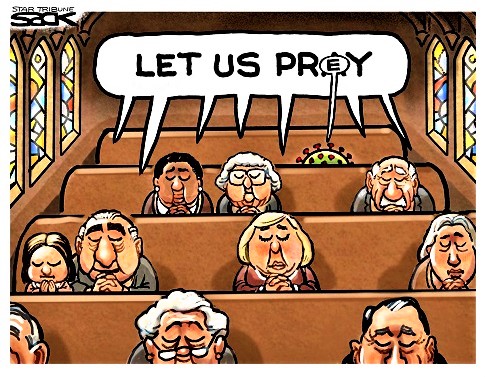
I just saw Bob Slatten’s post “Funny Papers” on I Should Be Laughing and had to add this cartoon from the post:



A Day Off

Today is the beginning of a four-day weekend for me. So, I’m basically going to take the day off completely. Besides, I’ve written a lot already this week.
Headaches and Insurance

On Tuesday, I had an appointment with the Headache Clinic at Dartmouth. I first went about six months ago, so for the past six months I have been taking monthly Emgality injections, which are very painful, by the way. Anyway, before I started taking the Emgality, I was having a headache seven days out of the week. Since the medicine kicked in, it took almost two months to begin working, my headaches have dropped to about four a week. Obviously, this is an improvement, but not the kind of improvement the clinic wants to see. In my appointment on Tuesday, the nurse practitioner who does all the follow-up visits talked to me about switching to Aimovig and/or Botox injections. Aimovig is another auto injector like Emglaity, but supposedly easier to use, not that Emglity was hard to administer. She asked which I would prefer. I have never been too keen on the idea of injecting poison into my body, so Botox is not something I really wanted to consider. Also, it’s thirty-one shots in the head, and I don’t like needles. However, I am getting desperate. I have dealt with headaches my entire life, and I just want some relief. I asked the nurse if I would be taking Aimovig and Botox or just one or the other. She told me that they would prefer that patients try both at the same time. Though research is being done on the combined effectiveness and not much information exists about this yet, it is believed that they work well together to prevent migraines. Here comes the caveat: very few insurance companies will pay for both treatments at the same time. She advised that I call my insurance provider and ask if they would cover both simultaneously.
Let me begin by saying that I hate insurance companies. They are crooked and cheap. They are always trying to cut corners and not pay for treatments advised by doctors. While my friends in other countries will say that the United States needs universal healthcare, and I am not going to argue with that, the US government is so colossally incompetent and corrupt that I am afraid it would actually be worse than the current situation. Considering that a large number of people were stupid enough to elect Donald Trump, how can I have faith that they would ever support truly universal healthcare? I just don’t believe it is possible in the greedy, capitalistic economy of the United States.
Now that I have given my rant about insurance companies, I will tell you what happened when I took the nurses advice and called my insurance company. Right off the bat, I got am idiotic computer giving me vast amounts of useless information that I did not ask for. So, I finally asked to be connected to an operator. I was given their pharmacy department. Finally, a live person! So I told her about my neurology visit and what had been recommended and asked would they cover both treatments. That’s when I began to get the runaround. I was told by the customer service representative that they had not received a preauthorization request for the Aimovig and therefore could not tell me if they would cover it or not. I already knew they would probably cover one or the other, but I wanted to know if they would possibly cover both. The reason I knew they would cover Aimovig or Botox is because when I was first prescribed Emgality, their reason for the initial denial was that I had not tried Aimovig or Botox first. Then she proceeded to tell me that Botox is a medical procedure and does not fall under her department, and I would have to talk to a representative from the medical department. So, she transferred me over there. I went through my explanation again. Again, I was told that he could not tell me if Botox would be covered because they had not received a preauthorization request. So I explained to him again that I was not asking if they would just cover Botox, but would they cover both treatments simultaneously. Again I was given the spiel about the Aimovig was covered by the pharmacy division and Botox was covered by his divisions, and he had no way of knowing if they would cover both since they would have to be requested separately. He told me to have the Headache Clinic request a preauthorization for both treatments.
At this point, I gave up on talking to the insurance company since they were obviously not going to tell me anything. So, I did as he suggested and called the Headache Clinic. This is when I got really annoyed. I was given a clerk to speak to and explained what I was calling about. I told her I needed them to request both treatments before they could tell me if both would be covered. She took down the message, and then had a nurse call me back. This was not the nurse practitioner I had spoken to earlier that morning. The nurse reviewed my chart and told me that it did not mention the Botox treatment and therefore the nurse practitioner must have decided against that course of action. I tried to explain that before she would order the Botox and the Aimovig simultaneously, that she wanted me to talk to the insurance company. I was basically told the since it was not in the chart, I needed to forget about it for now. When I tried explaining again, she finally said she would make a note of my call and ask the nurse practitioner, who would call me back. Do you think I have gotten a phone call back? No. While I like the people at the Headache Clinic, they are really bad about returning phone calls.
As it stands now, it appears that I will only be taking the Aimovig. Here’s what worries me, I was told by the pharmacy that by changing medications, it would take two to three months for the new medicine to begin working. If they had been able to schedule the Botox, the effects would be immediate and the botox would be working its magic while I waited for the Aimovig to begin working. I had been told that a Botox appointment would not take long to get scheduled because with the pandemic, they had a lot of appointments open. I am writing all of this because I had a major debilitating headache yesterday and was really hoping for a treatment that would work. Now, I wait.

Voting

I don’t often post about politics on my blog. There are just too many opinions about politics, and also, there is some internet troll out there who keeps saying nasty things about my political posts and my beliefs in a more democratic society. Whoever it may be, it may not be just one person. The message is almost always the same; he or she waits about two weeks after a political post to comment. This is a good thing; I have my comments set so that comments on posts over two weeks old must be approved by me. So, I just don’t approve them and mark them as spam. Anyway, this post is about something else that has been bothering me lately.
Quite frankly, I just don’t understand the Republican Party. They just baffle me. Most claim to be evangelical Christians, but they are the least Christ-like people in America. They follow absolutely none of Jesus’s teachings. Then there is the fact that they often say America is a democracy (it’s actually a Republic, you’d think with a name like Republican they’d embrace that), yet they work the hardest to make the United States as undemocratic as possible. Their latest scheme of opposing mail-in voting really confounds me. Trump and his Republican allies are launching an aggressive strategy to fight what many of the administration’s own health officials view as one of the most effective ways to make voting safer amid the deadly spread of COVID-19: the expanded use of mail-in ballots.
In this current voting cycle, Republicans are fighting tooth and nail to stop voting by mail. Why? I did a bit of research to see why this was the case. Why make it harder to vote? First of all, it should come as no surprise to me since Republicans want as few people as possible to vote because they believe it helps them in elections. This is why they have created voter ID laws. Even though in those states, it is relatively easy to get a free government ID, it’s still difficult for some people to get to the courthouse and apply for that ID. The push to limit voting options is in keeping with Republicans’ decades-running campaign to impose restrictions that disproportionately affect people of color, the poor, and younger voters, under the banner of combating voter fraud — which is exceedingly rare. Democrats have more core constituencies among the nation’s disenfranchised, and both parties have long believed that easier voting measures will benefit Democrats.
Trump views the issue in a stark, partisan way: He complains that under Democratic plans for national expansion of early voting and voting by mail, “you’d never have a Republican elected in this country again.” I’m not convinced this is true; even stupid people will vote by mail. Trump has said he believes vote-by-mail has been abused to hurt Republicans, and he “will not stand for it,” though the hypocrite that he is, he says that mail ballots could help some older voters — an important part of his voting base. It was a slight change that came at the urging of his advisers. Trump was roundly ridiculed for suggesting that expanding vote-by-mail would hurt Republicans in November. The New York Times called it a “false claim,” declaring that “there is no evidence to back up the argument from the right that all-mail elections favor Democrats.” But the truth is a little more complicated.
The United States has had absentee ballots for many years. I voted absentee the whole time I lived in Mississippi because the State of Mississippi wouldn’t allow out-of-state students to become Mississippi citizens, and thus we could not register to vote in Mississippi. It was all to charge us exorbitant out-of-state tuition, so I had to vote in Alabama by absentee ballot. The current public health crisis brings new urgency to the battle, as Democrats and a few Republican state officials turn to expanded voting by mail as an important way to avoid the serious health hazard of crowded polling stations amid a pandemic. In a pre-coronavirus world, Republicans found that the threat of voter fraud and the need for tighter voter restrictions were popular messages with segments of their base. If there was a chance that the political equation might change with the pandemic, Trump and his cronies have not seemed concerned. A lot of Alabamians vote by absentee ballot, yet Republicans control every statewide political office.
There are basically three categories of vote-by-mail in the US. The most restrictive level, found in seven states, including Alabama, is traditional absentee balloting, where voters have to give a reason why they can’t vote in person. Next is no-excuse absentee, where anyone can vote by mail but must request a ballot. About half of states have a version of that. Then there’s universal vote-by-mail, or “vote at home,” a system now used in five states—Colorado, Hawaii, Oregon, Utah, and Washington—plus many counties in California. New York just joined this group, at least for the primary. In this third system, the government automatically mails a ballot to every registered voter, and voters have about two weeks to mail the ballot back, or they can drop it off in person by election day.
Perhaps wary of the politics of taking an absolutist position amid the pandemic, and aware that absentee ballots can also be a preferred form of voting for some of Trump’s supporters (my mother being one of them), his advisers have pushed him to soften his position. After all, state’s rights have for the past 30 years or more been a hallmark of Republican ideology, and voting is the purview of the states, not the federal government. Republicans are highly focused on stopping Democrats from loosening absentee voting restrictions, which they have portrayed as a Democratic plot to inflate voting tallies.
Democrats and voting rights groups have filed lawsuits seeking to expand mail and absentee voting options and pushed for an extra $2 billion to help states adjust their election systems. National Republicans are fighting those efforts, while Trump doubled down on claims, without any evidence, that mail-in voting is vulnerable to fraud and that it helps Democrats. The studies done on mail-in-voting does not show this to be true. It merely shows that more people vote when it is easier to cast a ballot and does not universally favor one party over the other. It just shows that Trump is scared of the masses, and afraid they will vote him out of office, which I fervently hope they do.
While Trump and his cronies fight to prevent expansion of absentee ballots, nothing illustrates the mixed-up and hypocritical politics of the opposition to vote-by-mail better than the world’s most famous absentee voter declaring the practice corrupt. “Mail ballots are a very dangerous thing for this country, because they’re cheaters,” Trump told reporters in early April, a few weeks after casting an absentee ballot in Florida’s primary. “They’re fraudulent in many cases.” If this is the case, why did he vote absentee? Did he commit fraud by doing so? He’s broken so many laws and told so many lies, I have lost count.
The only thing we really know about voting this year is that absentee ballots are going to increase dramatically. Maybe making that easier would benefit Democrats, who live in densely populated urban areas where viral transmission is more likely. Or maybe it would benefit Republicans, who are older in general and so have more to fear of getting infected. There’s no way to know—which makes treating the question as one of partisan advantage thoroughly insane. Instead of focusing on which party might gain an edge, legislators and election officials would do well to spend their energy on what’s safest for voters and poll workers. It’s better to be remembered for keeping citizens safe than for forcing voters to choose between their health and the right to vote. Yet, we know, Trump and his ilk do not care about the health and well-being of the citizens of the United States. If they did, they wouldn’t be opening states back up to boost the economy. They care more about money lining their pockets than they do about the health of the average American.
Sorry this is so long. I guess I had a lot to say.


Authors
Recent Comments
Joe on The Gift of Love Steve Davis on The Gift of Love iameverywhere1 on Pic of the Day noisilycool3bc985058… on Pic of the Day noisilycool3bc985058… on Moment of Zen: A Room with a… Top Posts & Pages




Amazon Associate

As an Amazon Associate I earn from qualifying purchases. So, if you click on a link that takes you to Amazon.com, I may earn a commission.
Trust me, it isn’t much, but every little bit helps.

 Joe
Joe


 The Closet Professor