

We Are All God’s Children

For God has consigned all to disobedience, that he may have mercy on all. Oh, the depth of the riches and wisdom and knowledge of God! How unsearchable are his judgments and how inscrutable his ways!
— Romans 11:32-33
Sometimes I wonder if Paul, in writing Romans 9–11, was feeling what many of us in the LGBTQ+ Christian community have felt: the ache of being part of a people who seem to have rejected something essential and life-giving. For Paul, it was watching his beloved Jewish community turn away from the gospel of Christ (Romans 9:1–3). For me—and for so many of us—it’s standing in churches that reject us while clinging to a gospel we know in our bones is about mercy, love, and inclusion. Romans 10:12–13 says, “For there is no difference between Jew and Gentile—the same Lord is Lord of all and richly blesses all who call on him, for, ‘Everyone who calls on the name of the Lord will be saved.’” In Galatians 3:28, Paul tells us, “There is neither Jew nor Gentile, neither slave nor free, nor is there male and female, for you are all one in Christ Jesus.”
Paul’s conclusion in Romans 11 is not one of despair, but of wonder. After wrestling with rejection, exclusion, and the mysteries of God’s plan, in Romans 11:32 he writes “For God has consigned all to disobedience, that he may have mercy on all.”
We know something about rejection. We’ve heard the sermons, felt the silence, watched doors close. Isaiah 56:3-5 says:
Let no foreigner who is bound to the Lord say,
“The Lord will surely exclude me from his people.”
And let no eunuch complain,
“I am only a dry tree.”For this is what the Lord says:
“To the eunuchs who keep my Sabbaths,
who choose what pleases me
and hold fast to my covenant—
to them I will give within my temple and its walls
a memorial and a name
better than sons and daughters;
I will give them an everlasting name
that will endure forever.
Some of us have been told we must change to be loved by God—when all along, we were already held in that love. Romans 8:38–39 says, “For I am convinced that neither death nor life, neither angels nor demons, neither the present nor the future, nor any powers, neither height nor depth, nor anything else in all creation, will be able to separate us from the love of God that is in Christ Jesus our Lord.” And yet despite the rejections of others… we stayed. We sang the hymns. We read Scripture with reverence. We wept and prayed and kept believing that God’s mercy is bigger than the world’s fear. Micah 6:8 says, “He has shown you, O mortal, what is good. And what does the Lord require of you? To act justly and to love mercy and to walk humbly with your God.” Jesus rebuked those who have put up walls of exclusion. In Matthew 23:23 He says, “Woe to you, teachers of the law and Pharisees, you hypocrites! You give a tenth of your spices—mint, dill and cumin. But you have neglected the more important matters of the law—justice, mercy and faithfulness. You should have practiced the latter, without neglecting the former.”
Romans 11 is a reminder: rejection is not the end of the story. Romans 11:1–2 says, “I ask then: Did God reject his people? By no means! I am an Israelite myself, a descendant of Abraham, from the tribe of Benjamin. God did not reject his people, whom he foreknew. Don’t you know what Scripture says in the passage about Elijah—how he appealed to God against Israel.” (1 Kings 19:10-18) God is not finished with Israel, and God is certainly not finished with us. God’s plan was never about gatekeeping, never about purity tests or theological litmus strips. It was—and is—about mercy breaking into the human mess. Paul says in Romans 5:8, “But God demonstrates his own love for us in this: While we were still sinners, Christ died for us,” and Hosea 6:6 says, “For I desire mercy, not sacrifice, and acknowledgment of God rather than burnt offerings.”
Paul calls this a mystery. In Romans 11:25, he says, “I do not want you to be ignorant of this mystery, brothers and sisters, so that you may not be conceited: Israel has experienced a hardening in part until the full number of the Gentiles has come in.” And it is. It’s a mystery that the very people who were told they didn’t belong—Gentiles, outcasts, eunuchs, queers, sinners—are the ones Christ drew near to (Luke 7:36–50; John 4:7–29; Acts 8:26–39). It’s a mystery that God would use rejection to teach the church mercy. That even now, in a world and church still wrestling with whom to embrace, God is quietly gathering all of us in. (Ephesians 2:13–19) Jesus tells the Pharisees in John 10:16, “I have other sheep that are not of this sheep pen. I must bring them also. They too will listen to my voice, and there shall be one flock and one shepherd.”
We do not need to prove our worth to God. In Titus 3:4–7, Paul write to Titus and says, “But when the kindness and love of God our Savior appeared, he saved us, not because of righteous things we had done, but because of his mercy. He saved us through the washing of rebirth and renewal by the Holy Spirit, whom he poured out on us generously through Jesus Christ our Savior, so that, having been justified by his grace, we might become heirs having the hope of eternal life” We are not spiritual refugees in someone else’s kingdom. We are already part of the body of Christ—beloved, chosen, and called. Romans 12:4–5 says, “For just as each of us has one body with many members, and these members do not all have the same function, so in Christ we, though many, form one body, and each member belongs to all the others,” and Colossians 3:12 says, “Therefore, as God’s chosen people, holy and dearly loved, clothe yourselves with compassion, kindness, humility, gentleness and patience.”
Romans 11 doesn’t end in doctrine. It ends in doxology—a song of praise.
Oh, the depth of the riches of the wisdom and knowledge of God!
How unsearchable his judgments,
and his paths beyond tracing out!
“Who has known the mind of the Lord?
Or who has been his counselor?”
“Who has ever given to God,
that God should repay them?”
For from him and through him and for him are all things.
To him be the glory forever! Amen. (Romans 11:33-36)
That is where we live too: in that mysterious, radiant space between pain and praise. We have seen rejection, yes. But we’ve also seen what mercy can do. We’ve tasted the unsearchable depths of God’s wisdom and kindness. And we believe—despite it all—that mercy is coming for everyone. Remember Paul’s question in Romans 2:4, “Or do you show contempt for the riches of his kindness, forbearance and patience, not realizing that God’s kindness is intended to lead you to repentance?” In 1 Timothy 2:3–4, Paul tells Timothy, “This is good, and pleases God our Savior, who wants all people to be saved and to come to a knowledge of the truth.”
God is merciful. As LGBTQ+ Christians have known the sting of rejection, and we have heard his voice calling us beloved. We should thank Him for His mystery. We should thank God for His patience, and for His mercy including all of us, even when others do not. His Word can guide us to live in His mercy and help us to share it with others. God is not done yet—not with the church, not with this world, and, most certainly, not with us.

Moment of Zen: Cooper Koch


You may have seen that Cooper Koch is the newest male model for Calvin Klein.




Cooper, who is gay, has a twin brother Payton, who’s just as swoon-worthy (and also gay). Payton prefers to remain behind the camera as a film editor. He received an Emmy nomination for his editing of Only Murders in the Building.


Birthright Citizenship

Disclaimer: this is not my usual type of post, but as a historian, it is something I feel very passionate about. I hate when people try to rewrite history to suit their own political agenda. Republicans do it constantly, and it is a typical fascist ploy to gain support from the ignorant. (As I have always said, ignorance isn’t stupidity, though they can go hand in hand, ignorance is the disdain for learning.
In recent years, attempts have been made—most prominently by Trump and his allies—to narrow the scope of the 14th Amendment’s Citizenship Clause by asserting that it was intended only to apply to formerly enslaved people after the Civil War. This interpretation, if adopted, would dramatically alter the constitutional guarantee of birthright citizenship by excluding the U.S.-born children of undocumented immigrants or non-citizen parents. On January 20, 2025, Trump signed Executive Order 14160, titled “Protecting the Meaning and Value of American Citizenship,” aiming to end birthright citizenship for children born in the United States to non-citizen parents, including undocumented immigrants and those on temporary visas. The executive order asserts that the 14th Amendment’s Citizenship Clause does not apply to these children, challenging longstanding interpretations of the Constitution.
Trump’s reinterpretation of the 14th Amendment is not only legally unsound, but it also contradicts the very principles of originalism—a judicial philosophy espoused by several current members of the United States Supreme Court, including Justices Clarence Thomas, Neil Gorsuch, Amy Coney Barrett, and Brett Kavanaugh. Originalism holds that the Constitution should be interpreted according to its original public meaning at the time of its ratification. An honest application of this methodology to the 14th Amendment—adopted in 1868—reveals that the framers and ratifiers understood birthright citizenship to extend far beyond the formerly enslaved. The original debates, statutory context, and legislative intent make clear that the amendment was designed to establish a broad and enduring principle of jus soli (citizenship by place of birth), not a narrow race- or status-specific remedy.
The first sentence of the 14th Amendment reads:
“All persons born or naturalized in the United States, and subject to the jurisdiction thereof, are citizens of the United States and of the State wherein they reside.”
This language, while triggered by the injustices of slavery and the Supreme Court’s Dred Scott decision (1857), was not restricted to formerly enslaved persons. Rather, it established a general rule of national citizenship. As Senator Jacob Howard (1805-1871), who introduced the Citizenship Clause in the Senate, explained during the 1866 debates, it would “include every class of persons” born in the United States, with only narrow exceptions—notably, the children of foreign diplomats and tribal members under, sovereign jurisdiction.
Representative John Bingham (1815-1900), the principal framer of Section 1, likewise affirmed that the amendment was meant to secure the rights of “every human being born within the jurisdiction of the United States of parents not owing allegiance to any foreign sovereignty.” This phrasing did not exclude immigrants; rather, it excluded only those legally insulated from U.S. law, such as ambassadors and ministers. Immigrants, whether legally or illegally present, are subject to U.S. jurisdiction in every meaningful legal sense.
Thus, under originalist principles, the public understanding of the 14th Amendment in 1868 included birthright citizenship for all those born on American soil and subject to its laws, regardless of their parents’ status.
The broader context of the Civil Rights Act of 1866, passed shortly before the 14th Amendment, further undermines any restrictive reading. That law declared:
“All persons born in the United States and not subject to any foreign power… are hereby declared to be citizens.”
This clause formed the legislative basis for the 14th Amendment and demonstrates that Congress deliberately created a universal standard, not one limited to the formerly enslaved. While the Amendment’s ratification followed the Civil War and was motivated in part by the need to secure citizenship for freedmen, its framers understood that equal citizenship was a universal principle, not a racially contingent one.
This understanding has been upheld repeatedly by the Supreme Court, most notably in United States v. Wong Kim Ark (1898), which affirmed that a child born in the United States to Chinese parents—who were not U.S. citizens and were barred from naturalization—was nonetheless a U.S. citizen under the 14th Amendment. That decision relied heavily on both the text and historical intent of the Amendment, and it is directly contrary to the Trump-era argument that children of non-citizens are not constitutionally entitled to citizenship.
For originalists, the legitimacy of constitutional interpretation rests on fidelity to the Founders’ and ratifiers’ understanding. The attempt to redefine the 14th Amendment’s reach based on a selective, ahistorical reading that imagines it applied only to freed slaves is inconsistent with the actual record. It distorts the original public meaning by conflating historical motivation with constitutional scope. The motivation for an amendment may be rooted in a particular crisis—like the abolition of slavery—but its language and application must be understood in light of the general principles it enshrines.
Moreover, originalism demands that courts avoid imposing modern policy preferences or political pressures onto the Constitution. The Trump administration’s push to reinterpret the Citizenship Clause is a modern political maneuver, not a historically grounded legal argument. To accept such a revisionist reading would be to violate the very core of originalist jurisprudence. The legality of Executive Order 14160 is currently under review by the U.S. Supreme Court in the consolidated case Trump v. CASA. The framers of the amendment wrote in broad, inclusive terms—and debated and defended those terms publicly. They did not write a clause about race or lineage; they wrote one about the universal promise of citizenship to anyone born on American soil and subject to its laws.
Originalists on the Supreme Court, therefore, have a duty to honor that promise—not just as a matter of precedent or policy, but as a matter of fidelity to the constitutional text and its original meaning. Therefore, from an originalist perspective, the executive order contradicts the original understanding and judicial interpretation of the 14th Amendment. Originalist justices should uphold the Constitution’s text and historical intent by rejecting the executive order’s attempt to redefine birthright citizenship. And, while Chief Justice John Roberts and Justices Elena Kagan, Sonia Sotomayor, and Ketanji Brown Jackson do not identify as originalists, they would likely rule against Trump for the reinterpretation of a long standing understanding of the 14thAmendment. That leaves only Justice Alito, who occasionally employing originalist arguments, so whatever side of the fence he falls on this issue. Trump v. CASA will ultimately come down to the judicial consistency and moral integrity of their originalist ideology, though we know the most conservative Supreme Court justices, particularly Thomas and Alito, have no moral integrity or judicial consistency and are inherently political in their rulings.
All of that being said, after yesterday’s hearings, it should be a unanimous summary judgement in favor of CASA. Sadly, I have little faith that this will be the case, especially with the current politicized nature of the U.S. Supreme Court.

Weekend Ahead

I’m hoping this afternoon will be the beginning of a long weekend. I emailed my boss, who has been on vacation for the last week about taking some of my remaining vacation days. I had asked to take today off, but I did not realize it was a travel day for her. I think she was coming back from a conference in England, but since she doesn’t communicate things like that to us, I’m not completely sure where she had been. Anyway, when I found out she was traveling, I assumed I would not hear back from her. I could have texted her, but I would not have wanted to be bothered on a day when I had been traveling all day. So, when she gets back to work today, I will talk to her about taking this afternoon off. I have a half day that I need to take anyway. I’m already scheduled to be off tomorrow, and I’m going to see about taking Monday off as well. Anyway, we’ll see how that works out.
If I do take this time off, I’m hoping I can relax and read. We have several rainy days ahead, and I have always loved curling up with a book on a rainy day. I really didn’t have much to say today, but I will post my Isabella pic of the week. I think I have posted this picture before, but it’s one of my favorites:


Khajuraho Temples

The temples of Khajuraho, a UNESCO World Heritage site located in Madhya Pradesh, India, are renowned for their intricate sculptures that celebrate the full spectrum of human life—spiritual, sensual, and mundane. Constructed between the 10th and 12th centuries CE under the rule of the Chandela dynasty, these temples have drawn global attention for their uninhibited erotic carvings. While most focus has traditionally been directed toward heterosexual imagery, the presence of male same-sex activity in the sculptural program offers a rare and illuminating glimpse into a pre-modern Indian worldview that acknowledged, depicted, and integrated diverse expressions of desire, including male-male eroticism, without censure.
Among the 85 temples originally built at Khajuraho, 22 remain today. Temples like the Kandariya Mahadeva, Lakshmana, and Vishvanatha house the majority of the erotic sculptures. These carvings are typically located on the outer walls and are interspersed among depictions of deities, mythical creatures, daily life, and celestial beings. In this context, the erotic is not marginal or profane—it is part of a holistic worldview that includes kama (desire) as one of the four essential goals of life, alongside dharma (duty), artha (prosperity), and moksha (liberation).
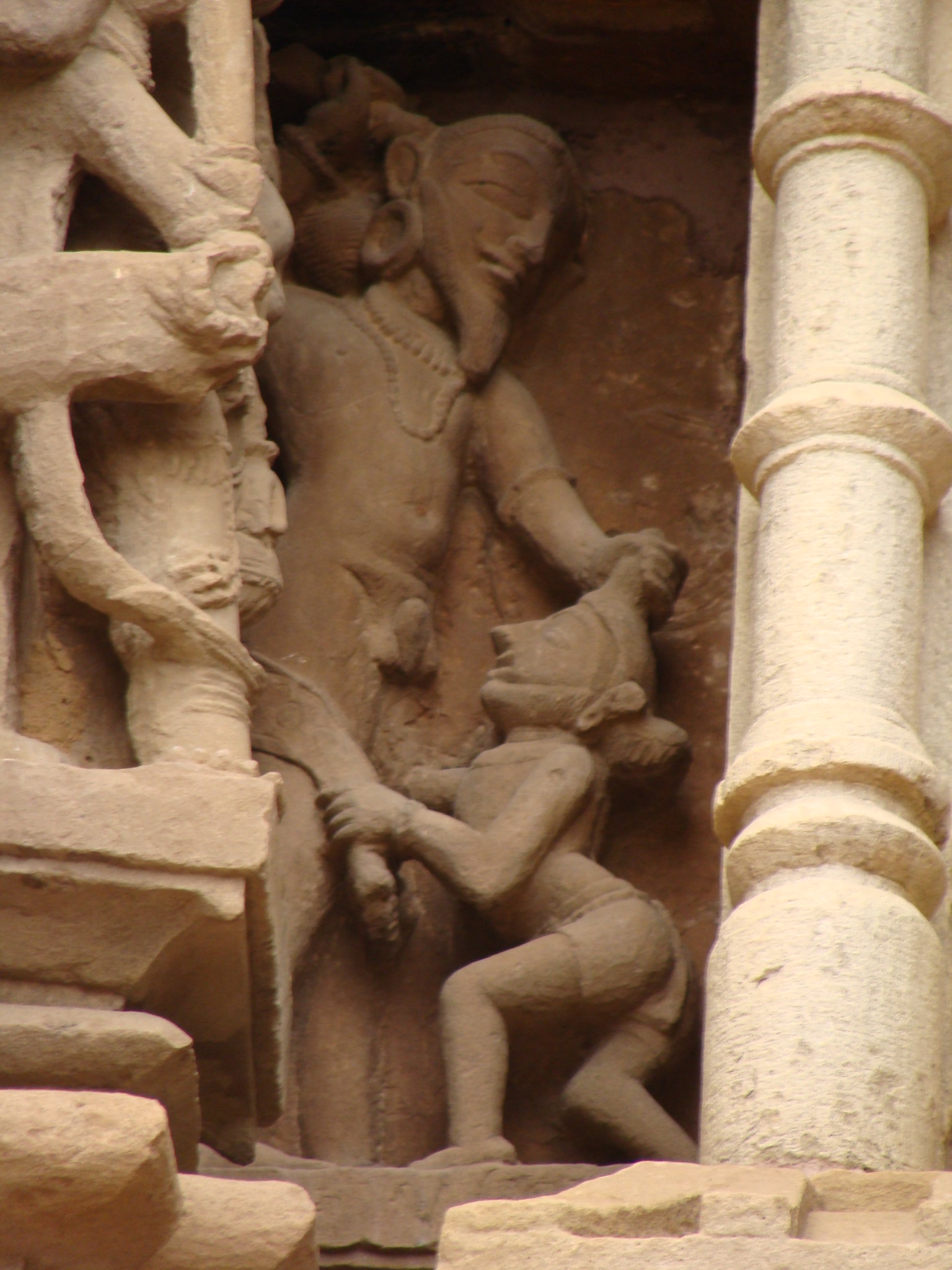
Within this framework, scenes of male same-sex activity appear—never as the dominant theme, but as a recognized and unashamed element of human and divine experience. One well-documented relief on the Kandariya Mahadeva Temple portrays three male figures: two engaged in what appears to be anal intercourse while the third supports or observes. The composition, carved with anatomical clarity and sensual expressiveness, is neither hidden nor diminutive. Instead, it is seamlessly integrated with other sexual depictions, suggesting that such interactions were not viewed as abnormal or unworthy of representation.
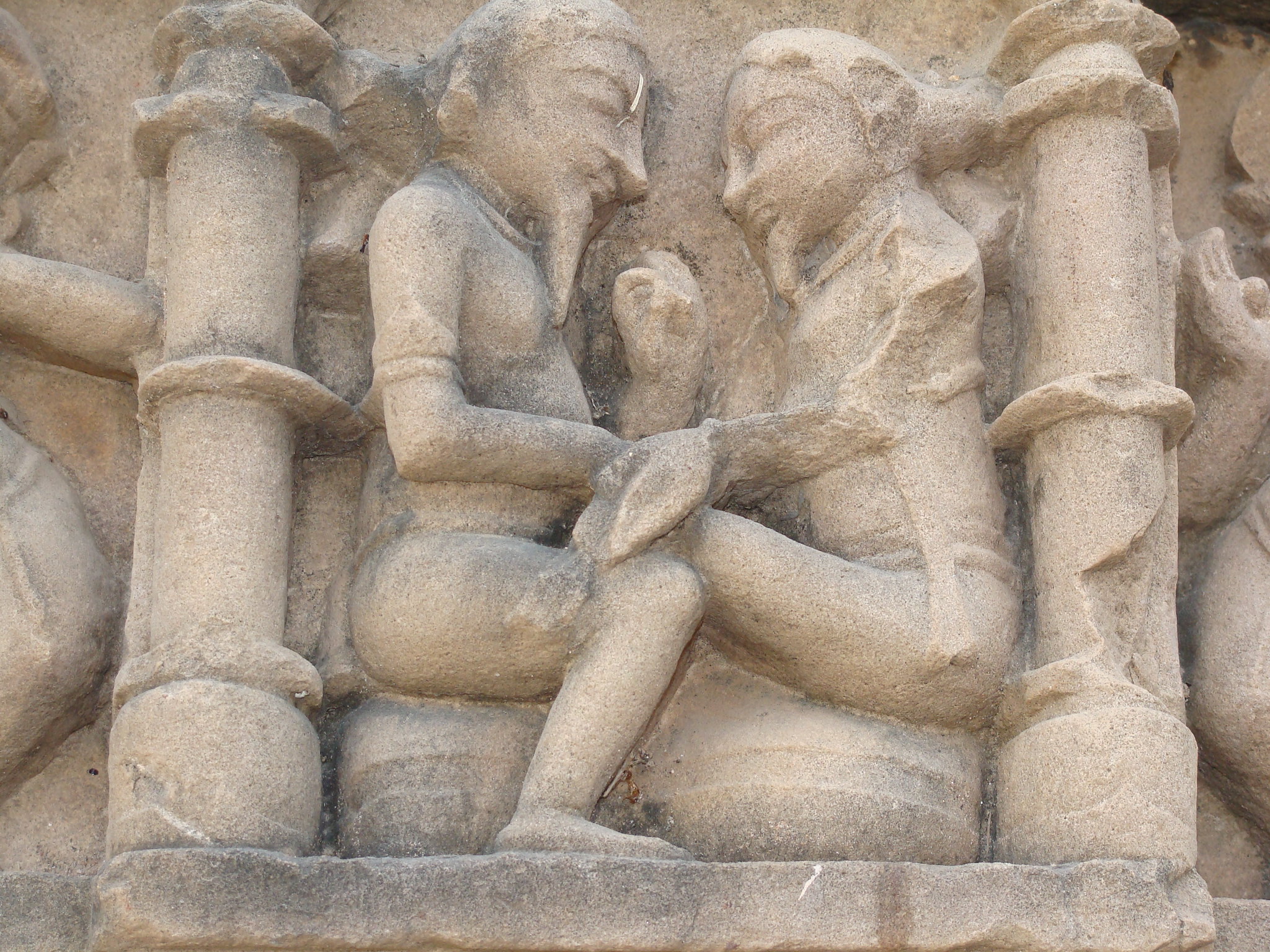
The Khajuraho sculptures are informed by Tantric philosophy, which celebrates the union of opposites—male and female, mortal and divine, physical and spiritual. Tantra does not moralize sexual behavior but instead sees it as a path to transcendence when practiced with awareness and ritual purpose. In such a framework, the body is not a source of shame but a vehicle for experiencing and accessing the sacred. This philosophical backdrop helps explain the inclusion of non-normative sexualities in the temple art.
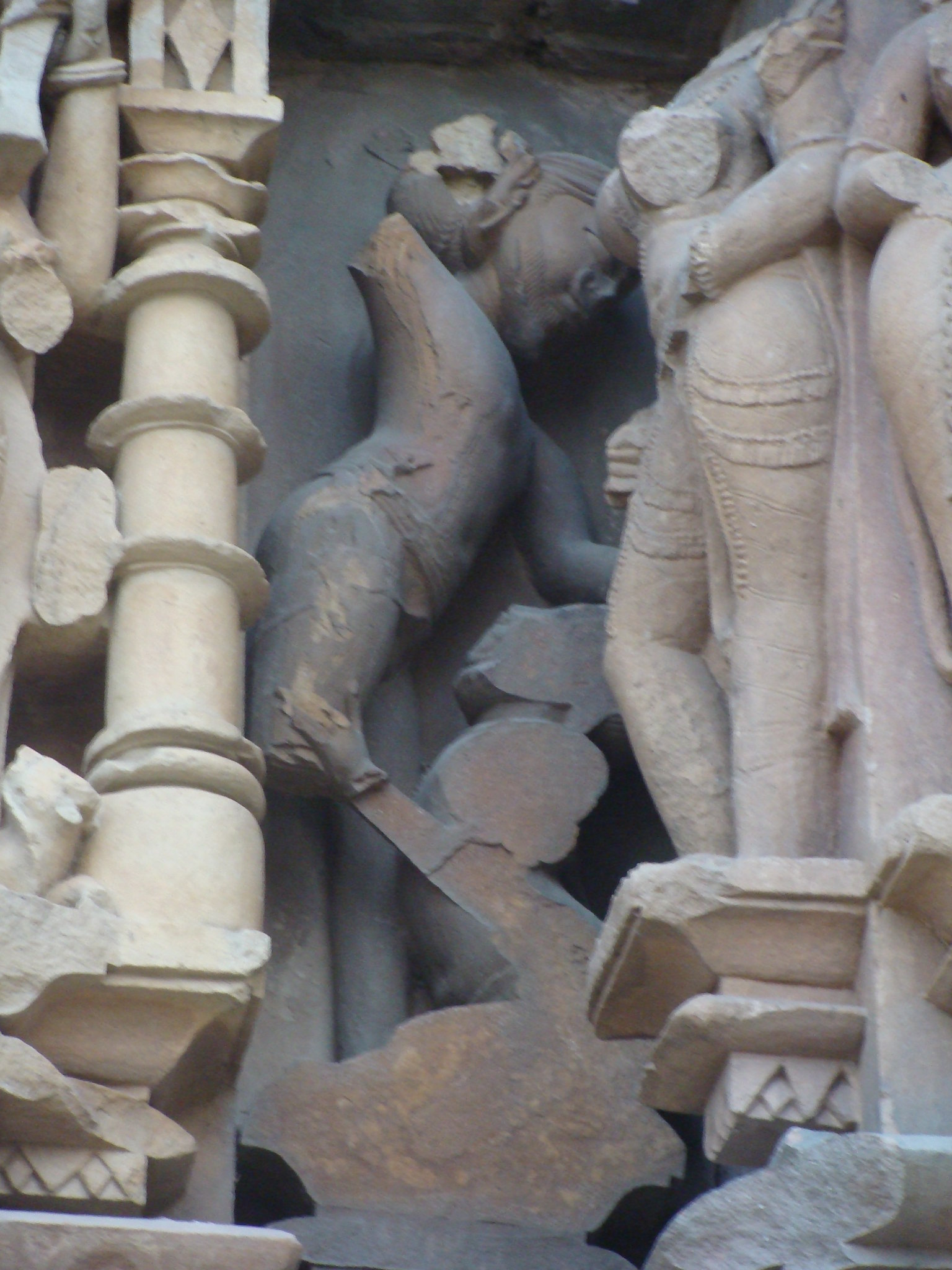
Moreover, the historical Indian worldview, as evidenced in ancient texts like the Kama Sutra and the Natyashastra, acknowledged and codified categories for male-male desire. The Kama Sutra describes the behavior of the kliba—a term that included a variety of gender-nonconforming or homosexual individuals—and elaborates on oral sex between men without moral condemnation. The presence of male same-sex depictions at Khajuraho may be seen as a visual extension of these texts, reflecting their acceptance within elite court and religious circles.
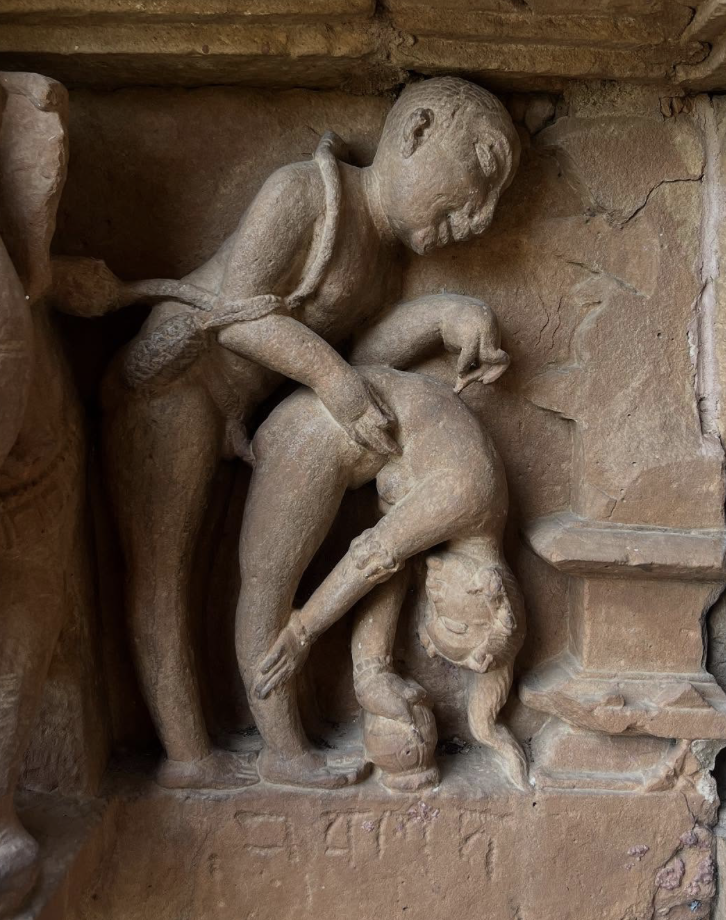
The British colonial period marked a turning point in the interpretation of Indian art and sexuality. Victorian sensibilities, combined with Christian morality, led to a widespread suppression of India’s diverse sexual past. Erotic art was dismissed as “obscene” or “degenerate,” and the Khajuraho sculptures were either censored or misinterpreted. The presence of male same-sex acts, in particular, was downplayed or ignored in early archaeological reports, a silence that endured into much of the 20th century.

Only in recent decades have Indian and international scholars begun to reassess Khajuraho through lenses unclouded by colonial morality. Researchers such as Devdutt Pattanaik and Ruth Vanita have foregrounded these representations as evidence of a more fluid and inclusive premodern Indian culture. In doing so, they challenge modern narratives that frame homosexuality as a “Western import” or a postcolonial phenomenon.
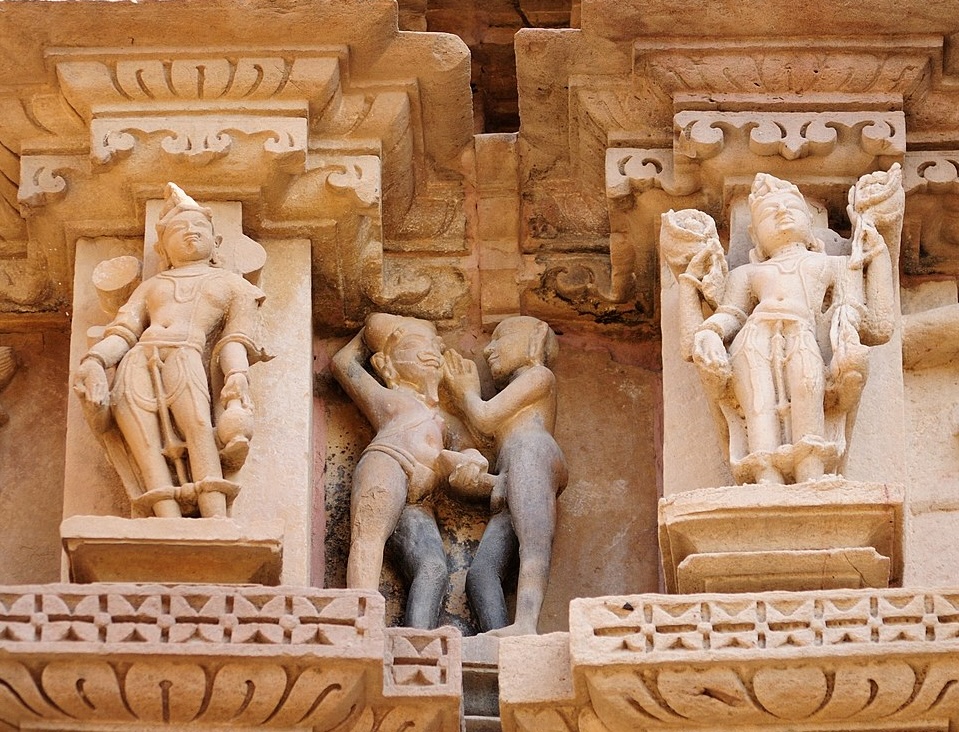
The male same-sex depictions at the Khajuraho Temples serve as powerful reminders of a historical moment when erotic plurality was not stigmatized but sculpted in stone for the divine and the earthly to witness. These carvings do not merely reflect acts of physical pleasure—they symbolize a cultural acceptance of the full range of human desire. As India and the world continue to grapple with questions of sexual identity and historical memory, the Khajuraho temples stand as enduring monuments to a time when the sacred and the sensual, including love between men, coexisted without shame.In recognizing and reclaiming these images, we honor a forgotten legacy—one that whispers across time from temple walls that have seen centuries, reminding us that queerness is not an aberration in Indian history, but a thread woven into its very cultural fabric.


Authors
Recent Comments
noisilycool3bc985058… on A Queen Was Born noisilycool3bc985058… on Pic of the Day noisilycool3bc985058… on Pic of the Day Joe on Pic of the Day noisilycool3bc985058… on Pic of the Day Top Posts & Pages



Amazon Associate

As an Amazon Associate I earn from qualifying purchases. So, if you click on a link that takes you to Amazon.com, I may earn a commission.
Trust me, it isn’t much, but every little bit helps.

 Joe
Joe

 The Closet Professor