Love Won!


The news just came down from the Supreme Court: Marriage equality is officially the law of the land!

Today is a historic day, first for everyone who can now marry the person they love no matter where they live, but also for all of us who are invested in the advancement of equality. Thanks to today’s decision, same-sex couples will have their marriages recognized in every state and can no longer be discriminated against for wanting to adopt a child — just like any other married couple in this country.

The U.S. Supreme Court ruled 5-4 on Friday that it is legal for all Americans, no matter their gender or sexual orientation, to marry the people they love. The justices found that under the 14th Amendment, states must issue marriage licenses to same-sex couples and recognize same-sex unions that were legally performed in other states. Justice Anthony Kennedy delivered the majority opinion and was joined by Justices Ruth Bader Ginsburg, Elena Kagan, Stephen Breyer and Sonia Sotomayor.

The decision is a historic victory for gay rights activists who have fought for years in the lower courts. Thirty-seven states and the District of Columbia already recognize marriage equality. The remaining 13 states ban these unions, even as public support has reached record levels nationwide. As gay Americans we have waited with bated breath and wondered why the Supreme Court has waited until the final days of the term to issue this seemingly obvious decision. Every major LGBT equality (or, inequality) decision from the Supreme Court–including, Bowers v. Hardwick (it is ok to criminalize sodomy), Romer v. Evans (the you-can’t-discriminate-against-gays-just-because-you-hate-them case), Lawrence v. Texas (it is not ok to criminalize sodomy), Hollingsworth v. Perry (marriage freedom in California), and United States v. Windsor (the Defense of Marriage Act is unconstitutional)–were handed down toward the end (in the case of Romer) or on the very last day of the Court’s term. Lawrence and Hollingsworth were both argued on the same day one decade apart and decided on the same day a decade apart (March 26 and June 26, in 2003 and 2013, respectively). The other cases were decided at around the same time: Windsor was argued the day after Perry and decided the same day. Romer was argued on October 10, 1995 and decided on May 20, 1996, the earliest of the bunch.

In the majority opinion, the justices outlined several reasons marriage rights should be extended to same-sex couples. They wrote that the right to marriage is an inherent aspect of individual autonomy, since “decisions about marriage are among the most intimate that an individual can make.” They also said gay Americans have a right to “intimate association” beyond merely freedom from laws that ban homosexuality. Kennedy consistently used the arguments by the opponents of same-sex marriage against them. He said that same-sex marriages would not diminish the dignity of marriage but increase it. Kennedy said that those who wanted to be married are upholding the dignity of marriage because they want the same respect that opposite-sex marriages have. In answering the traditions of marriage, Kennedy said that there is not an overall traditional definition of marriage because marriage has consistently changed over the centuries. Arranged marriages are no longer the norm, interracial marriages are no longer illegal, and gay equality has become accepted by the majority of Americans. Marriage equality has followed political and social change.

The majority determined that extending the right to marry protects families and “without the recognition, stability, and predictability marriage offers, children suffer the stigma of knowing their families are somehow lesser.” The majority concluded that the right for same-sex couples to marry is protected under the 14th Amendment, citing the clauses that guarantee equal protection and due process. Kennedy said that marriage is a fundamental right of the constitution, which the Fourteenth Amendment’s a Due Process and Equal Protection clauses guarantee.

I am sure that opponents will voice arguments against following the Court and many have already said that they will use civil disobedience to resist the ruling. However, let’s be clear, they Supreme Court did not make the same mistake as in Brown v Board of Education and call for the implementation to be done “with all deliberate speed.” Not is this the 1830s when Andrew Jackson ignored the Supreme Court ruling in Worcester v. Georgia when he said, “John Marshall has made his decision; now let him enforce it!”. I have no doubt that lower courts will be busy as people will be forced to file cases forcing local officials to issue marriage licenses. I have little doubt that this will be the case in Alabama. There are some politicians who will use their hatred of equality to attempt to fight, but they will ultimately fail. LOVE WON!


Flags

Occasionally, and it seems to happen more and more often, the sheer ignorance and stupidity of the politics of hate astounds me. On article I read stated that, “It was only a matter of time before anti-gay ultra conservatives used the debate over hanging the Confederate flag in governmental buildings to take aim at the display of the rainbow flag.” However, I have to disagree with that because the thought would never have occurred to me because it is so utterly ridiculous.

The American Family Association’s Bryan Fischer took to his radio program Tuesday to demand that if the Confederate flag is going to be removed from government buildings, so should the gay pride rainbow flag, which he called a symbol of “the Gay Reich.”
Fischer said:

If we are going to remove symbols of oppression from our culture, if we come to the point where we say any flag that represents bigotry, any flag that represents hatred, any flag that represents slavery or oppression needs to be removed, then I want to suggest to you that the next flag to go ought to be the rainbow flag of the Gay Reich.

The rainbow flag represents the gay lobby, it represents Big Gay, it represents what I’m calling for the first time today, I’m introducing a new term: the Gay Reich. They’ve got a flag just like the Nazis had their flag.

That flag is a symbol of slavery and oppression and bigotry and prejudice and bias. So if we’re going to go after symbols of oppression, we ought to make the rainbow flag the next target for removal in our culture.

As a southerner and a historian, I have many many problems with the use of the Confederate Battle Flag as a political symbol. It is a flag of losers. The Confederacy lost. That should be enough. However, it has been taken by even greater losers, i.e. racists, as a symbol of pride and hate. I personally believe that the only flags that should at state agencies is the American flag and the state flag. There is no reason for there to be any other controversy about this. If the government wants to fly the “six flags” of Texas or the “five flags” of Alabama, then it should not be on the Capitol grounds but instead at a historical park separate from the Capitol.

In Alabama, Governor George C. Wallace raised the Confederate Battle Flag above the state Capitol building as a symbol of white supremacy. It was a political move of hatred. It remained atop the dome of the Capitol until controversy over the flying of the flag in the early 1990s. The controversy was quietly and with no fanfare ended six days after Jim Folsom, Jr. became governor of Alabama in 1993. In a move Folsom’s father Governor “Big” Jim Folsom, Sr. would have been proud, Folsom simply ordered the flag to no longer be raised. It actually took a few days for anyone to notice. (A quick historical note, Big Jim spoke to a joint session of the Alabama Legislature the day after the Brown v. Board of Education decision was handed down by the Supreme Court and called for an immediate desegregation of Alabama schools, to which the legislature ignored and passed a law reaffirming school segregation.)

The only place that the Confederate Flag (and it should be the national flag not battle flag) should be flown near the Alabama Capitol is next door at the Little White House of the Confederacy Museum, but it shouldn’t be on the Capitol grounds. However, Alabama’s Governor a Robert Bentley (an idiotic dumbass) has chosen to make a political scene and take down the Confederate flags around the Capitol grounds. He should not have made a big fuss over it, like he did, and instead should have used Little Jim’s example and taken the flag down quietly. He’s making a big scene to cover his own incompetence over the Alabama budget crisis and to get publicity on the national news.

Some of my southern readers may disagree with me, but I do see the Confederate flags as symbols of oppression. If the South had won, LGBT acts would still be criminalizes, and we would have been hunted and jailed. The one thing that might have kept that from happening is that southern “hospitality” and “manners” would have demanded that we were hidden from sight. We would be the skeleton in the family closet. I think the Confederacy would have been an oppressive place for all those who were not the white elite.

I’ve gotten a little off topic talking about Confederate flags, but the whole matter is about bigotry. It honestly has nothing to do with “southern heritage.” However, no matter how you feel about the Confederate flag, the idea of comparing it to the rainbow flag is utter stupidity. The rainbow flag is about openness and acceptance, not about oppression. There is not such thing as a Gay Reich. I find the mention of a Gay Reich to be highly offensive. The Nazis of the Third Reich did their best to destroy homosexuality in Europe. They murdered, tortured, and lobotomized homosexuals merely for being alive. It is the idiotic argument of Reductio ad Hitlerum. When people have lost an argument and it goes to the ridiculous, they always resort to the Nazi Card, because they have run out of stupid arguments.


Six Flags


My niece really wanted to ride roller coasters yesterday, so I took her on the Georgia Cyclone first. The Georgia Cyclone is a wooden roller coaster that is a mirror image of the original Coney Island Cyclone, but ten feet higher.  If you’ve ever been on a wooden roller coaster you know they will nearly shake or beat you to death.  There isn’t a damn thing fun about them, which is why I took her on that one first.  It cured her of wanting to ride another one, most of which she was too short for anyway.  That may be a bit mean and sneaky of me, but they give me vertigo, make me sick and usually I end up with a headache, so better to go on one then have to ride them all.

Silvereagle, yes, it was hell.  The heat index I’m sure was over 100 degrees, and by the end of the day, it was thundering and lightning and most of the park closed down, so we went back to the hotel.

Susan, my mother and I have had this discussion of not volunteering me for things without my knowledge.  I made it absolutely clear that this was the last time I’m going to Six Flags.

Michael, yes, I do cherish these memories with my niece, and more importantly she cherishes them too.

JiEL, it is particularly nice that my niece loves it so.  Her aunt on her father’s side insists on taking her to Disney World (which I cannot afford), but the nice thing is, she has said on numerous occasions that it much more fun to go to Six Flags with me.

Jay, it’s getting harder for me to fit in some of these rides too.  Have you ever seen Gabriel Iglesias talk about getting on rides and seeing how many clicks they can get on the safety bar?  It is too funny. His amusement park stories are some of his funniest.

Amanda, people watching truly is the most fun.  So many hot guys!


Sacrificial Lamb


I feel like I’m being led away as the sacrificial lamb.  I am taking my niece to Six Flags today.  I hate amusement parks.  I hate the crowds.  I hate the rides.  However, I love my seven year old niece, and she did make straight A’s all year long.  My mother promised her a trip to Six Flags as a reward, and I get the supreme pleasure of doing something I hate with a passion.  I know it’s probably wrong of me, but I hope that she’s too short for the only two roller coasters that I’m “almost” willing to ride (The Great American Scream Machine and the Georgia Cyclone).  Pray for me to survive.  Especially, since it’s going to be 97 degrees today and God only knows how high the heat index will be.


Queer


Queer
by Frank Bidart 

Lie to yourself about this and you will
forever lie about everything.

Everybody already knows everything
so you can
lie to them. That’s what they want.

But lie to yourself, what you will

lose is yourself. Then you
turn into them.

                 *

For each gay kid whose adolescence

was America in the forties or fifties
the primary, the crucial

scenario

forever is coming out—
or not. Or not. Or not. Or not. Or not.

                 *

Involuted velleities of self-erasure.

                 *

Quickly after my parents
died, I came out. Foundational narrative

designed to confer existence.

If I had managed to come out to my
mother, she would have blamed not

me, but herself.

The door through which you were shoved out
into the light

was self-loathing and terror.

                 *

Thank you, terror!

You learned early that adults’ genteel
fantasies about human life

were not, for you, life. You think sex

is a knife
driven into you to teach you that.

Frank Bidart

Frank Bidart was born in Bakersfield, California, in 1939 and educated at the University of California at Riverside and at Harvard University, where he was a student and friend of Robert Lowell and Elizabeth Bishop.

His first volume of poetry, Golden State (1973), was selected by poet Richard Howard for the Braziller Poetry series, but it wasn’t until the publication of The Sacrifice (1983) that Bidart’s poetry began to attract a wider readership. Bidart’s early books are collected in In the Western Night: Collected Poems 1965-90 (1990).

His recent volumes include Star Dust (Farrar, Straus and Giroux, 2005), Music Like Dirt (2002), and Desire (1997), which was nominated for a Pulitzer Prize, and was a finalist for both the National Book Award and the National Book Critic’s Circle Award. He is also the co-editor of Robert Lowell’s Collected Poems (2003).

About his work, the former U.S. Poet Laureate Louise Glück has said, “More fiercely, more obsessively, more profoundly than any poet sinceBerryman (whom he in no way resembles) Bidart explores individual guilt, the insoluble dilemma.” And about his career as a poet, she said, “Since the publication, in 1973, of Golden State, Frank Bidart has patiently amassed as profound and original a body of work as any now being written in this country.”

His honors include the Wallace Stevens Award, the Lila Wallace-Reader’s Digest Foundation Writer’s Award, the Morton Dauwen Zabel Award given by the American Academy of Arts and Letters, the Shelley Award of the Poetry Society of America, and The Paris Review’s first Bernard F. Conners Prize for “The War of Vaslav Nijinsky” in 1981. In 2007, he received the Bollingen Prize in American Poetry.

Bidart was elected a Chancellor of the Academy of American Poets in 2003. He lives in Cambridge, Massachusetts, where he has taught at Wellesley College since 1972.


Riding in the “Sidecar”

The year is 1987. The boys wear pink Izod shirts, the girls wear big hair, everyone has a stash box, and AIDS is just an ugly rumor rumbling like a thunderstorm from the cities. A teenage runaway wanders the side of the road, a heartbeat away from despair, and is rescued by a long-haired angel on a Harley.

But that’s just the beginning of their story.

Josiah Daniels wanted peace and quiet and a simple life, and he had it until he rescued Casey from hunger, cold, and exhaustion. Then Joe’s life is anything but simple as he and his new charge navigate a world that is changing more rapidly than the people in it. Joe wants to raise Casey to a happy and productive adulthood, and he does. But even as an adult, Casey can’t conceive of a happy life without Joe. The trouble is getting Joe to accept that the boy he nurtured is suddenly the man who wants him.

Their relationship can either die or change with the world around them. As they make a home, negotiate the new rules of growing up, and swerve around the pitfalls of modern life, Casey learns that adulthood is more than sex, Joe learns that there is no compromise in happy ever after, and they’re both forced to realize that the one thing a man shouldn’t be is alone.

I was looking for a good image of the book, Sidecar, to use today, and of course, I should have known to look at Amy Lane’s blog, Yarning to Write. The hi-def version of the picture was posted on the day the book was released in 2012. I’m always at least a year or two behind in reviewing Amy’s books but I always love them. The reason I mention finding the book image on her blog is because it was interesting to see what Amy said about the book on the day it was release. She was worried about how the book would be received and wrote:

I’m still going to be… well, fidgety, until I see how this one [Sidecar] is received. I just am…. I worry, I guess. I always will. It ALWAYS feels like a profound act of hubris to share that weirdness that goes on in my oversized noggin with the whole rest of the world. I can’t explain it, I only
know it to be true. I’m just really excited when other people seem to think that what I’ve got in my head is worthwhile.

I don’t think Amy should ever worry about how her books will be perceived because she is a great writer. I know she does a lot of research for her books, and I personally love that. Also, she creates characters that you really wish you knew in life. Amy is a master at creating a level of intimacy among friends, which occurs long before any romantic interest pops up. By the time things get heated in Amy’s work you’re so invested in the characters you can’t stop reading because of the need to know what might happen next.

I know Amy Lane isn’t for everyone because she puts a lot a angst and hardships as obstacles for the characters in her novels. Occasionally though, she writes a book that is not as angsty and occasionally one that has no angst at all. Sidecar falls into the latter category, while there is some angst, it’s not nearly what some of her books have.

What I loved about Sidecar was the attention to detail Amy spent on her main characters, Josiah and Casey and how she weaves their story through a 25 year span. The story begins and ends with the he present day, but after the first chapter, it takes you back to 1987 and then progresses with snippets of different significant moments through the years. Each title is a song from the top 100 songs of 1987 (the first and last chapter are from 2011). Amy did a wonderful job of capturing the spirit of the different times. Each time she went forward in time, it was very clear where we were and the differentiation between the two periods showed how much effort she put into perfecting the feel of each of them.

In Sidecar deals with the very real issues of homelessness, friendship, loyalty and love set against a harsh backdrop of a remote California town where it’s hard to buy a decent meal, let alone wind up homeless. In Casey, Amy creates an energetic and loving young man with many redeeming qualities and dreams for his future regardless of the fact he’s found himself in what most would consider a very negative situation. In Josiah (Joe) we meet a man on a mission.  Joe is one of the, if not the, most caring and giving of the men Amy has created for us.  Joe may look like a regular biker dude, but he has a heart that more people in this world need (Joe says that it’s because he was raised as a Quaker).  While his life didn’t quite turn out like he thought it would, he’s found a way to add value and help his fellow man in a way he finds noble nonetheless. When you put the two together, the magic, along with some tears, a few fights and a few sleepless nights, can’t help but happen.


Bringing in the Sheaves


Those who sow in tears
     shall reap with shouts of joy!
He who goes out weeping,
     bearing the seed for sowing,
shall come home with shouts of joy,
     bringing his sheaves with him.

                            – Psalm 126:5-6

Bringing in the Sheaves

By Knowles Shaw

Sowing in the morning, sowing seeds of kindness,
Sowing in the noontide and the dewy eve;
Waiting for the harvest, and the time of reaping,
We shall come rejoicing, bringing in the sheaves.

     Bringing in the sheaves, bringing in the sheaves,
     We shall come rejoicing, bringing in the sheaves;
     Bringing in the sheaves, bringing in the sheaves,
     We shall come rejoicing, bringing in the sheaves.

Sowing in the sunshine, sowing in the shadows,
Fearing neither clouds nor winter’s chilling breeze;
By and by the harvest, and the labor ended,
We shall come rejoicing, bringing in the sheaves.

     Bringing in the sheaves, bringing in the sheaves,
     We shall come rejoicing, bringing in the sheaves;
     Bringing in the sheaves, bringing in the sheaves,
     We shall come rejoicing, bringing in the sheaves.

Going forth with weeping, sowing for the Master,
Though the loss sustained our spirit often grieves;
When our weeping’s over, He will bid us welcome,
We shall come rejoicing, bringing in the sheaves.

     Bringing in the sheaves, bringing in the sheaves, 
     We shall come rejoicing, bringing in the sheaves;
     Bringing in the sheaves, bringing in the sheaves,
     We shall come rejoicing, bringing in the sheaves.

Knowles Shaw (1834-1878) was a preacher, singer, and songwriter (of both words and music). In his day he was one of the best known figures in the American Restoration Movement. He was a member of the churches of Christ, which many of you know is a non-instrumental church. Perhaps Shaw’s best known work is the popular gospel song “Bringing in the Sheaves.”  Shaw was an exceptional singer by all accounts, and integrated hymns into his sermons as a natural extension of his message.

“Bringing in the Sheaves” was written in 1874, and was dedicated to the memory of Augustus Damon Fillmore (1823-1870), a fellow preacher and songwriter. For some reason this hymn has taken hold of the popular imagination as the go-to cultural reference for American “old-time religion.” It has appeared in a lengthy list of movies and television episodes. It is often associated with the Salvation Army because it is played by the Salvation Army band in the musical Guys and Dolls.

Ancient Israel was an agrarian society, and Jesus himself grew up in the farming country of Galilee, so the Bible naturally is full of references to the commonplace sights of planting and harvesting. It was difficult work to get a crop out of the dry, drought-prone land of Palestine, and then as now the farmers relied on their store of practical knowledge to get the most from their land. Jesus referred to this common knowledge in John 4:35, “Do you not say, ‘There are yet four months, then comes the harvest’?”

The harvest was a joyous time, especially if there was an assurance of a good yield after the uncertainties of the planting and growing season. Reapers would cut off the stalks close to the ground with a scythe, tying up convenient arm-loads and stacking them in groups for loading onto carts. The book of Ruth gives a detailed description of the ancient harvest practices, including the harvest feast when the crops were taken in and the work was over.

The Bible makes at least two spiritual applications of this earthly process. On a personal level, our actions and course of life, good or bad, are often compared to planting seed that grows to a harvest–good or bad, which I wrote about last week in the “Parable of the Soils.” And in a more outward-looking sense, our efforts toward spreading the gospel and leading others to Christ are frequently compared to sowing seed that will bring about a harvest in the lives of others.

Also, in the parable of the tares (or “weeds”) in Matthew 13:24-30, Jesus taught:

“The kingdom of heaven may be compared to a man who sowed good seed in his field, but while his men were sleeping, his enemy came and sowed weeds among the wheat and went away. So when the plants came up and bore grain, then the weeds appeared also. And the servants of the master of the house came and said to him, ‘Master, did you not sow good seed in your field? How then does it have weeds?’ He said to them, ‘An enemy has done this.’ So the servants said to him, ‘Then do you want us to go and gather them?’ But he said, ‘No, lest in gathering the weeds you root up the wheat along with them. Let both grow together until the harvest, and at harvest time I will tell the reapers, Gather the weeds first and bind them in bundles to be burned, but gather the wheat into my barn.'”

Jesus concludes with the warning, that although the wheat and the tares were growing side by side, and impossible to separate, the final reckoning would sort each out. God will not be mocked; His just judgment will return a harvest fitting to the seed that is sown.

The Old Testament spoke this truth in proverb and prophecy, and often with great poetic beauty. Proverbs 22:8 says, “Whoever sows injustice will reap calamity,” returning on himself the misfortunes he causes to others. Hosea 8:7 goes a step further, famously warning, “For they sow the wind, and they shall reap the whirlwind.” The result of continued sowing of wicked deeds is presented in terrifying language in Joel 3:13–“Put in the sickle, for the harvest is ripe. Go in, tread, for the winepress is full. The vats overflow, for their evil is great.” When God “tramples out the vintage” of His “grapes of wrath,” it is not a sight any wise person wants to witness. But even in the absence of great wickedness, the lack of good deeds has its consequences: “The harvest is past, the summer is ended, and we are not saved.”(Jeremiah 8:20)

On the positive side, the Bible also presents the harvest as a long-awaited recompense for the righteous person’s struggles. Hosea, though so much of his prophecy was of punishment, also exhorted the people with this beautiful picture of a better harvest to come: “Sow for yourselves righteousness; reap steadfast love; break up your fallow ground, for it is the time to seek the Lord, that He may come and rain righteousness upon you.”(Hosea 10:12) James seems almost to echo these words in this passage: “But the wisdom from above is first pure, then peaceable, gentle, open to reason, full of mercy and good fruits, impartial and sincere. And a harvest of righteousness is sown in peace by those who make peace.”(James 3:17-18)

In this sense we are all farmers, planting seed every day in the words we say and the things we do, for either good or bad; our harvest is being determined now, both in quality and proportion. “Whoever sows sparingly will also reap sparingly, and whoever sows bountifully will also reap bountifully.”(2 Corinthians 9:6)

As I said last week, we all will reap what we sow. God tells us that in numerous passages of the Bible. Many who call themselves Christians will tell us that as LGBT individuals, that we will reap Hell because we have sown a life of sin with our homosexuality. Even if I didn’t think they were wrong about this, their hatred is sowing not seeds of kindness but seeds of hatred and ungodly behavior. However, we cannot allow people like that to sow seeds of discord, nor can we allow them to push us away from God. Instead, we must continue to sow seeds of kindness so that we can nourish and grow in great faith within the Christian community.

We are already sowing the seeds of this with the faith initiatives of the Human Rights Campaign and within congregations who are LGBT friendly, such as the United Church of Christ and the Metropolitan Community Church. Some congregations are merely non-discriminatory and LGBT-affirming while others are specifically oriented toward gay, lesbian, bisexual, and transgender persons. Some local congregations, especially those designated as “Welcoming churches” in the Disciples of Christ, Baptist, Lutheran, Presbyterian, United Church of Christ, Methodist, Episcopal, and Brethren/Mennonite denominations, may consist of a majority of gay, lesbian, bisexual, and transgender members.

We cannot let the weeds of discord choke our growing faith communities and we should continue to celebrate the harvest of churches who are welcoming to all. The welcoming churches show the true spirit of the message of Jesus, and I believe as the LGBT community continues to gain acceptance and equal rights, we will see more churches opening their doors to the LGBT community.


Moment of Zen: Sexy Tweets


I have a confession that I’ve never really made a secret of on his blog, but I really enjoy porn, not to the point of addiction, but I do enjoy it.  It can be a great stress reliever, or at least it leads to a great stress release, if you get my drift.  There are always some porn stars that I really like, and follow on Twitter.  Troy Ryan, who is above and below (back and front), is one of those.  Troy reminds me of a guy I knew back when I was in graduate school, except that Troy is gay, and the guy I knew wasn’t.  I swear though that they could be twins.

Besides following Troy and some others and getting sexy tweets like these pictures, I also sometimes get notifications of when a lot of people I follow have favorited a tweet.  Sometimes those tweets are sexy selfies, sometimes similar to Troy’s and sometimes not as explicit.  However, when one of these comes up, it always brightens my day a little.  I hope these pictures of the sexy Troy Ryan brighten yours like they did mine.

P.S. Doesn’t he have the most perfect little butt?  I think so. The rest ain’t bad either.


Where They Stand


A recent poll released indicated 61% of Americans support marriage equality—but where does our next president stand? Sure, President Obama says the freedom to marry is a constitutional right, but he has less than two years left in office.

It’d be nice to think the matter will be settled once and for all after the soon-to-be-announced Supreme Court rules marriage equality, but whatever they decide will be considered, reconsidered and assailed in the coming years. (You only need to look to Roe v. Wade for proof.) 

In anticipation of the potentially historic news, we’re taking a look at where the major presidential candidates—both declared and just likely—stand on marriage equality.

Hilary Clinton

The Democratic frontrunner for the 2016 presidential election, Clinton says that she, much like President Obama and many others, has evolved on the issue of marriage equality. “I think that we have all evolved, and it’s been one of the fastest, most sweeping transformations that I’m aware of.”

Whether that evolution was heartfelt, a political strategy or the revelation of her true feelings all along, only she can say. As a presidential hopeful in 2008, she favored civil unions over same-sex marriage, and in 2014, told NPR host Terry Gross that marriage should be “a matter left to the states.”

But shortly after declaring her candidacy—in a video featuring two gay couples—the former senator and Secretary of State averred her unwavering support for same-sex marriage.

“Hillary Clinton supports marriage equality and hopes the Supreme Court will come down on the side of same-sex couples being guaranteed that constitutional right,” her campaign said in a statement this month.

Martin O’Malley

You’d be hard pressed to find a stronger ally for same-sex marriage and LGBT rights that this former governor of Maryland. O’Malley enthusiastically signed marriage equality into law in 2013.

“I get choked up just thinking about that evening,” he says of the passage of Maryland’s marriage equality referendum.

“I looked out over and saw my friends with their children, households headed by LGBT parents and all these people who had come together for a greater good. It was so real to me and so moving. This evening was not abstract it was about real people with real lives.”

Lincoln Chafee

You may not have heard of the Democratic former Governor of Rhode Island, but Chafee declared he was running for president back in April.

Back in 2004, he stated that each state “should be free to make its own decision on this issue,” but by 2013 he announced his full support for the freedom to marry, signing Rhode Island’s marriage equality bill into law.

“Rhode Island is upholding its legacy as a place founded on the principles of tolerance and diversity,” he said at the time. “I hope that leaders in capitals across the country—including Washington—will soon realize that marriage equality is an issue where doing the right thing and the smart thing are one and the same.”

Carly Fiorina

Fiorina, a former Hewlett-Packard CEO, announced her presidential campaign by May. She’s a tough one to figure out—while she supports Indiana’s “religious freedom” law, she also supports the right of same-sex couples to receive the legal benefits of marriage.

“What’s really at stake here for gay couples is how government bestows benefits,” she told USA Today. “What’s really at stake here for people of religious conviction is their conviction that marriage is a religious institution because only a man and a woman can create life, which is a gift that comes from God. And I think both of those points of view are valid.”

Though a longshot candidate, Fiorina is the only Republican contender (presumed or actual) to acknowledge the legitimacy of marriage equality and not just declare “let the states decide.”

Marco Rubio

Marco Rubio says he believes sexual orientation is innate and not a choice, but he still opposes same-sex marriage and thinks homosexuality is a sin, which might make him the worst kind of enemy of equality.

When his home state of Florida began allowing gay couples to wed, Rubio told Politico , “if they wanted to change that law, they should have gone to the legislature or back to the Constitution and try to change it…I don’t agree the courts have the power to do this.”

In a recent interview, Rubio declared “there is no federal constitutional right to same sex-marriage.”

“You would have to really have a ridiculous and absurd reading of the U.S. Constitution to reach the conclusion that people have a right to marry someone of the same sex,” he continued.

“Can a state decide to change their laws?” he asked. “Yes, but only through the political process, not through the court system. And that’s what is happening now. The advocates of same-sex marriage refuse to go to the legislatures because they can’t win that debate. They want to stigmatize, they want to ostracize anyone who disagrees with them as haters. It’s very simple. This is not a policy against anyone.”

Rubio added, “I believe, as do a significant percentage of Americans, that the institution of marriage… should remain in our laws recognized as the union of one man and one woman.”

Ted Cruz

The Republican senator from Texas declared his candidacy in March, and is one of the party’s most outspoken opponents of marriage equality.

Cruz is critical of judicial recourse and recently introduced an amendment that would protect state bans against same-sex marriage. “We have seen judges, and especially the Supreme Court, ignoring the law,” Cruz said.

“If the courts were following the Constitution, we shouldn’t need a new amendment,” he added. “But they are, as you put it quite rightly, ‘making it up’ right now and it’s a real danger to our liberty.”

Jeb Bush

Jeb Bush announced his candidacy last week to much fanfare (and by fanfare we mean Twitter blowing up with hilarious memes about his exclamatory campaign logo).

Sensing the national sea change on marriage equality, Bush has punted the issue, saying “it out to be a local decision—I mean a state decision.”

But we can take solace in the fact that he has little interest in a constitutional amendment repealing marriage equality.

“We live in a democracy, and regardless of our disagreements, we have to respect the rule of law,” Bush said in January.

Dr. Ben Carson

Ben Carson announced his candidacy back in May, boldly telling his hometown crowd “I’m not a politician.”

Carson made his opinion on the LGBT community known when he opined that “a lot of people who go into prison straight, and when they come out they’re gay.”

He’s also said that while gay people “should have the same rights as everyone else,” we don’t deserve “extra rights” like the freedom to marry. 

“They don’t get to redefine marriage,” he said.

Rand Paul

He’s got about as much chance of being president as his dad, Ron Paul, but the Kentucky senator did officially throw his hat in the ring.

In 2014, Paul said that he was “in favor of the concept” of a Federal Marriage Amendment—he later stated that same-sex marriage “offends [him] and a lot of other people.”

Rand’s also blamed the very idea of marriage equality on an ethical epidemic in America. “[T]here’s a moral crisis that allows people to think that there would be some sort of other marriage,” he told conservative Christians earlier this year.

Lindsey Graham

The South Carolina senator—and confirmed bachelor—is “testing the waters” for a potential presidential run, but we can only assume it’d be to get a better salary when he inevitably becomes a Fox News pundit.

In his time, Sen. Graham has opposed the repeal of Don’t Ask Don’t Tell and extending immigration benefits to same-sex partners. He’s on the record as saying he hopes the Supreme Court “will allow each state to define marriage within its borders,” but you can bet he hopes they define it as strictly between a man and a woman.

Mike Huckabee

The former Governor of Arkansas is among the most rabid opponents of marriage equality in the Republican party, and that’s saying something.

He’s even encouraged governors and state legislators to “consider ways to resist a Supreme Court decision that recognized same-sex marriage as a constitutional right.”

Who wouldn’t want to vote for a guy who tells two branches of the government to ignore the third?

Rick Perry

If you remember this former governor from Texas from the 2012 election cycle, you remember his comparing homosexuality to alcoholism—explaining that gays and lesbians should simply choose to abstain.

When a district court judge deemed Texas’ ban on same-sex marriage unconstitutional, Perry voiced his outrage, saying, “Texans spoke loud and clear by overwhelmingly voting to define marriage as a union between a man and a woman in our Constitution, and it is not the role of the federal government to overturn the will of our citizens.” 

He wants states to have the right to define marriage for themselves, saying “the idea that one size fits all coming out of Washington, D.C., is not going to work.”

Like a number of his anti-gay peers, though, Perry said he would “probably” attend gay or lesbian friend’s wedding. 

Rick Santorum

The candidate so anti-gay they turned his name into a dirty word is currently weighing a presidential bid.

When a judge he appointed struck down the same-sex marriage ban in his home state of Pennsylvania, Santorum called the judge’s appointment a “mistake.”

“The court has to stop being the judge and jury for the consciousness of America,” the former senator said. “That’s not what the court’s supposed to be. The court’s supposed to uphold the Constitution, not change the Constitution based on what they think is the current mood of the day.”

Talking to the Pew Forum in 2008, Santorum said allowing same-sex couples to marry “is completely deconstructing marriage and taking away a privilege that is given to two people, a man and a woman who are married, who have a child or adopt a child.”

In the same interview, Santorum blamed marriage equality for everything from the divorce rate to unplanned pregnancies.

Donald Trump

Donald Trump announced his candidacy for President on Tuesday, with The Washington Post declaring, “Donald Trump’s presidential candidacy is great entertainment. It’s terrible for politics.” 

Trump has been outspoken (ya think?) about his views opposing gay marriage, telling Howard Stern in 2013, “It’s never been an argument that’s been discussed with me very much. People know that it’s not my thing one way or the other.”

Ten months later, in November 2013, Trump attempted to paint an “evolved” view–one, however, that still opposed marriage equality. “I think really what you have is a very changing stance, and you see it changing very rapidly. If you go back 10 years ago it’s very different… I think I’m evolving, and I think I’m a very fair person, but I have been for traditional marriage. I am for traditional marriage, I am for a marriage between a man and a woman.”

Bernie Sanders

Socialist Vermont Senator Bernie Sanders announced his candidacy in April declaring that “People should not underestimate me.”

Sanders has a pretty sparkling record when it comes to marriage equality, dating back as early as 1996, when the then-Representative voted against the Defense of Marriage Act.

His home state of Vermont was the first to legalize same-sex unions in 2000 and the first state to pass legislation legalizing gay marriage in 2009.

He remains and unwavering ally to the cause.

George Pataki

The former Governor of New York made his long-shot Presidential bid back in May.

As a moderate Republican, Pataki is the only major Republican presidential hopeful who supports marriage equality.

In a recent political ad Pataki declared, “Defeating Islamic terrorists, shrinking government, growing the economy — these are the issues that matter most,” he said. “Instead we’re debating social issues like abortion and gay rights.” He called that a “distraction.”
Source:  http://www.newnownext.com/where-the-major-presidential-candidates-stand-on-marriage-equality/06/2015/

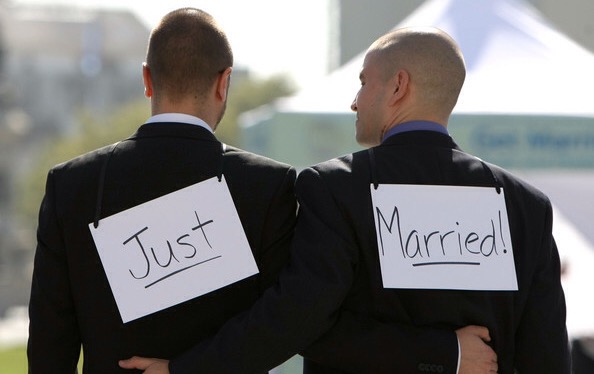
It Could Be Today

  
The countdown is on for the Supreme Court to render its verdict in watershed cases that could bring marriage equality to all 50 states. But an update to the high court’s calendar suggests we could get a ruling as early as this Thursday.

According to the Supreme Court website, the Court has added a non-argument session “for the announcement of opinions on Thursday, June 18, 2015, at 10 am.”  Insiders believe that’s when they’ll break the news of their decision in Obergefell v Hodges, which involves existing bans in Ohio, Michigan, Kentucky, and Tennessee.

It is possible, of course, that the justices will announce a verdict in some other case, and hold off on marriage equality until as late as June 30, when the current session ends.


What Are The Possible Verdicts In The Supreme Court Marriage Equality Cases?

Experts on both sides of the issue believe SCOTUS will issue a broad ruling granting federal marriage equality. But what does that actually mean? And what if the justices don’t? 

Below, I’ll review three possible verdicts the Supreme Court could issue in Obergefell v Hodges and spell out what they mean in practical terms.
Of course SCOTUS can be unpredictable at times, so it is still a situation we wait for with bated breath.

If SCOTUS Rules Marriage-Equality Bans Are Unconstitutional…

Any remaining barriers to gay marriage are also unconstitutional, meaning same-sex couples will be able to marry anywhere in the country.
 This is the best possible outcome, but if Ginsberg writes the opinion, then it could possibly be an even wider ruling.

If SCOTUS Limits Its Ruling To Require States To Recognize Marriage Equality…

Couples in states without same-sex marriage would actually have marry elsewhere, but must be afforded all the rights of the institution at home.
 This may be the case of Roberts writes the opinion.  If this is the case, then SCOTUS is keeping the status quo and issuing a half-hearted ruling such as we saw in Windsor, which struck down significant parts of DOMA.

If SCOTUS Rules In Favor of Bans On Marriage Equality…

In the immediate, bans in 14 states—including the ones in Ohio, Michigan, Kentucky, and Tennessee that are at stake in Obergefell v Hodges—would remain intact.
 This would be the most disastrous of rulings, and means that Kennedy, who wrote the opinion in Windsor sided against equality in Obergefell.

Tragically, though, states that had their marriage bans thrown out by federal courts in the past could attempt to reinstate such barriers. Existing same-sex marriages could come into question, as well. Experts agree such a ruling would have wide-ranging effects that could throw our hard-earned victories into chaos.

However SCOTUS rules, it’s guaranteed to be a major issue of the 2016 presidential race, and the religious right will go nuts, either with joy or with the belief that the world is ending.  
UPDATE: SCOTUS issued First Amendment and criminal law rulings, but nothing on Obergefell. The Court had seventeen opinions left to issue going into today. They issued six today. With eleven opinions left, SCOTUSblog believes that there is a possibility that they may extend the session into July. It happens on occasion, but because the justices have teaching and speaking obligations in July, they often attempt to finish by the end of June.