Taking It Easy


I think that I’m mostly going to just take it easy today.  Have you ever taken one of those very fun vacations where you did a lot of sightseeing and had a great time, but when you got home you were pretty tired?  Well, that is me right now.  I had an absolutely wonderful vacation in Louisiana, but I’m exhausted. So, I’m going to take it easy.  I will fill out a few job applications and take care of a few things that I couldn’t do while on vacation.  Mostly, though I’m going to rest and relax with my little girls.  

Several people have asked how my kittens are doing, so here’s a quick update.  The girls are great.  They’ve grown so much, and they will be a year old next month.  They are incredibly sweet but very opposite one another. Lucy is very shy, and Edith has yet to meet a stranger.  Lucy is more subdued, whereas Edith is rambunctious.  


The Ethiopian Eunuch


Now an angel of the Lord said to Philip, “Rise and go toward the south to the road that goes down from Jerusalem to Gaza.” This is a desert place. And he rose and went. And there was an Ethiopian, a eunuch, a court official of Candace, queen of the Ethiopians, who was in charge of all her treasure. He had come to Jerusalem to worship and was returning, seated in his chariot, and he was reading the prophet Isaiah. And the Spirit said to Philip, “Go over and join this chariot.” So Philip ran to him and heard him reading Isaiah the prophet and asked, “Do you understand what you are reading?” And he said, “How can I, unless someone guides me?” And he invited Philip to come up and sit with him. Now the passage of the Scripture that he was reading was this:
     “Like a sheep he was led to the slaughter
          and like a lamb before its shearer is silent,
          so he opens not his mouth.
     In his humiliation justice was denied him.
          Who can describe his generation?
          For his life is taken away from the earth.”  

And the eunuch said to Philip, “About whom, I ask you, does the prophet say this, about himself or about someone else?” Then Philip opened his mouth, and beginning with this Scripture he told him the good news about Jesus. And as they were going along the road they came to some water, and the eunuch said, “See, here is water! What prevents me from being baptized?” And he commanded the chariot to stop, and they both went down into the water, Philip and the eunuch, and he baptized him. And when they came up out of the water, the Spirit of the Lord carried Philip away, and the eunuch saw him no more, and went on his way rejoicing.

Acts 8:26-39

The story of the Ethiopian eunuch in Acts 8 is a marvelous depiction of God’s role in evangelism. There are many elements of God’s providence and intervention in the story of the Ethiopian eunuch. The account reveals the importance of these three things: the Word of God, the Holy Spirit’s leading, and a human evangelist. In order for a person to accept the truth, he must first hear the truth preached (Romans 10:14). It is God’s desire that the truth be preached everywhere (Acts 1:8). The Spirit of the Lord had been preparing the eunuch’s heart to receive the gospel. As the eunuch read Isaiah, he began to ask questions, and at just the right moment the Lord brought Philip across his path. The field was “ripe for harvest” (John 4:35), and Philip was God’s laborer in the field. This was no coincidence. It was God’s plan from the very beginning, and Philip was obedient to that plan.

The Ethiopian eunuch’s conversion illustrates Jesus’ promise to take the initiative to draw all kinds of people to himself (Jn.12:32). We might expect that Philip, who was a working-class Jew from a family with a biblical heritage, would become a follower of Jesus. But a black, sexually-altered treasury secretary for the royal family of a distant and totally pagan country? Yet the story emphasizes the lengths to which Jesus will go to draw people to himself. The passage narrates the culmination of Jesus’ drawing—but it also provides hints at how Jesus had been drawing him long before this time.

The story of the Ethiopian eunuch is a wonderful conversion story, but it takes on a much more significant story for LGBT Christians. The term eunuch in the ancient world was often synonymous with what we call today homosexuality, but was understood differently in ancient society. In Matthew 19:12, Jesus says “For there are eunuchs who have been so from birth, and there are eunuchs who have been made eunuchs by men, and there are eunuchs who have made themselves eunuchs for the sake of the kingdom of heaven. Let the one who is able to receive this receive it.”. Though, in this is trance, Jesus is teaching about divorce, but he clearly acknowledges that some men are born in a way that does not allow them to have children. These men that Jesus speaks of are men who did not marry in order to devote their lives to God, but also could, and I think it does, mean that some men are not mean to be with women, some of those men are asexual, others are homosexual.

Commentators generally suggest that the combination of “eunuch” together with the title “court official” indicates a literal eunuch, who would have been excluded from the Temple by the restriction in Deuteronomy 23:1. Some scholars point out that eunuchs were excluded from Jewish worship and extend the New Testament’s inclusion of these men to other sexual minorities. John J. McNeill, ordained as a Jesuit priest and a major figure in Queer Theology, cites the non-literal uses of “eunuch” in other New Testament passages such as Matthew 19:12, suggesting that this eunuch was “the first baptized gay Christian,” while Jack Rogers, a Presbyterian minister and author, writes that “the fact that the first Gentile convert to Christianity is from a sexual minority and a different race, ethnicity and nationality together” calls Christians to be radically inclusive and welcoming.

When evangelicals and fundamentalists share the gospel with gay men and lesbians, it is standard practice to tell the new believer he or she must stop being gay, but they forget that Jesus does not discriminate. He welcomed all people, even the Ethiopian eunuch, a high court official, who was probably perceived as a homosexual. Yet, Philip did not shun the man for his sexuality, whatever it may have been, but embraced him, taught him the gospel, baptized him, and sent him back to Ethiopia to spread the Good News. Whenever churches exclude LGBT Christians, they are not following the teachings of God, but the prejudices of man. We must remind them that turning someone away from God, as they often do, that it is the practice of Satan, because God welcomes all.


Moment of Zen: New Orleans 


Louisiana: A Fun Place to Be


We are having a great time here in Louisiana.  We spent two nights in New Orleans, and now we are spending two nights in Cajun country.  Tomorrow morning (the pic above is obviously not of a swamp tour, but isn’t he cute?), we are going on a swamp tour and possibly to see a plantation tomorrow afternoon.

  
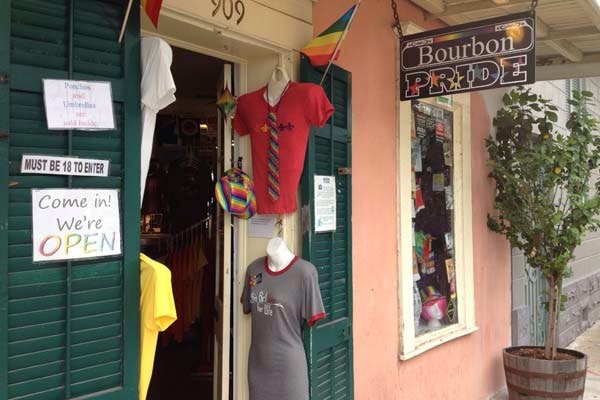
There isn’t a lot to say in this post, but here are two suggestions for when you go to New Orleans: eat at the Court of Two Sisters (entrance on Royal or Bourbon) for their fabulous jazz brunch and visit the five Louisiana State Museums.  Also, I highly suggest that you head down Bourbon past St Ann, where Oz and Bourbon Pub is and venture just over a block to a small store called Bourbon Pride.  Josh Duffy owns it and I’m a big fan of his music. Bourbon Prode has all the things a gay boy needs, and the staff was super nice and very helpful.  I’ll definitely be returning to Bourbon Pride next time I’m in New Orleans.


NOLA:  A Rich Gay Heritage

 
During the New Orleans’ early history, gay people were largely invisible, although same-gender communities existed throughout the culture. Although not self-identified, some prominent figures such as multi-millionaire John McDonogh – a life-long bachelor – might be recognized today as a gay man.

As the nineteenth century ended and a wild new music was being birthed in the saloons and bordellos of Storyville, Tony Jackson was crowned the “unrivaled king” of the early jazz pianists. Described as “an epileptic, alcoholic, homosexual Negro genius,” he composed countless songs, including “Pretty Baby,” inspired by a lover.

By the time writer Lyle Saxon arrived in 1919, the French Quarter was little more than a run-down slum. Saxon championed its preservation and promoted the Quarter as a welcoming home for artists. Among them was Truman Capote, who was born here and returned as a nineteen-year-old to write his first novel in a slave quarter apartment on Royal Street.

Tennessee Williams arrived in 1938 and knew immediately he had found his spiritual home. “A Streetcar Named Desire” would become the most famous New Orleans work of literature. Pioneering photographer Frances Benjamin Johnston retired to New Orleans in 1940, living in her Bourbon Street townhouse until her death in 1952.

A lively gay social world had long existed, but after Prohibition ended in 1933, it became more public. In 1936, a bar opened at the Lafitte Blacksmith Shop on Bourbon Street. Although its clientele was a varied group, gay men and women knew they were welcome. But in 1953, the owners lost their lease. They moved to the next corner and reopened as Café Lafitte in Exile – now one of the oldest gay bars in the country.

Private gay socializing flourished in mid-century New Orleans. The oldest continuing gay event, the Fat Monday Luncheon, began in 1949, and the oldest gay social organization, the Steamboat Club, was launched in 1953. The Krewe of Yuga was the first gay Carnival club in 1958, followed by the Krewe of Petronius in 1961.

 The Gay Liberation movement was slower to develop in New Orleans than in many other cities. This was due in part to local politics. In 1967, District Attorney Jim Garrison arrested Clay Shaw, a prominent gay business and civic leader, and charged him with conspiring to assassinate President John F. Kennedy. Although Shaw was eventually acquitted, the affair had a chilling effect on political organizing.

Nevertheless, a small group of activists founded the Gay Liberation Front of New Orleans in late 1970. Although the group dissolved within a year, participants subsequently organized a Metropolitan Community Church congregation and a chapter of the national lesbian organization, Daughters of Bilitis.

The emerging community suffered a great tragedy in June 1973, when a deliberately set fire in the Upstairs Lounge killed 32 people. 

But the indomitable New Orleans spirit prevailed. Southern Decadence started as a small party in 1972, the same year as the Tulane University Gay Students Union. The 1970s also saw the arrival of IMPACT newspaper, the Faubourg Marigny Bookstore and the first gay pride events.

The Gertrude Stein Society, which began in 1975, brought together a group of men and women who were instrumental in developing an active community infrastructure in the 1980s: the Louisiana Gay Political Action Caucus (1980), the State Gay Conference (1981), the New Orleans Gay Men’s Chorus and a local chapter of P-FLAG (both in 1982), and the NO/AIDS Task Force (1983).

The 1990s were a decade of political accomplishment. In 1991, the New Orleans City Council passed a gay non-discrimination ordinance. Shortly afterwards, Gov. Edwin W. Edwards issued a far-reaching executive order, prohibiting discrimination in state employment and services. In 1997, Louisiana earned the distinction of being the first state in the Deep South to pass a hate crimes law that covered sexual orientation, and New Orleans Mayor Marc H. Morial extended domestic partner benefits to city employees. And, in 1998, New Orleans became one of the earliest cities to add gender identity to its list of groups protected from discrimination.

As the century closed and the new millennium dawned, GLBT people in New Orleans could look with pride at a community that had achieved much in its political movement, while continuing to develop its vibrant social life.

  
I also want to add one more thing about New Orleans. Of the many times I’ve been here, I’ve stayed at the Holiday Inn-French Quarter, the Fairmont (now The Roosevelt Waldorf Astoria), and the Hilton. Each are very nice hotels (The Fairmont is probably the finest hotel I’ve ever stayed in, with the Peachtree Westin in Atlanta a close second), but on this trip, I stayed at the Prince Conti Hotel which is less than a block from Bourbon Street. It is by far my favorite hotel in New Orleans, and I highly recommend it to anyone coming to New Orleans. It has an exceptional price, has the best wi-if I’ve ever experienced in the city (or any hotel from that matter), and the staff could not be any friendlier. The front desk staff was so wonderful and friendly, remembering us each time we walked into the hotel and asking us how our day was and wishing us a good nights sleep and sweet dreams. It’s been a special experience. The hotel room was luxurious with high ceilings and an old southern feel. I will admit that the view from our room was not spectacular and the hallways smell a bit musty, but let’s face it, if you want a spectacular view, you will pay for it and everything else made up for the view. As for the musty smell, it is only noticeable when leaving your room, when coming back to your room from the odiferous city streets of New Orleans, the smell is quite refreshing (that is not even noticeable). So if you are heading to New Orleans, I suggest a stay at the Prince Conti Hotel. When I read reviews, the main thing was how expensive parking is at the hotel, but even when combined with the the hotel rate, it’s still less expensive than most hotels in the city, especially hotels in the heart of the French Quarter. 


The House of Ill Repute 

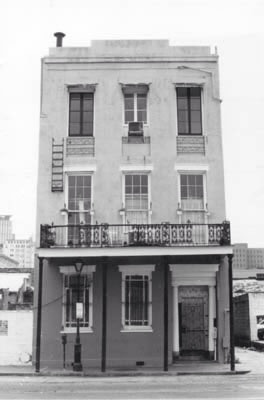
If the walls at 1026 Conti Street in the French Quarter could talk, they’d be international porn stars. It’s Norma’s House, the upscale brothel near the corner of Rampart run for 25 years by the sexy, shrewd and legendary “Last Madam” Norma Wallace. From 1938 until the early 1960s, Norma welcomed an upscale clientele including gangsters, governors, movie stars and scions of Uptown families.


Her often outrageous, sometimes touching and always fascinating stories are told in the best-selling “The Last Madam: A Life in the New Orleans Underworld,” by author Chris Wiltz.

“Norma’s house was the last wide-open parlor house in New Orleans,” Wiltz said. “Men went there as a rite of passage.”

During the first decade of this century, the house underwent reconstruction, and several unique features from Norma’s day were recreated, including the door to the “hideout” where the girls fled during raids and the hole in the wall where the money was secreted and the door where Norma made her payoffs.

Two years before her death in 1974, Norma began to tape-record her memories – the salacious stories of a smart, glamorous, powerful woman whose scandalous life made front-page headlines, and whose husbands and lovers ran the gamut from movie stars to gangsters to the boy next door, 39 years her junior, who became her fifth and final husband.

Wiltz’s book chronicles Norma’s rise from a life of poverty to that of a wealthy grande dame – a New Orleans legend with powerful political connections who was given the key to the city. “She answered to no one, and surrendered only to an obsessive love, which ultimately led to her surprising and violent death,” Wiltz said.

“The Last Madam” is also the story of New Orleans over five decades, steamy-thick with the vice and corruption that flourished in an Old World atmosphere.

“Wallace had the wit of Dorothy Parker and the instinct for self-dramatization of Tallulah Bankhead,” said The New York Times review. “The Last Madam admirably recreates a little slice of life otherwise devoured by time.”

Key to understanding the only owner of a bawdy house in New Orleans’ recorded history to receive the Key to the City from the mayor and council is the house itself. Built in the 1830s, the three-story, balconied building was also home to Storyville photographer E. J. Bellocq, who famously captured the “red-light ladies” for posterity.

Bellocq and his brother Leo, who would become a Jesuit priest, spent their childhoods in the building. They sold it in 1911, when E.J. Bellocq was in his late 30s, for $9,880. Bellocq particularly loved the light on the top floor; another photographer/artist now lives there. Portraits of Bellocq and Norma adorn the entry hall.


Satchmo

  
                                     Satchmo
                           By Melvin B. Tolson
 

                     King Oliver of New Orleans
         has kicked the bucket, but he left behind
              old Satchmo with his red-hot horn
                to syncopate the heart and mind.
                  The honky-tonks in Storyville
       have turned to ashes, have turned to dust,
                 but old Satchmo is still around
         like Uncle Sam’s IN GOD WE TRUST.

               Where, oh, where is Bessie Smith,
       with her heart as big as the blues of truth?
           Where, oh, where is Mister Jelly Roll,
           with his Cadillac and diamond tooth?
              Where, oh, where is Papa Handy
  With his blue notes a-dragging from bar to bar?
       Where, oh where is bulletproof Leadbelly
          with his tall tales and 12-string guitar?

                                Old Hip Cats,
              when you sang and played the blues
                    the night Satchmo was born,
       did you know hypodermic needles in Rome
         couldn’t hoodoo him away from his horn?
          Wyatt Earp’s legend, John Henry’s, too,
              is a dare and a bet to old Satchmo
  when his groovy blues put headlines in the news
            from the Gold Coast to cold Moscow.

                                 Old Satchmo’s
    gravelly voice and tapping foot and crazy notes
                             set my soul on fire.
                                   If I climbed
           the seventy-seven steps of the Seventh
  Heaven, Satchmo’s high C would carry me higher!
         Are you hip to this, Harlem? Are you hip?
              On Judgment Day, Gabriel will say
                       after he blows his horn:
   “I’d be the greatest trumpeter in the Universe
          if old Satchmo had never been born!”

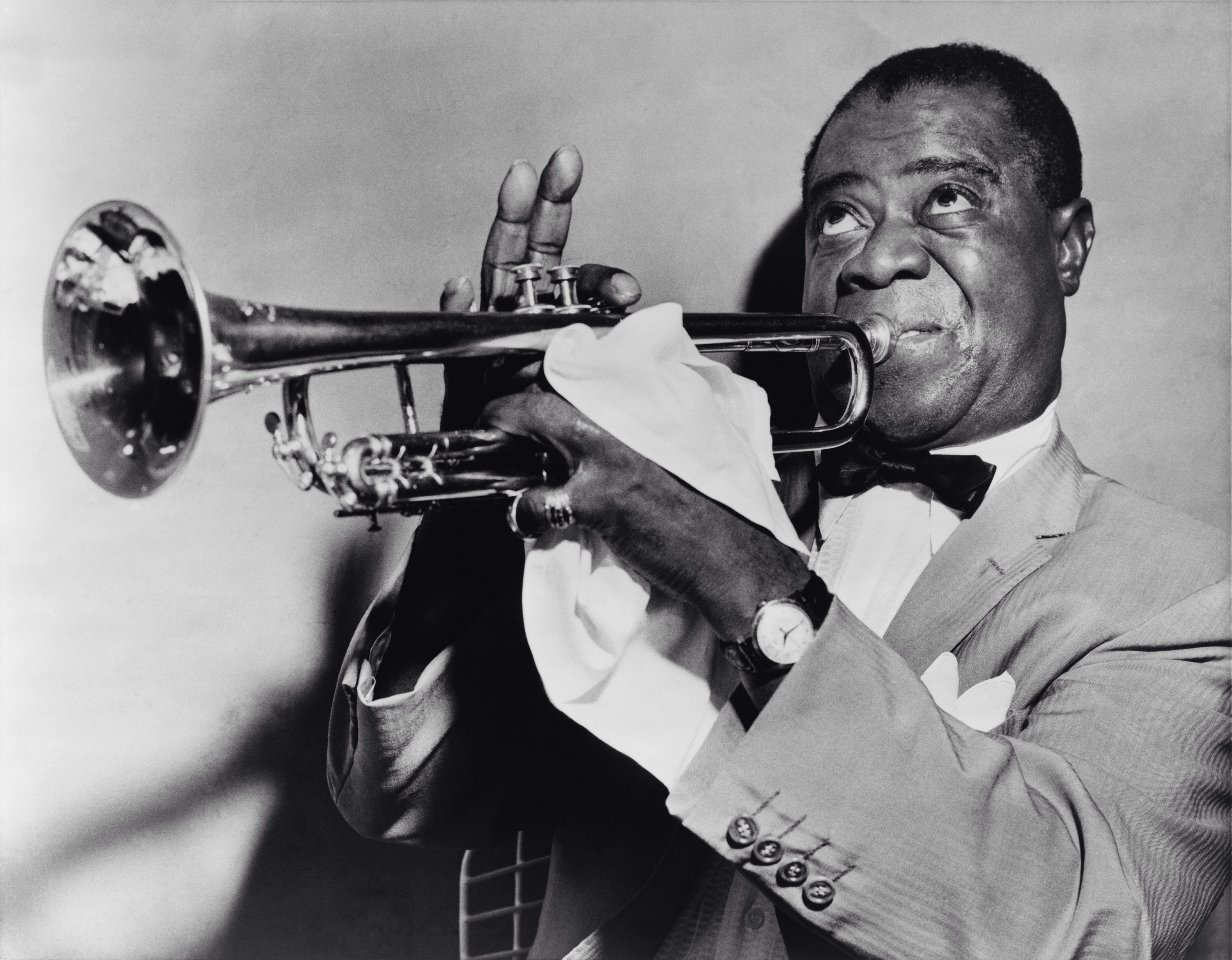
If  you are not familiar with the name Satchmo, it was the nickname for Louis Armstrong.  Louis had many nicknames as a child, all of which referred to the size of his mouth: “Gatemouth,” “Dippermouth,” and “Satchelmouth.” During a visit to Great Britain, Louis was met by Percy Brooks, the editor of Melody Maker magazine, who greeted him by saying, “Hello, Satchmo!” (He inadvertently contracted “Satchelmouth” into “Satchmo.”) Louis loved the new name and adopted it for his own. It provides the title to Louis’s second autobiography, is inscribed on at least two of Louis’s trumpets, and is on Louis’s stationery. 
Armstrong has always been a New Orleans legend and the airport is named Louis Armstrong International Airport.  Since I am heading there with my boyfriend today, I thought this made an appropriate poem.

P.S. I have a job interview this morning before we leave.  Hopefully, it will go well.  It’s not an ideal job, but it would be something until I find something better.


A Valadictory Address Censored


As a teacher and someone who has dealt with graduation speeches before, I’m not sure what to think about the story of a Colorado charter school who refused to let a class valedictorian, Evan Young, deliver a graduation speech in which he planned to come out as gay. I read the the statement of the school, but yet, I also know firsthand that school’s do lie. However, I have not read the students speech and therefore cannot compare the two.

 Twin Peaks Charter Academy High School in Longmont claims that the speech would have been disruptive and the first draft also included ridiculing comments about faculty and students and was condescending toward the school. School attorney Barry Arrington said in the statement that a graduation speech is not the time for a student to “push his personal agenda on a captive audience.”. They also claim that he didn’t follow the dress code for the ceremony by removing the sleeves of his graduation gown. Evan, who is 18, said he agreed to make suggested changes to the speech he planned to deliver on May 16 at the commencement ceremony for Twin Peaks. But he refused to remove the disclosure about his sexuality.

“My main theme is that you’re supposed to be respectful of people, even if you don’t agree with them. I figured my gayness would be a very good way to address that,” he said. He and his father, Don Young, said they weren’t notified until just a few minutes before the ceremony that Evan wouldn’t be allowed to speak or be recognized as valedictorian. This is where I think the school made a misstep. Whether they allowed Evan to give his speech or not, it is inappropriate not to recognize the valedictorian, especially if they continued to recognize the achievements of other students. Evan Young said he previously emailed a speech with other suggested changes to school officials, but they contend that he didn’t submit a revised version.

Before the ceremony, Don Young said school principal PJ Buchmann called and said the speech was a problem because his son had mentioned another student’s name and planned to come out as gay. If this is the case, then the school is making excuses beyond Evan’s disclosure of his sexuality, but are really only bothered by him coming out in his speech. They could have simply told the Evan that the entire theme of the speech was inappropriate and that he could not mention another student by name. I’ve known quite a number of valedictorians in my lifetime, I was one myself, and all of the ones I have known made speeches of encouragement. If the theme is what Evan said it was, then it was an appropriate theme, and his disclosure of his sexuality should not have been an issue.

In my opinion (and Evan is probably a little at fault, but he’s also young), the school handled this situation in the worst way possible. The speech should have been prepared weeks in advance and Evan and the faculty should have had plenty of time to revise it. However, it appears that the school chose to wait until the last minute, so that they would not receive negative publicity that might have forced their hand in allowing Evan to give his speech. Don Young said he and his wife didn’t know their son was gay. They were initially sympathetic to Buchman’s objections to the speech, considering there would be young children at the event, but did not like how Buchman handled the matter.

I have to agree with the Young’s. No matter the school’s reservations about he speech, they handled this in an underhanded way that deprived a young man of the honors that he no doubt worked very hard to achieve.


Plenty of Hard Times


 After they had proclaimed the good news to that city and had made many disciples, they returned to Lystra, then on to Iconium and Antioch. There they strengthened the souls of the disciples and encouraged them to continue in the faith, saying, ‘It is through many persecutions that we must enter the kingdom of God.’ And after they had appointed elders for them in each church, with prayer and fasting they entrusted them to the Lord in whom they had come to believe.
 Then they passed through Pisidia and came to Pamphylia. When they had spoken the word in Perga, they went down to Attalia. From there they sailed back to Antioch, where they had been commended to the grace of God for the work that they had completed. When they arrived, they called the church together and related all that God had done with them, and how he had opened a door of faith for the Gentiles. And they stayed there with the disciples for some time.


Acts 14:21-28 (NRSV) 

When I read today’s passage, I was powerfully drawn to the last sentence in verse 22, where Paul says, “It is through many persecutions that we must enter the kingdom of God.” I found myself captured by this thought and needing to understand it better. I think each of us has been through numerous trials and tribulations, whether it is because of our sexuality or other issues in our life, such as my current job search.

The fact that Paul uses the word “must” really grabbed my attention. Paul doesn’t say that we “might” have to go through persecutions to enter the kingdom. He doesn’t even say “probably.” He says that it is a “must.” There is no way to enter into heaven, Paul says, unless we are willing to go through persecutions and be able to keep our faith while doing so.

What does “persecutions” mean? Paul and many apostles faced persecution, torture, and death for their belief. Most early Christians didn’t face that level of persecution, but all of them faced hardship in life — as do we. How we react to those hard times will determine whether we make it into the kingdom of God.

James tells us the same thing in James chapter 1:

 …whenever you face trials of any kind, consider it nothing but joy, because you know that the testing of your faith produces endurance; and let endurance have its full effect, so that you may be mature and complete, lacking in nothing.
 If any of you is lacking in wisdom, ask God, who gives to all generously and ungrudgingly, and it will be given you. But ask in faith, never doubting, for the one who doubts is like a wave of the sea, driven and tossed by the wind; for the doubter, being double-minded and unstable in every way, must not expect to receive anything from the Lord.
(James 1:2-8 [NRSV])

James tells us that we must look at the hardships of our life and “consider it nothing but joy.” I know that sounds odd to most of us, but as I said last week, when God closes one door, i.e. we face a hardship, He is opening a new door for us. There are better things to come. And as James says, we must endure and we will be “lacking in nothing.”

With the loss of my job, the frustration of the job search, or the everyday problems of being a gay man in the Deep South, I could get angry with God, grow cynical, and walk away from my faith, and many people do, especially with the reaction they receive from many people who call themselves Christians but then condemn others for what they perceive as wrong. Instead, I do my best to respond by drawing closer to God, knowing that through God I will find the strength not just to endure, but to prevail in the midst of hardship. If we lose faith and question the intent of God, then God knows that and He will not reward our lack of faith. Therefore, my faith gives me great comfort in times of stress and difficulty for I know that my faith will bring me closer to God.

One person’s hardship may not be ours, but we all have our own hardships. How we react will make all the difference. “It is through many persecutions that we must enter the kingdom of God.” Instead of becoming discouraged, don’t view hardships as a sign that life has gone awry. Embrace them as learning opportunities for the soul and rejoice.


Moment of Zen: My Boyfriend 


Last week, I had nothing that was Zen worthy.  I felt like my world had crashed down on me, but I am so grateful to have a wonderful, thoughtful, and caring man as my boyfriend.  When he told me to meet him last Saturday, I had no idea that he planned on surprising me with that trip up the mountain for dinner.  He’s also been extremely supportive this week, even helping me with job applications.  I couldn’t ask for a better man.

By the way, I used that picture because the guy looks as if he’s trying to find a signal on his cellphone, well that is one of the nice things about that mountain retreat: no cell service (actually it’s just very limited). However, it is nice that you don’t have to worry about being disturbed.  It’s like we are in our own little world together and none of the outside influences can bother us.