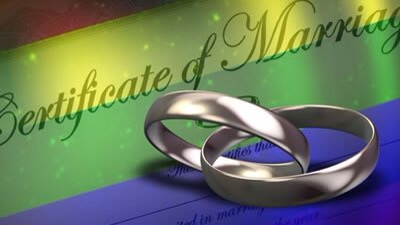
Gay marriage comes to Alabama over chief judge’s objections

IMG_0399

MONTGOMERY, Ala. (AP) – Alabama’s chief justice built his career on defiance: In 2003, Roy Moore was removed from the bench for defying a federal court order to remove a boulder-size Ten Commandments monument from the state courthouse.

On Monday, as Alabama became the 37th state where gays can legally wed, Moore took a defiant stand again, employing the kind of states’ rights language used during the Civil War and again during the civil rights movement.

He argued that a federal judge’s Jan. 23 ruling striking down the Bible Belt state’s gay-marriage ban was an illegal intrusion on Alabama’s sovereignty. And he demanded the state’s probate judges not issue any marriage licenses to same-sex couples.

“It’s my duty to speak up when I see the jurisdiction of our courts being intruded by unlawful federal authority,” the 67-year-old Republican chief justice of Alabama’s Supreme Court said in an interview Monday.

His stand did not succeed in stopping gay couples from tying the knot. And it brought forth another round of criticism of Moore at a time when the movie “Selma” has reminded many Americans of Alabama’s segregationist defiance of the federal government in the 1960s.

Richard Cohen, president of the Southern Poverty Law Center, a major civil rights organization, branded Moore the “Ayatollah of Alabama.”

Moore’s office in the Alabama judicial building is down the street from the Alabama Capitol, where in 1963 Gov. George Wallace promised “segregation now, segregation tomorrow, segregation forever” and vowed to fight what he portrayed as the tyranny of the federal government.

“Moore is using the religion issue to further his political career, just as Wallace used the race issue to further his,” Cohen said.

The Southern Poverty Law Center filed a judicial complaint against Moore accusing him of trying to incite chaos at the probate courts.

On Monday, some counties refused to issue same-sex marriage licenses or shut down their licensing operations altogether, citing confusion about what they should do. But at least seven of Alabama’s 67 counties issued gay marriage licenses, and same-sex couples were wed at courthouses in such places as Birmingham and Montgomery.

In Birmingham, the Jefferson County Probate Office said it had dispensed more than 250 licenses to same-sex couples by midday, with people still arriving. Only three opposite-sex couples had received licenses.

Some of the gay couples who had been lined up for hours exited courthouses to applause, delighted by the opportunity to exchange vows.

“I figured that we would be that last ones – I mean, they would drag Alabama kicking and screaming to equality,” said Laura Bush, who married Dee Bush in a park outside the courthouse in Birmingham.

Alabama Gov. Robert Bentley, a Republican and a Southern Baptist, said he believes strongly that marriage is between one man and one woman. But he said the issue should be “worked out through the proper legal channels” and not through defiance of the law.

Bentley noted that Alabama is about to be in the spotlight again with the 50th anniversary of the Voting Rights Act of 1965, which was passed after civil rights marchers were attacked and beaten in Selma, Alabama.

“I don’t want Alabama to be seen as it was 50 years when a federal law was defied. I’m not going to do that,” Bentley said. “I’m trying to move this state forward.”

After the Ten Commandments dispute made a national figure out Moore, he ran unsuccessfully for governor in 2006 and 2010. In 2012, he returned to the high court when he got elected chief justice. There has been speculation he might make a third run for governor.

He has been one of the state’s most outspoken critics of gay marriage and homosexuality. Moore called homosexuality an “inherent evil” in a 2002 ruling in a child custody case. On the campaign trail in 2012, he said that same-sex marriage would bring about the “ultimate destruction” of the country.

Late last month, U.S. District Judge Callie Granade ruled that the state marriage ban was unconstitutional and – in a later clarifying order – said probate judges have a legal duty under the U.S. Constitution to issue the licenses. On Monday morning, the U.S. Supreme Court refused to block the start of gay marriages in Alabama.

Moore bristled at the comparison to Wallace and disputed the notion that same-sex marriage is a civil rights issue.

“This is not about the right of people to be recognized with race or creed or color. This is about same-sex marriage. It is not the same subject,” he said.

“Eighty-one percent of the voters adopted the Alabama Sanctity of Marriage Amendment in the Alabama Constitution. I think they want leaders that will stand up against an unlawful intrusion of their sovereignty, and that’s what we’re seeing.


Flu?

2015/02/img_0234.jpg

On a day that I should be able to celebrate: Alabama is expected to begin issuing marriage license to couples today (if Clarence Thomas doesn’t grant an emergency stay before 8 am). However, I seem to have the flu. If it’s not the flu, it’s a very bad cold: coughing, headache, body aches, fever, congestion and nausea. Ugh! I guess I will be spending this morning in the doctor’s office.

FYI: It was confirmed to be the flu.


Triumph Over Adversity

2015/02/img_0130.jpg

Count it all joy, my brothers, when you meet trials of various kinds, for you know that the testing of your faith produces steadfastness. And let steadfastness have its full effect, that you may be perfect and complete, lacking in nothing.
If any of you lacks wisdom, let him ask God, who gives generously to all without reproach, and it will be given him. But let him ask in faith, with no doubting, for the one who doubts is like a wave of the sea that is driven and tossed by the wind. For that person must not suppose that he will receive anything from the Lord; he is a double-minded man, unstable in all his ways.

James 1:2-8

In this passage, James presents us with four steps to winning triumph over adversity: count, know, let, and ask. The Epistle of James is framed within an overall theme of patient perseverance during trials and temptations, and it begins with one of the most inspiring verses of the Bible. In James 1:2, we are told to “Count it all joy, my brothers, when you meet trials of various kinds.” James does not say “if” we experience adversity, but says “when” we experience adversity, because James knows that Christians, and really all humans, will experience trials and tribulations. In John 16:33, Jesus said, “In the world you will have tribulation. But take heart; I have overcome the world.” We will experience various trials, some of these adversities come because we are human, such as sickness, accidents, disappointments, and death, but other trials come because we are Christians. Those adversities come as temptations and battles with Satan and the evil he presents to us. As LGBT Christians, we face our own trials. Many claim that because we are gay, we cannot also be Christians. In an attempt to find a church that will accept us, we often find it disheartening when people who claim to be Christians turn their backs on us, but God welcomes all into Christianity. What should our response be to these adversities, James says to “Count it all joy!” So the first step in overcoming adversity is to count our joys and adopt a joyful attitude.

“But how,” we may ask, “is it possible to rejoice in the midst of trials?” The second imperative in verse three explains how knowing that the testing of our faith produces patience. The right knowledge concerning the value of trials makes it possible to have a joyful attitude. We are to understand that: trials test our faith, and faith that is tested can bring out the best in us. With this understanding, we can have joy in trials because we know from 2 Corinthians 4:17, “For this light momentary affliction is preparing for us an eternal weight of glory beyond all comparison.” The testing of our faith works for us, not against us, and when we use adversity to our advantage, it helps us to mature in our faith. Patience is not a passive acceptance of circumstances. It denotes the ability to exhibit steadfastness and dependability in the face of the most formidable difficulty. As LGBT Christians, we may be disheartened when a church rejects us, but we must rest assure in the knowledge that Fod does love us. Not all of those who call themselves Christians really are Christians, some are merely doing the devil’s work in disguise. We must have patience with our knowledge. Patience is a courageous perseverance in the face of suffering and the persistence to carry on, even when it is rough, despite the circumstances. Such a quality of stedfastness can come only through experiencing trials.

Having this understanding about what trials can accomplish enables us to have a joyful attitude toward such trials. But to really benefit from our trials, we must also obey the third imperative found in verse four that we must let patience “have its full effect, that you may be perfect and complete, lacking in nothing.” To truly turn trials into triumph. We must let patience do it’s work. Too often, we want to get our trials or difficulties over with quickly, but there are times when the best course is to bear up under the trial patiently. Instead of grumbling and complaining patiently endure the trial, doing good despite the trial. When we experience rejection from those who claim to be Christians, we must show them patience and let our own good work and righteousness speak for us. When patience has the opportunity to work, it produces maturity. In verse four, the word “perfect” does not mean that we must be sinless; Romans 3:23 states that “for all have sinned and fall short of the glory of God,” instead perfect means “completeness, wholeness, and maturity.”

Letting patience have its perfect work is not easy. It certainly requires wisdom which enables us to see the value of our trials. This brings us to the fourth imperative necessary to turn trials into triumph, found in verses five to eight that if we lack wisdom, we must ask for it from God. He has promised to give wisdom liberally, and He will not reproach us for making such a request. We should be careful to distinguish “wisdom” from “knowledge.” Knowledge involves information, facts, etc., whereas, wisdom is the ability or insight to properly use those facts in the most effective way. Failure to understand this distinction has led many into error. Many believe that this passage (James 1:5-8) teaches that God will give knowledge concerning His Will in answer to prayer, but knowledge comes only through His Word; we must carefully study it if we would know the Will of God. However, the wisdom to properly use His Word can be received through prayer. Proper prayer is that which is asked in faith and with no doubt. Prayer is the most important tool we have to combat the false Christians who teach hate toward the LGBT community. We must pray that not only will God give us the patience to persevere and the wisdom to follow His Word, but also that God will grant wisdom to those who profess hate in his name and let them understand that God’s wisdom comes not from hatred but from love.

So here is the key to turning trials into triumph: we must have the knowledge and perspective that adversity can accomplish much good, we must let the patient endurance of adversity accomplish it’s work, and we must do this all the while using the wisdom God gives in answer to prayer to help put it all together. When this is done, even trials can be a source of joy for the Christian. Remember, we must have faith and trust in God. Faith and trust in God should always bring us joy, even in times of adversity.


Moment of Zen: Cuddling

2015/02/img_0203.jpg

Whether it’s before, after, or during sex, or even instead of sex, I love cuddling. One of the ways that I realized that I was gay was the steong desire to be held by another man. There’s just something about being lovingly held in a man’s arms that is pure bliss. I love to cuddle.

The science behind cuddling’s appeal all comes down to one word: hormones. A good cuddle, hug or loving physical interaction with another person (including sex) releases a trio of feel-good substances in your brain: 1) oxytocin, the chemical responsible for happiness; 2) endorphins, the chemicals released after a really tough workout or when you eat chocolate; and 3) dopamine, the hormone that regulates the pleasure centers in your nervous system and helps reduce blood pressure.

So let’s release those hormones, and cuddle more.


How’s It Hangin’?

2015/02/img_0201.jpg

How’s it hangin’ is a very informal way to say hello to your fellow. What is actually hanging, is evident from the following example.

– Hey, Joe, how’s it hangin’?
– A little bit to the left.

The standard answer seems to most often be a literal answer as to how your penis really is hanging: long and to the left, tight and to the right, etc.

Yesterday a friend and I were discussing which side men “dress” on. Dressing left and dressing right are terms that most men, at least those who wear suits, know. It’s a term used by tailors when fitting suit pants. To “dress left” means that one keeps one’s male appendage shifted in the general direction of the left trouser leg. Likewise for the right.

I’ve been a bit fascinated by this topic since I first saw it on an episode of Friends when I was a teenager. Chandler went to get a suit tailored and the tailor grazed his privates to see if he dressed left or right. Chandler was horrified, but Joey explained that he thought that’s how all tailors determined which side a man’s privates hung. Chandler says that tailors usually just ask you instead of checking for themselves. (I may have some of the details wrong, but I do remember this episode.)

Straight male friends have always been fond of asking, “How’s it hangin’?” This always kind of excited me because it always made me think of my straight male friends’ penis and how he was hanging. According to a study I read, 75 percent of all men dress (hang) to the left, whereas, 25 percent dress to the right. There are several theories about why this is.

According to medical researchers, most men should dress left. This is basic biology, The left testicle is lower than the right. Thus, some men theorize that it was made to swing to the left, and swinging right would be uncomfortable. Some even go further that left dressing men are happier and more creative, while right dressing men are often in a bad mood.

Another theory says that most right-handed men dress to their left, and vice-versa for lefties, due to the way men return their penis through their pants’ fly. Some (including myself) have speculated that it is due to masturbation. The erection conforms to the curve of the palm, whether for a leftie or a rightie. Over time the penis is permanently changed. My guess is that it is really more revealing about which hand is dominant. I dress to the left, and I am right handed.

I came across one guy who theorized that after seeing lots of men naked that most gay men’s flaccid penis hangs towards the left and most straight men’s penis hangs to the right. However, my guess is that this particular man has seen a greater number of gay men than straight men naked and thus he has not only seen that most men hang to the left.

So, how’s it hangin’, guys?

2015/02/img_0194.jpg


Take Me To Church

2015/02/img_0169.jpg

In September, Irish songwriter Hozier released the video for his gospel-inspired epic, “Take Me to Church,” a cavernous song that uses love and ecstasy as a religious metaphor. The video depicts two men’s gentle intimacy, followed by brutal gay-bashing at the hands of masked vigilantes against lyrics like, “I was born sick, but I love it / command me to be well / Amen. Amen. Amen.”

The song serves simultaneously as a message about human rights, a commentary about Hozier’s upbringing in what he calls a “cultural landscape that is blatantly homophobic,” and a strong statement about the institutional homophobia in Putin’s Russia. In the months since its release, the video has gone viral (and we’ve been playing it over and over) — bringing the 23-year-old artist into sharp focus.

Lyrically the song is one large metaphor comparing a lover to religion. The idea for “Take Me to Church” had been building in Hozier-Byrne’s mind for a while before he sat down at his piano in early 2013. “I had a chorus, then all the verse ideas I had been working on or had lying around for a year, they all just fell into place,” says the Irish singer-songwriter, who uses the stage name Hozier.

The song grew out of his frustration with the Roman Catholic Church’s teachings on human sexuality. “It would preach gender inequality or discrimination based on sexual orientation,” he says. “There’s a lot more you could take issue with, but the song is about asserting yourself away from that and finding a new thing to devote yourself to.”

The song’s “loose collection of visual ideas” set the worship of sensuality against what Hozier perceives as the church’s shrine of lies. The line “I was born sick, but I love it/Command me to be well” paraphrases 17th-century British poet Baron Brooke Fulke Greville’s Chorus Sacerdotum, a poem Hozier discovered after hearing philosopher Christopher Hitchens quote it during a debate. The song uses the Hitchens’ quote “I was born sick; command me to be well”.

Having penned such a potentially controversial song, Hozier says, “I imagined it’d go to a small audience for a large part of my career. So the way it took off was totally unexpected.”

In an interview with The Irish Times, Hozier stated, “I found the experience of falling in love or being in love was a death, a death of everything. You kind of watch yourself die in a wonderful way, and you experience for the briefest moment–if you see yourself for a moment through their eyes–everything you believed about yourself gone. In a death-and-rebirth sense.”

In an interview with New York magazine, he elaborated: “Sexuality, and sexual orientation – regardless of orientation – is just natural. An act of sex is one of the most human things. But an organization like the church, say, through its doctrine, would undermine humanity by successfully teaching shame about sexual orientation – that it is sinful, or that it offends God. The song is about asserting yourself and reclaiming your humanity through an act of love.”

The Grammy-nominated Irish singer-songwriter says people assume he is gay because of his anti-Roman Catholic church anthem “Take Me To Church” and the anti-homophobia video which accompanies it. The song was written following a break-up with a girlfriend. The “Take Me To Church” video, which has attracted nearly 100 million YouTube views, depicts two men kissing before they are attacked by a homophobic mob.

The music video for “Take Me to Church” was directed by Brendan Canty and was released on September 25, 2013. The video, shot in grayscale on location at Inniscarra Dam in Cork, Ireland, follows the relationship between two men in a same-sex relationship and the violently homophobic backlash that ensues when the community learns of one of the men’s sexuality. Hozier himself does not appear in this video.

Hozier stated, “The song was always about humanity at its most natural, and how that is undermined ceaselessly by religious [organizations] and those who would have us believe they act in its interests. What has been seen growing in Russia is no less than nightmarish, I proposed bringing these themes into the story and Brendan liked the idea.”

“Yes, people do make that assumption (that I am gay), which is fine, but for me I don’t think it’s the point, you know what I mean. It doesn’t come into it what my sexual orientation is,” Hozier told Reuters.

“Regardless of the sexual orientation behind a relationship, it is still a relationship and still love… So people are free to make any assumption they want, it’s grand,” he laughed.


Historical Question

2015/02/img_0120.jpg

Many of my readers often assume that my major field of study is literature, because I post a poem every Tuesday and I write book reviews on a semi-regular basis. However first and foremost, I am a historian. All of my degrees are in history, but my doctoral studies were based on cultural history which included art, architecture, and literature. Whenever, I am studying something, I study it through a historical eye. Historical analysis is my modus operendi.

In recent weeks, I have been contemplating the anticipation/apprehension of the impending Supreme Court decision on same-sex marriage. A U.S. district court judge has ruled that Alabama’s same-sex marriage bans are unconstitutional, but placed a fourteen day stay on her decision to allow time for the Alabama Attorney General Luther Strange to attempt to extend the stay until the Supreme Court makes a decision. The 11th Circuit refused to extend the stay, and AG Strange is now attempting to get the Supreme Court to extend the stay pending their decision. If the Supreme Court follows its own precedent, it will allow the stay to be lifted on February 9, 2015, as planned.

The Court has allowed lower courts’ rulings to stand, bringing marriage equality to state after state, now with 36 in total. It would be quite chaotic if the Supreme Court didn’t strike down marriage bans now. And the court will be seen as having been exceedingly reckless. That doesn’t seem like something Justice Kennedy wants as his legacy on gay rights, having crafted it very carefully for several decades. He’ll go all the way, and the liberals will go with him.

It seems to be a foregone conclusion that the Supreme Court will rule in favor of same-sex marriage, but the question is still being asked as to how far the ruling will go. If Roberts decides to vote with Kennedy and the four liberals, he would then control the decision, because as Chief Justice, he could assign it to himself or any of the other justices. He could keep it away from Kennedy. If he votes for marriage equality, he would keep the decision for himself, and he would try to write it as narrowly as possible. In the past, Chief Justices have switched to the majority so that they can narrow the scope of the opinion.

As I look at the speculation concerning what the Supreme Court will do when it decides same-sex marriage in this term, I began to wonder: has their been similar situations in which this much speculation has been covered in the media on other issues? For most of its history, the U.S. Supreme Court has been seen as the lesser branch of government, as dominance has always passed between Congress and the President. Last night I did a fair amount of research to see if I could find any pre-decision media coverage of major Supreme Court cases. In history, we study the significance of a decision and occasionally (but not always) the story that led to the case being heard before the Supreme Court.

The question I have though is how much is the general public aware of cases going before the Supreme Court. Have Americans been aware enough before a decision is made to weigh in on the speculation? For instance, did most southerners know that Brown v. Board of Education would be decided in 1954? Were they aware enough to think about the consequences? As a student of history in the South, I have studied a great deal about the Civil Rights Movement, but I cannot remeber reading about reactions to school desegregation until after Brown was decided. Thinking of cases in my lifetime, I cannot think of a single instance other than Windsor v. United States in which this much speculation has occurred in a Supreme Court case before the decision was made.

No doubt there are legal scholars who speculate on Supreme Court rulings for a living, and I know there are reporters who cover the Supreme Court and thus speculation is part of their job. However, has Americans themselves been thrown into the speculation game. Maybe much of it has to do with the controversy drummed up by political figures wanting to get air time on television, or the abundance of 24 hour news networks, but it seems to me like this is one of the few times that America is actually waiting to see what the Supreme Court will do.

Legal history is not my forte, so it is entirely possible that there are numerous cases that caused controversy and speculation before the court ever issued an opinion. And maybe I’m just interested in this issue and therefore I’m paying more attention to media coverage. If I had the time, I could begin searching through newspapers looking for mentions of the Supreme Court’s terms, but unless someone wants to give me a huge grant to conduct that research, I don’t have the time or the energy to search through 225 years of newspapers.

So since my curiosity is up, I am going to ask my readers this question. Have you ever known there to me so much media coverage and speculation over an issue that has come before the Supreme Court?


Breaking News

IMG_0391

Appeals court denies AL request to stay same-sex marriage case

ATLANTA (WSFA) – The 11th Circuit Court of Appeals in Atlanta is issuing a decision that denies Alabama Attorney General Luther Strange’s request to issue a stay pending appeal of the state’s ban on same-sex marriage.

Alabama’s laws that banned gay marriage were struck down by federal judge Callie Granade on Jan. 23, but the judge issued a temporary stay to allow the State time to seek an appeal from the 11th Circuit.

Judge Granade’s stay is set to expire on Feb. 9 after which time Alabama probate judges will be required to start issuing marriage licenses to same-sex couples. The Plaintiffs have asked the judge to lift her stay. U.S. District Judge Callie Granade’s said in her ruling Tuesday the stay will remain in place until that date unless the U.S. Supreme Court issues a stay or makes a ruling.

The U.S. Supreme Court is expected to rule on the issue of same-sex marriage in June.

Continue checking back for additional updates and reaction.


Sonnet to Winter

IMG_6200.JPG

Sonnet to Winter
By Emily Chubbuck Judson

Thy brow is girt, thy robe with gems inwove;
And palaces of frost-work, on the eye,
Flash out, and gleam in every gorgeous dye,
The pencil, dipped in glorious things above,
Can bring to earth. Oh, thou art passing fair!
But cold and cheerless as the heart of death,
Without one warm, free pulse, one softening breath,
One soothing whisper for the ear of Care.
Fortune too has her Winter. In the Spring,
We watch the bud of promise; and the flower
Looks out upon us at the Summer hour;
And Autumn days the blessed harvest bring;
Then comes the reign of jewels rare, and gold,
When brows flash light, but hearts grow strangely cold.

About This Poem

Emily Chubbuck Judson was born in Eaton, New York, in 1817. Her books include An Olio of Domestic Verses (1852) and Charles Linn, or, How to Observe the Golden Rule: with Other Stories (1841). “Sonnet to Winter” was published in Judson’s book Alderbrook (W. D. Ticknor and company, 1847). Judson died in 1854.


Who Will Officiate?

2015/02/img_7758.jpg

Alabama’s gay marriage ban may end on February 9, 2015, or possibly before if the current stay is not continued or is lifted early by the 11th U.S. Circuit Court of Appeals. For now, the decision is on hold and the delay could be extended by the 11th Circuit, as the state has requested. The U.S. Supreme Court has said it would decide whether same-sex marriage should be allowed nationwide, and a decision is likely by late June. The question some media outlets are now asking is who will perform same-sex weddings?

The Alabama Chief Justice and some local judges are advocating anarchy with with attempts to ignore the federal courts. Alabama’s Chief Justice Roy Moore is leading the charge in the letter he wrote to Gov. Robert Bentley, asking him to defy the federal court ruling against Alabama’s same-sex marriage ban. This is deja vu all over again. The last time Moore was on the court in 2002 he was removed due to his refusal to take down the massive Ten Commandments monument he had installed in the state judicial building. Now, as before, Moore is facing a judicial ethics complaint filed by the Southern Poverty Law Center.

Furthermore, a number of judges have decided to quit performing marriages. Geneva County’s probate judge Fred Hamic has performed over 1,000 weddings during his seven year tenure, stating they are his favorite part of the job. But Hamic who claims to be a Christian says that he plans to quit performing the ceremonies if same-sex marriage begins in Alabama. Madison County’s probate office in Huntsville said last week it would quit performing marriages but cited personnel shortages, not gay marriage, as the reason. I doubt anyone believes that as the real reason. Montgomery County Probate Judge Steven Reed said he’ll marry anyone, straight or gay, but most state judges are up in the air about performing marriages. While Alabama law requires probate courts to issue marriage licenses, judges and other court officials have the option of whether to perform wedding ceremonies.

Many churches already ban gay weddings, so same-sex courthouse ceremonies became a real possibility for the state’s 68 probate judges when a federal judge in Mobile ruled Jan. 23 that the state’s constitutional and statutory ban on gay marriages violates the U.S. Constitution.

Monroe County Probate Judge Greg Norris, president of the state probate judge’s association, said he hasn’t heard of any judge who would refuse a wedding license to a same-sex couple if the decision by U.S. District Judge Callie V. S. Granade is upheld or the U.S. Supreme Court permits gay marriage. But many probate judges — who are elected and sometimes also serve as county commission chairs — are on the fence about whether to perform same-sex ceremonies, said Norris.

At least the State Health Department which maintains the Department of Vital Statistics is getting ready for the change. While the state is appealing Granade’s order, health officials and the probate judge’s group already are considering how to alter Alabama marriage licenses in case same-sex marriages can begin, Norris said. The forms currently refer to “bride” and “groom” and will likely have to be reprinted, he said.

Even if judges refuse to perform wedding or church organizations ban same-sex marriages to be performed, many other ordained ministers will marry same-sex couples. I have been ordained as a minister of the Universal Life Church, Modesto, California, and am therefore in good standing to marry anyone in the state of Alabama. The only requirement is that I must charge at least $1 to perform the wedding. So when (not if) the stay is lifted in Alabama, I will gladly marry anyone who would like me to perform the ceremony.

Moore can call for the Alabama judiciary to ignore a federal court ruling (which hopefully will get him removed from the bench a second time for ethics violations), judges across the state can refuse to perform weddings, and ministers can refuse as well, but same-sex couples will be married someday soon in the state of Alabama. Progress and equality will not be stopped, no matter how hard some may try.