

When you get a glimpse, the rest is left to the imagination, and I like where my imagination goes with this one.
When you get a glimpse, the rest is left to the imagination, and I like where my imagination goes with this one.

My kittens are fascinated by the bathroom too. I think I’d get along quite well with this guy. Having two calico kittens myself, why not make it three. Whereas his kitten is not out of my league, he sure is, but I’m a cat charmer and I might could win him over. Now if I just had a body like his…
I admit that the first part of this post is a bit silly, but I was too tired to right much of a post after an exhausting day yesterday. In total, I spent eighteen hours cooking (six of those were spent sleeping, but the black-eyed peas were in the crockpot during that time). I started the night before by boiling the chicken for the dumplings and making some extra broth for the greens. Once I got up at 7am I was cooking solidly from then until lunch was served at 12:30. Everything seemed to turn out deliciously, at least I enjoyed it and everyone else said that they did. Some of the older family members had been cooking this meal for over sixty years, so if it met with their seal of approval, I think I did pretty good.
There was only one food item that I was not happy with and that was the cracklin cornbread. I foolishly used a cracklin cornbread mix from the grocery store instead of making cornbread and adding cracklins. It turned out to be sweet cornbread, which I personally hate. Cracklin cornbread needs to be savory, not sweet. Luckily most people ate it with their turnip greens which are naturally bitter and hid the sweet taste. I won’t be making that mistake again. I did sneak over to the neighbors for a few minutes, and I ate a piece of her cracklin bread and it was delicious and perfect. It bothers me when I serve something that is less than perfect. When it comes to cooking, I am very much a perfectionist.

According to tradition, the New Year’s Day meal will bring you fortune in the year to come. Here in Alabama, we usually have greens (turnips or collards), black-eyed peas, hog jowls and cornbread. This has been the traditional meal served by my grandmama all my life. When she became too frail to do the cooking, I began to help, and since her death, I have done much of the cooking but with help from others. This year will be the first time that I am cooking the whole meal for the family and friends. We will probably have between 12-20 people, so it’s a lot of food to cook.

Since our family and friends are split over collards and turnips, I am cooking both, and hopefully they will being us plenty of wealth and prosperity in 2015. The greens are supposed to represent folding money. Collards and turnips are green, so is our folding money. It’s all about wealth, prosperity and good fortune as the New Year begins. Some folks say the more greens you eat on New Year’s Day, the more prosperous you will become during the year ahead.
I put the black-eyed peas in the crockpot last night so they will be ready by lunch time, we all need the good luck they are supposed to bring. If you search the internet, you’ll find various stories as to why eating black-eyed peas is supposed to bring good luck. One of those is going back to Civil War times when the Union troops stripped the countryside of all stored food, crops, livestock and whatever else they could not carry away. Northerners it seems, considered black eye peas, field peas, and field corn to only be good for feeding animals… thus… they didn’t steal it or destroy it. As the story goes, this then was the only food, along with maybe some salt pork, that was available at the time and Southern soldiers lived off it for awhile. It was their good luck to have had it.
We will also have hog jowls, which many of you may say yuck to this tradition, but we get them sliced like thick bacon and deep fry them, and it’s like eating the best bacon you’ve ever had. Pork traditionally brings wisdom in the new year, and around here hog jowls have always been the pork of choice. The important thing is to include pork as the meat of the day as opposed to some other animal meat. Pigs it seems, root or forage in a forward direction. This moving forward is seen as a symbol of moving forward in the New Year. Serving chicken, or a winged animal that flies, would represent your fortune as possibly flying away from you (however, since chickens rarely fly and they are seen as prosperous around here, we eat them anyway).
In addition to the traditional foods, we usually also have chicken and dumplings, which I will be making this year. I am also roasting a chicken. We decided on chicken over a turkey or ham because we didn’t want to make dressing which would be a requirement if we cooked a turkey. Of course to go with the pot likker (or liquor, if you prefer) from the greens and peas, I am making cornbread. It’s the one time of the year that I get cracklin cornbread (Cracklings or cracklin are pieces of either pork or poultry fat trimmings that have been fried until brown and crispy and it makes the most delicious cornbread). I will also make some regular cornbread for those who don’t like cracklin bread. We are also having homemade from scratch macaroni and cheese, no blue box for us.
For dessert, I have made a cranberry cake, and my mother is bringing a chocolate pie. Also a friend of ours is bringing apple pie and a few other desserts that I can’t remember. Of course all of this will be served with some sweet iced tea.
Many would consider this type of meal to be a “poor man’s meal.” It was often thought that if you “Eat poor on New Years, you’ll eat fat the rest of the year.” Whatever your reasons, eating this traditional New Year’s Day meal is a great way to start off any New Year. I’ve been doing so all my life, It’s just the good thoughts behind starting off another year with a hope for prosperity and good fortune. All in all, it will be quite a feast, and I love it. I wish all of you could join us.
HAPPY NEW YEAR!!!
Just in case you’d like the traditional foods all in one pot, here’s a recipe from Southern Living Magazine (which I’d substitute the ham for hog jowls).
Hoppin’ John Soup

Yield: Makes 11 cups
Hands-on: 30 Minutes
Total: 2 Hours, 5 Minutes
Ingredients
1/2 (16-oz.) package dried black-eyed peas, rinsed and sorted
2 pounds smoked turkey wings
1/3 cup finely chopped country ham (or hog jowls)
1/4 teaspoon dried crushed red pepper
2 garlic cloves, minced
1 jalapeño pepper, seeded and minced
2 carrots, cut into 1-inch pieces
1 celery rib, diced
1 large sweet onion, diced
1 bay leaf
2 tablespoons canola oil
1/2 (16-oz.) package fresh collard greens, trimmed and finely chopped
1 tablespoon hot sauce
1 tablespoon apple cider vinegar
Hot cooked brown rice
Cornbread Croutons
Flat-leaf parsley leaves
Preparation
1. Bring peas, turkey wings, and 6 cups water to a boil in a large Dutch oven. Cover, reduce heat to medium, and simmer 45 minutes or until peas are tender, skimming any foam from surface. Drain peas, reserving 1 1/4 cups liquid. Remove turkey meat from bones. Chop meat.
2. Sauté ham and next 7 ingredients in hot oil in Dutch oven over medium-high heat 10 minutes or until vegetables are tender. Add peas, reserved 1 1/4 cups liquid, turkey meat, collards, hot sauce, and 6 cups water. Bring to a boil; reduce heat to medium, and simmer, stirring occasionally, 30 minutes. Stir in vinegar. Season with salt and pepper. Discard bay leaf. Serve over rice with Cornbread Croutons and parsley.

The Old Year
By John Clare
The Old Year’s gone away
To nothingness and night:
We cannot find him all the day
Nor hear him in the night:
He left no footstep, mark or place
In either shade or sun:
The last year he’d a neighbour’s face,
In this he’s known by none.
All nothing everywhere:
Mists we on mornings see
Have more of substance when they’re here
And more of form than he.
He was a friend by every fire,
In every cot and hall–
A guest to every heart’s desire,
And now he’s nought at all.
Old papers thrown away,
Old garments cast aside,
The talk of yesterday,
Are things identified;
But time once torn away
No voices can recall:
The eve of New Year’s Day
Left the Old Year lost to all.
The year of our Lord two-thousand fourteen is almost over. I will not say that it has been an exceedingly good year, nor an exceedingly had year. It’s just been another year. I will reflect more on 2014 in my post tomorrow, but for now, let’s hope for a prosperous and healthy 2015 to friends, family, and my readers.


I am sure I am far behind on becoming a fan of the HBO series Game of Thrones, but I just got the first two seasons on DVD for Christmas. I spent much of the weekend watching the twenty episodes of the first season. If I subscribed to HBO, I’d probably have already seen the series before, but I don’t so I had to wait to get it on DVD. As soon as I watched the first episode, I knew I was hooked. Now I need the third season and can anxiously await the fourth season on DVD in February.
If you are not familiar with the HBO series, it is an adaptation of A Song of Ice and Fire, George R. R. Martin’s series of fantasy novels, the first of which is titled A Game of Thrones. I’ve never read the novels, but hope to one day. The novels and their adaptation derive aspects of their settings, characters and plot from various events of European history. A principal inspiration for the novels is the English Wars of the Roses (1455–85) between the houses of Lancaster and York, reflected in Martin’s houses of Lannister and Stark. Most of Westeros, with its castles and knightly tournaments, is reminiscent of High Medieval Western Europe. I am not an expert on Medieval Europe, but I have been fascinated by Medieval England since I took a class on it from a woman who I consider to have been one of the greatest history professors to ever live. She was also my mentor until her death, and she encouraged me to continue my study of history.
That being said, Game of Thrones has many redeeming qualities. There are a massive number of characters to keep up with, but the male eye candy is tremendous. With gay knights and nobles, there is a bit of gay sex thrown into the mix. The male nudity is not nearly as numerous as the female nudity, but each time it appears on the screen, it is well worth it. Amazingly, or maybe not so amazing, the most well-endowed actors tend to show frontal nudity, but there are plenty of male backsides to enjoy as well.
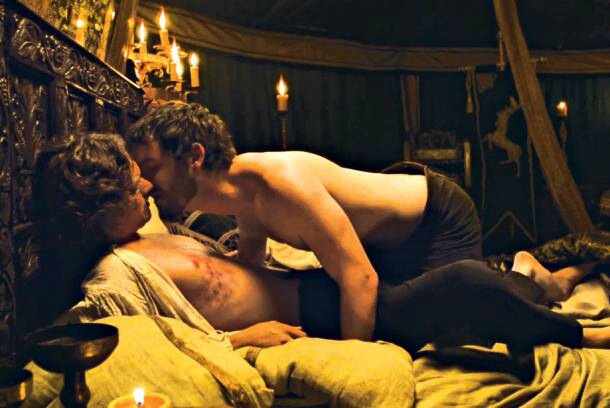
Game of Thrones star Finn Jones stated the obvious in one interview: There’s “not enough hot gay sex” on the show. Jones plays Loras Tyrell (pictured on his back in the above screenshot), a rather unique character for American television. He is unreservedly gay, but fierce as any other Westeros warrior.
Actor Kristian Nairn is best known as the dim-but-loyal Hodor on Game of Thrones. His character carries a crippled child around and only utters the word Hodor. Hodor is said to have giant’s blood in him and by the looks of his nude scene in season one, he’s a giant in more ways than one. But more interesting than his prodigious member is that he is openly gay. In an interview he said of being a gay man, “I had an upbringing to respect other people’s privacy, and their right to be and choose what they want, and I expect—no, demand—no less for myself. It’s a very small part of who I am on the whole, but nonetheless, in this day and age, it’s important to stand up and be counted. I have and always will stand my ground. So, yeah, people have been great, on the show, but I don’t see why it would be an issue.”
If you enjoy semi-historical television with a mix of fantasy, Game of Thrones is well worth watching.

Therefore, if anyone is in Christ, he is a new creation. The old has passed away; behold, the new has come.
2 Corinthians 5:17
God’s Word brings us a comforting promise, along with an insightful command as we face a new year: “Keep your life free from love of money, and be content with what you have, for He has said, ‘I will never leave you nor forsake you.’ So we can confidently say, ‘The Lord is my helper; I will not fear; what can man do to me?’” (Hebrews 13:5-6).
We can live this coming year without fear if we apply these four incredibly wonderful truths to our lives and root them deep into our hearts.
1) The Contentment of His Provision
Contentment is not getting what you want, but it is wanting what you already have. 1 Timothy 6:6-8 says, “But godliness with contentment is great gain, for we brought nothing into the world, and we cannot take anything out of the world. But if we have food and clothing, with these we will be content.” If you know Jesus Christ, you have contentment. If you’ve got clothes on your back, something to eat, and Jesus Christ in your heart, you’re rich!
Do you know why we have fear? Because we think our needs or the needs of someone we love are not going to be met. Or we fear that the things we think are meeting our needs are going to be taken away from us. The deepest need of your heart can only be met in the Lord Jesus Christ. He will provide for our needs, and we should do our best to help Him provide for others’ needs.
2) The Companionship of His Presence
I don’t know what I’m going to face next year. But there’s one thing I know, He will never leave me. As children of God, He will never leave us. He is always by our side, and He is guiding us in the path of righteousness.
We are often afraid we’re going to have to face something we don’t understand, and we’re going to have to face it alone. When God’s Word promises that God will never forsake us, it literally means that He will never abandon us. He will not give up on us. We need to practice the presence of the Lord this coming year. If we believe He is with us, then nothing can stop us and we will never be alone.
3) The Confidence of His Promise
We’re going to zero in on a little phrase in our verses in Hebrews, “He has said.” A promise is no better than the one who makes it. Who says, “I will never leave you nor forsake you”? It is the omnipotent, omniscient, omnipresent God. This is the confidence of His promise.
In the coming year, when we say, “God, I just don’t have the strength.” The omnipotent God will answer, “I will never leave you nor forsake you.” When we say, “God, I’m afraid of what is going to happen.” The omnipresent God says, “I will never leave you nor forsake you.” And when we say, “God, I don’t know what to do.” The omniscient God will respond, “I will never leave you nor forsake you.” He therefore will not forsake us and will be by our side through all that happens to us in the coming year.
4) The Comfort of His Protection
Hebrews 13:6 promises, “So we can confidently say, ‘The Lord is my helper; I will not fear; what can man do to me?'” Now, put that with verse 5, which says, “He has said.”
Like I said earlier, I don’t know what you’re going to go through this coming year. I do not know what joys and sorrows, trials and tribulations that I may go through this year. But I know you can boldly say, “The Lord is my helper; I will not fear; what can man do to me?” When we find our contentment, companionship, and confidence in Jesus, then, we’ll find our comfort and courage in Jesus. Remember that The Lord is our helper, and we should not have fear. Ultimately, no man can harm us or judge us if we believe in Jesus, for God is our only judge and if we do God’s will and follow His Word then we will truly be blessed in the hereafter, and with courage and faith, we will be blessed in this life as well.

While school is in session, I usually don’t have much time to read for pleasure. I do plenty of reading, but it’s usually school related reading. So when I have a break from school, I usually have a long list of books to read, which I love to do.

Let your imagination run wild with this lovely picture. To be honest, my internet connection is so limited at my parents’ place, where we spent Christmas night, that this post is by necessity brief. I hope that all of you had a very merry Christmas.
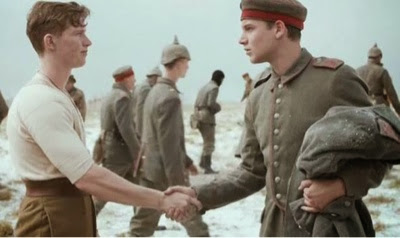
During World War I, on Christmas Day 1914, the sounds of rifles firing and shells exploding faded in a number of places along the Western Front in favor of holiday celebrations in the trenches and gestures of goodwill between enemies. On December 7, 1914, Pope Benedict XV suggested a temporary hiatus of the war for the celebration of Christmas. Though Germany readily agreed, the other powers refused.Even without a cessation of war for Christmas, family and friends of the soldiers wanted to make their loved ones’ Christmas special. They sent packages filled with letters, warm clothing, food, cigarettes, and medications. Yet what especially made Christmas at the front seem like Christmas were the troves of small Christmas trees.
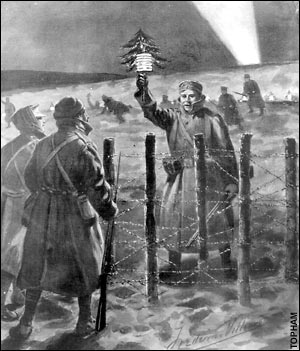
On Christmas Eve, many German soldiers put up Christmas trees, decorated with candles, on the parapets of their trenches. Hundreds of Christmas trees lighted the German trenches and although British soldiers could see the lights, it took them a few minutes to figure out what they were from. Could this be a trick? British soldiers were ordered not to fire but to watch them closely. Instead of trickery, the British soldiers heard many of the Germans celebrating. They heard songs that were very familiar being sung in the other trenches:
The British responded with the song in their own language:
Starting on Christmas Eve, many German and British troops sang Christmas carols to each other across the lines, and at certain points the Allied soldiers even heard brass bands joining the Germans in their joyous singing.
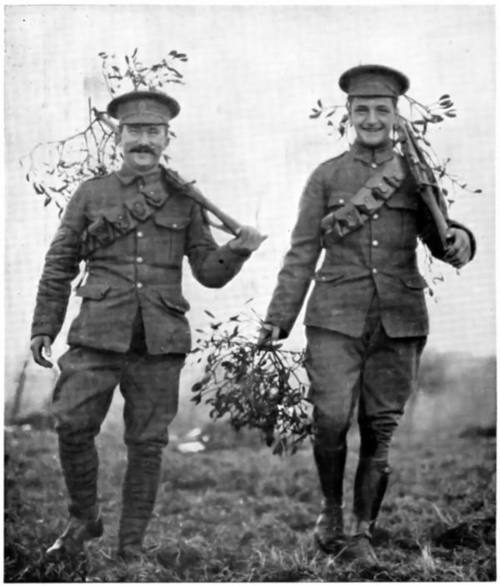
At the first light of dawn on Christmas Day, some German soldiers emerged from their trenches and approached the Allied lines across no-man’s-land, calling out “Merry Christmas” in their enemies’ native tongues. At first, the Allied soldiers feared it was a trick, but seeing the Germans unarmed they climbed out of their trenches and shook hands with the enemy soldiers. The men exchanged presents of cigarettes and plum puddings and sang carols and songs. There was even a documented case of soldiers from opposing sides playing a good-natured game of soccer.
Some soldiers used this short-lived ceasefire for a more somber task: the retrieval of the bodies of fellow combatants who had fallen within the no-man’s land between the lines.
The so-called Christmas Truce of 1914 came only five months after the outbreak of war in Europe and was one of the last examples of the outdated notion of chivalry between enemies in warfare. It was never repeated—future attempts at holiday ceasefires were quashed by officers’ threats of disciplinary action—but it served as heartening proof, however brief, that beneath the brutal clash of weapons, the soldiers’ essential humanity endured.
During World War I, the soldiers on the Western Front did not expect to celebrate on the battlefield, but even a world war could not destory the Christmas spirit.
The First World War is one of my favorite topics of study. It is so important for much of the history of the twentieth century, even though it is often overlooked. We, the GLBT community, also owe a great deal to the Great War. The First World War traumatised millions of men and challenged hegemonic conceptions of masculinity. In the post-war era, battles raged between competing socio-political groups over masculinity and the war experience. The homosexual movement posed one of the most significant challenges to pre-war gender norms. The war galvanised homosexuals to challenge social and cultural perceptions of gays as degenerate ‘enemies of the nation’. The movement was fragmented by rivalries and theoretical differences, but the memory of the war served as a central reference point for defining homosexual identity, masculinity and political rights in the Weimar Republic. The First World War was a turning point for Germany’s homosexual movement, as the war provided a central ideal – comradeship – that became a cornerstone for defining homosexual identity and justifying emancipation. An intensely militarised rhetoric permeated the language of gay rights organisations in the 1920s and, despite the differences among those organisations, the war gave homosexuals similar visions of a spiritually and politically liberated gay man who could use his training at the front to fight legal oppression and cultural prejudice.

Each Christmas Eve people all over the world will log on to the official Santa Tracker to follow his progress through U.S. military radar. I remeber the local NBC station would break in with updates on Santa’s location. As a kid, I always thought it was so cool. Tracking Santa all started in 1955, with a misprint in a Colorado Springs newspaper and a call to Col. Harry Shoup’s secret hotline at the Continental Air Defense Command, now known as NORAD.

The Santa Tracker tradition started with this Sears ad, which instructed children to call Santa on what turned out to be a secret military hotline. Kids today can call 1-877 HI-NORAD (1-877-446-6723) to talk to NORAD staff about Santa’s exact location.
Shoup’s children, Terri Van Keuren, Rick Shoup, and Pam Farrell, recently visited StoryCorps to talk about how the tradition began. Col. Shout had two phones on his desk, one was the “red” phone that only Shoup and a four-star general at the Pentagon had the number. Of course, this was the 1950s during the height of the Cold War. Shoup was the first line of defense against a nuclear attack.
The red phone rang one day in December 1955, and Shoup answered it. On the line was a small voice that asked “Is this Santa Claus?” Shoup was a serious, disciplined, and straight-laced colonel and was immediately annoyed at the call, thinking it was a joke. Then the little voice began to cry, Shoup realized it wasn’t a joke. So, Shoup went into Santa mode. He talked to the young boy, said a few “HO-HO-HOs” and asked if he’d been a good boy this year. Then Col. Shoup asked to speak to the boys mother. And the mother got on and said, ‘You haven’t seen the paper yet? There’s a phone number to call Santa. It’s in the Sears ad.’ Dad looked it up, and there it was, his red phone number.
That was the first of many phone calls that the Continental Air Defense Command received on the red phone. Shoup decided to assign a couple of airmen on the phones to act like Santa Claus. It became a big joke at the command center. Col. Harry Shoup came to be known as the “Santa Colonel.”
The airmen had a large glass board with the United States and Canada on it so that they could track airplanes in the skies. On Christmas Eve of 1955, when Shoup walked in, there was a drawing of a sleigh with eight reindeer coming over the North Pole. Shoup asked, “What is that?” The airmen replied, ‘Colonel, we’re sorry. We were just making a joke. Do you want us to take that down?’ Shoup looked at it for a while, and next thing you know, he had called the radio station and had said, ‘This is the commander at the Combat Alert Center, and we have an unidentified flying object. Why, it looks like a sleigh.’ Well, the radio stations would call him like every hour and ask, “Where’s Santa now?”
Later in life, Shoup got letters from all over the world, people saying, ‘Thank you, Colonel,’ for having a sense of humor. And in his 90s, he would carry those letters around with him in a briefcase that had a lock on it like it was top-secret information. The letters were important to him. He had been an important man for America’s defense in the Cold War, but he was also known as Colonel Santa.
Col. Shoup died in 2009. How many of you have fond memories of tracking Santa all thanks to this straight-laced military man who turned out to have a good-natured sense of humor?




 Joe


