From Fear to Joy

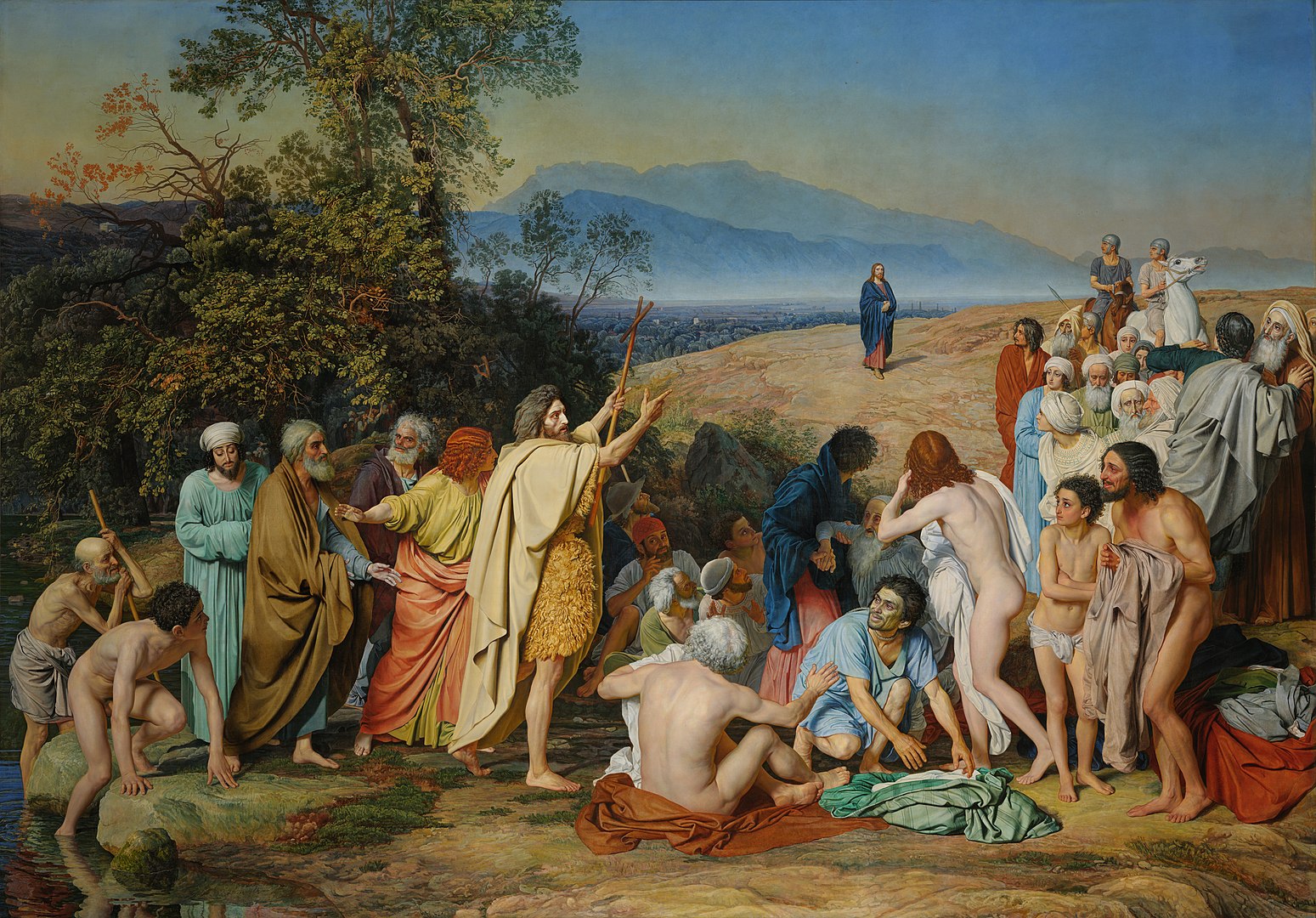
The Appearance of Christ Before the People by Alexander Andreyevich

“Nothing can separate us from the love of God that is in Christ Jesus our Lord.”

—Romans 8:39

The days between the Crucifixion and Easter morning were dark, uncertain, and full of fear. The disciples had followed Jesus, trusted him, even left behind their old lives for him—and now he was gone. Executed as a criminal. Buried in a borrowed tomb. Their hopes were shattered. They locked themselves away in fear.

The morning of His Resurrection did not begin in joy—it began in silence, confusion, and fear. The tomb was empty. Jesus was gone. Mary wept, believing his body had been taken. The disciples, unsure of what to believe, hid behind locked doors. The world had shifted under their feet.

If you’ve ever lived in that in-between space—between grief and hope, rejection and love, silence and revelation—Easter is your story too.

The disciples would have known the words of Psalm 30:5: “Weeping may stay for the night, but rejoicing comes in the morning.” Yet in the shadow of the Crucifixion, their grief clouded their understanding. Though Jesus had spoken plainly of what was to come, sorrow and fear made it difficult for them to remember. In Luke 9:22, Jesus told them: “The Son of Man must suffer many things and be rejected by the elders, the chief priests and the teachers of the law, and he must be killed and on the third day be raised to life.”

Many gay men, too, anticipate rejection when they come out—rejection from family, faith communities, or society. Jesus predicted that He would be rejected as well. He was misunderstood by many who expected the Messiah to be a political liberator, someone who would overthrow Roman rule. Yet Jesus accepted his fate, knowing that his rejection and death would lead to something greater. In John 2:19, He said: “Destroy this temple, and I will raise it again in three days.” Though the disciples did not grasp it at the time, Jesus was preparing them for the truth that death was not the end—that from what was broken, new life would rise. By holding on to our faith after our rejection, we will be reborn and risen because while others may have rejected us, God never will.

Many gay men of faith know what it is to feel locked out or hidden away. We’ve known fear. We’ve known doubt. We’ve been told, sometimes by the church itself, that we are not fully welcome in the places where love should flourish. But in the Resurrection, God does something unexpected and deeply personal: Christ returns, not to the powerful, but to the ones who are hurting, frightened, and unsure. And he calls them by name.

He speaks Mary’s name in the garden—and suddenly, her mourning becomes recognition. John 20:16 says, “Jesus said to her, ‘Mary.’ She turned toward him and cried out… ‘Teacher!’” She turns and knew: love had not left her.

John 20:19 says, “On the evening of that first day of the week, when the disciples were together, with the doors locked for fear… Jesus came and stood among them and said, ‘Peace be with you.’” He appears to the disciples in their fear and breathes peace into the room. They do not reach out first—he comes to them.

John 20:25 tells us that Thomas doubted that Jesus had risen, “He said to them, ‘Unless I see the nail marks in his hands and put my finger where the nails were, and put my hand into his side, I will not believe.’” And when Thomas cannot believe without proof, Jesus doesn’t shame him. Instead, a week later in John 20:27, Jesus went to Thomas and said, “Put your finger here; see my hands. Reach out your hand and put it into my side. Stop doubting and believe.”

This is not the love of a distant or conditional Savior. This is a love that returns for you. A love that steps across fear, past doubt, and into locked rooms and wounded hearts. This is a Savior who speaks your name—not with judgment, but with tenderness.

No amount of uncertainty or fear can lock Christ out. His resurrection is not only about defeating death—it’s about restoring relationship. It’s about stepping into locked rooms, into quiet hearts, into hidden places, and saying, “Peace be with you.” It’s about transforming sorrow into joy.

You are not forgotten. You are not disqualified. You are not too late.

The Risen Christ sees you fully—your questions, your longings, your deepest self—and says: Peace be with you. Rejoice. I have called you by name. You are mine.

Are there places in your life where fear still holds the door closed? Have you heard Christ calling you by name—and if not, are you open to listening? What would it mean to let resurrection joy take root in your story? Christ knows what it is to be misunderstood, doubted, and abandoned. And yet, he rises not to condemn, but to comfort. He comes not to erase your wounds, but to show you his own—and in doing so, to show you that your story is safe with him. Whether you are weeping in the garden or hiding behind locked doors, he is near. He speaks your name. He breathes peace. And he turns your fear into joy.

Jesus was crucified to suffer for our sins, and He was risen from the dead to allow us to be reborn. On this Easter Sunday, remember what the angel told Mary in Matthew 28:6 when she discovered the empty tomb:

“HE HAS RISEN”


Pics of the Day


Moment of Zen: Men Who Wear Glasses

I’m sure you’ve heard this saying before about “men seldom make passes…,” but did you know that it was actually a short poem by Dorothy Parker?

News Item
By Dorothy Parker

Men seldom make passes
At girls who wear glasses.

Thankfully, men do make passes at men who wear glasses, or at least, they should by the looks of these men.


Pic of the Day


A Good Friday Pause

I’m writing today’s post later than usual—and for good reason. As I mentioned earlier in the week, I’ve been working on a short story which has become more of a novella than a short story, and my mind was on that this morning. Also, I took the day off. Not for a big trip or even a long weekend getaway, but for something quieter, something more necessary: rest.

It’s Good Friday, a day of solemn reflection in the Christian calendar, marking the crucifixion of Jesus and the heavy silence that precedes the joy of Easter morning. Whether one observes it religiously or not, there’s something about Good Friday that invites stillness. Maybe it’s the echo of ancient grief. Maybe it’s just the gray light of early spring. But today, I let myself lean into that quiet.

I had planned to write this morning. I usually do. But after a long week—and a distracted mind—I simply forgot to write anything earlier. The temptation to fill every day with productivity is strong, even on holidays, especially when there is so much to be done, particularly the end of a very busy semester at work. But Good Friday, of all days, is a reminder that silence has its place too. That waiting is part of the story.

So, I worked on my novella. Read a few pages of a book I’ve been meaning to finish. Made tea. Watched the morning news, at least what I could stand of it. (I mute it every time the news mentions the current administration.) I simply let my mind wander.

And now, a little later than usual, I’m here—grateful for this space, for all of you who read and check in, and for the chance to slow down now and then, even if only for a moment.

Wherever you are today, and however you observe it, I hope you’re able to find a bit of rest, a breath of stillness, and maybe even a little grace.

Wishing you peace this Good Friday!


Pic of the Day


Florence: A Haven for Gay Artists

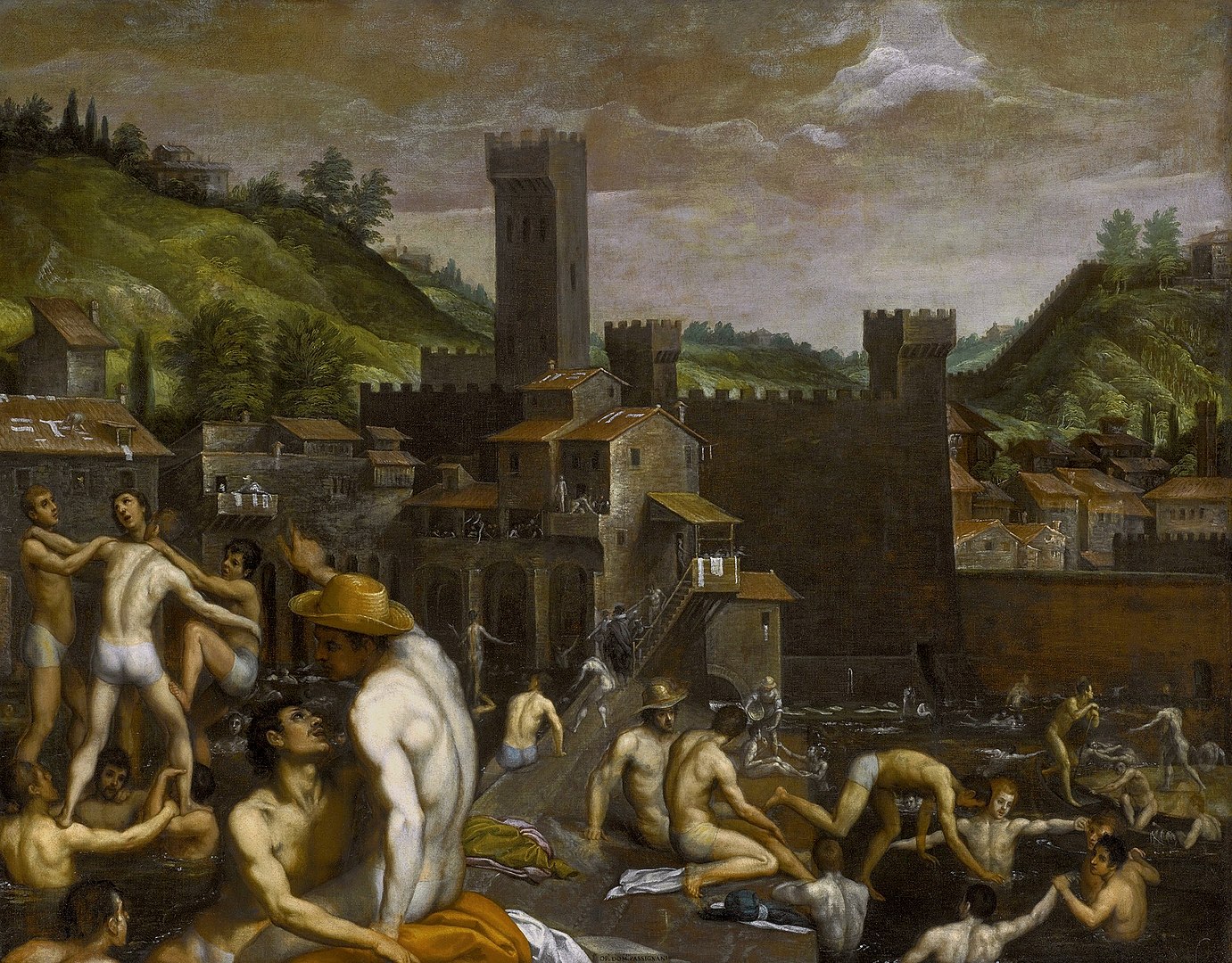
Passignano’s Bagnanti a San Niccolò (The Bathers at San Niccolò) c.1600

Throughout its long and culturally rich history, Florence, Italy has been a singular beacon for artistic innovation, intellectual inquiry, and—though often unspoken—a degree of sexual tolerance that fostered the flourishing of queer artistic expression. While not free of repression or societal prejudice, Florence’s nuanced approach to male same-sex desire, especially during the Renaissance, provided a relatively permissive environment in which gay artists, writers, and patrons could explore themes of male beauty and homoeroticism with a boldness rarely seen elsewhere in Europe. This openness left a profound imprint on Western art, particularly in the celebration of the idealized male nude.

Florence’s complex relationship with homosexuality begins with its legal records. In the late Middle Ages and early Renaissance, Florentine officials did periodically prosecute acts of sodomy; however, these charges were often handled by a special court called the Ufficiali di Notte (Officers of the Night), which, rather than enforcing severe punishment, often issued small fines or encouraged discretion. Historians such as Michael Rocke have detailed how this legal system—while certainly functioning to monitor sexuality—also allowed a surprising degree of leeway. Rocke’s influential study, Forbidden Friendships: Homosexuality and Male Culture in Renaissance Florence, documents how widespread male same-sex relations were, particularly among youths, apprentices, and even within elite circles.

This complex system of tacit tolerance allowed many artists and patrons to pursue relationships and artistic themes centered on male beauty without immediate fear of extreme censure. The Church’s looming influence often required a veil of classical or mythological allegory, but Florentine artists mastered this strategy, embedding homoerotic ideals within celebrated and culturally accepted artworks.

The Renaissance’s rediscovery of Greco-Roman ideals—particularly in Florence—led to a renewed emphasis on the idealized human form. Nowhere was this more apparent than in the explosion of male nude imagery, often clothed in mythological or biblical themes but clearly intended as a vehicle for the admiration of masculine beauty.Michelangelo Buonarroti, one of Florence’s most revered sons, was perhaps the most prominent example of this convergence of artistic genius and homoerotic expression. Deeply religious yet emotionally and artistically drawn to male beauty, Michelangelo left behind a vast body of work—both visual and poetic—that expresses intense admiration for the male form. His David (1501–1504), sculpted from a single block of marble, stands as the quintessential expression of the ideal male nude. While ostensibly a biblical hero, the sculpture’s nudity, grace, and sensuality are undeniably rooted in classical aestheticism and personal admiration. 

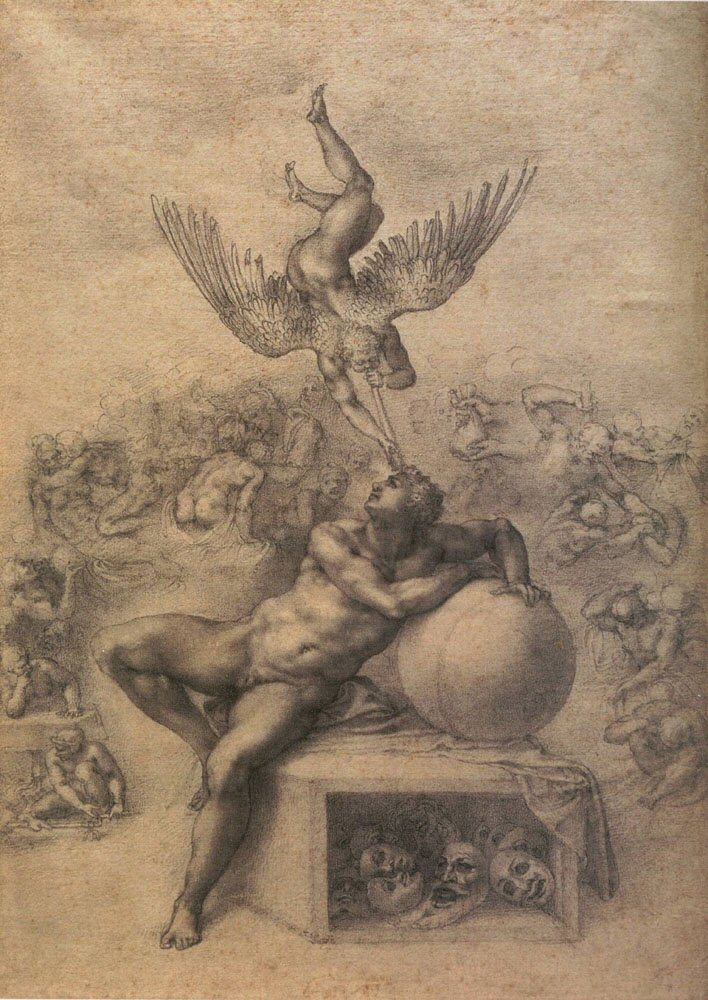
Michelangelo’s Il Sogno (The Dream)

Michelangelo’s love poems to young men like Tommaso dei Cavalieri further reveal the emotional landscape from which these artistic works emerged. Deil Cavalieri also appeared in Michelangelo’s art, such as in his 1533 drawing Il Sogno(The Dream). While the drawing is not directly linked to de’ Cavalieri, its similarity with the others has suggested to some scholars that it was connected to them. Unlike other works, the iconography does not derive from Greek mythology, and its subject is interpreted as related to beauty.

Michelangelo’s Dusk and Dawn on the Tomb of Duke Lorenzo

In the Medici Chapel (1520s–1530s), Michelangelo again uses male nude figures as symbolic forms in his allegorical representations of Dawn, Dusk, Night, and Day—emphasizing not only the muscular male body but also the melancholic introspection often associated with unattainable longing.

Da Vinci’s A Nude Man seen from the Front, c1480

Leonardo da Vinci, though more cautious than Michelangelo, also exemplifies this phenomenon. Arrested as a young man for accusations of sodomy (which were ultimately dropped), Leonardo lived most of his life with male companions and frequently drew male nudes, many of which contain sensual, almost tender depictions of the male body. His anatomical studies, such as those housed in the Royal Collection at Windsor, reflect an obsessive and intimate familiarity with male physicality, often surpassing the scientific purpose of the sketches.

Donatello, David (back view), c. 1440

The relative tolerance of same-sex love, coupled with the city’s humanist and aesthetic philosophies, gave rise to a cultural milieu where queer-coded art could flourish under classical and religious guises. This climate, while not openly affirming, allowed for an extraordinary level of subtextual and symbolic freedom. Artists such as Donatello, whose bronze David (c. 1440s) predates Michelangelo’s and features a more androgynous, sensual portrayal, added to the lexicon of homoerotic art in Florence. The languid pose, feather-brushed thigh, and soft musculature of Donatello’s David have been widely read by scholars as a coded celebration of male eroticism.

In literature, figures like Marsilio Ficino, a Neoplatonist philosopher under Medici patronage, exalted same-sex spiritual love as part of divine beauty. Ficino’s translations of Plato’s Symposium and other works gave philosophical legitimacy to love between men, which would become a foundational element of Renaissance humanism.

This artistic tradition continued to echo well beyond the Renaissance. In the 19th and early 20th centuries, Florence attracted numerous queer expatriates and artists who found inspiration and refuge in the city’s tolerant atmosphere and classical aesthetic. Figures such as Edward Perry Warren, John Addington Symonds, and even E.M. Forster spent time in Florence, drawn by its legacy of beauty, art, and the sensual freedom subtly encoded in its cultural DNA. 

Leighton’s The Sluggard, 1885

One of the most compelling and explicitly queer figures connected to 19th-century Florence is not Italian, but Frederick Leighton (1830–1896), the British painter and sculptor who was part of the expatriate art community in Italy. Leighton traveled extensively throughout Italy and maintained a strong relationship with Florence, where he studied and engaged with the classical tradition. Though he spent much of his later life in London, Florence was instrumental in shaping his early artistic ideals.Florence’s nuanced and historically shifting tolerance toward homosexuality enabled one of the most robust and beautiful traditions of male nudity in Western art. Through sculpture, painting, poetry, and philosophy, gay artists and patrons were able to explore male beauty not merely as a classical ideal but as a deeply personal, emotional, and sometimes spiritual pursuit. Florence stands as a historical haven—not without contradiction or repression, but with a legacy of quiet dignity and artistic boldness that continues to inspire to this day.


Pic of the Day


Quick Post

This will be quick. I haven’t had a chance to prepare a history/art/eroticism post for today. Hopefully, I’ll be able to post it tomorrow. In the meantime, I have a doctor’s appointment this afternoon. Some people dread going to the doctor, but I really like my doctor and always enjoy seeing him. It doesn’t hurt that he is devastatingly handsome. He’s straight and married, so I just get to admire him, but he is always so kind when I see him, and I never feel hurried or rushed when he’s seeing me. I think everything will be a good report, though we will discuss me being in the hospital.

Since I will likely post my history/art/eroticism post tomorrow, here’s is this week’s Isabella Pic of the Week:


Pic of the Day