



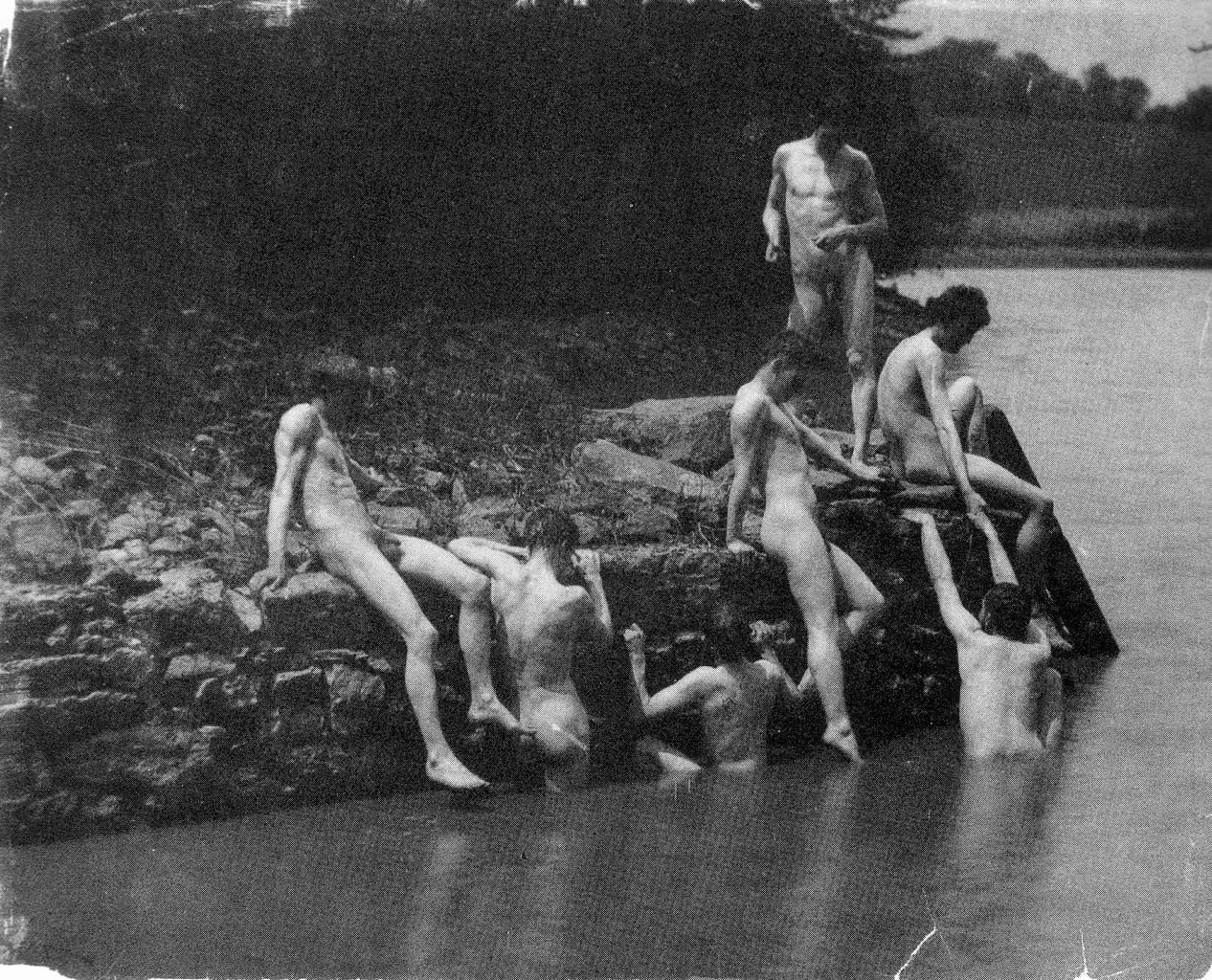


Thomas Eakins’ students swimming naked in Dove Lake, c. 1883–84
Four paintings—The Swimming Hole (1885) by Thomas Eakins, The Bathers (1898–1905) by Paul Cézanne, The Bathing Group (1914) by Henry Scott Tuke, and The Bathers (1885) by John Singer Sargent—each depict figures in or near water, a subject with deep art historical roots. They each depict the one of the few exceptions to the generally prudish Victorian attitude to nudity: swimming naked was widely accepted, and for males was seen as normal, even in public spaces. The other notable exceptions are depictions of nudes in classical, mythological, and allegorical art.
I have been looking at many 19th century artists, particularly American artists, for a class I am teaching, and one thing I have noticed that is remarkably different from Renaissance art is the lack of male nudes. In the Renaissance, some of the most famous pieces of art are of male nudes; Michelangelo’s and Donatello’s depictions of David come to mind. Yet, in 19th century America, few of the art produced are of nude men. However, female nudity abounds. The great American sculptor Hiram Powers’s The Greek Slave (1843) is of a young nearly naked woman in chains. The only depiction I know of Powers that was of a male nude is The Fisher Boy (1857). Both sculptures are of examples of classical and allegorical works.


The Greek Slave (1843) and The Fisher Boy (1857) by Hiram Powers
The four paintings by Eakins, Cézanne, Tuke, and Sargent are exceptions to the lack of male nudity. However, each approaches the theme of male nudity with distinct stylistic and thematic differences. The theme of male bathers has long been a subject in Western art, and like nearly all male nude artwork, the bathers often carry homoerotic undertones. The role of homoeroticism varies depending on the artist’s personal life, stylistic choices, and the cultural context in which they worked. Most of the known gay or bisexual men throughout history were artists. There are a few exceptions, and with nearly all of these historical figures, their sexuality has become a source of great debate. The sexuality of Eakins and Sargent are hotly contested in the art world. The sexuality of Cézanne has questioned for his personal detachment from women, lifelong male friendships, and repeated depictions of male figures in communal settings have led to some speculative interpretations. However, Tuke’s sexuality is not really debated. During the 1880s, Tuke met Oscar Wilde and other prominent poets and writers such as John Addington Symonds, most of whom were Uranian, an archaic term for homosexual men. Tuke’s art is sometimes referred to as Uranian art.

Eakins’ The Swimming Hole is a realist depiction of young men bathing in a natural setting. The composition is carefully structured, with figures arranged dynamically, demonstrating Eakins’ deep understanding of anatomy. He used photography as a reference, contributing to the work’s precision. The painting celebrates the male form, and some scholars suggest a homoerotic subtext, particularly given Eakins’ personal interest in male camaraderie and physicality. Eakins was deeply interested in the male nude, often using his students and friends as models in his photographic and painted studies. The Swimming Hole is notable for its emphasis on the beauty of the male form, with figures depicted in relaxed, intimate, and naturalistic poses. Eakins’ career was marked by controversy, particularly his insistence on using nude male models in his teaching, especially when women were present in class, which ultimately led to his dismissal from the Pennsylvania Academy of the Fine Arts. While Eakins’ sexuality remains debated, his work suggests an intense fascination with the male body that aligns with homoerotic artistic traditions.

Cézanne’s The Bathers presents a more abstracted and structural approach to the human form.. Cézanne’s approach to the male nude was more detached and formal, reducing figures to geometric forms and emphasizing composition over sensuality. He merges the men with the surrounding landscape. His brushwork and color palette are highly expressive, prioritizing form over detail. This painting is part of a series of bathers that played a crucial role in the development of modern art, influencing Cubism and abstraction. Rather than focusing on individuality, Cézanne treats the figures as part of a broader compositional harmony. While his Bathers paintings lack the overt homoeroticism seen in Eakins or Tuke, some scholars have suggested that Cézanne’s awkwardness around women and preference for male companionship may be reflected in his repeated depictions of groups of men in idealized, classical settings. His work was admired by later artists interested in queering traditional artistic forms, though it remains more intellectual than sensual.
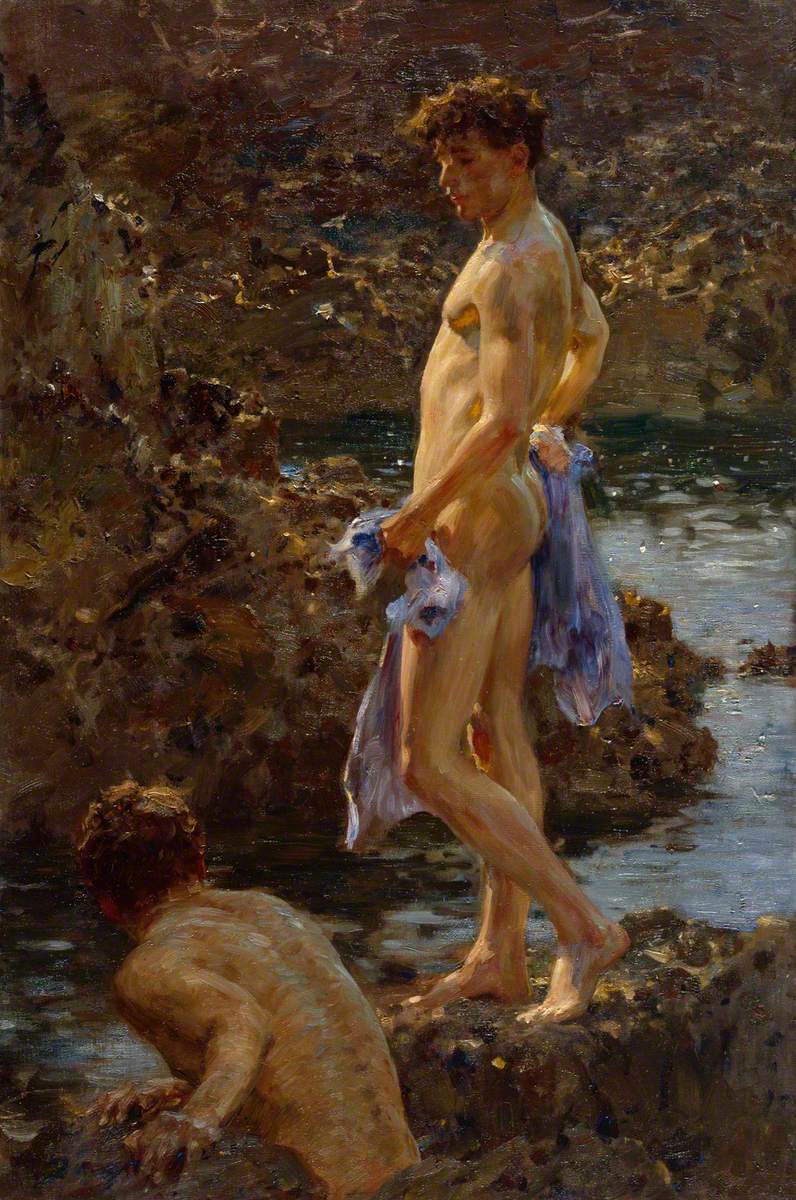
Tuke’s The Bathing Group shares thematic similarities with Eakins’ Swimming Hole, as it portrays young men bathing in a sunlit outdoor setting. However, Tuke’s work has a softer, impressionistic style with warm, glowing light that romanticizes the scene. His focus on adolescent male figures, combined with his use of color and light, creates an atmosphere of nostalgia and idealized youth. The painting reflects Tuke’s broader oeuvre, which often explored themes of male beauty and companionship in idyllic coastal settings. Tuke’s work is the most overtly homoerotic among the four painters. He frequently painted young, athletic men in idyllic seaside settings, often nude or minimally clothed, with a warm, romanticized glow. Unlike Eakins, whose realism could be read as clinical, Tuke’s impressionistic style and soft, golden lighting emphasize youth and sensuality. Tuke was known to have had close relationships with young men, and while his exact sexual orientation remains ambiguous, his work clearly celebrates male beauty in a way that aligns with homoerotic traditions in art.

Sargent’s The Bathers is more atmospheric and impressionistic than the others. It captures figures relaxing by the water, with loose brushwork and an emphasis on light and movement. Unlike Eakins’ rigorous realism or Cézanne’s abstraction, Sargent’s fluid style suggests spontaneity, capturing a fleeting moment rather than a structured composition. His interest in light and fabric is evident, as the painting conveys a sense of leisure and elegance characteristic of Sargent’s work. Sargent, like Tuke, has long been the subject of speculation regarding his sexuality. His portraits of both men and women often exude sensuality, and his friendships with men such as the poet and aesthete Vernon Lee suggest an affinity for male beauty. In The Bathers, Sargent takes a more impressionistic and fleeting approach to the subject, capturing a moment of leisure rather than lingering on the erotic possibilities of the male nude. However, his interest in male figures and fluid, suggestive brushwork align with the aesthetic codes often used to signal homoerotic desire. Sargent’s art is best known for his beautiful depictions of women in their finest clothing, and the majority of Sargent’s depictions of nude men were not discovered until after his death.
Each of these paintings offers a unique interpretation of the bathing scene and their homoerotic subtext reflect the respective artists’ styles, concerns, personal inclinations, and broader artistic movements. Eakins’ and Tuke’s paintings are more naturalistic, while Cézanne’s and, to some extent, Sargent’s approach abstraction or impressionism. Eakins prioritizes anatomical precision, while Cézanne breaks forms into geometric masses. Tuke and Sargent take a softer, more atmospheric approach. Eakins presents the male nude in a studied, naturalistic, and academic way, but his fascination with the subject led to controversy for potentially suggesting homoerotic undertones. Tuke romanticizes youth, while Cézanne constructs a timeless, almost mythological world, and Sargent captures a fleeting, elegant moment. Cézanne abstracts the figures, distancing them from direct sensuality but engaging with ideas of male camaraderie. Tuke openly romanticizes and celebrates youthful male beauty in a manner that strongly suggests queer desire. Sargent is more ambiguous, capturing fleeting moments of male interaction with a sensuous yet reserved touch. While only Tuke’s work seems directly intended to be read as homoerotic, all four artists contribute to a visual tradition in which the male nude serves as both a formal study and a space for exploring desire, intimacy, and beauty.

Gravity and Center
By Henri Cole
I’m sorry I cannot say I love you when you say
you love me. The words, like moist fingers,
appear before me full of promise but then run away
to a narrow black room that is always dark,
where they are silent, elegant, like antique gold,
devouring the thing I feel. I want the force
of attraction to crush the force of repulsion
and my inner and outer worlds to pierce
one another, like a horse whipped by a man.
I don’t want words to sever me from reality.
I don’t want to need them. I want nothing
to reveal feeling but feeling—as in freedom,
or the knowledge of peace in a realm beyond,
or the sound of water poured in a bowl.
About the Poem
Henri Cole’s poem “Gravity and Center” is a meditation on desire, longing, and the search for balance in life. Like much of Cole’s poetry, it explores personal emotions and experiences with a lyrical and restrained intensity. The poem captures the tension between wanting and letting go. Cole often writes about longing in a way that feels both personal and universal, reflecting the fleeting nature of human emotions and attachments.
The title suggests an invisible force that both holds things together and pulls them apart. Gravity can symbolize love, duty, or an internal struggle—things that keep a person anchored yet also cause tension. In contrast to gravity, the “center” suggests balance, self-control, or a point of inner peace. The poem may be about the struggle to find equilibrium between emotional intensity and the need for stability.
Cole frequently explores themes of identity, love, and mortality. This poem, in particular, conveys a sense of longing that might be connected to love, self-acceptance, or the search for meaning. “Gravity and Center” is deeply introspective, with a restrained yet emotionally charged tone. Cole’s use of simple yet elegant language allows for multiple interpretations, making the poem resonate with a wide audience. His poetry often embraces a balance between the personal and the universal, allowing readers to see their own experiences reflected in his words.
“Gravity and Center” is a poignant reflection on the human condition—our desires, our struggles for balance, and the forces that shape our emotional lives. Henri Cole’s precise and evocative style invites readers to sit with these tensions and reflect on their own experiences of love, longing, and stability.
About the Poet
Henri Cole is an American poet known for his deeply personal, lyrical, and emotionally introspective poetry. Born in Fukuoka, Japan, in 1956 to a French-Armenian mother and an American father, he grew up in Virginia. His work often explores themes of identity, love, desire, loss, and self-examination with a delicate yet powerful style.
Cole’s poetry is characterized by its precise language, vivid imagery, and emotional depth. He frequently writes about desire, human relationships, and personal reflection, often weaving in themes of queerness and self-acceptance. His poems are elegant yet restrained, blending formal precision with raw emotion. He is often compared to poets like Elizabeth Bishop and James Merrill for his attention to craft and lyricism.
He has received numerous accolades, including the Jackson Poetry Prize, the Kingsley Tufts Poetry Award, and a Guggenheim Fellowship. Cole has taught at various universities and is regarded as one of the most significant contemporary American poets. Henri Cole’s poetry is admired for its emotional clarity, precision, and ability to capture deep human experiences with simple yet profound language. His work resonates with those who appreciate poetry that is both intimate and universal.

I hate the time changing, and I know I’m not the only one. When we gain an hour in the fall isn’t too bad, but when we lose an hour in spring, it can be difficult to get back on schedule. Even though I went to bed at 10 pm last night, I didn’t wake until my alarm went off at 5:30 am. I have the alarm set, not really to wake me up because Isabella usually does a very good job of that, but so I don’t oversleep. It’s sort of my last ditch effort to wake up. Normally, it’s not very useful, but it was this morning. I don’t understand how I can get the same amount of sleep, and sometimes even more than usual, but still feel this tired and sleepy when I wake up. Maybe it’s because it’s a Monday. Whatever the reason, I hope everyone has a wonderful week!

“This is the day that the Lord has made; let us rejoice and be glad in it.”
—Psalm 118:24
Mornings can be tough, especially when the world around us feels heavy. As gay men, many of us have faced rejection, loneliness, or struggles with self-acceptance. Some days, it’s easy to wake up feeling discouraged, wondering if things will ever truly get better, especially under the current administrations regime. But here’s the truth: Every day we wake up is a new opportunity—a fresh start filled with God’s love, grace, and purpose. The enemy would love nothing more than for us to wake up and immediately focus on what’s wrong—the hardships, the disappointments, the fears, especially the fears. But God calls us to something greater. Instead of dwelling on the negativity, what if we started each day by thanking God for another chance to experience His goodness?
Paul reminds us in Romans 12:2, “Do not be conformed to this world, but be transformed by the renewal of your mind.” This means that our outlook on life isn’t shaped by what happens to us, but by how we choose to see it. Even when things look bleak, we can renew our minds by focusing on God’s promises rather than our problems. One of the most beautiful reminders in Scripture comes from Lamentations 3:22-23, “The steadfast love of the Lord never ceases; his mercies never come to an end; they are new every morning; great is your faithfulness.” No matter what happened yesterday—no matter the mistakes, the hurt, or the disappointment—God’s mercies are fresh each morning. He doesn’t hold our past against us. He meets us with grace and gives us the strength to keep going.
Before you even get out of bed, declare God’s truth over your life. Say, “I am loved. I am chosen. I have a purpose.” This affirmation reminds me of the movie, The Help. It’s a look at life in Jackson, Mississippi back in the early 60’s when racial division and inequality were most evident in the lives of the citizens of that community. I’ve watched The Help several times, and I am sadly reminded of a time when so many people were marginalized and treated as if they were less-than-human. I guess part of what saddens me is that much of the division and inequality between races remains still. We also see division and inequality today, especially with how politicians and churches treat transgender individual and other members of the LGBTQ+ community. In the movie, an African-American maid and nanny named Aibileen Clark, played by Viola Davis, helps to raise a young white girl named Mae Mobley, played by Eleanor Henry. In her role as a nurturing care-giver, Aibileen attempts to speak encouragement, value and worth into the life of the young girl by having her repeat several phrases along with her. “You is smart, you is kind, you is important.” Similarly, we can tell ourselves “I am loved. I am chosen. I have a purpose.”
Be mindful of what you consume in the morning. Instead of doomscrolling or watching latest disasters on the news, start your day with some good music, read your Bible, say a prayer, or just take a long hot shower to rinse away all the negativity you might have woken up with that morning. Some days will still be hard. There will be moments when the weight of the world feels overwhelming. But even in those moments, remember: You are not alone. God sees you, He loves you, and He has plans for you. There are also people in your life who love you and care about you. There are people who make you happy, remember them. So today, no matter what you’re facing, take a deep breath and say: This is the day the Lord has made—I will rejoice and be glad in it! Thank the Lord for a new day and fresh mercies. When life feels overwhelming, God can help us focus on His goodness instead of our worries. We should fill our hearts with joy, our minds with peace, and our spirits with strength. No matter what comes our way, we can choose to trust in God and embrace this day with hope. Go forward today and everyday knowing you are deeply loved, and let that love be the reason you rise each morning with joy.


 | vandycolt on Pic of the Day |
 | Steve Davis on A Queen Was Born |
 | noisilycool3bc985058… on A Queen Was Born |
| noisilycool3bc985058… on Pic of the Day |
| noisilycool3bc985058… on Pic of the Day |





As an Amazon Associate I earn from qualifying purchases. So, if you click on a link that takes you to Amazon.com, I may earn a commission.
Trust me, it isn’t much, but every little bit helps.















 Joe
Joe
 The Closet Professor