

Symbols of Unity, Not Division

And suddenly there was with the angel a multitude of the heavenly host praising God and saying: “Glory to God in the highest, And on earth peace, goodwill toward men!”
—Luke 2:13-14
Many of you are probably not familiar with this news story, but a anti-LGBTQ+ group called Clean Up Alabama (CUA) has been fighting to get Prattville Pride, Prattville, Alabama’s LGBTQ+ organization, removed form the annual Prattville Christmas Parade. I used to work in Prattville back when I was in college, and I have always hated the place. CUA stated, “The Christmas parade is a celebration of Christmas, the birth of Jesus Christ the Messiah. It is NOT a time to celebrate someone’s sexual preferences.” They obviously think the celebration of Christmas is a time to celebrate, not the message of Jesus Christ, but a message of hatefulness towards their fellow man (and women and non-binary, etc.). Let’s, for a moment, overlook the fact that Christmas was chosen to be on December 25 because it coincided with the Roman pagan holiday of Saturnalia and teh Winter Solstice, not the actual birth of Christ, and instead look at what should be the meaning of the holiday and the actions and symbols used to celebrate the season.
In Alabama, and my sister is one of them, they hate to say Happy Holidays instead of Merry Christmas or to use Xmas, because it highlights their Christian insecurities and takes the “CHRIST out of Christmas.” I wish they could all take my Art History class because they would find out that the X in Xmas is an old Christian tradition because it is part of the Chi Rho symbol. Early Christian art is filled with symbology to represent the meaning of the Christian faith.

Chi (X) and Rho (P) are the beginnings of the Greek word ΧΡΙΣΤΟΣ (Romanized: CHRISTOS). Before Emperor Constantine made Christianity legal in the Roman Empire, Christians were forced to hide their faith; however, they identified themselves with certain symbols: the cross and crucifix (the most commonly used symbols today), several different combinations of Greek letters (ichthys, Alpha and Omega, Chi Rho, IH monogram, IX monogram), the Good Shepherd, a dove, a peacock, or an anchor. Let us look at why these symbols were so important and meaningful to early Christians.
The ichthys (ἰχθύς in Greek, meaning “fish”) is a symbol consisting of two intersecting arcs that resemble the profile of a fish. The ichthys was used by early Christians as a secret symbol during times of persecution under the Roman Empire. It allowed them to identify themselves to one another discreetly. The Greek word ichthys also served as an acronym for the phrase: Ἰησοῦς Χριστὸς Θεοῦ Υἱὸς Σωτήρ (“Jesus Christ, Son of God, Savior”). Therefore, the ichthys represents Jesus Christ and the Christian faith. The fish itself is also significant because of its frequent appearance in the Gospels. The ichthys symbol is also a reference to the Holy Eucharist, with which the miracle of the multiplication of the loaves and fishes had such intimate connection both in point of time and significance. (Matthew 15:32–39 and Mark 8:1–9) It is also significant because Jesus called Peter and Andrew, both fishermen, to be His disciples. Mark 1: 16–18 says, “And as He walked by the Sea of Galilee, He saw Simon and Andrew his brother casting a net into the sea; for they were fishermen. Then Jesus said to them, ‘Follow Me, and I will make you become fishers of men.’ They immediately left their nets and followed Him.”
The Alpha and Omega since the earliest Christianity of the first and the last letters of the Greek alphabet, alpha (α or Α) and omega (ω or Ω), derives from the statement said by Jesus in Revelation 22:13, “I am the Alpha and the Omega, the Beginning and the End, the First and the Last.” The first two letters of the name of Jesus in Greek (ΙΗΣΟΥΣ), iota (Ι) and eta (Η), sometime superimposed one on the other was also a well known and very early way to represent Christ. Another early form of the monogram of Christ, found in early Christian ossuaries in Palaestina, was formed by superimposing the first (capital) letters of the Greek words for Jesus and Christ, i.e. iota Ι and chi Χ, so that this monogram means “Jesus (ΙΗΣΟΥΣ)Christ ΧΡΙΣΤΟΣ.”
The image of the Good Shepherd, often with a sheep on his shoulders, is the most common of the symbolic representations of Christ found in the Catacombs of Rome, and it is related to the Parable of the Lost Sheep (Matthew 18:12–14 and Luke 15:3–7). The dove as a Christian symbol is of very frequent occurrence in ancient ecclesiastical art. According to Matthew 3:16, “When He had been baptized, Jesus came up immediately from the water; and behold, the heavens were opened to Him, and He saw the Spirit of God descending like a dove and alighting upon Him.” For this reason, the dove became a symbol of the Holy Spirit, and in general it occurs often in connection with early representations of baptism. Ancient Greeks believed that the flesh of peafowl did not decay after death, and so the peacock became a symbol of immortality. Early Christianity adopted this symbolism, and thus many early Christian paintings and mosaics show the peacock. Christians also adopted the anchor as a symbol of hope in future existence because the anchor was regarded in ancient times as a symbol of safety. For Christians, Christ is the unfailing hope of all who believe in him: Saint Peter, Saint Paul, and several of the early Church Fathers speak in this sense. The Hebrews 6:19 says, “This hope we have as an anchor of the soul, both sure and steadfast, and which enters the Presence behind the veil” connects the idea of hope with the symbol of the anchor.
Most Christians do not have a very good understanding of what the symbols they sometimes use mean, nor do they understand the significance of the early Christian symbols and the sacrifices that early Christians made to spread the Word of God. Too many Christians are spouting hate and wrapping it in theology, but they forget that we are all one in Christ. Galatians 3:28 says, “There is neither Jew nor Gentile, neither slave nor free, nor is there male and female, for you are all one in Christ Jesus.”
An Update on Prattville Pride and the Prattville Christmas Parade:
A few hours before the city of Prattville’s annual Christmas parade was to start, a Trump-appointed federal judge ordered the city to allow an LGBTQ+ pride group’s float to be included. Prattville Pride called the order “a powerful affirmation of the importance of visibility, representation, and inclusion for all members of our community,” in a Facebook post.
In his order, U.S. District Judge R. Austin Huffaker of the Middle District of Alabama wrote: “While there are areas of unprotected speech, such as incitement of violence, the City makes no argument and provides no evidence that Prattville Pride has engaged in any speech or behavior that would remotely fall into an unprotected speech category. It is undisputed that Prattville Pride has complied with the City’s regulations.”
“The City removed Prattville Pride from the parade based on its belief that certain members of the public who oppose Prattville Pride, and what it stands for, would react in a disruptive way. But discrimination based on a message’s content “cannot be tolerated under the First Amendment,” the order continued.

Moment of Zen: Cat Dads

According to a recent survey, when given a choice, almost 60% of women prefer dating a man who owns a dog to dating a man who owns a cat. And almost 20% of women say they find Cat Dads to be somewhat or very unattractive versus only 5% who say the same about Dog Dads. The survey also found that men holding cats in their dating profile pics were viewed as 25% less attractive than even their selfie-taking counterparts who were not holding a pet at all. This survey tells me one thing, there are more Cat Dads for gay men. I am not a dog person, and honestly, I find men with dogs to be slightly more unattractive. I have a bit of a fear of dogs, so when I meet a guy who says he has a dog, it makes me pause to consider the attractiveness of the guy, because attractiveness is more than just physical aesthetics.

I also think that a man who has a cat is more likely to be kinder than a man who considers himself a dog person. That doesn’t mean I think badly of dog lovers but until you experience cats firsthand, you can’t really tell what it is to love and be loved by a cat.








Mix-Up

I realized yesterday when I received appointment reminder text message on my phone that my dermatology appointment that I thought was yesterday is actually today. I’m glad I figured it out before I showed up for the appointment. I had the date correct on my personal calendar but had put it on the wrong date for my work calendar, and I had been looking at my work calendar. I ended up still leaving work at noon because I had a migraine and needed to go home and go to bed. So, instead of a full work from home day today, I will only be working from home for half a day.
I have no plans for the weekend. The regular season for college football is finished last week, and the only game on this weekend that I might care about watching is the SEC Championship Game tomorrow between Georgia and Texas. I’m not as interested in either team as I would be if Alabama was playing in the championship, so I may or may not watch it. It will be according to how bored I am and what else is going on.
I hope everyone has a great weekend!

Winter Weather

While today won’t be as cold as it’s been the rest of this week (we expect to get above freezing, but only to 33 degrees), we are under a winter weather advisory. It’s not supposed to be too bad, with only about 4 inches of snow, but it’s enough to disrupt things. Thankfully, it seems like not as much snow fell last night as the weather people expected, and the current forecast shows a gap in the snowfall until this evening.
As you might can tell, I don’t have a lot to say today. I have a few things to do at work this morning, but I will be leaving around noon for a dermatology appointment this afternoon. Then, it will be to head back home and ride out the rest of the snow in the comfort of my apartment. I’ll be working from home tomorrow, so only 4 hours to be at the museum today, and thankfully, I will be the only one there. I’ve been a bit aggravated/frustrated with work for the past few weeks, so it will be nice to not have to deal with my coworkers.
Because I haven’t posted an Isabella picture of the week in a few weeks, here’s a rare picture of her “cuddling” with me:
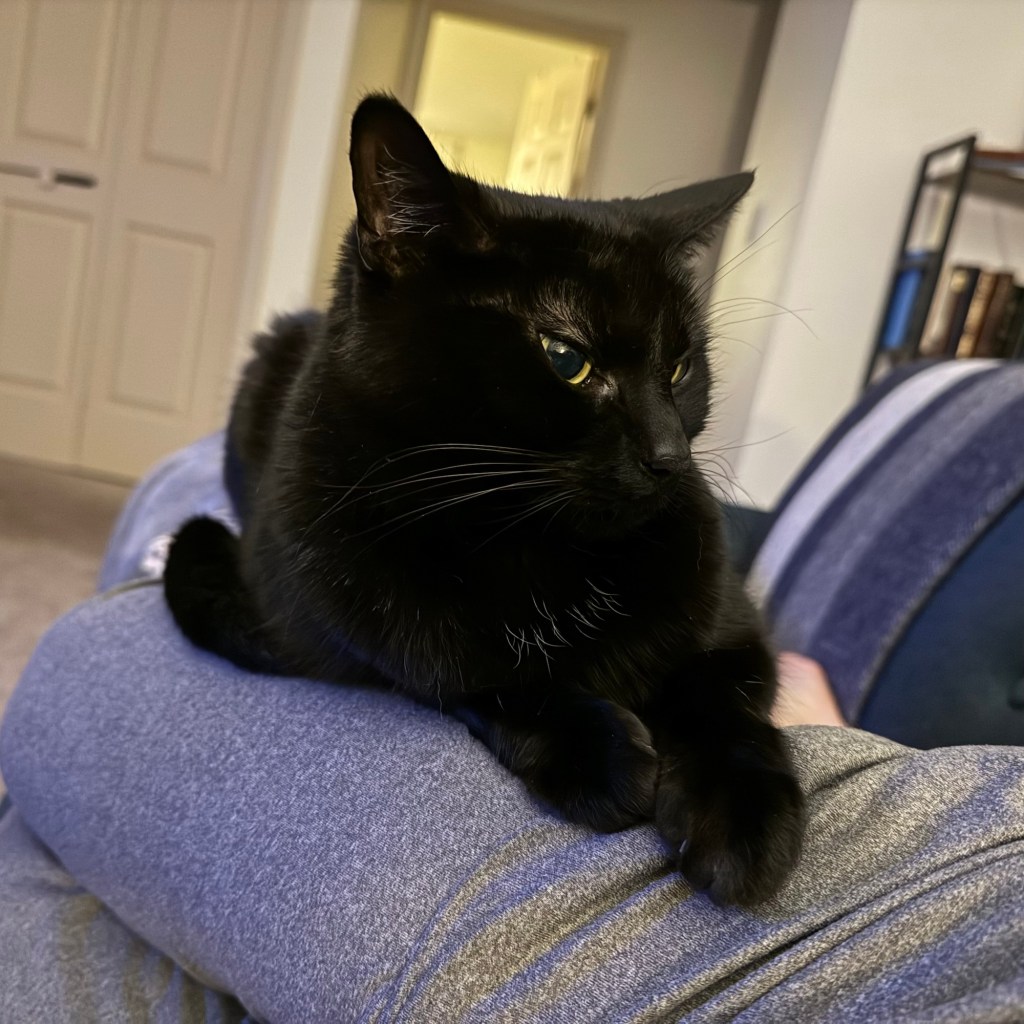
She looks a bit aggravated, but it’s only because I stopped rubbing her head to take her picture.

National Cookie Day

Today’s is December 4th, National Cookie Day. Growing up, I remember my mother baking cookies throughout the month of December for different holiday parties and get togethers. When I was in elementary school and we still had a Christmas party, everyone would bring some kind of treat. Our fellow students would only allow me and my sister to bring one thing: Mama’s cookies. They were basic cookie recipe from the Betty Crocker Cookbook with icing on them. I never thought there was much special about them, but everyone else seemed to love them. I much preferred my mother’s pecan cookies or her snowball cookies, which were my favorite. (See recipe below.)
We can thank the Dutch for more than windmills and tulips. The English word “cookie” derives from the Dutch word koekie, meaning “little cake.” Hard cookie-like wafers have existed for as long as baking has been documented. Not surprisingly, they traveled well, too. However, they were usually not sweet enough to be considered cookies by modern-day standards. The origin of the cookie appears to begin in Persia in the 7th century, soon after the use of sugar became common in the region. They then spread to Europe through the Muslim conquest of Spain. Cookies were common at all levels of society throughout Europe by the 14th century, from the royal cuisine to the street vendors.
Cookies arrived in America in the 17th century. Macaroons and gingerbread cookies were among the popular early American cookies. In most English-speaking countries outside of North America, the most common word for cookie is “biscuit.” In some regions, both terms, cookies, and biscuits are used.
To celebrate National Cookie Day, pick up some cookies at your local bakery and share some of your cookies with your family and friends! A great way to get started is by making a list of your favorite cookies to bake and enjoy. Then organize your baking tools and start your assembly line.

Snowball Cookies
Prep Time: 30 Min
Cook Time: 15 min
Servings: 60
Ingredients
• 1 cup unsalted butter, softened
• ½ cup powdered sugar
• 1 teaspoon vanilla extract
• 2 ¼ cups all-purpose flour
• 1 cup very finely chopped pecans
• ¼ teaspoon salt
• ⅓ cup powdered sugar, or more as needed
Preparation Steps
1. Gather all ingredients. Preheat the oven to 350 degrees F (175 degrees C).
2. Beat butter, 1/2 cup powdered sugar, and vanilla with an electric mixer in a large bowl until smooth.
3. Gradually mix in flour, pecans, and salt until completely incorporated.
4. Roll dough into walnut-sized balls and place 2 inches apart onto ungreased baking sheets.
5. Bake in the preheated oven until bottoms are light golden brown but tops are still pale, 12 to 15 minutes. (Try not to let cookies get too brown: it’s better to undercook them than to overcook them.)
6. Remove cookies from the oven and let sit on the baking sheets briefly before removing to wire racks.
7. Place 1/3 cup powdered sugar in a shallow bowl; roll hot cookies in sugar to coat, then return to the wire racks to cool.
8. Once cooled, roll cookies in the powdered sugar once more.
Note
Snowball cookies are incredibly easy to make for rich and buttery, melt-in-your-mouth festive treats rolled in powdered sugar to resemble snowballs.
Nutrition
Calories: 63 kcal
Fat: 4 g
Saturated Fat: 2 g
Unsaturated Fat: 0 g
Cholesterol: 8 mg
Sodium: 9 mg
Carbohydrates: 6 g
Fiber: 0 g
Protein: 1 g
Source URL
https://www.allrecipes.com/recipe/11171/snowballs-ii/


Authors
Recent Comments
vandycolt on The Luxury of No Plans iameverywhere1 on Road Trip Prep iameverywhere1 on Pic of the Day vandycolt on Pic of the Day Steve Davis on A Queen Was Born Top Posts & Pages




Amazon Associate

As an Amazon Associate I earn from qualifying purchases. So, if you click on a link that takes you to Amazon.com, I may earn a commission.
Trust me, it isn’t much, but every little bit helps.

 Joe
Joe


 The Closet Professor