Monthly Archives: August 2010

Coming Out: The Urges

Once I admitted to myself that I was gay, I decided that I had to come to terms with it more than just admitting it. I was lonely and wanted to find a boyfriend. This search still continues. Here is the last of the poems I wrote during this period.

The Urges

My heart aches,
My stomach churns,
My loins burn,
My head spins.
What are these symptoms of?
I have an itch
That cannot be scratched
If I only knew what was wrong
It happens when I see the beauty.
I either go mute or return to a stutter.
I tremble and quake and my nerves are shot to hell.

The agony of it.

I guess when I look back on retrospect, I was just horny as hell.

I apologize to all my readers for the lack of posts this week. I have been incredibly busy with my new job. That will probably continue for the next few weeks, but I will try to at least post once a day. I still have a few more in the coming out series that I will attempt to post in the next few days. Then we will be back to history, culture, art, and politics. Please stay tuned.


Coming Out to My Parents

Most of the text of this post come from my Father’s Day post on Cocks, Asses, and More.  However, parts of this post are relevant to my Coming Out series and also to the last of my poetic posts that I will have up tomorrow.

I know there are at least a few dads out there who read my blog, so I also wanted to tell you about my father.  Just like mothers, fathers can drive us crazy.  Most of us may not have been as close to our fathers as maybe we should have been or should be, but all of us have a father somewhere. 

We are very different in so many ways.  He is very outdoorsy: he hunts, he fishes, and constantly works outdoors.  I was always a bookworm, who liked books better than sports.  I’ve learned to like the outdoors:  I walk nature trails, I like to hike, and I even like to fish occasionally.  Whereas my father worked outside all his life, I prefer to work inside, research, writing, teaching, etc.  There are a lot of other differences as well.  We can generally have a conversation for about 15-20 minutes before we get into some type of argument.  My father has never felt I was right about anything.  I can be agreeing with him, and he will fuss at me for agreeing with him.  No matter what I say, he will say the opposite.  The other day, I made a remark about a house being painted white (it used to be gray), he argued with me that the house was painted gray, just a lighter shade.  Everyone else I know says the house is white, but he still says that it is gray.  It’s that sort of thing that drives me crazy.  Needless to day, we barely get along.  I love him nonetheless, I just don’t like him sometimes.  He can be very cruel and frustrating.

To switch gears a little bit, I want to tell you also how great my father can be, without me ever knowing it.  This is part of the reason that I forgive so much of the misery he causes me.  When my parents found out I was gay, it was a very traumatic experience for all concerned.  My mother had suspected for quite a while and was being very nosy.  She checked my email.  She didn’t like some of the emails that she saw.  Most of them, if not all, were fairly innocent, but there were some like an ad from Showtime about “Queer as Folk” and maybe another one from gay.com. I was over at my grandmother’s checking on her, when my mother called me and confronted me about it.  I was tired of denying it.  All of my friends knew, so why shouldn’t she.  I knew she wouldn’t like it.  She had confronted me several years before about it, and I denied it then.  I wasn’t ready, and to make sure that I never was, my mother told me, “If you would rather have a dick up my ass, then be part of this family, then get the hell out and go ahead and leave.  We will have nothing more to do with me.”  When this time came around, we got into a huge argument.  I yelled, she yelled, and I left.  I was still dependent on them for some things, but I could live without them.  My mother went to bed and cried for the next two weeks.  BTW, this all happened two days before Christmas, while I was home on Christmas break.  We still went to all the Christmas events with our family, but I refused to talk to my mother.  When my father got home the day all this happened, he talked to my mother about what was wrong.  She told him.  She tells him everything. This was one of the times when he sided with me.

He told my mother, that I was their child.  She could not stop loving me, just because she did not agree with my lifestyle. He would continue to love me, and she would have to do the same.  No matter what his children did, they would still love them (it may have helped that my sister married a complete and total jackass, who doesn’t physically abuse her, but abuses her mentally).  Then he  came and talked with me.  He told me that he didn’t care what I told my mother, but to tell her something or she would die in that bed in there (you don’t know my mother, but she would have).  Then he told me what surprised me the most, “I should have taught you how to fight the urges.  I am sorry that I failed you.”  It is the only time my father ever apologized to me for anything.  I never asked about the urges, but I am pretty sure I know what he was talking about.  He knew exactly how I felt.  He had been there himself, but he had chosen a different path.  Maybe that is why they still believe it is a choice.  But I see the misery in him almost everyday.  I went to my parents and told them both that I was celibate and would remain that way, and I had never acted on my sexuality (yes it was a lie, but it was one I think was and still is for the better).  They made me promise that I would not tell anyone else in the family, and I have agreed to that. Our family has become a “Don’t ask, don’t tell, don’t discuss” Zone.  It is not my preference but it is what I must deal with for the time being.  If I ever find a man to live my life with, I will deal with the other consequences then.  I don’t think I could hide from my family the love of my life (if he ever comes along).

They still consider my being gay a lifestyle choice, I never will.  I would have never chosen this myself.  I would have chosen to live a more open life, but that is mostly not possible where I live now, and especially not with my job.  But I know what makes me happy, and after a lot of prayer and meditation, God told me that love is what matters most in this world.  I came to understand that if I lived a lie and married a woman, I would make her and my life miserable (somewhat like my father has).  If I was going to be alone, then I would be alone. At least I wouldn’t be hurting someone else.  I realize that some people had more pressures to get married and have a family and come out later in life.  I do not fault them for that, it was a different time and different circumstances.  But in this day and age, I felt I could not lie to myself or anyone else and spend a large portion of my life as a lie.

I had been thinking of posting this on this blog for a few days now, but something happened today that really pissed me off and I was forced to just shrug it off.  If I calm down enough to write about it in a sensible way, I will.  I will say this though, discrimination, small town attitudes, and fucked up conservative values are a pain in the ass.  I will never understand why a person who is a good person (which I most certainly am, I strive everyday to treat people they way I want to be treated, even if they don’t always treat me that way).  We should all accept people for who they are and what they are.  See them as a person, not a label.


Coming Out: Acceptance

As I struggled with my sexuality, I did the only thing I could think to do. I did what I had been taught to do in times of trouble and decision (not that it really was a decision). I prayed and meditated. For months on end (and even years), I had sleepless nights as I prayed and meditated for guidance. Finally, the answer came. From that answer came this poem, the third in the series.

Acceptance

I am who I am, that cannot change.
I do what I do, only I can decide.
I ask for guidance, God guides me.
I pray for a path, that is what I follow.
I hate no one, but I do not love all.
The path tells me who I am;
The path shows me what to do;
The path guides me in the shadows.
The wide path is hatred;
The narrow leads to love.
I pray and the path is cleared.

As I was unpacking after my move to my new house, I found a sort of diary that I wrote several years ago. Inside were three poems that I wrote about my feelings concerning coming out. A commenter on Cocks, Asses, and More the other day said that he would like to hear more about me and my coming out. I responded that I planned on doing that on this blog. When I began writing these blog posts, I was originally going to give an introduction to one of those poems, but it grew more into a personal history of my struggle with my sexuality. Also, I decided to let the words speak for themselves. So these four or five coming out posts will not contain any pictures or images (at least that is the plan at this point).


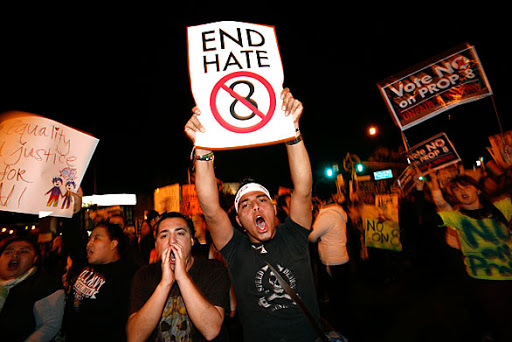
Equality California Hails Historic Federal Court Decision to Overturn Prop. 8

Federal court deems marriage ban unconstitutional

San Francisco, California –Today the U.S. federal district court overturned Proposition 8 on the grounds that the ban prohibiting same-sex couples from marrying is unconstitutional. The case now moves to the Ninth Circuit Court of Appeals.

In response to the ruling, Geoff Kors, executive director for Equality California, which filed an amicus brief supporting the Prop. 8 federal challenge, issued the following statement:

“We are thrilled with today’s ruling, which affirms that the protections enshrined in our U.S. Constitution apply to all Americans and that our dream of equality and freedom deserves protection. Judge Walker has preserved our democracy by ruling that a majority cannot deny a minority group of fundamental freedoms. This is as much a victory for the soul of our nation as it is for the thousands of same-sex couples and their families who will be directly impacted.

“We are truly indebted to Ted Olson and David Boies and to the American Foundation for Equal Rights. We owe Governor Schwarzenegger and Attorney General Jerry Brown a great deal of gratitude for their unprecedented decision not to defend this discriminatory measure. While this is a great success, we also know that the road to restore the freedom to marry could be a long one and that we must do everything in our power to protect this incredible victory. Equality California will do its part by working to elect a governor and attorney general this fall who refuse to spend tax-payer dollars to overturn this decision. We are also ready to battle the National Organization for Marriage this fall to keep their toxic agenda out of our state.

“Finally, together with thousands of volunteers we will keep sharing our stories in communities throughout California so that we continue building public support for the freedom to marry, which is essential to permanently restoring marriage equality in California.”

This was originally posted on WichedGayBlog.com.  However, one of the things I wanted to be able to do on this blog was to do political posts, and I thought this was a good time to start.  I don’t live in California, so I really don’t think I can adequately speak for the ruling today about Prop 8.  I do think it is a step in the right direction, but I do not hold a great deal of faith in where this will ultimately end up, i.e. the US Supreme Court.  I hope that I am underestimating the Supreme Court.


Coming Out: “Feelings of Betrayal”

This is the second poem in this series. This poem was written near the point in my journey when I was finally beginning to come out to myself but was still struggling, trying not to admit that I was gay.

Feelings of Betrayal

Betrayal,
The mind so often does
It thinks the sinful thoughts
It wanders to the forbidden world
The world I cannot have
It fails me at times
The times I need it most
The thoughts ache
But can bring such pleasure
Betrayal, Betrayal.

Betrayal,
My hear has betrayed so many
It has been betrayed by many
The prayers for the betrayals to end
The mind is the most sinful of the organs
Mind and manhood,
Heart and appendage
Betrayal, Betrayal.

Betrayal,
The organ of pleasure
I had not yet failed
One day to agony it may
Youth and vigor keep it alive
Heart and soul,
Mind and man,
Betrayal, Betrayal.

Betrayal,
Eruptions of enjoyment
A sin in itself
Spilling the seed to prevent a sin
The agony of not acting on readiness
To stop one
Begin an unfair sin
Betrayal, Betrayal.

Betrayal, Betrayal.
Ultimate Betrayal
Forgiven Betrayal
Uncontrollable Betrayal
Aching Betrayal
Pleasurable Betrayal
Unfair Betrayal Betrayal one in all
Betrayal all in one
Life’s many betrayals
Betray, betray
The Betrayal of Life.

As I was unpacking after my move to my new house, I found a sort of diary that I wrote several years ago. Inside were three poems that I wrote about my feelings concerning coming out. A commenter on Cocks, Asses, and More the other day said that he would like to hear more about me and my coming out. I responded that I planned on doing that on this blog. When I began writing these blog posts, I was originally going to give an introduction to one of those poems, but it grew more into a personal history of my struggle with my sexuality. Also, I decided to let the words speak for themselves. So these four or five coming out posts will not contain any pictures or images (at least that is the plan at this point).


This Is the Job I Want…

image

Read his shirt…Not only that, but French men have the best asses.

-The Closet Professor (AKA JoeBlow)


Coming Out: “Am I, or Am I Not?”

This is the first of the poems I wrote as a way to figure out my sexuality. A warning, I am not a great poet, but it does represent my feelings at the time before I came out even to myself.

Am I, or Am I Not?

I love to look,
I love to watch
But it is forbidden.
I have never acted.
Acting would mean banishment
A loss of all that I know and love
I would feel so safe, but
Yet I would feel such danger.
The eminent danger of a slow agonizing death.

What should I do?
I leave that to God.
Yet he forbids it most according to St. Paul.
I have acted in the opposite,
But that too is sin.

What can I do?
No one can answer.
I live a lie, but both must not be an option.
The curves, the beauty, the caress.

Am I acting or another?
Which can it be?
Who can I trust?
Only intoxication allows trust.
The agony of decision.
To forever e damned by what
I love for who I love.

Oh, how I ache.
Praying for an answer
I already know
Praying for forgiveness of urges
Prayers to move toward the light.

What shall I do?
I love all
I fear all
This cannot be
Though it is
Purification, meditation, prayer,
Purity, harmony, peace,
Hypocrisy, prudence, piety.

The church is the one true love
That beckons without remorse.
Can I follow that path and not be a heretic?
I doubt it,
I don’t know.
Where are the answers?
Where is the happiness?
God, please, guide me.
Show me the righteous way.

As I was unpacking after my move to my new house, I found a sort of diary that I wrote several years ago. Inside were three poems that I wrote about my feelings concerning coming out. A commenter on Cocks, Asses, and More the other day said that he would like to hear more about me and my coming out. I responded that I planned on doing that on this blog. When I began writing these blog posts, I was originally going to give an introduction to one of those poems, but it grew more into a personal history of my struggle with my sexuality. Also, I decided to let the words speak for themselves. So these four or five coming out posts will not contain any pictures or images (at least that is the plan at this point).


A Midsummer Night’s Dream

image
Puck’s soliloquy from the last lines of A Midsummer Night’s Dream, a comedy by William Shakespeare, is one of my favorite lines from any of Shakespeare’s plays.

If we shadows have offended,
Think but this, and all is mended,
imageThat you have but slumber’d here
While these visions did appear.
And this weak and idle theme,
No more yielding but a dream,
Gentles, do not reprehend:
if you pardon, we will mend:
And, as I am an honest Puck,
If we have unearned luck
Now to ‘scape the serpent’s tongue,
We will make amends ere long;
Else the Puck a liar call;
So, good night unto you all.
Give me your hands, if we be friends,
And Robin shall restore amends.

image In his essay “Preposterous Pleasures, Queer Theories and A Midsummer Night’s Dream“, Douglas E. Green explores possible interpretations of alternative sexuality that he finds within the text of the play, in juxtaposition to the proscribed social mores of the culture at the time the play was written. He writes that his essay “does not (seek to) rewrite A Midsummer Night’s Dream as a gay play but rather explores some of its ‘homoerotic significations’ … moments of ‘queer’ disruption and eruption in this Shakespearean comedy”. Green states that he does not consider Shakspeare to have been a “sexual radical”, but that the play represented a “topsy-turvy world” or “temporary holiday”image that mediates or negotiates the “discontents of civilization”, which while resolved neatly in the story’s conclusion, do not resolve so neatly in real life. Green writes that the “sodomitical elements”, “homoeroticism”, “lesbianism”, and even “compulsory heterosexuality” in the story must be considered in the context of the “culture of early modern England” as a commentary on the “aesthetic rigidities of comic form and political ideologies of the prevailing order”. Aspects of ambiguous sexuality and gender conflict in the story are also addressed in essays by Shirley Garner and William W.E. Slights (see citations below).

Garner, Shirley Nelson. “Jack Shall Have Jill;/ Nought Shall Go Ill“. A Midsummer Night’s Dream Critical Essays. Ed. Dorothea Kehler. New York: Garland Publishing Inc., 1998. 127–144
Slights, William W. E. “The Changeling in A Dream”. Studies in English Literature, 1500–1900. Rice University Press, 1998. 259–272.

If you love a good gay movie, musicals, cute guys, and/or Shakespeare, here is a suggestion for you. Indie movies are definitely not for everyone. In other words, specific movies tend to appeal to specific groups. Were the World Mine will obviously appeal to a gay audience, but also to people who are into Shakespeare, as it is fun and often ridiculous – just like the Bard’s play.

What Is It About?

image Were the World Mine was based on a short film entitled Fairies. The movie’s protagonist is Timothy (played by Tanner Cohen), a gay outcast at a prep school in a small town somewhere in America. He loves to daydream, and his daydreams always feature musical sequences and beautiful scenery. The object of his daydreams is Jonathan (played by Nathaniel David Becker), the star jock of the school. It is not long before Timothy gets involved into a school drama project, starts exploring Shakespeare and finds a recipe for the magical love potion in A Midsummer Night’s Dream – which allows him to turn the entire town gay.
Read more at Suite101: Were the World Mine Movie Review: An Indie Retelling of Shakespeare’s A Midsummer Night’s Dream.
Cupid’s Love Spell from A Midsummer Night’s Dream
OBERON

That very time I saw, but thou couldst not,
Flying between the cold moon and the earth,
Cupid all arm’d: a certain aim he took
At a fair vestal throned by the west,
And loosed his love-shaft smartly from his bow,
image As it should pierce a hundred thousand hearts;
But I might see young Cupid’s fiery shaft
Quench’d in the chaste beams of the watery moon,
And the imperial votaress passed on,
In maiden meditation, fancy-free.
Yet mark’d I where the bolt of Cupid fell:
It fell upon a little western flower,
Before milk-white, now purple with love’s wound,
And maidens call it love-in-idleness.
Fetch me that flower; the herb I shew’d thee once:
The juice of it on sleeping eye-lids laid
Will make or man or woman madly dote
Upon the next live creature that it sees.
Fetch me this herb; and be thou here again
Ere the leviathan can swim a league.

PUCK

I’ll put a girdle round about the earth
In forty minutes.

OBERON

Having once this juice,
I’ll watch Titania when she is asleep,
image And drop the liquor of it in her eyes.
The next thing then she waking looks upon,
Be it on lion, bear, or wolf, or bull,
On meddling monkey, or on busy ape,
She shall pursue it with the soul of love:
And ere I take this charm from off her sight,
As I can take it with another herb,
I’ll make her render up her page to me.
But who comes here? I am invisible;
And I will overhear their conference.

If you could have potion that could turn someone you have a crush on or are in love with gay, would you use it? Seriously, now. I am not talking about just on a whim. You would be changing this person’s life. Would you do it to satisfy your own happiness, even though it might not satisfy their own?


Coming Out: The Struggle

As I was unpacking after my move to my new house, I found a sort of diary that I wrote several years ago.  Inside were three poems that I wrote about my feelings concerning coming out. A commenter on Cocks, Asses, and More the other day said that he would like to hear more about me and my coming out.  I responded that I planned on doing that on this blog.  When I began writing this blog post, I was originally going to give an introduction to one of those poems, but it grew more into a personal history of my struggle with my sexuality.  Also, I decided to let the words speak for themselves.  So these four or five coming out posts will not contain any pictures or images (at least that is the plan at this point).

Before I came out, even to myself, I knew I had an attraction to other men.  I just did not know what it meant.  I know that I was naive back then, but I honestly did not know better.  I was struggling.  I was struggling with my faith in God.  I was struggling with the morals and beliefs I was reared to believe in.  I was struggling with my identity.

I was raised in a strictly moral household, one that was centered on the beliefs of my family and my church.  Being gay was never presented as an option.  Gay people were immoral, sinful, evil, promiscuous sissies, who were of the dregs of society and they were all going to die of AIDS.  This is what I was taught to believe.  I never once heard anything good about gay men or women.  I was taught instead hate, fear, and misunderstanding.

My parents had certain expectations of me.  I had bucked them a few times.  I refused to play football, but they forced me to play basketball and run track.  I was never athletic or coordinated, and I was generally an embarrassment to myself and my team.  However, my parents forced me onward.  I hated every minute of it.  Never once did I derive any joy from playing sports in high school. My parents also expected me to go to college, to marry the right girl, and produce grandchildren for them.

There was one problem with the last part.  I felt comfortable having girls as friends, but not as girlfriends.  I just had very little interest in the female sex.  Sexually, I found men very exciting, but I knew I could not act on it. I would become a pariah and even more of an embarrassment for my family.  I was already not manly enough for them.  I wasn’t, nor have I ever been a total queen (except maybe when I am very drunk, LOL), but I wasn’t the manly man they wanted as a son.  I preferred books to hunting.  I preferred books to sports.  I lost myself in my books.  I could live whatever life I wanted, as long as I had a good book to transport me to a different world.  I remember one summer in high school, I spent the whole summer reading every book Sidney Sheldon had written.

Because I thought it was expected, I tried to fall in love with a girl.  In a way, I was probably successful, but she was very much a tomboy.  It was a sex week romance over a summer in high school, when I went to a pre-college summer honors program at the big state university.  I knew I wanted to lose my virginity; I just always assumed that it would be with my slutty best female friend.  It wasn’t.  One night we were out on the quad, sitting and chatting, when I said, “I want to ask you something…”  To which she replied, “Let me guess, you want to have sex with me.”  It was most certainly not what I was going to ask, but she put the idea into my head.  So I agreed that this was what I wanted to ask her.  From that point on, I pursued the issue.  Finally, she gave in.  We went and bought condoms, to my horror (few times in my life have I ever been as embarrassed as that first time I bought a condom).  We drove to a nearby lake where no one was around and began to fool around.  We undressed partially, and I put on the condom.  As I began to enter her, the condom broke. (I did not know at the time about getting a size large enough to fit correctly.)  We decided it was an omen, that this was not meant to be.  So we left.  There were leaves all in my clothes when I got back.  A few days later she relented, and we tried again.  This time it was just as awkward.  We tried several positions, but I just could not seem to get inside her.  Finally, she climbed on top and lowered herself down on me.  It did not last very long, and then our virginities were gone.  All as Kiss From A Rose by Seal played continuously on the CD player in her dorm room.  I still have mixed emotions when I hear that song.

Then the summer was over.  She went back home and so did I, but we were two states apart.  This was before email was common (1995), and so we wrote back and forth in letters to each other. But the relationship finally fizzled out.  Recently, I found her on Facebook, but I haven’t had the nerve to “friend” her, especially, since she is now married.  I would hope she would remember me.  Don’t people always remember their first time?

When I returned home, my best friend was there waiting on me.  Of course, I told her that I lost my virginity, and in less than a week she wanted to have sex with me.  She had not wanted to be the one to take my virginity, but now that I was no longer a virgin, I was fair game in her book.  The first time, I refused, she got very angry, and kicked me out of her house.  We had been best friends for ten years, and I thought I had lost her. A few days later, I was at her house again, and she did not give me the option of saying no.  She took the lead.  Pushed me on the floor, undid my pants, and lowered herself on me.  I have always felt like I was raped, or at least manipulated into having sex with her.  I was seventeen, and everything at that age gave me an erection, so the only way of refusing was simply saying no.  I was not about to hurt her and get her off of me.  I was raised to be far to polite to refuse again.  I know this might sound odd, but this is how I have always felt.  We had sex that one time, and never again.  By the way, a few things about this girl: she was beautiful, very feminine, and had a boyfriend at the time.

I went home afterwards and took a long, long shower.  Even after the shower, I still felt dirty.  It is very hard for me to think about this, because it was a situation that I have struggled with for many years.  After that incident, I dated three other girls, none of those relationships went well. However, I have remained friends with one of those girls.  We did have a good time together. All the girls had a good time with me, but after the third, the struggle with my sexuality became a much tougher struggle, and I chose not to date women anymore after that.  I had basically decided that I would not date a woman and lead her on, knowing it would come to nothing.  It is at this point that I began to truly struggle with my sexuality.

During the next three phases of my coming out journey, I wrote three different poems.  They will be published in posts over the next few days.  I am not a great poet, so don’t expect anything great but the poems do trace my struggles with coming out, and I hope it will be relevant to someone.


Stefan George

Stefan George

Stefan George (1868-1933)

The German poet Stefan George was born in 1868 in the village of Büdesheim near Bingen, a small but ancient town on the Rhine. In 1873 his family moved to Bingen, where his father, who had first been an inn-keeper, became a successful wine-merchant. From 1882 to 1888 George attended the grammar school in Darmstadt. During the following two years, his first journeys abroad led him to London, Italy and most notably to Paris, were he met the poets of the French symbolism, above all Stéphane Mallarmé, who became the model for the beginning of George’s literary career. The literary situation in Germany at the time was dominated on the one hand by a shallow classicism, on the other hand by a gross naturalism, both of which were equally repelling to George. Mallarmé’s programme of pure poetry’ without any social relevance, his conviction that the Orphic interpretation of the earth is the only task of the poet’ and that everything that is sacred and wants to stay sacred veils itself into mysteries’, was like a revelation and quite appealing to the young George. From 1889 on he was registered for three terms at the University of Berlin, but attended only a few lectures. By the time of the publication of his first volume of poems in 1890 he had already assumed the life style that he was to keep up until his end. Never living in a home of his own – not because he could not have afforded it, as he had inherited a sufficient fortune from his parents, but because of the way he saw himself – he would stay as a guest of his friends and admirers in Berlin, Munich, Heidelberg, Basel, or else traveled abroad, mostly in Italy and in Paris. He avoided all publicity, and his books were only privately published. Moreover, he underlined the esoteric character of his writings by certain orthographic peculiarities and a special ornamental typography.

George’s subsequently famous Kreis (Circle) of like-minded friends was beginning to rally about the same time. Still it consisted mostly of fellows of about his own age treated as equals, as distinguished from the later situation, when George was the august master venerated by much younger disciples.

Hugo von HofmannsthalThough, to all appearances, George was of an almost exclusively homoerotic inclination, there is no indication that he ever went beyond the Platonic concept of spiritual guidance and aesthetic contemplation – to which he adhered doubtless partly out of mere social convention, but also for artistic discipline. Nevertheless, sometimes the strong emotions George displayed in his relationships to young men could be disturbing to them, as it is documented in the case of Hugo von Hofmannsthal. George was himself only 23 when he met the still younger but precocious Austrian poet, who was 17 then. It is not really clear what happened, but evidently their relations were troubled, though they kept up a correspondence for some years. Also another friendship of George that had been initially more successful ended in dissonance, when the Friedrich GundolfGermanist Friedrich Gundolf whom George had mentored as a teenager, and who had become his most ardent apostle, as a man in his late thirties insisted on marrying despite George’s disapproval.
What proved to be George’s most passionate, most ill-fated and poetically most fruitful love affair began in 1902, when he approached a boy in a street of Munich: Max Kronberger, a 14-year-old grammar-school student, felt flattered when a man he had noted before asked his permission to sketch his ‘interesting’ head. On the next day George succeeded in taking a photograph of the boy, but it seems that thereupon George’s courage failed him, as he did not try to meet the boy again for almost a year. At the time of their next accidental meeting in the street, Kronberger found out that George was a poet and, since his respectable parents agreed, they saw each other regularly from then on, in a relationship not always free from tension. However, Kronberger died of an acute disease on the day after his sixteenth birthday. What followed was a poetical glorification which was sometimes compared to the literary monument erected by Dante for Beatrice, but resembles rather the deification bestowed by Hadrian on Antinous, in a somewhat different way owing to the difference of times and circumstances, of course.

Your eyes were dim with distant dreams, you tended
No more with care the holy fief and knew
in every space the breath of living ended –
Now lift your head for joy has come to you.

The cold and dragging year that was your share,
A vernal tide of dawning wonders bore,
With blooming hand, with shimmers in his hair
A god appeared and stepped within your door.

Unite in gladness, now no longer darkened
and blushing for an age whose gold is flown:
The calling of a god you too have hearkened,
It was a god whose mouth has kissed your own.

You also were elect – no longer mourn
For all your days in unfulfilment sheathed…
Praise to your city where a god was born!
Praise to your age in which a god has breathed!

This forced gesture and overdone interpretation twisted everything George wrote looking back on his love for Maximin. His spontaneous feelings for an adolescent are better expressed in the verses that he, again in love, in 1905 addressed to the 14-year-old Hugo Zernik:

My child came home
The sea-wind tangled in his hair,
His gait still rocks
With conquered fears and young desires for quest.

The salty spray
Still tans and burns the bloom upon his cheek:
Fruit swiftly ripe
In savage scent and flame of alien suns.

His eyes are grave
With secrets now, that I shall never learn,
And faintly veiled,Since from a spring he came into our frost.

So wide the bud
That almost shyly I withdrew my gaze,
And I abstained
From lips that had already chosen lips.

My arm enclasps
One who unmoved by me, grew up and bloomed
To other worlds –
My own and yet, how very far from me!

George not only turned Maximin into a myth, but also used him as figurehead for his new aims, as expressed in his most ambitious poetry, contained in the volume Der Siebente Ring, (The Seventh Ring) of 1907. Now George’s programme was no longer art for art’s sake, but a political vision formed in opposition to a time and society he considered vile and decayed, a spiritually void world of mean commercial utilitarianism and brutal power-politics garnished with decorative phrases.

George, who had been opposed to the reality of the Prussian-dominated German Empire, as contrasted with his idea of Germany, was not carried away by the storm of enthusiasm at the outbreak of the First World War in 1914, and felt rather confirmed by the defeat of 1918. In the turmoil of the post-war years, George became the lodestar of the most idealistic part of the young generation, as represented by Klaus MannKlaus Mann (born in 1906), who remembered later that “my admiration for him was boundless. I saw him as the leader and prophet, the Caesarean priestly figure as he presented himself. Amidst a rotten and barbarous civilization, he embodied human and artistic dignity, uniting discipline and passion, grace and majesty. Each of his gestures was of an exemplary, programmatic character. He stylized his own biography like a myth: his romance, the boy Maximin, was the core of a philosophy that was a revelation to the circle of disciples. — The reunification of morals and beauty seemed to have been realized in the mystery of Maximin. Here I found the reconciliation of Hellenic and Christian ethos. Stefan George’s ordering mind had – or so did I believe – solved the fundamental conflict that Heinrich Heine analyses with intuition and perspicacity, that reigns as tragic leitmotiv over the works of Friedrich Nietzsche. — My youth venerated in Stefan George the Templar whose mission and deed is described in his poem. When the black wave of nihilism was threatening to devour our culture, he arrived, the militant seer and inspired knight.”
At the surface, there were doubtless some similarities between George’s Maximinprogram of a hierarchic reformation based upon a new aristocracy of mind and spirit, and the ideologies of the fascist movements as they were beginning to flourish in several European countries during the nineteen-twenties. Though to him, for his attitude and sentiments, it was impossible to identify his cause with the Nazism that was to take over Germany, the ambiguity became clear in 1933, when some of his followers embraced the upheaval wholeheartedly, while others, like his oldest companion, the Jewish poet Karl Wolfskehl, were forced to emigrate. George himself, who was already fatally ill, declined all honors by which the new rulers tried to gain his support, and, silent but demonstrative, left Germany to end his life elsewhere. He died on the 4th of December 1933, in Locarno, Ticino, Switzerland.

Editorial Board, World History of Male Love, “Famous Homosexuals”, Stefan George, 2000 <http://www.gay-art-history.org/gay-history/gay-literature/famous-homosexuals/stefan-george-gay/stefan-george-gay.html>