

Monthly Archives: May 2013
Doctor Dumbass

When I think of my profession, first and foremost, I am an historian. I’m also a teacher, who wants to share his knowledge of history. Currently, I teach high school, mainly because college jobs are hard to find. I honestly don’t think that once I complete my PhD that the job market will be much better for history professors, which is why a news article I read yesterday pisses me off so much. Harvard history professor Niall Ferguson recently made what I consider some idiotic remarks. At a May 2013 investment conference in Carlsbad, California, Ferguson was asked about his views on economist John Maynard Keynes‘s quotation that “in the long run we are all dead.” Ferguson implied that Keynes was indifferent to the future because he was gay and did not have children.
Ferguson did post an apology for these statements shortly after reports of his comments were published, saying his comments were “as stupid as they were insensitive”. In the apology, Ferguson stated: “My disagreements with Keynes’s economic philosophy have never had anything to do with his sexual orientation. It is simply false to suggest, as I did, that his approach to economic policy was inspired by any aspect of his personal life.” However, how seriously can we take Ferguson’s apology. If you read his full apology “An Open Letter to the Harvard Community” in the Harvard Crimson, you will see that he does not back down from saying that Keynes’s homosexuality influenced his decision making, he just gives it a different twist this time. His apology sounds much more like when someone says, “Yeah, I was told to apologize, and though I should not have said it and I am ‘sorry,’ I was still right.”
Bruce Bartlett, an American historian whose area of expertise is supply-side economics and served as a domestic policy adviser to President Ronald Reagan and as a Treasury official under President George H. W. Bush, argued that right wing critics of Keynes have long used his homosexuality to “defame him and discredit his theories” and that Ferguson was simply the latest. Paul Harris, writing in The Guardian, suggested that Ferguson had borrowed his controversial view of Keynes from similar opinions expressed by historian Gertrude Himmelfarb and economist Joseph Schumpeter. Several commentators pointed out that the views Ferguson expressed on Keynes and his sexuality at the conference can be found in previous lectures and published work by Ferguson himself. Bartlett, among others has argued that Ferguson misunderstands Keynes’ view that one cannot simply ignore the short term in the interest of the long term.
I probably should backtrack a bit here for those not familiar with John Maynard Keynes. Keynes was a British economist whose ideas have fundamentally affected the theory and practice of modern macroeconomics, and informed the economic policies of governments. Keynes is most famous for Keynesian economics, which bears his name. Keynesian economics is an economic theory stating that active government intervention in the marketplace and monetary policy is the best method of ensuring economic growth and stability. Supporters of Keynesian economics believe it is the government’s job to smooth out bumps in business cycles.
As for Keynes’s personal life, his early romantic and sexual relationships were almost exclusively with men. At Eton and at Cambridge, Keynes had been in many homosexual relationships; significant among these early partners were Dilly Knox and Daniel Macmillan. Keynes was open about his homosexual affairs, and between 1901 to 1915, kept separate diaries in which he tabulated his many sexual encounters. Keynes’s relationship and later close friendship with Macmillan was to be fortuitous; through Dan, Macmillan & Co first published his Economic Consequences of the Peace. Attitudes in the Bloomsbury Group, in which Keynes was avidly involved, were relaxed about homosexuality. Keynes, together with writer Lytton Strachey, had reshaped the Victorian attitudes of the influential Cambridge Apostles; “since [their] time, homosexual relations among the members were for a time common”, wrote Bertrand Russell. One of Keynes’s greatest loves was the artist Duncan Grant, whom he met in 1908. Like Grant, Keynes was also involved with Lytton Strachey, though they were for the most part love rivals, and not lovers. Keynes had won the affections of Arthur Hobhouse, as well as Grant, both times falling out with a jealous Strachey for it. Strachey had previously found himself put off by Keynes, not least because of his manner of “treat[ing] his love affairs statistically.”
Ray Costelloe (who would later marry Oliver Strachey) was an early heterosexual interest of Keynes. Of this infatuation, Keynes had written “I seem to have fallen in love with Ray a little bit, but as she isn’t male I haven’t [been] able to think of any suitable steps to take.”
In 1921, Keynes fell “very much in love” with Lydia Lopokova, a well-known Russian ballerina, and one of the stars of Sergei Diaghilev’s Ballets Russes. For the first years of the courtship, Keynes maintained an affair with a younger man, Sebastian Sprott, in tandem with Lopokova, but eventually chose Lopokova exclusively. They married in 1925. The union was happy, with biographer Peter Clarke writing that the marriage gave Keynes “a new focus, a new emotional stability and a sheer delight of which he never wearied.” Lydia became pregnant in 1927 but miscarried. Ferguson at least had the good graces to acknowledge this fact in his “apology.”
Back to Ferguson, it is abhorrent to me that Harvard University, one of America’s most prestigious centers of learning, would employ someone such as Ferguson. However, Harvard is know for employing controversial historians, which in my opinion, Harvard should be ashamed of itself. Niall Ferguson is the worst kind of historian, one who is politically bent and has no sense of objectivity. It makes him one-sided and therefore not creditable. So as Leslie Winkle referred to Sheldon Cooper on The Big Bang Theory, so will I refer to Niall Ferguson as “Doctor Dumbass.”
Team Blake
I’m not much for reality TV, or the different contest shows, but every now and then I really get into one of these shows. This year it is The Voice on NBC. With Shakira and Usher replacing Christina Aguilera and Cee Lo Green, season four couldn’t be better. I’m also fully behind Team Blake, who has chosen some tremendous talent this year. If you aren’t a fan of The Voice, and you love great country music (I’m not a huge country music fan, but I love a great country song. There is some other music as well besides country.), then you should be watching The Voice. Coach Blake Shelton has chosen all country singers this year, and in my opinion, he should be blowing all of the rest of the competition out of the water. All of the judges have talented team members, but to me, none compare
to Blake’s. So, I will introduce them to you.
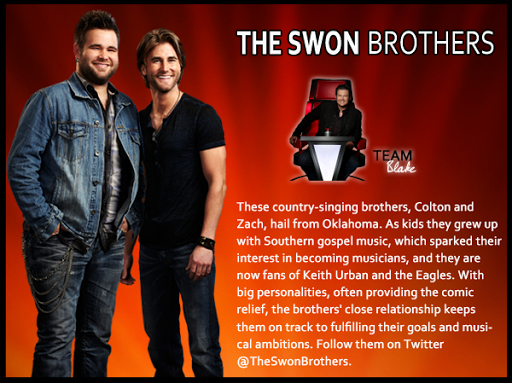
MY FAVORITE: The Swon Brothers
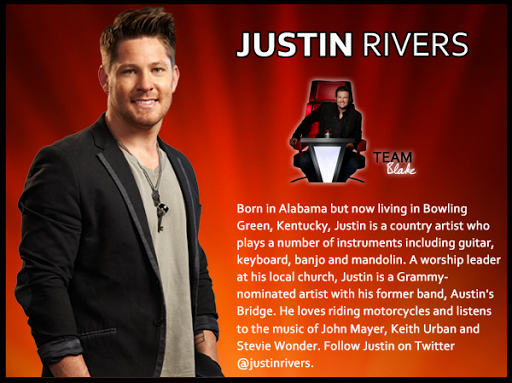
THE ALABAMA BOY: Justin Rivers
SWEET SIXTEEN: Danielle Bradbury

THE KNOCKOUT: Holly Tucker
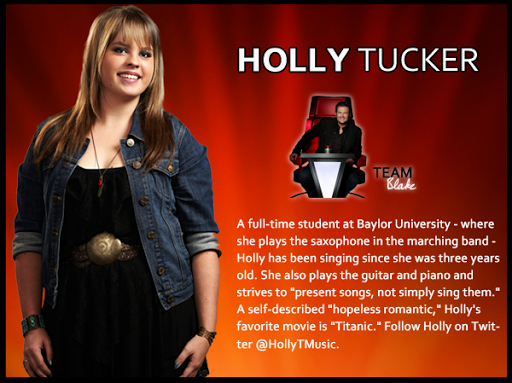
I don’t want to see any of Team Blake go, but one will be eliminated on tonight’s show. If I were to chose the one to go in this knockout round, it would have to be Holly Tucker. Colton and Zach to me are the strongest as The Swon Brothers. They have the energy and the talent, and as Shakira said last night, “There music is comforting.” As a fellow Alabamian, I have to also pull for Justin. He’s cute and has a star quality about him that can’t be denied. Danielle is going to be the darling of this competition. At only sixteen, she has a big voice, one that will take her far. Holly though just did not stand out that much for me. Blake chose great songs for his team and I wish them all the best tonight.
UPDATE: I can’t believe that America voted Holly Tucker as their favorite from Team Blake. Their second favorite was Danielle, leaving Blake to have to chose between Justin Rivers and The Swon Brothers. Blake chose The Swon Brothers. I hated to see Justin go.
Queer by Frank Bidart

Queer
by Frank Bidart
Lie to yourself about this and you will
forever lie about everything.
Everybody already knows everything
so you can
lie to them. That’s what they want.
But lie to yourself, what you will
lose is yourself. Then you
turn into them.
*
For each gay kid whose adolescence
was America in the forties or fifties
the primary, the crucial
scenario
forever is coming out—
or not. Or not. Or not. Or not. Or not.
*
Involuted velleities of self-erasure.
*
Quickly after my parents
died, I came out. Foundational narrative
designed to confer existence.
If I had managed to come out to my
mother, she would have blamed not
me, but herself.
The door through which you were shoved out
into the light
was self-loathing and terror.
*
Thank you, terror!
You learned early that adults’ genteel
fantasies about human life
were not, for you, life. You think sex
is a knife
driven into you to teach you that.
Frank Bidart
Frank Bidart was born in Bakersfield, California, in 1939 and educated at the University of California at Riverside and at Harvard University, where he was a student and friend of Robert Lowell and Elizabeth Bishop.
His first volume of poetry, Golden State (1973), was selected by poetRichard Howard for the Braziller Poetry series, but it wasn’t until the publication of The Sacrifice (1983) that Bidart’s poetry began to attract a wider readership. Bidart’s early books are collected in In the Western Night: Collected Poems 1965-90 (1990).
His recent volumes include Star Dust (Farrar, Straus and Giroux, 2005),Music Like Dirt (2002), and Desire (1997), which was nominated for a Pulitzer Prize, and was a finalist for both the National Book Award and the National Book Critic’s Circle Award. He is also the co-editor of Robert Lowell’s Collected Poems (2003).
About his work, the former U.S. Poet Laureate Louise Glück has said, “More fiercely, more obsessively, more profoundly than any poet sinceBerryman (whom he in no way resembles) Bidart explores individual guilt, the insoluble dilemma.” And about his career as a poet, she said, “Since the publication, in 1973, of Golden State, Frank Bidart has patiently amassed as profound and original a body of work as any now being written in this country.”
His honors include the Wallace Stevens Award, the Lila Wallace-Reader’s Digest Foundation Writer’s Award, the Morton Dauwen Zabel Award given by the American Academy of Arts and Letters, the Shelley Award of the Poetry Society of America, and The Paris Review‘s first Bernard F. Conners Prize for “The War of Vaslav Nijinsky” in 1981. In 2007, he received the Bollingen Prize in American Poetry.
Bidart was elected a Chancellor of the Academy of American Poets in 2003. He lives in Cambridge, Massachusetts, where he has taught at Wellesley College since 1972.
Gay and Southern

One of my readers, blog buddies, and a dear friend, Jay, sent me a link to an article about the realities of coming out in the South, and I wanted to share it with my readers. (“Coming Out in the South” by Damon M. Banks) My experience with coming out were much like those of the author of this piece. Before the ready access of the Internet, there were no sources of information to find. Yes, you might could find a book at the local library, but who wanted the librarian, who you either knew or your family did, to know you were checking out that kind of book. I remember when the book Midnight in the Garden of Good and Evil came out and I wanted to read it, so I checked it out of the library. When I began to read it and realized the number of gay characters in it, I was afraid of what someone might think of me reading it, so I immediately took it back. It was a few years before I had the courage to go back and read it.
came out and I wanted to read it, so I checked it out of the library. When I began to read it and realized the number of gay characters in it, I was afraid of what someone might think of me reading it, so I immediately took it back. It was a few years before I had the courage to go back and read it.Nowadays, if a kid wanted to read a book, they can just download it on one of their many electronic devices. If they have a question about homosexuality, they can Google it on their smartphone or any other Internet connected device. They can also use the Internet to connect with a wide range of people with similar interests on the many social networking sites. The Internet is a wonderful tool to help someone reach out and discover who they are.
As the author of the piece above pondered, what would my life have been like if I had the technology kids have today? Would I been brave enough to come out earlier? Or would I have understood my sexuality earlier and been able to come to terms with it sooner? Being Christian, gay, and a Southerner, is not the easiest qualities to come to terms with, but I and many others have.
What was your reaction to the article linked above? For those of you in the South, is it a pretty accurate description of your coming out?
It’s Okay To Be Gay And Christian

As for the one who is weak in faith, welcome him, but not to quarrel over opinions. One person believes he may eat anything, while the weak person eats only vegetables. Let not the one who eats despise the one who abstains, and let not the one who abstains pass judgment on the one who eats, for God has welcomed him. Who are you to pass judgment on the servant of another? It is before his own master that he stands or falls. And he will be upheld, for the Lord is able to make him stand.Romans 14:1-4 ESV
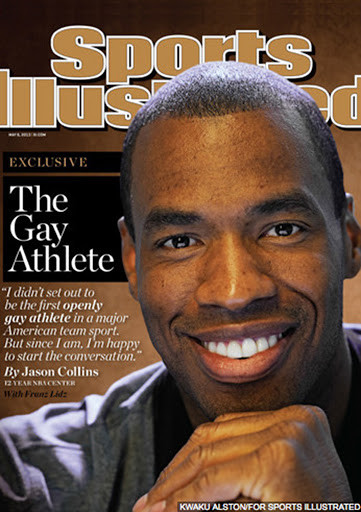
This week, Jason Collins came out as a black, gay, professional basketball player in Sports Illustrated. His bold and courageous move was met with encouragement and support from a wide cross-section of America. Many notable figures, including Magic Johnson, Father James Martin, Kobe Bryant, Nancy Pelosi, Rev. Al Sharpton, and both the Clinton and Obama families offered words of support and encouragement.
This outpouring of support was not shared, however, by Chris Broussard, a commentator on ESPN’s “Outside the Lines” who was asked for his personal opinion about Collins’ coming out. Broussard stated that he was a Christian, and as such, he was compelled to say that being gay was “open rebellion” against God. When asked about the fact that Jason Collins was also a Christian, Broussard stated that one cannot be gay and Christian at the same time.
The following clergy and religious leaders in America responded to Broussard:
Rev. Gil Caldwell, TruthinProgress.com, National Board of PFLAG, Asbury Park, NJBishop Yvette Flunder, Fellowship of Affirming Ministries, San Francisco, CARev. Darlene Garner, Metropolitan Community Church, Prince George’s County, MDThe Very Rev. Gary Hall, Dean, Washington National Cathedral, Washington, DCRev. Cedric Harmon, Many Voices, Washington, DCRev. Candy Holmes, Metropolitan Community Church, Prince George’s County, MDThe Reverend Luis Leon, St. John’s Church – Lafayette Square, Washington, DCThe Reverend Dr. Jacqueline J. Lewis, Middle Collegiate Church, New York, NYThe Rev. Dr. Pamela R. Lightsey, Boston University, Boston, MARev. Irene Monroe, Harvard University, Cambridge, MAGene Robinson, IX Episcopal Bishop of New HampshirePastor Joseph Tolton, Fellowship of Affirming Ministries, New York, NY
Here is what they said in a jointly written Washington Post editorial:
As Christian leaders in America, we know that Christians hold a wide variety of viewpoints on human sexuality. It is not necessary, nor is it right, to reject lesbian, gay, bisexual, and transgender (LGBT) people out of hand due to the Christian faith. To do so, misrepresents the ever widening nature of the gospel of Christ, who engaged with those on the margins, and placed in leadership people who were not powerful by worldly standards.We are pastors and leaders who have discovered that LGBT people are often the most faithful members of our congregations and denominations. We have received blessings upon blessings when we free them to be the people God made them to be and use the gifts that God gave them. In the same way, we are thankful that Jason Collins has been able to use his God-given gifts for athletics, and now has the freedom to be faithfully and authentically himself with the world. That is a cause for rejoicing, not of condemnation.When Broussard uttered his words of condemnation, LGBT-supportive people of faith sprang into action. Faithful America has already gathered over 24,000 signatures, asking that the Bible not be used to bash gay athletes on EPSN. GLAAD is helping faith leaders like us formulate a challenge to the false claim that Christians must uniformly reject LGBT people and LGBT athletes. And thousands of people of faith are offering a prayer for thanksgiving for Jason Collins and the role model he is for thousands of LGBT athletic young people, including people of color.As Christian leaders, we also encourage the media to report the reality that an increasing number of people of faith, including many Christians, are embracing and supporting their LGBT friends and family. They do so, not despite their faith, but because of it. As GLAAD demonstrated in last year’s ‘Missing Voices’ report, too often, stories like that of Jason Collins becomes one of “gay v. Christian,” when the reality is that Collins is a man of strong Christian faith, as are many who support him.We pray that God will open the eyes of Chris Broussard and help him mature in his faith. May Broussard see that Christianity is not a faith that is closed off to those who are different from him, but one that continually expands, reaching out to the neighbor and the stranger, sharing the good news. We encourage Broussard to listen with humility to LGBT Christians, their lives and stories. It is through listening that we learn.We are among those who give thanks for the life and witness of Jason Collins. May he always know that God has created him and loves him just as he is. May he exemplify the courage and grace that he has displayed in the last two days. And may God use him to send that message of love and inclusion to others, telling everyone of the ever widening love of God.
Those who read my blog, and especially those who read my Sunday posts, know that I am gay and Christian. I can’t understand those people who reject someone merely because they are judging that person for some perceived wrong. Matthew 7:1 clearly states, “Judge not, that you be not judged.” God is our ultimate judge, and Jesus, who welcomed all people, especially those on the margins of society, is our advocate before God. There will always be those dissenting voices who spew spurious lies and hatred toward LGBT people, but we must remember that God loves us unconditionally.
Moment of Zen: Coffee

On a morning like this, my moment of zen is coffee! It’s cold and rainy, and I just didn’t want to get out of bed.
Why I Love Baseball!

I find baseball uniforms sexy. What can I say! I also find the body type of a baseball player to be my ideal of a near perfect physique. Anybody else feel the same way?
May is National Masturbation Month

In case you were wondering, May is National Masturbation Month. The celebration of May as National Masturbation Month began in 1995 in San Francisco as a response to the forced resignation of then U.S. Surgeon General Joycelyn Elders.
After a speech at the United Nations World AIDS Day in 1994, an audience member asked Elders about masturbation’s potential for discouraging early sexual activity. She answered,”I think it is something that is part of human sexuality and a part of something that perhaps should be taught.”
That was the end of Elders’ career as America’s first black Surgeon General, but the spark for National Masturbation Month. Offended by Elders’ ouster, the ever progressive, pro-sex staff of San Francisco’s sex toy and education company Good Vibrations decided to find a way to keep the focus on Elders’ unjust firing, and to bring talk about masturbation into the mainstream in just the way Elders had envisioned.
Realizing that large number of folks lacked support and advice to help them enjoy the simple, basic act of masturbation, Good Vibrations sought to provide support, advice, and reassurance for people looking to open their own personal sexual horizons.
And so was born National Masturbation Month. Among the first steps Good Vibrations took was to promote masturbation as healthy, safe and natural way to express one’s sexuality, thereby removing much of the shame and stigma have so long colored the act masturbation.
So, is it true, as so many believe that masturbation is so commonplace, natural, pleasurable and healthy that “ninety-eight percent of us masturbate, and the other two percent are liars?” If so, why do we need an entire month to educate people on something they’re already enjoying?
The answer is twofold: First, to help those already enjoying themselves to delve further. Second, and most importantly, it looks like plenty of people might still benefit from some encouragement and education.
A recent cross sample study of American adults asked the question: “On average, over the past 12 months, how often did you masturbate?” Only 38 percent of women said they’d masturbated at all during the past year, while 61 percent of men had done so.
A 2007 article in Sexual and Relationship Therapy notes that masturbation may help men improve immune system function, build resistance to prostate gland infection, promote overall prostate health. Moreover, Australian researchers have shown that frequent masturbation may lower a man’s risk of developing prostate cancer.
A survey of men found the more frequently a man masturbates between the ages of 20 and 50, the less likely they are to get prostate cancer. In fact, those who masturbated more than five times a week were one-third less likely to develop prostate cancer.
These findings were the subject of a 2003 Doonesbury panel by Pulitzer Prize-winning Garry Trudeau. In the panel, one character alludes to masturbation as “self-dating.” Nearly half of the 700 papers which normally syndicate Doonesbury did not to run that strip, proving that public discussion of masturbation is still a thorny issue for some, and perhaps attesting to the need for an observance like National Masturbation Month.
Earlier studies have shown that rates of masturbation are higher for both men and women with higher education, more frequent sexual thoughts, sexual experimentation before puberty, and more lifetime sexual partners. Moreover, masturbation has documented physical benefits for both men and women, to say nothing of likely emotional and psychological benefits.


Authors
Recent Comments
Top Posts & Pages


Amazon Associate

As an Amazon Associate I earn from qualifying purchases. So, if you click on a link that takes you to Amazon.com, I may earn a commission.
Trust me, it isn’t much, but every little bit helps.

 Joe
Joe


 The Closet Professor