

Monthly Archives: August 2023
Moment of Zen: My Morning Tea

I rarely drink coffee when I first wake up in the morning, but I love a good hot cup of tea. I usually drink English Breakfast Tea.



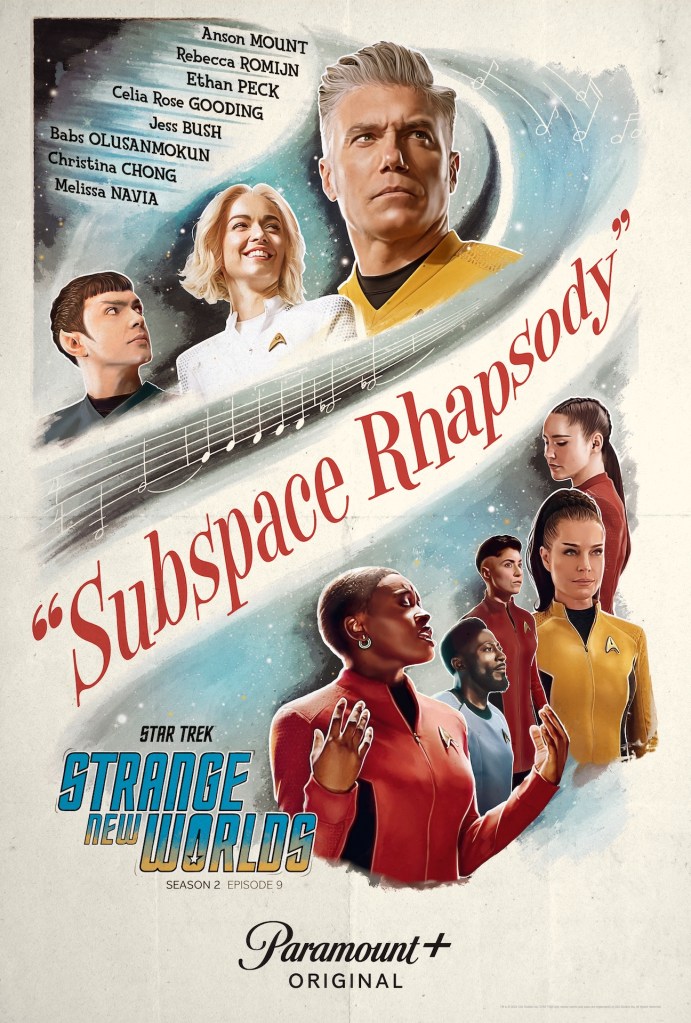
Strange Musical Worlds

In the penultimate episode of the second season of Star Trek: Strange New Worlds, “Subspace Rhapsody,” the show goes somewhere no other Star Trek show has gone before: the world of musicals. I’m not always your most typical gay man and don’t always follow stereotypes, unless I’m camping it up for one reason or another, but I am an embodiment of one stereotype: I love musicals and always have. With that being said, I’ll have to admit, even I was a little skeptical about a Star Trek musical episode. Could they pull it off? Would it be incredibly cheesy or silly? Could the cast even sing?
However, the producers of Star Trek surprised me. I know there will be some naysayers, and there are plenty of Trekkies who seem to actually hate everything Star Trek, yet still consider themselves “fans.” Said naysayers either nitpick one very minor thing and claim it goes against “canon” and ruined the whole show (and I mean show not just episode), or they will claim that Star Trek should always be serious scientific exploration. Leonard Nimoy, the original Spock, said in a 2009 interview with Reuters, “Canon is only important to people because they have to cling to their knowledge of the minutiae. Open your mind! Be a ‘Star Trek’ fan and open your mind and say, ‘Where does Star Trek want to take me now?’”
Nearly every episode has had its critics, but just as many have people who were enthusiastic about it. Facebook fan groups are already having debates about the merits of the episode. The same naysayers hated the recent Strange New Worlds/Lower Decks crossover episode “Those Old Scientists.” I thought it was one of the best episodes of the series, but I’ve also liked the Spock-centric episodes: “Spock Amok” and “Charades.” The best Star Trek series have had a balance of fun and wacky episodes and serious and scientific episodes. For example on Deep Space Nine, there are the serious “O’Brien Must Suffer” episodes and the humorous “Ferengi” episodes. In both Strange New Worlds and Deep Space Nine (the two series I know the best), a serious episode was usually followed by a fun episode or vice versa. Picard and Discovery, both of which I liked in their own way, tend to stick to serious episodes and use a serial story arch format for the season. Strange New Worlds and Deep Space Nine often follow the episodic format similar to Star Trek and The Next Generation. Both formats have their advantages, but I think I often prefer the episodic format.
One of the things I enjoy about Strange New Worlds is that there are certain subtle commentaries and traditions about Star Trek in each of the episodes. The writers/producers seemed to give a nod to the Leonard Nimoy quote above in “Subspace Rhapsody.” When Uhura plays Cole Porters “Anything Goes,” I suspect it was a message from the producers and writers to say, “Where does Star Trek want to take me now?” The bottom line is they did pull it off. Yes, it was cheesy and silly at times, but it’s a musical and by the nature of the genre, people break out into song when normal people wouldn’t. Also, like many musicals, it had its emotional moments and plenty of humor along the way. That leaves the last question: Could the cast even sing? The answer is, some can, others are OK. Rebecca Romjin (Number One) and Celia Rose Gooding (Uhura) have beautiful voices as does Jess Bush (Nurse Chapel). As for the others, the lack of being a music virtuoso makes sense in the way it was done or they sing as part of the chorus. I’m not sure anyone would want to hear Carol Kane sing with that voice of hers. I also liked that the style of music that various characters sing fit their characters. For example, Anson Mount’s Captain Pike has an almost county twang to his songs. Ethan Peck’s Spock is more serious.
I’ve tried not to give too much away, so I don’t think I’ve given any spoilers. Forgive me if I have. Of course, my enjoyment of “Subspace Rhapsody” is just my opinion (but I’ve already watched it twice since it was released yesterday). Trekkies everywhere will have strong opinions one way or another. I liked it and wanted to share my own opinion. Overall, if anyone was going to do a “Star Trek Musical” this was the way it should have been and was done. The “Subspace Rhapsody” official cast recording will be available for purchase starting today, though Apple Music accidentally released it early and then took it down. If/when you watch it, I’d love to hear your opinion of the episode (I know those outside the United States aren’t yet able to watch the episodes).

Life’s Journey

Just some sage advice for the day:
“Always look at what you have left. Never look at what you have lost.” — Robert H. Schuller
“Enjoy the little things, for one day you may look back and realize they were the big things.” — Robert Breault
“In a forest of a hundred thousand trees, no two leaves are alike. And no two journeys along the same path are alike.” — Paulo Coelho
“Pursue some path, however narrow and crooked, in which you can walk with love and reverence.” — Henry David Thoreau

Indicted…Again

Former President Donald Trump was indicted yesterday. It wasn’t the first time, nor is it likely to be the last. Yesterday’s indictment was specifically for several crimes associated with conspiring to defraud Americans about the 2020 election (conspiring to defraud the United States, conspiring to disenfranchise voters, and conspiring and attempting to obstruct an official proceeding). Each of these indictments is a sad day for the country. Last night, I was watching news coverage about the indictments, and one of the commentators was so giddy, like a child on Christmas morning, that it was disturbing. I know a lot of people will rejoice over the series of indictments against Trump, and I am happy he is facing consequences for his complete disregard for the rule of law. However, I also think each of these indictments are also an indictment of the American people.
Trump never received a majority of the popular vote, but it still shows that there are a large number of Americans who do not care about the laws of this country or their fellow Americans but care only about having control over others. Supporters of candidates like Trump, Ron DeSantis, or Greg Abbott don’t measure the success of these politicians on what they have done for them but what they have done against those they hate, whether that means someone of a different race or sexuality (among numerous other groups because these same people strive on their hatred of those not like them).
Furthermore, I’m not going to rejoice just yet over Trump receiving his comeuppance, because indictments are only the beginning. I will rejoice (if you can even call it that) only when he has been convicted and sent to prison. As one commentator said last night, that’s a long way away. Even if he’s convicted, it will be a long process, and sadly, Trump is likely not going to prison until he’s exhausted all of his appeals, if he is ever sentenced to prison time in the first place.
The saddest part of all of this is not only that it shows that democracy in the United States is broken, but that there will still be Trump supporters who will still be Trump supporters when he’s proven guilty and escorted to prison. They’ll see this as purely political. This is a dark period of American democracy. The fact that a Trump was ever elected in the first place shows how broken the United States is. History will not look kindly on Americans of this era. The question we need to worry most about is: Will American democracy survive this era?

We hurry on, nor passing note

We hurry on, nor passing note
By Digby Mackworth Dolben
We hurry on, nor passing note
The rounded hedges white with May;
For golden clouds before us float
To lead our dazzled sight astray.
We say, ‘they shall indeed be sweet
‘The summer days that are to be’—
The ages murmur at our feet
The everlasting mystery.
We seek for Love to make our own,
But clasp him not for all our care
Of outspread arms; we gain alone
The flicker of his yellow hair
Caught now and then through glancing vine,
How rare, how fair, we dare not tell;
We know those sunny locks entwine
With ruddy-fruited asphodel.
A little life, a little love,
Young men rejoicing in their youth,
A doubtful twilight from above,
A glimpse of Beauty and of Truth,—
And then, no doubt, spring-loveliness
Expressed in hawthorns white and red,
The sprouting of the meadow grass,
But churchyard weeds about our head.
About the Poet
During the 19th century the gay British poet Digby Mackworth Dolben was little known. He owes his poetic reputation to his cousin, Robert Bridges, Poet Laureate of the United Kingdom from 1913 to 1930, who edited a partial edition of his verse, Poems, in 1911. Bridges guaranteed Dolben’s reputation with Three Friends: Memoirs of Digby Mackworth Dolben, Richard Watson Dixon, Henry Bradley (1932), as well as the careful editing of his poetry. Bridges said that the poems Dolben left behind were equal to “anything that was ever written by any English poet at his age.” Hopkins’ infatuation for Dolben and Dolben’s tragic death feature in Simon Edge’s 2017 novel The Hopkins Conundrum.

Dolben was born February 8, 1848, in Guernsey and brought up at Finedon Hall in Northamptonshire. He was educated at Cheam School and Eton College. At Eton, his distant cousin Bridges was his senior and took him under his wing. Dolben caused considerable scandal at school by his exhibitionist behavior. He chronicled his romantic attachment to another pupil a year older than he was, Martin Le Marchant Gosselin, by writing love poetry. He also defied his strict Protestant upbringing by joining group of studetns of the Oxford Movement, a movement of high church members of the Church of England which began in the 1830s and eventually developed into Anglo-Catholicism. He then claimed allegiance to the Order of St Benedict, affecting a monk’s habit. He was considering a conversion to Roman Catholicism. On June 28, 1867, Dolben drowned in the River Welland when bathing with the ten-year-old son of his tutor, Rev. C. E. Prichard, Rector of South Luffenham in Rutland. Dolben was then aged 19 and preparing to go up to Oxford.
According to Simon Edge, the English poet and Jesuit priest Gerard Manley Hopkins was “so captivated by a brief meeting [with Dolben] that he spent the rest of his life mourning him.” In a letter to Bridges after Dolben’s death, Hopkins said “there can very seldom have happened the loss of so much beauty (in body and mind and life) and of the promise of still more as there has been in his case.” Hopkins also asked Bridges whether Dolben’s family had considered publishing his poems. Fortunately, the independently wealthy Bridges later published books of poems by both Dolben and Hopkins, or their poetry might have been lost to the world forever. Dolben’s poems were published in a single volume by Bridges in 1911; the Oxford Dictionary of National Biography says that his work stands “among the best of the poetry of the Oxford Movement.” Dolben’s death, it adds, “was the end of a life of exceptional poetic promise.”
In his biography of Dolben, Bridges identifies Dolben’s ardent affection for another of his Eton classmates, a particularly attractive (if in Bridges’s estimation somewhat vacuous) member of their high church circle. Bridges calls this an “idolization”, but infatuation is a better term; the poems are plainly homoerotic. While editing the book Bridges refused the suggestion put forth by mutual friends that he rewrite Dolben’s poems to read as though they had been written for a girl: but he did agree to suppress the identity of Gosselin, the seemingly oblivious young man who had so enamored Dolben. Gosselin, the British Minister to Lisbon and a knight, had himself died a few years before Bridges began his memoir. (His widow requested the suppression after denying access to his diary.) Bridges does not ignore Dolben’s sexuality. However, he is never direct, and his discussion of his sexuality is hesitant, extremely guarded without any direct or conclusive statement.


Authors
Recent Comments
noisilycool3bc985058… on Pic of the Day iameverywhere1 on Not Quite as Planned iameverywhere1 on Pic of the Day noisilycool3bc985058… on Not Quite as Planned Joe on Pic of the Day Top Posts & Pages



Amazon Associate

As an Amazon Associate I earn from qualifying purchases. So, if you click on a link that takes you to Amazon.com, I may earn a commission.
Trust me, it isn’t much, but every little bit helps.

 Joe
Joe


 The Closet Professor