Monthly Archives: August 2025

TGIF!

While my bosses refused to let me work from home for an extended period, I did at least get to keep my regular Friday work-from-home day—and I am so glad it’s here. This week has been a trying one, my first back in the office after my medical leave.

The first three days of the week, our parking lot was closed, which left me with two choices: park in a lot up a steep hill or park in one three times farther away but on level ground. On Monday, I tried the hill. Going down that morning was rough; going back up in the afternoon was pure agony. On Tuesday, I chose the level route—only to discover that the extra distance was even worse.

By Wednesday, I’d been told that the museum’s reserved spaces would be available because campus security was going to deal with the cars parked there that didn’t belong to museum patrons. I bet you can guess what I found when I arrived—the same cars, still in those spots. So, back to the hill it was. Going down wasn’t terrible, but going up… well, let’s just say I took my time. Once inside the museum, I had to sit before I could do anything else. By then, I knew what my body would and wouldn’t tolerate, so I paced myself.

Yesterday, the parking situation was finally back to normal. But the workday itself made up for it. A two-hour meeting in uncomfortable plastic chairs is never fun, but it’s worse with a pinched nerve. I switched to a padded chair after the first fifteen minutes, but it wasn’t much better. By the end, I was shifting around like I was sitting on a bed of nails. Lunch in the break room wasn’t an improvement—the wooden chairs are no kinder to my back.

Back at my desk, my chair finally let my leg relax, and I took my midday meds. The relief lasted until I had to get up to let someone into a locked room. That part was fine; what wasn’t fine was running into a talkative professor who’s also president of an arts organization board we both serve on. He asked about my back, and I told him about the pinched nerve. He had a similar problem before a hip replacement fixed it, and he went on to talk about the board meeting tomorrow—which I doubt I’ll make. Eventually, the pain got so bad that I had to stop him mid-story and say, “I have to go sit down.”

In short, I overdid it yesterday, and I’m paying for it today. My leg is in a lot of pain this morning, and I’m hoping my meds kick in soon. At least I can work comfortably today from my own couch.

And now, to send you into the weekend on a happier note—here’s your Isabella Pic of the Week. She’s sleeping peacefully—though she wasn’t quite so peaceful at 1 a.m. last night when she insisted I get up. Turned out her water bowl was low. I filled it, and she let me go back to bed without complaint. She’s lucky she’s cute, and even luckier that she’s the perfect Friday reminder to rest, recharge, and keep a little sweetness close at hand.
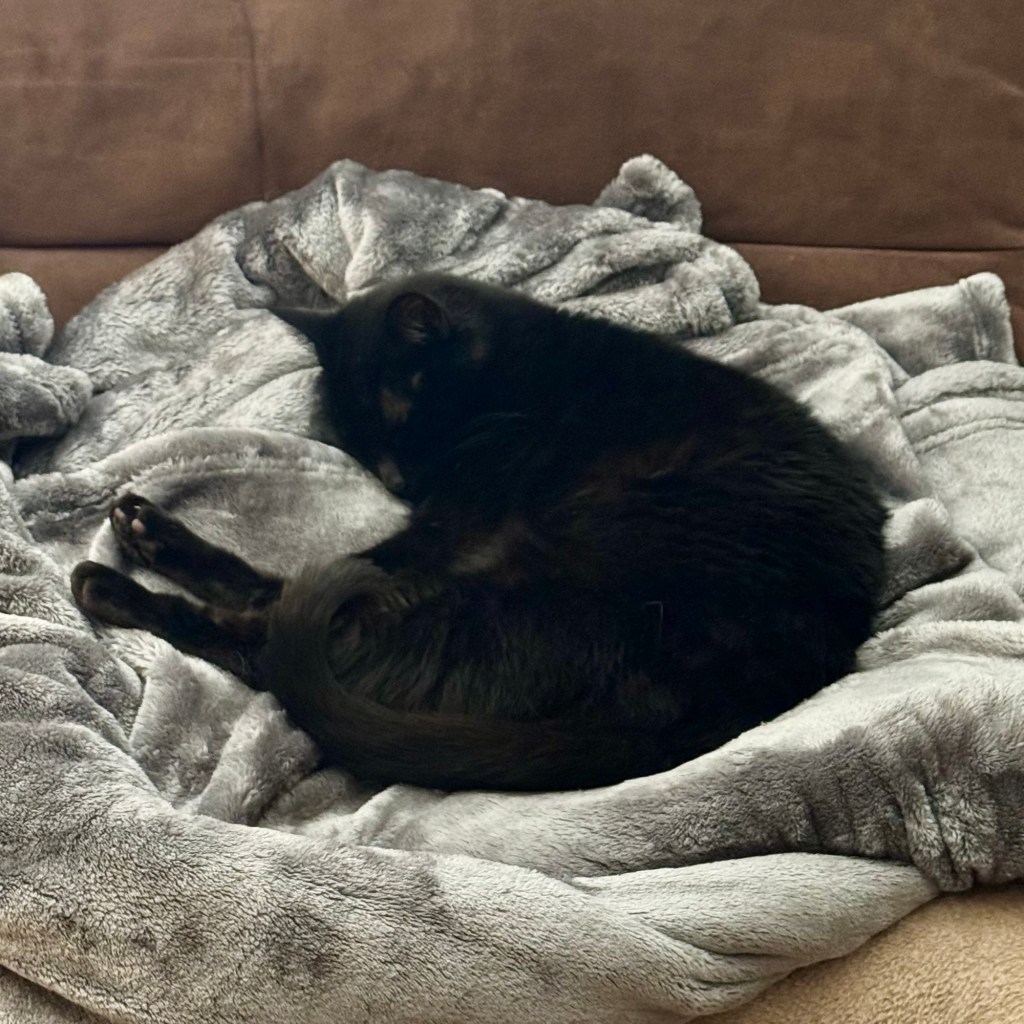
Here’s to a weekend with no steep hills, no long walks, no terrible chairs… and maybe just a few cat naps of our own.
Pic of the Day


Naked Among the Gods

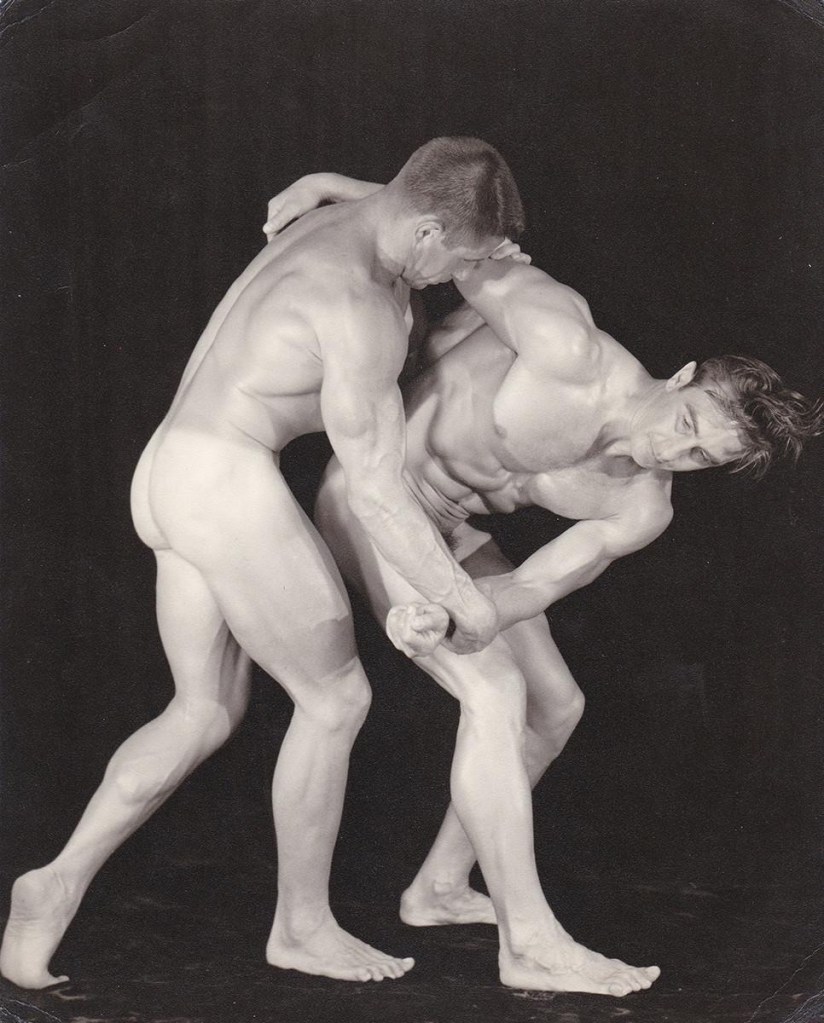
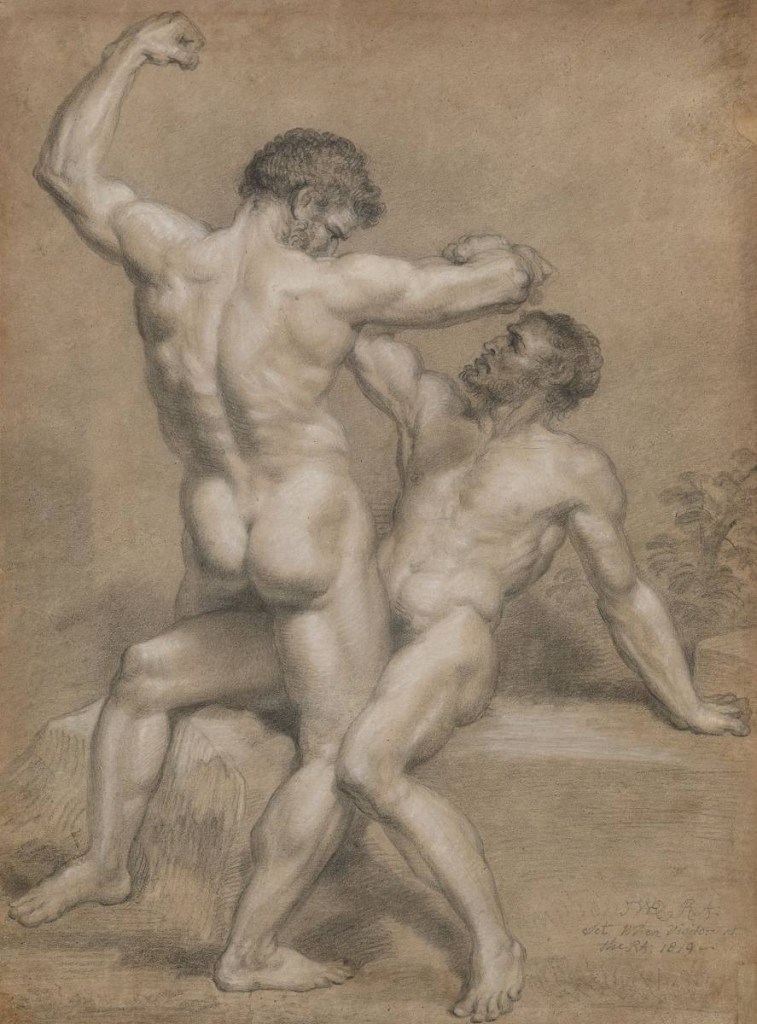
Two nude men wrestling
James Ward
1819

I’ve always been fascinated by how the Ancient Greeks embraced the naked body—especially the male form—not as something shameful, but as something worthy of admiration, celebration, and even reverence. To modern eyes, the sheer number of nude statues and painted vases from the ancient world might seem excessive or erotic (and sometimes, they are), but to the Greeks, nudity wasn’t just about sex. It was about excellence, identity, citizenship, and being fully human.

They didn’t just tolerate public nudity in certain settings—they expected it. Athletes competed fully nude in the Olympic Games, not as a rebellious act, but as a deeply held tradition. The word gymnasium itself comes from the Greek gymnos(γυμνός), meaning “naked.” Young men trained in the nude not just to strengthen their bodies, but to shape their minds and characters. The gymnasium was a civic and educational space where nudity signaled discipline, honesty, and a commitment to becoming the best version of oneself. Nudity wasn’t a distraction—it was part of the lesson.

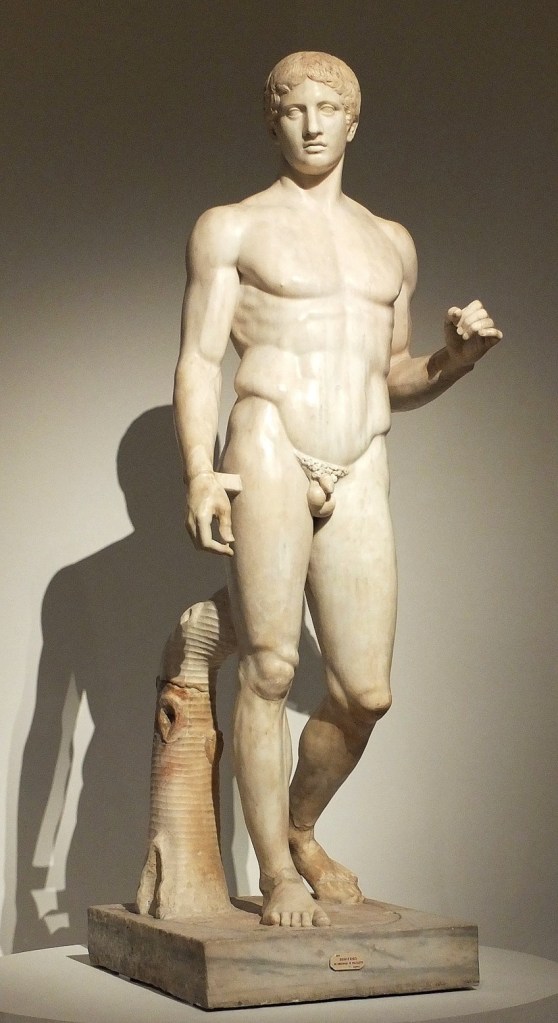
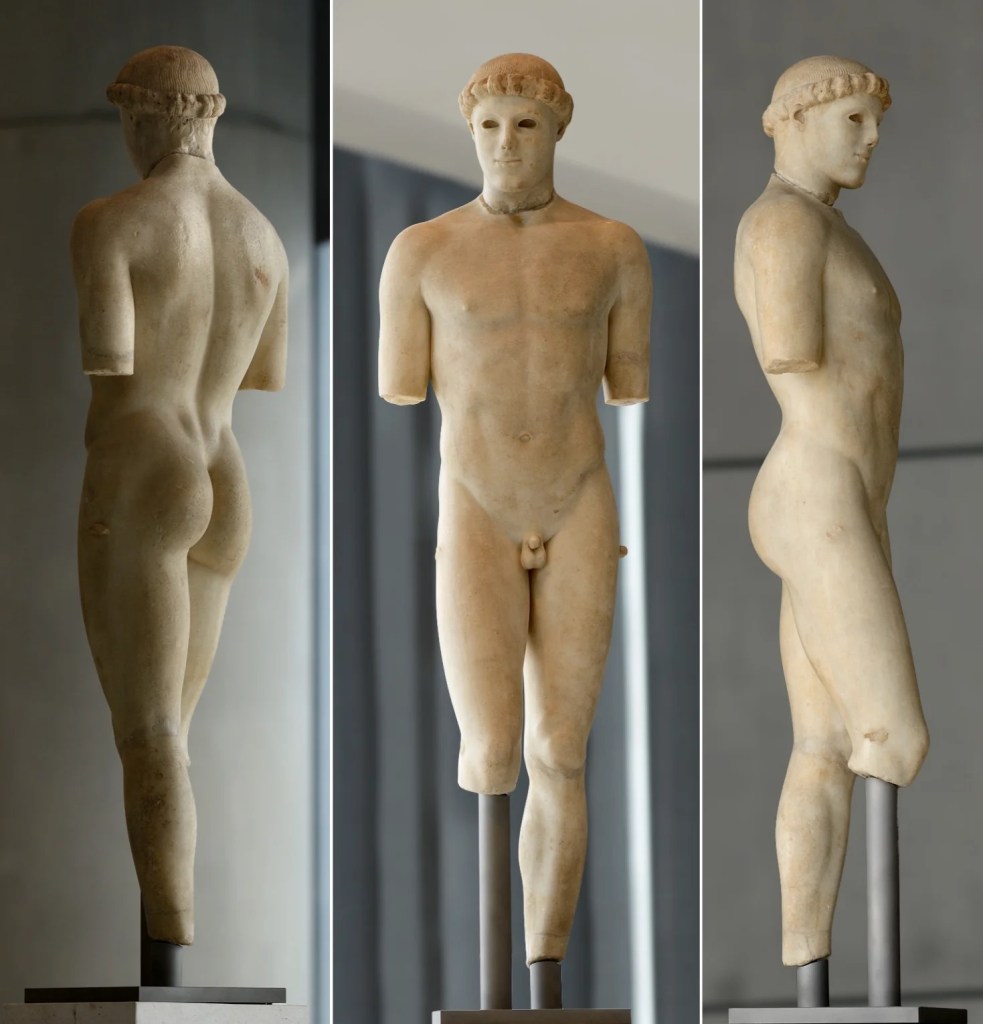
Kritios Boy

And that reverence for the human form found its most lasting legacy in art. One of the earliest and most striking examples is the Kritios Boy (c. 480 BCE), often seen as the turning point in Greek sculpture. Unlike the stiff, idealized youth of earlier kouros figures, the Kritios Boy is relaxed, confident, and lifelike. There’s no armor, no toga, no fig leaf—just a serene, nude adolescent standing in gentle contrapposto. He feels both real and ideal.

Polykleitos’s Doryphoros 

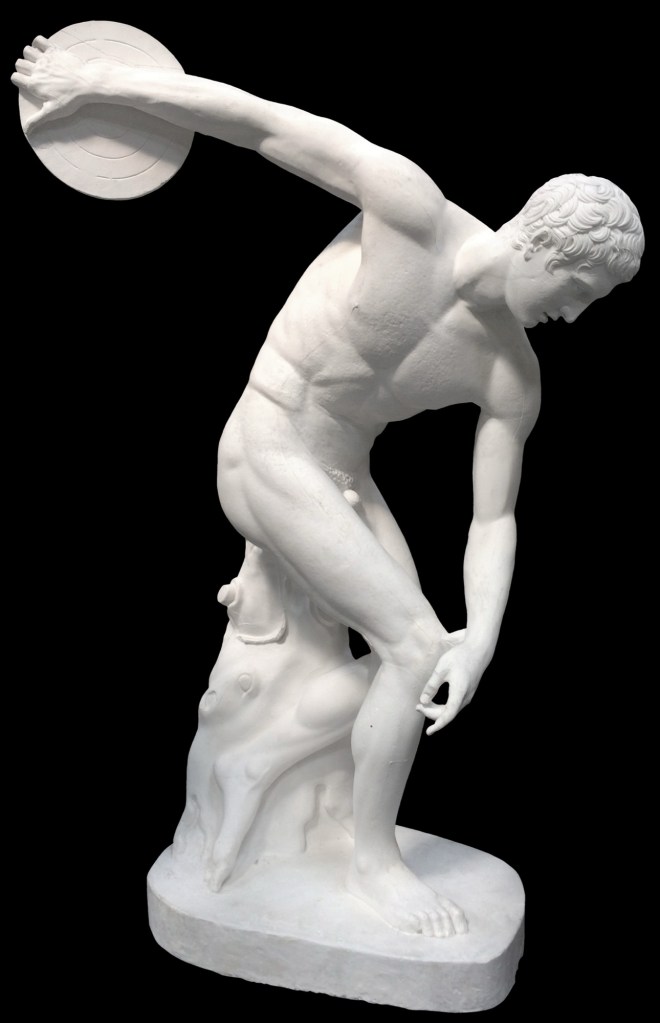
Another favorite of mine is Polykleitos’s Doryphoros (Spear Bearer), a statue designed to embody the perfect male proportions. Here again, the nudity isn’t incidental—it’s essential. You can’t demonstrate bodily harmony if the body is covered. Nudity, in this case, is a kind of visual philosophy. Then there’s the Discobolus (Discus Thrower) by Myron, which captures a man’s body in mid-motion, muscles taut, entirely nude, perfectly balanced between tension and grace. His nudity heightens the athletic drama and draws the viewer into that moment of perfection.


Myron’s Discobolus

It wasn’t just in sculpture. The Greeks captured daily life, training scenes, and intimate gatherings on painted pottery, particularly in the red-figure vase tradition. These vases, often used for wine drinking at symposia, show men wrestling, bathing, reclining with lovers, and engaging in philosophical dialogue—always nude or mostly nude. One amphora I saw during a museum visit showed a trainer instructing a youth at the gymnasium, both fully exposed, their nudity treated as entirely normal, even expected. Another vase depicts two young men sharing a kiss in a quiet, domestic scene—tender, not titillating. These glimpses into Greek life are reminders that the naked body wasn’t always about arousal. Sometimes, it was about presence—being fully seen, fully known.

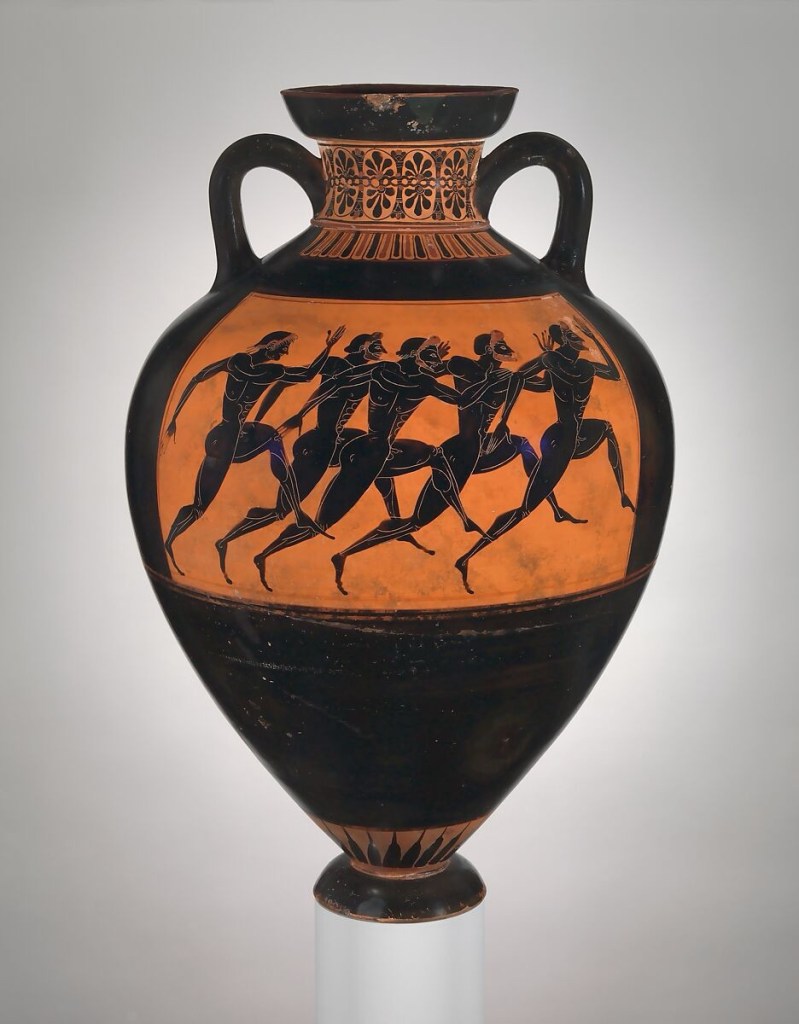
Terracotta Panathenaic prize amphora
Attributed to the Euphiletos Painter
ca. 530 BCE

This attitude feels almost alien in a country like ours. Here in America, nudity is still largely taboo, wrapped up in Puritanical baggage and frequently equated with obscenity or indecency. Even in Vermont, where public nudity is technically legal in most cases (as long as you’re not lewd or explicitly sexual), you rarely see anyone baring it all outside of a secluded swim spot or a clothing-optional festival. There’s something quietly telling about that—how the law might allow something, but cultural discomfort still keeps it hidden.

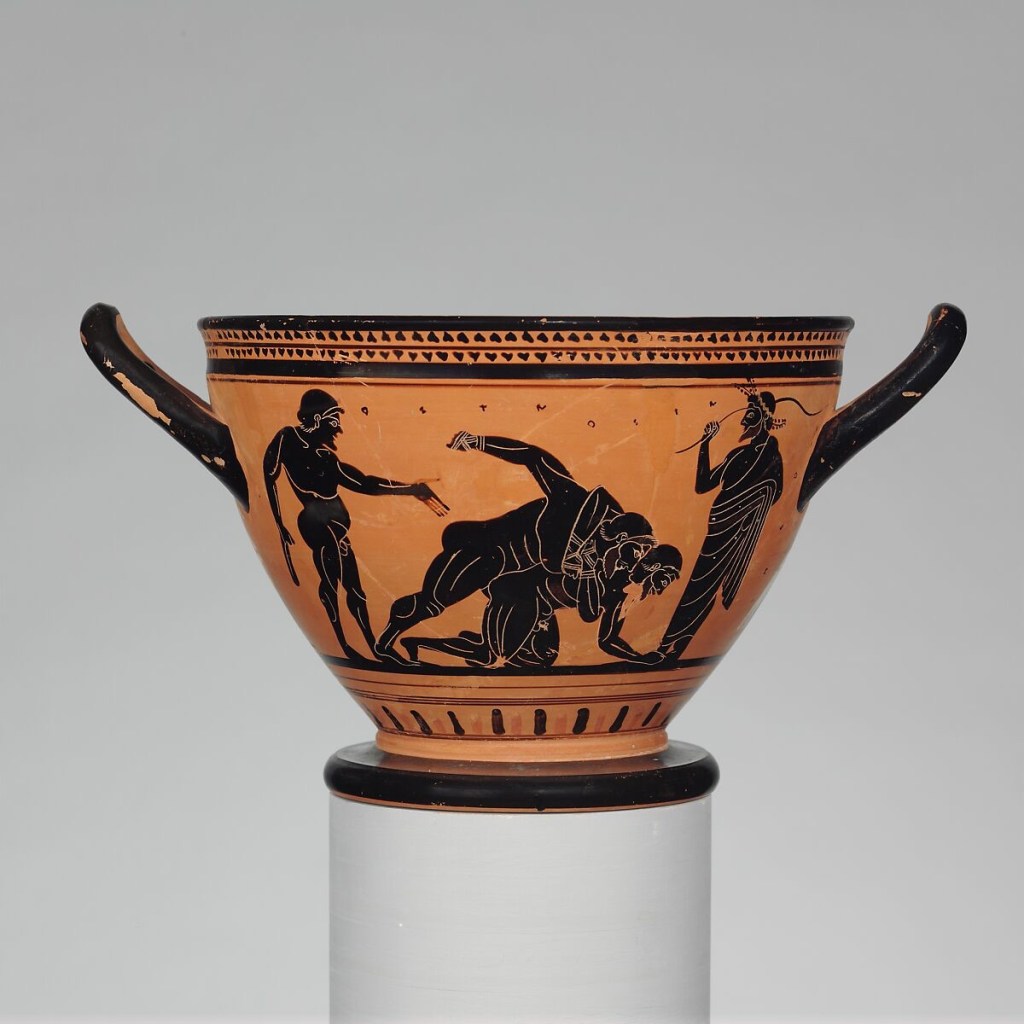
Terracotta skyphos (deep drinking cup)
Attributed to the Theseus Painter
ca. 500 BCE

And yet, I can’t help but wonder: what would it mean if we took a more Ancient Greek view of nudity—not as something to be feared or fetishized, but as something natural, honest, even virtuous?

A few years ago, I attended a gay men’s retreat at Easton Mountain in upstate New York, and it gave me a real-world glimpse of what the Greeks might have understood intuitively. Nudity there wasn’t shocking or scandalous—it was completely natural. The pool was always full of naked bodies, sunlit and unselfconscious. I don’t think I ever saw a bathing suit near it. The sauna and hot tub were clothing-free zones by default, and during some of the workshops—body painting, liberation exercises, guided meditations—nudity was gently encouraged as a way to connect more honestly with ourselves and others. It wasn’t about showing off. It was about showing up. I left feeling more open, more grounded in my body, and more aware of how rare that kind of freedom really is.

It might mean raising a generation less ashamed of their bodies. It might mean allowing ourselves to admire beauty without reducing it to sex. It might mean being more comfortable in our own skin, literally and figuratively. While the Greeks didn’t extend this attitude equally—women were mostly excluded from these public displays of nudity—there’s something liberating in imagining a culture where both women and men could be nude in non-sexualized spaces without fear or judgment.

As a gay man, I think often about how visibility and embodiment intersect. For many of us, our relationship to our bodies has been shaped by shame, secrecy, and desires we were never meant to name. What if we had grown up seeing the male body—our bodies—as something to admire without guilt? What if nudity wasn’t something to hide or automatically sexualize, but something that simply was? Would we be more honest? Kinder to ourselves? More connected to one another? Might we even find ourselves a little closer to the divine—just as the Ancient Greeks did, in their reverence for the human form and their gods?


Pic of the Day


Just Two More Days

So far, this week at work has been rough. I expected a lot of catching up after being out on emergency medical leave, but I didn’t expect the added challenge of my boss being openly—or at least quietly—hostile about it. It’s not always outright confrontation, but her demands and unwillingness to even discuss accommodations have been deeply disappointing. She’s also requesting documentation that, according to my physical therapist, should only come from HR. I’ll have to tell her that today, which I’m sure will be another fun conversation.

The whole situation has triggered a lot of anxiety and deepened the depression I was already feeling from the fact that my pain doesn’t seem to be getting any better. Part of that, I think, is because of how far I’ve had to walk from our temporary parking lot. Our usual lot is closed for repairs, and the longer walk from the temporary lots has been rough. The lot is supposed to reopen tomorrow, so I asked to move my work-from-home day from Friday to Wednesday to help reduce the strain. She refused.

When I tried to find another solution—asking her to address the problem of our two museum-reserved parking spaces being used by people who aren’t even patrons—she told me to take it up with her boss. It felt less like “couldn’t” and more like “wouldn’t,” but I did as she said. Thankfully, he actually took action, going out to take pictures of the cars parked there and contacting campus security. He’s dealt with severe back pain himself, though for him walking brought relief. I explained that for me, it’s the opposite—every extra step makes the pain worse.

There are other issues I could get into, but honestly, I’m too tired to go into detail. I just hope today is a better day, and I hope all of you have a good one too.

I just need to survive two more days.


Pic of the Day


Dog Days Done

Today’s poem arrives right on cue at the close of the Dog Days of Summer. As of yesterday, August 11, those long, sultry days ended; today, August 12, begins the slow march toward autumn. Salena Godden’s “Dog Days Done” captures this turning point with sensual, lyrical detail—personifying summer’s departure and autumn’s arrival in a way that feels both personal and universal. Godden, a British poet and novelist of Jamaican-Irish heritage, writes from a place of inclusivity and celebration, embracing her own bisexual identity and the diverse experiences that shape her work. In this piece, she reminds us that every ending is also a beginning.

Dog Days Done
By Salena Godden

Summer lifts her skirt
revealing a glimmer of

amber, light and yellow.
Summer takes her time

to pack her belongings,
her weary butterflies

and thirsty bees.
And somewhere

in a distant field
August writes

goodbye letters
in gold on hay

and corn and
chestnut and you.

The morning after
the first thunderstorm

you’ll open the window
and smell it changed,

wafts of smoke,
and rain and past.

This ending
is a beginning.

Make hay
and make love,

gather bilberries
and blackberries.

Dog days done,
Sirius is south,

the last burst of roses,
apples and cider,

the Lughnasadh feast,
the tomato harvest,

the fruits so red and ripe
in September’s hands,

summer feeding
autumn’s mouth.

About the Poem

“Dog Days Done” is a rich meditation on the seasonal turning point between the sultry heat of late summer and the first breath of autumn—precisely the transition we enter today. Godden personifies summer as a graceful, almost theatrical figure—“Summer lifts her skirt / revealing a glimmer of amber”—infusing the natural shift with sensuality and warmth.

Throughout, the imagery pulses with the fatigue and richness of August: “weary butterflies” and “thirsty bees” suggest both the end of a long labor and the sweetness that remains. The image of August writing goodbye letters in gold merges the agricultural—hay, corn, chestnut—with the personal—“and you”—inviting the reader into the intimacy of the season’s farewell.

The poem pivots on the moment after the first thunderstorm, when you “smell it changed,” a sensory shift signaling not loss, but renewal: “This ending / is a beginning.” Godden’s call to “Make hay / and make love” bridges work and pleasure, grounding the cyclical rhythm of the seasons in human touch and connection.

Her reference to the Lughnasadh feast places the poem firmly within a deep cultural and historical tradition. Lughnasadh, a Celtic festival named for the god Lugh, marks the beginning of the harvest season, traditionally celebrated on August 1 with games, markets, feasting, and offerings of the first fruits. It honors both the labor of the growing season and the gratitude for its bounty. By invoking it here, Godden aligns the personal and the cosmic—her imagery becomes not just about the turning of the weather, but about humanity’s timeless connection to the land and the cycles that sustain us.

Her closing lines—“summer feeding / autumn’s mouth”—collapse the boundaries between past and future, underscoring how every ending carries the seeds of what follows. There is also, in the openness of her imagery, a quiet inclusivity: love, labor, and renewal belong to everyone, a reflection of Godden’s own embrace of diverse identities and experiences.


About the Poet

Salena Godden is a British poet, author, broadcaster, and performance artist of Jamaican-Irish heritage, widely regarded as one of the most dynamic voices in contemporary UK literature. Her work spans poetry, memoir, essays, and fiction, with collections such as Under the Pier (2011), Fishing in the Aftermath: Poems 1994–2014 (2014), Pessimism Is for Lightweights – 13 Pieces of Courage and Resistance (2018), and With Love, Grief and Fury (2024). Her debut novel, Mrs Death Misses Death (2021), won multiple awards and was shortlisted for others, cementing her place as a distinctive and daring storyteller.

Openly bisexual, Godden’s creative life has often been shaped by queer spaces and sensibilities. She has spoken of writing in “glorious gay bars” and embraces a worldview informed by inclusivity, fluid identity, and celebration of difference. These values infuse her work with a generosity of spirit and a refusal to confine human experience to narrow definitions.

Elected a Fellow of the Royal Society of Literature, Godden is also an acclaimed performer, known for her live readings that blend lyricism, humor, and political consciousness. Her poetry often carries both the intimacy of lived experience and the resonance of myth, connecting personal moments to universal cycles—much like the seasonal turn captured in “Dog Days Done.”


Back to the Office… Ready or Not

Today, I head back to work. My paid medical leave officially ended yesterday. Technically, it should have shifted from continuous leave to intermittent leave for the next two months, but the Human Resources Department at my university managed to botch the approval. They didn’t follow through with everything my doctor requested, so now I have to sort that out. I need to contact my doctor this morning to see if HR even sent him the paperwork needed to fix this.

I wish they had at least considered a work-from-home arrangement, but my boss refuses to even request it. So, that’s off the table. Instead, I’ll go into the office today and spend my time reading and sending emails—tasks I could easily do from my laptop at home. I have no appointments or meetings scheduled, and if I did, they’d be virtual. My boss seems to lack any sign of empathy or sympathy, but there’s no point in continuing to complain about her. It’s just not worth the energy. There’s nothing I can do except quietly keep an eye out for other opportunities. I’d prefer to stay in New England, but I might have to look farther afield. What I won’t do is move back to Alabama.

Sorry for the work rant, but it’s what’s on my mind this morning. Since I have to face the day regardless, I’m trying to focus on the positives—like how well things went when I ventured out yesterday.

Yesterday, I ran a few errands and—surprisingly—it went great. I had no pain, walked without a limp, and felt like myself again. The only odd moment was leaving the gas station, when my right leg suddenly got wobbly. It didn’t hurt; it just wasn’t cooperating. Still, I considered the outing a success. The only caveat: I never walked more than 20–30 yards at a time. We’ll see what happens today when I have to walk farther and sit in my office chair for hours.

This morning didn’t get off to the best start. I woke up with pain in my leg and had to sit down while my coffee brewed. Maybe the day will smooth out like it did yesterday, but honestly, with the way I’m feeling right now, I’m not overly optimistic. Still, I’m holding onto the hope that today will surprise me for the better—because I could use a day that ends with me feeling proud I made it through.


Pic of the Day

This pic would have been perfect for yesterday’s Moment of Zen, but I didn’t come across it until last night.


Narrow is the Way 

Enter through the narrow gate; for the gate is wide and the road is easy that leads to destruction, and there are many who take it. For the gate is narrow and the road is hard that leads to life, and there are few who find it. 

— Matthew 7:13–14

Jesus’s words about the narrow and wide gates are often used to caution believers against living comfortably in sin or following the crowd without discernment. But for LGBTQ+ Christians, these verses can take on a deeper, more personal resonance.

In a world where many still misunderstand or reject queer identities—especially in Christian spaces—simply choosing to walk in truth can feel like walking the hardest, loneliest road. But Jesus never said the narrow path would be easy. He said it would lead to life.

Many of us as LGBTQ+ people of faith know intimately what it means to seek that narrow gate. We refuse the wide gate of silence, of pretending, of conforming to a version of faith that demands we deny who God created us to be. Saying “yes” to both our faith and our identity is not choosing an easy road—but it is choosing life.

Deuteronomy 30:19–20 says, “I have set before you life and death, blessings and curses. Choose life so that you and your descendants may live, loving the Lord your God, obeying him, and holding fast to him…” In choosing life, we choose authenticity. We choose to hold fast to a God who calls us beloved—not in spite of who we are, but wholly, wonderfully, because of who we are.

There are those who try to tell us that being LGBTQ+ and Christian is impossible. That living our truth is stepping off the path of righteousness. But we look again at Jesus’s words: the road that leads to life is hard. If it were about comfort, popularity, or fitting in, the wide gate would be enough. But our Savior walked a narrow path, too—one that led through rejection, struggle, and even death, but ultimately broke open into resurrection and glory. Hebrews 12:2–3 says, “Looking to Jesus the pioneer and perfecter of our faith… who for the sake of the joy that was set before him endured the cross, disregarding its shame…”

Jesus understands what it means to walk a path that others mock or reject. He never promised his followers an easy way. But he promised his presence—and the Spirit’s strength for the journey. Isaiah 30:21 says, “And when you turn to the right or when you turn to the left, your ears shall hear a word behind you, saying, ‘This is the way; walk in it.’”

It’s easy to read “few find it” and feel isolated. But we are not the only ones walking this way. Across time and across the globe, queer believers are choosing the narrow gate daily, choosing integrity over fear, choosing the gospel over shame, choosing love over exclusion. Romans 8:18–19 tells us, “I consider that the sufferings of this present time are not worth comparing with the glory about to be revealed to us. For the creation waits with eager longing for the revealing of the children of God.”

We know it won’t be an easy road—nearly all of us in the LGBTQ+ community, especially LGBTQ+ Christians, already know that. We have endured countless trials—whether from the church, from family, or from others who hate us or believe we are unworthy of God’s love. Not all who reject us are even religious, but their hatred is not our spiritual concern. Our calling is to honor God and to live the life Christ asks of us. As James 1:2–3 reminds us: “My brothers and sisters, whenever you face trials of any kind, consider it nothing but joy, because you know that the testing of your faith produces endurance.”

The journey may be narrow, but it is not empty. It is lined with the footprints of saints and witnesses—some named, many anonymous—who dared to trust in the wideness of God’s mercy. We walk with them.And most importantly: God walks with us.