
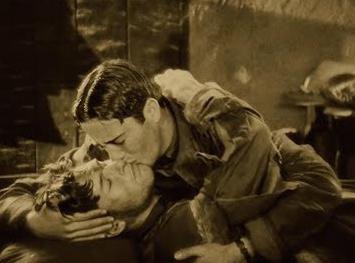
When people talk about LGBTQ+ moments in classic Hollywood, the conversation usually begins somewhere in the 1930s or 1940s, often in coded dialogue, lingering glances, or the carefully crafted innuendo of the Production Code era. Yet one of the most fascinating moments in early cinema happened before the Hays Code truly tightened its grip on Hollywood morality: a kiss between two men in the 1927 silent film Wings.
Most people know Wings because it won the very first Academy Award for Best Picture (then called “Outstanding Picture”) at the first Academy Awards ceremony. It was a massive World War I aviation epic, famous for its aerial combat scenes and ambitious filmmaking. What many modern viewers do not realize is that near the end of the film, there is an intimate scene between the two male leads, Jack Powell and David Armstrong, played by Charles ‘Buddy’ Rogers and Richard Arlen.
In the scene, David lies dying after being mistakenly shot down by Jack. As Jack cradles his friend in grief and desperation, he kisses him. It is brief and tender, not presented as overtly romantic, but emotionally intimate in a way that still surprises audiences nearly a century later.
Was it intended to be a “gay kiss”? Probably not in the way we would define it today. The scene is framed through the intense emotional bonds forged by war and male friendship. Yet to dismiss it entirely as devoid of queer meaning would also ignore the realities of both cinema and audience interpretation.
Hollywood has always had gay men within it—actors, directors, writers, costume designers, composers, and producers—even when they were forced to remain hidden. Silent-era Hollywood especially existed in a somewhat freer space before the stricter moral policing of later decades. Audiences, too, were more complex than historians once acknowledged. Gay men sitting in darkened theaters in 1927 may very well have recognized something in that moment that straight audiences interpreted differently. Queer audiences have always learned to read between the lines, to find fragments of themselves in stories never openly meant for them.
That is part of what makes the scene so fascinating. It works on multiple levels at once. For mainstream audiences, it was tragic camaraderie and devotion between brothers-in-arms. For others, perhaps it hinted at something deeper and more emotionally honest than Hollywood would later allow itself to show for decades.
The scene also reminds us how fluid emotional expression between men could sometimes appear in early cinema before later cultural anxieties hardened those boundaries. There is vulnerability in the moment, tenderness, physical affection, and grief expressed openly. Even today, many films struggle to portray male intimacy with such sincerity.
For many years, however, there was a chance audiences might never see Wings again at all.
Like countless silent films, Wings was once considered a lost film. The original prints existed on nitrate film stock, which was notoriously unstable and highly flammable. Nitrate film deteriorates over time, becoming brittle, sticky, chemically unstable, and eventually capable of spontaneous combustion under the wrong conditions. Entire film archives and movie vaults were destroyed in catastrophic nitrate fires during the early twentieth century. My own museum has had many nitrate reels of film in the collection over the years. Several were sent to the Smithsonian Institution to be digitized, while those that remained are stored in a special freezer designed to slow deterioration and reduce the danger of spontaneous combustion. Archivists and curators quickly learn that you never want to open an old film reel and smell vinegar. That sharp vinegar odor is often a sign of “vinegar syndrome,” a chemical breakdown process that signals the film is actively deteriorating.
When a surviving print of Wings was discovered in the archives of the Cinémathèque Française in Paris, archivists understood immediately how urgent the situation was. The film had to be copied as quickly as possible from nitrate stock onto modern “safety film” stock, which used acetate rather than nitrate and was far less dangerous and far more stable for long-term preservation.
Without that preservation effort, one of the most historically significant films ever made—and one of early Hollywood’s most unexpectedly touching moments of male intimacy—might have vanished forever.
That is one of the beautiful things about film preservation. We are not simply saving entertainment. We are saving cultural memory, emotional history, and the quiet moments that speak across generations. A nearly hundred-year-old silent film can still surprise us, still move us, and still make us wonder what certain audiences may have seen hidden between the frames.
And perhaps that is part of the enduring magic of Wings. Beneath the spectacle of airplanes and warfare lies a fleeting moment of tenderness that continues to resonate long after the silent era faded away.








 The Closet Professor
Thank you for commenting. I always want to know what you have to say. However, I have a few rules: 1. Always be kind and considerate to others. 2. Do not degrade other people's way of thinking. 3. I have the right to refuse or remove any comment I deem inappropriate. 4. If you comment on a post that was published over 14 days ago, it will not post immediately. Those comments are set for moderation. If it doesn't break the above rules, it will post.