I began my life in the South and for five years lived as a closeted teacher, but am now making a new life for myself as an oral historian in New England. I think my life will work out the way it was always meant to be. That doesn't mean there won't be ups and downs; that's all part of life. It means I just have to be patient. I feel like October 7, 2015 is my new birthday. It's a beginning filled with great hope. It's a second chance to live my life…not anyone else's.
My profile picture is "David and Me," 2001 painting by artist Steve Walker. It happens to be one of my favorite modern gay art pieces.
Today I’m having an endoscopy, which means I’m not working today. It’s one of those quiet, necessary pauses that comes with living with stage 4 liver disease.
The odd thing about this diagnosis is that, for now, there isn’t much to do. My liver is functioning well enough at the moment, and that may remain true for many years—ten, fifteen, maybe even twenty. If the day ever comes when it can’t do its job, the only cure currently available is a liver transplant. That’s still a long way off, and there’s hope that medical advances will offer new options before then. Doctors already know that some medications used for diabetes can slow the progression of liver disease, which is encouraging.
What is certain is that my doctors need to keep a close eye on things.
That means ultrasounds every six months and an endoscopy every year or two, depending on what they find. When the liver can’t handle blood flow as well as it should, pressure can build up elsewhere in the body, sometimes affecting the veins in the esophagus.
These are called esophageal varices. They often cause no symptoms, which is what makes them dangerous. I was told that many ruptures are fatal simply because the bleeding happens so quickly that help doesn’t arrive in time. That seriousness is exactly why monitoring matters—when varices are found early, they can often be treated with medication and careful follow-up.
So today is about prevention: checking in, staying ahead of potential problems, and taking care of myself. It’s not how I’d choose to spend my day, but it’s part of living thoughtfully and realistically with a chronic condition. For now, that’s enough.
Oh! Christmas wreath upon the wall, Within thine ivied space I see the years beyond recall, Amid thy leaves I trace The shadows of a happy past, When all the world was bright, And love its magic splendour cast O’er morn and noon and night.
Oh! Christmas wreath upon the wall, ’Neath memory’s tender spell A wondrous charm doth o’er thee fall, And round thy beauty dwell. Thine ivy hath the satiny sheen Of tresses I’ve caressed, Thy holly’s crimson gleam I’ve seen On lips I oft have pressed.
Oh! Christmas wreath upon the wall, A mist steals o’er my sight. Dear hallow’d wreath, these tears are all The pledge I now can plight To those loved ones whose spirit eyes Shine down the flight of time; Around God’s throne their voices rise To swell the Christmas Chime!
About the Poem
There is something quietly powerful about a Christmas wreath. We hang it almost without thinking—on a door, above a mantel, in a hallway we pass through every day. And yet, as Anna de Brémont reminds us, the wreath becomes far more than decoration. It becomes a frame for memory.
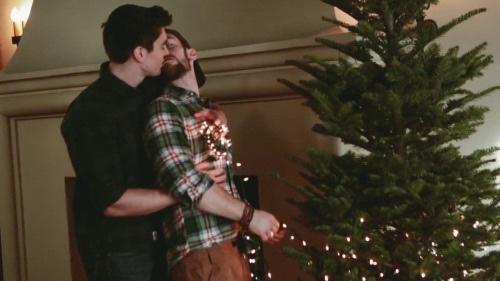
For many LGBTQ+ people, Christmas is a season layered with complexity. It holds beauty and warmth, but also silence—loves once hidden, names never spoken aloud, affections carefully guarded. Some of our most meaningful relationships lived in the margins of what was considered acceptable, even as they shaped us deeply and truthfully.
The wreath in this poem holds those memories without judgment. Its ivy and holly recall touch and intimacy—hair once caressed, lips once kissed—loves that were real, even if they could not always be visible. De Brémont does not apologize for this remembering. She sanctifies it.
As the poem moves toward its close, grief and hope meet. Those we loved, and sometimes lost too soon or too quietly, are not erased. Their presence is gathered into something eternal. Their voices, the poem tells us, now rise in the Christmas chime around God’s throne.
For those of us who have ever wondered whether our love was too much, too different, or too inconvenient to be holy, this poem offers a quiet reassurance: love remembered with tenderness is never wasted. It endures. It is held. It belongs.
This Christmas, may the wreaths we hang remind us not only of tradition, but of truth—that love, in all its forms, is worthy of remembrance, and that nothing genuine is ever outside the reach of grace.
In “The Christmas Wreath,” Anna de Brémont transforms a familiar holiday symbol into a vessel of remembrance. The evergreen wreath—traditionally a sign of eternal life—becomes a mirror through which the speaker revisits love, intimacy, and loss.
The ivy and holly are not merely decorative. They take on human qualities:
ivy becomes the “satiny sheen / Of tresses I’ve caressed”
holly recalls the “crimson gleam” of beloved lips
This is a deeply embodied poem. Memory is tactile. Love is remembered through touch, color, and physical closeness.
In the final stanza, the poem shifts heavenward. The wreath no longer holds only memory—it becomes a bridge between worlds. The speaker’s tears are not despairing, but devotional, offered as a sacred pledge to loved ones whose voices now join the “Christmas Chime” around God’s throne.
The poem does not deny grief; it sanctifies it.
About the Poet
Anna de Brémont (1859–1922) was an American poet, novelist, and playwright whose work often explored themes of love, longing, memory, and emotional interiority. Writing at the turn of the 20th century, she was part of a literary moment that valued lyricism and personal reflection—especially in poetry intended for quiet reading rather than public performance.
While not widely read today, de Brémont’s poetry resonates with modern readers for its emotional clarity and its willingness to hold tenderness and sorrow in the same breath. Her Christmas poetry, in particular, avoids sentimentality, instead offering a mature meditation on love that endures beyond time.
* * *
Perhaps that is why we hang wreaths year after year. Not just to celebrate the season—but to remember. To honor love that shaped us. To trust that nothing truly cherished is ever lost.May this season hold space for both your joy and your longing. Both belong.
I woke up this morning with a migraine and am currently sitting here with my coffee, trying to decide whether I’m going to call in sick or if this will be one of those migraines that eventually eases up. Right now, it’s a waiting game.
I’ll admit, part of me simply doesn’t want to go to work today—but I also hate calling in sick, especially on a Monday. Mondays already feel heavy enough without adding guilt to the mix.
So for now, I’m sipping coffee, giving my head a little time, and seeing how things go. I hope your Monday is starting out better than mine, and I hope the week ahead is a good one for all of us.
☕️
Update: I did go in to work. The migraine isn’t gone, but it’s manageable for now. If it gets worse, I’ll head home.
“Do not be afraid; for see—I am bringing you good news of great joy for all the people.”
— Luke 2:10
The heart of the Christmas story does not begin in a sanctuary or a palace. It begins in the fields, at night, among shepherds—men who lived on the margins of society, trusted with animals but rarely with respect. When the angels appear, their first words are not instruction or correction, but reassurance: Do not be afraid.
That alone tells us something important about God.
The angels do not announce Christ’s birth to the powerful or the pious. They come to those who were accustomed to being overlooked. And the message they bring is not selective or guarded: it is “good news of great joy for all the people.” Before there is a manger, before there are wise men, before there is any theology to debate, there is this simple proclamation—joy, freely offered.
For LGBTQ+ Christians, Christmas can be complicated. Many of us carry memories of worship spaces where our presence felt conditional, or family gatherings where silence pressed harder than words. We know what it is to stand just outside the circle, listening carefully for signs of welcome. And yet, the first Christmas announcement was made to people who were already used to standing outside.
That is not accidental.
The incarnation—the Word becoming flesh—means that God chose closeness over distance. God did not shout salvation from heaven; God entered human life completely. Born into poverty. Dependent on others. Vulnerable. Luke tells us that Mary wrapped the child in bands of cloth and laid him in a feeding trough. There is no triumphal display here, only tenderness. Only presence.
Isaiah speaks of a child born for us, a son given—not as a threat, but as a gift. This child is called Wonderful Counselor, Prince of Peace. Peace, not conformity. Nearness, not exclusion. The Christmas story insists that God’s love is not abstract or theoretical; it arrives embodied, specific, and astonishingly ordinary.
And when the shepherds hear the angels’ song, they do not stay put. They go. They seek. They trust that the message is truly meant for them. When they find the child, Scripture says they return glorifying and praising God—not because their lives have suddenly become easier, but because they have been seen.
That matters.
This season, you may feel joyful—or weary, or guarded, or unsure how much of yourself you can safely bring into sacred spaces. Wherever you are, hear this clearly: the Christmas story does not require you to earn your place. God has already come looking for you. Emmanuel—God with us—means God with us in our real lives, not our edited ones.
As we draw closer to Christmas, may we remember that the good news was first spoken to those least likely to expect it. And may that same message still echo for us today:
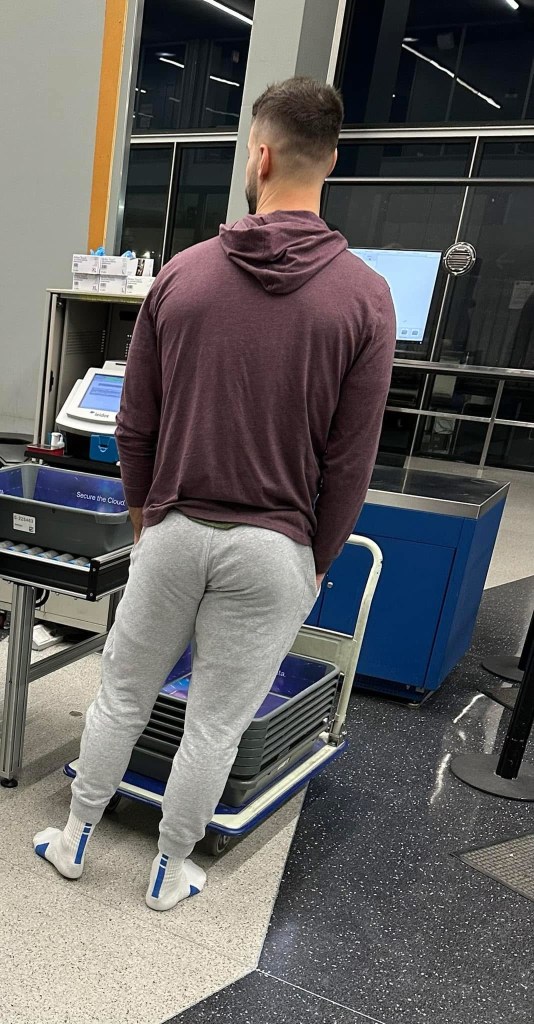
It’s that time of year when the weather cools, comfort becomes essential, and gray sweatpants give us more than one reason to appreciate the view. As Mother Nature turns the skies gray, gray sweatpants quietly put nature’s handiwork on display.





















 Joe
Joe





 The Closet Professor