Category Archives: Art

Was Norman Rockwell Gay?

20140309-230617.jpg

Without thinking too much about it in specific terms, I was showing the America I knew and observed to others who might not have noticed.
Norman Rockwell

Born in New York City in 1894, Norman Rockwell always wanted to be an artist. Rockwell found success early. He painted his first commission of four Christmas cards before his sixteenth birthday. While still in his teens, he was hired as art director of Boys’ Life, the official publication of the Boy Scouts of America, and began a successful freelance career illustrating a variety of young people’s publications.

At age 21, Rockwell’s family moved to New Rochelle, New York, where Rockwell set up a studio with the cartoonist Clyde Forsythe and produced work for such magazines as Life, Literary Digest, and Country Gentleman. In 1916, the 22-year-old Rockwell painted his first cover for The Saturday Evening Post, the magazine considered by Rockwell to be the “greatest show window in America.” Over the next 47 years, another 321 Rockwell covers would appear on the cover of the Post. Also in 1916, Rockwell married Irene O’Connor; they divorced in 1930.

The 1930s and 1940s are generally considered to be the most fruitful decades of Rockwell’s career. In 1930 he married Mary Barstow, a schoolteacher, and the couple had three sons, Jarvis, Thomas, and Peter. The family moved to Arlington, Vermont, in 1939, and Rockwell’s work began to reflect small-town American life.

In 1943, inspired by President Franklin Roosevelt’s address to Congress, Rockwell painted the Four Freedoms paintings. They were reproduced in four consecutive issues of The Saturday Evening Post with essays by contemporary writers. Rockwell’s interpretations of Freedom of Speech, Freedom to Worship, Freedom from Want, and Freedom from Fear proved to be enormously popular. The works toured the United States in an exhibition that was jointly sponsored by the Post and the U.S. Treasury Department and, through the sale of war bonds, raised more than $130 million for the war effort.

Although the Four Freedoms series was a great success, 1943 also brought Rockwell an enormous loss. A fire destroyed his Arlington studio as well as numerous paintings and his collection of historical costumes and props.

In 1953, the Rockwell family moved from Arlington, Vermont, to Stockbridge, Massachusetts. Six years later, Mary Barstow Rockwell died unexpectedly. In collaboration with his son Thomas, Rockwell published his autobiography, My Adventures as an Illustrator, in 1960. The Saturday Evening Post carried excerpts from the best-selling book in eight consecutive issues, with Rockwell’s Triple Self-Portrait on the cover of the first.

In 1961, Rockwell married Molly Punderson, a retired teacher. Two years later, he ended his 47-year association with The Saturday Evening Post and began to work for Look magazine. During his 10-year association with Look, Rockwell painted pictures illustrating some of his deepest concerns and interests, including civil rights, America’s war on poverty, and the exploration of space.

So much has been written about Rockwell, including his own autobiography, that his life would seem to be a closed case. But he receives a fascinating rethinking in Deborah Solomon’s American Mirror: The Life and Art of Norman Rockwell, in which she makes a case for his homoerotic desires.

Although she can’t conclusively prove that Rockwell had sex with men, she makes an argument that he “demonstrated an intense need for emotional and physical closeness with men” and that his unhappy marriages were attempts at “passing” and “controlling his homoerotic desires.” Rockwell also had a close bond with the openly gay artist J.C. Leyendecker and his gay brother, Frank, also an artist, and counted himself as the “one true friend” the brothers had. As Solomon states, “it was both an artistic apprenticeship and an unclassifiable romantic crush.” According to Solomon, Rockwell went on to have close relationships with his studio assistants (even sleeping in the same bed with one on an extended camping trip) and created his own version of idealized boyhood beauty.

While digging into his back story, Solomon offers sensitive close readings of some of his well-known works that smack of homoeroticism but have been cherished (and sanitized) for their depiction of all-American values. For example, when she points out that in the beloved portrait of a young boy seated next to a police officer at a diner counter, “The Runaway,” the cop can be seen as a “figure of tantalizing masculinity, a muscle man in a skin-tight uniform and boots,” it’s almost as if we’re seeing a proto-Tom of Finland emerge before our eyes. In this analysis, it’s not only a painting that represents a desire for both independence and security, it shows the tenderness between men (of any age) and encapsulates the complicated life and desires of an artist many have written off as a proselytizer of an American dream that didn’t include them. According to Solomon, Rockwell was constantly yearning for another ideal, of youthful male beauty, that always seemed to lie beyond reach.

I’m all for taking a close look into history and uncovering evidence that a historical figure may have been gay; however, this is one instance where I tend to think that Solomon is making a bit of a stretch. I personally have never viewed Norman Rockwell’s work as homoerotic, but as idealistic Americana. I certainly see no traces of a Tom of Finland police officer in the doughy 1950s officer of “The Runaway.” I will admit that I have not read Deborah Solomon’s book nor have I had the chance to evaluate the evidence, but it seems like pure speculation to me. American Mirror has produced a fair amount of controversy, so I do not think I am alone in finding fault with Solomon’s assumptions.

Patrick Toner, a professor at Wake Forest University, wrote:

In her new biography, however, Deborah Solomon presents a Rockwell we might not be inclined to love so much. Her most shocking claim is that he was sexually attracted to young boys. Almost equally shocking, but more subtle, is her suggestion that Rockwell’s self-absorption had a body count—his behavior led directly or indirectly to at least three ugly deaths.

There is no reason to go along with Solomon about these things. As I’ll show, her arguments—such as they are—are deeply flawed, and she has a pronounced tendency to either distort or ignore evidence to the contrary of her claims. As her interpretation of Rockwell himself is irremediably flawed, so is her interpretation of his art. Hers is a book without merit.

Toner continues by stating:

Her evidence for Rockwell’s pedophilia consists of three intertwined claims: First, he paints a lot of boys. Second, he forms strong relationships with some of the boys who serve as models for these paintings. Third, some of these paintings are sexually suggestive. Solomon thinks that pedophilia serves as the best unifying explanation for these claims. I doubt even that, but even if it were the case, there are problems with all three.

Toner’s review of American Mirror is quite long but interesting. From what I have read, it seems as if Solomon had a particular agenda, probably for publicity, in writing her Rockwell biography. It seems that sensationalism is what sells biographies these days, and Solomon has certainly written what seems to be a sensational book. The fact is, if Norman Rockwell was homosexual, there seems no way of proving it except through speculation. I doubt it would surprise many people if one of America’s greatest artists was gay, because let’s face it, most of history’s great artists were. However, I think Rockwell would have probably painted a new version of the picture below to answer the questions of his sexuality:

20140309-230655.jpg

In “The Gossips,” a Saturday Evening Post cover from March 6, 1948, it seems Rockwell had a neighbor who started a disagreeable rumor about him. What can one do about a nasty gossip? Well, if you are a famous illustrator, you can paint a cover about it. It started with just a couple of people, then it just grew, leaving Rockwell in need of more models. The result, said the editors, is that we see “almost the entire adult population of Arlington, Vermont.” As he worked on the project, the artist worried that his friends and neighbors might be offended, so he included his wife and himself. Mary Rockwell is second and third in the third row, spreading the rumor via rotary phone. In the gray felt hat in the bottom row is, of course, the artist himself (you can click on the image for a close-up). You’ll notice the lady at the end is the one at the beginning who started the rumor, and our friend Rockwell appears to be giving her a piece of his mind. Apparently, the neighbor who started the rumor in real life never spoke to Rockwell again. I have a feeling it was no great loss.
The Barcelona Inside Me

20130819-224728.jpg

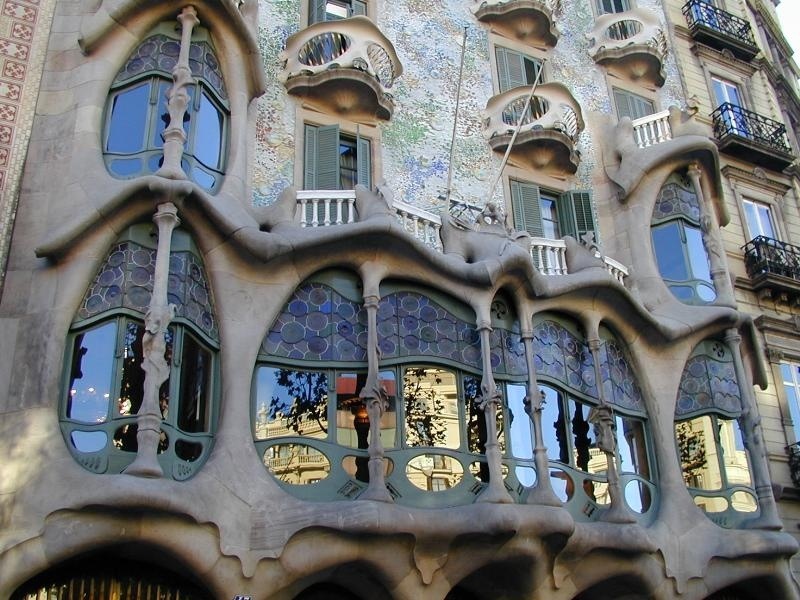
The Barcelona Inside Me
by Robin Becker

Give me, again, the fairy tale grotto
with the portico-vaulting overhead.
Let me walk beneath the canted columns
of Gaudí’s rookery, spiral
along his crenelated Jerusalem
of broken tiles, crazy shields.
Yes, it’s hot as hell and full
of tourists at the double helix,
but the anarchists now occupy
the Food Court, and the arcadian dream
for the working class includes this shady
colonnade cut into the mountainside.
I’ve postponed my allegiance to
the tiny house movement, to the 450
square feet of simple, American maple
infrastructure and the roomy
mind suspended like a hammock
between joists. Serpents and castle
keeps shimmer, and a mosaic invitation
to the Confectionery gets me a free
café con leche on the La Rambla,

where honeycombed apartments bend
on chiseled stone and host
floating, wrought-iron balconies.
I think I’ll move into Gaudí’s dream
of recycled mesh, walk barefoot
on his flagstone tiles
inscribed with seaweed
and sacred graffiti
from pagan tombs.
O, Barcelona of chamfered corners!
And chimneys of cowled
warriors! From Gaudí’s Book
of Revelations, I invite the goblet
and the stone Mobius strip
to a tapas of grilled prawns and squid.
Gaudí’s book of Revelations.

About This Poem
“Visiting several of Antoni Gaudí’s masterpieces challenged my attachment to minimalism, occasioned some reading about Spanish architectural and cultural history, and led to unfamiliar, descriptive language. I tried to make the poem’s line turns and diction shifts reflect the speaker’s surprise at the city’s delights. Into the architect’s fantastical creations I plunged, a tourist with a dream of staying on.”—Robin Becker

About This Poet
Robin Becker was born in 1951 in Philadelphia, Pennsylvania. She earned a B.A. and M.A. from Boston University and taught for seventeen years at the Massachusetts Institute of Technology.

I am dedicating the posting of this poem today to a dear friend of mine who will be traveling to Spain next month, and I wish him safe travels. I hope he will have a wonderful time.


We Are God’s Children

It’s so easy to get wrapped up in all the details of being a Christian.  There are theological issues to resolve, questions we don’t have answers to, and disagreements that have existed since the beginning.  Sometimes, it’s easy to miss the forest for the trees.

So this week, let’s step back and get back to the basics.

If you’re frustrated in your life, confused by issues, or way too busy for your own good, take a moment to relax.  Take a deep breath.  Ask God for a refreshing spiritual breeze in your life.
Then read the following two passages for a reminder of why we’re Christians.

1 John 4:7-19

King James Version (KJV)
Beloved, let us love one another: for love is of God; and every one that loveth is born of God, and knoweth God.
He that loveth not knoweth not God; for God is love.
In this was manifested the love of God toward us, because that God sent his only begotten Son into the world, that we might live through him.
10 Herein is love, not that we loved God, but that he loved us, and sent his Son to be the propitiation for our sins.
11 Beloved, if God so loved us, we ought also to love one another.
12 No man hath seen God at any time. If we love one another, God dwelleth in us, and his love is perfected in us.
13 Hereby know we that we dwell in him, and he in us, because he hath given us of his Spirit.
14 And we have seen and do testify that the Father sent the Son to be the Saviour of the world.
15 Whosoever shall confess that Jesus is the Son of God, God dwelleth in him, and he in God.
16 And we have known and believed the love that God hath to us. God is love; and he that dwelleth in love dwelleth in God, and God in him.
17 Herein is our love made perfect, that we may have boldness in the day of judgment: because as he is, so are we in this world.
18 There is no fear in love; but perfect love casteth out fear: because fear hath torment. He that feareth is not made perfect in love.
19 We love him, because he first loved us.

1 John 3:1-3

King James Version (KJV)
Behold, what manner of love the Father hath bestowed upon us, that we should be called the sons of God: therefore the world knoweth us not, because it knew him not.

Beloved, now are we the sons of God, and it doth not yet appear what we shall be: but we know that, when he shall appear, we shall be like him; for we shall see him as he is.
And every man that hath this hope in him purifieth himself, even as he is pure.


You are a child of God.

May that be the single thing that sticks in your mind as you tackle whatever life throws at you this week.

God loves you, exactly as you are.  So take that love and share it!

The Ancient Olympics

ancient-olympics When I took my first history class in college, I did a research project on the Ancient Olympics. I had always been fascinated with the thought of athletes competing in the nude, but I also was in by the Summer Olympics that year, which were being held in Atlanta. My family and I actually went to the Olympics that year since it was close by and had a great time. I was thinking today about doing another history post and I was thinking about all the conversation we have been having about circumcision, and the idea of the Ancient Olympics came to me.

b_39k2701retocuhedbb_39k2038retouchedb

One of the things I learned during that research project on the Ancient Olympics is that men were not allowed to compete if they were kynodesmecircumcised, which meant that during that time Greek Jews were not allowed to compete in the Ancient Olympics. I also learned that in order to protect their penis during wrestling matches and other contact sports, the men would tie a string around the tip of their foreskin enclosing their glans, thus keeping them safe. The kynodesme was tied tightly around the part of the foreskin that extended beyond the glans. The kynodesme could then either be attached to a waist band to expose the scrotum, or tied to the base of the penis so that the penis appeared to curl upwards.

hugh-plummer-02-13 article-0-0909EC69000005DC-218_468x637

The ancient Olympics were rather different from the modern Games. There were fewer events, and only free men who spoke Greek could compete, instead of athletes from any country. Also, the games were always held at Olympia instead of moving around to different sites every time.

3-sport-nude-lubo-spirko 30s_french_soldiers_wrestling_nude
Like our Olympics, though, winning athletes were heroes who put their home towns on the map. One young Athenian nobleman defended his political reputation by mentioning how he entered seven chariots in the Olympic chariot-race. This high number of entries made both the aristocrat and Athens look very wealthy and powerful.
6a00d83451b90769e20133eca5dbe4970b-400wi

There are numerous myths about how the Olympics began. One myth says that the guardians of the infant god Zeus held the first footrace, or that Zeus himself started the Games to celebrate his victory over his father Cronus for control of the world. Another tradition states that after the Greek hero Pelops won a chariot race against King Oenomaus to marry Oenomaus’s daughter Hippodamia, he established the Games.

Patrick sindre skoglund[2]

Athletic games also were an important part of many religious festivals from early on in ancient Greek culture. In the Iliad, the famous warrior Achilles holds games as part of the funeral services for his best friend Patroclus. The events in them include a chariot race, a footrace, a discus match, boxing and wrestling.

yik Braeden Baade (6)

The footrace was the sole event for the first 13 Olympiads. Over time, the Greeks added longer footraces, and separate events. The pentathlon and wrestling events were the first new sports to be added, in the 18th Olympiad.
milo-of-kroton
Click on any of the event names to see a description of a particular sport:

olive-wreath-ancient-olympicsThe victorious olive branch. The Ancient Olympic Games didn’t have any medals or prizes. Winners of the competitions won olive wreaths, branches, as well as woolen ribbons. The victors returned home as heroes – and got showered with gifts by their fellow citizens.
Here are two videos the History Channel did about the Ancient Olympics. Too bad, they have them wearing modesty pouches.

By the way, for those interested, here is an explanation of women’s role in the Ancient Olympics:
Married women were banned at the Ancient Olympics on the penalty of death. The laws dictated that any adult married woman caught entering the Olympic grounds would be hurled to her death from a cliff! Maidens, however, could watch (probably to encourage gettin’ it on later). But this didn’t mean that the women were left out: they had their own games, which took place during Heraea, a festival worshipping the goddess Hera. The sport? Running – on a track that is 1/6th shorter than the length of a man’s track on the account that a woman’s stride is 1/6th shorter than that of a man’s! The female victors at the Heraea Games actually got better prizes: in addition to olive wreaths, they also got meat from an ox slaughtered for the patron deity on behalf of all participants! Overall, young girls in Ancient Greece weren’t encouraged to be athletes – with a notable exception of Spartan girls. The Spartans believed that athletic women would breed strong warriors, so they trained girls alongside boys in sports. In Sparta, girls also competed in the nude or wearing skimpy outfits, and boys were allowed to watch.
Another side note, Spartan marriage rituals are quite fascinating, if any one is interested I will do a straight post about Spartan sexuality and the marriage rituals. It will have some about gay sex, these were the Spartans after all.


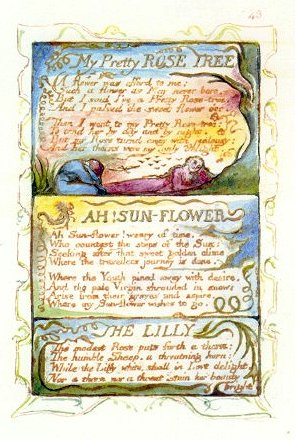
Ah! Sun-flower

Afternoon” by Philip Gladstone

Ah! Sun-flower

BY WILLIAM BLAKE

Ah Sun-flower! weary of time,
Who countest the steps of the Sun:
Seeking after that sweet golden clime
Where the traveller’s journey is done;

Where the Youth pined away with desire,
And the pale Virgin shrouded in snow
Arise from their graves and aspire
Where my Sun-flower wishes to go.

Ah Sunflower” is a poem written by the English poet William Blake. It was published as part of his collection Songs of Experience in 1794Ed Sanders of The Fugs set the poem to music and recorded it on The Fugs First Album in 1965. For the passing of the 2nd millennium British composer Jonathan Doveset the text of “Ah, Sunflower” and two other poems by Blake (“Invocation” and “The Narrow Bud Opens Her Beauties To The Sun”) in his piece “The Passing of the Year” (2000), a song cycle for double chorus and piano. In 2002 the Canadian sisters Kate and Anna McGarrigle wanted to record Ed Sanders’ setting in French; they asked Philippe Tatartcheff to translate the poem, only to find the words no longer scanned with the tune. So they composed a new tune which accommodated both languages. That appeared the following year on their album La vache qui pleure in both English and French recordings. (From Wikipedia)


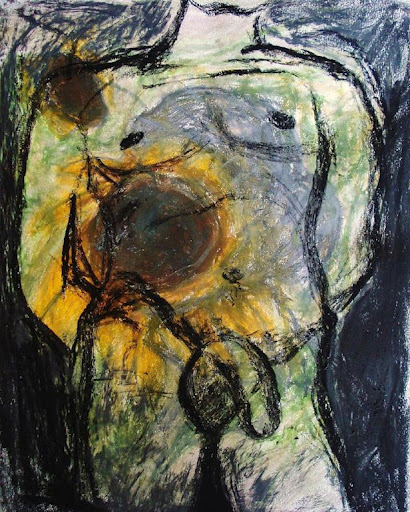
Male Nudes with Sunflowers” by Sheri Larsen

While reading Where the Heart Beats by Kay Larson (see my post Where the Heart Beats), I came across an interesting passage about Allen Ginsberg, who was a longtime fan of William Blake.  In his Harlem apartment in 1948, Ginsberg was masturbating while reciting the above poem, but “the poem’s elusive heart was not revealing itself.”  Then he heard a voice, which he believed was either Blake or God from the “Ancient of Days” intoning their words and revealing the meaning of these words.  According to Larson, Ginsberg saw the solidity of the world seem to flicker and go transparent. In an interview in 1995, Ginsberg stated, “And I was living (in 1948) in Harlem, East Harlem, New York, on the sixth floor of a tenement. There was a lot of theology books around, in an apartment that I had rented from a theology student-friend, so I was reading a lot of Plato’s Phaedrus, St John of the Cross…and (William) Blake. And I had the sudden… reading “The Sick Rose” and “The Sunflower”, I had the odd sensation of hearing Blake’s voice outside of my own body, a voice really not too much unlike my own when my voice is centered in my sternum, maybe a latent projection of my own physiology, but, in any case, a surprise, maybe a hallucination, you can call it, hearing it in the room, Blake reciting it, or some very ancient voice of the Ancient of Days reciting, “Ah Sunflower…” So there was some earthen-deep quality that moved me, and then I looked out the window and it seemed like the heavens were endless, or the sky was endless, I should say.”   The vision continued to unfold over the next few days.  The poem awakened a deeper “real universe,” a cosmic consciousness for Ginsberg, which he saw everywhere he looked.  Though he tried to invoke the experience again, he was never able to do so. (Probably because he did not have the correct sequence of drugs or alcohol again, but who knows.)  The point is that the poem revealed something to Ginsberg.  Something that we may never fully understand.


The experience my have inspired a later poem by Ginsberg published in 1955. The Ginsberg poem, “Sunflower Sutra” brings to light a very important and universal issue. Although it was written in the 1950’s it is still comparable to the here and now. When Ginsberg wrote this poem, it was the time of conservatives, consumerism, and strong morals. Ginsberg did not relate to such a culture and instead expressed himself through his poems, which blatantly rejected such outlooks on life. “Sunflower Sutra” is about the death of the inner beauty and spirit in one’s soul in relation to the destruction of nature and the realization that it is never too late to bring such creativity and beauty back to life. Ginsberg describes the fall of a mighty the sunflower. Once a bright yellow beacon of life, it now is “broken like a battered crown.” Having been covered by the dirt and grime of industry, by human “ingenuity,” this sunflower is really representing a demise in humanity. Rather than choosing nature as a prime example for life, choosing the “perfect beauty of a sunflower,” we have chosen industry and technology, and have forgotten that we are flowers. Ginsberg berates the dust and grime which have rained down from the locomotives onto “my sunflower O my soul” and wonders “when did you forget you were a flower?” This poem really is not about a flower, but the tragedy of losing one’s inner beauty, the vivacity and brightness which makes one shine.


Sunflower Sutra

I walked on the banks of the tincan banana dock and
sat down under the huge shade of a Southern
Pacific locomotive to look at the sunset over the
box house hills and cry.
Jack Kerouac sat beside me on a busted rusty iron
pole, companion, we thought the same thoughts
of the soul, bleak and blue and sad-eyed,
surrounded by the gnarled steel roots of trees of
machinery.
The oily water on the river mirrored the red sky, sun
sank on top of final Frisco peaks, no fish in that
stream, no hermit in those mounts, just ourselves
rheumy-eyed and hungover like old bums
on the riverbank, tired and wily.
Look at the Sunflower, he said, there was a dead gray
shadow against the sky, big as a man, sitting
dry on top of a pile of ancient sawdust–
–I rushed up enchanted–it was my first sunflower,
memories of Blake–my visions–Harlem
and Hells of the Eastern rivers, bridges clanking Joes
Greasy Sandwiches, dead baby carriages, black
treadless tires forgotten and unretreaded, the
poem of the riverbank, condoms & pots, steel
knives, nothing stainless, only the dank muck
and the razor-sharp artifacts passing into the
past–
and the gray Sunflower poised against the sunset,
crackly bleak and dusty with the smut and smog
and smoke of olden locomotives in its eye–
corolla of bleary spikes pushed down and broken like
a battered crown, seeds fallen out of its face,
soon-to-be-toothless mouth of sunny air, sunrays
obliterated on its hairy head like a dried
wire spiderweb,
leaves stuck out like arms out of the stem, gestures
from the sawdust root, broke pieces of plaster
fallen out of the black twigs, a dead fly in its ear,
Unholy battered old thing you were, my sunflower O
my soul, I loved you then!
The grime was no man’s grime but death and human
locomotives,
all that dress of dust, that veil of darkened railroad
skin, that smog of cheek, that eyelid of black
mis’ry, that sooty hand or phallus or protuberance
of artificial worse-than-dirt–industrial–
modern–all that civilization spotting your
crazy golden crown–
and those blear thoughts of death and dusty loveless
eyes and ends and withered roots below, in the
home-pile of sand and sawdust, rubber dollar
bills, skin of machinery, the guts and innards
of the weeping coughing car, the empty lonely
tincans with their rusty tongues alack, what
more could I name, the smoked ashes of some
cock cigar, the cunts of wheelbarrows and the
milky breasts of cars, wornout asses out of chairs
& sphincters of dynamos–all these
entangled in your mummied roots–and you there
standing before me in the sunset, all your glory
in your form!
A perfect beauty of a sunflower! a perfect excellent
lovely sunflower existence! a sweet natural eye
to the new hip moon, woke up alive and excited
grasping in the sunset shadow sunrise golden
monthly breeze!
How many flies buzzed round you innocent of your
grime, while you cursed the heavens of the
railroad and your flower soul?
Poor dead flower? when did you forget you were a
flower? when did you look at your skin and
decide you were an impotent dirty old locomotive?
the ghost of a locomotive? the specter and
shade of a once powerful mad American locomotive?
You were never no locomotive, Sunflower, you were a
sunflower!
And you Locomotive, you are a locomotive, forget me
not!
So I grabbed up the skeleton thick sunflower and stuck
it at my side like a scepter,
and deliver my sermon to my soul, and Jack’s soul
too, and anyone who’ll listen,
–We’re not our skin of grime, we’re not our dread
bleak dusty imageless locomotive, we’re all
beautiful golden sunflowers inside, we’re blessed
by our own seed & golden hairy naked
accomplishment-bodies growing into mad black
formal sunflowers in the sunset, spied on by our
eyes under the shadow of the mad locomotive
riverbank sunset Frisco hilly tincan evening
sitdown vision.
          Allen Ginsberg

          Berkeley, 1955


Art and Degas

I have been working this weekend on some promotions for my schools new art club.  This has gotten me to think about art, and though, Edgar Degas was characterized as an “old curmudgeon” this quote below is quite beautiful.

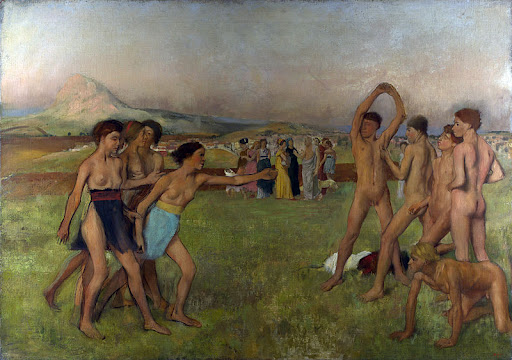
Young Spartans Exercising, also known as Young Spartans, is an oil on canvas painting by French impressionist artist Edgar Degas. The work depicts two groups of male and female Spartan youths exercising, though the subject matter of the painting has, in recent times, been challenged. The work is now in the permanent collection of The National Gallery in London.

Edgar Degas was a French artist famous for his work in painting, sculpture, printmaking and drawing. He is regarded as one of the founders of Impressionism although he rejected the term, and preferred to be called a realist. A superb draftsman, he is especially identified with the subject of the dance, and over half of his works depict dancers. These display his mastery in the depiction of movement, as do his racecourse subjects and female nudes. His portraits are notable for their psychological complexity and depiction of human isolation.
Early in his career, he wanted to be a history painter, a calling for which he was well prepared by his rigorous academic training and close study of classic art. In his early thirties, he changed course, and by bringing the traditional methods of a history painter to bear on contemporary subject matter, he became a classical painter of modern life.


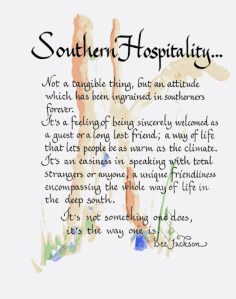
Southern Hospitality

Wishing you magnolia mornings and sweet tea afternoons.
Thank goodness for lazy warm days, with some sweet tea and southern hospitality.  I am very much looking forward to my day off tomorrow.  I’m glad the school gives us Good Friday as a holiday.
SAVANNAH PRINTS AND CALLIGRAPHY BY DEE JACKSON

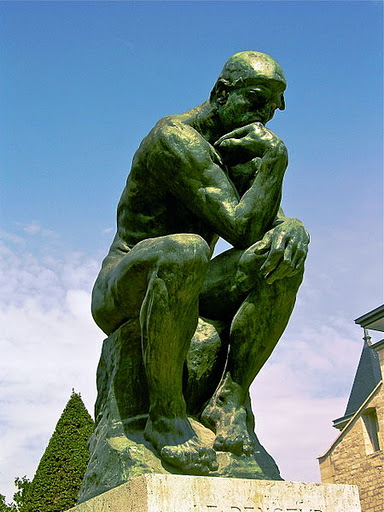
Auguste Rodin

The Thinker
Musée Rodin, Paris

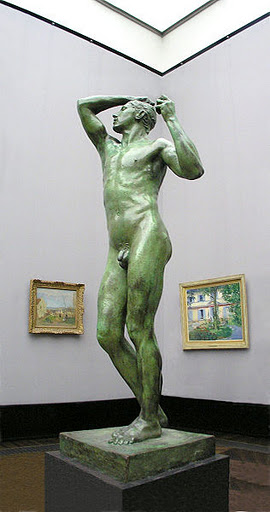
Auguste Rodin on of my favorite sculptors was born  in Paris today in 1840. He began his art study at 14 in the Petite École and in the school of Antoine Barye, earning his living by working for an ornament maker. In 1863 he went to work for the architectural sculptor A. E. Carrier-Belleuse, who had a great influence on him. From 1870 to 1875 he continued in the same trade in Brussels and then briefly visited Italy. In the Salon of 1877 he exhibited a nude male figure, The Age of Bronze (1876; Paris). It was both extravagantly praised and condemned; his critics unjustly accused him of having made a cast from life. From the furor Rodin gained the active support and patronage of Turquet, undersecretary of fine arts. His Age of Bronze and St. John (1878) were purchased for the Luxembourg Gardens, Paris.

The government gave him a studio in Paris, where he worked the rest of his life with growing fame. From 1880 on Rodin worked intermittently on studies for a huge bronze door for the Musée des Arts décoratifs. It was inspired by Dante’s Inferno and was to be called the Gate of Hell. He never finished it. Among the 186 figures intended for it are Adam and Eve (1881; Metropolitan Mus.), The Thinker (1879-1900), and La Belle Heaulmière (both: Paris). These, together with his group The Burghers of Calais (Calais), completed in 1894, are among his most famous creations.

The Age of Bronze
Alte Nationalgalerie, Berlin

Other ambitious works are his monuments to Balzac (1897; Paris) and to Victor Hugo (1909; Paris). Rodin is also known for his drawings, his many fine portrait busts, and his figures and groups in marble, such as Ugolino (1882), Danaïd (1885), The Kiss (1886), and The Hand of God (1897-98) in the Rodin Museum, Paris, and Pygmalion and Galatea and The Bather in the Metropolitan Museum, N.Y.C. He is best represented in the Rodin museums of Paris and Philadelphia, but fine examples of his work are included in many public collections throughout the world.

Rodin’s work is generally considered the most important contribution to sculpture of his century, although some recent critical opinion has found his allegorical works pretentious. Realistic in many respects, it is nevertheless imbued with a profound, romantic poetry. The Gothic, the dance, and the works of Dante, Baudelaire, and Michelangelo were major sources of inspiration. Rodin considered his work completed when it expressed his idea, and as a result his sculpture is varied in technique; some is polished, some is gouged and scraped, and some seems scarcely to have emerged from the rough stone. He worked long over his more important works, returning to them again and again but without injuring their essential vitality.

Bibliography

See biographies by F. Grunfeld (1987) and R. Butler (1993); studies by R. M. Rilke (1902 and 1907, rev. tr. 2004), S. Story (rev. ed. 1966), A. E. Elsen (1963, repr. 1967), R. Descharnes and J. F. Chabrun (tr. 1967), I. Jainu (1967), Y. Taillandier (1967), C. Lampert (1987), K. Varnedoe (2001), and A. E. Eisen (2003).

The Walking Man
Art Institute of Chicago
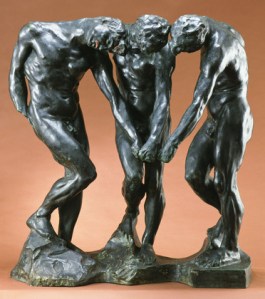
The Three Shades 


Petite Mort: Recollections of a Queer Public

Anonymous — Perry Street

Where was your first homosexual encounter? For many gay men of my generation and/or from rural America, the internet’s GayOLs (i.e. gay chatrooms on AOL, et. al.), Gay.coms, and Manhunts, provided some of our first gay encounters.  And for many gay men, especially those of a certain age and geography, it was in public. And for many men, that meant coming to New York City. Before AIDS and before the Giuliani crackdown, cruising created a sort of roughshod community, an underlying queerness of the streets that sowed the seeds of social and political action. In Petite Mort: Recollections of a Queer Public, artists Carlos Motta and Joshua Lubin-Levy curate a love letter-cum-souvenir to the Big Apple’s fading eroticism.

Aram Jibilian — Untitled

Seeking to create an “Atlas of Queer Affection” and question notions of intimacy, assimilation and gay politics, artists Carlos Motta — of the fascinating We Who Feel Differently documentary project on multi-national queer culture — and Joshua Lubin-Levy called upon an intergenerational group of over 60 gay men to submit drawings of spaces in the city where a public sexual encounter occurred.

Drawn from memory and depicting sites from Chinatown to The Rambles and the Twin Towers, the submissions were curated into a sexy, sardonic, meditative, and ultimately moving book. As subjective blueprint of the city, it values not simply the space “as is” but how it has been performed and engaged, highlighting the fundamental connection between public space and queer life. This ain’t your mamma’s NYC.

Aram Jibilian — Untitled
Anonymous — Perry Street

Who: Me and a Greek-German boy.

What: Public sexual encounter.

When: Summer 2010.
Where: Across from Perry Street, on the park overlooking the West Side piers.
How: After wandering aimlessly through the city, an invisible magnetic force led us there.


Aram Jibilian — Untitled

In this warm steamy men’s bathroom on the 6th floor of New York University’s Leon Shimkin Hall, I found a place to blow off some serious art school steam. There were always at least a couple of other men waiting.

Jean-Michel Sivry — West Side

It was Sunday. We marched westward through Bank, Perry, or Charles Street. At the crossing with Greenwich Avenue there were the trucks side-by-side. We reached the final avenue before the river. Guys passed beneath the decrepit structure of the elevated highway. On the other side, the docks, the wonderful wharves. In the vast warehouses in ruins, openings were used, doors had been opened, gaps in the walls. Inside: stairs, scales, holes through the floors, metal debris, spokes of light, glass canopies, panels collapsed… an architecture of desire.

Petite Mort: Recollections of a Queer Public (Forever & Today, 2011) features additional texts by Aiken Forrett, Eileen Myles, Joel Czarlinsky, Johan Andersson, José Esteban Muñoz, Kate Bornstein, and Tim Dean, amongst others. To purchase, visit Printed Matter (195 10th Ave., NYC; 212-925-0325) or e-mail petitemort@foreverandtoday.org. Click here to preview in entirety.


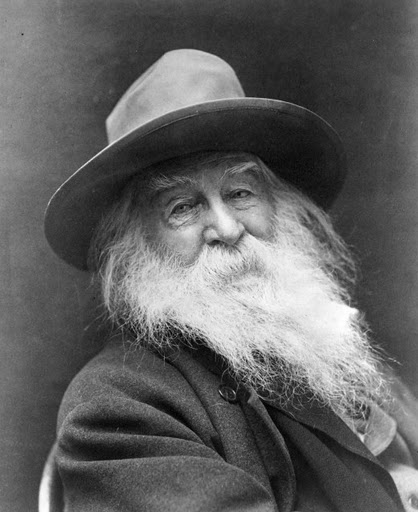
Ode to Walt Whitman

Eakins was profoundly influenced by the ideas of Walt Whitman, with whom he became close friends, after painting his portrait in 1887-1888. Eakins’ carefully composed images of naked youths in arcadian landscape settings (such as The Swimming Hole, 1893-1895) constitute visual equivalents of Whitman’s poems, celebrating male beauty and comradeship. Eakins often painted scenes of all-male athletic activities, such as rowing (for example, The Biglin Brothers Turning the Stake, 1873) and boxing (for example, Counting Out, 1888).

Ode to Walt Whitman
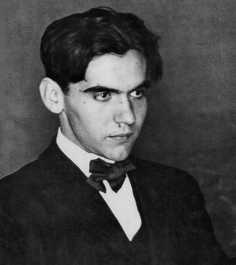
by Federico Garcia Lorca

By the East River and the Bronx
boys were singing, exposing their waists
with the wheel, with oil, leather, and the hammer.
Ninety thousand miners taking silver from the rocks
and children drawing stairs and perspectives.

But none of them could sleep,
none of them wanted to be the river,
none of them loved the huge leaves
or the shoreline’s blue tongue.

By the East River and the Queensboro
boys were battling with industry
and the Jews sold to the river faun
the rose of circumcision,
and over bridges and rooftops, the mouth of the sky emptied
herds of bison driven by the wind.

But none of them paused,
none of them wanted to be a cloud,
none of them looked for ferns
or the yellow wheel of a tambourine.

As soon as the moon rises
the pulleys will spin to alter the sky;
a border of needles will besiege memory
and the coffins will bear away those who don’t work.

New York, mire,
New York, mire and death.
What angel is hidden in your cheek?
Whose perfect voice will sing the truths of wheat?
Who, the terrible dream of your stained anemones?

Not for a moment, Walt Whitman, lovely old man,
have I failed to see your beard full of butterflies,
nor your corduroy shoulders frayed by the moon,
nor your thighs pure as Apollo’s,
nor your voice like a column of ash,
old man, beautiful as the mist,
you moaned like a bird
with its sex pierced by a needle.
Enemy of the satyr,
enemy of the vine,
and lover of bodies beneath rough cloth…

Not for a moment, virile beauty,
who among mountains of coal, billboards, and railroads,
dreamed of becoming a river and sleeping like a river
with that comrade who would place in your breast
the small ache of an ignorant leopard.

Not for a moment, Adam of blood, Macho,
man alone at sea, Walt Whitman, lovely old man,
because on penthouse roofs,
gathered at bars,
emerging in bunches from the sewers,
trembling between the legs of chauffeurs,
or spinning on dance floors wet with absinthe,
the faggots, Walt Whitman, point you out.

He’s one, too! That’s right! And they land
on your luminous chaste beard,
blonds from the north, blacks from the sands,
crowds of howls and gestures,
like cats or like snakes,
the faggots, Walt Whitman, the faggots,
clouded with tears, flesh for the whip,
the boot, or the teeth of the lion tamers.

He’s one, too! That’s right! Stained fingers
point to the shore of your dream
when a friend eats your apple
with a slight taste of gasoline
and the sun sings in the navels
of boys who play under bridges.

But you didn’t look for scratched eyes,
nor the darkest swamp where someone submerges children,
nor frozen saliva,
nor the curves slit open like a toad’s belly
that the faggots wear in cars and on terraces
while the moon lashes them on the street corners of terror.

You looked for a naked body like a river.
Bull and dream who would join wheel with seaweed,
father of your agony, camellia of your death,
who would groan in the blaze of your hidden equator.

Because it’s all right if a man doesn’t look for his delight
in tomorrow morning’s jungle of blood.
The sky has shores where life is avoided
and there are bodies that shouldn’t repeat themselves in the dawn.

Agony, agony, dream, ferment, and dream.
This is the world, my friend, agony, agony.
Bodies decompose beneath the city clocks,
war passes by in tears, followed by a million gray rats,
the rich give their mistresses
small illuminated dying things,
and life is neither noble, nor good, nor sacred.

Man is able, if he wishes, to guide his desire
through a vein of coral or a heavenly naked body.
Tomorrow, loves will become stones, and Time
a breeze that drowses in the branches.

That’s why I don’t raise my voice, old Walt Whitman,
against the little boy who writes
the name of a girl on his pillow,
nor against the boy who dresses as a bride
in the darkness of the wardrobe,
nor against the solitary men in casinos
who drink prostitution’s water with revulsion,
nor against the men with that green look in their eyes
who love other men and burn their lips in silence.

But yes against you, urban faggots,
tumescent flesh and unclean thoughts.
Mothers of mud. Harpies. Sleepless enemies
of the love that bestows crowns of joy.

Always against you, who give boys
drops of foul death with bitter poison.
Always against you,
Fairies of North America,
Pájaros of Havana,
Jotos of Mexico,
Sarasas of Cádiz,
Apios of Seville,
Cancos of Madrid,
Floras of Alicante,
Adelaidas of Portugal.

Faggots of the world, murderers of doves!
Slaves of women. Their bedroom bitches.
Opening in public squares like feverish fans
or ambushed in rigid hemlock landscapes.

No quarter given! Death
spills from your eyes
and gathers gray flowers at the mire’s edge.
No quarter given! Attention!
Let the confused, the pure,
the classical, the celebrated, the supplicants
close the doors of the bacchanal to you.

And you, lovely Walt Whitman, stay asleep on the Hudson’s banks
with your beard toward the pole, openhanded.
Soft clay or snow, your tongue calls for
comrades to keep watch over your unbodied gazelle.

Sleep on, nothing remains.
Dancing walls stir the prairies
and America drowns itself in machinery and lament.
I want the powerful air from the deepest night
to blow away flowers and inscriptions from the arch where you sleep,
and a black child to inform the gold-craving whites
that the kingdom of grain has arrived.

For more information and analysis of this poem, take a look at “Lorca’s Homographic Poetics of Nationalism” by Frederick Luis Aldama

Also see:

I would not consider this one of my favorite poems, but it is interesting in its own way. John K. Walsh speculates in his essay “Lorca’s Ode to Walt Whitman” that Lorca’s Cuban hiatus marked his “open passage into a homosexual mien, and the acknowledgment of his proclivities.”  As with most poetic coming outs, this is bold and expressive.