

I have come to believe that a great teacher is a great artist and that there are as few as there are any other great artists. Teaching might even be the greatest of the arts since the medium is the human mind and spirit.
John Steinbeck

I have come to believe that a great teacher is a great artist and that there are as few as there are any other great artists. Teaching might even be the greatest of the arts since the medium is the human mind and spirit.
John Steinbeck

Without thinking too much about it in specific terms, I was showing the America I knew and observed to others who might not have noticed.
—Norman Rockwell
Born in New York City in 1894, Norman Rockwell always wanted to be an artist. Rockwell found success early. He painted his first commission of four Christmas cards before his sixteenth birthday. While still in his teens, he was hired as art director of Boys’ Life, the official publication of the Boy Scouts of America, and began a successful freelance career illustrating a variety of young people’s publications.
At age 21, Rockwell’s family moved to New Rochelle, New York, where Rockwell set up a studio with the cartoonist Clyde Forsythe and produced work for such magazines as Life, Literary Digest, and Country Gentleman. In 1916, the 22-year-old Rockwell painted his first cover for The Saturday Evening Post, the magazine considered by Rockwell to be the “greatest show window in America.” Over the next 47 years, another 321 Rockwell covers would appear on the cover of the Post. Also in 1916, Rockwell married Irene O’Connor; they divorced in 1930.
The 1930s and 1940s are generally considered to be the most fruitful decades of Rockwell’s career. In 1930 he married Mary Barstow, a schoolteacher, and the couple had three sons, Jarvis, Thomas, and Peter. The family moved to Arlington, Vermont, in 1939, and Rockwell’s work began to reflect small-town American life.
In 1943, inspired by President Franklin Roosevelt’s address to Congress, Rockwell painted the Four Freedoms paintings. They were reproduced in four consecutive issues of The Saturday Evening Post with essays by contemporary writers. Rockwell’s interpretations of Freedom of Speech, Freedom to Worship, Freedom from Want, and Freedom from Fear proved to be enormously popular. The works toured the United States in an exhibition that was jointly sponsored by the Post and the U.S. Treasury Department and, through the sale of war bonds, raised more than $130 million for the war effort.
Although the Four Freedoms series was a great success, 1943 also brought Rockwell an enormous loss. A fire destroyed his Arlington studio as well as numerous paintings and his collection of historical costumes and props.
In 1953, the Rockwell family moved from Arlington, Vermont, to Stockbridge, Massachusetts. Six years later, Mary Barstow Rockwell died unexpectedly. In collaboration with his son Thomas, Rockwell published his autobiography, My Adventures as an Illustrator, in 1960. The Saturday Evening Post carried excerpts from the best-selling book in eight consecutive issues, with Rockwell’s Triple Self-Portrait on the cover of the first.
In 1961, Rockwell married Molly Punderson, a retired teacher. Two years later, he ended his 47-year association with The Saturday Evening Post and began to work for Look magazine. During his 10-year association with Look, Rockwell painted pictures illustrating some of his deepest concerns and interests, including civil rights, America’s war on poverty, and the exploration of space.
So much has been written about Rockwell, including his own autobiography, that his life would seem to be a closed case. But he receives a fascinating rethinking in Deborah Solomon’s American Mirror: The Life and Art of Norman Rockwell, in which she makes a case for his homoerotic desires.
Although she can’t conclusively prove that Rockwell had sex with men, she makes an argument that he “demonstrated an intense need for emotional and physical closeness with men” and that his unhappy marriages were attempts at “passing” and “controlling his homoerotic desires.” Rockwell also had a close bond with the openly gay artist J.C. Leyendecker and his gay brother, Frank, also an artist, and counted himself as the “one true friend” the brothers had. As Solomon states, “it was both an artistic apprenticeship and an unclassifiable romantic crush.” According to Solomon, Rockwell went on to have close relationships with his studio assistants (even sleeping in the same bed with one on an extended camping trip) and created his own version of idealized boyhood beauty.
While digging into his back story, Solomon offers sensitive close readings of some of his well-known works that smack of homoeroticism but have been cherished (and sanitized) for their depiction of all-American values. For example, when she points out that in the beloved portrait of a young boy seated next to a police officer at a diner counter, “The Runaway,” the cop can be seen as a “figure of tantalizing masculinity, a muscle man in a skin-tight uniform and boots,” it’s almost as if we’re seeing a proto-Tom of Finland emerge before our eyes. In this analysis, it’s not only a painting that represents a desire for both independence and security, it shows the tenderness between men (of any age) and encapsulates the complicated life and desires of an artist many have written off as a proselytizer of an American dream that didn’t include them. According to Solomon, Rockwell was constantly yearning for another ideal, of youthful male beauty, that always seemed to lie beyond reach.
I’m all for taking a close look into history and uncovering evidence that a historical figure may have been gay; however, this is one instance where I tend to think that Solomon is making a bit of a stretch. I personally have never viewed Norman Rockwell’s work as homoerotic, but as idealistic Americana. I certainly see no traces of a Tom of Finland police officer in the doughy 1950s officer of “The Runaway.” I will admit that I have not read Deborah Solomon’s book nor have I had the chance to evaluate the evidence, but it seems like pure speculation to me. American Mirror has produced a fair amount of controversy, so I do not think I am alone in finding fault with Solomon’s assumptions.
Patrick Toner, a professor at Wake Forest University, wrote:
In her new biography, however, Deborah Solomon presents a Rockwell we might not be inclined to love so much. Her most shocking claim is that he was sexually attracted to young boys. Almost equally shocking, but more subtle, is her suggestion that Rockwell’s self-absorption had a body count—his behavior led directly or indirectly to at least three ugly deaths.
There is no reason to go along with Solomon about these things. As I’ll show, her arguments—such as they are—are deeply flawed, and she has a pronounced tendency to either distort or ignore evidence to the contrary of her claims. As her interpretation of Rockwell himself is irremediably flawed, so is her interpretation of his art. Hers is a book without merit.
Toner continues by stating:
Her evidence for Rockwell’s pedophilia consists of three intertwined claims: First, he paints a lot of boys. Second, he forms strong relationships with some of the boys who serve as models for these paintings. Third, some of these paintings are sexually suggestive. Solomon thinks that pedophilia serves as the best unifying explanation for these claims. I doubt even that, but even if it were the case, there are problems with all three.
Toner’s review of American Mirror is quite long but interesting. From what I have read, it seems as if Solomon had a particular agenda, probably for publicity, in writing her Rockwell biography. It seems that sensationalism is what sells biographies these days, and Solomon has certainly written what seems to be a sensational book. The fact is, if Norman Rockwell was homosexual, there seems no way of proving it except through speculation. I doubt it would surprise many people if one of America’s greatest artists was gay, because let’s face it, most of history’s great artists were. However, I think Rockwell would have probably painted a new version of the picture below to answer the questions of his sexuality:

In “The Gossips,” a Saturday Evening Post cover from March 6, 1948, it seems Rockwell had a neighbor who started a disagreeable rumor about him. What can one do about a nasty gossip? Well, if you are a famous illustrator, you can paint a cover about it. It started with just a couple of people, then it just grew, leaving Rockwell in need of more models. The result, said the editors, is that we see “almost the entire adult population of Arlington, Vermont.” As he worked on the project, the artist worried that his friends and neighbors might be offended, so he included his wife and himself. Mary Rockwell is second and third in the third row, spreading the rumor via rotary phone. In the gray felt hat in the bottom row is, of course, the artist himself (you can click on the image for a close-up). You’ll notice the lady at the end is the one at the beginning who started the rumor, and our friend Rockwell appears to be giving her a piece of his mind. Apparently, the neighbor who started the rumor in real life never spoke to Rockwell again. I have a feeling it was no great loss.
The Barcelona Inside Me
by Robin Becker
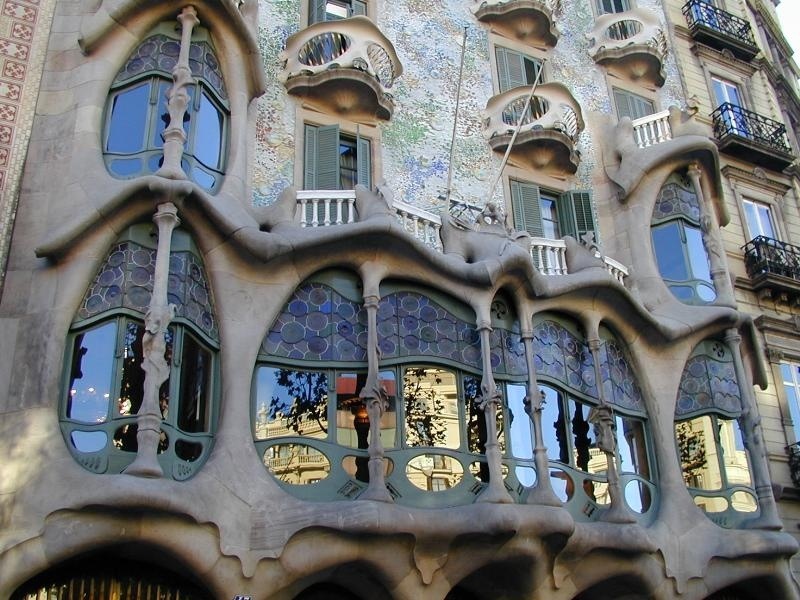
Give me, again, the fairy tale grotto
with the portico-vaulting overhead.
Let me walk beneath the canted columns
of Gaudí’s rookery, spiral
along his crenelated Jerusalem
of broken tiles, crazy shields.
Yes, it’s hot as hell and full
of tourists at the double helix,
but the anarchists now occupy
the Food Court, and the arcadian dream
for the working class includes this shady
colonnade cut into the mountainside.
I’ve postponed my allegiance to
the tiny house movement, to the 450
square feet of simple, American maple
infrastructure and the roomy
mind suspended like a hammock
between joists. Serpents and castle
keeps shimmer, and a mosaic invitation
to the Confectionery gets me a free
café con leche on the La Rambla,
where honeycombed apartments bend
on chiseled stone and host
floating, wrought-iron balconies.
I think I’ll move into Gaudí’s dream
of recycled mesh, walk barefoot
on his flagstone tiles
inscribed with seaweed
and sacred graffiti
from pagan tombs.
O, Barcelona of chamfered corners!
And chimneys of cowled
warriors! From Gaudí’s Book
of Revelations, I invite the goblet
and the stone Mobius strip
to a tapas of grilled prawns and squid.
Gaudí’s book of Revelations.
About This Poem
“Visiting several of Antoni Gaudí’s masterpieces challenged my attachment to minimalism, occasioned some reading about Spanish architectural and cultural history, and led to unfamiliar, descriptive language. I tried to make the poem’s line turns and diction shifts reflect the speaker’s surprise at the city’s delights. Into the architect’s fantastical creations I plunged, a tourist with a dream of staying on.”—Robin Becker
About This Poet
Robin Becker was born in 1951 in Philadelphia, Pennsylvania. She earned a B.A. and M.A. from Boston University and taught for seventeen years at the Massachusetts Institute of Technology.
I am dedicating the posting of this poem today to a dear friend of mine who will be traveling to Spain next month, and I wish him safe travels. I hope he will have a wonderful time.
So this week, let’s step back and get back to the basics.
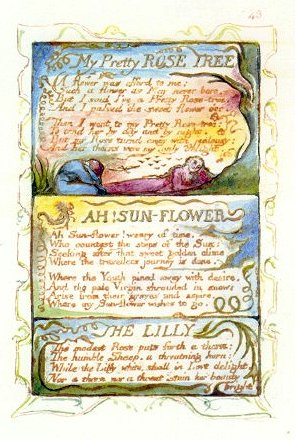
If you’re frustrated in your life, confused by issues, or way too busy for your own good, take a moment to relax. Take a deep breath. Ask God for a refreshing spiritual breeze in your life.
Then read the following two passages for a reminder of why we’re Christians.
1 John 4:7-19
King James Version (KJV)7 Beloved, let us love one another: for love is of God; and every one that loveth is born of God, and knoweth God.
8 He that loveth not knoweth not God; for God is love.
9 In this was manifested the love of God toward us, because that God sent his only begotten Son into the world, that we might live through him.
10 Herein is love, not that we loved God, but that he loved us, and sent his Son to be the propitiation for our sins.
11 Beloved, if God so loved us, we ought also to love one another.
12 No man hath seen God at any time. If we love one another, God dwelleth in us, and his love is perfected in us.
13 Hereby know we that we dwell in him, and he in us, because he hath given us of his Spirit.
14 And we have seen and do testify that the Father sent the Son to be the Saviour of the world.
15 Whosoever shall confess that Jesus is the Son of God, God dwelleth in him, and he in God.
16 And we have known and believed the love that God hath to us. God is love; and he that dwelleth in love dwelleth in God, and God in him.
17 Herein is our love made perfect, that we may have boldness in the day of judgment: because as he is, so are we in this world.
18 There is no fear in love; but perfect love casteth out fear: because fear hath torment. He that feareth is not made perfect in love.
19 We love him, because he first loved us.1 John 3:1-3
King James Version (KJV)3 Behold, what manner of love the Father hath bestowed upon us, that we should be called the sons of God: therefore the world knoweth us not, because it knew him not.2 Beloved, now are we the sons of God, and it doth not yet appear what we shall be: but we know that, when he shall appear, we shall be like him; for we shall see him as he is.
3 And every man that hath this hope in him purifieth himself, even as he is pure.
 When I took my first history class in college, I did a research project on the Ancient Olympics. I had always been fascinated with the thought of athletes competing in the nude, but I also was in by the Summer Olympics that year, which were being held in Atlanta. My family and I actually went to the Olympics that year since it was close by and had a great time. I was thinking today about doing another history post and I was thinking about all the conversation we have been having about circumcision, and the idea of the Ancient Olympics came to me.


One of the things I learned during that research project on the Ancient Olympics is that men were not allowed to compete if they were  circumcised, which meant that during that time Greek Jews were not allowed to compete in the Ancient Olympics. I also learned that in order to protect their penis during wrestling matches and other contact sports, the men would tie a string around the tip of their foreskin enclosing their glans, thus keeping them safe. The kynodesme was tied tightly around the part of the foreskin that extended beyond the glans. The kynodesme could then either be attached to a waist band to expose the scrotum, or tied to the base of the penis so that the penis appeared to curl upwards.


The ancient Olympics were rather different from the modern Games. There were fewer events, and only free men who spoke Greek could compete, instead of athletes from any country. Also, the games were always held at Olympia instead of moving around to different sites every time.


There are numerous myths about how the Olympics began. One myth says that the guardians of the infant god Zeus held the first footrace, or that Zeus himself started the Games to celebrate his victory over his father Cronus for control of the world. Another tradition states that after the Greek hero Pelops won a chariot race against King Oenomaus to marry Oenomaus’s daughter Hippodamia, he established the Games.

![sindre skoglund[2]](http://lh4.ggpht.com/_6trla2rXMnY/TDtnOAT0hpI/AAAAAAAAK-Y/agC77Vvi9AQ/s1600-h/sindreskoglund22.jpg "sindre skoglund[2]")
Athletic games also were an important part of many religious festivals from early on in ancient Greek culture. In the Iliad, the famous warrior Achilles holds games as part of the funeral services for his best friend Patroclus. The events in them include a chariot race, a footrace, a discus match, boxing and wrestling.


The footrace was the sole event for the first 13 Olympiads. Over time, the Greeks added longer footraces, and separate events. The pentathlon and wrestling events were the first new sports to be added, in the 18th Olympiad. 
Click on any of the event names to see a description of a particular sport:
 The victorious olive branch. The Ancient Olympic Games didn’t have any medals or prizes. Winners of the competitions won olive wreaths, branches, as well as woolen ribbons. The victors returned home as heroes – and got showered with gifts by their fellow citizens.
Here are two videos the History Channel did about the Ancient Olympics. Too bad, they have them wearing modesty pouches.


By the way, for those interested, here is an explanation of women’s role in the Ancient Olympics:
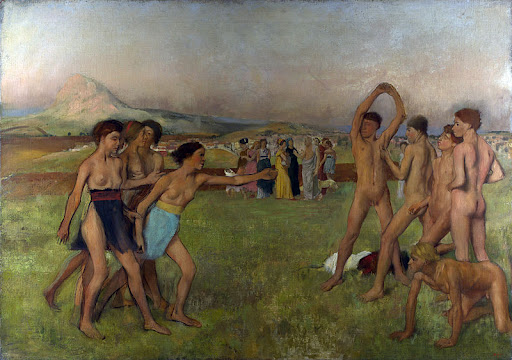
Married women were banned at the Ancient Olympics on the penalty of death. The laws dictated that any adult married woman caught entering the Olympic grounds would be hurled to her death from a cliff! Maidens, however, could watch (probably to encourage gettin’ it on later). But this didn’t mean that the women were left out: they had their own games, which took place during Heraea, a festival worshipping the goddess Hera. The sport? Running – on a track that is 1/6th shorter than the length of a man’s track on the account that a woman’s stride is 1/6th shorter than that of a man’s! The female victors at the Heraea Games actually got better prizes: in addition to olive wreaths, they also got meat from an ox slaughtered for the patron deity on behalf of all participants! Overall, young girls in Ancient Greece weren’t encouraged to be athletes – with a notable exception of Spartan girls. The Spartans believed that athletic women would breed strong warriors, so they trained girls alongside boys in sports. In Sparta, girls also competed in the nude or wearing skimpy outfits, and boys were allowed to watch.
Another side note, Spartan marriage rituals are quite fascinating, if any one is interested I will do a straight post about Spartan sexuality and the marriage rituals. It will have some about gay sex, these were the Spartans after all.
 |
| “Afternoon” by Philip Gladstone |
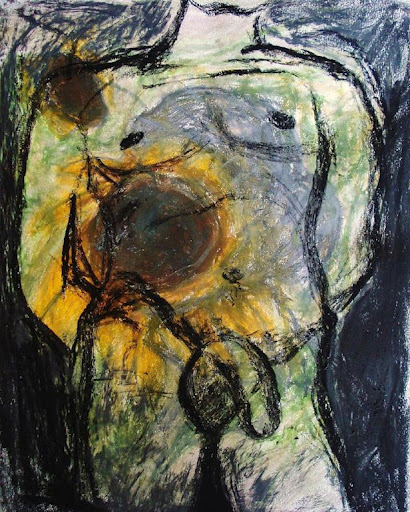 |
| “Male Nudes with Sunflowers” by Sheri Larsen |


I have been working this weekend on some promotions for my schools new art club. This has gotten me to think about art, and though, Edgar Degas was characterized as an “old curmudgeon” this quote below is quite beautiful.

 |
| Wishing you magnolia mornings and sweet tea afternoons. |
 |
| SAVANNAH PRINTS AND CALLIGRAPHY BY DEE JACKSON |
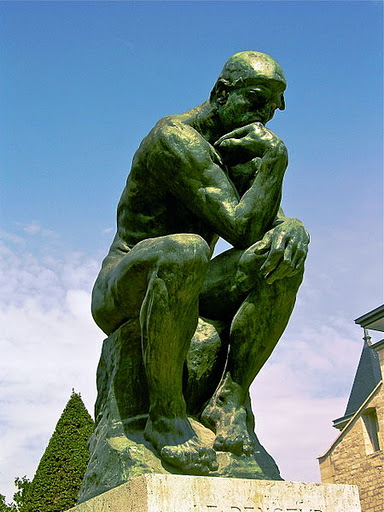 |
| The Thinker Musée Rodin, Paris |
Auguste Rodin on of my favorite sculptors was born in Paris today in 1840. He began his art study at 14 in the Petite École and in the school of Antoine Barye, earning his living by working for an ornament maker. In 1863 he went to work for the architectural sculptor A. E. Carrier-Belleuse, who had a great influence on him. From 1870 to 1875 he continued in the same trade in Brussels and then briefly visited Italy. In the Salon of 1877 he exhibited a nude male figure, The Age of Bronze (1876; Paris). It was both extravagantly praised and condemned; his critics unjustly accused him of having made a cast from life. From the furor Rodin gained the active support and patronage of Turquet, undersecretary of fine arts. His Age of Bronze and St. John (1878) were purchased for the Luxembourg Gardens, Paris.
The government gave him a studio in Paris, where he worked the rest of his life with growing fame. From 1880 on Rodin worked intermittently on studies for a huge bronze door for the Musée des Arts décoratifs. It was inspired by Dante’s Inferno and was to be called the Gate of Hell. He never finished it. Among the 186 figures intended for it are Adam and Eve (1881; Metropolitan Mus.), The Thinker (1879-1900), and La Belle Heaulmière (both: Paris). These, together with his group The Burghers of Calais (Calais), completed in 1894, are among his most famous creations.
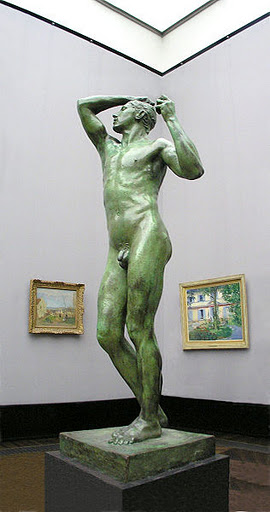 |
| The Age of Bronze Alte Nationalgalerie, Berlin |
Other ambitious works are his monuments to Balzac (1897; Paris) and to Victor Hugo (1909; Paris). Rodin is also known for his drawings, his many fine portrait busts, and his figures and groups in marble, such as Ugolino (1882), Danaïd (1885), The Kiss (1886), and The Hand of God (1897-98) in the Rodin Museum, Paris, and Pygmalion and Galatea and The Bather in the Metropolitan Museum, N.Y.C. He is best represented in the Rodin museums of Paris and Philadelphia, but fine examples of his work are included in many public collections throughout the world.
Rodin’s work is generally considered the most important contribution to sculpture of his century, although some recent critical opinion has found his allegorical works pretentious. Realistic in many respects, it is nevertheless imbued with a profound, romantic poetry. The Gothic, the dance, and the works of Dante, Baudelaire, and Michelangelo were major sources of inspiration. Rodin considered his work completed when it expressed his idea, and as a result his sculpture is varied in technique; some is polished, some is gouged and scraped, and some seems scarcely to have emerged from the rough stone. He worked long over his more important works, returning to them again and again but without injuring their essential vitality.
Bibliography
See biographies by F. Grunfeld (1987) and R. Butler (1993); studies by R. M. Rilke (1902 and 1907, rev. tr. 2004), S. Story (rev. ed. 1966), A. E. Elsen (1963, repr. 1967), R. Descharnes and J. F. Chabrun (tr. 1967), I. Jainu (1967), Y. Taillandier (1967), C. Lampert (1987), K. Varnedoe (2001), and A. E. Eisen (2003).
 |
| The Walking Man Art Institute of Chicago |
 |
|
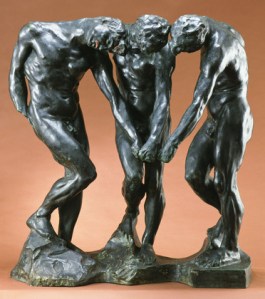
The Three Shades
|
 |
| Anonymous — Perry Street |
Where was your first homosexual encounter? For many gay men of my generation and/or from rural America, the internet’s GayOLs (i.e. gay chatrooms on AOL, et. al.), Gay.coms, and Manhunts, provided some of our first gay encounters. And for many gay men, especially those of a certain age and geography, it was in public. And for many men, that meant coming to New York City. Before AIDS and before the Giuliani crackdown, cruising created a sort of roughshod community, an underlying queerness of the streets that sowed the seeds of social and political action. In Petite Mort: Recollections of a Queer Public, artists Carlos Motta and Joshua Lubin-Levy curate a love letter-cum-souvenir to the Big Apple’s fading eroticism.
 |
| Aram Jibilian — Untitled |
Seeking to create an “Atlas of Queer Affection” and question notions of intimacy, assimilation and gay politics, artists Carlos Motta — of the fascinating We Who Feel Differently documentary project on multi-national queer culture — and Joshua Lubin-Levy called upon an intergenerational group of over 60 gay men to submit drawings of spaces in the city where a public sexual encounter occurred.
Drawn from memory and depicting sites from Chinatown to The Rambles and the Twin Towers, the submissions were curated into a sexy, sardonic, meditative, and ultimately moving book. As subjective blueprint of the city, it values not simply the space “as is” but how it has been performed and engaged, highlighting the fundamental connection between public space and queer life. This ain’t your mamma’s NYC.
 |
| Aram Jibilian — Untitled |
When: Summer 2010.
Where: Across from Perry Street, on the park overlooking the West Side piers.
How: After wandering aimlessly through the city, an invisible magnetic force led us there.


 | David on National Underwear Day |
 | National Underwear D… on First Crushes in Plain Si… |
 | iameverywhere1 on Moment of Zen: Sleeping I… |
| iameverywhere1 on Monday Morning Daydreams |
 | vandycolt on Pic of the Day |





 Joe
Joe
 The Closet Professor