I doubt there are many people who have not heard the news that the hottest little diver in Britain made a big announcement Monday. British Olympic diver Tom Daley revealed he’s been in a relationship with another man in an emotional YouTube video. This video just warmed my heart. I’ve always had a special place in my heart for the incredibly cute and talented Tom Daley, this video just endeared me to him more.
Daley, 19, says in the video, “Come spring this year, my life changed massively when I met someone and it made me feel so happy, so safe and everything just feels great. And that someone is a guy.”
He then adds, “It was always in the back of my head that something like that could happen, but it wasn’t until spring this year that something just clicked … My whole world just changed, right there and then.”
Still, Daley stops short of using either the term “gay” or “bisexual.” “Of course I still fancy girls,” he says. “But I mean, right now I’m dating a guy and I couldn’t be happier. It makes me feel safe and just really does feel right.”
The diver, who tweeted the video to his more than 2.4 million Twitter followers, concludes, “I’m still Tom. I still want to win an Olympic gold medal at Rio 2016 for Great Britain. I’m still as motivated as ever to do that.”
Daley’s sexuality had been the subject of ample media speculation for some time. The diver, who won a bronze medal at the 2012 London Summer Olympics and was recently named the sexiest man in the world by Attitude magazine, laughed off the gay rumors in an interview with The Mirror earlier this year.
“I think it’s funny when people say I’m gay… I laugh it off… I’m not,” he was quoted as saying. “But even if I was, I wouldn’t be ashamed. It wouldn’t bother me in the slightest what people thought.” Still, Daley said he was “cool” with his sizable gay fanbase: “It’s great to have gay fans even though my friends gently take the mick.”
It appears that Tom is a new breed of man. He’s not one who seems to like to be labeled. Isn’t that something that would be wonderful if we didn’t have to announce our labels and that we could just be who we are. Alas, the world seems to need us to label ourselves so we do, but I congratulate Tom in not bowing to the pressure of a label.
When famed Olympic British diver Tom Daley revealed to the world Monday morning that he is in a relationship with a man, some of the responses from the Twitter universe were, unfortunately, less than positive. However, Daley also received an outpouring of support from the public — including a handful of celebrities who were quick to vocalize their pride regarding the athlete’s decision.
Now, it looks as if Daley can also expect his family to get behind his decision to publicly come out. Though the diver’s grandparents admitted they were a bit “confused” and surprised at first, the pair told the Daily Mail that they vowed to support their Olympic athlete grandson.
“We asked him if he was absolutely sure. He’s our first grandson from our son who died,” Daley’s grandparents told reporters. “We have always been supportive of him and we always will. We’re not old-fashioned, in fact we’re quite liberal. But I do think he’s too young to be making this sort of decision… But we hugged him, we thanked him for coming to see us, and we’ll be seeing him over Christmas. We’ll always be here for Tom.”
Sounds like Tom has quite a supportive family and I couldn’t be happier for him!
I have been reading up on summaries and analyses of Emerson’s “Self-Reliance.” I put off the reading and discussion of the essay until we return to school on Tuesday. I knew that if I started yesterday, I’d be interrupted for the holiday weekend, so I put it off. It also allowed me to study up on Emerson more. I’m trying to make it as interesting and thought provoking as I can so that we can have a good discussion, which means I need to make it as simple as possible for this particular group of students, who can be a bit lazy at times. Though you, my dear readers, may not be as enamored with Emerson and Transcendentalism as I am, I hope you will stick with reading this post as I get around to explaining why I think that a reading of Emerson today, of all days, is especially important.
As I was reading commentaries on Emerson, I came across the article “The Foul Reign of ‘Self-Reliance’,” in which Benjamin Anastas exposes what he considers to be the havoc wreaked by Ralph Waldo Emerson’s seminal essay on generations of Americans. Anastas asks us to consider: Did the great Ralph Waldo Emerson get it wrong? Have we? Have we turned self-reliance into self-centeredness? And while I tend to think he goes a bit overboard in laying virtually all American self-centeredness at Emerson’s feet, his ultimate point about his interpretation of self-reliance being an unassailable (and dangerous) moral and spiritual principle these days is one that is at least worth taking a closer look at. And we certainly wouldn’t advocate for a return to the dehumanizing, piety of the Puritanism to which Emerson was responding.
Early in the heart of the 19th Century, young America was in trouble. A brutal economic bust. Banks collapsing all over. Confidence was wavering. And here came the brilliant transcendentalist philosopher Ralph Waldo Emerson, like a blazing star. Trust yourselves, he said. Look inside. Speak what you think in hard words. Above all, embrace self-reliance. And boy did that go deep. It’s American bedrock. Maybe too deep, which is what Anasta says in his article. It’s become self-centeredness. Polarizing rigidity. In an interview with Tom Ashbrook. Of NPR’s “On Point,” Anasta states that he wrote “The Foul Reign of ‘Self-Reliance’” in an Emersonian style of purposeful antagonism. I personally think that he was a bit too antagonistic, and that “Self-Reliance” spoke to him in a totally different way then it did to me.
Anastas read “Self-Reliance” and sees a call for each person to be concerned with their own self and not be concerned with others. At least, he claims this is how Americans interpreted it and has in turn become the American pursuit of self-interest and self-centeredness.
However, I believe that Emerson’s true point is not to advocate selfish people, but to advocate non-conformity. Emerson wanted people to rely on their inner self. That inner self which is guided by a rational God. No two people are identical. We were created that way on purpose. If all we do is follow others, then there is no free will. We simply conform to the pack mentality. Does this mean that we should be selfish? No it doesn’t. Emerson believes that our true inner voice is not selfish. If we rely on our inner moral code then we work for the betterment of all mankind.
If we were to blindly follow and conform, then no LGBT person would ever come out of the closet. Today is National Coming Out Day. It is a day for us to celebrate who we truly are. National Coming Out Day is observed annually to celebrate coming out and to raise awareness of the LGBT community and civil rights movement. The holiday is observed in a wide variety of ways: from rallies and parades to information tables in public spaces. Participants often wear pride symbols such as pink triangles and rainbow flags. Whereas, I may not go around telling people, especially those who have no need to know, that I am gay, I have become more comfortable in my own skin. If people want to assume I am gay or assume that I am straight, then that is their prerogative. However, the one major thing that Emerson has taught me is to be who I am. Being who we are has been a bit of a theme this week for this blog, and I thank Emerson for that reminder.
Though rumors of him being gay were rampant when he was on Fox’s Prison Break, Wentworth Miller never responded to the rumors. Now, he has revealed that he’s gay in a letter to the Russia’s St. Petersburg International Film Festival declining their invitation to attend.
Wentworth’s letter, which is posted on GLAAD’s website, thanks festival organizers for an invitation but states that “as a gay man, I must decline. I am deeply troubled by the current attitude toward and treatment of gay men and women by the Russian government.”
“Wentworth’s bold show of support sends a powerful message to LGBT Russians, who are facing extreme violence and persecution: you are not alone,” said a statement from GLAAD representative Wilson Cruz, who is also an actor (My So-Called Life).
Miller’s announcement comes amid international condemnation of tough laws targeting homosexuals that the Russian government has passed in recent months. The new laws include fines for individuals accused of spreading “propaganda of nontraditional sexual relations” to minors, and penalizes those who express pro-gay views online or in the news media. Gay pride rallies are banned as well, as is the adoption of Russian-born children by same-sex couples.
On July 25, 1985, HIV/AIDS was given a global spotlight when it was announced that screen icon Rock Hudson was suffering from the disease.
Looking gaunt and almost unrecognizable, rumors began to circulate about his health earlier in the summer when the actor had made a public appearance to promote a new cable series of his friend and former co-star Doris Day.
After collapsing in Paris in July 1985, he was diagnosed with AIDS and given treatment with the drug HPA-23, which at the time was unavailable in the United States. It was while he was in the hospital that it was announced to the public that Hudson had AIDS:
“According to publicist Yanou Collart, who acted as his spokeswoman in Paris, the decision was Hudson’s. ‘The hardest thing I ever had to do in my life was to walk into his room and read him the press release,’ says Collart. “I’ll never forget the look on his face. How can I explain it? Very few people knew he was gay. In his eyes was the realization that he was destroying his own image. After I read it, he said simply, ‘That’s it, it has to be done.’ “
Hudson passed away at the age of 59, on October 2, 1985, less than three months after the announcement, in his Beverly Hills home. In his last weeks he was visited by many famous friends such as Carol Burnett, Roddy McDowell and Elizabeth Taylor, who upon his death was reported as saying “Please God, he did not die in vain.”
Hudson’s AIDS diagnosis put the disease into the headlines and changed the way the public thought of AIDS patients, as well as gay stereotypes. Before his death he created the Rock Hudson AIDS Foundation, donating the $250,000 he received from an advance of a biography to the foundation.
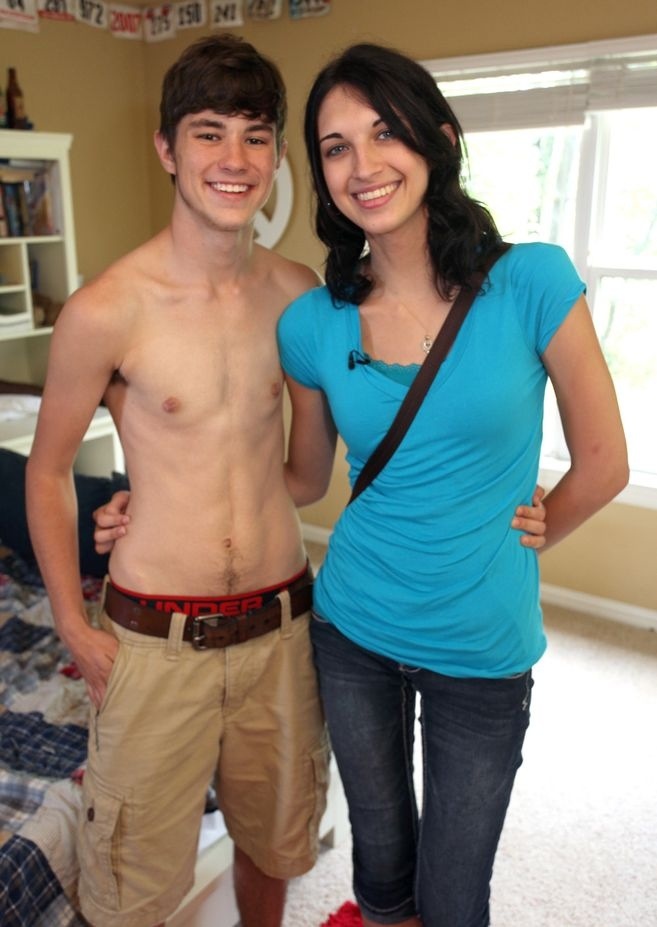
A pair of teenagers from Oklahoma might seem like your typical young couple, but their love story is unlike many others. The transgender couple actually transitioned together.
“I hated my breasts, I always felt like they didn’t belong. Now I finally feel comfortable in my own body,” Andrews explained to British tabloid The Sun about surgically removing his breasts last month. “Now when I’m out in a public pool or lifting weights, no one raises an eyebrow. They just think I’m a guy. … I can wear a tank top, which I couldn’t before, and I can go swimming shirtless. I can just be a regular guy. And I’m so lucky to have my family and Katie to rely on.”
The brunette teen from Bixby did not always feel so complete. In a segment for “Inside Edition” last year, she said that as a young child she was “[b]ullied and abused. Ridiculed. Ashamed and embarrassed.”
“Knowing what Katie went through for eight-plus years — there’s nothing worse than watching your child suffer,” Hill’s mom, Jazzlyn, told Tulsa World. “It’s still my baby — male or female, she’s still my child. And I don’t have to kneel at her grave.”
Andrews’ mom feels the same.
“Seeing Katie go through her surgery was helpful to Arin,” she said, according to British tabloid The Mirror. “It was being around it and seeing her getting to transform. And being a couple at the time was I think just the cherry on the cake. Every transgender person would love to have the transformation physically because it just completes them as a person.”
A few months ago, I posted about the model Colby Melvin. If you don’t know who he is, then I think you should. Born in the deep South, Colby Melvin was brought up to be a gentleman, but his mother taught him early on that to make a difference in this world, you need to be a little bit “hell raiser” too! So, it isn’t surprising that Colby has quickly become one of the most public activists in the fight for marriage equality across the country. Colby holds fast to his core beliefs of sincerity, civility, honesty and kindness and has used them as the basis for his commitment to raise awareness for LGBT issues. Combining his passion for politics with his love of entertainment, Colby emerged as a top spokesmodel for Andrew Christian. Soon after, he began working with Full Frontal Freedom, a coalition of independent artists and media executives – using their talent and creativity to raise awareness and enhance civil discourse. It was his first video with Full Frontal Freedom, a parody of a popular One Direction hit, that garnered Colby national attention for his willingness to publicly fight for the causes he believes in. The “Disclosure” video became one of the most watched political videos of the 2012 campaign cycle and resulted in Colby receiving the Human Rights Award for Political Performing Arts from the Jim Owles Liberal Democratic Club in New York.
As outspoken as Colby has become about LGBT issues and the fight for marriage equality, his journey was not always easy. After graduating from Spring Hill College in Mobile, Alabama, Colby went to work in the oil and gas industry. The oil spill of 2010 found him in a major management position helping in the Gulf Coast recovery. It was during this time that Colby’s “secret” was discovered by a superior. After tolerating the corporate bullying, Colby made a decision – he would not hide who he was. Colby left his job, came out to family and friends and began working towards his dream of becoming a force in the LGBT community.
I am a great admirer of Colby, even more so after I saw this video about his experience coming out that was posted on the Underwear Expert blog on National Coming Out Day. This is such a touching video, from the photos to the story Colby tells, that I had to share it with you guys. I especially identified with is answer to the question, “Did you always know you were gay?”
Colby’s message is of acceptance and courage, friendship and trust; an important message indeed. And coming from a guy that’s come so far in so little time, it’s especially topical. Being gay behind closed doors is sometimes what we need, but being who we are and proud of it isn’t just about opening one door — it’s about opening door, after door, after door because when we are true to ourselves self, anything is possible. While my job doesn’t allow me to come out and be as open as Colby, I admire him. My coming out experiences were not like his, but it does show that there is hope for the LGBT community in the South. There are accepting people in the South, and I have known many of them. They are also generally the ones that I am out and proud to.
Colby is also actively political and it shows in many of the charities he is involved in, especially concerning gay marriage equality. He produced and starred in a music-video parody of One Direction’s “What Makes You Beautiful” earlier this summer. The video, released by Full Frontal Freedom, a campaign to increase political awareness of LGBT issues and promote LGBT equality, showcased rewritten lyrics urging Romney to release his tax returns. That video has received 3.4 million views, by the way. Melvin is to present the video later this month at the Jim Owles Liberal Democratic Club’s Pre-Election Reception in New York on Thursday, October 25, 2012.
A handful of models, including Andrew Christian faves Colby Melvin and Quinn Jaxon, have teamed up with Full Frontal Freedom, an “Independent pro-equality movement not affiliated with, endorsed by or sponsored by any state campaign.” The collaboration produced a winning political parody of One Direction’s “What Makes You Beautiful.” Starring a sexually mixed (half-straight, half-gay) and underwear clad cast of characters that includes Colby Melvin (who’s also the face and spokesmodel for the coalition), Quinn Jaxon, Brandon Brown, Jonathan Myers and David Brackett, the video asks Romney to show what’s down below:
Colby Melvin told The Underwear Expert, “The whole purpose of Full Frontal Freedom is about using different forms of media and artists so we can promote political engagement and just get people to give a sh*t.” And how exactly do you do that? Get ultra viral underwear models to get involved. “We get tons and tons and tons of views on our pictures and videos, so many comments and likes,” Colby continued. “We can actually use that for good to get people involved in the issues.”
He stars in the play “Harvey,” which opens on June 14.
Sara Krulwich/The New York Times
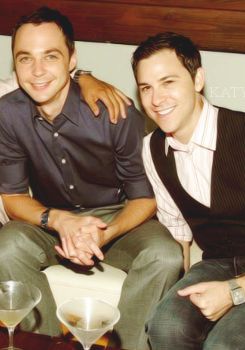
You may or may not know this, but my current favorite show is The Big Bang Theory (see here, here, here, and here). In addition, I love Jim Parsons, who plays Sheldon on the show. So I was quite ecstatic when i read that Jim Parsons has revealed he is gay and in a committed relationship in a new interview. I am even more in love with Parsons now then I was before.
Writes Healy: ‘”The Normal Heart” resonated with him on a few levels: Mr. Parsons is gay and in a 10-year relationship, and working with an ensemble again onstage was like nourishment, he said.”
Parsons and Spiewak
Parsons’ sexuality has been the source of media speculation for several years. Though the Times doesn’t identify Parsons’ partner, the actor thanked Todd Spiewak during a 2010 Emmy Award acceptance speech. He has shown up to awards shows and made public theater contributions together with Spiewak, reportedly an art director, on several previous occasions.
The National Enquirer also reported that Parsons and Spiewak were at one time engaged and planning a Massachusetts-based Christmas wedding, which has since allegedly been called off because Parsons doesn’t want children. None of this has ever been confirmed nor denied by Parsons’ representatives, who have continually declined to speak about their client’s sexuality, according to AfterElton.
I am very proud of Jim Parsons. He’s such a great actor and deserves every Emmy that he receives. Congratulations Jim, I love you man. I wish you many, may years of continued success.
I read this the other day, and really wanted to share it with you guys. It broke my heart. I think we have all had that feeling of hopelessness at some point, and thankfully we survived it, not all kids do. Kergan Edwards-Stout wrote this compelling letter, and I hope that you find it as interesting as I do.
Dear Dirk,*
The thought of you has filled me with hate almost every day since we first met — but for different reasons altogether than you might expect.
I still remember the terror I felt every time I approached the soccer field. It was in junior high, a difficult time for almost everyone, but especially for me.
You see, I’d always known I was gay. Even in kindergarten, just looking at Jeff Hayward’s smile would make me happy, and I knew intrinsically that it was all right to feel this way — to love other boys — as everything about it felt completely natural and unforced.
In junior high, however, I was placed on the same soccer team as you, and everything changed.
What I had seen as natural and good, you were suddenly calling abnormal and detestable. Every “faggot” you spit toward me hit directly between the eyes, and the whispers, taunts, and dirty looks you and Mike Baker sent my way continually unnerved me, affecting both my sense of self and my performance on the field. Because of you, questions about my masculinity hovered over me, and I would feel physically ill at the thought of another practice or game. I would choose different, roundabout paths to my classes, just to avoid where I knew you’d be.
In high school, while I went on to be active in theater and academics, you and Mike continued to rise socially, becoming the big men on campus that I’d longed to be. You were even voted onto the homecoming king’s court, and as you took to the field, flashing your charming smile, all I could see was the sneer on your lips when you turned and glanced my way.
But that isn’t why you fill me with hate.
Just prior to our senior year, during summer break, word came that you’d tried to commit suicide and were in a coma. No one knew what had happened, but you eventually returned to school our senior year. You were just as popular as you had been before, and perhaps even more so, now that you had this added air of intrigue about you. But despite your outright hatred of me, I still wondered about you and about what could have possibly led you to try to take your own life. You more than anyone seemed to have it all, and despite the way you continued to torment me, I felt a pang of pity for you.
The following summer, I got another call. You’d again tried to kill yourself, tying a noose from the garage rafters — only this time you succeeded. Your mother discovered you, hanging there, upon her return home.
How lonely you must have felt, Dirk, as you tied that rope. Could you really see no path forward? Was there no one you could have reached out to? Was there no friend, family member, priest, counselor — not one person you could’ve trusted with your pain?
Later, I heard that you’d left behind a note, writing that although you did not like girls, you did not want to like boys. And suddenly it became horribly clear to me. You and I were exactly alike. That anger and venom you directed at me, you were also directing at yourself.
How I wish, Dirk, that you’d allowed yourself to connect with me. I’m not saying that a friendship between us could have altered your path, but just knowing that we weren’t the only ones could’ve made our lives easier. For me, discovering that there were other gay people out there did help. I found a progressive bookstore, not too far from where we lived, and I’d covertly journey there as often as I could, just to lose myself in reading about a world that I knew I’d someday enter.
And even if a friendship between us wasn’t possible, given our differing social status, imagine how less torturous you could have made another’s life, simply by being kind.
While in school, my hatred was based solely upon how mean you were to me. Now my anger is reserved for the lack of value you placed upon yourself. Clearly, you didn’t think you were worth loving. Where did you get such a message? You were smart, personable, an exceptional athlete, and beyond handsome. Even with all the venom you sent my way, I still admired your more affirming qualities. Regardless, despite these many gifts, somewhere along the way, you were taught that instead of acting on your love of other men, you’d be better off dead.
I hate that you hurt so, Dirk, and hate just as much that you listened to those who filled your head with such thoughts.
I also hate that I was so absorbed in and blinded by my own situation that I couldn’t see your venom for what it really was. What if, one day, instead of running the other way when I saw you, I had instead offered you a smile?
Dirk, you might be surprised to know whom I ran into at our high school reunion: your old pal, Mike Baker. Imagine my shock, spotting him across the room, when we suddenly locked eyes. I immediately went to that same place of fear and panic, but that only lasted a moment, until I saw him break out into a big grin and make a beeline toward me.
I was shocked when he warmly clasped my hand in his, as if we were longtime friends. “I’ve been looking all over for you,” he said, intently. “I’ve really been wanting to say ‘hello.'” While he never brought up our shared past, it was clear to me that he was making amends.
Did you know, Dirk, that Mike’s younger brother has come out as gay? Would it surprise you to know that Mike is totally OK with it? If you had known back then that your best friend might have been accepting of you, could that have possibly altered your decision?
People loved you, Dirk — then and now.
I wish I could have held you, Dirk, comforted you, and told you that everything would be all right. Our individual uniquenesses are a gift, given by our maker, which we then get to share with the world. Your void is noticeable, even 20-odd years later.
You could’ve done so much, Dirk, if only you’d realized that each one of us is deserving of love and respect.
Wishing you peace,
Kergan
*Though innocence for all was lost some years ago, in respect of their families, all names have been changed.
When Randy Phillips uploaded his first video to YouTube, he knew it would change his life forever—he just didn’t know if it would be for the better or for the worse.
For all of his adult life a secret was barreling down on the 21-year-old soldier that not even his military-provided bulletproof vest could protect him from. It was so detrimental that it could end his career and damage his relationships.
Phillips was gay. And the military had express rules against coming out.
But, the Alabama native decided that he needed to come out—and do it in a way “there would be no turning back,” said Phillips in a Skype interview. “It was the easiest way for me to do it.”
A self-described “big fan” of YouTube, Phillips created his AreYouSuprised channel last spring just before the military was repealing its strict anti-gay policy Don’t Ask, Don’t Tell.
“I thought it was easiest just to convey my message through YouTube instead of actually blogging,” he said in his Southern-tinged accent.
Instead of launching a public self-outing campaign like Lt. Dan Choi, another soldier who made headlines for fighting against DADT, Phillips’ came out quietly and gradually.
His folksy demeanor, boyish good looks and social media smarts transformed him into a different kind of Lt. Dan Choi—one for a generation of people reared on YouTube.
He shot his first dozen videos, recorded last spring, neck down to conceal his identity, his voice and hands standing in for facial expressions. The videos were shot in a southwest Asian country that Phillips couldn’t reveal (one of those “hot and sandy ones”), captured a clearly nervous Phillips talking about being gay in the military.
Voice shaking and hand trembling, Phillips’ introduced his then-closeted self to the world last April.
“The whole point of this video is to come out. That’s even hard to say,” he said faintly, warning that his coming out process could take a year.
“I was just nervous, [I had] personal fear, and fear of rejection from my friends and family,” Phillips said without stumbling, a stark contrast from his first videos when his voice sounded like a man about to fly down the tracks of the world’s tallest roller coaster. “I was even nervous of saying the words ‘I’m gay’ period.”
There also were legal issues to consider. Under the military’s policy, “Don’t ask, don’t tell,” which in effect banned gays from openly serving, he was violating the rules. However, he began the videos four months after Obama announced he was repealing the ban.
Investigations were tapering off, Phillips said. But publicly posting coming out videos—while serving overseas—still was a risky thing to do. And the emotional toll of being found out forced him to dart between well-hidden spots to record the videos.
Initially, the videos could only be discovered if someone was looking for a specific subject, such as DADT or one happened to be on Outserve, a private Facebook group for gay military members, where he posted the videos. He credits the members’ support for helping him come out.
“Everybody at that point who had seen my videos … [gave] me so much emotional support. It was a like a counselor for me.”
In August, however, things started to change. That’s when he posted an unrelated video of one of his fellow soldiers covering Adele’s “Rolling in the Deep.” Suddenly, his quiet channel got a visitor spark. People came to hear the song and then apparently noticed the other videos in his channel.
Phillips wasn’t naive. He knew that any bump in traffic could lead people to see his coming out videos so it didn’t come as a shock to him.
“I put my videos on there and from there they got shared around the Web and passed around, like everything on the Internet,” Phillips said.
After people discovered his channel, an earlier recording of Phillips coming out to his friend, Chris, started pulling in viewers.
With the wind battering his camera during an otherwise ordinary jovial moment, Phillips tells one of his closest friends he’s gay. Instead of freaking out, his friend laughs and says “I could give a rat’s ass…love is love.”
When the camera stopped recording Chris “was like ‘That’s cool, I don’t mind. You are still one of my good friends.’” Phillips recalled. “He said nothing will ever change and we would still be great friends and that he wouldn’t think of me any differently.”
In September, when DADT was officially lifted, Phillips kept true to his promise: not only did he reveal his identity to his fans on YouTube, he also posted a video of him coming out to his father and showed his face for the first time.
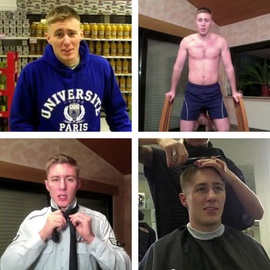
Finally, people could see the worry on his brow and his closely cropped light brown hair with a stylish flip in front .
Sitting at a desk against a map-clad wall, a weary eyed Phillips apprehensively dials his phone to tell him one of the hardest things a gay guy will ever say to his father.
The call takes more than an agonizing minute to connect. Phillips preps his dad for the news. He tells his him he has something important to say and then implores: “Will you still love me? Serious?”
Phillips’ voice stammers and he continually looks away from the phone like his father’s disapproving face was peering back at him.
“Yes,” his father asserts.
Phillips takes in a deep breath and then finally utters the words: “Dad. I’m gay.”
“OK,” his father says in an detached voice. The video lasts four more minutes. During that time there’s a lot of back and forth. His father maintains his stoic tone, but does say “I will always love you.” The mild-mannered Phillips responds “yes sir.”
The coming out video earned Phillips international press coverage. But he was puzzled why the voyeuristic video grabbed the attention of millions.
“I’m such a boring person. I couldn’t believe that that many people wanted to see something that hundreds and thousands of kids do every single year,” he said. “It was just a conversation on the phone.”
But it obviously meant more to others. The seven minute video has more 57,000 likes and 84,000 comments. Many are supportive of him, but there also are some homophobic haters in the crowd, which doesn’t bother him.
“Everybody can feel bulletproof behind the safety of their own computer,” he said bluntly.
“A lot of haters are going to click on it and they’re going to feel insecure,” he said. “It’s super easy to make really negative comments, and they did.”
Phillips said the video received between 5,000 to 10,000 hateful comments.
“But its nothing that [haters] haven’t said to my face… I know a lot of people like to vent over the Internet,” he said. He also shoots down critics who said Phillips released the video just for attention.
“I don’t think that many people realize how YouTube helped me, and how it pushed me. How grateful I was that I get to share my story and show people what the average reaction would be…and that life gets so much better after that.”
He admitted that the videos of him coming out to his father, and later, his mom who didn’t take the news as well, had an “ambush” aspect to them since he didn’t ask for their permission to broadcast them. (That charge came from an article in Salon who lambasted Phillips’ choice of doing this.)
“Maybe,” Phillips said. “I am not going to argue with that 100 percent. I don’t think either of my parents, if I were to ask them, ‘Hey, is it OK if I put this on the Internet?’, I don’t think they anybody would’ve said ‘yeah, go ahead.’”
“I explained to my parents about how much I owe that to the YouTube community and how many emails [he received]” that he forwarded to his parents including one who came out to his parents at 34-years-old thanks to Phillips’ video.
Although his relationship with his very conservative Southern parents remains at arm’s length (“They wouldn’t go out of their way to ask me how everything is going…but they don’t mind”), the support from the YouTube community helped him.
“I think my parents now understand that they helped more people than they thought they ever would,” Phillips said. Reaction to the video from the Air Force was also supportive. “Not one single person came up to me and said something negative,” he said.
Following the coming out videos, Phillips altered the direction of his channel from less of a gritty account of his personal life, to a mix of light-hearted videos. His channel pivoted from closely resembling the front section of a news weekly to the glossy style of Men’s Health with its mix of workout videos and travel diaries.
He has more than 36,000 subscribers and 11 million total video views. The support he received from his emotional videos helped him keep his channel up and running.
“I am going to film whatever I want to from now on, I have absolutely no push to go in any direction whatsoever,” Phillips said confidently. Also, he wants to evolve past being known as the ‘gay soldier,’ and to show the world there is more to him than that.
“I want to show everyone out there in the YouTube world that I am a plain, boring, normal guy and that being gay is just a part of me,” Phillips asserted. “I am not trying to make a career out of it. I’ve said everything that I need to say as far as coming out.”
Showing off indeed. The boyish, but built, Phillips is often times shirtless. “I’m from Alabama, I’ve been shirtless more of my life than I’ve been clothed, so whatever,” he joked. But clearly the lack of attire doesn’t hurt when it comes to gaining an audience.
Phillips’ videos are fun, candid and usually last under five minutes. The video’s lighting and sound doesn’t mirror that of a wannabe professional production like other YouTube channels. They show off Phillip’s down-to-earth, approachable, friendly side.
Viewers are treated to a glimpse of military life that not even CNN could provide. We follow him to the grocery store, watch him as he teaches us how to build stronger triceps and he occasionally does an unscripted question and answer sessions that he pulls from 10,000 follower strong Twitter account.
It takes him only about 25 minutes to shoot and edit a video, which he says a only a few of his coworkers follow along. “One of my coworker’s wives is my biggest fan,” he laughed.
The Air Force does not supervise what Phillips uploads but their code of conduct prohibits him from dabbling into anything political and he has to clearly assert that whatever views he provides are of his own.
Although his videos are pretty genial, he’s aware when he crosses a line. Earlier this month, he posted, and then quickly pulled, a video of him flexing just in his underwear tweeting “I think that video was just a little [too] much.”
His fans, however, continue to be supportive and probably won’t think he would ever go “too far.” A search for @AreYouSuprised on Twitter reveals some rabid fans that Phillips takes in stride.
“It’s funny, I take it pretty light-heatedly,” he laughed.
“I think its amazing that I had such so more of a choice then I would, and there is no reason for it. There is nothing that I have ever done that’s crazy. I’ve never been much of an activist, I just shared my personal story.”














 Joe
Joe





 The Closet Professor