Category Archives: History

The Crooked Man


Charles Beaumont wrote the short story “The Crooked Man,” which presented a dystopian future wherein heterosexuality is stigmatized in the same way that homosexuality was in the 1950s. It depicts heterosexuals living as furtively as pre-Stonewall gays and lesbians. “The Crooked Man” was first rejected by Esquire magazine, which found it too controversial, and then published by Hugh Hefner, a young man from Chicago who had recently launched a magazine called Playboy. After letters of outrage at Beaumont’s “The Crooked Man” poured in, Hefner addressed readers. “If it was wrong to persecute heterosexuals in a homosexual society,” he wrote in response, “then the reverse was wrong, too.”

“The Crooked Man” is really just a couple of scenes. A handsome young man named Jesse furtively ducks into a nightclub. He sits in a private booth, closes the beaded curtain around the booth, and dims the light. He is instantly hit-on by two separate men. The men have a code, fingers tapping across the stomach, to indicate that they want sex. Jesse turns them down. He is waiting for someone — a woman named Mina.

Jesse is in love with Mina, but this future love between heterosexual couples is forbidden. Artificial insemination is the law, and the sexes are strictly segregated. Heterosexuals are considered perverts, and hunting them down is official government policy: “These sick people must be cured and made normal,” announces the platform of the majority political party. Jesse has learned to “pass” in this culture. He learns how to walk gay, and turn down sexual advances — which seem to happen constantly — with tact.

Mina shows up. She is disguised, her flowing blonde hair tucked under a wig. Yet it’s very difficult to hide the movement and expressions of a woman, and she and Jesse are found out. He is quickly removed to a government van, which will take him for surgery, re-education, the works.

Though Hefner is most famous for his numerous romantic exploits over the years, he has always been a proponent of sexual freedom: heterosexual, homosexual, or bisexual.  Even now, the twice-divorced 89-year-old entrepreneur says that gay marriage isn’t hurting anyone.  “Without question, love in its various permutations is what we need more of in this world,” he said. “The idea that the concept of marriage will be sullied by same-sex marriage is ridiculous. Heterosexuals haven’t been doing that well at it on their own.”  Hefner should know, he’s been married three times already.

Come Out to the National Parks 

The National Park Service is encouraging LGBT Americans to come out and visit the more than 400 parks overseen by the federal agency.  The latest move by the park service to engage the LGBT community is part of the new Find Your Park initiative, launched recently in conjunction with the National Park Foundation.

Gay and lesbian park service employees and lesbian singer Mary Lambert, one of several celebrity centennial ambassadors for the initiative, are helping to spread the inclusive invite as part of the new public awareness and education campaign celebrating the milestone centennial anniversary of the National Park Service in 2016.

I’ve always loved the National Parks, and once considered joining. The National Parks Service as a historian.  When I was a kid, my family would go camping at least once a year at the Gulf Islands National Seashore at Ft. Pickens near Pensacola.  We would also often go in the summers to the Great Smokey Mountain National Park and stay in either Pigeon Forge, Tennessee, or Cherokee, North Carolina.  I learned so much at these National Parks and Ft. Pickens was one of the major reasons for my love of history.  The beauty of the National Parks is unmatched anywhere, and they deserve to be celebrated.

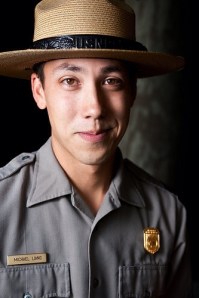
A video featuring gay park ranger Michael Liang, a visual information specialist at Santa Monica Mountains National Recreation Area in Southern California shows him jogging through Cheeseboro Canyon off the 101 where he runs prior to heading to work.  Liang noted that parks allow visitors to “slow down” their minds and “notice” the beauty of the outdoors.  “All you have to do is get up, get out there, and find your park,” said Liang.


Liang, 29, explained that the park service is looking to create the next generation of park supporters and advocates with the campaign.  “If you look at who we traditionally attracted, it was upper middle-class families,” noted Liang, who grew up in Michigan and started with the park service as an intern in 2004. “The parks are funded by the taxpayers, so it is really important we represent the diversity of the country and the population.”

Through the Find Your Park’s website, http://www.findyourpark.com/, any visitor can upload their own video talking about their love for America’s protected spaces or an individual park site that is of particular interest to them.  “It is a digital platform to share your stories. We invite the public to share their favorite national park stories or how they want to envision what the park service looks like,” said Liang. “It is a great way for LGBT people to share why it is important to them or what we can do to make them more relevant to our community.”

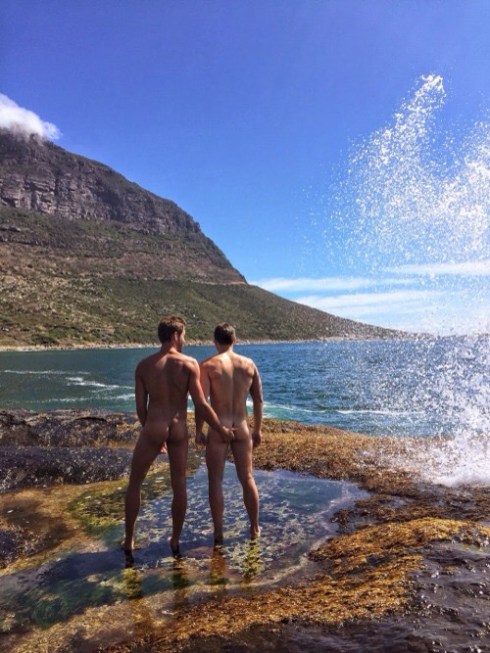
Responsible for the marketing materials of the park where he works, Liang said he is mindful of using photos that show a diverse array of visitors. He is working on a series of posters aimed at inspiring Los Angeles residents to visit the Santa Monica Mountains west of the city.  “I take personal responsibility to ensure the people depicted in those photos reflect the diversity of L.A., for example, having two men holding hands watching the sunset in the Santa Monica Mountains,” said Liang, who came to the park last June from Philadelphia where he worked in the park service’s regional office for the Northeast. “I am still discovering our park. By June my challenge is to identify LGBT historical figures with our park. It will be perfect timing to start digging into those stories.”

One way the parks can attract LGBT visitors, said Liang, is through the programming sites offer guests. He pointed to the Bay Area’s Rosie the Riveter/WWII Home Front National Historical Park on the waterfront in Richmond, which has sought to capture the stories of LGBT people who either worked in the East Bay shipyards during the war or were service members who embarked from Bay Area military bases for combat in the Pacific Rim.

“How we can attract LGBT visitors is through creating national park sites that tell the story of our community,” said Liang, who is hopeful that one day there will be an LGBT-specific national park site. “While there currently isn’t one yet in the system, there is the theme study looking at LGBT sites.”

In January 2014 the B.A.R. broke the news that the park service had teamed with Megan E. Springate, who identifies as queer and is seeking a Ph.D. in archaeology at the University of Maryland, to oversee a National Historic Landmark LGBTQ Theme Study and proposed framework.  As part of the project, the park service is seeking nominations of places important to the country’s LGBT community for inclusion on the National Register of Historic Places or to be designated as a National Historic Landmark. Both are considered important first steps that could lead to the properties one day becoming national park sites.

According to park service officials, only five properties in the country have been granted some form of federal historic preservation recognition specifically due to their relationship to LGBT history. There are four sites presently included in the National Register of Historic Places and one – New York City gay bar the Stonewall Inn – listed as a National Historic Landmark. The second landmark, the Chicago home of gay rights pioneer Henry Gerber, should be finalized later this year.

Last month the National Park Service released a seven-page document listing various ways members of the public can assist with its LGBTQ Heritage Initiative. Steps people can take run the gamut from proposing landmark-worthy sites to creating LGBT-themed tours of historic districts.

“The National Park Service has just released a document that brings together the many ways that people across America, regardless of identity, location, or how much time they have, can participate and engage with the initiative,” Springate wrote in an email to members of the Rainbow Heritage Network, a group for LGBT history advocates. “These include sharing information about places important to your community, spreading the word, visiting historic places, and writing nominations or nomination amendments for the National Register of Historic Places or National Historic Landmarks programs.”

The document can be downloaded online at http://www.nps.gov/history/heritageinitiatives/LGBThistory/GetInvolved.pdf


St. Patrick’s Day


Here are two poems for St. Patrick’s Day, both appropriately titled, “St. Patrick’s Day.”

St. Patrick’s Day
By Jean Blewett

There’s an Isle, a green Isle, set in the sea,
     Here’s to the Saint that blessed it!
And here’s to the billows wild and free
     That for centuries have caressed it!

Here’s to the day when the men that roam
     Send longing eyes o’er the water!
Here’s to the land that still spells home
     To each loyal son and daughter!

Here’s to old Ireland—fair, I ween,
     With the blue skies stretched above her!
Here’s to her shamrock warm and green,
     And here’s to the hearts that love her!

St. Patrick’s Day
BY Eliza Cook

St. Patrick’s Day! St. Patrick’s Day!
Oh! thou tormenting Irish lay—
I’ve got thee buzzing in my brain,
And cannot turn thee out again.
Oh, mercy! music may be bliss
But not in such a shape as this,
When all I do, and all I say,
Begins and ends in Patricks’s Day.

Had it but been in opera shape,
Italian squall, or German scrape,
Fresh from the bow of Paganini,
Or caught from Weber of Rossini,
One would not care so much—but, oh!
The sad plebeian shame to know
An old blind fiddler bore away
My senses with St. Patrick’s Day.

I take up Burke in hopes to chase
The plaguing phantom from its place;
But all in vain—attention wavers
From classic lore to triplet quavers;
An “Essay” on the great “Sublime”
Sounds strangely set in six-eight time.
Down goes the book, read how I may,
The words will flow to Patrick’s Day.


St. Patrick’s Day is celebrated every year on March 17th, honoring the Irish patron saint, St. Patrick. The celebrations are largely Irish culture themed and typically consist of wearing green, parades, and drinking. Some churches may hold religious services and many schools and offices close in Suffolk County, the area containing Boston and its suburbs.

St. Patrick, or the “Apostle of Ireland,” actually started out in the pagan religion. While not much is known about his early life, as many of his life’s details were lost to folklore, letters from St. Patrick reveal that he was captured in Wales, Scotland, or another close area outside of Ireland and taken to Ireland as a slave. Years later, he escaped and returned to his family, who were Romans living in Britain, going back to Ireland for mission work after finding a place as a cleric and then Bishop within the Christian faith. He was born around 460, and by the 600s, he was already known as the Patron Saint of Ireland.

There are many legends associated with St. Patrick. The symbol of the shamrock used for St. Patrick’s Day comes from the story of St. Patrick using the shamrock to illustrate the Holy Trinity. The three-leafed plant coincided with the Pagan religion’s sanctity of the number three and is the root of the green color theme.  Another popular belief is that St. Patrick banished the snakes from Ireland. The story says that while St. Patrick was fasting, snakes attacked him, so he chased all snakes into the ocean. However, there have never been snakes in Ireland during the post-glacial period. The absence of snakes and symbolism involved with snakes is believed to explain the story, although it could have been referring to type of worm rather than snakes. One legend has St. Patrick sticking a walking stick into the ground while evangelizing, which turned into a tree.

St. Patrick’s Day was first celebrated in America in 1737, organized by the Charitable Irish Society of Boston, including a feast and religious service. This first celebration of the holiday in the colonies was largely to honor and celebrate the Irish culture that so many colonists had been separated from.  Early celebrations continued this modest tradition. In New York, the first celebration took place as a small gathering at the home of an Irish protestant. St. Patrick’s Day parades started in New York in 1762 by a group of Irish soldiers in the British military who marched down Broadway. This began the tradition of a military theme in the parade, as they often feature marching military unites. The holiday eventually evolved from the modest religious dinner into the raucous holiday we know today.


Jean McKishnie Blewett (4 November 1862 – 19 August 1934) was a Canadian journalist, author and poet.  Eliza Cook (24 December 1818 – 23 September 1889) was an English author, Chartist poet and writer born in London Road, Southwark.


Soul Mates


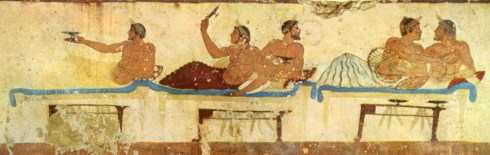
Plato’s Symposium uses the dialogue to expound various theories of love. Each participant by means of very personal contributions adds something towards an exposition of love that at the end receives its conclusion from Socrates. The comic playwright, Aristophanes’s speech is an explanation of why people in love say they feel “whole” when they have found their love partner. He begins by explaining that people must understand human nature before they can interpret the origins of love and how it affects their own times. 

 Aristophanes says that in the beginning there were three parents: Sun, Moon, and Earth. Each produced an offspring, round and otherwise like itself. From sun was produced the man; from earth, the woman; from moon, the androgyne. Each of these three was a double, one head with two faces looking out in opposite directions, four arms and legs, and two sets of genitalia. They moved about on the earth with a great deal more freedom and power than humans do now, for they rolled-ran hand over hand and foot over foot at double speed.  In other words, they did cartwheels to get around.

One day, these fast, powerful, but foolish creatures decided to scale Mt. Olympus to attack the gods.

What should the gods do to show the foolish humans the error of their ways? Should they shoot them down with thunderbolts? No, they decided, too boring. They’d done that before to the giants. Besides, who would pour out libations and offer sacrifices to them if they destroyed their worshipers? They had to devise a new punishment.

Zeus thought and thought. Finally he had a brainstorm. Humans were not a real threat, but they did need a dressing down. Their arrogance would be checked if they lost their speed, strength, and confidence. Zeus decided that if they were cut in half, they would be only half as fast and half as strong. Even better, it was a re-usable plan. Should they act up again, he would repeat the operation, leaving them with only one leg and one arm each.

After he revealed his plan to his fellow Olympians, he asked Apollo to join him in putting it into effect. The king of the gods cut the man-man, woman-woman, and man-woman creatures in half and Apollo made the necessary repairs. The face, previously facing out, Apollo turned inward. Then he gathered all the skin together (like a purse) with an opening in the middle as a reminder to mankind of his earlier state.

After the surgery, the half creatures ran around frantically looking for their other halves, seeking them out, embracing them, and trying to join together again. Unable to join, the creatures despaired and began to starve to death in their sorrow. Zeus, again mindful of his need for worship, decided something must be done to recharge the creatures’ spirits, so he instructed Apollo to create a means to rejoin temporarily. This Apollo did by turning the genitals to the belly side of the body.

Before, mankind had procreated by dropping seed on the ground. This new system created an interesting new means of producing offspring.

The creatures who had been double women before, naturally sought out women; those who had been androgynous, sought out members of the opposite gender; those who had been double men, sought out the company of men, and not simply for intercourse, but so they could become whole again by being rejoined with their soul mates.


Fifty Years Ago…Remembering Selma

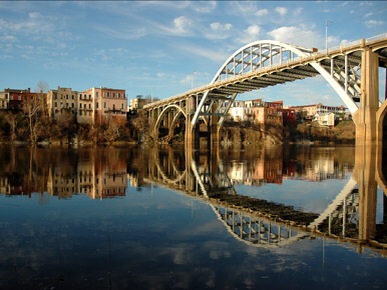
It may look like a simple through arch bridge, but the Edmund Pettus Bridge is not a simple bridge.   The Edmund Pettus Bridge is a bridge that carries U.S. Route 80 across the Alabama River in Selma, Alabama.  I’ve crossed it countless times in my life, and have always been struck by the history made there. Built in 1940, it is named for Edmund Winston Pettus, a former Confederate brigadier general, Democratic Party U.S. Senator from Alabama and Grand Dragon of the Alabama Ku Klux Klan.  The Pettus Bridge was the site of the conflict of Bloody Sunday on March 7, 1965, when armed officers attacked civil rights demonstrators attempting to march to the state capital of Montgomery.

Saturday, marked the fiftieth anniversary of the event as thousands gathered in the small city of Selma, Alabama to hear among others, President Obama speak. Obama’s address commemorated the 50th anniversary of “Bloody Sunday” during the marches to Montgomery in 1965, but his rhetorical scope encompassed all of American history.  Obama made the case that we are not exceptional in the perfection of our virtue, but rather, exceptional in our relentless struggle to live up to our ideals:

For we were born of change. We broke the old aristocracies, declaring ourselves entitled not by bloodline, but endowed by our Creator with certain unalienable rights. We secure our rights and responsibilities through a system of self-government, of and by and for the people. That’s why we argue and fight with so much passion and conviction, because we know our efforts matter. We know America is what we make of it.

For Obama, the marchers at Selma helped set a new course for American democracy. “Because of what they did, the doors of opportunity swung open not just for African-Americans, but for every American,” he told the crowd. “Women marched through those doors. Latinos marched through those doors. Asian-Americans, gay Americans, and Americans with disabilities came through those doors.” Had one of his predecessors not already taken the phrase, perhaps he would have called this a new birth of freedom.

He further noted, “We do a disservice to the cause of justice by intimating that bias and discrimination are immutable, or that racial division is inherent to America. If you think nothing’s changed in the past 50 years, ask somebody who lived through the Selma or Chicago or L.A. of the ’50s. Ask the female CEO who once might have been assigned to the secretarial pool if nothing’s changed. Ask your gay friend if it’s easier to be out and proud in America now than it was 30 years ago. To deny this progress — our progress — would be to rob us of our own agency; our responsibility to do what we can to make America better.”

Linking all “warriors of justice,” he invoked immigrants, slaves, and more who worked to change the U.S., he commented, “We are the gay Americans whose blood ran on the streets of San Francisco and New York, just as blood ran down this bridge.”

It is often forgotten the role of LGBT Americans in the Civil Rights Movement for African-Americans.  James Baldwin was at the Selma to Montgomery March, and he wrote the first gay book I ever read, Giovanni’s Room.  Lorraine Hansberry was a lesbian, whose 1959 play, A Raisin in the Sun, blazed a trail for African Americans into mainstream theatre and entertainment.  Bayard Rustin was not only dedicated to orchestrating the civil rights movement, he was also one of Dr. Martin Luther King Jr.’s closest advisors, and the organizer of the epic 1963 March on Washington. The Civil Rights Movement owes a debt of gratitude to the many LGBT Americans who fought for equal rights in the 1950s and 1960s.


Gong Hei Fat Choi: Happy Chinese New Year!

2015/02/img_04051.jpg

Today is the first day of the Chinese calendar, and we welcome the year of the goat (or sheep or ram, according to which translation you choose). The year of the goat is part of an ancient tradition in which the Chinese zodiac, Shēngxiào, attaches animal signs to each lunar year in a cycle of 12 years.

It reflects a similar concept in western astrology and means “circle of animals” – and remains popular in Asian communities around the world.

But as we bring the year of the horse to an end, where did the animals of the Chinese zodiac come from and what do they mean?

It is known that the animals of the zodiac have been popular since the Han Dynasty, between 206 BC and 220 AD. Pottery artifacts dating back to the Tang Dynasty, 618 to 907 AD, show the animals were popular at that time – but they have also been found on relics from the Warring States Period, 475 to 221 BC.

According to some historians, the animals of the Chinese zodiac were brought to China via the Silk Road, the central Asia trade route that brought Buddhism from India to Han China in the 1st or 2nd century BC.

Others argue that the belief predates Buddhism and has origins in early Chinese astronomy that used Jupiter as a constant – due to its 12-year orbital period around the earth. Some suggest the use of animals in astrology began with ancient Chinese nomadic tribes, who developed the calendar for agriculture and hunting.

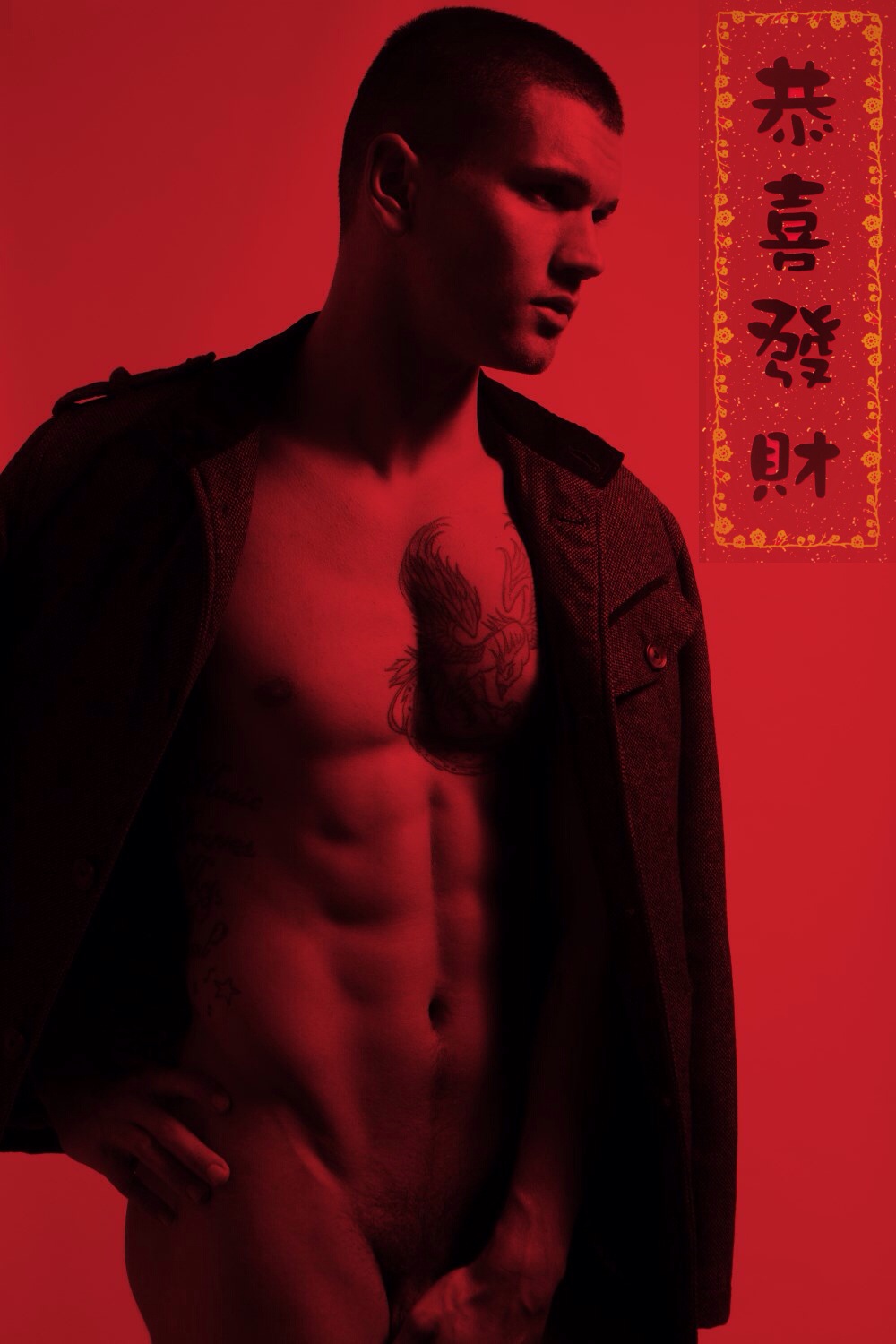
Red is the predominant color used in New Year celebrations. Red is the emblem of joy, and this color also symbolizes virtue, truth and sincerity. On the Chinese opera stage, a painted red face usually denotes a sacred or loyal personage and sometimes a great emperor. Candies, cakes, decorations and many things associated with the New Year and its ceremonies are colored red. The sound of the Chinese word for “red” is in Mandarin homophonous with the word for “prosperous”. Therefore, red is an auspicious color and has an auspicious sound.

The translation of the Mandarin word “yang” (since this is technically the Year of the Yang) – a “horned animal” – has led to dispute over whether the Chinese New Year will bring the year of the goat, sheep or ram. But folklorists say it is the western translation which is the problem, as the “yang” can mean either animal, depending on what Chinese character it is paired with.

Experts say it does not matter which animal the zodiac sign refers to, as the emphasis relies on the connotation of the animal. According to Zhao Shu, a researcher with the Beijing Research Institute of Culture and History, “This ‘yang’ is fictional. It does not refer to any specific kind of sheep or goat.”

The animal choice can depend on which area of Asia the person is from, as different regions of China have their own interpretations. According to Google, the phrase “the year of the ram” is most commonly used in India, followed by Canada and the United States, while the Philippines had high search levels for the “year of the sheep”.

The Year of the Goat has been predicted by Chinese astrologers to be a sign of a bad year. However, it is the eighth character of the zodiac and eight in Chinese sounds similar to their word for prosper. The Chinese commonly regard sheep as an auspicious animal, and the Year of the Sheep, therefore, heralds a year of promise and prosperity, so I’m not sure why some astrologers are expecting a bad year. To improve your fortunes this year, it is advised that people to wear black and blue, and to carry sheep talismans or accessories to help ward off bad luck.

Whichever you choose to use, Gong Hei Fat Choi, which loosely translates to “Congratulations and be prosperous,” and is a traditional greeting of the new year.


Long Johns

IMG_9972.JPG

Last week when Alabama broke numerous records for all time lows, silvereagle commented
“Cold here also. 20 right now. Glad I am inside. Wear those longjohns. Wonder where they got that name? Was John really long? What if his name had been Dick? Lol”. So I thought I might find the answer. How did long johns get their name?

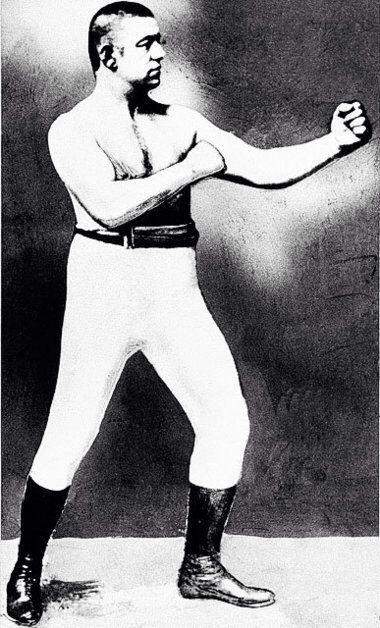
Long johns were first introduced into England in the seventeenth century but only become popular as sleepwear in the 18th century. The manufacturing foundations of long johns may lie in Derbyshire, England, at John Smedley’s Lea Mills, located in Matlock. The company has a 225-year heritage and is said to have created the garment, reputedly named after a famous boxer who fought in long underwear.

IMG_0004.JPGThe setting: a smoke-filled room with a boxing ring in Boston, Massachusetts around 1879.

The bell announced round three. Two antagonists rose from opposing corners, carefully calculating their next moves. Big John Sullivan, also called “The Boston Strong Boy,” made the first move: a blazing uppercut blow from the left. His deceived opponent fell hard, eyelids wavering.

Big John swaggered over his fallen victim, bragging, “I can lick anybody, anywhere, anytime.”

Modesty may not have been Big John’s forté, as John became known not only for his fighting style but for the mark he left upon the world of fashion. Unlike other fighters of his time, Big John wore one-piece thermals in the ring, otherwise known as the Union suit.

As his notoriety grew, John’s wardrobe took on the identity of the man, himself. Thus creating “long johns” as the character’s article of choice to wear.

In 2004, Michael Quinion, a British etymologist and writer, first postulated that the “john” in the item of apparel may be a reference to Sullivan, who wore the above mentioned union suit in the ring. This explanation, however, is uncertain and the word’s origin is ultimately unknown.

A less colorful explanation comes from Stanfield’s of Canada. An adjustable two-piece design is credited to Canadian Frank Stanfield, a native of Truro, Nova Scotia, who patented his design on 7 December 1915. In 1898, Stanfield and his brother John had developed a product called Stanfield’s Unshrinkable Underwear for Stanfield’s, their garment manufacturing company. Frank Stanfield may have given it the nickname long johns after his brother.

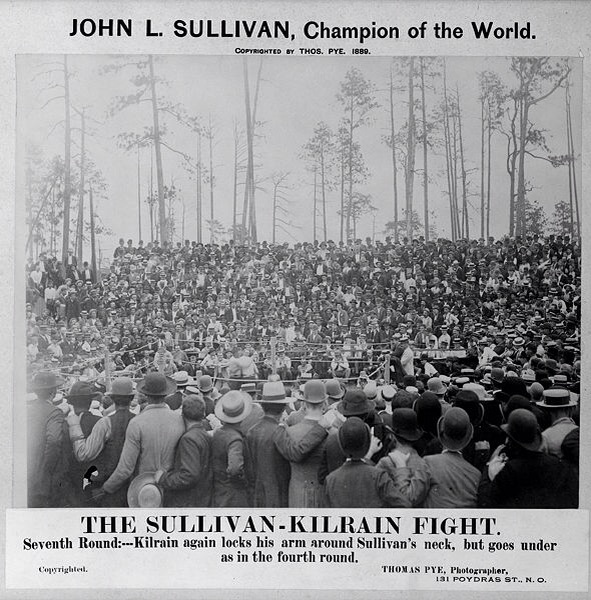
The most interesting part of my research (to me at least) into the name long johns was that I actually knew who John L. Sullivan was. I used to live less than five miles from the site of Sullivan’s most famous fight. You see, at the corner of Richburg Road and Sullivan-Kilrain Road in rural Mississippi there’s a monument that honors the last bare-knuckle boxing fight, famously known as the Sullivan-Kilrain fight. When I took the back roads to school, which I often did to avoid the worst of traffic, I regularly passed by this monument. The fight is 125-years-old and happened on July 8, 1889. The prize fight was between Jake Kilrain and John L. Sullivan.

On the 125th anniversary, WJTV News in Jackson, Mississippi, did a story about the Sullivan-Kilrain fight. Harold Hartfield, who’s grandfather witnessed the fight said “A lot of the people that was here for the fight actually came on special trains out of New Orleans to witness the fight.” They came from New Orleans on a train track that runs alongside Highway 11 because the governor of Louisiana forbid the fight in his state. However, a large number of influential politicians and businessmen (including, if memory serves me correctly, the mayor of New Orleans) wanted the fight to happen, so they decided to find a new place outside Louisiana’s borders. Bare-knuckled fighting was banned in most southern states, so they had to meet in rural Mississippi at this secret location near the train tracks out of New Orleans.

This being July in South Mississippi, the temperature got up to 106 degrees and the fight went 75 rounds and lasted two hours and 16 minutes. There is no doubt that the heat and humidity were oppressive, especially since the fight took place in late morning as the day began to heat up.

During these fights, a round ended when someone hit the ground and did not depend on a time limit. At the end of the 75 rounds, the assistants for Kilrain took him back to his corner and the doctor said he should not go back in the ring. The doctor feared that Sullivan would kill him if it went on longer. So Kilrain threw in the sponge, which is the same as throwing in the towel.

But since this was a bare-fisted prize fight and was illegal, there was a price to pay to the law. Both fighters left Mississippi for the Northeast but were brought back for trial in the Circuit Court of Marion County, Mississippi. They were both found guilty. Sullivan paid a $500 fine. Kilrain served a two month jail sentence. He served on the farm of Charles Rich where the fight had taken place.

IMG_0005.JPG


Silent Night

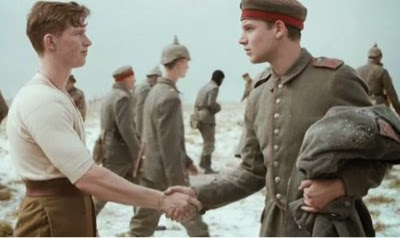
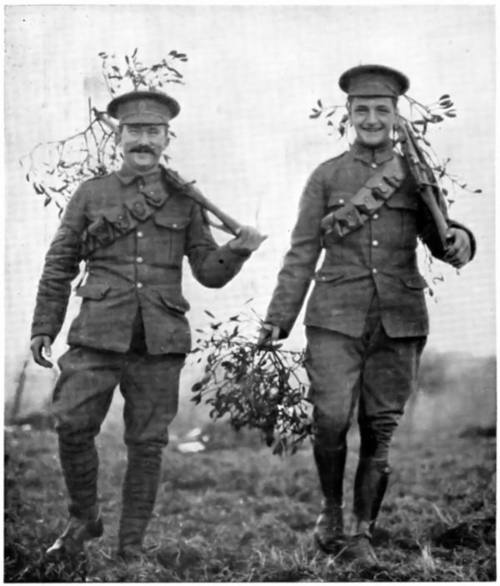
One of the most amazing events of the First World War happened 100 years ago today. As a historian of World War I, I can’t let the day go by without retelling this story, which is one of my all-time favorite Christmas stories, and by he way if you have not seen this commercial by Salisbury, you really should.  The picture above is from the commercial.  Click on this link to watch it:  http://youtu.be/NWF2JBb1bvM. It was made in partnership with The Royal British Legion and was inspired by real events from 100 years ago today. I cried the first time I watched it because it’s such an inspiring story of the spirit of Christmas.

During World War I, on Christmas Day 1914, the sounds of rifles firing and shells exploding faded in a number of places along the Western Front in favor of holiday celebrations in the trenches and gestures of goodwill between enemies. On December 7, 1914, Pope Benedict XV suggested a temporary hiatus of the war for the celebration of Christmas. Though Germany readily agreed, the other powers refused.Even without a cessation of war for Christmas, family and friends of the soldiers wanted to make their loved ones’ Christmas special. They sent packages filled with letters, warm clothing, food, cigarettes, and medications. Yet what especially made Christmas at the front seem like Christmas were the troves of small Christmas trees.

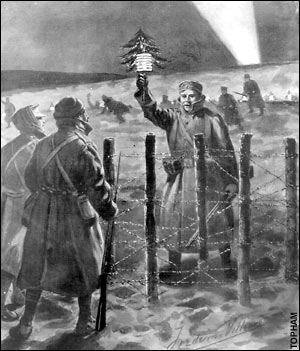
On Christmas Eve, many German soldiers put up Christmas trees, decorated with candles, on the parapets of their trenches. Hundreds of Christmas trees lighted the German trenches and although British soldiers could see the lights, it took them a few minutes to figure out what they were from. Could this be a trick? British soldiers were ordered not to fire but to watch them closely. Instead of trickery, the British soldiers heard many of the Germans celebrating.  They heard songs that were very familiar being sung in the other trenches:

Stille Nacht, heilige Nacht,
Alles schläft; einsam wacht
Nur das traute hochheilige Paar.
Holder Knabe im lockigen Haar,
Schlaf in himmlischer Ruh!

The British responded with the song in their own language:

Silent night, holy night
All is calm all is bright
‘Round yon virgin Mother and Child
Holy infant so tender and mild
Sleep in heavenly peace

Starting on Christmas Eve, many German and British troops sang Christmas carols to each other across the lines, and at certain points the Allied soldiers even heard brass bands joining the Germans in their joyous singing.

At the first light of dawn on Christmas Day, some German soldiers emerged from their trenches and approached the Allied lines across no-man’s-land, calling out “Merry Christmas” in their enemies’ native tongues. At first, the Allied soldiers feared it was a trick, but seeing the Germans unarmed they climbed out of their trenches and shook hands with the enemy soldiers. The men exchanged presents of cigarettes and plum puddings and sang carols and songs. There was even a documented case of soldiers from opposing sides playing a good-natured game of soccer.

Some soldiers used this short-lived ceasefire for a more somber task: the retrieval of the bodies of fellow combatants who had fallen within the no-man’s land between the lines.

The so-called Christmas Truce of 1914 came only five months after the outbreak of war in Europe and was one of the last examples of the outdated notion of chivalry between enemies in warfare. It was never repeated—future attempts at holiday ceasefires were quashed by officers’ threats of disciplinary action—but it served as heartening proof, however brief, that beneath the brutal clash of weapons, the soldiers’ essential humanity endured.

During World War I, the soldiers on the Western Front did not expect to celebrate on the battlefield, but even a world war could not destory the Christmas spirit.

The First World War is one of my favorite topics of study. It is so important for much of the history of the twentieth century, even though it is often overlooked. We, the GLBT community, also owe a great deal to the Great War. The First World War traumatised millions of men and challenged hegemonic conceptions of masculinity. In the post-war era, battles raged between competing socio-political groups over masculinity and the war experience. The homosexual movement posed one of the most significant challenges to pre-war gender norms. The war galvanised homosexuals to challenge social and cultural perceptions of gays as degenerate ‘enemies of the nation’. The movement was fragmented by rivalries and theoretical differences, but the memory of the war served as a central reference point for defining homosexual identity, masculinity and political rights in the Weimar Republic. The First World War was a turning point for Germany’s homosexual movement, as the war provided a central ideal – comradeship – that became a cornerstone for defining homosexual identity and justifying emancipation. An intensely militarised rhetoric permeated the language of gay rights organisations in the 1920s and, despite the differences among those organisations, the war gave homosexuals similar visions of a spiritually and politically liberated gay man who could use his training at the front to fight legal oppression and cultural prejudice.


Tracking Santa

IMG_9524.JPG

Each Christmas Eve people all over the world will log on to the official Santa Tracker to follow his progress through U.S. military radar. I remeber the local NBC station would break in with updates on Santa’s location. As a kid, I always thought it was so cool. Tracking Santa all started in 1955, with a misprint in a Colorado Springs newspaper and a call to Col. Harry Shoup’s secret hotline at the Continental Air Defense Command, now known as NORAD.

IMG_9673.JPG

The Santa Tracker tradition started with this Sears ad, which instructed children to call Santa on what turned out to be a secret military hotline. Kids today can call 1-877 HI-NORAD (1-877-446-6723) to talk to NORAD staff about Santa’s exact location.

Shoup’s children, Terri Van Keuren, Rick Shoup, and Pam Farrell, recently visited StoryCorps to talk about how the tradition began. Col. Shout had two phones on his desk, one was the “red” phone that only Shoup and a four-star general at the Pentagon had the number. Of course, this was the 1950s during the height of the Cold War. Shoup was the first line of defense against a nuclear attack.

The red phone rang one day in December 1955, and Shoup answered it. On the line was a small voice that asked “Is this Santa Claus?” Shoup was a serious, disciplined, and straight-laced colonel and was immediately annoyed at the call, thinking it was a joke. Then the little voice began to cry, Shoup realized it wasn’t a joke. So, Shoup went into Santa mode. He talked to the young boy, said a few “HO-HO-HOs” and asked if he’d been a good boy this year. Then Col. Shoup asked to speak to the boys mother. And the mother got on and said, ‘You haven’t seen the paper yet? There’s a phone number to call Santa. It’s in the Sears ad.’ Dad looked it up, and there it was, his red phone number.

That was the first of many phone calls that the Continental Air Defense Command received on the red phone. Shoup decided to assign a couple of airmen on the phones to act like Santa Claus. It became a big joke at the command center. Col. Harry Shoup came to be known as the “Santa Colonel.”

The airmen had a large glass board with the United States and Canada on it so that they could track airplanes in the skies. On Christmas Eve of 1955, when Shoup walked in, there was a drawing of a sleigh with eight reindeer coming over the North Pole. Shoup asked, “What is that?” The airmen replied, ‘Colonel, we’re sorry. We were just making a joke. Do you want us to take that down?’ Shoup looked at it for a while, and next thing you know, he had called the radio station and had said, ‘This is the commander at the Combat Alert Center, and we have an unidentified flying object. Why, it looks like a sleigh.’ Well, the radio stations would call him like every hour and ask, “Where’s Santa now?”

Later in life, Shoup got letters from all over the world, people saying, ‘Thank you, Colonel,’ for having a sense of humor. And in his 90s, he would carry those letters around with him in a briefcase that had a lock on it like it was top-secret information. The letters were important to him. He had been an important man for America’s defense in the Cold War, but he was also known as Colonel Santa.

Col. Shoup died in 2009. How many of you have fond memories of tracking Santa all thanks to this straight-laced military man who turned out to have a good-natured sense of humor?


The Enigma

IMG_9460.JPG

I have been fascinated by the story of Alan Turing for many years. He is a great unsung hero of the Second World War, and he has just recently begun getting some recognition for his genius. He’s often forgotten because he was gay, convicted in England for gross indecency in 1962, and forced to take estrogen treatments to curb his sexuality. He committed suicide two years later. Below is an article from the Huffington Post Gay Voices:

Alan Turing’s Biographer On The Truth About The Troubled Genius And His Tragic Death
By David Freeman

Sixty years after his tragic death, the brilliant English mathematician Alan Turing (1912-1954) has come back to life, if only virtually, in the new movie The Imitation Game.

The movie spotlights Turing’s work as a codebreaker during World War II. That’s a logical choice given his success in cracking a key German naval code known as Enigma.

The feat, which is believed to have shortened the war by at least two years and saved millions of lives, led Winston Churchill to say that Turing had made the single biggest contribution to the Allied victory over the Nazis.

But if cracking Enigma was Turing’s most tangible achievement, his greatest scientific legacy is his earlier theoretical work in the field now known as computer science. So says Andrew Hodges, the author of “Alan Turing: The Enigma,” the newly republished 1983 Turing biography on which The Imitation Game was based.

“The thing that really singles him out is his theoretical work in the 1930s, published at the end of 1936 [in his famous paper On Computable Numbers], in which he brought up this idea of the universal Turing machine,” Hodges says in a recent interview with The Huffington Post’s senior science editor, David Freeman. “And he said, rather tantalizingly, we can now invent a machine…and that really is the generalized idea of the computer as we now know it.”

Ultimately, the computer visionary and cryptanalyst–who was gay–broke not only the Enigma code but also the legal code of post-war England, which criminalized sexual contact between men. Turing was convicted of gross indecency in 1952. Two years later, in the aftermath of harrowing estrogen treatments intended to curb his sexual impulses, he died of cyanide poisoning.

Some have argued that the poisoning was accidental. But Hodges said it was a suicide he had carefully planned to minimize the emotional pain felt by his survivors.

“He’d been using cyanide in this home chemistry experiment,” Hodges, a mathematician at the Wadham College, Oxford University, says in the interview. “And I have no doubt at all that this experiment was there as a cover which allowed people, especially his mother, to believe that it was an accident.”

Turing received a posthumous royal pardon on Dec. 24, 2013.

http://www.huffingtonpost.com/2014/12/01/alan-turing-biographer-genius-death_n_6205838.html?utm_hp_ref=gay-voices&ir=Gay%20Voices