Category Archives: History

The Order of Chaeronea

20130825-203319.jpg

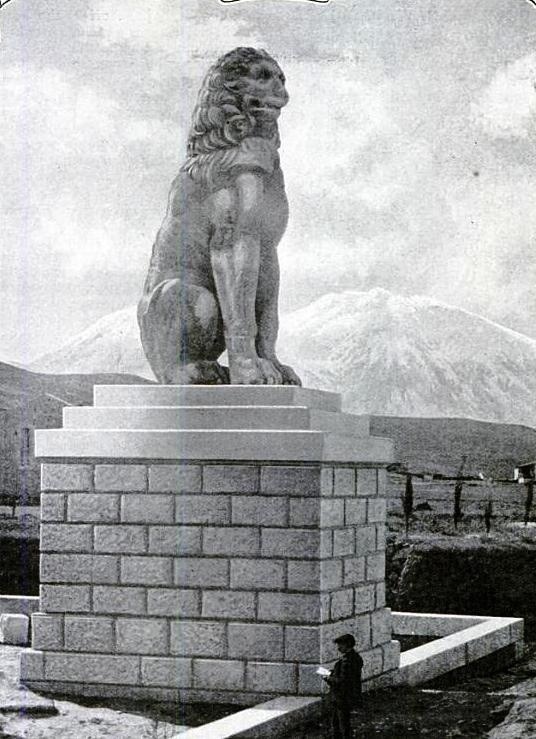
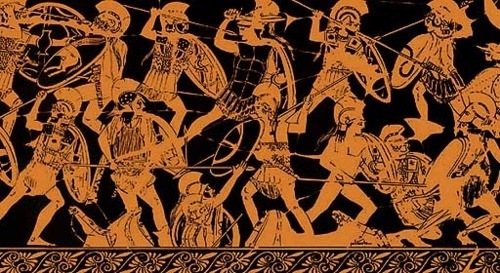
In the reckoning of George Cecil Ives, today would be the sixth day of the year 2341, since he counted years from the Battle of Chaeronea, which fell on 20th day August in 338 BC. A self-described “evolutionary anarchist,” Ives was also a poet and penologist who, around 1893, founded a secret homosexual society, the Order of Chaeronea, the name taken from the town in ancient Greece where, in the late 19th century, the remains were found of an elite corps of 150 pairs of male lovers who died in 338 BC in a battle against Philip II of Macedon. The army of Alexander the Great and Philip II of Macedon (for he was still alive then) vanquished the one-hundred-fifty members of the Sacred Band of Thebes in this last battle before Greece was under the hegemony of the Macedonians.
20130825-203423.jpg

Sacred Band of Thebes were much lamented by Alexander himself, and have never really been forgotten. And, all those years later, George Cecil Ives’ Order of Chaeronea (the specifically spiritual effort within “the Movement” for full equality for queer people that he and many others took part in during the late 19th century) was founded specifically in their honor and memory, hence his dating schema mentioned earlier.

George Cecil Ives was born on October 1, 1867. He was raised by his father’s mother, Emma Ives, and referred to her as his mother. Ives and his grandmother primarily resided in England at Bentworth Hall, or in the South of France. Ives was educated at home and at Magdalene College, Cambridge.

In 1892, Ives met Oscar Wilde at the Authors’ Club in London. By this time Ives had accepted his homosexuality and was working to promote the end of the oppression of homosexuals, what he called the “Cause.” Ives hoped that Wilde would join the “Cause” but Wilde did not have the same compassion towards this movement that Ives did. Lord Alfred Douglas met Ives in 1893 and introduced him to several Oxford poets, whom Ives encouraged to join the “Cause.”

By 1897, Ives understood that the “Cause” would not be accepted openly in society and must therefore have a means of underground communication. Thus he created and founded the Order of Chaeronea, a secret society for homosexuals. Ives and other members dated letters and other materials based on this date, so that 1899 would be written as C2237. An elaborate system of rituals, ceremonies, a service of initiation, seals, codes, and passwords were used by the members.

The ‘Rules of Purpose’ stated that the Order was to be ‘A Religion, A Theory of Life, and Ideal of Duty’, although its purpose was primarily political. Members of the Order were ‘Brothers of the Faith’, and were required to swear under the ‘Service of Initiation’, that “you will never vex or persecute lovers” and “That all real love shall be to you as sanctuary.” The group was male dominated, but did include a few lesbian members. At its peak ‘the Elect’ numbered perhaps two or three hundred, but no membership lists survive. Oscar Wilde was, however, likely an early recruit, along with Lord Alfred Douglas “Bosie”. Other members may have included Charles Kains Jackson, Samuel Elsworth Cottam, Montague Summers, and John Gambril Nicholson.

An elaborate system of rituals, ceremonies, a service of initiation, seals, codes, and passwords were established. The Order, according to Ives’ notebooks, had a specific purpose, distinct prescriptions and philosophy, and its particular symbolism: the “sign-word” AMRRHAO and “the seal of the double wreath.” The prerequisites of membership were indicated to be “Zeal, Learning and Discipline.” The principle of secrecy was conveyed by the metaphor of “The Chain” underlining that one should never reveal any information about the order or its members. The writings of Walt Whitman were particularly revered.

Ives was keen to stress that the Order was to be an ascetic movement, not to be used as a forum for men to meet men for sex, although he accepted a degree of ‘passionate sensuality’ could take place. He also believed that love and sex between men was a way to undermine the rigid class system, as a true form of democracy. The Secret Society became a worldwide organization, and Ives took advantage of every opportunity to spread the word about the “Cause.”

In Ives’ words:

We believe in the glory of passion. We believe in the inspiration of emotion. We believe in the holiness of love. Now some in the world without have been asking as to our faith, and mostly we find that we have no answer for them. Scoffers there be, to whom we need not reply, and foolish ones to whom our words would convey no meaning. For what are words? Symbols of kindred comprehended conceptions, and like makes appeal to like.
Letters of Note

One of my fellow teachers was telling me about this website/blog called Letters of Note. (Letters of Note is a blog-based archive of fascinating correspondence, complete with scans and transcripts of the original missives where available. Letters of Note is an attempt to gather and sort fascinating letters, postcards, telegrams, faxes, and memos.) Since my colleague told me about this blog, I have enjoyed reading some of the letters. On a whim, I searched for letters about homosexuality, and found this one. I hope you enjoy.

Homosexuality is nothing to be ashamed of

20130820-215928.jpg

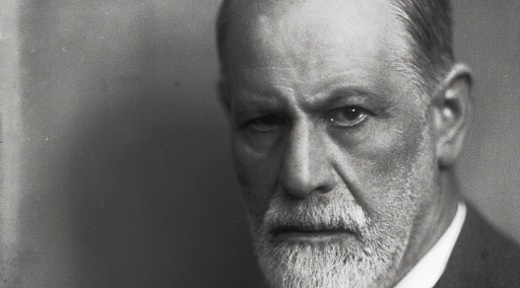
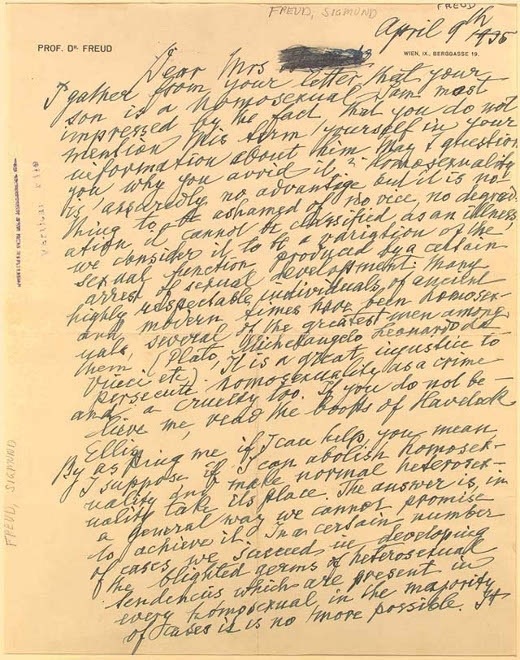
In 1935, the father of psychoanalysis, Sigmund Freud, was contacted by a worried mother who was seeking treatment for her son’s apparent homosexuality. Freud, who believed that all humans are attracted to both sexes in some capacity, responded with the following letter of advice.

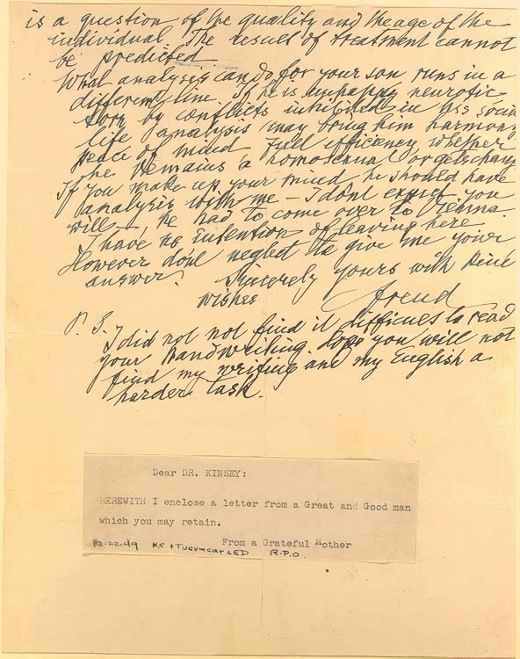
(The letter was later passed on to Alfred Kinsey and reproduced in The American Journal of Psychiatry in 1951, hence the note attached to its foot.)

Transcript follows.

Source: The Truth Tree; Image of Sigmund Freud via Multiart.

20130820-220219.jpg

20130820-220231.jpg

Transcript

April 9th 1935

PROF. DR. FREUD

Dear Mrs [Erased],

I gather from your letter that your son is a homosexual. I am most impressed by the fact that you do not mention this term yourself in your information about him. May I question you why you avoid it? Homosexuality is assuredly no advantage, but it is nothing to be ashamed of, no vice, no degradation; it cannot be classified as an illness; we consider it to be a variation of the sexual function, produced by a certain arrest of sexual development. Many highly respectable individuals of ancient and modern times have been homosexuals, several of the greatest men among them. (Plato, Michelangelo, Leonardo da Vinci, etc). It is a great injustice to persecute homosexuality as a crime – and a cruelty, too. If you do not believe me, read the books of Havelock Ellis.

By asking me if I can help, you mean, I suppose, if I can abolish homosexuality and make normal heterosexuality take its place. The answer is, in a general way we cannot promise to achieve it. In a certain number of cases we succeed in developing the blighted germs of heterosexual tendencies, which are present in every homosexual in the majority of cases it is no more possible. It is a question of the quality and the age of the individual. The result of treatment cannot be predicted.

What analysis can do for your son runs on a different line. If he is unhappy, neurotic, torn by conflicts, inhibited in his social life, analysis may bring him harmony, peace of mind, full efficiency, whether he remains a homosexual or gets changed. If you make up your mind he should have analysis with me — I don’t expect you will — he has to come over to Vienna. I have no intention of leaving here. However, don’t neglect to give me your answer.

Sincerely yours with best wishes,

Freud

P.S. I did not find it difficult to read your handwriting. Hope you will not find my writing and my English a harder task.


Bayard Rustin Will Posthumously Be Awarded the Presidential Medal of Freedom

image

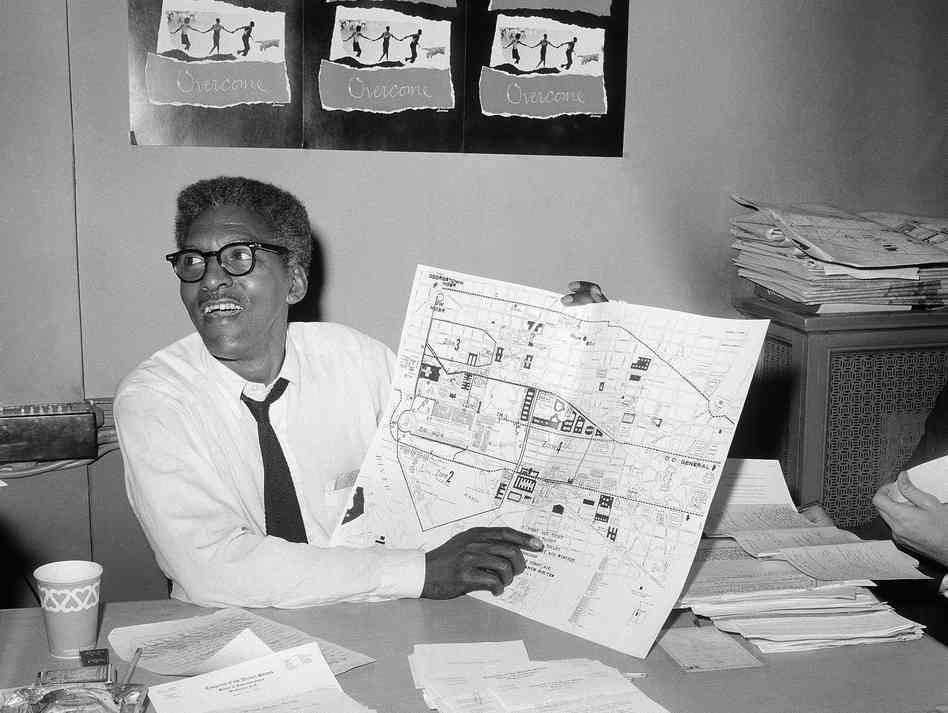
The trailblazing strategist behind the 1963 March on Washington will this year be posthumously awarded the Presidential Medal of Freedom. That’s a long way from the days when civil rights activists counted on Bayard Rustin’s hard work. Rustin taught MLK about non-violence, a strategy he’d learned from Gandhi. He organized the 1963 March on Washington. But he was discouraged from being a public spokesperson for civil rights because he was gay. Many activists at the time felt the movement wasn’t big enough to include homosexuality.

For 60 years, Rustin fought for peace and equal rights — demonstrating, organizing and protesting in the United States and around the world. Rustin grew up in West Chester, Pa. In college in the 1930s, he joined the Communist Youth League for a few years, attracted by the group’s anti-racist efforts. He later embraced socialism.

He was a gay black man, tall, with high cheekbones, and a gifted singer. He played a bit part in a Broadway musical alongside Paul Robeson, and Rustin often sang for his audiences as he toured the country, conducting race-relations workshops.

Rustin was considered a master organizer, a political intellectual and a pacifist; he served time in prison for refusing to register for the draft. He created the first Freedom Rides, which challenged segregation on interstate buses. Along with King, Rustin was one of the founders of the Southern Christian Leadership Conference.

He had two strong mentors. A.J. Muste, the head of the pacifist organization the Fellowship of Reconciliation, hired Rustin as a youth secretary to conduct workshops and demonstrations against war and segregation. Rustin’s other mentor was A. Philip Randolph, the head of the first predominantly black union, the Brotherhood of Sleeping Car Porters.

“What Rustin took away from Randolph, especially, is the recognition that economic issues and racial justice issues are completely intertwined,” says his biographer, John D’Emilio.

Despite his extensive involvement in the civil rights movement, Rustin was content to remain behind the scenes, D’Emilio says.

“I think of it as part of the Quaker heritage that he internalized. You don’t push yourself forward,” D’Emilio says. “It doesn’t matter if you don’t get the credit for it. What is important is this notion of speaking truth to power.”

In 1953, Rustin’s homosexuality became a public problem after he was found having sex in a parked car with two men. He was arrested on a morals charge. Later, when he was chosen to organize the 1963 march, some civil rights activists objected. In an effort to discredit the march, segregationist Sen. Strom Thurmond took to the Senate floor, where he derided Rustin for being a communist, a draft dodger and a homosexual. Ironically, author D’Emilo says, it became a rallying point — for the civil rights leaders.

“Because no one could appear to be on the side of Strom Thurmond, he created, unwittingly, an opportunity for Rustin’s sexuality to stop being an issue,” he says.

The march was a success, and at its end, a triumphant Rustin stepped up to the microphone to read the demands that the leaders of the civil rights movement would take to President John F. Kennedy.

First on the list: “effective Civil Rights legislation — no compromise, no filibuster — and that it include public accommodations, decent housing, integrated education, [fair employment], and the right to vote.”

Rustin wanted to move the civil rights agenda from protesting to politics and to work within the system — blacks and whites together — to create jobs and other opportunities. His effort fell flat, stymied by a more militant generation and the dominant issue of the times, the Vietnam War. Rustin said, “It has split the civil rights movement down the middle. It has caused many white people who were in it to say, ‘That must wait now until we stop Vietnam.’ ”

In his later years, Rustin continued to speak out on a variety of fronts, and his personal life also changed: He met Walter Naegle.

Naegle, Rustin’s surviving partner, says that in the final years of his life, Rustin became more involved in gay rights.

“He saw this as another challenge, another barrier that had to be broken down — a larger struggle for human rights and for individual freedoms,” Neagle says.

Or, as Rustin put it:

“The barometer for judging the character of people in regards to human rights is now those who consider themselves gay, homosexual, lesbian. The judgment as to whether you can trust the future, the social advancement, depending on people, will be judged on where they come out on that question.”

Activist Mandy Carter says Rustin was a visionary, understanding the parallels in the civil rights struggle and the gay rights movement. Carter is on the leadership council the National Black Justice Coalition, an LGBT civil rights group.

“For me and for a lot of us who are black, and gay and lesbian, bi, trans, who see ourselves as social justice advocates as well, to have this person — such an amazing role model,” she says.

Carter says there was just no one like him, and she is delighted such a key individual in the civil rights movement is now being recognized with the nation’s highest honor.

Rustin died in 1987 in New York. He was 75.


Remembering Rock

20130725-223520.jpg

On July 25, 1985, HIV/AIDS was given a global spotlight when it was announced that screen icon Rock Hudson was suffering from the disease.
Looking gaunt and almost unrecognizable, rumors began to circulate about his health earlier in the summer when the actor had made a public appearance to promote a new cable series of his friend and former co-star Doris Day.
After collapsing in Paris in July 1985, he was diagnosed with AIDS and given treatment with the drug HPA-23, which at the time was unavailable in the United States. It was while he was in the hospital that it was announced to the public that Hudson had AIDS:

“According to publicist Yanou Collart, who acted as his spokeswoman in Paris, the decision was Hudson’s. ‘The hardest thing I ever had to do in my life was to walk into his room and read him the press release,’ says Collart. “I’ll never forget the look on his face. How can I explain it? Very few people knew he was gay. In his eyes was the realization that he was destroying his own image. After I read it, he said simply, ‘That’s it, it has to be done.’ “

Hudson passed away at the age of 59, on October 2, 1985, less than three months after the announcement, in his Beverly Hills home. In his last weeks he was visited by many famous friends such as Carol Burnett, Roddy McDowell and Elizabeth Taylor, who upon his death was reported as saying “Please God, he did not die in vain.”
Hudson’s AIDS diagnosis put the disease into the headlines and changed the way the public thought of AIDS patients, as well as gay stereotypes. Before his death he created the Rock Hudson AIDS Foundation, donating the $250,000 he received from an advance of a biography to the foundation.
Hudson’s death is also credited with jumpstarting Elizabeth Taylor’s fundraising crusade to fight AIDS and Chairman of California’s AIDS Advisory Board Committee Bruce Decker said upon Hudson’s death: “His illness and death have moved the fight against AIDS ahead more in three months than anything in the past three years.”
Tales of the City author Armistead Maupin was quoted as saying: “I’m sure Rock’s coming out will stand as a landmark in the gay community.”

Independence

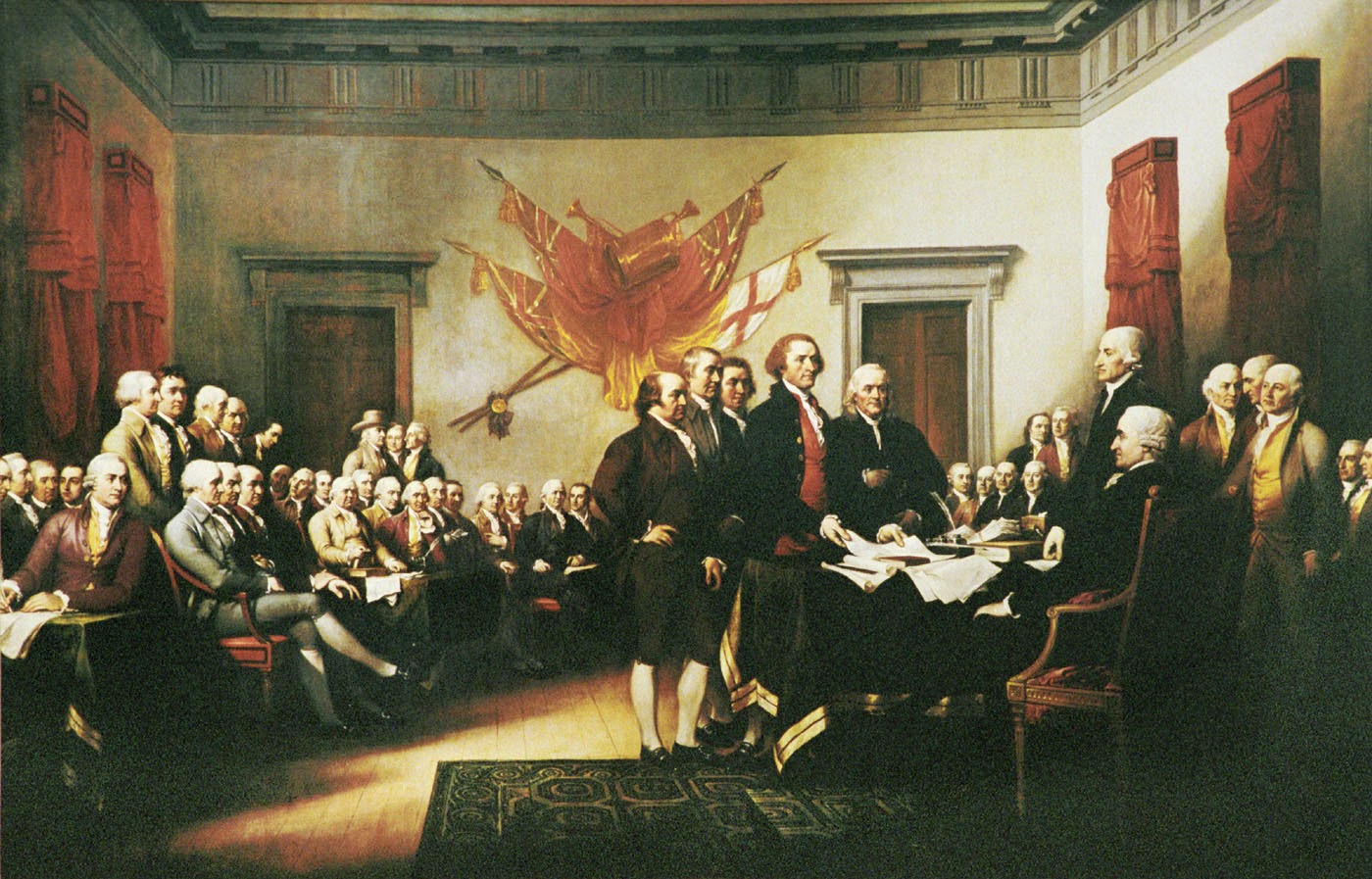
John Trumbull’s Declaration of Independence
When in the Course of human events, it becomes necessary for one people to dissolve the political bands which have connected them with another, and to assume among the powers of the earth, the separate and equal station to which the Laws of Nature and of Nature’s God entitle them, a decent respect to the opinions of mankind requires that they should declare the causes which impel them to the separation.
We hold these truths to be self-evident, that all men are created equal, that they are endowed by their Creator with certain unalienable Rights, that among these are Life, Liberty and the pursuit of Happiness.–That to secure these rights, Governments are instituted among Men, deriving their just powers from the consent of the governed, –That whenever any Form of Government becomes destructive of these ends, it is the Right of the People to alter or to abolish it, and to institute new Government, laying its foundation on such principles and organizing its powers in such form, as to them shall seem most likely to effect their Safety and Happiness. Prudence, indeed, will dictate that Governments long established should not be changed for light and transient causes; and accordingly all experience hath shewn, that mankind are more disposed to suffer, while evils are sufferable, than to right themselves by abolishing the forms to which they are accustomed. But when a long train of abuses and usurpations, pursuing invariably the same Object evinces a design to reduce them under absolute Despotism, it is their right, it is their duty, to throw off such Government, and to provide new Guards for their future security.–Such has been the patient sufferance of these Colonies; and such is now the necessity which constrains them to alter their former Systems of Government. The history of the present King of Great Britain is a history of repeated injuries and usurpations, all having in direct object the establishment of an absolute Tyranny over these States. To prove this, let Facts be submitted to a candid world.
The Declaration of Independence is arguably one of the most influential documents in American History. Other countries and organizations have adopted its tone and manner in their own documents and declarations. For example, France wrote its ‘Declaration of the Rights of Man’ and the Women’s Rights movement wrote its ‘Declaration of Sentiments’. However, the Declaration of Independence was actually not technically necessary in proclaiming independence from Great Britain.
A resolution of independence passed the Philadelphia Convention on July 2. This was all that was needed to break away from Britain. The colonists had been fighting Great Britain for 14 months while proclaiming their allegiance to the crown. Now they were breaking away. Obviously, they wanted to make clear exactly why they decided to take this action. Hence, they presented the world with the ‘Declaration of Independence’ drafted by thirty-three year old Thomas Jefferson.

The text of the Declaration has been compared to a ‘Lawyer’s Brief’. It presents a long list of grievances against King George III including such items as taxation without representation, maintaining a standing army in peacetime, dissolving houses of representatives, and hiring “large armies of foreign mercenaries.” The analogy is that Jefferson is an attorney presenting his case before the world court. Not everything that Jefferson wrote was exactly correct. However, it is important to remember that he was writing a persuasive essay, not a historical text. The formal break from Great Britain was complete with the adoption of this document on July 4, 1776.

Jefferson wrote the Declaration in a way that was meant to be read aloud.  The first two paragraphs are some of the most powerful words ever written.  Each year when I teach about the Declaration in my Civics, Government, and history classes, I make sure that it is read aloud so that the students get the full effect.  The most popular way to do this is to play the following video:  http://youtu.be/jYyttEu_NLU.  My students tend to pay more attention to the famous actors who read the Declaration of Independence.
HAPPY INDEPENDENCE DAY, MY FELLOW AMERICANS!

Paul Revere’s Ride

image

 
Paul Revere’s Ride
Henry Wadsworth Longfellow
Listen, my children, and you shall hear
Of the midnight ride of Paul Revere,
On the eighteenth of April, in Seventy-Five:
Hardly a man is now alive
Who remembers that famous day and year.
He said to his friend, “If the British march
By land or sea from the town to-night,
Hang a lantern aloft in the belfry-arch
Of the North-Church-tower, as a signal-light,–
One if by land, and two if by sea;
And I on the opposite shore will be,
Ready to ride and spread the alarm
Through every Middlesex village and farm,
For the country-folk to be up and to arm.”
Then he said “Good night!” and with muffled oar
Silently rowed to the Charlestown shore,
Just as the moon rose over the bay,
Where swinging wide at her moorings lay
The Somerset, British man-of-war:
A phantom ship, with each mast and spar
Across the moon, like a prison-bar,
And a huge black hulk, that was magnified
By its own reflection in the tide.
Meanwhile, his friend, through alley and street
Wanders and watches with eager ears,
Till in the silence around him he hears
The muster of men at the barrack door,
The sound of arms, and the tramp of feet,
And the measured tread of the grenadiers
Marching down to their boats on the shore.
Then he climbed to the tower of the church,
Up the wooden stairs, with stealthy tread,
To the belfry-chamber overhead,
And startled the pigeons from their perch
On the sombre rafters, that round him made
Masses and moving shapes of shade,–
By the trembling ladder, steep and tall,
To the highest window in the wall,
Where he paused to listen and look down
A moment on the roofs of the town,
And the moonlight flowing over all.
Beneath, in the churchyard, lay the dead,
In their night-encampment on the hill,
Wrapped in silence so deep and still
That he could hear, like a sentinel’s tread,
The watchful night-wind, as it went
Creeping along from tent to tent,
And seeming to whisper, “All is well!”
A moment only he feels the spell
Of the place and the hour, and the secret dread
Of the lonely belfry and the dead;
For suddenly all his thoughts are bent
On a shadowy something far away,
Where the river widens to meet the bay, —
A line of black, that bends and floats
On the rising tide, like a bridge of boats.
Meanwhile, impatient to mount and ride,
Booted and spurred, with a heavy stride,
On the opposite shore walked Paul Revere.
Now he patted his horse’s side,
Now gazed on the landscape far and near,
Then impetuous stamped the earth,
And turned and tightened his saddle-girth;
But mostly he watched with eager search
The belfry-tower of the old North Church,
As it rose above the graves on the hill,
Lonely and spectral and sombre and still.
And lo! as he looks, on the belfry’s height,
A glimmer, and then a gleam of light!
He springs to the saddle, the bridle he turns,
But lingers and gazes, till full on his sight
A second lamp in the belfry burns!
A hurry of hoofs in a village-street,
A shape in the moonlight, a bulk in the dark,
And beneath from the pebbles, in passing, a spark
Struck out by a steed that flies fearless and fleet:
That was all! And yet, through the gloom and the light,
The fate of a nation was riding that night;
And the spark struck out by that steed, in his flight,
Kindled the land into flame with its heat.
He has left the village and mounted the steep,
And beneath him, tranquil and broad and deep,
Is the Mystic, meeting the ocean tides;
And under the alders, that skirt its edge,
Now soft on the sand, now loud on the ledge,
Is heard the tramp of his steed as he rides.
It was twelve by the village clock
When he crossed the bridge into Medford town.
He heard the crowing of the cock,
And the barking of the farmer’s dog,
And felt the damp of the river-fog,
That rises when the sun goes down.
It was one by the village clock,
When he galloped into Lexington.
He saw the gilded weathercock
Swim in the moonlight as he passed,
And the meeting-house windows, blank and bare,
Gaze at him with a spectral glare,
As if they already stood aghast
At the bloody work they would look upon.
It was two by the village clock,
When be came to the bridge in Concord town.
He heard the bleating of the flock,
And the twitter of birds among the trees,
And felt the breath of the morning breeze
Blowing over the meadows brown.
And one was safe and asleep in his bed
Who at the bridge would be first to fall,
Who that day would be lying dead,
Pierced by a British musket-ball.
You know the rest. In the books you have read,
How the British Regulars fired and fled,–
How the farmers gave them ball for ball,
From behind each fence and farmyard-wall,
Chasing the red-coats down the lane,
Then crossing the fields to emerge again
Under the trees at the turn of the road,
And only pausing to fire and load.
So through the night rode Paul Revere;
And so through the night went his cry of alarm
To every Middlesex village and farm,–
A cry of defiance, and not of fear,
A voice in the darkness, a knock at the door,
And a word that shall echo forevermore!
For, borne on the night-wind of the Past,
Through all our history, to the last,
In the hour of darkness and peril and need,
The people will waken and listen to hear
The hurrying hoof-beats of that steed,
And the midnight message of Paul Revere.
image
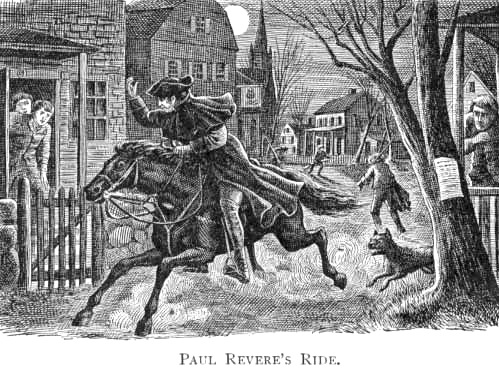
Thursday is Independence Day, so I thought I would post a patriotic poem.  Though the events of this poem occurred on April 18-19, 1775, over a year before the signing of the Declaration of Independence, it is one of the most famous events of the American Revolution.  In 1774 and the Spring of 1775 Paul Revere was employed by the Boston Committee of Correspondence and the Massachusetts Committee of Safety as an express rider to carry news, messages, and copies of resolutions as far away as New York and Philadelphia.
 
On the evening of April 18, 1775, Paul Revere was sent for by Dr. Joseph Warren and instructed to ride to Lexington, Massachusetts, to warn Samuel Adams and John Hancock that British troops were marching to arrest them. After being rowed across the Charles River to Charlestown by two associates, Paul Revere borrowed a horse from his friend Deacon John Larkin. While in Charlestown, he verified that the local “Sons of Liberty” committee had seen his pre-arranged signals. (Two lanterns had been hung briefly in the bell-tower of Christ Church in Boston, indicating that troops would row “by sea” across the Charles River to Cambridge, rather than marching “by land” out Boston Neck. Revere had arranged for these signals the previous weekend, as he was afraid that he might be prevented from leaving Boston).
 
On the way to Lexington, Revere “alarmed” the country-side, stopping at each house, and arrived in Lexington about midnight. As he approached the house where Adams and Hancock were staying, a sentry asked that he not make so much noise. “Noise!” cried Revere, “You’ll have noise enough before long. The regulars are coming out!” After delivering his message, Revere was joined by a second rider, William Dawes, who had been sent on the same errand by a different route. Deciding on their own to continue on to Concord, Massachusetts, where weapons and supplies were hidden, Revere and Dawes were joined by a third rider, Dr. Samuel Prescott. Soon after, all three were arrested by a British patrol. Prescott escaped almost immediately, and Dawes soon after. Revere was held for some time and then released. Left without a horse, Revere returned to Lexington in time to witness part of the battle on the Lexington Green.
 
The events of that night were immortalized by Henry Wadsworth Longfellow to commemorates Revere’s actions. Longfellow’s poem is not historically accurate but his “mistakes” were deliberate. He had researched the historical event, using works like George Bancroft’s History of the United States, but he manipulated the facts for poetic effect.  He was purposely trying to create American legends, much as he did with works like The Song of Hiawatha (1855) and The Courtship of Miles Standish (1858).  Longfellow was inspired to write the poem after visiting the Old North Church and climbing its tower on April 5, 1860. He began writing the poem the next day. It was first published in the January 1861 issue of The Atlantic Monthly. It was later re-published in Longfellow’s Tales of a Wayside Inn as “The Landlord’s Tale” in 1863. The poem served as the first in a series of 22 narratives bundled as a collection, similar to Geoffrey Chaucer’s The Canterbury Tales, and was published in three installments over 10 years.
 
The poem is spoken by the landlord of the Wayside Inn and tells a partly fictionalized story of Paul Revere. In the poem, Revere tells a friend to prepare signal lanterns in the Old North Church to inform him if the British will attack by land or sea. He would await the signal across the river in Charlestown and be ready to spread the alarm throughout Middlesex County, Massachusetts. The unnamed friend climbs up the steeple and soon sets up two signal lanterns, informing Revere that the British are coming by sea. Revere rides his horse through Medford, Lexington, and Concord to warn the patriots.
 

Joan of Arc

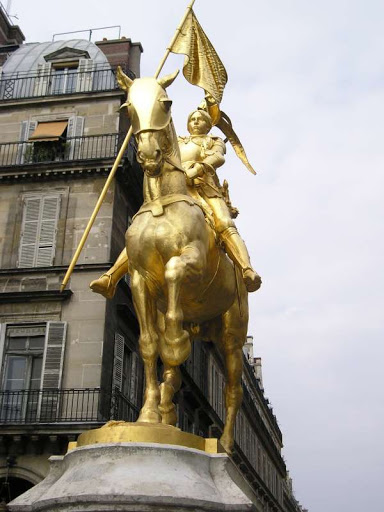
Emmanuel Frémiet’s statue of Joan of Arc, in military attire, stands outside the Place des PyramidesParis.
Joan of Arc (Fr: Jeanne d’Arc), a French revolutionary executed by the English for heresy in 1431, is a national heroine of France and a Roman Catholic saint. Joan shunned the traditional roles and garb of women in her era for the lifestyle and dress of a soldier, ultimately providing a pretense for her conviction and execution. Whether her crossdressing and lifestyle have implications for her sexuality or gender identity is debated.

Kelly DeVries notes that, “No person of the Middle Ages, male or female, has been the subject of more study than Joan of Arc. She has been portrayed as saint, heretic, religious zealot, seer, demented teenager, proto-feminist, aristocratic wanna-be, savior of France, person who turned the tide of the Hundred Years War and even Marxist liberator.”[1] Due to such widely differing interpretations of her life and its meaning, many interpretations of the implications of her adoption of a male dress and lifestyle have been debated.

As Susan Crane notes, “Joan of Arc wore men’s clothes almost continually from her first attempts to reach the Dauphin, later crowned Charles VII, until her execution twenty-eight months later. In court, on campaigns, in church, and in the street she cross-dressed, and she refused to stop doing so during the long months of her trial for heresy. Joan’s contemporary supporters and adversaries comment extensively on her clothing, and the records of her trial provide commentary of her own, making her by far the best-documented transvestite of the later Middle Ages”[2]

After her capture while protecting the French retreat at Margny, Joan was sold to the English, imprisoned, and subsequently tried for heresy. Despite the attempts of the judges to get her to repent for her donning of male attire, Joan repeatedly defends the wearing of them as a “small matter” that was “the commandment of God and his angels.” As Pernoud and Clin note, “Other questions about her mode of dress provoked only repetitions of these answers: She had done nothing that was not by the commandment of God. Probably not even Cauchon could then have guessed the importance that her mode of dress would come to assume.”[3] As Beverly Boyd observed, “The issue was, of course, [Joan’s] voices .. but the emblem of the heresy was her wearing of men’s clothing.”[4]

Joan signed a cedula, possibly without understanding, indicating that she would no longer wear men’s clothing, only to “relapse” later, giving the court justification to have her executed (“Only those who had relapsed — that is, those who having once adjured their errors returned to them — could be condemned to death by a tribunal of the Inquisition and delivered for death.”)[5] On May 30, 1431, Joan of Arc was burned at the stake.

Notes:

  1. DeVries, Kelly (1996). Fresh Verdicts on Joan of Arc / A Woman As A Leader Of Men. Garland Publishing. pp. 3.
  2. DuParc, Pierre (1977). Procès en Nullité de la Condamnation de Jeanne d’Arc, Volume 1. Société de l’Histoire de France. pp. 289-290.  Another translation is given in: Murray, T. Douglas (1902). Jeanne d’Arc, Maid of Orleans: Deliverer of France. pp. 223.
  3. DuParc, Pierre (1977). Procès en Nullité de la Condamnation de Jeanne d’Arc, Volume 1. Société de l’Histoire de France. pp. 306. Another translation is given in: Pernoud, Régine (1994). Joan of Arc By Herself and Her Witnesses. Scarborough House. pp. 39.
  4. DuParc, Pierre (1977). Procès en Nullité de la Condamnation de Jeanne d’Arc, Volume 1. Société de l’Histoire de France. pp. 426.
  5. BAN Lat. 1119 f.47r; Proces… Vol I page 220,221

More information can be found at: “Cross-dressing, gender identity, and sexuality of Joan of Arc”


MEDIA RELEASE: New Exhibitions Reveal Untold Stories of Queer History

New Exhibitions at GLBT History Museum to Highlight Queer

Asian Pacific Islander Women, Early AIDS Prevention Efforts       

San Francisco — Two new shows opening in September at The GLBT History Museum highlight  evocative untold stories from the recent history of San Francisco. An exhibition in the Front Gallery will trace the emergence of organizing by queer and transgender women in the city’s Asian Pacific Islander communities. In addition, a small, focused exhibit in the museum’s Corner Gallery will focus on the pioneering role of the Sisters of Perpetual Indulgence in promoting safer sex during the early years of the AIDS crisis.  

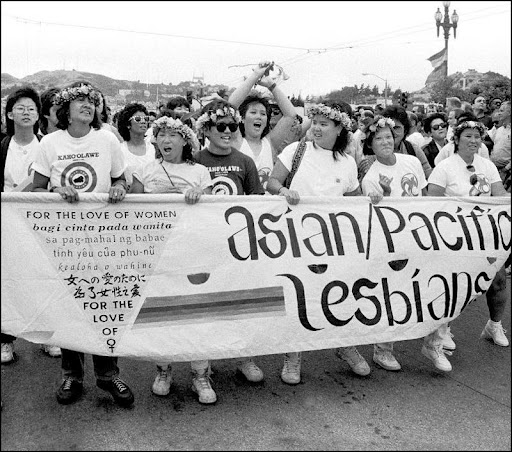
“For Love and Community: Queer Asian Pacific Islanders Take Action, 1960-1990s” recounts the creation of the Asian Pacific Islander queer women’s and transgender community. Many of its members were born in the city, with deep roots in San Francisco Chinatown. Others moved to the Bay Area as adults, working to build support networks and advocate for change. The exhibition features photographs from these organizers that tell a story of family, community, activism and love, and audio clips from oral history interviews that give voice to a history that has never been heard.  
“API queer women and transfolks have been out and working towards social change in San Francisco since at least the 1960s,” notes curator Amy Sueyoshi. “What’s most incredible is that this movement reflects activism en masse. It’s inspiring to see so many people taking action to make a more compassionate world accepting of difference. In a city of rich legacies from both API and queer communities, this exhibition finally reveals the organizing at their intersection.”   
  
“For Love and Community” opens Tuesday, September 18, with a public reception from 7:00 to 9:00 p.m. Many of the women whose stories are told in the exhibition will attend. Partial funding for the exhibition was provided by the Cesar Chavez Institute at San Francisco State University. 
“Play Fair! The Sisters of Perpetual Indulgence Make Sex Safer” sheds light on a modest brochure that broke new ground by launching the gay community’s sex-positive response to the AIDS crisis. Since 1979, the Sisters of Perpetual Indulgence have transformed GLBT politics, activism and volunteerism. One major contribution is the long-running Play Fair campaign, one of the first gay safe-sex initiatives.

In 1982, six sisters produced the initial Play Fair brochure, designed to get the gay community talking about prevention and treatment of sexually transmitted infections in a language free of judgment and guilt. The first edition came out just as GLBT people began to grapple with what would become the AIDS epidemic. In the 30 years since, the brochure has been updated twice while retaining all its original potency, humor and vitality.

Produced in partnership with the Sisters of Perpetual Indulgence Inc., the “Play Fair!” exhibit will open with a public reception on Friday, September 28, 7:00 – 9:00 p.m.
ABOUT THE GLBT HISTORY MUSEUM
The GLBT History Museum is the first full-scale, stand-alone museum of its kind in the United States. The museum is a project of the GLBT Historical Society, a research center and archives founded in 1985 that houses one of the world’s largest collections of lesbian, gay, bisexual and transgender historical materials.

Admission to the museum is $5.00 general; $3.00 for California students; and free for members. For more information, visit www.glbthistory.org.

For more details on “For Love and Community,” download the PDF of the curators statement and exhibition credits by clicking here.

For more information on the Sisters of Perpetual Indulgence Inc., visit the Sisters’ website.

The following photographs may be reproduced in conjunction with coverage of the exhibitions at The GLBT History Museum. The full photo credits given in the captions are required.    

Asian/Pacific Lesbians marching in the 1989 San Francisco LGBT Pride Parade. Photo: Cathy Cade at www.cathcade.com; courtesy of the Bancroft Library.

Produced by the Sisters of Perpetual Indulgence in 1982, the “Play Fair!” brochure launched the safer sex movement. Photo courtesy of the GLBT Historical Society.


Kiss Mor Chiks

Thousands of supporters of fast food restaurant Chick-fil-A made their way to restaurants all over Alabama and the United States Wednesday to stand in long lines in support of the restaurant chain.   Customers packed dining rooms and found themselves wrapped in lines outside restaurants in Montgomery, Prattville, Auburn, Dothan and many other locations around the state and country. Cars snaked around the buildings all day and stretched great distances beyond parking lots.  By early evening, some of the restaurants reported they’d exhausted their food supply and were preparing to close.

The day was billed by conservatives, and credited to talk show host and former Arkansas Governor Mike Huckabee, as an unofficial “Chick-fil-A Appreciation Day” in support of the company. CFA said it had nothing to do with the event’s organization.   CFA President, Dan Cathy, recently sparked a nationwide controversy following remarks that he does not support same-sex marriage. Cathy told a Baptist magazine that he believes in the Biblical definition of marriage, a union between a man and a woman. The family-owned company’s 1,600+ outlets remain closed on Sundays for religious reasons. Cathy’s remarks have made his company the target of multiple boycotts. The Jim Henson Company pulled its toys from the company’s kids’ meals. Mayors of several large cities, including Boston and Chicago, have also said the company isn’t welcomed, although its unlikely the company’s permits will be denied.

Protestors are planning a nationwide event, scheduled for Friday, at which point they’re planning to show their public displays of affection at area restaurants by kissing as same-sex couples.  Opponents of Cathy’s stance have planned “Kiss Mor Chiks” for Friday, asking people of the same sex to show up at Chick-fil-A locations and kiss each other.  Does anyone want to meet me at a Chick-fil-A for the kiss of a lifetime? Actually, I don’t think that the “Kiss Mor Chiks” event is the best way to deal with the situation.  A complete and total boycott of Chick-fil-A is my plan. I’ve always liked Chick-fil-A’s food, but I will not be supporting their restaurants. There are plenty of restaurants with better chicken.

I had not planned on blogging about this, but two things changed my mind. First, I heard my sister, who does not know I am gay, say that she would go to Chick-fil-A on Wednesday to show her support.  Before I could tell her that I would never go back to Chick-fil-A, she had already changed the subject, and I just let the comment slide (not something I am proud of).  The second thing was the massive amount of coverage about “Chick-fil-A Appreciation Day” on the local news.

As churches struggle with the issue of homosexuality, a long tradition of same sex marriage indicates that the Christian attitude toward same sex unions may not always have been as “straight” as is now suggested. A Kiev art museum contains a curious icon from St. Catherine’s monastery on Mt. Sinai.
It shows two robed Christian saints. Between them is a traditional Roman pronubus (best man) overseeing what in a standard Roman icon would be the wedding of a husband and wife. In the icon, Christ is the pronubus. Only one thing is unusual. The husband and wife are in fact two men.

The very idea seems initially shocking. The full answer comes from other sources about the two men featured, St. Serge and St. Bacchus, two Roman soldiers who became Christian martyrs.

While the pairing of saints, particularly in the early church, was not unusual, the association of these two men was regarded as particularly close. Severus of Antioch in the sixth century explained that “we should not separate in speech [Serge and Bacchus] who were joined in life.” More bluntly, in the definitive 10th century Greek account of their lives, St. Serge is openly described as the “sweet companion and lover” of St. Bacchus.

In other words, it confirms what the earlier icon implies, that they were a homosexual couple who enjoyed a celebrated gay marriage. Their orientation and relationship was openly accepted by early Christian writers. Furthermore, in an image that to some modern Christian eyes might border on blasphemy, the icon has Christ himself as their pronubus, their best man overseeing their gay marriage.

The very idea of a Christian gay marriage seems incredible. Yet after a twelve year search of Catholic and Orthodox church archives Yale history professor John Boswell, and author of Same Sex Unions In Pre-Modern Europe, has discovered that a type of Christian gay marriage did exist as late as the 18th century.


Contrary to myth, Christianity’s concept of marriage has not been set in stone since the days of Christ, but has evolved as a concept and as a ritual.

Professor Boswell discovered that in addition to heterosexual marriage ceremonies in ancient church liturgical documents (and clearly separate from other types of non-marital blessings of adopted children or land) were ceremonies called, among other titles, the “Office of Same Sex Union” (10th and 11th century Greek) or the “Order for Uniting Two Men” (11th and 12th century). That certainly sounds like gay marriage.

Boswell found records of same sex unions in such diverse archives as those in the Vatican, in St. Petersburg, in Paris, Istanbul, and in Sinai, covering a period from the 8th to 18th centuries. Nor is he the first to make such a discovery. The Dominican Jacques Goar (1601-1653) includes such ceremonies in a printed collection of Greek prayer books.

It sounds to me that the so-called “traditional” definition of marriage as between one man and one woman is not so traditional.  It is based on verses in the Old Testament, which also states that King Solomon had 700 wives and 300 concubines. 


The Ancient Olympics

ancient-olympics When I took my first history class in college, I did a research project on the Ancient Olympics. I had always been fascinated with the thought of athletes competing in the nude, but I also was in by the Summer Olympics that year, which were being held in Atlanta. My family and I actually went to the Olympics that year since it was close by and had a great time. I was thinking today about doing another history post and I was thinking about all the conversation we have been having about circumcision, and the idea of the Ancient Olympics came to me.

b_39k2701retocuhedbb_39k2038retouchedb

One of the things I learned during that research project on the Ancient Olympics is that men were not allowed to compete if they were kynodesmecircumcised, which meant that during that time Greek Jews were not allowed to compete in the Ancient Olympics. I also learned that in order to protect their penis during wrestling matches and other contact sports, the men would tie a string around the tip of their foreskin enclosing their glans, thus keeping them safe. The kynodesme was tied tightly around the part of the foreskin that extended beyond the glans. The kynodesme could then either be attached to a waist band to expose the scrotum, or tied to the base of the penis so that the penis appeared to curl upwards.

hugh-plummer-02-13 article-0-0909EC69000005DC-218_468x637

The ancient Olympics were rather different from the modern Games. There were fewer events, and only free men who spoke Greek could compete, instead of athletes from any country. Also, the games were always held at Olympia instead of moving around to different sites every time.

3-sport-nude-lubo-spirko 30s_french_soldiers_wrestling_nude
Like our Olympics, though, winning athletes were heroes who put their home towns on the map. One young Athenian nobleman defended his political reputation by mentioning how he entered seven chariots in the Olympic chariot-race. This high number of entries made both the aristocrat and Athens look very wealthy and powerful.
6a00d83451b90769e20133eca5dbe4970b-400wi

There are numerous myths about how the Olympics began. One myth says that the guardians of the infant god Zeus held the first footrace, or that Zeus himself started the Games to celebrate his victory over his father Cronus for control of the world. Another tradition states that after the Greek hero Pelops won a chariot race against King Oenomaus to marry Oenomaus’s daughter Hippodamia, he established the Games.

Patrick sindre skoglund[2]

Athletic games also were an important part of many religious festivals from early on in ancient Greek culture. In the Iliad, the famous warrior Achilles holds games as part of the funeral services for his best friend Patroclus. The events in them include a chariot race, a footrace, a discus match, boxing and wrestling.

yik Braeden Baade (6)

The footrace was the sole event for the first 13 Olympiads. Over time, the Greeks added longer footraces, and separate events. The pentathlon and wrestling events were the first new sports to be added, in the 18th Olympiad.
milo-of-kroton
Click on any of the event names to see a description of a particular sport:

olive-wreath-ancient-olympicsThe victorious olive branch. The Ancient Olympic Games didn’t have any medals or prizes. Winners of the competitions won olive wreaths, branches, as well as woolen ribbons. The victors returned home as heroes – and got showered with gifts by their fellow citizens.
Here are two videos the History Channel did about the Ancient Olympics. Too bad, they have them wearing modesty pouches.

By the way, for those interested, here is an explanation of women’s role in the Ancient Olympics:
Married women were banned at the Ancient Olympics on the penalty of death. The laws dictated that any adult married woman caught entering the Olympic grounds would be hurled to her death from a cliff! Maidens, however, could watch (probably to encourage gettin’ it on later). But this didn’t mean that the women were left out: they had their own games, which took place during Heraea, a festival worshipping the goddess Hera. The sport? Running – on a track that is 1/6th shorter than the length of a man’s track on the account that a woman’s stride is 1/6th shorter than that of a man’s! The female victors at the Heraea Games actually got better prizes: in addition to olive wreaths, they also got meat from an ox slaughtered for the patron deity on behalf of all participants! Overall, young girls in Ancient Greece weren’t encouraged to be athletes – with a notable exception of Spartan girls. The Spartans believed that athletic women would breed strong warriors, so they trained girls alongside boys in sports. In Sparta, girls also competed in the nude or wearing skimpy outfits, and boys were allowed to watch.
Another side note, Spartan marriage rituals are quite fascinating, if any one is interested I will do a straight post about Spartan sexuality and the marriage rituals. It will have some about gay sex, these were the Spartans after all.