
This post begins a new series on The Closet Professor about the history of the early gay rights movement. Most if not all of you have heard of the Stonewall Riots, and though most people credit Stonewall with the beginning of gay rights, there were precursors to the movement. This series is based on a paper I once wrote about the gay rights movement but has been updated to some extent. I hope you enjoy it and find it informative.
The summer of 1969 showed the best and worst of America. In June, President Nixon announced Vietnamization as a way to get America out of  the Vietnam War, which reminds me a lot of our present policy of Iraqization of the now (supposedly) ended war in Iraq. Man stood on the moon for the first time on July 16 with the Apollo 11 landing. In August, Woodstock demonstrated to the world the epitome of the flower children’s culture and the height of the counter culture movement. While such events were celebrated in American culture, the summer of 1969 was also marked by a series of tragedies. Judy Garland died from an overdose of drugs. The Manson Family murdered actress Sharon Tate, her unborn child, and four others in Bel Air, California, in what has
  become known as Helter Skelter. Mary Jo Kopechne died in a drunk driving accident with Ted Kennedy in Chapppaquiddick, Massachusetts. And 248 people perished in Mississippi when Hurricane Camille crashed into the Gulf Coast. The Civil Rights Movement was also going through a change. With the assassination of Martin Luther King, Jr. in Memphis in 1968, the end had come to the classic period of the Civil Rights Movement. The movement was becoming more radical and began to splinter off into more groups of people, including women and the gay and lesbian community.
With the Stonewall Riots, the modern gay and lesbian rights movement had its beginnings in Greenwich Village, New York, during the summer of 1969.  The Stonewall Riots marked a change in the direction of the gay liberation movement that had been brewing since the end of World War II with the founding of the Mattachine Society in Los Angeles with chapters in New York, Philadelphia, and San Francisco. Gays and lesbians worked with the Civil Rights Movement, participated in the anti-war movement, and kept their sexuality in the background. But the “Friends of Dorothy” and “Daughters of Bilitis” were determined to no longer stay in the background and have homosexuality criminalized as it had been in the past. On the night of June 27, 1969, the gays and lesbians in the Stonewall Inn fought back after a police raid, and the modern gay liberation movement was born and would continue to grow as gay pride marches marked the subsequent anniversaries of the Stonewall Riots each year in New York during the month of June.
Although most historians of the gay liberation movement place the climax of  the beginning of the modern movement on the Stonewall Riots, some west coast historians give the metropolitan centers of the movement as Los Angeles and San Francisco in the fifties with the founding of the Mattachine Society, the earliest homophile activist organization, and the antiwar movement in San Francisco during the sixties. Martin Meeker of the University of Southern California presented a re-evaluation of the Mattachine Society in his article “Behind the Mask of Respectability: Reconsidering the Mattachine Society and Male Homophile Practice 1950s and 1960s,” and Justin David Suran of the University of California, Berkeley examines the effects of the Vietnam War on the gay liberation movement in “Coming Out Against the War: Antimilitarism and the Politicization of Homosexuality in the Era of Vietnam.”
Next: The Mattacine Society
Announcement: I have decided that I will try something new with The Closet Professor. Most college classes either meet on Mondays, Wednesdays, and Fridays or on Tuesdays and Thursdays. Therefore, I have decided that The Closet Professor, which has a very loyal but also relatively small following, will begin posting only on Mondays, Wednesdays, and Fridays. These posts take more time to put together than the posts on my other blog, so I have chosen to give you quality not quantity. I love this blog, and it is the blog I love to do: teach. I hope that you will continue to read and comment as the posts slow down just a bit. Occasionally, I will randomly post things for other days as the mood strikes but for now, I plan to follow the new schedule.
Thanks for reading.
Category Archives: History
Gay Rights Movement: Introduction
The Golden Rule
![1030[4]](http://lh3.ggpht.com/_6trla2rXMnY/TIw3QPsmLEI/AAAAAAAAN2Y/IZGLztn6FuI/s1600-h/1030%5B4%5D%5B4%5D.jpg "1030[4]")
The Golden Rule or ethic of reciprocity is a maxim, an ethical code, or a morality, that essentially states any of the following (see examples below):
- One should treat others according to how one would like others to treat one’s self (positive, passive form)
- Treat others as you would like to be treated (positive, active form)
- One should not treat others in ways one would not like to be treated (prohibitive, passive form)
- Do not treat others in ways you would not like to be treated (prohibitive, active form. Also called the Silver Rule)
The Golden Rule has a long history, and a great number of prominent religious figures and philosophers have restated its reciprocal, bilateral nature in various ways (not limited to the above forms).
The Golden Rule is arguably the most essential basis for the modern concept of human rights, in which each individual has a right to just treatment, and a responsibility to ensure justice for others. A key element of the Golden Rule is that a person attempting to live by this rule treats all people with consideration, not just members of his or her in-group. The Golden Rule has its roots in a wide range of world cultures, and is a standard which different cultures use to resolve conflicts.
The Golden Rule, as a concept, has a history that long predates the term “Golden Rule” (or “Golden law,” as it was called from the 1670s). The ethic of reciprocity was present in certain forms in the philosophies of ancient Babylon, Egypt, India, Greece, Judea, and China. The “Golden Rule” however usually refers to the saying of Jesus of Nazareth: “Therefore all things whatsoever ye would that men should do to you, do ye even so to them.” (Matthew 7:12, see also Luke 6:31) The common English phrasing is “Do unto others as you would have them do unto you”. A similar form appeared in a Catholic catechism around 1567 (certainly in the reprint of 1583).
The ethic of reciprocity has been a part of culture and religious laws from what seems to be the beginning of time. It is present in the first law code: The Code of Hammurabi. Here are some examples of the ethic of reciprocity in various religions, societies, and philosophies:
Ancient Egypt
An early example of the Golden Rule that reflects the Ancient Egyptian concept of Maat appears in the story of The Eloquent Peasant which is dated to the Middle Kingdom (c. 2040–1650 BCE): “Now this is the command: Do to the doer to cause that he do.” An example from a Late Period (c. 1080 – 332 BCE) papyrus: “That which you hate to be done to you, do not do to another.”
Ancient Greek philosophy
The Golden Rule in its prohibitive form was a common principle in ancient Greek philosophy. Examples of the general concept include:
- “What you do not want to happen to you, do not do it yourself either. ” – Sextus the Pythagorean The oldest extant reference to Sextus is by Origin in the third century of the common era.[15]
- “Do not do to others what would anger you if done to you by others.” – Isocrates
- “It is impossible to live a pleasant life without living wisely and well and justly (agreeing ‘neither to harm nor be harmed’), and it is impossible to live wisely and well and justly without living a pleasant life.” – Epicurus
- “One should never do wrong in return, nor mistreat any man, no matter how one has been mistreated by him.” – Plato’s Socrates (Crito, 49c) (c. 469 BC–399 BCE)
Buddhism
Putting oneself in the place of another, one should not kill nor cause another to kill.
One who, while himself seeking happiness, oppresses with violence other beings who also desire happiness, will not attain happiness hereafter.
—Dhammapada 10. Violence
Confucianism
Zi Gong asked, saying, “Is there one word which may serve as a rule of practice for all one’s life?” The Master said, “Is not RECIPROCITY such a word?
—Confucius, Analects XV.24 (tr. Chinese Text Project)
Never impose on others what you would not choose for yourself.
—Confucius, Analects XV.24 (tr. David Hinton)
Hinduism
One should never do that to another which one regards as injurious to one’s own self. This, in brief, is the rule of dharma. Other behavior is due to selfish desires.
—Brihaspati, Mahabharata (Anusasana Parva, Section CXIII, Verse 8)
For those who set their hearts on me
And worship me with unfailing devotion and faith,
The way of love leads sure and swift to me.
Those who seek the transcendental Reality,
Unmanifested, without name or form,
Beyond the reach of feeling and of thought,
With their senses subdued and mind serene
And striving for the good of all beings,
They too will verily come unto me.
—[Bhagavad-Gita, Chapter XII.]
Islam
Hurt no one so that no one may hurt you.
—Muhammad, The Farewell Sermon
Jeffrey Wattles holds that the golden rule appears in the following statements attributed to Muhammad:
“Woe to those . . . who, when they have to receive by measure from men, exact full measure, but when they have to give by measure or weight to men, give less than due”
—Qur’an (Surah 83, “The Unjust,” vv. 1–4)
The Qur’an commends:
“those who show their affection to such as came to them for refuge and entertain no desire in their hearts for things given to the (latter), but give them preference over themselves”
—Qur’an (Surah 59, “Exile,” vv. 9)
Jainism
In Jainism, the golden rule is firmly embedded in its entire philosophy and can be seen in its clearest form in the doctrines of Ahimsa and Karma
Following quotation from the Acaranga Sutra sums up the philosophy of Jainism:
Nothing which breathes, which exists, which lives, or which has essence or potential of life, should be destroyed or ruled over, or subjugated, or harmed, or denied of its essence or potential.
In support of this Truth, I ask you a question – “Is sorrow or pain desirable to you ?” If you say “yes it is”, it would be a lie. If you say, “No, It is not” you will be expressing the truth. Just as sorrow or pain is not desirable to you, so it is to all which breathe, exist, live or have any essence of life. To you and all, it is undesirable, and painful, and repugnant.
Judaism
The concept of the Golden Rule originates most famously in a Torah verse (Hebrew: “ואהבת לרעיך כמוך”):
You shall not take vengeance or bear a grudge against your kinsfolk. Love your neighbor as yourself: I am the LORD.
—Leviticus 19:18[45], the “Great Commandment”
Taoism
The sage has no interest of his own, but takes the interests of the people as his own. He is kind to the kind; he is also kind to the unkind: for Virtue is kind. He is faithful to the faithful; he is also faithful to the unfaithful: for Virtue is faithful.
—Tao Teh Ching, Chapter 49
Regard your neighbor’s gain as your own gain, and your neighbor’s loss as your own loss.
—T’ai Shang Kan Ying P’ien
The Golden Rule is how I live my life. It is an ancient law and religious belief. If all people would understand that this is the central tenement of major morals of the world, we would live in a world of peace, wisdom, and true virtue. I try to live my life as an example of this principle, sometimes I fail, but I work daily in order not to. So treat your fellow human as you would like to be treated. If we all did this, there would be no Manhunt ads stating “No fats, No Fems.” Accept your fellow man, whoever they may be. The central tenement of the Chinese philosophy of Legalism is that all mankind is evil and through strict laws, the government can rid people of that inherent evil. I actually believe the opposite: All of mankind is good, they just need to be given the chance to show that goodness. If one day, the world realizes this concept, there will be no homophobia, there will be no racism, there will be no sexism, there will be no war, there will be no discrimination or hate of any kind.
Over on my blog Cocks, Asses, and More there is a companion post to this one. It is also about the Golden Rule but describes it in a more personal way.
Thanks for reading.
The First Amendment and Book Burning
They came first for the Communists,
and I didn’t speak up because I wasn’t a Communist.Then they came for the trade unionists,
and I didn’t speak up because I wasn’t a trade unionist.Then they came for the Jews,
and I didn’t speak up because I wasn’t a Jew.Then they came for me
and by that time no one was left to speak up.Martin Niemöller (1892–1984)
The above poem was featured on my friend crothdiver’s blog Anything Male, the other day in a post he wrote about the recent controversy surrounding a pastor in Florida who was planning on burning the Qur’an. The whole subject has had my riled up for days and has had me thinking of American’s First Amendment rights, censorship rights, and the ignorance of book burning. So I thought I would address these three ideas from my own perspective.
First of all, who was Martin Niemöller? German theologian and war hero as a submarine commander in World War I, he became a minister in 1924. When the Nazis came to power in 1933, he was originally a supporter of the Nazi party, but later he protested their interference in church affairs and helped combat discrimination against Christians of Jewish background. As founder of the anti-Nazi Confessing Church, he worked to oppose Adolf Hitler. Arrested in 1937, he was interned until 1945. After the war he helped rebuild the Evangelical Church. Increasingly disillusioned with prospects for demilitarization, he became a controversial pacifist; for his efforts to extend friendship ties to Soviet-bloc countries, he received the Lenin Peace Prize (1967) and West Germany’s Grand Cross of Merit (1971).
The First Amendment
Congress shall make no law respecting an establishment of religion, or prohibiting the free exercise thereof; or abridging the freedom of speech, or of the press; or the right of the people peaceably to assemble, and to petition the Government for a redress of grievances.

I agree with the President on this issue. Mr. Jones may have the right to speak out against Islam and may technically have the right to burn books. However, by burning the Qur’an, Mr. Jones has incited riots and hatred toward Americans around the world, when we are currently at war with religious extremists, he is attempting to burn their word of God. The Qur’an is literally the word of Allah, as spoken through his messenger, the Archangel Gabriel, and memorized and recited by the prophet Muhammad. Quite honestly, I can see 100 percent why this would upset even the most peaceful Muslims in the world. This act also puts our soldiers overseas at an even greater risk. In Afghanistan, we are dealing with people who need only the slightest provocation to seek retribution. The act of burning the Qur’an is more than just the slightest provocation. The Taliban used the natural disaster of the floods in Pakistan to attack innocent people, they have no morals. These are not true believers, if they were, they would honor Allah, not desecrate his name. Why fuel the fires of average Muslims with the burning of their holy book. By even the threat, Mr. Jones has aided Al Qaeda and the Taliban in their methods of recruitment. He has put the national security of America and the security of American citizens and soldiers abroad at risk. It has been a long standing tradition and backed by laws in America that using the excuse of freedom of speech is not legal if you are inciting danger. Just as you are not able to yell fire in a crowded building when there is not a fire, you also cannot incite world wide riots for your own publicity seeking exploits as Mr. Jones has done.
Book Burning
 First, let me say that I am a total and complete bibliophile. I love and cherish books. Some of my most prized possessions are books. I find the written and printed word to be sacred. To burn a book is one of the most destructive and horrific events that can one can do to an inanimate object.
Book burning, biblioclasm or libricide is the practice of destroying, often ceremoniously, books or other written material and media. In modern times, other forms of media, such as phonograph records, video tapes, and CDs have also been ceremoniously burned, torched, or shredded. The practice, usually carried out in public, is generally motivated by moral, religious, or political objections to the material.
Some particular cases of book burning are long and traumatically remembered – because the books destroyed were irreplaceable and their loss constituted a severe damage to cultural heritage, and/or because this instance of book burning has become emblematic of a harsh and oppressive regime. Such were the destruction of the Library of Alexandria, the obliteration of the Library of Baghdad, the burning of books and burying of scholars under China’s Qin Dynasty, the destruction of Mayan codices by Spanish conquistadors and priests, and some seem more for publicity for a cause such as Nazi book burnings, the burning of Beatles records after a remark by John Lennon concerning Jesus Christ, and the destruction of the Sarajevo National Library.
 There have been many religious leaders in history who have burned books that they found offensive. In 1497, followers of the Italian priest Girolamo Savonarola collected and publicly burned pornography, lewd pictures, pagan books, gaming tables, cosmetics, copies of Boccaccio’s Decameron, and all the works of Ovid which could be found in Florence. Savonarola’s dictatorship in Florence also led to the persecution of homosexuals, as did nearly every other existence of extreme dictatorships and book burnings. That is why I find the poem at the beginning of this post to be so poignant.
In my opinion, whether it is an off-the-wall extremist minister in Florida, a crazy monk in medieval Florence, or a ruthless anti-Semitic leader in 1930s and 1940s Germany, it is a very dangerous first step to the destruction of all that America holds sacred. Book burning is symbolic and pure censorship and only leads to extremism.
2012

This post really doesn’t have anything to do with GLBT culture, but I saw this picture and it reminded me about the whole Mayan Calendar thing. There are a lot of people out there who do not understand the belief of the Mayans that the world would end in 2012, so I thought I would explain it from my perspective.
In order to correctly orient oneself to the cycles of time, one must be able to calculate these cycles with great accuracy. To this end, the Olmecs, and later they Mayans, developed a number of calendrical systems. At the center was the tzolkin, or sacred calendar, which consisted of 260 days; this calendar worked on two cycles, a cycle of 13 numbered days and a cycle of 20 named days. These two cycles would repeat themselves every 260 days. In addition, they had the tun, or ceremonial calendar, which was 360 days long plus five concluding, unlucky days. Another calendar was the katun, which was a cycle of 20 tuns. They also used a Venus calendar (584 days), a half-year lunar calendar, and cycles of the sky gods.
In combination, these calendars made the Mesoamericans the most accurate reckoners of time before the modern period reaching an accuracy of being one day off every 6000 years (which is far more accurate than our calendar). All the days of these calendars in their incredible complexity served as astronomical almanacs that rigidly controlled behavior and religious ceremony. The Olmec and Mayan Long Count calendar runs for 5125 solar years at which time these societies predicted the world could end in fire. The current cycle began in 3114 bce and is scheduled to end on December 21, 2012.
This is one of my favorite topics in history. I just find it fascinating. To explain this a little better than just giving a description of the calendars, they Toltecs and Mayans believed that when the cycles ended that the time was ripe for the destruction of the world. It did not necessarily mean that the world would end, but just that it could.
So don’t vote for Sarah Palin, Hell won’t freeze over, and the world will continue, LOL.
The History of Southern Decadence
 Since it was founded in 1781, New Orleans has marched to the beat of its own drum. For two centuries, those in control of the Louisiana state government have tried in vain to impose their prejudices on a city that is French, Spanish, Creole, African, Catholic, pagan and very gay (in both senses of the word). If nothing else, New Orleans knows how to throw a party, from the world-famous Mardi Gras to other, more specialized celebrations.
One of these celebrations began quite inauspiciously in August of 1972, by a group of friends living in a ramshackle cottage house at 2110 Barracks Street in the Treme section of New Orleans, just outside of the French Quarter.  It was in desperate need of repair, and the rent was $100 per month. At any given time the residents numbered anywhere from six to ten, and it was still sometimes difficult to come up with the rent.
The large bathroom became a natural gathering place in the house. It had no shower, only a clawfoot tub, but it also had a sofa. With from six to ten residents, and one bathtub, everyone became close friends. While one soaked in the tub, another would recline on the couch and read A Streetcar Named Desire
 And so it was, on a sultry August afternoon in 1972, that this band of friends decided to plan an amusement. According to author James T. Spears, writing in Rebels, Rubyfruit and Rhinestones: Queering Space in the Stonewall South
The following year the group decided to throw another Southern Decadence Party.  They met at Matassa’s bar in the French Quarter to show off their costumes, then they walked back to “Belle Reve.” This first “parade” included only about 15 people impersonating such “decadent Southern” icons as Belle Watling, Mary Ann Mobley, Tallulah Bankhead, Helen Keller, and New Orleans’ own Ruthie the Duck Lady. This impromptu parade through the French Quarter and along Esplanade Avenue laid the groundwork for future events, and the group decided to repeat the party again the following year.
In 1974, the Southern Decadence visionaries named Frederick Wright as the first Grand Marshal, hoping to provide at least a modicum of order. For the next six years, the format of the celebration changed little. The founding group continued to appoint each year’s Grand Marshal by consensus. Some were gay, some were not. But all were members of the founding group.  By 1981, most of the original organizers had moved on with their lives. Many felt that the event had become so big that it was no longer the intimate party they had started nine years earlier. Of the original group, only Grand Marshal V Robert King was actively participating. He, along with some of his friends that hung out at the Golden Lantern bar, thought it was worth continuing and they took over the festivities. It was at this point that Southern Decadence became primarily a gay event. Other protocol changes made in 1981 included moving the starting point of the annual parade from Matassa’s to the Golden Lantern bar, and allowing Grand Marshals to personally name their own successors. Both of these traditions continue today. And in 1987, the Grand Marshal began to make a proclamation of the official theme, color and song.
  Because the 2005 celebration was cancelled due to Hurricane Katrina, Southern Decadence 2005 Grand Marshals Lisa Beaumann and Regina Adams reigned for both 2005 and 2006, making the very first time in Southern Decadence history that grand marshals
ruled for two years. And keeping with the unpredictability of Decadence, the Grand Marshals from 2008 reigned once again in 2009.
The rest, as they say, is history. What began as a little costume party is now a world-famous gay celebration. In the 39th year, it has mushroomed from a small gathering of friends to a Labor Day weekend tradition, attracting over 100,000 participants, predominantly gay and lesbian, and generating almost $100 million in tourist revenue. This annual economic impact ranks it among the city’s top five most significant tourist events. The mayor has even welcomed the event with an Official Proclamation.  Described by one reporter as “a happening of haberdashery fit for an LSD Alice in Wonderland,” Southern Decadence 2010 will be as outrageous as ever and live up to its reputation as New Orleans’ largest gay street fair. It all begins in earnest six weeks before Labor Day. However, the real party starts on the Wednesday before Labor Day, and the events are non-stop. It picks up steam daily as it nears Sunday’s big street parade, which rivals New Orleans’ gay Mardi Gras in scope, with the party lasting well into the day on Monday.
 If you’ve never been to Southern Decadence, and sadly I haven’t, here are some tips to know before you go. What follows are some thoughts gathered from locals that will help you get the most out of your experience.
Pass by the NO/AIDS Task Force’s information tables located on the St. Ann Street sidewalk in front of Hit Parade Gift and Clothing, at the corner of Bourbon and St. Ann Streets. You’ll find lots of community information and details of the weekend’s events. The literature racks inside of Hit Parade are another great source for all of the Southern Decadence information that you will need.
During Southern Decadence, some streets of the French Quarter do not allow parking – look for, and heed, no parking signs. Plan on doing a lot of walking. Comfortable shoes are a must. Always walk where it is well lit and there are a lot of people. New Orleans is a city of neighborhoods.  Like all large cities, the Big Easy does have some trouble spots. Always walk with others, never alone if possible. Don’t wander about the city. In New Orleans the neighborhoods can change, literally, when you cross a street. Always carry a map. If you’re drinking, don’t go stumbling about the French Quarter. Locals know that the people who encounter trouble are usually the ones who have been drinking.
And a bit of urban common sense is in order. When you walk the streets, don’t bring your wallet. Take the cash you need and possibly a credit card, along with some sort of identification, and put them in a pocket that no one can slip their hand into. Don’t wear expensive jewelry. Basically, don’t take anything with you that you would have a hard time replacing if it were lost.
If your car is impounded, it will cost you over $100 plus whatever else the city decides to tack on. Your car can be retrieved from the City Auto Pound, located in a dangerous area of the city, 400 N. Claiborne Ave., (504.565.7236). This will spoil a good time. Cabs are not difficult to get during Southern Decadence. If you are going to take a cab, try UNITED CABS: 504.522.9771 or 504.524.9606. Write these numbers down and put them in your wallet. This cab company can be trusted. United Cabs has a sound reputation with the New Orleans gay community.  People are allowed to drink on the streets in New Orleans — that large 24-oz Southern Decadence cup that you’ll see people walking with and drinking from likely contains several shots of alcohol! However, if your drink isn’t already in a plastic cup, please ask for one before leaving your favorite watering hole. Glass and cans are not allowed on the streets for safety reasons.
Most bars in New Orleans are open twenty-four hours a day. Pace yourself. Most important, it’s easy to get caught up in all the excitement and forget to eat. If you want to make it through the weekend, solid food is a necessity. Of course, New Orleans is world famous for its food and indulging is part of a complete New Orleans experience.
Clean bathrooms can be difficult to find during Southern Decadence. Most businesses close their facilities to everyone but paying customers. If your hotel is far from the action, take care of the more important business before you hit the streets. If you need to, plan on buying lunch or dinner and using the restaurant’s bathroom before you pay the check!  The French Quarter is an historic neighborhood. Please respect it. No matter how “bad” you have to go, do not urinate in the streets or on door steps or through iron gates. This is a good way to end up in central lock-up, and people who are arrested sit in jail until the courts re-open after Labor Day. It will cost you about $200. And it’s not polite. Listen to your body. Get in line before you really have to go. By the time you’re crossing your legs, you might be at the front of the line.
During Southern Decadence weekend, you’re guaranteed to get an eyeful of great costumes and fabulous bodies. Officially, public nudity is not allowed and there are obscenity laws on the books. Better judgment should be the rule of the day.
Southern Decadence is a BIG non-stop party. People drink and are having a good time. It’s easy to forget that there is a real world out there. Free condoms are available from the NO/AIDS Task Force station located near the Bourbon Pub / Parade. Don’t allow the party to overwhelm your better judgment. We want you to come again. Have fun and play safe!
A Nudist Religion?

Occasionally, the Professor learns something new. I had heard of Jains, and have even taught about them, but the other night, I learned something new about the Jains.
Jainism: Reverence for All Living Things
Jainism was founded by Nataputra Vardhamana, known as Mahavira, “Great Hero,” who became an ascetic, who promoted pacifism and vegetarianism. His followers believe that all living things have an eternal spirit and must be treated with reverence. The central ideas of their faith is Ahisma—nonviolence to all living things, Moksha—liberation from the cycle of death and reincarnation, and The Three Jewels—right knowledge, right faith, and right conduct. There are five basic ethical principles (vows) prescribed. The degree to which these principles must be practiced is different for renunciant and householder. Thus:
1. Non-violence (Ahimsa) – to cause no harm to living beings.
2. Truth (Satya) – to always speak the truth in a harmless manner.
3. Non-stealing (Asteya) – to not take anything that is not willingly given.
4. Celibacy (Brahmacarya) – to not indulge in sensual pleasures.
5. Non-possession (Aparigraha) – to detach from people, places, and material things.
Jains mostly became scholars and merchants, but farmers, who periodically had to kill plants and animals, could not fully commit to Jainism, though some followed its tenements. Jains are known to walk with a broom before them, sweeping away all living things, so as not to harm them. 
Jain saints
Among Jains , there are two main sects- Shwethambara and Digambara. Shwethabars worship idols in pre-sainthood form while digambars worship god in the sainthood form.Nude saints are found in digambar jains community only.
Symbol of Great Sacrifice
Sainthood itself, according to principles, is a symbol of sacrifice. Jaina saints follow strict principles.In digambar community, saints are of three categories.
 1. KSHULLAKA

2.AILLAKA, and
3. NIRGRANTHA
Kshullakas wear a saffron dhothi and a saffron cloth is put across their bust. Aillaks wear only a piece in the waist just cover their penis, and nirgranthas are fully nude. This is always followed irrespective of seasonal changes. Female saints (nuns) are allowed only for the first stage and they are called Aryikas. Other two stages are not allowed for them.
Principles followed by jaina nude saints are the following:
1. They will not take a bath or brush their teeth. They only wash their hands and feet and face after going for excretion. They just rub their teeth with their finger after eating food. But they are not permitted to use brush and bathe , as we do. The reason is that, by that action, microbes and other small organisms on our body may die. And , a nirgrantha is to see that no creature dies by his behavior.
2. They take food only once a day.That too is a strict practice. They can not use dishes or dining table . They stand , stretch out their palms, and somebody puts food into their open palms. They test by perusing cleanly and, after confirming that no germ, nor any other dust is there in it, they eat it. If any such thing is found, they leave it there and no food will be taken by them till next day.
3. If they hear any cry of an animal or of a person in distress etc., while taking food , they give up their food.
4. The food they take is simple and tasteless. They take rice, chapa made of wheat, some curry(without salt), coconut water. The food is just to get minimum strength required to maintain life activities.
5. They often take ‘hunger vow’-i.e., no food for the day. Sometimes, this hunger vow continues for up to eight days. The great nude saint of twentieth century, Acharya Shantisagarji Maharaj, had a total period of twenty-six years of hunger in his life span of seventy years.
6. They should not use vehicles for movement. They have to travel by walking only. And they walk faster than us! As they are not supposed to use vehicles, they cannot be seen in foreign countries. They are seen only in India.7. They do not use beds, sleeping bags, or bed sheets and rugs. They sleep on wooden planks or wooden cots, just with a mat on it. In sleep also they do not change their side, with the idea that some germ moving there might be get killed.
8. They do not speak at night.
9. They are not expected to involve themselves in any worldly matters.10. Needless to say- they keep away from sex, not only physically, but also mentally.
11. They keep only the following items with them -a pincha (a bundle of naturally fallen peacock feathers to brush away the dust while sitting), a kamandala (a wooden vessel to clean themselves after going for excretion), and shastras (religious books). They do not keep money or any valuable things.12. They are not supposed to get angry- even to someone who who is angry with them.
13. They don’t even drink water after their regular food, i.e. once a day.
14. They remove their hairs on their face and head only with their hands/ They wont use tools for that.


Homosexuality and the Writers of the Harlem Renaissance
Eric Garber’s study creates a picturesque montage of Harlem gay life during this period when many African Americans tolerated, indulged in, and even celebrated homosexuality. Garber’s is a cinematic look at gay life, art, and culture that pauses here and there to capture the details of the night club scene, art work, personalities, and so on.
Painting Harlem as a gay liberated capital, Garber shows how homosexuality, among intellectuals especially, was accepted as a personal matter that did not interfere with the larger, more important work in racial and cultural advancement. Gays were oppressed during the period, but a thriving black gay subculture ensured that open secrets were kept.
Bessie Smith, Ma Rainey, “Moms” Mabley, Mabel Hampton, Alberta Hunter, Gladys Bentley, and other lesbian or bisexual women found employment in show business, and many sang the blues about gay lives and loves.
Drag balls, commonplace during the period, were called “spectacles of color” by Langston Hughes in The Big Sea (1945); such balls were frequented often by the Harlem bohemians who wrote candidly about them in their correspondence.
Speakeasies and buffet flats (rental units notorious for cafeteria-style opportunities for a variety of sex) were spaces in which gays were granted generous liberation. Wallace Thurman, in Infants of the Spring (1932), gives a realistic rendering of the buffet flat that he, Langston Hughes, and Richard Bruce Nugent shared from time to time.
This artistic community was a complex one with an intricate network of members that cut across all sectors of the art world. At a time when New York still had laws banning homosexuality and when baths and gay bars were raided frequently, it is noteworthy that the Harlem Renaissance was moved along, in great measure, by gay men and women who led amazing double lives.
The Function of the Closet
The function of the closet during this period is complex. Although the closet has typically been seen as oppressive, many of these gay artists subverted the stultifying power of the closet by forming an artistic coalition grounded in secrecy and loyalty. Thus, the closet was reconstructed to form a protective shield against discrimination from publishers, patrons, and the media. The closet enabled many writers to blend into the mainstream and to publish without the fear of exposure.
The Influence of Alain Locke
 Alain Locke (1886-1954), who has been credited with ushering in the New Negro movement, has been justly criticized for advancing the careers of young black males to the obvious neglect of such writers as Grimké, Dunbar-Nelson, and Georgia Douglas Johnson. Locke, a Harvard Ph.D. and professor at Howard University, promoted the careers of Wallace Thurman, Richard Bruce Nugent, Countee Cullen, and Langston Hughes.
To crown only Locke with the accolade of inspiring the Harlem Renaissance is to deny the seminal positions held by W. E. B. DuBois, Jessie Fauset, James Weldon Johnson, and the Opportunity and Crisis organizations in fostering the careers of many of the period’s artists.
Without question a misogynist, Locke’s contribution to the development of a gay male literary heritage was formidable and certainly deliberate. He was at the center of the Harlem gay coterie and very early on gave impetus to the careers of Cullen and, especially, Hughes.
Countee Cullen
 Through frequent letters, Locke urged Countee Cullen (1903-1946) to write poetry aimed at bettering the race. Urging Cullen to read Edward Carpenter’s anthology of male-male friendship Ioläus, Locke helped the young writer find comfort in realizing his gay self. Thus, Locke was also, in part, responsible for Cullen’s maturing gay sensibilities.
Cullen learned the importance of the closet and wrote poetry that promoted the image and idea of the New Negro while also subtly expressing his gay self. Scholars are beginning to investigate the coded language in Cullen’s poetry in order to establish him as a leading figure in the black gay male literary heritage. Many of the lyrics in The Black Christ and Other Poems (1929) and The Medea and Some Poems (1935) lend themselves to gay readings.
Yet, in as early a work as Color (1925), Cullen wrote gay verses, such as “Tableau,” “Fruit of the Flower,” and “For a Poet”–a poem written at a time when Cullen was embroiled in unrequited love for Langston Hughes.
Langston Hughes
 Before he had finished college at Lincoln University in Pennsylvania and during his many travels, Langston Hughes (1902-1967) was pursued by Locke, with Cullen mediating. Although sexual relationships never materialized, the intimate friendships of these three gay men were concretized in their commitment to their literary careers and shared racial ideologies.
Although there were regular philosophical disagreements regarding the bewildering vocation of poets who were also deemed “race men,” still a tight bond developed that knit these writers together for their entire lives.
Hughes, arguably the most closeted of the renaissance gay males, had many close associations with homosexuals and lesbians throughout his life. And, as with Cullen, scholars are beginning to decipher the codification of his gayness in his poetry, drama, and fiction.
Commentators have cited many poems as candidates for gay readings, among them “Young Sailor,” “Waterfront Streets,” “Desire,” “Trumpet Player,” “Café 3 A. M.,” and the sequence of poems in Montage of a Dream Deferred (1951).
Angelina Weld Grimké
 Angelina Weld Grimké (1880-1958) made her contribution to the lesbian literary heritage as a poet during the Harlem Renaissance. She was published in Locke’s The New Negro (1925) and in Cullen’s Caroling Dusk (1927). Grimké’s love lyrics, many as yet unpublished, are mostly addressed to women and describe love that is hidden, unrequited, or otherwise unrealized.
The honesty of the lesbian passion in these beautiful lyrics secures for Grimké a place in African-American gay literature. Poems such as “Rosalie,” “If,” “To Her of the Cruel Lips,” “El Beso,” “Autumn,” “Give Me Your Eyes,” “Caprichosa,” and “My Shrine” are all testimony to the unrealized lesbian love for which Grimké longed.
Alice Dunbar-Nelson
 Alice Dunbar-Nelson (1875-1935) was married several times, most notably to the poet Paul Laurence Dunbar. All of her marriages were troublesome for one reason or another, but despite her personal problems, she managed to write and publish fiction and poetry. The lesbian relationships that checkered her life had a significant influence on her creativity. For example, Gloria T. Hull suggests that, in the unpublished novel This Lofty Oak, Dunbar-Nelson chronicles the life of Edwina B. Kruse, one of her lovers.
Dunbar-Nelson’s literary reputation during the Harlem Renaissance is assessed largely (and Hull contends erroneously) on her achievement as a poet. She published “Violets” in Crisis in 1917, a work that exemplifies the polish and lucidity that typify her poetry, especially her sonnets.
Hull documents other lesbian affairs with Fay Jackson Robinson, a Los Angeles journalist, and Helene Ricks London, a Bermuda artist. Dunbar-Nelson wrote poetry for these women, most of which does not survive except in diary fragments. Dunbar-Nelson’s diary reveals her prominent place in an active network of African-American lesbians.
Claude McKay
 In Home to Harlem (1927), Jamaican-born Claude McKay (1899-1948) openly discusses Harlem’s black experience with lesbianism and even has a significant black gay male character. Following Wayne F. Cooper’s fine biography of McKay (which discusses honestly the writer’s homosexuality), scholars are beginning to make connections between the writer’s sexuality and his writing.
Yet, as is the case with many of the renaissance writers, McKay’s homosexuality as an influence on his creativity must be traced by reading between the lines. Some poems seem to be perfect candidates for such readings, among them “Bennie’s Departure,” “To Inspector W. E. Clark,” “Alfonso, Dressing to Wait at Table,” “The Barrier,” “Courage,” “Adolescence,” “Home Thoughts,” and “On Broadway.”
Other poems, such as “Desolate” and “Absence,” can easily be given gay readings, inasmuch as gays often write on the themes of isolation, dreams deferred, unrequited or secret love, and alienation. 
Wallace Thurman
The short life of Wallace Thurman (1902-1934) gave to the African-American gay and lesbian tradition two novels–The Blacker the Berry (1929) and Infants of the Spring (1932)–which are unmatched as clear and honest depictions of black gay and lesbian life.
Richard Bruce Nugent
The long life of Richard Bruce Nugent (1906-1989) produced very few literary monuments, but like Thurman, Nugent had a penchant for shocking readers and producing works with a decidedly foreign and provocative voice. Locke included Nugent’s gay story “Sahdji” in The New Negro and encouraged the young writer to work at narrative.
 In 1926, the one and only issue of Fire!! (a quarterly “Devoted to the Younger Negro Artists”), carried Nugent’s more developed homosexual story “Smoke, Lilies, and Jade”–now praised as the first published African-American gay short story. The story is the fictionalization of an evening Nugent spent walking and talking with Langston Hughes.
The story is a major achievement in gay literary history because it can be read as a defense of homosexuality while it also poignantly thematizes male-male love as beautifully natural and wholesome.
Even in his later years, Nugent continued to write openly about the gay experience: In 1970, Crisis published a Christmas story, “Beyond Where the Star Stood Still,” in which Herod’s catamite offers a remarkable gift to the infant Jesus. Again, Nugent–embracing the mushrooming Gay Rights movement–aimed at forcing the safe African-American world, shaped largely by the fundamentalist church, to face the reality of a black gay presence.
Subverting the Mainstream Power Establishments
Although Harlem was awash with gay literary production during the renaissance, it would be overstating reality to say that there was a deliberate gay movement afoot. Homosexuality might have found toleration in the privacy of speakeasies and salon parties, but the boardrooms at major publishing companies were far less inviting.
Couple that fact with the conservatism that underlined the very notion of a “Talented Tenth,” and it is easy to conclude that any gay literary production (with the clear exception of Thurman and Nugent, who were severely criticized) would have to subvert, in rather creative ways, the mainstream white and black power establishments.
Recurring Themes, Issues, and Ideas
The recurring themes, issues, and ideas in the gay and lesbian writing of the period underscore the endurance of those writers who strove to express their gay selves.
A recurrent motif in the writings of the period is the presence of a forbidden, unnamed, and genderless love. Also common is the use of nature to express the budding forth of an unquestionable though unutterable beauty that is often unappreciated and wasted. Most writers stutter through expressions of a kind of passion so noble yet so unattainable that it must be enacted secretively or abandoned.
Because sexuality is inextricably wound up in the very experience of being human, it often shares turf with deep religious experience or political conviction. Cullen’s “The Black Christ,” for example, is on the surface a narrative poem of salvation. Yet the poet weaves the salvation experience neatly into the somewhat veiled story of Jim’s questionable sexuality.
The homoeroticism of the poem pictures the lynched black boy as a beauty of nature who is raped and sacrificed because he goes unappreciated. Ironically, he is falsely accused and killed for attempting to rape a beautiful white girl whom he understands as the embodiment of Spring. The poem, like many of the period, can be read on a deeper, less apparent level as a diatribe against sexual repression.
Perhaps the most prevalent theme among gay writers of the period is that of the unrealized or displaced dream. One cannot read Grimké, Hughes, McKay, or Cullen without confronting the unachievable, unnamed, and haunting dream.
From the most closeted to the most liberated, the writers of the gay Harlem Renaissance form an unquestionable tradition through which contemporary gay and lesbian readers can see the depth and range of experiences that, in many cases, mirror theirs. If these mirrored images have the power to transform and liberate, perhaps the new renaissance currently underway by African-American gay and lesbian writers will produce a literature that represents more realized and fulfilling dreams.
What Can GLBT People Learn from the Harlem Renaissance?
Justin at A Gay College Guy in Virginia was so kind in giving a shout out to both this blog and my other blog. Justin recently revealed on his blog that he will be taking a class on African American Literature this semester. In honor of Justin and the class that he is taking, I was inspired to write several posts about the Harlem Renaissance, one of the richest periods in American art and literature for African American artists. Many of the topics of the literature of the Harlem Renaissance can be seen as an analogy for the plight of GLBT people in America and around the world as we work everyday for further acceptance, not to mention the number of gay and lesbian artists that made the Harlem Renaissance possible.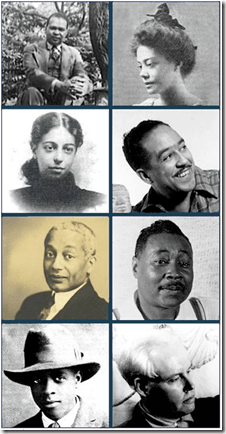 Known also by the names Black Renaissance or New Negro Movement, the Harlem Renaissance represented a cultural movement among African Americans roughly between the end of World War I (1918) and the beginning of the Great Depression (1929). The names given to this movement reveal its essential features. Certainly the words “black” and “Negro” mean that this movement centered on African Americans, and the term “renaissance” indicates that something new was born or, more accurately, that a cultural spirit was reawakened in African American cultural life. Although most historians remember the Harlem Renaissance as a literary movement, in fact, African Americans during the 1920s also made great strides in musical and visual arts, as well as science. Finally, the focus on Harlem—an old Dutch-built neighborhood of New York City—indicates that this “renaissance” was something of an urban phenomenon. In fact, the exciting developments in African American cultural life of the 1920s were not limited to Harlem, but also had roots in other urban communities where black Americans migrated in great numbers: East St. Louis, Illinois; Chicago’s south side; and Washington, D.C. The Harlem Renaissance included several important gay and lesbian writers.
The artists of the Harlem Renaissance forwarded two goals. Like the journalists and other “crusaders” of the Progressive era, black authors tried to point out the injustices of racism in American life. Second, newspaper editors, activists, authors, and other artists began to promote a more unified and positive culture among African Americans. Early efforts to publicize a more unified consciousness among African Americans included two publications in 1919: Robert Kerlin’s collection of editorial material in Voice of the Negro and Emmett Scott’s Letters from Negro Migrants. On the political front, leaders such as Marcus Garvey began to put forth plans for black economic self-sufficiency, political separatism, and the creation of a cross-national African consciousness.  Several important developments during the World War I era gave rise to the Harlem Renaissance. First, black southerners since the turn of the century had been moving in large numbers to the North’s industrial cities. As a result, southern blacks who had been denied their political rights and had resorted to sharecropping as a means of livelihood came into contact with northern African Americans who were more often the descendants of free blacks and, therefore, had better access to education and employment. Additionally, black Americans moving to the cities had much to complain about. World War I, the so-called war to make the world safe for democracy, had been a bitter experience for most African Americans. The U.S. Army was rigidly segregated, race riots broke out in many American cities during or immediately after the war, and the North was residentially and economically segregated like the South, despite the absence of Jim Crow Laws.
Gays, Lesbians and The Harlem Renaissance
The culture of the Harlem Renaissance was one that was open to sexual exploration and gays and lesbians, both Black and White, found a community there. The jazz and blues clubs of Harlem felt like a welcoming place to gays and lesbians of different races. Author Arwyn Moore claims that many white gays and lesbians who frequented Harlem nightlife became a part of the Black culture: listening to the music, reading the literature and most importantly, relating to common prejudice and bigotry both experienced from the greater mainstream culture.
Rent Parties
In addition to the clubs of Harlem, private rent parties became a place where gays and lesbians could dance and socialize without fear of being arrested. Rent parties were private parties that people threw in their apartments to raise  rent. Rent parties became places for gays and lesbians to mingle in relative safety.
Out Blues Musicians
The Blues music that was popular at the time was also an attraction for gays and lesbians. Many of the lyrics spoke of gender-bending men and women, blurring of sexual boundaries and same-sex attraction. One of the most famous Blues singers of that time was Gladys Bentley who was notorious for wearing men’s clothing on stage and for her marriage to another woman.
Ma Rainey was another Black lesbian singer, her famous song begged listeners to “Prove it on Me.” Ma Rainey was said to have had a relationship with bisexual singer Bessie Smith.
Five Years Ago…
 At this moment, five years ago, I sat having brunch with my roommate, not knowing that in the next twelve hours, my world would be turned upside down. We returned home form brunch, she passed out from too many mimosas, and I sat and watched in horror as a hurricane covered the whole Gulf of Mexico. It was coming straight for us and was steadily strengthening. I tried to wake my roommate to see if she wanted to evacuate, but once she had been drinking, not much would wake her until she had recovered. The news from the Weather Channel got increasingly worse. We had to get out of there. Finally, she woke up and realized the same thing.
 I had lived through hurricanes before, nothing though on this magnitude. What most people don’t realize is that living inland an hour or two away from the coast can still be a devastating place. The tidal surge is not as much of a concern for us as is the tornadoes and winds that come with the storm as it makes its way inland. We decided not to wait out the storm and left town, almost too late. The wind and rain had already begun. We took a more rural course to avoid the massive traffic delays. Finally, late into the night, we reached Texas and found a hotel room. There, we were stuck for the next five day, in a town whose cable service refused to have any other news service but Fox News. We watched as the levees broke in New Orleans, hoping to hear reports from home. They didn’t come.
 On Thursday, we decided that it was time to head back home. The closer we got, the more devastation and destruction we saw. Roads were closed due to the number of trees that had fallen and not enough manpower was available to clear them. Other roads that had been opened were closed to most traffic except for relief workers and emergency personnel. The devastation we saw was indescribable, and we weren’t even headed to New Orleans or the Gulf Coast. The most difficult part of the journey was finding a gas station that had both electricity and gas. Most of the stations had run out and did not know when more could be delivered. Most of the other stations had not had electricity restored to them and remained closed.
 Finally, we got near home to see the street next to us with hundreds of pine trees piled up and completely blocking the road. It looked more like a lumber yard than a residential neighborhood. A tornado had landed in our neighborhood. We passed a nearby church, that had been set up as a tent city. Tents were all that many people had left. Food and water was in short supply and everyone was trying to help out. Then we turned on our street. I was wholly unprepared for the sight that was there. The houses around us were largely spared. Our house was barely visible from the pine trees that lay on top of it. Thankfully, it was a sturdy house and the walls had survived. One tree had gone through the roof like an arrow, leaving a hole in the roof that pierced though the air conditioner ducts and and eventually stuck out of the living room. That one tree had done the most damage, for as the rain continued, the water flowed through the air conditioner ducts and out the vents, leaving what looked like waterfall paintings down the walls. The carpet was sopping wet and with the humidity and heat, minus air conditioning, the house felt like a sauna. The hundreds of books in my home office were destroyed with water damage, and most of my clothes were ruined by the same waterfalls that had come through the air conditioner ducts. Those that weren’t destroyed by the water rushing into the house were already beginning to mold from the heat and humidity.
 Suddenly, I had found myself homeless, since the house was utterly unlivable. Family and friends came with trucks, trailers, and extra gas to load up my belongings and take them to a storage unit in the town my parents lived. My life had suddenly been packed away in boxes and put into storage. I would not find another permanent place to live for over a year. During that year, I was forced to live in the schools dorms. It was all that was available. Then, a friend of mine had grandparents with an extra house and they allowed me to live there for the next six months. Finally, things began to settle down and life returned somewhat to normal, but it has been a long process. It is also one of the reasons that I am still in graduate school because certain milestones of my degree process had to be put off for months because of the turmoil caused by Katrina.
 New Orleans is what you hear about most in the news. It was the larges city hit by the disaster and the floods caused by the levees breaking were extremely destructive. What most of the news accounts today are forgetting is that the Mississippi Gulf Coast was what was where the hurricane made landfall. The cities of Bay St. Louis and Waveland were wiped off the map. They have rebuilt but it was a slow and long process. The devastation was so great that the two towns discussed merging and becoming Bayland, because the destruction seemed too insurmountable. They honestly wondered if they could rebuild the cities from the ground up. The cities of Long Beach, Gulfport, and Biloxi were equally devastated. Antebellum homes that had stood for over 100 years, and had survived Hurricane Camille in 1969, were lost forever. Only the foundations remained, nothing else could even be seen of these houses. Two universities were forced to close because of the devastation wrought by the storm. One never did rebuild and chose to concentrate their efforts on their other campus. The other took up residence in an old abandoned hospital while they attempted to rebuild in a new location a few more mile inland.
So as the discussion of Katrina is on the news today, please remember that it was not just New Orleans that suffered. It was the whole Gulf Coast from New Orleans to Pensacola, Florida. Also, remember that the hurricane and its destruction did not end after it made landfall. The destruction continued inland for hundreds of miles. South of Interstate-10 was hit the hardest, but inland the destruction reached all the way to Interstate-20.
Edward II, Queen of England?
 The fourteenth-century English king, Edward I was “afflicted” with a son who did not live up to the manly expectations he had for him; his son, Edward, liked gardening and shoeing horses more than jousting. Modern sensibilities aside, in the world of medieval royalty, such unmanly pursuits were simply unworthy of a future king. To clear up the problem, Edward I (also known as Edward Longshanks, “The Hammer of the Scots”) appointed him a wildly charismatic squire named Piers Gaveston from Gascony. The hope was that this successful, talented young man might rub off on young Edward. The two got on famously. A bit too famously:
…and when the King’s son saw him he fell so much in love that he entered upon an enduring compact with him, and chose and determined to knit an indissoluble bond with him, before all other mortals.
Other chroniclers note that the King feared Gaveston “loved his son inordinately,” that the younger Edward “had an inordinate affection for a certain Gascon knight,” and that the Gascon might find himself in trouble “on account of the undue intimacy which the young Lord Edward had adopted towards him.”
 Before long, the King was looking for excuses to keep the two apart. The youngsters had gotten into trouble by trespassing onto the Bishop of Coventry’s property and poaching the Bishop’s deer, and the King seized upon this incident as an opportunity to separate them for a few months. However, rather than send away the squire, Edward removed his own son (their relationship was, admittedly, chilly). Young Edward was absent from court for the summer of 1305, and Gaveston was left without a playmate.
 The happy pair couldn’t be kept apart forever. Edward returned to court, and before long he was bestowing gifts, titles and land on Gaveston. In one particularly bold move in April of 1307 he asked his father Edward I to make Gaveston the Count of Ponthieu, which was a pretty modest title but did include a fair bit of land. King Edward, who’d spent a lot of his time battling the Scots (and would later leave his son in rather a poor position there), would have none of it:
You baseborn whoreson! Do you want to give lands away now, you who never gained any? As the Lord lives, if it were not for fear of breaking up the kingdom you should never enjoy your inheritance!
King Edward reached forward and grabbed a handful of his son’s hair, and yanked it clean out. Gaveston was banished from England entirely, but Prince Edward followed him out, showering him with tapestries, quilts, assorted other presents and easy money. This banishment only lasted about three months, because Edward I died on July 7. This left Prince Edward, now Edward II, free to indulge himself.
The Reign of Edward II
 As such, the first thing Edward II did was recall Gaveston and appoint the man earl of Cornwall and give him tons of money. Gaveston was also immediately slated to marry Edward’s niece, even though his taste in girls was, well, somewhat questionable. The new king also stripped the bishop of Coventry (he of the poached deer) of his title and imprisoned the bishop in the Tower of London. Things went downhill from there.
At Gaveston’s wedding, Edward called for games and jousting, at which the young groom and his coterie excelled. This tweaked the old baronial guard to no end. Those nobles who enjoyed power during Edward I’s reign were now second-fiddle to the dashing young king, and a newcomer at that. To make matters worse, when out making arrangements for his royal marriage, Edward made Gaveston regent rather than any of the other more experienced, highly-placed barons. Edward had also been efficiently depleting the crown’s coffers by bestowing outrageous gifts on his friend. As contemporary chroniclers wrote,
Our King… was incapable of moderate favor, and on account of [Gaveston] was said to forget himself, and so [Gaveston] was accounted a sorcerer.
When Edward returned with his new bride Isabella, Gaveston met them toting so much jewelry he “quite eclipsed the king.” The king ditched his bride and ran to Gaveston, embracing him tightly, crying, “Brother, brother!” Isabella’s father, King Philip IV of France, had given Edward some fancy jewelry which was found to be hanging on Gaveston’s neck the very next day. This angered many of the nobles, and it was simply bad form for someone else to shows up wearing your wedding presents a few days after the ceremony.
English Nobles and Their Hatred of Gaveston
Several contemporary sources criticized Edward’s seeming infatuation with  Piers Gaveston, to the extent that he ignored and humiliated his wife. Chroniclers called the relationship excessive, immoderate, beyond measure and reason and criticized his desire for wicked and forbidden sex. The Westminster chronicler claimed that Gaveston had led Edward to reject the sweet embraces of his wife; while the Meaux Chronicle (written several decades later) took concern further and complained that, Edward took too much delight in sodomy. While such sources do not, in themselves, prove that Edward and Gaveston were lovers, they at least show that some contemporaries and later writers thought strongly that this might be the case.
Gaveston was considered to be athletic and handsome; he was a few years older than Edward and had seen military service in Flanders before becoming Edward’s close companion. He was known to have a quick, biting wit, and his fortunes continued to ascend as Edward obtained more honors for him, including the Earldom of Cornwall. Earlier, Edward I had attempted to control the situation by exiling Gaveston from England. However, upon the elder king’s death in 1307, Edward II immediately recalled him. Isabella’s marriage to Edward subsequently took place in 1308. Almost immediately, she wrote to her father, Philip the Fair, complaining of Edward’s behavior.
Gaveston the upstart was proving to be such a pain that a group of nobles threatened to boycott the coronation unless he wasn’t allowed to be there. Diplomatic Edward assured them he wouldn’t. Of course, he showed up anyway. Not only did he show up, but he was in the processional line carrying the crown, dressed in royal purple sewn with pearls, “so decked out that he more resembled the god Mars than an ordinary mortal.” Barons scrambled to throw him out or kill him outright, but, with some effort, calmed themselves.
As it turned out, Gaveston had also insisted upon coordinating the entire event, and he flubbed it completely. The ceremony ran over by three full hours and was short of seats, forcing nobility to stand. Standing room in the back was so crowded that a knight was suffocated underfoot. Even with the extra time, the banquet wasn’t ready when it finished. Food was poorly cooked and service was reportedly very poor. The ceremony was a complete disaster, and only because a certain Gascon had worked his way deeply in the king’s favor. It wasn’t long before Queen Isabella, by all accounts a charming, beautiful person, was writing her father that “I am the most wretched of wives,” and that Edward was “an entire stranger in my bed.”
Earls to Swine
Clearly, this situation couldn’t last. An overwhelming majority of barons got together and announced that this had gone far enough, and that Gaveston had to go. To be sure, Edward would not be the first or last English king to  whore around the kingdom but, medieval attitudes towards homosexuality being seen as sinful and blasphemous, something bad was eventually bound to happen. Edward, surrounded by powerful, strong-willed men, capitulated, stripped Gaveston of his titles and land, and sent him off to Ireland. To make sure he wasn’t coming back, the bishops announced that the Gaveston would be excommunicated if he ever set foot back in England. However, before long, he lobbied the pope strongly and got the excommunication threat removed. He returned, and Edward obligingly appointed him to be the earl of Cornwall again. Three years later, the barons again united in disgust and threw Gaveston out. To reign in the king’s expenses they also took over his finances, in his words, “as one would provide for an idiot.”
Gaveston was back before long, associating openly with Edward, who made him earl of Cornwall for the third time. The bishops excommunicated Gaveston; the lords prepared for civil war. The king and his favorite fled to Scotland, hoping to secure safety there, but to no avail. As armies commanded by the Ordainers approached the couple in Newcastle, they fled, leaving behind not only household servants, furniture, and treasure, but Edward’s long-suffering wife Isabella. She was three months pregnant. If nothing else, she enjoyed a modicum of popular support, having been yanked around the country by her husband and his lover and, heavy with child, abandoned to advancing armies.
As the forces got closer to the couple, Edward was forced to dump Gaveston off and tried to stir up support for himself in any number of English cities. It didn’t work; Gaveston was captured by the earl of Pembroke, who promised to deliver him to the king and barons for suitable punishment. However, on the way back, the good Pembroke passed within a few miles of his own castle. He had been away for some time, and took this opportunity to slip by and freshen up the wife. The one night he was gone a renegade group of disgruntled barons swept over Gaveston and ransacked his room. And if they weren’t pissed enough, they found him in possession of some of the crown jewels. Gaveston’s weakness for jewelry and baubles had proved urgent enough for him to convince King Edward to loan them out. While Gaveston’s motives for “borrowing” the crown jewels were probably vanity rather than theft, the presence of such sacred items on his person was more than enough to get him in trouble. He was marched some miles on bare feet and thrown into a nearby dungeon.
To his credit, Pembroke was upset. He didn’t harbor kinder feelings for Gaveston than anybody else, but he had given his word that the prancer would make it back to Edward. He asked a variety of barons and other officials to intervene on his behalf so as not to lose face, but nobody wanted to rescue Gaveston — in the hands of barons, he was truly friendless.
An Untidy End
Finally, one of them took some initiative. Gaveston was marched outside, up a hill, and forced to lie his head on a stump, whereupon it was neatly removed. There was then some consternation about who exactly ought to grab the head and take responsibility for the deed; once that was settled they were stuck with the headless body of Gaveston and had to do something with it. The corpse was carried to the castle of one of Gaveston’s enemies, the earl of Warwick, but he turned it away at the door. It was accepted by some nuns in Oxford, but they couldn’t bury it because Gaveston had died an excommunicate.
While Gavseton had riled up enough nobility to instigate a civil war, his sudden death split their union and the kingdom drifted back to internal squabbling rather than armed conflict. However, Edward was inconsolable: “By God’s Soul, he acted as a fool. If he had taken my advice he would never have fallen into the hands of the earls,” he wept. Fortunately for his troubled  psyche, Isabella gave birth to the future Edward III just in time to distract him. The king cooed over his child. Isabella had been patient with him during this dalliance, and their relationship improved. For a little while, anyway. And then, it soured. Precipitously.
Following Gaveston’s death, the king increased favor to his nephew-by-marriage (who was also Gaveston’s brother-in-law), Hugh Despenser the Younger. But, as with Gaveston, the barons were indignant at the privileges Edward lavished upon the Despenser father and son, especially when the younger Despenser began in 1318 to strive to procure for himself the earldom of Gloucester and its associated lands.
 With Hugh Despenser, the situation grew worse. Edward II made similar mistakes with Despenser and his reign was challenged by the pretender John Deydras. Deydras was eventually executed but not before Edward II’s unpopularity for his actions became even more apparent. Eventually, Despenser was banished, but unlike Gaveston, he was not to return. Queen Isabella had enough, and left Edward II for another lover – Mortimer. Despenser was eventually tracked down and executed – he had his genitals cut off and burnt in a fire before his eyes.
In 1327, Edward II was imprisoned, and Isabella and her lover, Mortimer seized control of the kingdom. After trying to escape, Mortimer eventually ordered Edward’s death.
The government of Isabella and Mortimer was so precarious that they dared not leave the deposed king in the hands of their political enemies. On 3 April, Edward II was removed from Kenilworth and entrusted to the custody of two subordinates of Mortimer, then later imprisoned at Berkeley Castle in Gloucestershire where, it was generally believed, he was murdered by an agent of Isabella and Mortimer on 11 October 1327.
On the night of 11 October while lying on a bed [the king] was suddenly seized and, while a great mattress… weighed him down and suffocated him, a plumber’s iron, heated intensely hot, was introduced through a tube into his anus so that it burned the inner portions beyond the intestines. — Thomas de la Moore.
It was said that the screams of the king were so loud that they could be heard miles away.
Edward III finally asserted his independence. In October 1330, a Parliament was called in Nottingham, just days before Edward’s eighteenth birthday, and Mortimer and Isabella were seized by Edward and his companions from inside Nottingham Castle. In spite of Isabella’s entreaty to her son, “Fair son, have pity on the gentle Mortimer,” Mortimer was conveyed to the Tower.
 Accused of assuming royal power and of various other high misdemeanors, he was condemned without trial and ignominiously hanged at Tyburn on 29 November 1330, his vast estates being forfeited to the crown. Mortimer’s widow, Joan, received a pardon in 1336 and survived till 1356. She was buried beside Mortimer at Wigmore, but the site was later destroyed.
Cultural depictions of Edward II of England
Edward II of England has been portrayed in popular culture a number of times. The most famous fictional account of Edward II’s reign is Christopher Marlowe’s play Edward II (c. 1592). It depicts Edward’s reign as a single narrative, and does not include Bannockburn.
In 1991 English filmmaker Derek Jarman adapted the Christopher Marlowe play into a film featuring Tilda Swinton, Steven Waddington, Andrew Tiernan, Nigel Terry, and Annie Lennox. The film specifically portrays a homosexual relationship between Edward II and Piers Gaveston.
Edward II was portrayed as an effeminate homosexual in Braveheart. Edward II’s death and sexuality are mentioned a number of times in Michael Crichton’s novel Timeline
A major new biography of Edward II by Seymour Phillips was published in 2010.


Authors
Recent Comments
Joe on Pic of the Day noisilycool3bc985058… on Pic of the Day vandycolt on Moment of Zen: Reading noisilycool3bc985058… on Pic of the Day iameverywhere1 on Not Quite as Planned Top Posts & Pages



Amazon Associate

As an Amazon Associate I earn from qualifying purchases. So, if you click on a link that takes you to Amazon.com, I may earn a commission.
Trust me, it isn’t much, but every little bit helps.

 Joe
Joe


 The Closet Professor