Category Archives: Inspiration

Something We All Should Read…

This article has been going around Facebook and being forwarded by email (that is how I first saw it), and I’ve noticed people talking about it, as well, not just forwarding it on.  I think it has an important message, and if you haven’t read it, I hope that you will.

I’m Christian, unless you’re gay.
by DAN PEARCE on NOVEMBER 14, 2011



Today I want to write about something that has bothered me for the better part of a decade. I’ve carved out no fewer than a dozen drafts of this post, all strangely unalike, all ultimately failing to accomplish the job I’ve set out to do. Truth is, I’ve been trying to write it off and on for more than a year now, and the right words have been seemingly impossible to come by.

In the end, and in order to post it, I guess I had to care more about the message than I do about potential backlash. I’m not being facetious when I say that I hope I can get this message across without offending… well… everybody.

What I really hope is that this post will spark and encourage poignant and worthwhile discussion that will lead to some poignant and worthwhile changes in the lives of at least a few people who are hurting.

That being said, I believe some strong words need to be said today.

“God hates fags.” We’ve all seen the signs being waved high in the air by members of the Westboro Baptist church. On TV. In real life. It’s hard not to take notice.

Over the years, I’ve watched seemingly never-ending disgustingness and hatred spill across the media airwaves from those who belong to the organization. For those who don’t know much about that “church,” they have made a seedy name for themselves by doing drastic things like picketing beneath atrocious signs and hosting flagrant anti-gay protests at military funerals.

Almost every person of nearly every religion has no problem loathing and condemning the Westboro Baptist Church and its members, and perhaps with reason. They take freedom of speech far beyond what our founding fathers intended when they fought to give us that right, and they laugh at the rest of the world while they do.

But today I don’t want to talk about those idiots. I want to talk about you. And me.

And my friend who I’ll call Jacob.

Jacob is 27 years old, and guess what… he’s gay.

Not a lot of people know. He lives in a community where being gay is still very “frowned upon.”

I was talking to him on the phone a few weeks ago, telling him about my failed attempts to write this post. He was trying to hold his emotions in, but he eventually became tearful as we deliberated the very problem that this post attempts to discuss.

Before I go on, I feel I must say something one time. Today’s post is not about homosexuality. It’s not about Christians. It’s not about religion. It’s not about politics. It’s about something else altogether. Something greater. Something simpler.

It’s about love.

It’s about kindness.

It’s about friendship

And love, kindness, and friendship are three things that Jacob hasn’t felt in a long time.

I’m thankful he gave me permission to share our conversation with you. It went something like this.

“Jacob, I honestly don’t know how to write it,” I said. “I know what I want to get across, but I can never find the right words.”

“Dan, you need to write it. Don’t give up. I’m telling you, it needs to be said.”

I paused. “You don’t understand. It’s too heated a subject. It’s something people are very emotional and touchy about. I’d be lynched.”

My friend hesitated. “Dan, you are the only friend I have that knows I’m gay. The only freaking one,” he said.

“What do you mean? I know you’ve told other friends.”

That’s when his voice cracked. He began crying.

“Every single person I’ve told has ditched me. They just disappear. They stop calling. They remove me on Facebook. They’re just gone,” he said. “They can’t handle knowing and being friends with a gay person.”

I didn’t know what to say. So I didn’t say anything.

“You don’t know what it’s like, man. You don’t know what it’s like to live here and be gay. You don’t know what it’s like to have freaking nobody. You don’t know what it’s like to have your own parents hate you and try and cover up your existence. I didn’t choose this. I didn’t want this. And I’m so tired of people hating me for it. I can’t take it anymore. I just can’t.”

How do you respond to that?

I wanted to tell him it was all in his head. I knew it wasn’t. I wanted to tell him it would get better and easier. The words would have been hollow and without conviction, and I knew it.

You see, I live in this community too. And I’ve heard the hate. I’ve heard the disgust. I’ve heard the disdain. I’ve heard the gossip. I’ve heard the distrust. I’ve heard the anger. I’ve heard it all, and I’ve heard it tucked and disguised neatly beneath a wrapper of self-righteousness and a blanket of “caring” or “religious” words. I’ve heard it more times than I care to number.

About gay people.

About people who dress differently.

About people who act differently.

About fat people.

About people with drug addictions.

About people who smoke.

About people with addictions to alcohol.

About people with eating disorders.

About people who fall away from their faiths.

About people who aren’t members of the dominant local religion.

About people who have non-traditional piercings.

About people who just look at you or me the wrong way.

I’ve heard it, and I’ve heard it over, and over, and over again.

Hell, in the past (and to some degree in the present) I participated in it. I propagated it. I smugly took part in it. I’ll admit that.

And I did so under the blanketing term “Christian.” I did so believing that my actions were somehow justified because of my beliefs at the time. I did so, actually believing that such appointments were done out of… love.

This isn’t just a Utah phenomenon. I’ve lived outside of this place. I’ve worked outside of this place. It was just as bad in Denver. It was just as bad in California. I see it on blogs. I hear it on television shows and radio programs. I hear it around my own family’s dinner table from time to time. Usually said so passively, so sneakily, and so “righteously.”

From Christians.

From Buddhists.

From Hindus.

From Muslims.

From Jews.

“God hates fags.” “God hates addicts.” “God hates people who shop at Salvation Army.” “God hates people that aren’t just like me.”

People may not be holding up picket signs and marching around in front of television cameras but… come on. Why is it that so many incredible people who have certain struggles, problems, or their own beliefs of what is right and wrong feel so hated? Why do they feel so judged? Why do they feel so… loathed? What undeniable truth must we all eventually admit to ourselves when such is the case?

Now, I’m not religious. I’m also not gay. But I’ll tell you right now that I’ve sought out religion. I’ve looked for what I believe truth to be. For years I studied, trying to find “it”. Every major religion had good selling points. Every major religion, if I rewound far enough, had some pretty incredible base teachings from some pretty incredible individuals.

Check this out, and feel free to correct me if I get this wrong…

According to Christians, Jesus taught a couple of interesting things. First, “love one another.” Second, “He that is without sin among you, let him first cast a stone at her.” (“Her” being a woman who cheated on her man.)

According to Buddhists, Buddha taught a couple of thought-provoking things. First, “Hatred does not cease by hatred, but only by love; this is the eternal rule.” Second, “Holding on to anger is like grasping a hot coal with the intent of throwing it at someone else; you are the one who gets burned.”

According to Hindus, a couple of fascinating teachings come to mind. First, “Do not get angry or harm any living creature, but be compassionate and gentle; show good will to all.” (Krishna) Second, “Love means giving selflessly, excluding none and including all.” (Rama)

According to Muslims, Muhammad taught a couple interesting things as well. First, “A true Muslim is the one who does not defame or abuse others; but the truly righteous becomes a refuge for humankind, their lives and their properties.” Second, “Do you love your creator? Love your fellow-beings first.”

According to Judaism, their scriptures teach a couple remarkable things. First, “Love your neighbor like yourself.” Second, “Examine the contents, not the bottle.”

The greatest spiritual leaders in history have all preached love for others as the basis for all happiness, and never did they accompany such mandates with a list of unlovable actions or deeds. They never said, love everybody except for the gays. Love everybody except for the homeless. Love everybody except for the drug users. Love everybody except for the gang members, or those covered in ink, or the spouse abusers. They didn’t tell us it was okay to love everybody with the exception of the “trailer trash,” those living in poverty, or the illegal immigrants. They didn’t tell us it was okay to love everybody except for our ex-lovers, our lovers’ ex lovers, or our ex-lovers’ lovers. The mandate was pretty damn clear, wasn’t it?

Love others.

Period.

So if this is the founding directive of all the major religions… why is it that sometimes the most “Christlike” people are they who have no religion at all?

Let me repeat that.

Why is it that sometimes the most Christlike people are they who have no religion at all?

I have known a lot of people in my life, and I can tell you this… Some of the ones who understood love better than anyone else were those who the rest of the world had long before measured as lost or gone. Some of the people who were able to look at the dirtiest, the poorest, the gays, the straights, the drug users, those in recovery, the basest of sinners, and those who were just… plain… different…

They were able to look at them all and only see strength. Beauty. Potential. Hope.

And if we boil it down, isn’t that what love actually is?

Don’t get me wrong. I know a lot of incredible Christians, too. I know some incredible Buddhists and Muslims and Hindus and Jews. I know a lot of amazing people, devout in their various religions, who truly love the people around them.

I also know some atheist, agnostic, or religionless people who are absolutely hateful of believers. They loathe their religious counterparts. They love only those who believe (or don’t believe) the same things they do.

In truth, having a religion doesn’t make a person love or not love others. It doesn’t make a person accept or not accept others. It doesn’t make a person befriend or not befriend others.

Being without a religion doesn’t make somebody do or be any of that either.

No, what makes somebody love, accept, and befriend their fellow man is letting go of a need to be better than others.

Nothing else.

I know there are many here who believe that living a homosexual life is a sin.

Okay.

But, what does that have to do with love?

I repeat… what does that have to do with love?

Come on. Don’t we understand? Don’t we get it? To put our arm around someone who is gay, someone who has an addiction, somebody who lives a different lifestyle, someone who is not what we think they should be… doing that has nothing to do with enabling them or accepting what they do as okay by us. It has nothing to do with encouraging them in their practice of what you or I might feel or believe is wrong vs right.

It has everything to do with being a good human being. A good person. A good friend.

That’s all.

To put our arm around somebody who is different. Why is that so hard?

I’m not here to say homosexuality is a sin or isn’t a sin. To be honest, I don’t give a rip. I don’t care. I’m not here to debate whether or not it’s natural or genetic. Again, I… don’t… care. Those debates hold no encumbrance for me.

What I care about is the need so many of us have to shun and loathe others. The need so many of us have to feel better or superior to others. The need some of us have to declare ourselves right and “perfect” all the freaking time and any chance we have.

And for some of us, these are very real needs.

But I will tell you this. All it really is… All any of it really is… is bullying.

Sneaky, hurtful, duplicitous, bullying.

Well, guess what.

There are things we all do or believe that other people consider “sinful.” There are things we all do or believe that other people consider “wrong.” There are things we all do or believe that other people would be disgusted or angered by.

“Yes, but I have the truth!” most people will adamantly declare.

Okay.

Whether you do or not…

I promise you it doesn’t matter what you believe, how strongly you live your beliefs, or how true your beliefs are. Somebody else, somewhere, thinks you are in the wrong. Somebody else, somewhere, thinks your beliefs are senseless or illogical. Somebody else, somewhere, thinks you have it all wrong. In fact, there are a lot of people in this world who do.

We each understand that. We already know that. It’s the world we live in and we’re not naïve. We’re not stupid. We get it.

Yet, we expect and want love anyway. We expect and want understanding. We expect and want tolerance. We expect and want humanity. We expect and want respect for our beliefs, even from those who don’t believe the same things we do. Even from those who think we’re wrong, unwise, or incorrect.

We expect all of that from the people who disagree with us and who disagree with our lifestyles and beliefs because, let’s be honest, nothing we do is actually bad enough to be worthy of disgust, anger, hatred, or cold-shouldering. Right? None of the ways in which we live our lives would warrant such behavior. Right? None of our beliefs are worthy of ugly disdain from others.

Right?

No, we’re all… perfect. Freaking, amazingly, impossibly… perfect.

But the gays… well, shoot.

[sigh]

You know what I think?

Let this sink in for a minute…

I think it doesn’t matter if you or I or anybody else thinks homosexuality is a sin. It doesn’t matter if you or I think anything is a sin. It doesn’t matter if homosexuality is a sin or not. In fact, it doesn’t matter if anything anybody else does is a sin or not.

Because sin is a very personal thing! It always has been and it always will be!

And it has nothing to do with love.

Absolutely nothing.

Disparity and difference have nothing to do with love.

We shouldn’t choose who we will love and who we won’t.

“I’m Christian, unless you’re gay.”

That’s the message we’re sending, you know.

“I’m Christian, unless I’m hotter than you.”

“I’m Christian, unless I’m uglier than you.”

“I’m Christian, unless I found out you cheated on your income taxes.”

“I’m Christian, unless you cut me off in traffic.”

“I’m Christian, unless you fall in love with the person I once fell in love with.”

“I’m Christian, unless you’re that guy who smells like crap on the subway.”

“I’m Christian, unless you’re of a different religion.”

“Oh, but you’re not gay? You’re clean, and well dressed, and you have a job? You look the way I think you should look? You act the way I think you should act? You believe the things I think you should believe? Then I’m definitely a Christian. To you, today, I’m a Christian. You’ve earned it.”

I bet you’ve heard that message coming from others. Maybe you’ve given that message to others.

Either way, I hope we all can agree that we mustn’t live that message. We just shouldn’t.

But many of us do.

And we do it all the time.

For some of us, it might as well be tattooed across our necks and foreheads.

Maybe not in those words, but the message is clear to those who hear and are listening. It’s clear to those who are watching and seeing.

The message has been very clear to my friend Jacob.

“Every single person I’ve told has ditched me. They just disappear. They stop calling. They remove me on Facebook. They’re just gone. They can’t handle knowing and being friends with a gay person.”

“You don’t know what it’s like, man. You don’t know what it’s like to live here and be gay. You don’t know what it’s like to have freaking nobody. You don’t know what it’s like to have your own parents hate you and try and cover up your existence. I didn’t choose this. I didn’t want this. And I’m so tired of people hating me for it. I can’t take it anymore. I just can’t.”

Jacob is a dear friend. He’s my brother. He’s a damn good human being. He’s absolutely incredible.

He’s also gay.

But why does that make any difference at all?

It doesn’t. Not to me.

And I wish with everything inside of me that it didn’t make any difference to others. I wish we didn’t all have to find ways that we’re better than others or more holy and saintly than others in order to feel better about our own messy selves. I wish people wouldn’t cluster entire groups of people together and declare the whole lot unworthy of any love and respect.

But that is the point of such thinking and action, isn’t it? I mean, it’s simpler that way. It makes it easier for us to justify our thoughts, words, and prejudices that way.

All these people become clumped together. And in the process, they all somehow become less than human.

They become unworthy of our love.

And what a great thing it is when that happens, right? I mean, it helps us to free ourselves from the very directives that have been passed down for millennia from the greatest teachers and philosophers in history. It makes our rationalization for hatred, bigotry, and abhorrence so easily justifiable; so maskable.

So right.

It gives us the golden chance to look at ourselves and not be disgusted by what the glass reflects back at us.

Then, sadly and ultimately, it pushes us to that point where we no longer have any sort of arm to put around others at all. We no longer have a hand to offer our fellow human beings. We no longer have a need to.

And why would we?

Why the hell should we?

Unless, of course, we actually want to live what we all so often claim that we “believe.”

My dear friends…

This has to stop. We have to put our ugly picket signs down. We have to be the examples that help make it happen in our own lives and in the lives of the people that surround us.

We have to be that voice. We each must be that voice.

We must tell others that we will not accept or listen to such hurtful and hateful sentiments.

We must show love where love right now doesn’t exist.

Will you please join me?

My request today is simple. Today. Tomorrow. Next week. Find somebody, anybody, that’s different than you. Somebody that has made you feel ill-will or even [gulp…] hateful. Somebody whose life decisions have made you uncomfortable. Somebody who practices a different religion than you do. Somebody who has been lost to addiction. Somebody with a criminal past. Somebody who dresses “below” you. Somebody with disabilities. Somebody who lives an alternative lifestyle. Somebody without a home.

Somebody that you, until now, would always avoid, always look down on, and always be disgusted by.

Reach your arm out and put it around them.

And then, tell them they’re all right. Tell them they have a friend. Tell them you love them.

If you or I wanna make a change in this world, that’s where we’re gonna be able to do it. That’s where we’ll start.

Every. Single. Time.

Because what you’ll find, and I promise you this, is that the more you put your arm around those that you might naturally look down on, the more you will love yourself. And the more you love yourself, the less need you’ll ever have to find fault or be better than others. And the less we all find fault or have a need to be better than others, the quicker this world becomes a far better place to live.

And don’t we all want to live in a better world? Don’t we all want our kids to grow up in a better, less hateful, more beautiful world?

I know I do.

So let’s be that voice. Let’s offer that arm to others. Because, the honest truth is… there’s gonna come a day when you or I are going to need that same courtesy. There’s going to come a day that we are desperate for that same arm to be put around us. We’ll be desperate for that same friendship. We’ll be desperate for that same love.

Life will make sure of it. For you. For me. For everyone.

It always does because… as it turns out… there’s not a damn person on earth who’s perfect.

Dan Pearce, Single Dad Laughing

PS. I would love your comments and thoughts today. More than anything, I’d really like to hear people’s individual struggles. I’d like to hear your struggles. I believe that everybody will benefit as we all share that which hurts us and haunts us.

When have you seen or experienced this? What effects has it had in your life or the lives of others that are close to you? Have you ever seen positive results as people become more loving toward those who are different? How have you felt along the way?

There are those who have struggled because they have been on the receiving end of it. And there are those who have struggled as they work to overcome it. I’ve grappled on both sides.

This message is so important to me; among the most important that this faulted blogger has ever written and because of that I have no hesitation asking you to share it. If it’s important to you, too, please share it. If you believe its message needs to be spread, please share it. Use your voice for that which it was meant.

Use your voice to embolden the world. Use your voice to say, “enough is enough.” Use your voice to stand up and declare that there is no other way besides love.

With all my heart. Please.

SOURCE: I’m Christian, unless you’re gay.


The Golden Rule

550w_gs_trevor_donovan3

In the 4th century BC, the Greek philosopher Plato stated “May I do to others as I would that they should do unto me.” The previous quote is most commonly known in Christianity as the Golden Rule, by other faiths and philosophies it is known as the ethic of reciprocity.  I’ve often talked about the Golden Rule, but I wanted to show how it can apply in our personal lives and relationships.  By following the Golden Rule, we can learn to be better friends and lovers.

The following are ten suggestions for how to put the Golden Rule into effect:

  1. Practice empathy. Make it a habit to try to place yourself in the shoes of another person. Don’t always judge a person by their outward appearance, you might find that they have something tremendous to offer.  Unless you are the picture of absolute perfection, you know that you yourself do not want to be judge by one look.  Get to know the person.  You might find out that you are in love with his mind or his sweet nature or any number of things that could make him your perfect partner.
  2. Practice compassion. Once you can understand another person, and feel what they’re going through, learn to want to end their suffering. And when you can, take even a small action to somehow ease their suffering in some way. Maybe it is as simple as telling your boyfriend that you love him.  Maybe it is giving him a night of pleasure when he really needs a moment to relax.  He may have had a stressful day, well do what you can to relieve that stress.  It may be to leave him alone, or it may be to tell him to lie back as you show him that it can be all about his pleasure.
  3. How would you want to be treated? The Golden Rule doesn’t really mean that you should treat someone else exactly as you’d want them to treat you … it means that you should try to imagine how they want to be treated, and do that. So when you are intimate with a man, think about what would pleasure him.  Don’t just think about what pleases you, though this is usually a good start, but always consider your partner.  He will appreciate it.
  4. Be courteous in bed. When it comes to our own pleasure, we sometimes forget to reciprocate.  Think about being in the 69 position, he is doing something wonderful to you and you concentrate on that instead of what you are doing to him.  My advice is to ride the waves of pleasure but also realize that the more pleasure you are giving to him, the more electric energy is working between you.  Allow your bodies to become in sync with one another and ride each others pleasures.
  5. Listen to others. Another weakness: we all want to talk, but very few of us want to listen. And yet, we all want to be listened to. So take the time to actually listen to another person, rather than just wait your turn to talk. It’ll also go a long way to helping you understand others. This goes along with listening to what he tells you in bed.  His movement, his moans, his reactions, all tell you how much he enjoys what you are doing.  If it looks like he is not enjoying it, try something else or simply ask him how you can improve what you are doing.  Every sexual experience in my life has been a learning experience.  Each time that I am with another man, I reflect on what I could have done better and do it next time.  Communicate with each other.  Don’t be afraid to tell your partner what you want, and make sure that he feels comfortable enough to ask you what he wants. 
  6. Overcome prejudice. We all have our prejudices, whether it’s based on skin color, attractiveness, height, age, gender … it’s human nature, I guess. But try to see each person as an individual human being, with different backgrounds and needs and dreams. And try to see the commonalities between you and that person, despite your differences.
  7. Stop criticism. We all have a tendency to criticize others, whether it’s people we know or people we see on television. However, ask yourself if you would like to be criticized in that person’s situation. The answer is almost always “no”. So hold back your criticism, and instead learn to interact with others in a positive way.
  8. Don’t control others. It’s also rare that people want to be controlled. Trust me. So don’t do it. This is a difficult thing, especially if we are conditioned to control people. But when you get the urge to control, put yourself in that person’s shoes. You would want freedom and autonomy and trust, wouldn’t you? Give that to others then. Now the opposite of this is also true.  Sometimes a man does want to be dominated.  If this is what he wants, dominate him.  All relationships can be made better through communication.
  9. Be the change. Gandhi famously told us to be the change we want to see in the world. Well, we often think of that quote as applying to grand changes, such as poverty and racism and violence. Well, sure, it does apply to those things … but it also applies on a much smaller scale: to all the small interactions between people. Do you want people to treat each other with more compassion and kindness? Then let it start with you. Even if the world doesn’t change, at least you have.
  10. Notice how it makes you feel. Notice how your actions affect others, especially when you start to treat them with kindness, compassion, respect, trust, love. But also notice the change in yourself. Do you feel better about yourself? Happier? More secure? More willing to trust others, now that you trust yourself? These changes come slowly and in small increments, but if you pay attention, you’ll see them.

Many people have criticized the golden rule; George Bernard Shaw once said of the golden rule, “Do not do unto others as you would that they should do unto you. Their tastes may not be the same.” (Maxims for Revolutionists; 1903). “The golden rule is a good standard which is further improved by doing unto others, wherever reasonable, as they want to be done by.” Karl Popper (The Open Society and Its Enemies, Vol. 2) This concept has recently been called “The Platinum Rule” Philosophers, such as Immanuel Kant, Friedrich Nietzsche, and Bertrand Russell, have objected to the rule on a variety of grounds. The most serious among these is its application. How does one know how others want to be treated? The obvious way is to ask them, but this cannot be done if one assumes they have not reached a particular and relevant understanding.  So we should communicate with our friends and lovers.  Tell them what you like, ask them what they like, and you can create a relationship in which both of you will be happy.


The Pumpkin by John Greenleaf Whittier

The Pumpkin
by John Greenleaf Whittier

Oh, greenly and fair in the lands of the sun,
The vines of the gourd and the rich melon run,
And the rock and the tree and the cottage enfold,
With broad leaves all greenness and blossoms all gold,
Like that which o’er Nineveh’s prophet once grew,
While he waited to know that his warning was true,
And longed for the storm-cloud, and listened in vain
For the rush of the whirlwind and red fire-rain.

On the banks of the Xenil the dark Spanish maiden
Comes up with the fruit of the tangled vine laden;
And the Creole of Cuba laughs out to behold
Through orange-leaves shining the broad spheres of gold;
Yet with dearer delight from his home in the North,
On the fields of his harvest the Yankee looks forth,
Where crook-necks are coiling and yellow fruit shines,
And the sun of September melts down on his vines.

Ah! on Thanksgiving day, when from East and from West,
From North and from South comes the pilgrim and guest;
When the gray-haired New Englander sees round his board
The old broken links of affection restored,
When the care-wearied man seeks his mother once more,
And the worn matron smiles where the girl smiled before,
What moistens the lip and what brightens the eye?
What calls back the past, like the rich Pumpkin pie?

Oh, fruit loved of boyhood! the old days recalling,
When wood-grapes were purpling and brown nuts were falling!
When wild, ugly faces we carved in its skin,
Glaring out through the dark with a candle within!
When we laughed round the corn-heap, with hearts all in tune,
Our chair a broad pumpkin,—our lantern the moon,
Telling tales of the fairy who travelled like steam
In a pumpkin-shell coach, with two rats for her team!

Then thanks for thy present! none sweeter or better
E’er smoked from an oven or circled a platter!
Fairer hands never wrought at a pastry more fine,
Brighter eyes never watched o’er its baking, than thine!
And the prayer, which my mouth is too full to express,
Swells my heart that thy shadow may never be less,
That the days of thy lot may be lengthened below,
And the fame of thy worth like a pumpkin-vine grow,
And thy life be as sweet, and its last sunset sky
Golden-tinted and fair as thy own Pumpkin pie!

In the poem “The Pumpkin” by 19th century poet John Greenleaf Whittier, the tradition of Thanksgiving is described as a time of remembrance and return, a celebration of abundance, both of sustenance and of love, at a family gathering. The poet depicts the scene sensually, packing each line with the fruits of a healthy harvest and the warmth of a kitchen sweet from baking. By the end of the poem, the words achieve an almost too-full splendor:

And the prayer, which my mouth is too full to express,
Swells my heart that thy shadow may never be less,
That the days of thy lot may be lengthened below,
And the fame of thy worth like a pumpkin-vine grow…

Having lived on a farm his entire life, Whittier offers his reader the plentiful harvest as a symbol of a productive year, evoking the historical origin of Thanksgiving as the meal held in 1621 by the Wampanoag together with the Pilgrims who settled in Plymouth, Massachusetts; the harvest festival was a shared tradition of both cultures, and the account of a peaceful celebration between the two groups is still the basis for the holiday today. While some of the elements of the story are myths that were consciously exaggerated in the 1890s and early 1900s in the hopes of forging a national identity in the aftermath of the Civil War, the core message of acceptance and commonality still remains for many celebrants.

SOURCES:


Being Thankful

In everyone’s life, at some time, our inner fire goes out. It is then burst into flame by an encounter with another human being. We should all be thankful for those people who rekindle the inner spirit.
Albert Schweitzer
Keep your eyes open to your mercies. The man who forgets to be thankful has fallen asleep in life.
Robert Louis Stevenson
We can always find something to be thankful for, and there may be reasons why we ought to be thankful for even those dispensations which appear dark and frowning.
Albert Barnes
We can be thankful to a friend for a few acres, or a little money; and yet for the freedom and command of the whole earth, and for the great benefits of our being, our life, health, and reason, we look upon ourselves as under no obligation.
Lucius Annaeus Seneca
If a fellow isn’t thankful for what he’s got, he isn’t likely to be thankful for what he’s going to get.
Frank Howard Clark
If you are really thankful, what do you do? You share.
W. Clement Stone
Like Christ said, love thee one another. I learned to do that, and I learned to respect and be appreciative and thankful for what I had.
James Brown
Some people are always grumbling because roses have thorns; I am thankful that thorns have roses.
Alphonse Karr
Thanksgiving is a time when the world gets to see just how blessed and how workable the Christian system is. The emphasis is not on giving or buying, but on being thankful and expressing that appreciation to God and to one another.
John Clayton
The unthankful heart… discovers no mercies; but let the thankful heart sweep through the day and, as the magnet finds the iron, so it will find, in every hour, some heavenly blessings!
Henry Ward Beecher
We have to be thankful considering our number as a family we enjoy very good health generally but you may be sure me and my partner have quite enough to exercise our minds and occupy our attention.
John Hawley
We in the United States should be all the more thankful for the freedom and religious tolerance we enjoy. And we should always remember the lessons learned from the Holocaust, in hopes we stay vigilant against such inhumanity now and in the future.
Charlie Dent

Black and White/Gay and Straight Twins

James (left) and Daniel Kelly, twin brothers.

The two teenage boys sitting on the sofa opposite are different in almost every way. On the left is James: he’s black, he’s gay, he’s gregarious, and he’s academic. He’s taking three A-levels next summer, and wants to go to university. Daniel, sitting beside him, is white. He’s straight, he’s shy, and he didn’t enjoy school at all. He left after taking GCSEs, and hopes that his next move will be an apprenticeship in engineering.

So, given that they are diametrically opposed, there is one truly surprising thing about James and Daniel. They are twins. They were born on 27 March 1993, the sons of Alyson and Errol Kelly, who live in south-east London. And from the start, it was obvious to everyone that they were the complete flipside of identical. “They were chalk and cheese, right from the word go,” says Alyson. “It was hard to believe they were even brothers, let alone twins.”

The boys’ colour was the most obvious, and extraordinary, difference. “When James was born he was the spitting image of Errol, and I remember seeing his curly hair and thinking – he’s just like his dad. It was another two hours before Daniel was born: and what a surprise he was! He was so white and wrinkly, with this curly blond hair.”

It wasn’t the first time nature had shocked Alyson and Errol. Daniel and James were the family’s third set of twins: Errol and Alyson each already had a set with a previous partner. Errol’s first set are fraternal boys, Shane and Luke, who are 21; Alyson’s are identical boys, Charles and Jordan, 20. The only singleton in the house is the couple’s youngest child, and only daughter, 14-year-old Katie. “Apart from her, it’s twin city,” says Alyson. “At least life was made a bit easier by the fact that we always had two of everything.”

But it was clear that having one black and one white twin was going to mark the family out, wherever they went. “We’d go on holiday and people would say, ‘Is that one a friend you brought along?'” says Alyson. For Errol the response of strangers was harder to deal with. “People didn’t believe Daniel was mine,” he says. “They didn’t always say anything, but I could tell it was what they were thinking.”

So how does it happen that a white and a black partner – who would usually produce, as Alyson and Errol did in their other children, black-skinned offspring – have a child who is as white as his mum? I spoke to Dr Jim Wilson, population geneticist at Edinburgh University – and his first question was, “What is Errol’s heritage?” Errol is Jamaican – and that, says Jim, is the basic explanation.

“It wouldn’t really be possible for a black African father and a white mother to have a white child, because the African would carry only black skin gene variants in his DNA, so wouldn’t have any European DNA, with white skin variants, to pass on,” he explains.

“But most Caribbean people, though black-skinned, have European DNA because in the days of slavery, many plantation owners raped female slaves, and so introduced European DNA into the black gene pool.

“The thing about skin colour is that even a bit of African DNA tends to make a person’s skin colour black – so to be white, the child must have inherited more of the father’s European DNA with its white skin variants. Added to the mother’s European DNA, this led to a child with white skin – while his brother, who is black-skinned, inherited more of his father’s African DNA.

“The Caribbean father will have less European DNA than African DNA, so it’s more likely he’ll pass on African DNA – but rarely, and I’ve worked it out to be around one in 500 sets of twins where there’s a couple of this genetic mix, the father will pass on a lot of European DNA to one child and mostly African DNA to the other. The result will be one white child and one black.”

Alyson got used to the comments and the stares, the sniggers about their parentage and the “stupid things people said” when her boys were babies; but then, when Daniel and James went to nursery aged three, the twins’ skin colour plunged the family into controversy. “They were at this very politically correct nursery, and the staff told us that when Daniel drew a picture of himself, he had to make himself look black – because he was mixed-race,” says Alyson. “And I said, that’s ridiculous. Why does Daniel have to draw himself as black, when a white face looks back at him in the mirror?”

After a row with the nursery staff, she gave interviews to her local paper and TV. “I kicked up a fuss, because it really bothered me,” she says. “Daniel had one white parent and one black, so why couldn’t he call himself white? Why does a child who is half-white and half-black have to be black? Especially when his skin colour is quite clearly white! In some ways it made me feel irrelevant – as though my colour didn’t matter. There seemed to be no right for him to be like me.”

Daniel and James are listening politely, but with slight resignation, while their mum relays the story – it is clear that, though they are aware that they are unusual, it is Alyson who is keenest on telling their tale. They don’t remember the nursery incident, they say; but nod their heads as Alyson says she took them both out of it in protest.

Primary school passed without colour being an issue: but, says Alyson, everything changed when they went to secondary school. And at this point the boys, too, add their voices: because the racism they encountered there had a huge effect on them, and on what happened to them next.

It all started well, says Alyson. “The school was almost all-white, so James was unusual. But it wasn’t a problem for James – it was a problem for Daniel.

“The boys were in different classes, so for a while no one realised they were related. Then someone found out, and the story went round that this white boy, Daniel, was actually black, and the evidence was that he had a black twin brother, James, who was right here in the school. And then Daniel started being picked on and it got really ugly and racist, and there were lots of physical attacks. Daniel was only a little kid, and he was being called names and being beaten up by much older children – it was really horrible. We even called the police.”

“I was really bullied,” cuts in Daniel, his face hardening at the memory. “People couldn’t believe James and I were brothers, and they didn’t like the fact that I looked white, but was – as they saw it – black.”

It is interesting that it was the white twin, Daniel, and not the black twin who was on the receiving end of racism – but, though it’s counter-intuitive, Alyson agrees that it betrayed very deep-seated prejudices. “Those kids couldn’t stand the fact that, as they saw it, this white kid was actually black. It was as though they wanted to punish him for daring to call himself white,” she says.

While we are chatting, James and Daniel are sitting at opposite ends of the sofa; they give the impression of being polite around one another, but don’t seem particularly close. As Alyson says, everything about them is chalk and cheese: even their body language is at odds – James moves lightly and delicately, while Daniel moves in a more muscular, masculine way. But when Alyson reaches this stage of their story, you see a glimmer of that age-old solidarity where siblings who keep one another at arm’s length, nonetheless pitch in when one of them is threatened.

“I started to notice how angry Daniel was getting at school, how people were provoking him and how he was getting hurt,” says James. “And when he got pulled in fights, I went in too, to help him. I didn’t want to see my brother being treated like that.” James does not look like a kid who would end up in any fight: but, when his brother was up against it, he weighed in – and, says Alyson, the bruises and cuts they both came home with told their own tale.

It is possible Daniel would not have liked school anyway, but being on the receiving end of racist abuse certainly did not help. “I would have left in year 7 if I could,” he says. “But instead, I left in year 11 – and it felt so good to get away.” He moved to a school that was much more racially mixed, and which his older brothers had attended. “People knew I was Charles and Jordan’s brother, but they were fine about it,” he says.

James, meanwhile, stayed on at the old school. “It was fine in the sixth form – things settled down, and I had never been on the receiving end of much racism,” he says.

But at the same time, he was coming to terms with another major difference from his brother – the fact that he is gay. “I knew from about the age of 15, but I kept it to myself for a while,” he explains. “And then a few months ago, it just seemed like the right time to tell my family. I was most worried about my dad, about what he’d say … but in the end he was fine about it.”

Daniel, too, thought it was fine. “It wasn’t as though it was a big surprise. I’d thought it for a while,” he says. “But I said to him, ‘If anyone starts bullying you about it, I’ll be there to support you.’ After all, James did that for me when I was being bullied. If anyone starts any homophobic stuff against him, I’ll be there to fight them off.”

Like all teenage siblings, there is plenty of joshing among the two of them. “I certainly wouldn’t wear James’s clothes!” says Daniel, laughing. “But if it’s the other way round, he’d wear mine!”

“No I wouldn’t,” shoots back James. “My taste in clothes is way better than yours.”

Alyson says that, initially, James’s coming out was a surprise. “We were like, ‘Woa!'” she says. “My big worry was that he’d think he was different, or special, because he was gay – so we said to him: ‘That’s fine, it’s what you are, but it doesn’t make you any more special than the other children in this family.'” Errol says he was proud of his boy for being open and honest about his feelings. “It’s fine; I’m glad he felt he could tell us,” he says.

But Alyson does admit that, just as she once worried about racist abuse being directed at Daniel, she now worries about homophobic abuse being directed at James. “It’s something you think about from time to time, but the main thing I worry about is him staying safe – I want all of my children to be safe, obviously,” she says.

These days the boys frequent very different social scenes. “A lot of my friends are lesbian or gay, and I go to gay clubs, and they aren’t places where Daniel hangs out,” says James. His big out-of-school interest is cheerleading – while Daniel, whose older half-brothers Shane and Luke are both acrobats, loves tumbling. “It’s something I’ve enjoyed for ages – I love the thrill of it, and I love how it makes me feel,” he says. After leaving school he had a spell as an acrobat on a cruise ship, which is where his older brothers also work, but he didn’t stay long. “I thought it sounded brilliant, but I missed my family too much so I came home,” he says. He has now applied for an apprenticeship, and hopes to make engineering his future.

Occasionally, the twins go out together for the evening. “It’s good fun, because we can be drinking in a bar and someone will come along for a chat who doesn’t know we’re twins. And of course they never suspect and then someone else will say, ‘Hey, do you know James and Daniel are brothers?'” says James. “And people never, ever believe it – they always think it’s a wind-up.”

“Sometimes we even get people who say: ‘I don’t believe you! Prove it!'” says Daniel, laughing. “But we don’t care whether they believe it or not anyway – we know it’s true.”

Alyson says all she wants, like any mum, is for her boys to be happy, and to live lives free from prejudice, so that each can flourish in his own way. “Mind you,” she says with a smile, “I do sometimes find myself wondering, now the children are all getting older, what the future holds. There will be another generation eventually – who will that bring along, I wonder?

“Twins are almost a must, I’d say. But the other big thing is: how many white grandchildren will I have? And how many black?” She throws back her head and laughs, and Errol laughs with her. They’re a straightforward, outspoken family, the Kellys: all they’ve ever wanted for their children is a fair chance in life. And if their youngest twins have made anyone think twice about their preconceptions about race and colour, they don’t mind that in the least. “It’s good to challenge people on race and sexuality and other issues where there’s prejudice,” says Alyson. “If knowing my boys encourages anyone to think a bit more deeply about how we label people, then that’s just great as far as I’m concerned.”

SOURCE: “Black and white twins”, by Joanna Moorhead, The Guardian, Friday 23 September 2011.


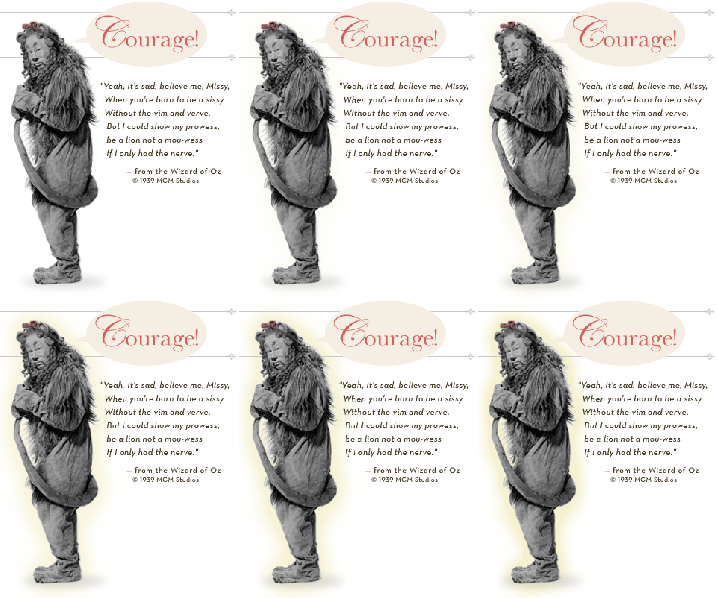
Courage!

Courage! What makes a king out of a slave? Courage! What makes the flag on the mast to wave? Courage! What makes the elephant charge his tusk in the misty mist, or the dusky dusk? What makes the muskrat guard his musk? Courage! What makes the sphinx the seventh wonder? Courage! What makes the dawn come up like thunder? Courage! 

Those are the immortal words of the Cowardly Lion in The Wizard of Oz.  I have always loved the Cowardly Lion, not for his cowardice, but because he not only is a true hero who finds his courage in the end, but also because he is the one character that I have always identified with the most, for his courage.  The Cowardly Lion has been on my mind lately for a few reasons.  It is the time of year that I always show The Wizard of Oz as a way to discuss the Populist Movement in American History. Also, having posted about gay icons during LGBT History Month, I have been reminded of the courage that so many LGBT people have had that help make our lives easier to live.  Furthermore, I was sent a link to the British docu-drama A Very British Sex Scandal (which I plan to write about in a future post).  The docu-drama is about the courage of Peter Wildeblood in helping to decriminalize homosexuality in Britain.

So this week, I want to focus on courage, and the courage that it takes to be a gay person, even in this day and age.  There are still places where homosexuality is still illegal, and in many parts of the United States, gay people are still discriminated against.  I hope that one day it will no longer be an issue and that people can and will be accepted for who they are, and not derided for “what” they are.


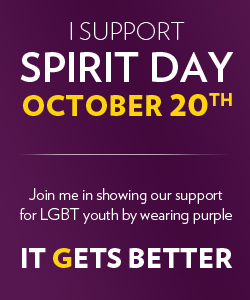
Support LGBT Youth: Wear Purple for Spirit Day

Millions of Americans wear purple on Spirit Day as a sign of support for lesbian, gay, bisexual and transgender (LGBT) youth and to speak out against bullying. Spirit Day was started in 2010 by teenager Brittany McMillan as a response to the young people who had taken their own lives. Observed annually on October 20, individuals, schools, organizations, and corporations, media professionals and celebrities wear purple, which symbolizes spirit on the rainbow flag. Getting involved is easy — participants are asked to simply “go purple” on October 20 as we work to create a world in which LGBT teens are celebrated and accepted for who they are.

Far too many of us have been targeted or mistreated just for being who we are, especially during our youth. We know that one of the worst parts of that experience is feeling alone and isolated, as if no one understands or cares. The motivation for Spirit Day is to conquer this with a very simple gesture.

Let’s send a message to all the young people looking to find acceptance for themselves, their family and friends who are gay, lesbian, bisexual, or transgender. From television studios to school assemblies to storefronts to sporting events: Wear purple on October 20!

The idea of wearing purple as a symbolic gesture came from Brittany McMillan who was moved by the tragic stories of teen suicides in the LGBT community in 2010. She wanted to highlight the color purple, which represents “spirit” in the rainbow pride flag, as a show of hope and resilience. The idea caught on like wildfire. From Hollywood to pep rallies, people were wearing purple in a vivid display of love and support.

We all have been profoundly impacted by these stories and want to send a powerful signal that we collectively value and celebrate the lives of all young people. In a sea of encouraging friends all wearing purple in a massive gesture of unity, it gets much harder to feel alone. Our hope is that this day of solidarity and strength in numbers will be a source of on-going inspiration for young people as they face the inevitable challenges of learning to love themselves for who they are, sometimes in the face of extreme adversity.

Please join me. Let’s do it again with even more creativity and visibility. It doesn’t take much and who doesn’t look good in purple? Help us make it clear that, regardless of the obstacles, young people should always feel surrounded by love and crowds of allies. Wear purple, let your support shine.


A Little Inspiration

Be who you are and say what you feel, because those who mind don’t matter and those who matter don’t mind.

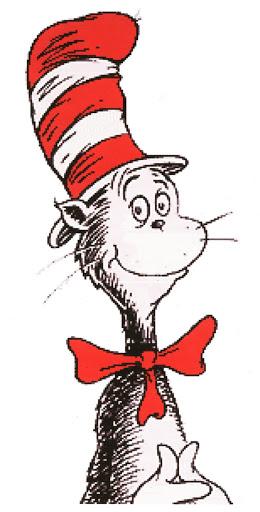
Dr. Seuss


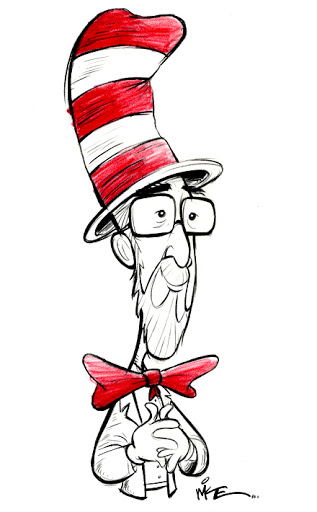
Theodor Seuss Geisel, better known to the world as the beloved Dr. Seuss, was born in 1904 on Howard Street in Springfield, Massachusetts. Ted’s father, Theodor Robert, and grandfather were brewmasters in the city. His mother, Henrietta Seuss Geisel, often soothed her children to sleep by “chanting” rhymes remembered from her youth. Ted credited his mother with both his ability and desire to create the rhymes for which he became so well known.

Although the Geisels enjoyed great financial success for many years, the onset of World War I and Prohibition presented both financial and social challenges for the German immigrants. Nonetheless, the family persevered and again prospered, providing Ted and his sister, Marnie, with happy childhoods.

The influence of Ted’s memories of Springfield can be seen throughout his work. Drawings of Horton the Elephant meandering along streams in the Jungle of Nool, for example, mirror the watercourses in Springfield’s Forest Park from the period. The fanciful truck driven by Sylvester McMonkey McBean in The Sneetches could well be the Knox tractor that young Ted saw on the streets of Springfield. In addition to its name, Ted’s first children’s book, And To Think That I Saw It On Mulberry Street, is filled with Springfield imagery, including a look-alike of Mayor Fordis Parker on the reviewing stand, and police officers riding red motorcycles, the traditional color of Springfield’s famed Indian Motocycles.

Ted left Springfield as a teenager to attend Dartmouth College, where he became editor-in-chief of the Jack-O-Lantern, Dartmouth’s humor magazine. Although his tenure as editor ended prematurely when Ted and his friends were caught throwing a drinking party, which was against the prohibition laws and school policy, he continued to contribute to the magazine, signing his work “Seuss.” This is the first record of the “Seuss” pseudonym, which was both Ted’s middle name and his mother’s maiden name.

To please his father, who wanted him to be a college professor, Ted went on to Oxford University in England after graduation. However, his academic studies bored him, and he decided to tour Europe instead. Oxford did provide him the opportunity to meet a classmate, Helen Palmer, who not only became his first wife, but also a children’s author and book editor.

After returning to the United States, Ted began to pursue a career as a cartoonist. The Saturday Evening Post and other publications published some of his early pieces, but the bulk of Ted’s activity during his early career was devoted to creating advertising campaigns for Standard Oil, which he did for more than 15 years.

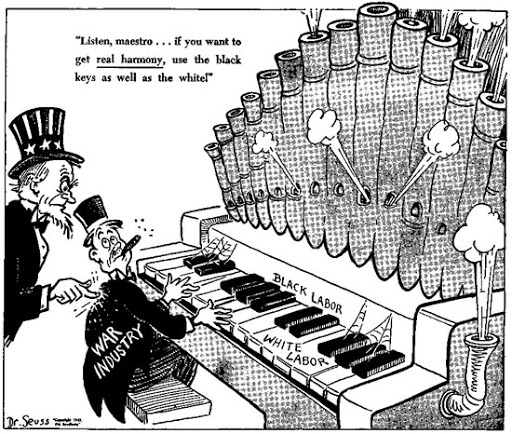
As World War II approached, Ted’s focus shifted, and he began contributing weekly political cartoons to PM magazine, a liberal publication. Too old for the draft, but wanting to contribute to the war effort, Ted served with Frank Capra’s Signal Corps (U.S. Army) making training movies. It was here that he was introduced to the art of animation and developed a series of animated training films featuring a trainee called Private Snafu.

While Ted was continuing to contribute to Life, Vanity Fair, Judge and other magazines, Viking Press offered him a contract to illustrate a collection of children’s sayings called Boners. Although the book was not a commercial success, the illustrations received great reviews, providing Ted with his first “big break” into children’s literature. Getting the first book that he both wrote and illustrated, And to Think That I Saw It on Mulberry Street, published, however, required a great degree of persistence – it was rejected 27 times before being published by Vanguard Press.

The Cat in the Hat, perhaps the defining book of Ted’s career, developed as part of a unique joint venture between Houghton Mifflin (Vanguard Press) and Random House. Houghton Mifflin asked Ted to write and illustrate a children’s primer using only 225 “new-reader” vocabulary words. Because he was under contract to Random House, Random House obtained the trade publication rights, and Houghton Mifflin kept the school rights. With the release of The Cat in the Hat, Ted became the definitive children’s book author and illustrator.

After Ted’s first wife died in 1967, Ted married an old friend, Audrey Stone Geisel, who not only influenced his later books, but now guards his legacy as the president of Dr. Seuss Enterprises.

At the time of his death on September 24, 1991, Ted had written and illustrated 44 children’s books, including such all-time favorites as Green Eggs and Ham, Oh, the Places You’ll Go, Fox in Socks, and How the Grinch Stole Christmas. His books had been translated into more than 15 languages. Over 200 million copies had found their way into homes and hearts around the world.

Besides the books, his works have provided the source for eleven children’s television specials, a Broadway musical and a feature-length motion picture. Other major motion pictures are on the way.

His honors included two Academy awards, two Emmy awards, a Peabody award and the Pulitzer Prize.


Lynn Lavner and Homosexuality

“There are 6 admonishments in the Bible concerning homosexual activity and our enemies are always throwing them up to us usually in a vicious way and very much out of context. What they don’t want us to remember is that there are 362 admonishments in the Bible concerning heterosexual activity. I don’t mean to imply by this that God doesn’t love straight people, only that they seem to require a great deal more supervision.” from Butch Fatale–Lynn Lavner

Lynn Lavner is an American comedian and musician from Brooklyn, New York. Much of her material is based around the facts that she is Jewish and a lesbian. She is frequently billed as “America’s Most Politically Incorrect Entertainer.”

Lavner began her career in 1981 when she wrote the music to the lesbian themed play Ladies! Don’t Spit and Holler!. After a showing of the play a fan came up to her and asked if the soundtrack was available on album. When Lavner told her it wasn’t, the fan, who had recently inherited a large amount of money, offered to put up the money so the soundtrack could be adapted into an album.

Lavner’s musical style harkens back to Tin Pan Alley pop. Lavner lists some of her major influences as George Gershwin, Irving Berlin, and Cole Porter. Lavner initially was inspired to begin playing piano by her father, who played to entertain company.


Philia: Brotherly Love

Let brotherly love continue. Be not forgetful to entertain strangers: for thereby some have entertained angels unawares. Remember them that are in bonds, as bound with them; and them which suffer adversity, as being yourselves also in the body. Marriage is honourable in all, and the bed undefiled: but whoremongers and adulterers God will judge. Let your conversation be without covetousness; and be content with such things as ye have: for he hath said, I will never leave thee, nor forsake thee. So that we may boldly say, The Lord is my helper, and I will not fear what man shall do unto me. Remember them which have the rule over you, who have spoken unto you the word of God: whose faith follow, considering the end of their conversation. Jesus Christ the same yesterday, and to day, and for ever.

Hebrews 13:1-8

We recognize philia and its meaning from the name Philadelphia, that is, the city of brotherly love. This is the love of friendship, best friends, and the fellowship of being with those people you enjoy.

Philia is the Greek word for neighborly love – the bonds of friendship that bind us together in community. Philia can be defined as “the reserve of human warmth, enthusiasm and generosity that nourishes and stimulates the fellowship at the heart of civic life.” By “reserve” I mean that these qualities already exist in our communities; we just need to draw them out. In other words, our communities are inherently resilient. The lens of resilience is fundamental to Philia because it makes us re-examine our assumptions about how individuals and communities function and grow. It reminds us that we are not merely passive recipients in need of outside support and intervention, but have a built-in capacity to heal, adapt, transform and survive.

In contrast to the desiring and passionate yearning of eros, philia entails a fondness and appreciation of the other. For the Greeks, the term philia incorporated not just friendship, but also loyalties to family and polis-one’s political community, job, or discipline. Philia for another may be motivated, as Aristotle explains in the Nicomachean Ethics, Book VIII, for the agent’s sake or for the other’s own sake. The motivational distinctions are derived from love for another because the friendship is wholly useful as in the case of business contacts, or because their character and values are pleasing (with the implication that if those attractive habits change, so too does the friendship), or for the other in who they are in themselves, regardless of one’s interests in the matter. The English concept of friendship roughly captures Aristotle’s notion of philia, as he writes: “things that cause friendship are: doing kindnesses; doing them unasked; and not proclaiming the fact when they are done” (Rhetoric, II. 4, trans. Rhys Roberts).

Aristotle elaborates on the kinds of things we seek in proper friendship, suggesting that the proper basis for philia is objective: those who share our dispositions, who bear no grudges, who seek what we do, who are temperate, and just, who admire us appropriately as we admire them, and so on. Philia could not emanate from those who are quarrelsome, gossips, aggressive in manner and personality, who are unjust, and so on. The best characters, it follows, may produce the best kind of friendship and hence love: indeed, how to be a good character worthy of philia is the theme of the Nicomachaen Ethics. The most rational man is he who would be the happiest, and he, therefore, who is capable of the best form of friendship, which between two “who are good, and alike in virtue” is rare (NE, VIII.4 trans. Ross). We can surmise that love between such equals-Aristotle’s rational and happy men-would be perfect, with circles of diminishing quality for those who are morally removed from the best. He characterizes such love as “a sort of excess of feeling”. (NE, VIII.6)
Friendships of a lesser quality may also be based on the pleasure or utility that is derived from another’s company. A business friendship is based on utility–on mutual reciprocity of similar business interests; once the business is at an end, then the friendship dissolves. This is similar to those friendships based on the pleasure that is derived from the other’s company, which is not a pleasure enjoyed for whom the other person is in himself, but in the flow of pleasure from his actions or humor.

The first condition for the highest form of Aristotelian love is that a man loves himself. Without an egoistic basis, he cannot extend sympathy and affection to others (NE, IX.8). Such self-love is not hedonistic, or glorified, depending on the pursuit of immediate pleasures or the adulation of the crowd, it is instead a reflection of his pursuit of the noble and virtuous, which culminate in the pursuit of the reflective life. Friendship with others is required “since his purpose is to contemplate worthy actions… to live pleasantly… sharing in discussion and thought” as is appropriate for the virtuous man and his friend (NE, IX.9). The morally virtuous man deserves in turn the love of those below him; he is not obliged to give an equal love in return, which implies that the Aristotelian concept of love is elitist or perfectionist: “In all friendships implying inequality the love also should be proportional, i.e. the better should be more loved than he loves.” (NE, VIII, 7,). Reciprocity, although not necessarily equal, is a condition of Aristotelian love and friendship, although parental love can involve a one-sided fondness.

The concept of philia love, or brotherly love, can be analogous to the modern idea of Platonic Love.  Today, when people refer to “Platonic Love” they are referring to an affectionate relationship without sexual intimacy. This is not what Plato meant when referring to love. Plato’s Symposium addresses love and presents various opinions on the subject. A symposium was a banquet, usually accompanied by much wine, but at this particular symposium, the diners chose to remain relatively sober. Likewise, the customary symposium entertainment was sent away. This made the discussion of love the central aspect of the feast. The recounted speech of Diotima is taken to be closest to Plato’s own ideas on love.

The type of love Plato seems to have admired most was that in which one man loved another because of his intelligence or virtue, rather than because of his physical attractions — a love of the idea of beauty more than the physical appearance, and a love of a person is a lesser love to that of absolute beauty, the ideal form.

Platonic love in the modern world can also refer to love between gay men.  I think that we should think of Platonic love and Philia love in the same way.  We should love our fellow man, treat him kindly without expecting something in return.  The beauty of friendship is that you are a friend through thick and thin, which could be described as a Platonic relationship, but the traditional definition of Philia love is a friendship based on conditions.  However, I think that if we think of brotherly love as a love with conditions, then we are doing it an injustice.  We should love our friends unconditionally, and I hope that is what all of us do.

Sources:

Philia from Wikipedia
A Short Handbook on Love
Definition of Philia
Philosophy of Love
Platonic Love

Note:  I debated whether or not to include the Biblical passage above because it comes from Hebrews Chapter 13.  See, I have a bit of a fear of the number “13,” not a major fear, just a wariness.  In other words, I have a slight case of “Triskaidekaphobia.” Triskaidekaphobia (from Greek tris meaning “3”, kai meaning “and”, deka meaning “10” and phobia meaning “fear” or “morbid fear”) is fear of the number 13; it is a superstition and related to a specific fear of Friday the 13th, called paraskevidekatriaphobia or friggatriskaidekaphobia.