Category Archives: Music

Travelin’ Thru

Travelin’ Thru
Lyrics by Dolly Parton

Well I can’t tell you where I’m going, I’m not sure of where I’ve been
But I know I must keep travelin’ till my road comes to an end
I’m out here on my journey, trying to make the most of it
I’m a puzzle, I must figure out where all my pieces fit

Like a poor wayfaring stranger that they speak about in song
I’m just a weary pilgrim trying to find what feels like home
Where that is no one can tell me, am I doomed to ever roam
I’m just travelin’, travelin’, travelin’, I’m just travelin’ on

Questions I have many, answers but a few
But we’re here to learn, the spirit burns, to know the greater truth
We’ve all been crucified and they nailed Jesus to the tree
And when I’m born again, you’re gonna see a change in me

God made me for a reason and nothing is in vain
Redemption comes in many shapes with many kinds of pain
Oh sweet Jesus if you’re listening, keep me ever close to you
As I’m stumblin’, tumblin’, wonderin’, as I’m travelin’ thru

I’m just travelin’, travelin’, travelin’, I’m just travelin’ thru

Oh sometimes the road is rugged, and it’s hard to travel on
But holdin’ to each other, we don’t have to walk alone
When everything is broken, we can mend it if we try
We can make a world of difference, if we want to we can fly

Goodbye little children, goodnight you handsome men
Farewell to all you ladies and to all who knew me when
And I hope I’ll see you down the road, you meant more than I knew
As I was travelin’, travelin’, travelin’, travelin’, travelin’ thru

I’m just travelin’, travelin’, travelin’, I’m just travelin’
Drifting like a floating boat and roaming like the wind
Oh give me some direction lord, let me lean on you
As I’m travelin’, travelin’, travelin’, thru

I’m just travelin’, travelin’, travelin’, I’m just travelin’ thru

Like the poor wayfaring stranger that they speak about in song
I’m just a weary pilgrim trying to find my own way home
Oh sweet Jesus if you’re out there, keep me ever close to you
As I’m travelin’, travelin’, travelin’, as I’m travelin’ thru

When this posts, I will already be in the air and about to land at JFK Airport. I then fly from JFK to Long Beach, which is (by my best calculations, I’m not good with the time changes) a six hour flight. I’ll take my Xanax and be just fine, but ready, oh so ready, to land in Long Beach and get to my hotel.


Let Him In

There’s a Stranger at the door,
Let Him in;
He has been there oft before,
Let Him in;
Let Him in, ere He is gone,
Let Him in, the Holy One,
Jesus Christ, the Father’s Son,
Let Him in.

Open now to Him your heart,
Let Him in;
If you wait He will depart,
Let Him in;
Let Him in, He is your Friend,
He your soul will sure defend,
He will keep you to the end,
Let Him in.

Hear you now His loving voice?
Let Him in;
Now, oh, now make Him your choice,
Let Him in;
He is standing at your door,
Joy to you He will restore,
And His name you will adore,
Let Him in.

Now admit the heav’nly Guest,
Let Him in;
He will make for you a feast,
Let Him in;
He will speak your sins forgiv’n.
And when earth ties all are riv’n,
Comfort, rest, you will be giv’n,
Let Him in.


Leaning on the Everlasting Arms 

The eternal God is your dwelling place, and underneath are the everlasting arms.Deuteronomy 33:27

Leaning on the Everlasting Arms
What a fellowship, what a joy divine,
Leaning on the everlasting arms;
What a blessedness, what a peace is mine,
Leaning on the everlasting arms.
Leaning, leaning, safe and secure from all alarms;
Leaning, leaning, leaning on the everlasting arms.
O how sweet to walk in this pilgrim way,
Leaning on the everlasting arms;
O how bright the path grows from day to day,
Leaning on the everlasting arms.
Leaning, leaning, safe and secure from all alarms;
Leaning, leaning, leaning on the everlasting arms.
What have I to dread, what have I to fear,
Leaning on the everlasting arms;
I have blessed peace with my Lord so near,
Leaning on the everlasting arms.
Leaning, leaning, safe and secure from all alarms;
Leaning, leaning, leaning on the everlasting arms.
Leaning on the Everlasting Arms is a hymn published in 1887 with music by Anthony J. Showalter and lyrics by Showalter and Elisha Hoffman.  Showalter said that he received letters from two of his former pupils saying that their wives had died. When writing letters of consolation, Showalter was inspired by the phrase in the Book of Deuteronomy 33:27.
Isn’t it a great thought to think that God is supporting us, and that His arms are strong enough to hold us during difficult times?  That truth should provide a refuge for us.  In times when relationships disappoint us or finances fail us, it is encouraging to know that there is one who is everlasting and whose arms are there for us to lean on. 
The Apostle Paul tells us about a weakness he had in 2 Corinthians 12.  He referred to it as a thorn in the flesh.  (I have heard of some scholars that speculate that it was homosexuality, since Paul was Greek and his relation to Timothy was thought to be pederastic.  However, this is pure speculation and remains a 2,000 year old mystery.)  Paul prayed that this weakness would be taken away.  He prayed 3 different times, and God chose not to remove the “thorn.”  He then tells us about an important spiritual truth.  If the “thorn” was Paul’s homosexual urges, then I would speculate that God did not remove the thorn because God did not see it as a thorn or a weakness.
Whatever the perceived weakness was, the truth is that God uses our weaknesses, our flaws, and our personal challenges, and does something extraordinary.  He takes His strength and our weaknesses, and He does something awesome with that combination.  He allows us, in weakness, to share in His glory and power.  Paul then makes the following statement “Therefore I will boast all the more gladly about my weaknesses, so that Christ’s power may rest on me. That is why, for Christ’s sake, I delight in weaknesses, in insults, in hardships, in persecutions, in difficulties. For when I am weak, then I am strong.”  What an amazing statement!  Delight in weaknesses? insults? hardships? persecutions? and difficulties?  To be honest, I struggle with having that kind of mindset, even though I know it is truth.
Sources:

Stepping in the Light

For to this you have been called, because Christ also suffered for you, leaving you an example, so that you might follow in his steps.1 Peter 2:21

Last Sunday, I visited this wonderful used book store. There I found the 1894 edition of “Pentecostal Hymns.” Below is one of the songs from that hymnal and a song that we still sing today. May we all try to walk in the steps of the Savior.

Stepping in the Light
Eliza E. Hewitt, pub.1890

Trying to walk in the steps of the Savior,
Trying to follow our Savior and King;
Shaping our lives by His blessed example,
Happy, how happy, the songs that we bring.

Refrain:
How beautiful to walk in the steps of the Savior,
Stepping in the light, stepping in the light,
How beautiful to walk in the steps of the Savior,
Led in paths of light.

Pressing more closely to Him Who is leading,
When we are tempted to turn from the way;
Trusting the arm that is strong to defend us,
Happy, how happy, our praises each day.

Walking in footsteps of gentle forbearance,
Footsteps of faithfulness, mercy, and love,
Looking to Him for the grace freely promised,
Happy, how happy, our journey above.

Trying to walk in the steps of the Savior,
Upward, still upward, we follow our Guide;
When we shall see Him, “the King in His beauty,”
Happy, how happy, our place at His side.


Dancing Queen

Dancing Queen
ABBA

You can dance, you can jive, having the time of your life
See that girl, watch that scene, digging the Dancing Queen

Friday night and the lights are low
Looking out for the place to go
Where they play the right music, getting in the swing
You come in to look for a king
Anybody could be that guy
Night is young and the music’s high
With a bit of rock music, everything is fine
You’re in the mood for a dance
And when you get the chance…

You are the Dancing Queen, young and sweet, only seventeen
Dancing Queen, feel the beat from the tambourine
You can dance, you can jive, having the time of your life
See that girl, watch that scene, digging the Dancing Queen

You’re a teaser, you turn ’em on
Leave them burning and then you’re gone
Looking out for another, anyone will do
You’re in the mood for a dance
And when you get the chance…

You are the Dancing Queen, young and sweet, only seventeen
Dancing Queen, feel the beat from the tambourine
You can dance, you can jive, having the time of your life
See that girl, watch that scene, digging the Dancing Queen

I love ABBA. You can always sing along to their music. Since the release of “Dancing Queen,” it has been adopted by the LGBT community, and remains one of the most ubiquitous “gay anthems.” I had a host of gay anthems I could have chosen from, including “Born This Way” by Lady Gaga, or a classic like “Somewhere Over the Rainbow” sung by Judy Garland, but since I’d chosen three disco songs, I chose to stick with disco.

In the early hours of June 28, 1969, forty-seven years ago today, riots broke out at the Stonewall Inn in New York City. If you don’t know much about the Stonewall Riots or you just want to refresh you memory, click on this link (STONEWALL) and you’ll be taken to a series of blog posts that emerged from a paper I once wrote on the subject. We’ve come a very long way since 1969.


Y.M.C.A.


Y.M.C.A.

The Village People
Young man, there’s no need to feel down.
I said, young man, pick yourself off the ground.
I said, young man, ’cause you’re in a new town
There’s no need to be unhappy.

Young man, there’s a place you can go.
I said, young man, when you’re short on your dough.
You can stay there, and I’m sure you will find
Many ways to have a good time.

It’s fun to stay at the Y.M.C.A.

They have everything for you men to enjoy,
You can hang out with all the boys…

It’s fun to stay at the Y.M.C.A.

You can get yourself clean, you can have a good meal,
You can do whatever you feel…

Young man, are you listening to me?
I said, young man, what do you want to be?
I said, young man, you can make real your dreams.
But you got to know this one thing!

No man does it all by himself.
I said, young man, put your pride on the shelf,
And just go there, to the Y.M.C.A.
I’m sure they can help you today.

It’s fun to stay at the Y.M.C.A.

They have everything for you men to enjoy,
You can hang out with all the boys…

It’s fun to stay at the Y.M.C.A.

You can get yourself clean, you can have a good meal,
You can do whatever you feel…

Young man, I was once in your shoes.
I said, I was down and out with the blues.
I felt no man cared if I were alive.
I felt the whole world was so jive…

That’s when someone came up to me,
And said, young man, take a walk up the street.
There’s a place there called the Y.M.C.A.
They can start you back on your way.

It’s fun to stay at the Y.M.C.A.

They have everything for you men to enjoy,
You can hang out with all the boys…

Y.M.C.A…you’ll find it at the Y.M.C.A.

Young man, young man, there’s no need to feel down.
Young man, young man, get yourself off the ground.

Y.M.C.A…you’ll find it at the Y.M.C.A.

Young man, young man, there’s no need to feel down.
Young man, young man, get yourself off the ground.

Y.M.C.A…just go to the Y.M.C.A.

Young man, young man, are you listening to me?
Young man, young man, what do you wanna be?

Y.M.C.A.” (An Oral History)

America’s favorite ballpark sing-along is actually (gasp!) a disco anthem about gay sex. Or is it? On the 30th anniversary of the Village People smash, we get the full story from the folks who know best: the cowboy, the construction worker…

Jeff Pearlman // May 27, 2008

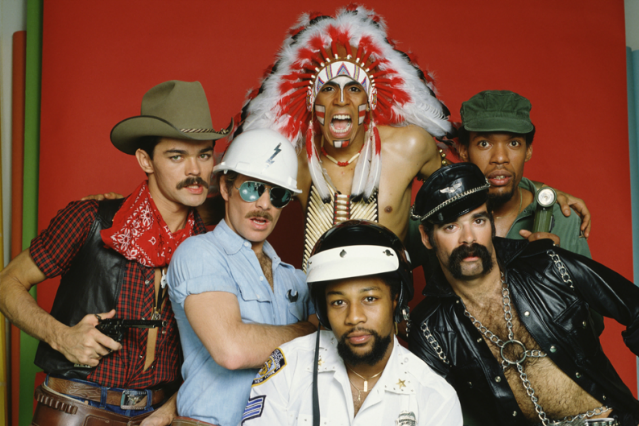
Henri Belolo (music producer, from a 2000 interview with disco-disco.com): [In 1975] I was talking to the gay community about what they liked, what they wanted to listen to musically, and what was their dream, their fantasy. One day [producer Jacques Morali and I] were walking in the streets of New York. I remember clearly it was down in the Village, and we saw an Indian walking down the street and heard the bells on his feet. We followed him into a bar.He was a bartender — he was serving and also dancing on the bar. And while we were watching him dancing and sipping our beer, we saw a cowboy watching him dance. And Jacques and I suddenly had the same idea. We said, “My God, look at those characters. “So we started to fantasize about what were the characters of America.The mix, you know, of the American man…And we named it the Village People.

The pair placed an ad that called for MACHO TYPES WITH MUSTACHE, eventually filling the roles of cowboy, cop, construction worker, soldier, leather-clad biker, and Indian. David Hodo, a 28-year-old struggling singer and actor, responded immediately.

David Hodo:I had just finished a musical about the Grand Ole Opry, and I had a mustache. It was Christmastime, and I needed money. They wanted a cowboy, and I had just finished a western — perfect. But when they said they wanted me to be the construction worker, that was my dad’s dream come true. I’m handy, but I’ve never built anything of consequence.

Victor Willis, who had starred in one of the original productions of The Wiz, would be the lead singer, a cop. A toll collector named Glenn Hughes was the leatherman. Alex Briley originally dressed as a sailor (but switched to a Navy ensign’s uniform when performing the group’s 1979’s hit “In the Navy”). Dancer Felipe Rose, born to a Lakota Sioux father, was, naturally, the Indian. Randy Jones, a singer raised on a North Carolina farm, became the cowboy.

Morali had sold hit-churning label Casablanca (home to Donna Summer and Kiss) on the concept of this boy band even before the roles were cast. The group’s first album, 1977’s Village People, featured the disco hit “San Francisco (You’ve Got Me). “The title track of the following year’s Macho Man debuted (and peaked) at No. 25 on the charts but later became a gay touchstone.

Randy Jones: Something just clicked with us. We had that spark. Victor was a terrific singer: He had the style of Teddy Pendergrass. He was married to Phylicia Rashad. But we didn’t start as a gay group, and not everyone in the group was gay — that’s an incorrect notion. So much of our music was played in black, Latin, and gay underground clubs; that’s’ where the first Village People album found its initial audience.

Hodo: It was 1977, and we were leaving a photography session on 23rd Street. Jacques Morali saw the big pink YMCA on 23rd and asked, “What is this YMCA, anyway? “And after laughing at his accent, we told him the Y was a place where you could go when you first came to New York when you didn’t have any money — you can stay there for very little. And of course, someone joked, “Yeah, but don’t bend over in the showers. “And Jacques, bless his heart, said, “I will write a song about this!”

Jones: David’s a little off. Yeah, Jacques came up with the idea. But what happened is that when I moved to New York in 1975, I joined the McBurney YMCA on 23rd Street. I took Jacques there three or four times in 1977, and he loved it. He was fascinated by a place where a person could work out with weights, play basketball, swim, take classes, and get a room. Plus, with Jacques being gay, I had a lot of friends I worked out with who were in the adult-film industry, and he was impressed by meeting people he had seen in the videos and magazines. Those visits with me planted a seed in him, and that’s how he got the idea for “Y.M.C.A.” — by literally going to the YMCA.

Hodo: We had finished our [third] album, Cruisin’, and we needed one more song as a filler. Jacques wrote “Y.M.C.A.” in about 20 minutes — the melody, the chorus, the outline. Then he gave it to Victor Willis and said, “Fill in the rest.” I was a bit skeptical about some of our hits, but the minute I heard “Y.M.C.A.,” I knew we had something special. Because it sounded like a commercial. And everyone likes commercials.

Jones: It was not intended as a gay anthem. Do you have the lyrics in front of you? There’s nothing gay about them. I think Victor wrote the words, but it’s all a big fucking mystery. The guy who really deserves the credit is Horace Ott, who arranged the horns and strings. Jacques had the ideas, but Horace transformed them into songs.

Horace Ott: What I loved about “Y.M.C.A.” was, to be honest, everything. Great beat, great voice with Victor, great timing in the midst of the disco boom. Now, was it a gay song? I don’t know. It certainly appealed to a lot of people who embraced that lifestyle.

Hodo: “Y.M.C.A.” certainly has a gay origin. That’s what Jacques was thinking when he wrote it, because our first album [1977’s Village People] was possibly the gayest album ever. I mean, look at us. We were a gay group. So was the song written to celebrate gay men at the YMCA? Yes. Absolutely. And gay people love it.

Leah Pouw (media relations manager, Young Men’s Christian Association): We at the YMCA celebrate the song. It’s a positive statement about the YMCA and what we offer to people all around the world.

The song’s undeniable, jinglelike hook made it a natural candidate for a single; it debuted on the Billboard Hot 100 chart on November 11, 1978, and peaked 13 weeks later at No. 2. On January 6, 1979, the Village People appeared on Dick Clark’s American Bandstand, TV’s biggest pop-music showcase.

Jones: We were flying up from South America for the show, and we worked on the choreography on the airplane — handclaps, turning, marching in place…stuff like that. Well, the audience at this particular taping was a bunch of kids bused in from a cheerleader camp. The first time we got to the chorus, we were clapping our hands above our heads. And the kids thought it looked like we were making a Y. So they automatically did the letters. We saw this and started doing letters with them. It was purely audience-generated, which is probably why it’s still so popular. And that’s great for me, because it keeps the checks coming in every six months.

Hodo: When I saw the movements, I thought, “Wow, that is so stupid.” Then everyone in America started doing it, and I thought, “Wow, that is so brilliant.” It took on a life of its own. The next thing we know, Hideki Saijo has the No. 1 hit in Japan with his ver- sion of “Y.M.C.A.” And we hit No. 2 [in the U.S.]. That’s how it always works. Saijo claimed to have invented the dance, so as soon as we got to Japan, we straightened him out.

“Y.M.C.A.” spent 26 weeks on Billboard’s top 100 (during which time the actual YMCA threatened to sue the band before dropping the lawsuit), but due largely to egos and personality clashes, the Village People quickly crumbled. Willis left the band in 1979, just before they were to start work on the feature film Can’t Stop the Music. He was replaced by Ray Simpson, one of the group’s backup singers and the brother of Ashford & Simpson’s Valerie Simpson. The movie (starring Steve Guttenberg as “Jack Morell” and ex-Olympian Bruce Jenner) bombed, as did the soundtrack album.

Three more studio albums came and went with barely a whimper; Willis returned briefly to contribute to 1982’s Fox on the Box. He also recorded an unreleased solo album and struggled with substance abuse. By the end of ’85, the Village People — who eventually sold a reported 65 million albums — gave up.

Jones: I left for the first time in ’81, when the group went in a different direction. But I kept getting royalties. Then I was the only one doing any kind of performing. [When the group broke up], Glenn was working in a camera store, David was a bartender, Alex was working in an office, Felipe was a secretary. It was sad — these were talented men who were once atop the world and deserved a chance to continue their craft.

The Village People regrouped in 1987, but not to record new material. They were proudly and officially a nostalgia act, available for weddings, bar mitzvahs, and corporate events.

Hodo: Bar mitzvahs used to be our bread and butter, everywhere from the Pierre Hotel to backyards. But we haven’t played one in five or six years, because now the parents grew up in the ’80s, not the ’70s. REO Speedwagon does bar mitzvahs instead of us.

Roger Bennett (coauthor, Bar Mitzvah Disco): “Y.M.C.A.” is the single most important song to hit the Jewish religion since “Hava Nagila.” And paradoxically, not one of the Village People is Jewish. But they did play a critical function, providing a slew of new role models for Jewish youth. We were under such pressure to become bankers, accountants, and lawyers. They opened our eyes to other career possibilities: a cop, a builder, a flamboyant Indian…

In February 1996, five years after Morali’s death from AIDS, a onetime aspiring priest from Tampa, Florida, the son-in-law of Yankees owner George Steinbrenner, changed everything.

Joseph Malloy (former general partner, New York Yankees): It was the opening of Legends Field, our spring-training stadium in Tampa, and a couple of the grounds crew guys approached me with the idea of bringing a little excitement to the exhibition games. In the middle of the fifth inning, when they dragged the infield, the guys wanted to do the arm motions to “Y.M.C.A.” I hadn’t heard the song for a long, long time, but the crowd absolutely loved it. I thought, “Hmmm, this might work in New York.”

On April 9, 1996, the Yankees opened at home against the Kansas City Royals. With a driving snowstorm battering players and fans alike, five Yankee Stadium groundskeepers began their customary walk to clean the infield in the middle of the fifth inning. Then, from the speakers, a familiar horn riff and disco beat kicked in.

Juan Gonzalez (from his New York Daily News column, October 29, 1996): They began to dance, strut, and gyrate around second base while they dragged the field. The capacity crowd roared with approving laughter. We all cheered and applauded, and for a moment we all felt a little warmer inside. It was baseball poking fun at itself, reminding us all that this huge, multibillion-dollar, cutthroat business is, after all, about people having a good time.

Molloy: I remember looking at [Yankees] Wade Boggs and Derek Jeter and seeing them swaying to the music. When those grounds crew guys dropped their rakes and performed, you had to watch. From the owner’s box, I would do the Y-M-C-A motions with the crowd. I should have trademarked it.

Michael Musto (columnist, The Village Voice): “Y.M.C.A.” is one of many cultural phenomena that started as a gay in-joke and eventually became stripped of its winkiness and subsumed by the mainstream. Back in the ’70s, the masses did those crazy hand gestures along with the song, truly thinking it was an upbeat number about how nice the Y is, but at least the sophisticated crowd was plugged into the real meaning. The Studio 54 set knew full well the Village People were a campy assortment of gay stereotypes nodding to the gays with coded sexual allusions and macho posturing.

Molloy: “Y.M.C.A.” is about homosexuality? I had no idea until this very moment. Wow! Well, it’s a great song that makes people feel good. That’s what’s important.

Not long after Yankee Stadium made “Y.M.C.A.” a fifth-inning staple (which is still being done 12 seasons later), other teams took notice. Also in ’96, the Oakland Coliseum was undergoing a $200 million renovation. As an A’s batter stood at the plate, trying to concentrate while, say, Randy Johnson unleashed a 97-mph inside fastball, the noise from bulldozers and jackhammers filled the air.

David Rinetti (vice president of stadium operations, Oakland A’s): We wanted to do something cool to make the most of a terrible time. So we dressed two guys up as construction workers and sent them out to the construction site. Then we’d have two of our security guards go out there and pretend to tell them to stop making so much noise. Everyone [in the crowd] believed it — then “Y.M.C.A.” would come on and the four of them would break out into dance. One of our security guards was a guy named Icebox who played in the local roller-derby league. He was a huge man, and when he danced…

Robert “Icebox” Smith (Oakland Coliseum security guard): I tore that place up. The A’s weren’t so hot that year, but we brought that house down every single night. It was magical. We were on ESPN for weeks. It was a gay song?

Fans ate it up — some even came dressed as the characters. Teams would host Village People Nights, capped off by postgame concerts — often by the Village People themselves.

Dr. Costas Karageorghis (sports psychologist, London’s Brunel University): When you think of using music to engage a crowd and increase cohesion, “Y.M.C.A.” is the perfect track. It turns a group of individuals into a unit, just like the wave, simply because of a common action. I haven’t heard it played at rugby, though — probably too butch.

Kyle Smith (director of stadium operations, Brevard County Manatees): There are a handful of songs that just make you get up and dance. At our ballpark, “Y.M.C.A.” has to be considered one of them. “Y.M.C.A.” is a gaysong? Honestly, I had no clue.

Cameron Harris (Wally the Warthog mascot, Winston-Salem Warthogs): I’m the only mascot I know who does the whole Y-M-C-A hand gesture thing while standing on his head. As soon as the first beats come out of the speakers, everyone in the stands is asking, “Where’s Wally? Where’s that wild Wally?” Not sure what you mean about it being a gay song…. I know the Y is a healthy place to exercise.

Musto: All these years later, the gay subtext is gone, and it’s a rah-rah crowd-pleaser for the baseball stadium crowd. It happens. A rallying song for the oppressed turns into a middle-of-the-road spirit-lifter, mainly because the straights like to steal things from the gays, take away all the scary edge, and make it their own.

Tim Wiles (director of research, Baseball Hall of Fame): The song is not alone in coming way out of left field. [Ramones’ “Blitzkrieg Bop”] is played in a lot of ball parks, and someone said to me once, “If Joey Ramone knew this was being played at games, he’d roll over in his grave.”

Brian Johnson (former major-league catcher): I’m not sure you can have a game without playing “Y.M.C.A.” The funny thing is, every ballplayer I know has heard the song a thousand times, but how many of them know it has to do with gay men at the Y? One percent, maybe? But that’s baseball players — not the most informed when it comes to music.

Brandon McCarthy (pitcher, Texas Rangers): I have no idea how “Y.M.C.A.” got popular or how it has remained so. If I had earplugs, I’d put them in every time that song came on.

J.P. Howell (pitcher, Tampa Bay Rays): I hate “Y.M.C.A.” I’ve been over it since I first heard it.

Jones: We made a mark in pop music but an even deeper impression in pop culture. People remember Donna Summer, Kiss, the Bee Gees, but they didn’t have the same impact on pop culture that the Village People did.

Belolo (from disco-disco.com): In life, you discover that an invention is not always one man or two men; it’s a combination of people putting their love together. “Y.M.C.A.” became a standard that will stay forever.

Hodo: The real genius of “Y.M.C.A.” is that it can be taken any way you want. We were once on a television show in England, and the hostess said, “Now, this is a gay song, isn’t it?” And I said, “No, actually it’s a Christian song — the Young Men’s Christian Association. “I mean, honey, isn’t it obvious?

Source: http://www.spin.com/2008/05/ymca-oral-history/


We Will Survive 

I Will Survive

Gloria Gaynor

At first I was afraid, I was petrified
Kept thinking I could never live without you by my side
But then I spent so many nights thinking how you did me wrong
And I grew strong
And I learned how to get along
And so you’re back
From outer space
I just walked in to find you here with that sad look upon your face
I should have changed that stupid lock, I should have made you leave your key
If I’d known for just one second you’d be back to bother me
Go on now, go, walk out the door
Just turn around now
‘Cause you’re not welcome anymore
Weren’t you the one who tried to hurt me with goodbye
Do you think I’d crumble
Did you think I’d lay down and die?

Oh no, not I, I will survive
Oh, as long as I know how to love, I know I’ll stay alive
I’ve got all my life to live
And I’ve got all my love to give and I’ll survive
I will survive, hey, hey1

It took all the strength I had not to fall apart
Kept trying hard to mend the pieces of my broken heart
And I spent oh-so many nights just feeling sorry for myself
I used to cry
But now I hold my head up high and you see me
Somebody new
I’m not that chained-up little person and still in love with you
And so you felt like dropping in and just expect me to be free
Well, now I’m saving all my lovin’ for someone who’s loving me
Go on now, go, walk out the door
Just turn around now
‘Cause you’re not welcome anymore
Weren’t you the one who tried to break me with goodbye
Do you think I’d crumble
Did you think I’d lay down and die?

Oh no, not I, I will survive
Oh, as long as I know how to love, I know I’ll stay alive
I’ve got all my life to live
And I’ve got all my love to give and I’ll survive
I will survive

Oh
Go on now, go, walk out the door
Just turn around now
‘Cause you’re not welcome anymore
Weren’t you the one who tried to break me with goodbye
Do you think I’d crumble
Did you think I’d lay down and die?

Oh no, not I, I will survive
Oh, as long as I know how to love, I know I’ll stay alive
I’ve got all my life to live
And I’ve got all my love to give and I’ll survive
I will survive
I will survive

We will survive. I feel for those who lost loved ones in the tragedy in Orlando. I know how hard it can be to lose someone you love. But we will survive. We will survive as individuals. We will survive as a community. We will survive as a country. We will survive.

When writing about the song in her book We Will Survive, Gloria Gaynor wrote, “I wanted everybody—including myself—to believe that we could survive.” “I Will Survive” had a particularly large influence within the LGBT community at the time of its release. This was mostly attributed to the lack of acceptance of LGBT individuals at the time. Because of this, the song is often referred to as the Queer Anthem. The LGBT community is said to have identified with “I Will Survive” because the textual message of defiant and enduring presence was already well tailored to queer identification needs, but this message and the song’s titular statement took on even deeper meaning with the dawn of the AIDS epidemic in the 1980s.

Since this is Pride Month, I had chosen to use various gay anthems for the poetry this month. Originally, “I Will Survive” was meant to be the last in the series, but in the wake of the tragedy in Orlando, I decided to use it this week instead because we will survive this tragedy.


I’m Coming Out 

I’m Coming Out (Original CHIC Mix)
Diana Ross

I’m coming out
I’m coming
I’m coming out

I’m coming out
I want the world to know
Got to let it show
I’m coming out
I want the world to know
I got to let it show

There’s a new me coming out
And I just had to live
And I want to give
I’m completely positive
I think this time around
I am gonna do it
Like you never do it
Like you never knew it
Oh, I’ll make it through

The time has come for me
To break out of the shell
I have to shout
That I’m coming out

I’m coming out
I want the world to know
Got to let it show
I’m coming out
I want the world to know
I got to let it show
I’m coming out
I want the world to know
Got to let it show
I’m coming out
I want the world to know
I got to let it show

I’ve got to show the world
All that I want to be
And all my billities
There’s so much more to me
Somehow, I have to make them
Just understand
I got it well in hand
And, oh, how I’ve planned
I’m spreadin’ love
There’s no need to fear
And I just feel so glad
Every time I hear

I’m coming out
I want the world to know
Got to let it show
I’m coming out
I want the world to know
I got to let it show

From Wikipedia:

In 1979, Diana Ross commissioned Chic founders Nile Rodgers and Bernard Edwards to create material for a new album after taking her daughters to see the band in concert, following the success of Ross’s final Ashford & Simpson-composed and produced LP, The Boss. Rodgers got the idea for “I’m Coming Out” after noticing three different drag queens dressed as Diana Ross at a New York club called the GG Barnum Room. The lyrics hold an additional meaning to Ross, as she was leaving Motown Records and “coming out” from under Berry Gordy’s thumb.

“I’m Coming Out” still stands as an anthem for the gay community. The way it is perceived and its queer significance is to celebrate who you are. It refers to coming out as lesbian, gay, bisexual, transgender, or queer. Queers who had not revealed their sexuality had shut out a part of their identity. Most would find it safer to pretend that they are heterosexual rather than reveal their true sexual orientation. Queer individuals use this phrase to express that their identity is real. It is used over other phrases because it most closely describes the process of coming out from hiding who one is and exposing to the world that they are proud of who they are.


Amazing Grace

Amazing Grace
John Newton, 1779

Amazing grace! How sweet the sound
That saved a wretch like me!
I once was lost, but now am found;
Was blind, but now I see.

’Twas grace that taught my heart to fear,
And grace my fears relieved;
How precious did that grace appear
The hour I first believed.

Through many dangers, toils and snares,
I have already come;
’Tis grace hath brought me safe thus far,
And grace will lead me home.

When we’ve been there ten thousand years,
Bright shining as the sun,
We’ve no less days to sing God’s praise
Than when we’d first begun.

John Newton wrote the words from his own personal experiences of “dangers, toils and snares.” He grew up without any particular religious conviction, but his life’s path was formed by a variety of twists and turns that were often put into motion by his disdain for authority. He was conscripted into service in the Royal Navy, and after leaving the service, he became involved in the Atlantic slave trade. In 1748, a violent storm battered his vessel off the coast of County Donegal, Ireland, so severely that he called out to God for mercy. This became his moment of spiritual conversion. He continued his slave trading career until 1754 or 1755, when he ended his seafaring altogether and began studying Christian theology.

“Amazing Grace” presents a message of forgiveness and redemption that is possible regardless of the sins we commit. It tells us that the soul can be delivered from despair through the mercy of God. “Amazing Grace” is one of the most recognizable songs in the English-speaking world. It has been sung  at nearly every funeral I’ve ever attended and never fails to be presented with a beautiful rendition when sung in church. The beauty and simplicity of the message is one of the universal teachings of Christ.


The Unclouded Day

THE UNCLOUDED DAY
Author: J. K. Alwood

O they tell me of a home far beyond the skies,
O they tell me of a home far away;
O they tell me of a home where no storm clouds rise,
O they tell me of an unclouded day.

Refrain


O the land of cloudless day,
O the land of an unclouded day,
O they tell me of a home where no storm clouds rise,
O they tell me of an unclouded day.

O they tell me of a home where my friends have gone,
O they tell me of that land far away,
Where the tree of life in eternal bloom
Sheds its fragrance through the unclouded day.

Refrain

O they tell me of a King in His beauty there,
And they tell me that mine eyes shall behold
Where He sits on the throne that is whiter than snow,
In the city that is made of gold.

Refrain

O they tell me that He smiles on His children there,
And His smile drives their sorrows all away;
And they tell me that no tears ever come again
In that lovely land of unclouded day.

Refrain

This is one of my favorite hymns. I used to love leading this song when I was a song leader. As long as I got the “O” in the right key, then everyone would follow along. But I also love this song for its meaning in the hope that it provides.

In the first verse, the song tells us about a beautiful home where we all hope to be one day. It talks about a place where there are no clouds in the sky and there is only beautiful rays of sunshine that brightens our day. The second verse brings us even more hope. It’s a place where we can see our friends who have gone on before us and we can see family members who have going on before. It’s a place of eternal beauty and of eternal love.

The third and fourth verse talk about God and all the beauty that he beholds. It describes heaven as a place where God has a throne that is whiter than snow and the city is made of gold. It also talks about how our smiles will drive away all the sorrows of this life.

This song has two particular meanings for me. It means that there is hope that one day I will see those I’ve lost again. And as someone who lives with depression and anxiety, there will be a day when the clouds of those dreadful maladies are washed away forever. It’s a place where I’ll be free of headaches and can enjoy eternity with my Lord and Savior.

As we contemplate the days of spring in the unclouded days that outnumber the cloudy ones, we can take comfort that God’s beauty is all around us.