Category Archives: Nudity

Moment of Zen: Body, Remember….

tumblr_lffyg7yHbd1qe7y73o1_1280
Body, Remember….
C.P. Cavafy
Body, remember not only how much you were loved,
not only the beds you lay on,
but also those desires that glowed openly
in eyes that looked at you,
trembled for you in the voices—
only some chance obstacle frustrated them.
Now that it’s all finally in the past,
it seems almost as if you gave yourself
to those desires too—how they glowed,
remember, in eyes that looked at you,
remember, body, how they trembled for you in those voices.
(C.P. Cavafy, Collected Poems. Translated by Edmund Keeley and Philip Sherrard. Edited by George Savidis. Revised Edition. Princeton University Press, 1992)

Limericks by Auden

tumblr_lgkxjaakHO1qcptz0o1_500As the poets have mournfully sung,
Death takes the innocent young,
The rolling-in-money,
The screamingly-funny,
And those who are very well hung.

— W. H. Auden


tumblr_lgzhvgaNau1qb7pqeo1_500After vainly invoking the Muse,
A poet cried “Hell! What’s the use?
“There is more inspiration
“At Grand Central Station–
“I shall go there this moment and cruise.”

— W. H. Auden


tumblr_le81xcgxvw1qbgs6do1_500A friend, who is not an ascetic,
Says: “Ireland, my dear, is magnetic!
“No snakes; lots of elves,
“Who just offer themselves–
“Rather small, but most sympathetic.”

— W. H. Auden


Moment of Zen: Fireside

BOTD-010311-06


Stopping by Woods on a Snowy Evening

Winter only has a few more weeks left.  The cold is almost over, and it certainly feels like its over here, with our 80 degree weather.  We had to turn the air conditioners back on today.  I dread the heat.  I always love the fall and the winter because we have a respite from the oppressive heat and humidity of the Deep South.  So before winter ends, I have to add one of my favorite winter poems:
Stopping by Woods on a Snowy Evening
by Robert Frost (1923)!000000aaa001a0000aawintry_mix10
Whose woods these are I think I know.
His house is in the village though;
He will not see me stopping here
To watch his woods fill up with snow.

My little horse must think it queer
To stop without a farmhouse near
Between the woods and frozen lake
!000000aaa001a0000aaaasnow-a038The darkest evening of the year.

He gives his harness bells a shake
To ask if there is some mistake.
The only other sound’s the sweep
Of easy wind and downy flake.

The woods are lovely, dark and deep.
But I have promises to keep,
!000000aaa001a0000groupsnow-a040And miles to go before I sleep,
And miles to go before I sleep.


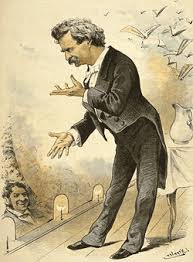
Onanism by Mark Twain

Did Mark Twain, nom de plume for Samuel Langhorne Clemens (1835-1910), really say that 95% of men masturbate and the other 5% lie about it (or statistics to that effect)? In any event, at about 44 years of age, here’s what he said as speaker at a dinner held in 1879 at a Paris supper club. Fellow diners were, to say the least, surprised by what they heard. Enjoy!

Some Thoughts on the Science of Onanism
by Mark Twain

[One evening in Paris in 1879, The Stomach Club, a society of American writers and artists, gathered to drink well, to eat a good dinner and hear an address by Mark Twain. He was among friends and, according to the custom of the club, he delivered a humorous talk on a subject hardly ever mentioned in public in that day and age. After the meeting, he preserved the manuscript among his papers. It was finally printed in a pamphlet limited to 50 copies 64 years later.]

My gifted predecessor has warned you against the “social evil–adultery.” In his able paper he exhausted that subject; he left absolutely nothing more to be said on it. But I will continue his good work in the cause of morality by cautioning you against that species of recreation called self-abuse to which I perceive you are much addicted. All great writers on health and morals, both ancient and modern, have struggled with this stately subject; this shows its dignity and importance. Some of these writers have taken one side, some the other.
Homer, in the second book of the Iliad says with fine enthusiasm, “Give me masturbation or give me death.” Caesar, in his Commentaries, says, “To the lonely it is company; to the forsaken it is a friend; to the aged and to the impotent it is a benefactor. They that are penniless are yet rich, in that they still have this majestic diversion.” In another place this experienced observer has said, “There are times when I prefer it to sodomy.”
Robinson Crusoe says, “I cannot describe what I owe to this gentle art.” Queen Elizabeth said, “It is the bulwark of virginity.” Cetewayo, the Zulu hero, remarked, “A jerk in the hand is worth two in the bush.” The immortal Franklin has said, “Masturbation is the best policy.”
Michelangelo and all of the other old masters–“old masters,” I will remark, is an abbreviation, a contraction–have used similar language. Michelangelo said to Pope Julius II, “Self-negation is noble, self-culture beneficent, self-possession is manly, but to the truly great and inspiring soul they are poor and tame compared with self-abuse.” Mr. Brown, here, in one of his latest and most graceful poems, refers to it in an eloquent line which is destined to live to the end of time–“None knows it but to love it; none name it but to praise.”
Such are the utterances of the most illustrious of the masters of this renowned science, and apologists for it. The name of those who decry it and oppose it is legion; they have made strong arguments and uttered bitter speeches against it–but there is not room to repeat them here in much detail. Brigham Young, an expert of incontestable authority, said, “As compared with the other thing, it is the difference between the lightning bug and the lightning.” Solomon said, “There is nothing to recommend it but its cheapness.” Galen said, “It is shameful to degrade to such bestial uses that grand limb, that formidable member, which we votaries of Science dub the Major Maxillary*–when they dub it at all–which is seldom, It would be better to amputate the os frontis** than to put it to such use.”
The great statistician Smith, in his report to Parliament, says, “In my opinion, more children have been wasted in this way than any other.” It cannot be denied that the high antiquity of this art entitles it to our respect; but at the same time, I think its harmfulness demands our condemnation. Mr. Darwin was grieved to feel obliged to give up his theory that the monkey was the connecting link between man and the lower animals. I think he was too hasty. The monkey is the only animal, except man, that practices this science; hence, he is our brother; there is a bond of sympathy and relationship between us. Give this ingenuous animal an audience of the proper kind and he will straightway put aside his other affairs and take a whet; and you will see by his contortions and his ecstatic expression that he takes an intelligent and human interest in his performance.
The signs of excessive indulgence in this destructive pastime are easily detectable. They are these: a disposition to eat, to drink, to smoke, to meet together convivially, to laugh, to joke and tell indelicate stories–and mainly, a yearning to paint pictures. The results of the habit are: loss of memory, loss of virility, loss of cheerfulness and loss of progeny.
Of all the various kinds of sexual intercourse, this has the least to recommend it. As an amusement, it is too fleeting; as an occupation, it is too wearing; as a public exhibition, there is no money in it. It is unsuited to the drawing room, and in the most cultured society it has long been banished from the social board. It has at last, in our day of progress and improvement, been degraded to brotherhood with flatulence. Among the best bred, these two arts are now indulged in only private–though by consent of the whole company, when only males are present, it is still permissible, in good society, to remove the embargo on the fundamental sigh.
My illustrious predecessor has taught you that all forms of the “social evil” are bad. I would teach you that some of these forms are more to be avoided than others. So, in concluding, I say, “If you must gamble your lives sexually, don’t play a lone hand too much.” When you feel a revolutionary uprising in your system, get your Vendome Column down some other way–don’t jerk it down.***


Note: Formal title of his Presentation was “Some Thoughts on the Science of Onanism.” Not that it would matter to Twain (who was well ahead of his time on masturbation), most biblical scholars today see Onan’s alleged “sin” as a reference to his disobedience of God’s alleged order to procreate. Instead, Onan engaged in coitus interruptus—withdrawing his penis before ejaculating. Masturbation had nothing to do with it.
* in the area of the sinuses (as best I can tell)
** frontal bone—forehead
***Twain’s satiric reference is to a penis-like column (pictured above), originally put in place by Napoleon, which rises majestically in Paris like an obelisk or erect phallus in the Place Vendôme. Napoleon himself stands on the head of this vertical shaft in full glory.
 
From: http://artofmalemasturbation.tumblr.com/MarkTwain.


For a more explicit view of masturbation, please visit my other blog.


Walk in the Woods

Walk in the Woods  by Shyaners

Walking through
the trees with
no where to go.

Seeing all of the
animals scurrying
to and fro.

Thinking about
all that has happened
through my life.

tumblr_lgvypkNsBd1qf57cco1_400Who has come in and
who has gone out.

Having doubts about
my beauty, doubts
about my soul.

Doubts about my
happiness, doubts
about my whole.

Knowing that at
any second it could
all be over and done.

No way to go back and
redo what I regret.

No way to go back and
change the many times
I fret.

All I know is that I can
only live one day at a
time.

Leaving people who
get into my way
sadly behind.

I found this poem when trying to find one that would go with the picture above.  When I came across this poem, I fell in love with.  It is perfect simplicity at its finest.


Frost at Midnight

Frost at Midnight by Samuel Taylor Coleridge (1798)
tumblr_lfz1saHQeM1qa9neao1_500The Frost performs its secret ministry,
Unhelped by any wind. The owlet’s cry
Came loud–and hark, again! loud as before.
The inmates of my cottage, all at rest,
Have left me to that solitude, which suits
Abstruser musings: save that at my side
My cradled infant slumbers peacefully.
’Tis calm indeed! so calm, that it disturbs
And vexes meditation with its strange
And extreme silentness. Sea, hill, and wood,
This populous village! Sea, and hill, and wood,
With all the numberless goings-on of life,
Inaudible as dreams! the thin blue flame
Lies on my low-burnt fire, and quivers not;
Only that film, which fluttered on the grate,
Still flutters there, the sole unquiet thing.
Methinks, its motion in this hush of nature
Gives it dim sympathies with me who live,
Making it a companionable form,
Whose puny flaps and freaks the idling Spirit
By its own moods interprets, every where
Echo or mirror seeking of itself,
And makes a toy of Thought.

                  But O! how oft,
How oft, at school, with most believing mind,
Presageful, have I gazed upon the bars,
To watch that fluttering stranger! and as oft
With unclosed lids, already had I dreamt
Of my sweet birth-place, and the old church-tower,
Whose bells, the poor man’s only music, rang
!000000aaa001asnowwinter6From morn to evening, all the hot Fair-day,
So sweetly, that they stirred and haunted me
With a wild pleasure, falling on mine ear
Most like articulate sounds of things to come!
So gazed I, till the soothing things, I dreamt,
Lulled me to sleep, and sleep prolonged my dreams!
And so I brooded all the following morn,
Awed by the stern preceptor’s face, mine eye
Fixed with mock study on my swimming book:
Save if the door half opened, and I snatched
A hasty glance, and still my heart leaped up,
For still I hoped to see the stranger’s face,
Townsman, or aunt, or sister more beloved,
My play-mate when we both were clothed alike!

    Dear Babe, that sleepest cradled by my side,
Whose gentle breathings, heard in this deep calm,
Fill up the intersperséd vacancies
And momentary pauses of the thought!
My babe so beautiful! it thrills my heart
With tender gladness, thus to look at thee,
And think that thou shalt learn far other lore,
And in far other scenes! For I was reared
In the great city, pent ’mid cloisters dim,
And saw nought lovely but the sky and stars.
But thou, my babe! shalt wander like a breeze
By lakes and sandy shores, beneath the crags
Of ancient mountain, and beneath the clouds,
Which image in their bulk both lakes and shores
And mountain crags: so shalt thou see and hear
The lovely shapes and sounds intelligible
!000000aaa001asnowday1Of that eternal language, which thy God
Utters, who from eternity doth teach
Himself in all, and all things in himself.
Great universal Teacher! he shall mould
Thy spirit, and by giving make it ask.

    Therefore all seasons shall be sweet to thee,
Whether the summer clothe the general earth
With greenness, or the redbreast sit and sing
Betwixt the tufts of snow on the bare branch
Of mossy apple-tree, while the nigh thatch
Smokes in the sun-thaw; whether the eave-drops fall
Heard only in the trances of the blast,
Or if the secret ministry of frost
Shall hang them up in silent icicles,
Quietly shining to the quiet Moon.

  • Born: 21 October 1772
  • Birthplace: Devonshire, England
  • Died: 25 July 1834 (heart attack)
  • Best Known As: The author of The Rime of the Ancient Mariner

Samuel Taylor Coleridge was famous for dreamy and somewhat creepy poems like The Rime of the Ancient Mariner, Christabel and Kubla Khan (the last of which he allegedly wrote subconsciously during a fever dream). Coleridge and poet William Wordsworth were close pals and their collection of poetry titled Lyrical Ballads (1798) was an early pillar of what became known as the Romantic movement in poetry and art. Coleridge is probably best known for a poem from that collection, The Rime of the Ancient Mariner, which describes a sailor who curses himself and his ship by killing an albatross. Coleridge is also remembered for his turbulent personal life, especially his decades-long addiction to opium.


Happy Valentine’s Day

tumblr_ley3ymUlcs1qg66b4o1_400The history of Valentine’s Day — and its patron saint — is shrouded in mystery. But we do know that February has long been a month of romance. St. Valentine’s Day, as we know it today, contains vestiges of both Christian and ancient Roman tradition. So, who was Saint Valentine and how did he become associated with this ancient rite? Today, the Catholic Church recognizes at least three different saints named Valentine or Valentinus, all of whom were martyred.
One legend contends that Valentine was a priest who served during the third century in Rome. When Emperor Claudius II decided that single men made better soldiers than those with wives and families, he outlawed marriage for young men — his crop of potential soldiers. Valentine, realizing the injustice of the decree, defied Claudius and continued to perform marriages for young lovers in secret. When Valentine’s actions were discovered, Claudius ordered that he be put to death.


Other stories suggest that Valentine may have been killed for attempting to help Christians escape harsh Roman prisons where they were often beaten and tortured.
tumblr_lfzzqqIsTs1qbtfb6o1_500
According to one legend, Valentine actually sent the first “valentine” greeting himself. While in prison, it is believed that Valentine fell in love with a young girl — who may have been his jailor’s daughter — who visited him during his confinement. Before his death, it is alleged that he wrote her a letter, which he signed “From your Valentine,” an expression that is still in use today. Although the truth behind the Valentine legends is murky, the stories certainly emphasize his appeal as a sympathetic, heroic, and, most importantly, romantic figure. It’s no surprise that by the Middle Ages, Valentine was one of the most popular saints in England and France.


tumblr_lg5fplqKAd1qc75dro1_500While some believe that Valentine’s Day is celebrated in the middle of February to commemorate the anniversary of Valentine’s death or burial — which probably occurred around 270 A.D — others claim that the Christian church may have decided to celebrate Valentine’s feast day in the middle of February in an effort to “christianize” celebrations of the pagan Lupercalia festival. In ancient Rome, February was the official beginning of spring and was considered a time for purification. Houses were ritually cleansed by sweeping them out and then sprinkling salt and a type of wheat called spelt throughout their interiors. Lupercalia, which began at the ides of February, February 15, was a fertility festival dedicated to Faunus, the Roman god of agriculture, as well as to the Roman founders Romulus and Remus.


To begin the festival, members of the Luperci, an order of Roman priests, would gather at the sacred cave where the infants Romulus and Remus, the founders of Rome, were believed to have been cared for by a she-wolf or lupa. The priests would then sacrifice a goat, for fertility, and a dog, for purification.


1452The boys then sliced the goat’s hide into strips, dipped them in the sacrificial blood and took to the streets, gently slapping both women and fields of crops with the goathide strips. Far from being fearful, Roman women welcomed being touched with the hides because it was believed the strips would make them more fertile in the coming year. Later in the day, according to legend, all the young women in the city would place their names in a big urn. The city’s bachelors would then each choose a name out of the urn and become paired for the year with his chosen woman. These matches often ended in marriage. Pope Gelasius declared February 14 St. Valentine’s Day around 498 A.D. The Roman “lottery” system for romantic pairing was deemed un-Christian and outlawed. Later, during the Middle Ages, it was commonly believed in France and England that February 14 was the beginning of birds’ mating season, which added to the idea that the middle of February — Valentine’s Day — should be a day for romance. The oldest known valentine still in existence today was a poem written by Charles, Duke of Orleans to his wife while he was imprisoned in the Tower of London following his capture at the Battle of Agincourt. The greeting, which was written in 1415, is part of the manuscript collection of the British Library in London, England. Several years later, it is believed that King Henry V hired a writer named John Lydgate to compose a valentine note to Catherine of Valois.


ErosIn Great Britain, Valentine’s Day began to be popularly celebrated around the seventeenth century. By the middle of the eighteenth century, it was common for friends and lovers in all social classes to exchange small tokens of affection or handwritten notes. By the end of the century, printed cards began to replace written letters due to improvements in printing technology. Ready-made cards were an easy way for people to express their emotions in a time when direct expression of one’s feelings was discouraged. Cheaper postage rates also contributed to an increase in the popularity of sending Valentine’s Day greetings. Americans probably began exchanging hand-made valentines in the early 1700s. In the 1840s, Esther A. Howland began to sell the first mass-produced valentines in America.


According to the Greeting Card Association, an estimated one billion valentine cards are sent each year, making Valentine’s Day the second largest card-sending holiday of the year. (An estimated 2.6 billion cards are sent for Christmas.)


5bd2b7e1962d1c50eb7d67e66f9e_grandeApproximately 85 percent of all valentines are purchased by women. In addition to the United States, Valentine’s Day is celebrated in Canada, Mexico, the United Kingdom, France, and Australia.
Valentine greetings were popular as far back as the Middle Ages (written Valentine’s didn’t begin to appear until after 1400), and the oldest known Valentine card is on display at the British Museum. The first commercial Valentine’s Day greeting cards produced in the U.S. were created in the 1840s by Esther A. Howland. Howland, known as the Mother of the Valentine, made elaborate creations with real lace, ribbons and colorful pictures known as “scrap.”
From: http://www.history.com/topics/valentines-day.

ErosMeteyard

XOXO,
JoeBlow

A Little Help for Valentine’s Day

Spell for a Man to Obtain a Male Lover
Egypt, perhaps 6th century
OverOurHead.netOne of the great problems in studying the history of sexuality in the past, as with other areas of human personal life, is that the vast majority of sources come from sources left by social elites. In many areas and periods only the elites could write, and even where a wider section of the population could write (as, probably, in classical Greece), the texts that have been preserved, usually by monastic copying and in monastic libraries for Greek texts, were works produced by the elites.

In Christian Egypt (or “Coptic Egypt”) there seems to have been fairly widespread literacy – in both Greek and Coptic languages – and much popular material has survived on papyrus. The particular climate of Egypt has alone made this possible. We are in a position then to explore aspects of Christian society in Egypt which remain obscure elsewhere. One set of sources which has been made available to English readers are the various collection of ritual “spells”. These texts, dating from the first to the eleventh century, show a religious life quite different from that of the elite theologians who were writing at the same time.

One of the spells translated in this volume is for a man to obtain a male lover: evidence of a homosexual sub-culture, neither philosophic nor literary which we may believe existed at other times and places in the ancient world, but which has left little evidence.

xjul1Spell 84: For a Man to Obtain a Male Lover

This text contains a same-sex love spell commissioned by one Papalo to “bind” another man, Phello (this name literally means “the old man” or “the monk”), by means of a variety of powerful utterances (especially ROUS). Besides extending the scope of erotic binding spells in late antiquity, this spell also employs formulae common to several Coptic texts of ritual power. The folds in the text and the description of the text’s depositing (lines 6-7) imply that this spell was intended to be placed near the beloved man.

TEXT
+CELTATALBABAL [.]KARASHNEIFE[.]NNAS’KNEKIE, by the power of Yao Sabaoth, ROUS ROUS ROUS ROUS ROUS ROUS ROUS ROUS
(ring signs)

+++I adjure you by your powers and your amulets and
places where you dwell and your names, that just as I take you
a put you at the door and the pathway of Phello, son of Maure,
(so alos) you must take his heart and his mind; you must dominate
his entire body.

gayegypt_1942_34252557When he (tries to) stand, you must not allow him to stand
When he (tries to) sit, you must not allow him to sit
When he lies down to sleep, you must not allow him to sleep.

He must seek me from town to town, from city to city,
from field to filed, from region to region,
until he comes to me and subjects himself under my feet-
me, Papapolo son of Noe-
while his hand is full of all goodness,
until I satisfy with him the desire of my heart
and the demand of my soul,
with pleasant desire and love unending,
right now, right now, at once! Do my work

Notes:
The reference to “his hand full of all goodness” may be connected with the Hebrew use of “hand” for “penis”. (Give a new meaning to the Spanish phrase mano-a-mano [hand to hand], doesn’t it?).

Ancient spells are not one of my specialties, but I found this very intriguing for two reasons. First, this is a Christian spell, and second, because I wonder if it works. If anyone tries this spell, and it works, then let me know, LOL.


And now for a little humor:

IIntruder² #9 – Ancient Egyptian Cock

http://www.IIntruder.TK
One of them has been cursed by the Ancient Egyptian God Set, and the other finds it quite amusing…


Where Go The Boats?

Where Go The Boats? by Robert Louis Stevenson

Dark brown is the river,
Golden is the sand
tumblr_lfuhhdweHp1qfhvvko1_500It flows along forever,
With trees on either hand.

Green leaves a-floating,
Castles of the foam,
Boats of mine a-boating
Where with all come home?

On goes the river
And out past the mill,
Away down the valley,
Away down the hill.

Away down the river,
A hundred miles or more,
Other little children
Shall bring my boats ashore


