Category Archives: Poetry

Patience Taught by Nature 


 Patience Taught by Nature

 By Elizabeth Barrett Browning

“O Dreary life!” we cry, “O dreary life!”
And still the generations of the birds
Sing through our sighing, and the flocks and herds
Serenely live while we are keeping strife
With Heaven’s true purpose in us, as a knife
Against which we may struggle. Ocean girds
Unslackened the dry land: savannah-swards
Unweary sweep: hills watch, unworn; and rife
Meek leaves drop yearly from the forest-trees,
To show, above, the unwasted stars that pass
In their old glory. O thou God of old!
Grant me some smaller grace than comes to these;—
But so much patience, as a blade of grass
Grows by contended through the heat and cold.

About This Poem
“Patience Taught by Nature” was published in Browning’s book A Drama of Exile: and other poems (H. G. Langley, 1845).  Elizabeth Barrett Browning was born in 1806 at Coxhoe Hall, Durham, England. Her books include An Essay on Mind and Other Poems (1826), The Seraphim and Other Poems (1838), and Poems before Congress (1860). Browning died on June 29, 1861, in Florence.


I am praying that God give me patience with these headaches.  I had thought I was given relief when I went through the first round of treatments with prednisone, because I had periods of no pain followed by periods of mild headaches, but in the last several days, they headaches have gotten worse.  When I woke up Sunday and couldn’t even get out of bed all day because of my headache and any medicine I took brought either mild relief or no relief at all, I knew. Had to go back to the doctor.  Sunday’s headache was by far the worst I’ve ever had.  My doctor was actually out of the office yesterday, but I did get in to see his nurse practitioner.  She gave me a Toradol shot and samples of a new medicine called Bupap.  Bupap has been known to help with tension, migraine, and cluster headaches but is not a first line of defense but usually a last resort.  It is effective at controlling he pain, but as a barbiturate, it is highly addictive, so I have to be careful taking it.  At least it is providing some relief.  I also found out that my CT scan came back clean, so I do not have a tumor, thank God, though I really wasn’t worried about that.  The nurse practitioner and my doctor may send me to a neurologist if the headaches do not improve. 

Florence Ripley Mastin: Poet and Teacher


Night Fell
By Florence Ripley Mastin

Night fell one year ago, like this.
He had been writing steadily.
Among these dusky walls of books,
How bright he looked, intense as flame!
Suddenly he paused,
The firelight in his hair,
And said, “The time has come to go.”
I took his hand;
We watched the logs burn out;
The apple boughs fingered the window;
Down the cool, spring night
A slim, white moon leaned to the hill.
To-night the trees are budded white,
And the same pale moon slips through the dusk.
O little buds, tap-tapping on the pane,
O white moon,
I wonder if he sleeps in woods
Where there are leaves?
Or if he lies in some black trench,
His hands, his kind hands, kindling flame that kills?
Or if, or if …
He is here now, to bid me last good-night?


When Florence Josephine Mastin was in her 20s and already a published poet, she decided to replace her girlish middle name with “Ripley.” “Ripley” sounds jaunty and masculine, and Mastin was proud of her Ripley ancestors, including George Ripley, a Transcendentalist who founded the utopian community of Brook Farm in West Roxbury, Mass. For the rest of her life, her friends called her Ripley. 

Florence Ripley Mastin chose her own name, and she spent her entire life trying to hoist that name out into the world. Between roughly 1900 and 1967, the year before she died at age 81, she published probably hundreds of poems in newspapers and magazines, including more than 90 in the New York Times alone. She authored several books of poetry, and her work appeared approximately a dozen times in Poetry between 1918 and 1935. 

Mastin’s timing was lucky and unlucky. She was brash and butch and she loved women—one woman especially—but she died one year before the Stonewall riots. She was not a great poet, but she was lucky enough to be writing in a time where poetry was published in almost every daily newspaper, and commissioned for just about every public ceremony. Poetry, during her lifetime, was a viable, exciting, and culturally relevant pursuit; Mastin relished its sheen of elitism, but the truth is that she benefited from its mass appeal. She was able to publish prolifically as a high school teacher with modest talent and without many connections to the literary scene. 

Grace Beatrice MacColl, Mastin’s partner of some 50 years, was a fellow teacher at Erasmus Hall High School in the Flatbush neighborhood of Brooklyn. Mastin met MacColl, who was born in Vermont, when they were students at Barnard College. When they graduated, they both took the exam to become New York City high school teachers, and applied to teach at Erasmus “because of its illustrious past, its beautiful campus, and its famous staff of teachers,” Mastin later wrote. 

Mastin and MacColl’s partnership was as public as the era allowed: They presented themselves as “close friends and devoted companions,” to use a phrase from feminist historian Judith Schwarz. Family members and friends sent “love to Grace” in their letters, and the pair traveled together, marched in suffrage parades, and lived together. When an Erasmus student working on a profile of Mastin for the school newspaper wrote her a letter in 1961 mentioning her “devoted friendship” with MacColl, Mastin wrote back paragraphs on the “gifted beautiful girl” who “was a constant inspiration for my poetry: She had a keen, a brilliant mind, a broad understanding and a subtle and delightful wit. She was more of a realist than I, and was an excellent balance wheel for my romanticism. A more noble, true and devoted friend never lived.”

Mastin wrote on subjects from the suffrage movement to both world wars to Sputnik to Vietnam. Since the above poem was published in 1918, I tend to think that it is about a young man going to war.  If it was written early in 1918, it would have been roughly a year since men began being sent to war.  In the poem “At the Movies,” two stanzas on watching a newsreel of British soldiers, was anthologized in a 1919 Treasury of War Poetry and is one of her only works to be reproduced frequently online. 

Occasionally she was funny, even cruel. In one undated handwritten poem, she savaged “certain modern poets”:

The ebullitions of modern poets make me sick.
I am an ordinary person, thank God,
With an ordinary brain and ordinary emotions;
And I come in tired to a warm fire and a drink,
And I open this book of verse . . . . . . . .
I may as well be a surgeon hereafter
And open gall bladders and tracts of bile and
holes with pus in them.
Why should I continue to read your verse
Spread everywhere like damp fungus?
… Dirty highways caked with manure will be
clean to me after you.

As her confusion and anger at highbrow moderns suggests, Mastin was an old-fashioned lyric poet with little interest in being on the literary cutting edge. And though she was publishing constantly, there is no evidence that she was in regular conversation with serious poets of her day, even those she admired. For Robert Frost’s 75th birthday in 1949, Mastin published a poem about him in the New York Times, then printed the poem on a huge scroll and had her students at Erasmus sign it. When Frost gave a talk at the New School soon afterward, a delegation of three students presented him with the scroll. She was only a dozen years younger than Frost, but this is the work of a fan, not a peer. 

Grace MacColl died in 1960 and was buried in the Mastin family plot on a hilltop overlooking the Tappan Zee. Afterward, Mastin couldn’t maintain her home Four Gables on her own, and she moved into an apartment north of Piermont, where she had a porch, a garden, and a view of her beloved Hudson River. “I think I never shall feel old—and maybe it is because I have lived with poetry all my life—and poetry is timeless,” she wrote around that time. “It is built of music and dreams so it never grows old.” She died in 1968. 

Florence Ripley Mastin loved to see her name—the name she had chosen for herself—in print. She kept detailed records tracking which newspapers reprinted which poems and who nominated her for which awards. Today, a few boxes of those papers can be found in the archives of Syracuse University’s Bird Library: dispatches from a life in poetry when such a thing must have seemed like anyone’s for the taking.

It is possible today to see Mastin as an unlikable woman; an unrelenting self-promoter, she sent clippings and copies of her work to friends, acquaintances, and politicians, including President Eisenhower. She was forever bragging about her Mayflower ancestry and her distant familial connection to Ralph Waldo Emerson. But she was a confident striver, that great American archetype, and her identity as a poet gave shape and weight to an otherwise ordinary life. She called herself a poet, and then she made herself one. And her story illustrates an important but easily overlooked chapter in the story of poetry in the 20th century.


Two Poems By Cyrus Cassells


Beautiful Signor
By Cyrus Cassells 

     All dreams of the soul 
     End in a beautiful man’s or woman’s body. 

     —Yeats, “The Phases of the Moon” 

Whenever we wake,
still joined, enraptured—
at the window,
each clear night’s finish
the black pulse of dominoes
dropping to land;

whenever we embrace,
haunted, upwelling,
I know
a reunion is taking place—      

Hear me when I say
our love’s not meant to be
an opiate;
helpmate,
you are the reachable mirror
that dares me to risk
the caravan back
to the apogee, the longed-for
arms of the Beloved—


Dusks of paperwhites,
dusks of jasmine,
intimate beyond belief

beautiful Signor

no dread of nakedness

beautiful Signor

my long ship,
my opulence,
my garland

beautiful Signor

extinguishing the beggar’s tin,
the wind of longing

beautiful Signor

laving the ruined country,
the heart wedded to war

beautiful Signor

the kiln-blaze
in my body,
the turning heaven

beautiful Signor

you cover me with pollen

beautiful Signor

into your sweet mouth—

This is the taproot:
against all strictures,
desecrations,
I’ll never renounce,
never relinquish
the first radiance, the first
moment you took my hand—

This is the endless wanderlust:
dervish,
yours is the April-upon-April love
that kept me spinning even beyond
your eventful arms
toward the unsurpassed:

the one vast claiming heart,
the glimmering,
the beautiful and revealed Signor.


Return to Florence
By Cyrus Cassells

How do I convey the shoring gold
at the core of the Florentine bells’
commingled chimes?

Vast as a suddenly revealed
field of wheat,
that up-and-away gold
is equivalent to the match-burst
morning I returned,
intent as doubting Thomas,
to my old classroom terrace,
open to the showy, blue yes
of the bustling Arno,
to my timeless, sun-laved
Basilica of Santo Spirito,
and discovered
ebullient citizens reciting,
at a hundred different posts,
the same unbetraying passage
of Dante’s Paradise.
 

Cyrus Cassells is the author of four books of poetry: The Mud ActorSoul Make a Path Through ShoutingBeautiful Signor, and More Than Peace and Cypresses. Among his honors are a Lannan Literary Award, a William Carlos Williams Award, a Pushcart Prize, two NEA grants, and a Lambda Literary Award, which he won for Beautiful Signor. He is a tenured Associate Professor of English at Texas State University-San Marcos, and lives in Paris and Austin.

Moment of Zen: Spring 


The year’s at the spring
And day’s at the morn;
Morning’s at seven;
The hillside’s dew-pearled;
The lark’s on the wing;
The snail’s on the thorn;
God’s in His heaven –
All’s right with the world!
~ Robert Browning

“The only thing that could spoil a day was people. People were always the limiters of happiness except for the very few that were as good as spring itself.” ~ Ernest Hemingway


St. Patrick’s Day


Here are two poems for St. Patrick’s Day, both appropriately titled, “St. Patrick’s Day.”

St. Patrick’s Day
By Jean Blewett

There’s an Isle, a green Isle, set in the sea,
     Here’s to the Saint that blessed it!
And here’s to the billows wild and free
     That for centuries have caressed it!

Here’s to the day when the men that roam
     Send longing eyes o’er the water!
Here’s to the land that still spells home
     To each loyal son and daughter!

Here’s to old Ireland—fair, I ween,
     With the blue skies stretched above her!
Here’s to her shamrock warm and green,
     And here’s to the hearts that love her!

St. Patrick’s Day
BY Eliza Cook

St. Patrick’s Day! St. Patrick’s Day!
Oh! thou tormenting Irish lay—
I’ve got thee buzzing in my brain,
And cannot turn thee out again.
Oh, mercy! music may be bliss
But not in such a shape as this,
When all I do, and all I say,
Begins and ends in Patricks’s Day.

Had it but been in opera shape,
Italian squall, or German scrape,
Fresh from the bow of Paganini,
Or caught from Weber of Rossini,
One would not care so much—but, oh!
The sad plebeian shame to know
An old blind fiddler bore away
My senses with St. Patrick’s Day.

I take up Burke in hopes to chase
The plaguing phantom from its place;
But all in vain—attention wavers
From classic lore to triplet quavers;
An “Essay” on the great “Sublime”
Sounds strangely set in six-eight time.
Down goes the book, read how I may,
The words will flow to Patrick’s Day.


St. Patrick’s Day is celebrated every year on March 17th, honoring the Irish patron saint, St. Patrick. The celebrations are largely Irish culture themed and typically consist of wearing green, parades, and drinking. Some churches may hold religious services and many schools and offices close in Suffolk County, the area containing Boston and its suburbs.

St. Patrick, or the “Apostle of Ireland,” actually started out in the pagan religion. While not much is known about his early life, as many of his life’s details were lost to folklore, letters from St. Patrick reveal that he was captured in Wales, Scotland, or another close area outside of Ireland and taken to Ireland as a slave. Years later, he escaped and returned to his family, who were Romans living in Britain, going back to Ireland for mission work after finding a place as a cleric and then Bishop within the Christian faith. He was born around 460, and by the 600s, he was already known as the Patron Saint of Ireland.

There are many legends associated with St. Patrick. The symbol of the shamrock used for St. Patrick’s Day comes from the story of St. Patrick using the shamrock to illustrate the Holy Trinity. The three-leafed plant coincided with the Pagan religion’s sanctity of the number three and is the root of the green color theme.  Another popular belief is that St. Patrick banished the snakes from Ireland. The story says that while St. Patrick was fasting, snakes attacked him, so he chased all snakes into the ocean. However, there have never been snakes in Ireland during the post-glacial period. The absence of snakes and symbolism involved with snakes is believed to explain the story, although it could have been referring to type of worm rather than snakes. One legend has St. Patrick sticking a walking stick into the ground while evangelizing, which turned into a tree.

St. Patrick’s Day was first celebrated in America in 1737, organized by the Charitable Irish Society of Boston, including a feast and religious service. This first celebration of the holiday in the colonies was largely to honor and celebrate the Irish culture that so many colonists had been separated from.  Early celebrations continued this modest tradition. In New York, the first celebration took place as a small gathering at the home of an Irish protestant. St. Patrick’s Day parades started in New York in 1762 by a group of Irish soldiers in the British military who marched down Broadway. This began the tradition of a military theme in the parade, as they often feature marching military unites. The holiday eventually evolved from the modest religious dinner into the raucous holiday we know today.


Jean McKishnie Blewett (4 November 1862 – 19 August 1934) was a Canadian journalist, author and poet.  Eliza Cook (24 December 1818 – 23 September 1889) was an English author, Chartist poet and writer born in London Road, Southwark.


The Guitar


The Guitar
By Federico García Lorca

The weeping of the guitar
Begins.
The goblets of dawn
Are smashed.
The weeping of the guitar
Begins.
Useless
To silence it.
Impossible
To silence it.
It weeps monotonously
As water weeps
As the wind weeps
Over snowfields.
Impossible
To silence it.
It weeps for distant
Things.
Hot southern sands
Yearning for white camellias.
Weeps arrow without target
Evening without morning
And the first dead bird
On the branch.
Oh, guitar!
Heart mortally wounded
By five swords.


Underwear


Underwear
By Lawrence Ferlinghetti

I didn’t get much sleep last night
thinking about underwear
Have you ever stopped to consider   
underwear in the abstract   
When you really dig into it
some shocking problems are raised   
Underwear is something   
we all have to deal with   
Everyone wears
some kind of underwear
The Pope wears underwear I hope
The Governor of Louisiana   
wears underwear
I saw him on TV
He must have had tight underwear
He squirmed a lot
Underwear can really get you in a bind
You have seen the underwear ads
for men and women
so alike but so different
Women’s underwear holds things up
Men’s underwear holds things down   
Underwear is one thing   
men and women have in common   
Underwear is all we have between us
You have seen the three-color pictures
with crotches encircled
to show the areas of extra strength
and three-way stretch
promising full freedom of action
Don’t be deceived
It’s all based on the two-party system
which doesn’t allow much freedom of choice   
the way things are set up   
America in its Underwear
struggles thru the night
Underwear controls everything in the end   
Take foundation garments for instance   
They are really fascist forms
of underground government
making people believe
something but the truth
telling you what you can or can’t do   
Did you ever try to get around a girdle   
Perhaps Non-Violent Action
is the only answer
Did Gandhi wear a girdle?
Did Lady Macbeth wear a girdle?
Was that why Macbeth murdered sleep?   
And that spot she was always rubbing—
Was it really in her underwear?
Modern anglosaxon ladies
must have huge guilt complexes
always washing and washing and washing   
Out damned spot
Underwear with spots very suspicious   
Underwear with bulges very shocking   
Underwear on clothesline a great flag of freedom   
Someone has escaped his Underwear   
May be naked somewhere
Help!
But don’t worry
Everybody’s still hung up in it
There won’t be no real revolution
And poetry still the underwear of the soul   
And underwear still covering
a multitude of faults
in the geological sense—
strange sedimentary stones, inscrutable cracks!   
If I were you I’d keep aside
an oversize pair of winter underwear   
Do not go naked into that good night   
And in the meantime
keep calm and warm and dry
No use stirring ourselves up prematurely   
‘over Nothing’
Move forward with dignity
hand in vest
Don’t get emotional
And death shall have no dominion   
There’s plenty of time my darling
Are we not still young and easy
Don’t shout


About the Poet

On March 24, 1919, Lawrence Ferlinghetti was born in Yonkers, New York. After spending his early childhood in France, he received his BA from the University of North Carolina, an MA from Columbia University, and a PhD from the Sorbonne.

During World War II he served in the US Naval Reserve and was sent to Nagasaki shortly after it was bombed. He married in 1951 and has one daughter and one son.

In 1953, Ferlinghetti and Peter Martin began to publish City Lights magazine. They also opened the City Lights Books Shop in San Francisco to help support the magazine. In 1955, they launched City Light Publishing, a book-publishing venture. City Lights became known as the heart of the “Beat” movement, which included writers such as Kenneth Rexroth, Gary Snyder, Allen Ginsberg, and Jack Kerouac.

Currently, Ferlinghetti writes a weekly column for the San Francisco Chronicle. He also continues to operate the City Lights bookstore, and he travels frequently to participate in literary conferences and poetry readings.


The Dream

2015/02/img_0085.jpg

The Dream
By Edna St. Vincent Millay

Love, if I weep it will not matter,
And if you laugh I shall not care;
Foolish am I to think about it,
But it is good to feel you there.

Love, in my sleep I dreamed of waking, —
White and awful the moonlight reached
Over the floor, and somewhere, somewhere,
There was a shutter loose, —it screeched!

Swung in the wind, — and no wind blowing! —
I was afraid, and turned to you,
Put out my hand to you for comfort, —
And you were gone! Cold, cold as dew,

Under my hand the moonlight lay!
Love, if you laugh I shall not care,
But if I weep it will not matter, —
Ah, it is good to feel you there!


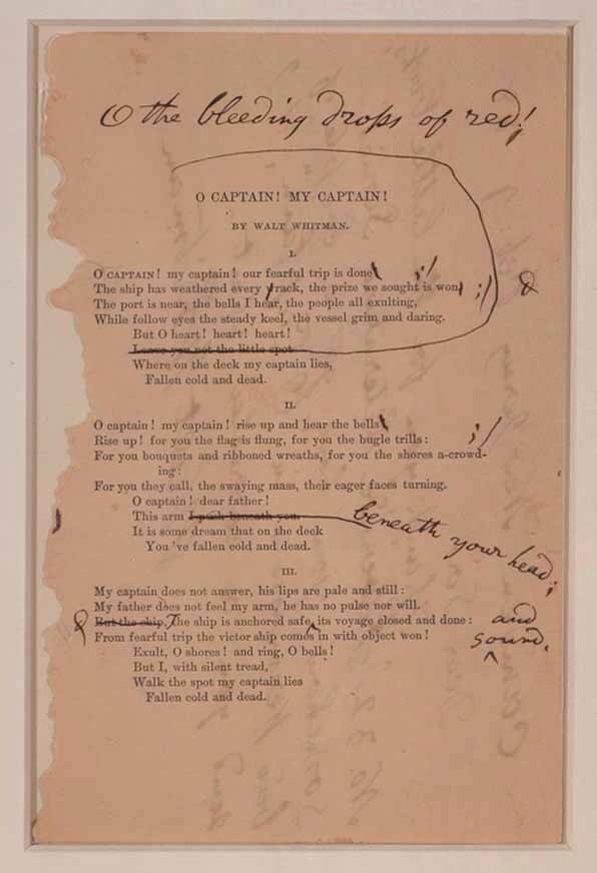
O Captain! My Captain!

2015/02/img_0345.jpg

O Captain! My Captain!
Walt Whitman, 1819 – 1892

O Captain! my Captain! our fearful trip is done, The ship has weather’d every rack,
the prize we sought is won, The port is near, the bells I hear, the people all exulting,
While follow eyes the steady keel, the vessel grim and daring; But O heart! heart! heart!
O the bleeding drops of red, Where on the deck my Captain lies, Fallen cold and dead.
O Captain! my Captain! rise up and hear the bells; Rise up- for you the flag is flung- for
you the bugle trills,

For you bouquets and ribbon’d wreaths- for you the shores
a-crowding,
For you they call, the swaying mass, their eager faces turning;
Here Captain! dear father!
This arm beneath your head!
It is some dream that on the deck,
You’ve fallen cold and dead.

My Captain does not answer, his lips are pale and still,
My father does not feel my arm, he has no pulse nor will,
The ship is anchor’d safe and sound, its voyage closed and done,
From fearful trip the victor ship comes in with object won;
Exult O shores, and ring O bells!
But I with mournful tread,
Walk the deck my Captain lies,
Fallen cold and dead.

Since yesterday was Presidents Day and I’ve never featured this poem, I thought it would be a wonderful tribute, as this poem was meant to be. When President Abraham Lincoln was assassinated on April 14, 1865, a war-weary nation was plunged into shock. The last great battles of the Civil War were still a recent memory, and the murder of the president seemed to be a bloody, pointless coda to four years of conflict and instability. There was a great outpouring of grief across the country, and poems and songs were written mourning the nation’s loss.

One American who grieved for the fallen president was the poet Walt Whitman. Whitman had lived in Washington for most of the war and was a great admirer of Lincoln, whom he felt embodied the American virtues of plain-spokenness, courage, and “horse-sense.” He often saw the president riding around town on horseback, and the two men sometimes exchanged cordial bows.

Lincoln’s death inspired Whitman to write one of his most memorable works—a simple, three-stanza poem of sorrow that bore little resemblance to his other, more experimental writings. “O Captain! My Captain!” was published in New York’s Saturday Press in November of 1865, and was met with immediate acclaim. The poem’s evocation of triumph overshadowed by despair spoke to readers throughout the shattered nation, and it was widely reprinted and published in anthologies. “O Captain! My Captain!” became one of the most popular poems Whitman would ever write, and helped secure for him a position as one of the greatest American poets of the 19th century.

Whitman was very particular about the appearance of his poems and paid careful attention to every detail of spelling and punctuation. When Whitman noticed several errors in one edition of “O Captain! My Captain!” he mailed the page to the publishers with his corrections marked in ink. As you read this version of the poem, look at Whitman’s notes and ask yourself how his changes contributed to the poem’s impact.

2015/02/img_0346.jpg


Sick

2015/02/img_8593.jpg

Sick
By Shel Silverstein, 1930 – 1999

“I cannot go to school today,”
Said little Peggy Ann McKay.
“I have the measles and the mumps,
A gash, a rash and purple bumps.
My mouth is wet, my throat is dry,
I’m going blind in my right eye.
My tonsils are as big as rocks,
I’ve counted sixteen chicken pox
And there’s one more–that’s seventeen,
And don’t you think my face looks green?
My leg is cut–my eyes are blue–
It might be instamatic flu.
I cough and sneeze and gasp and choke,
I’m sure that my left leg is broke–
My hip hurts when I move my chin,
My belly button’s caving in,
My back is wrenched, my ankle’s sprained,
My ‘pendix pains each time it rains.
My nose is cold, my toes are numb.
I have a sliver in my thumb.
My neck is stiff, my voice is weak,
I hardly whisper when I speak.
My tongue is filling up my mouth,
I think my hair is falling out.
My elbow’s bent, my spine ain’t straight,
My temperature is one-o-eight.
My brain is shrunk, I cannot hear,
There is a hole inside my ear.
I have a hangnail, and my heart is–what?
What’s that? What’s that you say?
You say today is. . .Saturday?
G’bye, I’m going out to play!”

Oh, if it were only Saturday and I’d be well. Unlike Peggy Ann McKay, I am very much sick.