Category Archives: Poetry

One day is there of the series

IMG_9241.JPG

One day is there of the series
Emily Dickinson

One day is there of the series
Termed “Thanksgiving Day”
Celebrated part at table
Part in memory –
Neither Ancestor nor Urchin
I review the Play –
Seems it to my Hooded thinking
Reflex Holiday
Had There been no sharp subtraction
From the early Sum –
Not an acre or a Caption
Where was once a Room
Not a mention whose small Pebble
Wrinkled any Sea,
Unto such, were such Assembly,
‘Twere “Thanksgiving day” –


Novemebr

IMG_9324.JPG

November
by William Cullen Bryant

Yet one smile more, departing, distant sun!
One mellow smile through the soft vapory air,
Ere, o’er the frozen earth, the loud winds run,
Or snows are sifted o’er the meadows bare.
One smile on the brown hills and naked trees,
And the dark rocks whose summer wreaths are cast,
And the blue gentian flower, that, in the breeze,
Nods lonely, of her beauteous race the last.
Yet a few sunny days, in which the bee
Shall murmur by the hedge that skirts the way,
The cricket chirp upon the russet lea,
And man delight to linger in thy ray.
Yet one rich smile, and we will try to bear
The piercing winter frost, and winds, and darkened air.

About William Cullen Bryant
William Cullen Bryant’s poetry is affiliated with the Romantics, often reflecting an obsession with nature and a thoughtful desire for silence and solitude. Bryant was born on November 3, 1794. An American nature poet and journalist, Bryant wrote poems, essays, and articles that championed the rights of workers and immigrants. In 1829, Bryant became editor in chief of the New York Evening Post, a position he held until his death in 1878. His influence helped establish important New York civic institutions such as Central Park and the Metropolitan Museum of Art. In 1884, New York City’s Reservoir Square, at the intersection of 42nd Street and Sixth Avenue, was renamed Bryant Park in his honor.


In Flanders Field

IMG_9239-0.JPG

In Flanders Fields
By John McCrae

In Flanders fields the poppies blow
Between the crosses, row on row,
That mark our place; and in the sky
The larks, still bravely singing, fly
Scarce heard amid the guns below.

We are the Dead. Short days ago
We lived, felt dawn, saw sunset glow,
Loved and were loved, and now we lie
In Flanders fields.

Take up our quarrel with the foe:
To you from failing hands we throw
The torch; be yours to hold it high.
If ye break faith with us who die
We shall not sleep, though poppies grow
In Flanders fields.

McCrae’s “In Flanders Fields” remains to this day one of the most memorable war poems ever written. It is a lasting legacy of the terrible battle in the Ypres salient in the spring of 1915. Canadian physician Major John McCrae was inspired to write it on May 3, 1915, after presiding over the funeral of former student, friend, and fellow soldier Alexis Helmer, who died in the Second Battle of Ypres. According to legend, McCrae discarded the poem in a nearby trash can because he was not satisfied with it. A fellow officer retrieved it and sent it to newspapers in England. The Spectator, in London, rejected it, but the London-based magazine Punch published “In Flanders Fields” on December 8, 1915.

McCrae was moved to the medical corps and stationed in Boulogne, France, in June 1915 where he was promoted to Lieutenant-Colonel, and placed in charge of medicine at the Number 3 Canadian General Hospital. He was promoted to the acting rank of Colonel on January 13, 1918, and named Consulting Physician to the British Armies in France. The years of war had worn McCrae down, however. He contracted pneumonia that same day, and later came down with cerebral meningitis. On January 28, 1918, he died at the military hospital in Wimereux and was buried there with full military honors.

I chose this poem today because around the world, today is celebrated as Armistice Day or Remembrance Day and in the United States as Veterans Day. World War I – known at the time as “The Great War” – officially ended when the Treaty of Versailles was signed on June 28, 1919, five years after the assassination of Archduke Franz Ferdinand of Austria which had begun the war. The Treaty was signed in the Hall of Mirrors at the Palace of Versailles outside the town of Versailles, France. However, fighting ceased seven months earlier when an armistice, or temporary cessation of hostilities, between the Allied nations and Germany went into effect on the eleventh hour of the eleventh day of the eleventh month. For that reason, November 11, 1918, is generally regarded as the end of “the war to end all wars.”

In November 1919, President Wilson proclaimed November 11 as the first commemoration of Armistice Day with the following words: “To us in America, the reflections of Armistice Day will be filled with solemn pride in the heroism of those who died in the country’s service and with gratitude for the victory, both because of the thing from which it has freed us and because of the opportunity it has given America to show her sympathy with peace and justice in the councils of the nations…”. The original concept for the celebration was for a day observed with parades and public meetings and a brief suspension of business beginning at 11:00 a.m.

A Congressional Act approved May 13, 1938, officially made the 11th of November in each year a legal holiday—a day to be dedicated to the cause of world peace and to be thereafter celebrated and known as “Armistice Day.” Armistice Day was primarily a day set aside to honor veterans of World War I, but in 1954, after World War II had required the greatest mobilization of soldiers, sailors, Marines and airmen in the Nation’s history; after American forces had fought aggression in Korea, the 83rd Congress, at the urging of the veterans service organizations, amended the Act of 1938 by striking out the word “Armistice” and inserting in its place the word “Veterans.” With the approval of this legislation on June 1, 1954, November 11th became a day to honor American veterans of all wars.

Though there has been a few attempts to move the holiday to a Monday or to celebrate it at other times, Veterans Day continues to be observed on November 11, regardless of what day of the week on which it falls. The restoration of the observance of Veterans Day to November 11 not only preserves the historical significance of the date, but helps focus attention on the important purpose of Veterans Day: A celebration to honor America’s veterans for their patriotism, love of country, and willingness to serve and sacrifice for the common good.

Note:
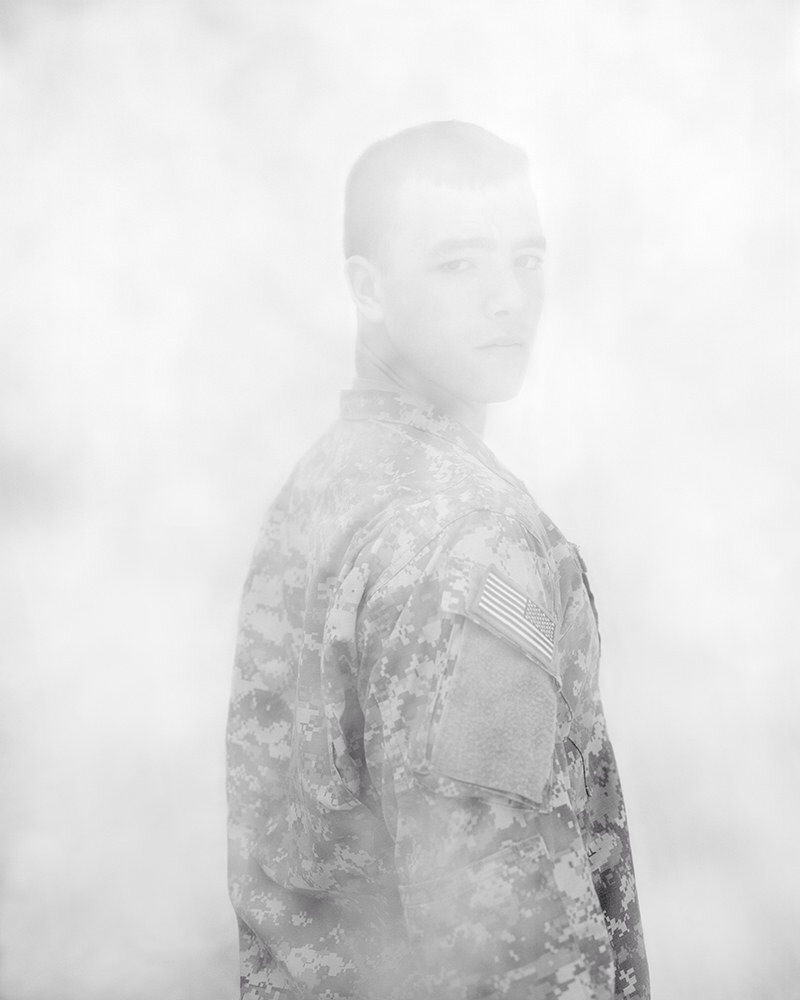
The photograph above is from Kristine Potter’s series of black and white photographs, The Grey Line, a collection of portraits made at The United States Military Academy at West Point. I loved the mist in this picture. To me, it was a perfect symbol for a Veterans Day commemoration.


Four Winds

IMG_7837.JPG

Four Winds
By Sara Teasdale

“Four winds blowing thro’ the sky,
You have seen poor maidens die,
Tell me then what I shall do
That my lover may be true.”
Said the wind from out the south,
“Lay no kiss upon his mouth,”
And the wind from out the west,
“Wound the heart within his breast,”
And the wind from out the east,
“Send him empty from the feast,”
And the wind from out the north,
“In the tempest thrust him forth,
When thou art more cruel than he,
Then will Love be kind to thee.”


Haunted Houses

IMG_6610.JPG

Haunted Houses
By Henry Wadsworth Longfellow, 1807 – 1882

All houses wherein men have lived and died
Are haunted houses. Through the open doors
The harmless phantoms on their errands glide,
With feet that make no sound upon the floors.

We meet them at the door-way, on the stair,
Along the passages they come and go,
Impalpable impressions on the air,
A sense of something moving to and fro.

There are more guests at table than the hosts
Invited; the illuminated hall
Is thronged with quiet, inoffensive ghosts,
As silent as the pictures on the wall.

The stranger at my fireside cannot see
The forms I see, nor hear the sounds I hear;
He but perceives what is; while unto me
All that has been is visible and clear.

We have no title-deeds to house or lands;
Owners and occupants of earlier dates
From graves forgotten stretch their dusty hands,
And hold in mortmain still their old estates.

The spirit-world around this world of sense
Floats like an atmosphere, and everywhere
Wafts through these earthly mists and vapours dense
A vital breath of more ethereal air.

Our little lives are kept in equipoise
By opposite attractions and desires;
The struggle of the instinct that enjoys,
And the more noble instinct that aspires.

These perturbations, this perpetual jar
Of earthly wants and aspirations high,
Come from the influence of an unseen star
An undiscovered planet in our sky.

And as the moon from some dark gate of cloud
Throws o’er the sea a floating bridge of light,
Across whose trembling planks our fancies crowd
Into the realm of mystery and night,—

So from the world of spirits there descends
A bridge of light, connecting it with this,
O’er whose unsteady floor, that sways and bends,
Wander our thoughts above the dark abyss.

Henry Wadsworth Longfellow
Henry Wadsworth Longfellow, one of the “Fireside Poets,” wrote lyrical poems about history, mythology, and legend that were popular and widely translated, making him the most famous American of his day.

I’ve always loved a good ghost story. Do you think ghost stories are silly or interesting? Do you have a favorite? Do you believe in ghosts?

I find ghost stories fascinating, and I do have a few favorites. And, I do believe in ghosts. I think some souls just have a hard time moving on in the afterlife.


Rome at the Pyramid of Cestius Near the Graves of Shelley and Keats

IMG_9100.JPG

Rome at the Pyramid of Cestius Near the Graves of Shelley and Keats (1887)
By Thomas Hardy

Who, then, was Cestius,
And what is he to me? –
Amid thick thoughts and memories multitudinous
One thought alone brings he.

I can recall no word
Of anything he did;
For me he is a man who died and was interred
To leave a pyramid

Whose purpose was exprest
Not with its first design,
Nor till, far down in Time, beside it found their rest
Two countrymen of mine.

Cestius in life, maybe,
Slew, breathed out threatening;
I know not. This I know: in death all silently
He does a kindlier thing,

In beckoning pilgrim feet
With marble finger high
To where, by shadowy wall and history-haunted street,
Those matchless singers lie . . .

–Say, then, he lived and died
That stones which bear his name
Should mark, through Time, where two immortal Shades abide;
It is an ample fame.

The Protestant Cemetery of Rome, now officially called the Cimitero acattolico (“Non-Catholic Cemetery”) and often referred to as the Cimitero degli Inglesi (“Englishmen’s Cemetery”), is located near Porta San Paolo alongside the Pyramid of Cestius, a small-scale Egyptian-style pyramid built in 30 BC as a tomb and later incorporated into the section of the Aurelian Walls that borders the cemetery. The presence of Mediterranean cypress, pomegranate, and other trees, and a grassy meadow suggests the more naturalistic landscape style of northern Europe, where cemeteries sometimes incorporate grass and other greenery. As the official name indicates, it is the final resting place of non-Catholics including but not exclusive to Protestants or British and Americans. It contains the graves of many Orthodox Christians, Jews, Muslims and other non-Christians. It is one of the oldest burial grounds in continuous use in Europe, having started to be used around 1716.

The Cimitero Acattolico di Roma contains possibly the highest density of famous and important graves anywhere in the world. It is the final resting-place of the poets Shelley and Keats, of many painters, sculptors and authors, a number of scholars, several diplomats, Goethe’s only son, and Antonio Gramsci, a founding father of European Communism, to name only a few.

When you visit this cemetery in Rome, one of the first sites you see is the Pyramid of Cestius. I have to admit, the Protestant cemeteries in Rome and Florence were two of the highlights of my research trip to Italy several years ago. Not only are cemeteries a great source of research, but also the gravestones are often more than just markings for the dead, but works of art. One of those pieces of art is the Angel of Grief, an 1894 sculpture by William Wetmore Story which serves as the grave stone of the artist and his wife Emelyn Story. The grave is now used to describe multiple grave stones throughout the world erected in the style of the Story stone.

IMG_9099.JPG

If you are ever in Rome, you really should visit the Cimitero Acattolico di Roma.


Once More Unto the Breach

IMG_1814.JPG

From Henry V
By William Shakespeare

Once more unto the breach, dear friends, once more;
Or close the wall up with our English dead.
In peace there’s nothing so becomes a man
As modest stillness and humility:
But when the blast of war blows in our ears,
Then imitate the action of the tiger;
Stiffen the sinews, summon up the blood,
Disguise fair nature with hard-favour’d rage;
Then lend the eye a terrible aspect;
Let pry through the portage of the head
Like the brass cannon; let the brow o’erwhelm it
As fearfully as doth a galled rock
O’erhang and jutty his confounded base,
Swill’d with the wild and wasteful ocean.
Now set the teeth and stretch the nostril wide,
Hold hard the breath and bend up every spirit
To his full height. On, on, you noblest English.
Whose blood is fet from fathers of war-proof!
Fathers that, like so many Alexanders,
Have in these parts from morn till even fought
And sheathed their swords for lack of argument:
Dishonour not your mothers; now attest
That those whom you call’d fathers did beget you.
Be copy now to men of grosser blood,
And teach them how to war. And you, good yeoman,
Whose limbs were made in England, show us here
The mettle of your pasture; let us swear
That you are worth your breeding; which I doubt not;
For there is none of you so mean and base,
That hath not noble lustre in your eyes.
I see you stand like greyhounds in the slips,
Straining upon the start. The game’s afoot:
Follow your spirit, and upon this charge
Cry ‘God for Harry, England, and Saint George!’

Yesterday I wrote about the Equal Rights Amendment and how I believe we should have a new ERA that includes LGBT equality. The ERA was introduced into every Congress from 1923 until it was passed in 1972. It was a long fought battle, which was never won. Once it had passed through Congress, there were fifty battles to be fought and a minimum of thirty-eight had to be won. Those fighting the good fight, lost three battles too many. Once more into the breach we should go and fight the good fight again, but this time we should make sure that all men and women are equal.


The Night They Drove Old Dixie Down

IMG_8730.JPG

The Night They Drove Old Dixie Down
By Robbie Robertson

Virgil Kane is the name
And I served on the Danville train
‘Till Stoneman’s cavalry came
And tore up the tracks again

In the winter of ’65
We were hungry, just barely alive
By May the 10th, Richmond had fell
It’s a time I remember, oh so well

The night they drove old Dixie down
And the bells were ringing
The night they drove old Dixie down
And the people were singing
They went, “Na, na, la, na, na, la”

Back with my wife in Tennessee
When one day she called to me
“Virgil, quick, come see,
There goes Robert E. Lee!”

Now, I don’t mind chopping wood
And I don’t care if the money’s no good
You take what you need
And you leave the rest
But they should never
Have taken the very best

The night they drove old Dixie down
And the bells were ringing
The night they drove old Dixie down
And all the people were singing
They went, “Na, na, la, na, na, la”

Like my father before me
I will work the land
And like my brother above me
Who took a rebel stand

He was just 18, proud and brave
But a Yankee laid him in his grave
I swear by the mud below my feet
You can’t raise a Kane back up
When he’s in defeat

The night they drove old Dixie down
And the bells were ringing
The night they drove old Dixie down
And all the people were singing
They went, “Na, na, la, na, na, la”

The night they drove old Dixie down
And all the bells were ringing
The night they drove old Dixie down
And the people were singing
They went, “Na, na, la, na, na, la”

Robbie Robertson wrote this song, which is about the American Civil War – “Dixie” is a term indicating the old American South, and was defeated by the Union army. Robertson came up with the music for this song, and then got the idea for the lyrics when he thought about the saying “The South will rise again,” which he heard the first time he visited the South. This led him to research the Civil War.

The song’s lyric refers to conditions in the Southern states in the winter of early 1865 (“We were hungry / Just barely alive”); the Confederate states are starving and defeated. Reference is made to the date May 10, 1865, by which time the Confederate capital of Richmond had long since fallen (in April); May 10 marked the capture of Confederate President Jefferson Davis and the definitive end of the Confederacy.

I decided to choose this song because of the Supreme Court turned away appeals Monday from five states seeking to prohibit same-sex marriages, paving the way for an immediate expansion of gay and lesbian unions. By refusing to hear the appeals, the Supreme Court is driving Old Dixie down. Yesterday’s decision only effects the southern state of Virginia, plus four northern states (though Oklahoma can be considered either).

The justices on Monday did not comment in rejecting the appeals from Wisconsin, Indiana (both Seventh Circuit), Oklahoma, Utah (both Tenth Circuit), and Virginia (Fourth Circuit). The First, Second, and Third Circuits are made up of states with marriage equality already in force.

The court’s order immediately ends delays on marriage in those states. Couples in six other states — Colorado, Kansas, North Carolina, South Carolina, West Virginia and Wyoming — should be able to get married in short order. Those states would be bound by the same appellate rulings that were put on hold pending the Supreme Court’s review.

That would make same-sex marriage legal in 30 states and the District of Columbia. No other state cases were currently pending with the high court, but the justices stopped short of resolving for now the question of same-sex marriage nationwide.

Two other appeals courts, in Cincinnati and San Francisco, could issue decisions any time in same-sex marriage cases. Judges in the Cincinnati-based Sixth Circuit who are weighing pro-gay marriage rulings in Kentucky, Michigan, Ohio and Tennessee, appeared more likely to rule in favor of state bans than did the Ninth Circuit judges in San Francisco, who are considering Idaho and Nevada restrictions on marriage. This would leave only the Fifth, Eighth, and Eleventh Circuits without rulings on marriage equality, though cases are making their way through the courts in these Circuits.

Experts and advocates on both sides of the issue believed the justices would step in and decide gay marriage cases this term. However, the justices sidestepped the issue for now. Advocates believe that the justices have an obligation to settle an issue of such national importance, not abdicate that responsibility to lower court judges. Opting out of hearing the cases leaves those lower court rulings in place, but it leaves twenty states in a state of limbo.

It takes just four of the nine justices to vote to hear a case, but it takes a majority of at least five for an eventual ruling. Monday’s opaque order did not indicate how the justices voted on whether to hear the appeals. Of there is a dispute with the Sixth Circuit ruling against marriage equality, then the Supreme Court will likely be forced to hear the case and make a nationwide decision. Only time will tell, but the Fifth, Eighth, and Eleventh Circuits will likely eventually rule along the lines of what is expected of the Sixth Circuit, which will be further reason for the Court to take the case since their will be conflict in the lower courts. The Fifth and Eleventh Circuits are comprised of the Old Confederacy, a section of the country that is staunchly anti-LGBT rights. Virginia may have been brought down but the fight is not over.



Every Day

IMG_8904.JPG

Every Day
Written by Jeffrey Steele and Alissa Moreno
Recorded by Rascal Flatts

You could’ve bowed out gracefully
But you didn’t
You knew enough to know
To leave well enough alone
But you wouldn’t
I drive myself crazy
Tryin’ to stay out of my own way
The messes that I make
But my secrets are so safe
The only one who gets me
Yeah, you get me
It’s amazing to me

How every day
Every day, every day
You save my life

I come around all broken down and
Crowded out
And you’re comfort
Sometimes the place I go
Is so deep and dark and desperate
I don’t know, I don’t know

How every day
Every day, every day
You save my life

Sometimes I swear, I don’t know if
I’m comin’ or goin’
But you always say something
Without even knowin’
That I’m hangin’ on to your words
With all of my might and it’s alright
Yeah, I’m alright for one more night-
Every day
Every day, every day, every day
Every day, every day
You save me, you save me, oh, oh, oh
Every day
Every, every, every day-

Every day you save my life

Jeffrey Steele, one of the song’s co-writers, was inspired to write down the title after meeting singer Sarah Buxton at a restaurant in Nashville, Tennessee. Buxton told Steele about her roommate, saying “Every day, she saves my life”. Steele then went home thinking about a lyric. Later on, while at a songwriting seminar in Colorado, Steele met songwriter Alissa Moreno, who was playing a melody on the piano. Steele then sang the title that he had written alongside Moreno’s melody, they worked on the lyric and melody, and the song was completed. He then sent the song to record producer Dann Huff, who recommended the song to Rascal Flatts. The group then recorded it for their Still Feels Good album, giving Moreno her second outside cut as a songwriter.

A friend sent me the lyrics to this song in a very sweet card. In the card, he wrote about all the reasons he thought this song described me. The thing is, it really describes him from my perspective. He’s always been there for me when I was down. He’s always been their encouraging me to be a better person, and I really do try. I value our friendship and though my friend may say that every day, I save his life, he’s the one that saves mine everyday by being my friend. Through thick and thin, he’s a true friend. I love you, my friend.


Amendment

IMG_8726.JPG

Amendment
By Christina Davis

The love of each of us
for some of us,

of some of us

for all of us—

and what would come if it were
welcome, if learning were
to prepare “a self with which to

welcome”

the in-

admissible, stranger

whose very being gives
evidence of
a discrepancy. School of our just

beginning to think
about this, I believe
the seats will be peopled.

About This Poem

“The idea that emerged through the poem was that each generation enlarges what we as a people are capable of receiving, that the amendments to the Constitution recognize an increase in what we constitute. Though each generation confronts a new concept of what is strange, the task remains the same: when I look back on the progress of America (and other nations and peoples) it takes the form of this incremental admission, and when I consider future progress it is likewise this reception of the heretofore strange.

The original version of the poem had the word ‘education,’ but I changed it to ‘learning’ because learning is continuous throughout our lifetime and I did not want to limit this progress to the young.

I’d also been thinking of poetry itself, both the struggle of poems to integrate and include and also the way in which poetry is often called ‘inaccessible.’ Whereas I would suggest that the limitation has to do with its reception: it is treated as the ‘inadmissible,’ not what won’t let us in, but what we refuse to allow too near. Imagine what would come if it were welcome?”
—Christina Davis

Christina Davis is the author of An Ethic (Nightboat Books, 2013). She is the Curator of the Woodberry Poetry Room at Harvard University and lives in Cambridge