Category Archives: Poetry

The Pumpkin by John Greenleaf Whittier

The Pumpkin
by John Greenleaf Whittier

Oh, greenly and fair in the lands of the sun,
The vines of the gourd and the rich melon run,
And the rock and the tree and the cottage enfold,
With broad leaves all greenness and blossoms all gold,
Like that which o’er Nineveh’s prophet once grew,
While he waited to know that his warning was true,
And longed for the storm-cloud, and listened in vain
For the rush of the whirlwind and red fire-rain.

On the banks of the Xenil the dark Spanish maiden
Comes up with the fruit of the tangled vine laden;
And the Creole of Cuba laughs out to behold
Through orange-leaves shining the broad spheres of gold;
Yet with dearer delight from his home in the North,
On the fields of his harvest the Yankee looks forth,
Where crook-necks are coiling and yellow fruit shines,
And the sun of September melts down on his vines.

Ah! on Thanksgiving day, when from East and from West,
From North and from South comes the pilgrim and guest;
When the gray-haired New Englander sees round his board
The old broken links of affection restored,
When the care-wearied man seeks his mother once more,
And the worn matron smiles where the girl smiled before,
What moistens the lip and what brightens the eye?
What calls back the past, like the rich Pumpkin pie?

Oh, fruit loved of boyhood! the old days recalling,
When wood-grapes were purpling and brown nuts were falling!
When wild, ugly faces we carved in its skin,
Glaring out through the dark with a candle within!
When we laughed round the corn-heap, with hearts all in tune,
Our chair a broad pumpkin,—our lantern the moon,
Telling tales of the fairy who travelled like steam
In a pumpkin-shell coach, with two rats for her team!

Then thanks for thy present! none sweeter or better
E’er smoked from an oven or circled a platter!
Fairer hands never wrought at a pastry more fine,
Brighter eyes never watched o’er its baking, than thine!
And the prayer, which my mouth is too full to express,
Swells my heart that thy shadow may never be less,
That the days of thy lot may be lengthened below,
And the fame of thy worth like a pumpkin-vine grow,
And thy life be as sweet, and its last sunset sky
Golden-tinted and fair as thy own Pumpkin pie!

In the poem “The Pumpkin” by 19th century poet John Greenleaf Whittier, the tradition of Thanksgiving is described as a time of remembrance and return, a celebration of abundance, both of sustenance and of love, at a family gathering. The poet depicts the scene sensually, packing each line with the fruits of a healthy harvest and the warmth of a kitchen sweet from baking. By the end of the poem, the words achieve an almost too-full splendor:

And the prayer, which my mouth is too full to express,
Swells my heart that thy shadow may never be less,
That the days of thy lot may be lengthened below,
And the fame of thy worth like a pumpkin-vine grow…

Having lived on a farm his entire life, Whittier offers his reader the plentiful harvest as a symbol of a productive year, evoking the historical origin of Thanksgiving as the meal held in 1621 by the Wampanoag together with the Pilgrims who settled in Plymouth, Massachusetts; the harvest festival was a shared tradition of both cultures, and the account of a peaceful celebration between the two groups is still the basis for the holiday today. While some of the elements of the story are myths that were consciously exaggerated in the 1890s and early 1900s in the hopes of forging a national identity in the aftermath of the Civil War, the core message of acceptance and commonality still remains for many celebrants.

SOURCES:


The Book of David by Bryan Borland

THE BOOK OF DAVID
from My Life as Adam

by Bryan Borland

He’s divorced and remarried now,
blue collared factory slave
in Mississippi somewhere, shackled
to the second shift, daily
repetitive movements undoing history,
heat and grease replacing the smell
of freedom at sixteen,
of my bedroom in November, my parents off
chasing Rolling Stones.

He corrected me when I sang “bright red” instead
of “flat bed” Ford in “Take It Easy,”
said to treat it like a popsicle then
let me lay my head on his stomach

(most straight boys don’t).

So many men but he was the only one who
took the time to teach me.

I’d watch him communicate patiently with
his deaf younger brother, his rough hands
transformed through sign language,
a gentle education
on the complexities of the world.
These are my last memories of him.

I picture him now guiding the new guys on
how to operate the machines.

I picture them listening.

About the Author
Bryan Borland is a multi-time Pushcart-nominated poet from Little Rock, Arkansas, and the owner of Sibling Rivalry Press, LLC, a young publishing house whose goal is to develop, promote, and market underground artistic talent – those who don’t quite fit into the mainstream. As a poet, Bryan writes primarily narrative poems that create portraits of moments through words. Whether chronicling old friends and lovers in his “Book of” series (“The Book of David,” The Book of Cody,” “The Book of Dmitri,” etc.) or inviting us into his family through poems like “Sons of Abraham” and “Supper,” Bryan seeks to poetically etch tally marks into the walls of life; to, in essence, prove he’s been here.
His first collection of poetry, My Life as Adam, is a potent cocktail of family life, religion, and sexuality, the three pillars of Southern life. It was one of only five books of poetry selected by the American Library Association for their first annual “Over the Rainbow” list of noteworthy LGBT-themed publications. 
Through Sibling Rivalry Press, Borland has also worn the editor’s hat, putting together Ganymede Unfinished, a tribute to the late John Stahle and his beautiful journalGanymede that features the work of poets Jee Leong Koh, Jeff Mann, Matthew Hittinger, writers Charlie Vázquez, Perry Brass, and Scott Hess, artist Seth Ruggles Hiler, and photographer Eric Davis, among others. The success of Ganymede Unfinished led Bryan to create Assaracus, the world’s only quarterly print journal dedicated exclusively to gay male poets. Assaracus has exploded onto the poetry scene and has featured the work of Antler, Gavin Dillard, Raymond Luczak, and Emanuel Xavier.
Bryan is a staple at the Arkansas Literary Festival’s Pub or Perish reading series, and in 2011, he gave the keynote address of the Atlanta Queer Literary Festival. He was also named as one of the Arkansas Times‘ “Eight for the Future” in a cover story focusing on young Arkansans making an impact.
Bryan doesn’t mind, and, in fact, embraces being labeled a gay poet. As Philip F. Clark wrote to Borland while editing My Life as Adam, “Someone out there is waiting to read you. Write for yourself, but write for him, too.”
Want more Bryan? You can read an interview with him here , another interview with him here, and yet another interview with him here. You can add him as a friend onFacebook and can follow him on Twitter. You can also hang out with him if you ever get to Little Rock.

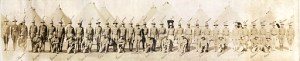
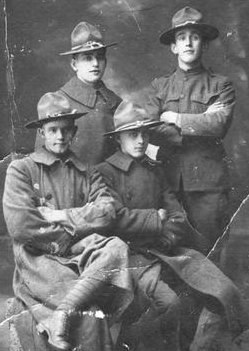
The Courage of Those Who Serve

In Flanders Fields
By: Lieutenant Colonel John McCrae, MD (1872-1918)
Canadian Army
In Flanders Fields the poppies blow
Between the crosses row on row,
That mark our place; and in the sky
The larks, still bravely singing, fly
Scarce heard amid the guns below.

We are the Dead. Short days ago
We lived, felt dawn, saw sunset glow,
Loved and were loved, and now we lie
In Flanders fields.

Take up our quarrel with the foe:
To you from failing hands we throw
The torch; be yours to hold it high.
If ye break faith with us who die
We shall not sleep, though poppies grow
In Flanders fields.

November 11, or what has come to be known as Veterans Day, was originally set as a U.S. legal holiday to honor Armistice Day – the end of World War I, which officially took place on November 11, 1918. In legislature that was passed in 1938, November 11 was “dedicated to the cause of world peace and to be hereafter celebrated and known as ‘Armistice Day.’ As such, this new legal holiday honored World War I veterans.

In 1954, after having been through both World War II and the Korean War, the 83rd U.S. Congress, at the urging of the veterans service organizations, amended the Act of1938 by striking out the word “Armistice” and inserting the word “Veterans.” With the approval of this legislation on June 1, 1954, November 11 became a day to honor American veterans of all wars.

McCrae’s “In Flanders Fields” remains to this day one of the most memorable war poems ever written. It is a lasting legacy of the terrible battle in the Ypres salient in the spring of 1915. Here is the story of the making of that poem:

Although he had been a doctor for years and had served in the South African War, it was impossible to get used to the suffering, the screams, and the blood here, and Major John McCrae had seen and heard enough in his dressing station to last him a lifetime.

John McCrae

As a surgeon attached to the 1st Field Artillery Brigade, Major McCrae, who had joined the McGill faculty in 1900 after graduating from the University of Toronto, had spent seventeen days treating injured men — Canadians, British, Indians, French, and Germans — in the Ypres salient.

It had been an ordeal that he had hardly thought possible. McCrae later wrote of it:

“I wish I could embody on paper some of the varied sensations of that seventeen days… Seventeen days of Hades! At the end of the first day if anyone had told us we had to spend seventeen days there, we would have folded our hands and said it could not have been done.”

One death particularly affected McCrae. A young friend and former student, Lieut. Alexis Helmer of Ottawa, had been killed by a shell burst on 2 May 1915. Lieutenant Helmer was buried later that day in the little cemetery outside McCrae’s dressing station, and McCrae had performed the funeral ceremony in the absence of the chaplain.

The next day, sitting on the back of an ambulance parked near the dressing station beside the Canal de l’Yser, just a few hundred yards north of Ypres, McCrae vented his anguish by composing a poem. The major was no stranger to writing, having authored several medical texts besides dabbling in poetry.

In the nearby cemetery, McCrae could see the wild poppies that sprang up in the ditches in that part of Europe, and he spent twenty minutes of precious rest time scribbling fifteen lines of verse in a notebook.

A young soldier watched him write it. Cyril Allinson, a twenty-two year old sergeant-major, was delivering mail that day when he spotted McCrae. The major looked up as Allinson approached, then went on writing while the sergeant-major stood there quietly. “His face was very tired but calm as we wrote,” Allinson recalled. “He looked around from time to time, his eyes straying to Helmer’s grave.”

When McCrae finished five minutes later, he took his mail from Allinson and, without saying a word, handed his pad to the young NCO. Allinson was moved by what he read:

“The poem was exactly an exact description of the scene in front of us both. He used the word blow in that line because the poppies actually were being blown that morning by a gentle east wind. It never occurred to me at that time that it would ever be published. It seemed to me just an exact description of the scene.”

In fact, it was very nearly not published. Dissatisfied with it, McCrae tossed the poem away, but a fellow officer retrieved it and sent it to newspapers in England. The Spectator, in London, rejected it, but Punch published it on 8 December 1915.


Courage by Anne Sexton

Courage 
by Anne Sexton

It is in the small things we see it.
The child’s first step,
as awesome as an earthquake.
The first time you rode a bike,
wallowing up the sidewalk.
The first spanking when your heart
went on a journey all alone.
When they called you crybaby
or poor or fatty or crazy
and made you into an alien,
you drank their acid
and concealed it.

Later,
if you faced the death of bombs and bullets
you did not do it with a banner,
you did it with only a hat to
comver your heart.
You did not fondle the weakness inside you
though it was there.
Your courage was a small coal
that you kept swallowing.
If your buddy saved you
and died himself in so doing,
then his courage was not courage,
it was love; love as simple as shaving soap.

Later,
if you have endured a great despair,
then you did it alone,
getting a transfusion from the fire,
picking the scabs off your heart,
then wringing it out like a sock.
Next, my kinsman, you powdered your sorrow,
you gave it a back rub
and then you covered it with a blanket
and after it had slept a while
it woke to the wings of the roses
and was transformed.

Later,
when you face old age and its natural conclusion
your courage will still be shown in the little ways,
each spring will be a sword you’ll sharpen,
those you love will live in a fever of love,
and you’ll bargain with the calendar
and at the last moment
when death opens the back door
you’ll put on your carpet slippers
and stride out.


Thanatopsis

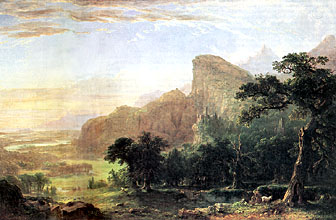
To commemorate All Saints Day and Día de los Muertos, I give you Thanatopsis by William Cullen Bryant.

THANATOPSIS
by: William Cullen Bryant (1794-1878)

Asher Durand: “Scene from Thanatopsis” (1850)

O him who in the love of Nature holds
Communion with her visible forms, she speaks
A various language; for his gayer hours
She has a voice of gladness, and a smile
And eloquence of beauty, and she glides
Into his darker musings, with a mild
And healing sympathy, that steals away
Their sharpness, ere he is aware. When thoughts
Of the last bitter hour come like a blight
Over thy spirit, and sad images
Of the stern agony, and shroud, and pall,
And breathless darkness, and the narrow house,
Make thee to shudder and grow sick at heart;–
Go forth, under the open sky, and list
To Nature’s teachings, while from all around–
Earth and her waters, and the depths of air–
Comes a still voice–Yet a few days, and thee
The all-beholding sun shall see no more
In all his course; nor yet in the cold ground,
Where thy pale form was laid with many tears,
Nor in the embrace of ocean, shall exist
Thy image. Earth, that nourish’d thee, shall claim
Thy growth, to be resolved to earth again,
And, lost each human trace, surrendering up
Thine individual being, shalt thou go
To mix for ever with the elements,
To be a brother to the insensible rock,
And to the sluggish clod, which the rude swain
Turns with his share, and treads upon. The oak
Shall send his roots abroad, and pierce thy mould.

Yet not to thine eternal resting-place
Shalt thou retire alone, nor couldst thou wish
Couch more magnificent. Thou shalt lie down
With patriarchs of the infant world–with kings,
The powerful of the earth–the wise, the good,
Fair forms, and hoary seers of ages past,
All in one mighty sepulchre. The hills
Rock-ribb’d and ancient as the sun,–the vales
Stretching in pensive quietness between;
The venerable woods; rivers that move
In majesty, and the complaining brooks
That make the meadows green; and, pour’d round all,
Old Ocean’s grey and melancholy waste,–
Are but the solemn decorations all
Of the great tomb of man. The golden sun,
The planets, all the infinite host of heaven,
Are shining on the sad abodes of death,
Through the still lapse of ages. All that tread
The globe are but a handful to the tribes
That slumber in its bosom.–Take the wings
Of morning, pierce the Barcan wilderness,
Or lose thyself in the continuous woods
Where rolls the Oregon and hears no sound
Save his own dashings–yet the dead are there:
And millions in those solitudes, since first
The flight of years began, have laid them down
In their last sleep–the dead reign there alone.
So shalt thou rest: and what if thou withdraw
In silence from the living, and no friend
Take note of thy departure? All that breathe
Will share thy destiny. The gay will laugh
When thou art gone, the solemn brood of care
Plod on, and each one as before will chase
His favourite phantom; yet all these shall leave
Their mirth and their employments, and shall come
And make their bed with thee. As the long train
Of ages glides away, the sons of men,
The youth in life’s green spring, and he who goes
In the full strength of years, matron and maid,
The speechless babe, and the gray-headed man–
Shall one by one be gathered to thy side
By those who in their turn shall follow them.

So live, that when thy summons comes to join
The innumerable caravan which moves
To that mysterious realm where each shall take
His chamber in the silent halls of death,
Thou go not, like the quarry-slave at night,
Scourged by his dungeon; but, sustain’d and soothed
By an unfaltering trust, approach thy grave,
Like one who wraps the drapery of his couch
About him, and lies down to pleasant dreams.

William Cullen Bryant

(born Nov. 3, 1794, Cummington, Mass., U.S. — died June 12, 1878, New York, N.Y.) U.S. poet. At age 17 Bryant wrote “Thanatopsis,” a meditation on nature and death that remains his best-known poem; influenced by deism, it in turn influenced Ralph Waldo Emerson and Henry David Thoreau. Admitted to the bar at age 21, he spent nearly 10 years as an attorney, a profession he hated. His Poems (1821), including “To a Waterfowl,” secured his reputation. In 1825 he moved to New York City, where for almost 50 years (1829 – 78) he was editor in chief of the Evening Post, which he transformed into an organ of progressive thought.


We Have Not Long To Love

We Have Not Long To Love
BY TENNESSEE WILLIAMS

We have not long to love.
Light does not stay.
The tender things are those
we fold away.
Coarse fabrics are the ones
for common wear.
In silence I have watched you
comb your hair.
Intimate the silence,
dim and warm.
I could but did not, reach
to touch your arm.
I could, but do not, break
that which is still.
(Almost the faintest whisper
would be shrill.)
So moments pass as though
they wished to stay.
We have not long to love.
A night. A day….

Source: Poetry (February 1991).


Androgyne, Mon Amour

Androgyne, Mon Amour
BY TENNESSEE WILLIAMS


I

Androgyne, mon amour,
brochette de coeur was plat du jour,
(heart lifted on a metal skewer,
encore saignante et palpitante)
where I dined au solitaire,
table intime, one rose vase,
lighted dimly, wildly gay,
as, punctually, across the bay
mist advanced its pompe funèbre,
its coolly silvered drift of gray,
nightly requiem performed for
mourners who have slipped away…

Well, that’s it, the evening scene,
mon amour, Androgyne.

Noontime youths,
thighs and groins tight-jean-displayed,
loiter onto Union Square,
junkies flower-scattered there,
lost in dream, torso-bare,
young as you, old as I, voicing soundlessly
a cry,
oh, yes, among them
revolution bites its tongue beneath its fiery
waiting stare,
indifferent to siren’s wail,
ravishment endured in jail.
Bicentennial salute?
Youth made flesh of crouching brute.

(Dichotomy can I deny of pity in a lustful eye?)

II

Androgyne, mon amour,
shadows of you name a price
exorbitant for short lease.
What would you suggest I do,
wryly smile and turn away,
fox-teeth gnawing chest-bones through?

Even less would that be true
than, carnally, I was to you
many, many lives ago,
requiems of fallen snow.

And, frankly, well, they’d laugh at me,
thick of belly, thin of shank,
spectacle of long neglect,
tragedian of public mirth.

(Chekhov’s Mashas all wore black
for a reason I suspect:
Pertinence? None at all—
yet something made me think of that.)

“Life!” the gob exclaimed to Crane,
“Oh, life’s a geyser!”
Oui, d’accord—
from the rectum of the earth.

Bitter, that. Never mind.
Time’s only challenger is time.

III

Androgyne, mon amour,
cold withdrawal is no cure
for addiction grown so deep.
Now, finally, at cock’s crow,
released in custody of sleep,
dark annealment, time-worn stones
far descending,
no light there, no sound there,
entering depths of thinning breath,
farther down more ancient stones,
halting not, drawn on until

Ever treacherous, ever fair,
at a table small and square,
not first light but last light shows
(meaning of the single rose
where I dined au solitaire
sous l’ombre d’une jeunesse perdue?)

A ghostly little customs-clerk
(“Vos documents, Mesdames, Messieurs?”)
whose somehow tender mockery
contrives to make admittance here
at this mineral frontier
a definition of the pure…

Androgyne, mon amour.

San Francisco, 1976

“Androgyne, Mon Amour” by Tennessee Williams, from THE COLLECTED POEMS OF TENNESSEE WILLIAMS, copyright © 1937, 1956, 1964, 2002 by The University of the South. Used by permission of New Directions Publishing Corp.


Source: THE COLLECTED POEMS OF TENNESSEE WILLIAMS (New Directions Publishing Corporation, 2002)


For more about Tennessee Williams, Click on “Read More” below.

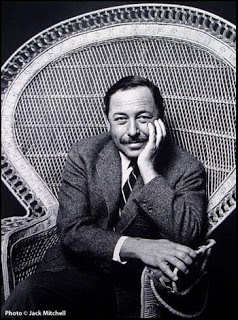
Tennessee Williams

1911–1983

The production of his first two Broadway plays, The Glass Menagerie and A Streetcar Named Desire, secured Tennessee Williams’s place, along with Eugene O’Neill and Arthur Miller, as one of America’s major playwrights of the twentieth century. Critics, playgoers, and fellow dramatists recognized in Williams a poetic innovator who, refusing to be confined in what Stark Young in the New Republic called “the usual sterilities of our playwriting patterns,” pushed drama into new fields, stretched the limits of the individual play and became one of the founders of the so-called “New Drama.” Praising The Glass Menagerie “as a revelation of what superb theater could be,” Brooks Atkinson in Broadway asserted that “Williams’s remembrance of things past gave the theater distinction as a literary medium.” Twenty years later, Joanne Stang wrote in the New York Times that “the American theater, indeed theater everywhere, has never been the same” since the premier of The Glass Menagerie.Four decades after that first play, C. W. E. Bigsby in A Critical Introduction to Twentieth-Century American Drama termed it “one of the best works to have come out of the American theater.” A Streetcar Named Desire became only the second play in history to win both the Pulitzer Prize and the New York Drama Critics Circle Award. Eric Bentley, in What Is Theatre?, called it the “master-drama of the generation.” “The inevitability of a great work of art,” T. E. Kalem stated in Albert J. Devlin’s Conversations with Tennessee Williams, “is that you cannot imagine the time when it didn’t exist. You can’t imagine a time when Streetcar didn’t exist.”

More clearly than with most authors, the facts of Williams’s life reveal the origins of the material he crafted into his best works. The Mississippi in which Thomas Lanier Williams was born March 26, 1911, was in many ways a world that no longer exists, “a dark, wide, open world that you can breathe in,” as Williams nostalgically described it in Harry Rasky’s Tennessee Williams: A Portrait in Laughter and Lamentation. The predominantly rural state was dotted with towns such as Columbus, Canton, and Clarksdale, in which he spent his first seven years with his mother, his sister, Rose, and his maternal grandmother and grandfather, an Episcopal rector. A sickly child, Tom was pampered by doting elders. In 1918, his father, a traveling salesman who had often been absent—perhaps, like his stage counterpart in The Glass Menagerie, “in love with long distances”—moved the family to St. Louis. Something of the trauma they experienced is dramatized in the 1945 play. The contrast between leisurely small-town past and northern big-city present, between protective grandparents and the hard-drinking, gambling father with little patience for the sensitive son he saw as a “sissy,” seriously affected both children. While Rose retreated into her own mind until finally beyond the reach even of her loving brother, Tom made use of that adversity. St. Louis remained for him “a city I loathe,” but the South, despite his portrayal of its grotesque aspects, proved a rich source to which he returned literally and imaginatively for comfort and inspiration. That background, his homosexuality, and his relationships—painful and joyous—with members of his family, were the strongest personal factors shaping Williams’s dramas.

During the St. Louis years, Williams found an imaginative release from unpleasant reality in writing essays, stories, poems, and plays. After attending the University of Missouri, Washington University—from which he earned a B.A. in 1938—and the University of Iowa, he returned to the South, specifically to New Orleans, one of two places where he was for the rest of his life to feel at home. Yet a recurrent motif in his plays involves flight and the fugitive, who, Lord Byron insists in Camino Real: A Play,must keep moving, and the flight from St. Louis initiated a nomadic life of brief stays in a variety of places. Williams fled not only uncongenial atmospheres but a turbulent family situation that had culminated in a decision for Rose to have a prefrontal lobotomy in an effort to alleviate her increasing psychological problems. (Williams’s works often include absentee fathers, enduring—if aggravating—mothers, and dependent relatives; and the memory of Rose appears in some character, situation, symbol or motif in almost every work after 1938.) He fled as well some part of himself, for he had created a new persona—Tennessee Williams the playwright—who shared the same body as the proper young gentleman named Thomas with whom Tennessee would always be to some degree at odds.

In 1940, Williams’s Battle of Angels was staged by the Theatre Guild in an ill-fated production marred as much by faulty smudge pots in the lynching scene as by Boston censorship. Despite the abrupt out-of-town closing of the play, Williams was now known and admired by powerful theater people. During the next two decades, his most productive period, one play succeeded another, each of them permanent entries in the history of modern theater: The Glass Menagerie, A Streetcar Named Desire, Summer and Smoke, The Rose Tattoo, Camino Real, Cat on a Hot Tin Roof, Orpheus Descending, Suddenly Last Summer, Sweet Bird of Youth, and The Night of the Iguana. Despite increasingly adverse criticism, Williams continued his work for the theater for two more decades, during which he wrote more than a dozen additional plays containing evidence of his virtues as a poetic realist. In the course of his long career he also produced three volumes of short stories, many of them as studies for subsequent dramas; two novels, two volumes of poetry; his memoirs; and essays on his life and craft. His dramas made that rare transition from legitimate stage to movies and television, from intellectual acceptance to popular acceptance. Before his death in 1983, he had become the best-known living dramatist; his plays had been translated and performed in many foreign countries, and his name and work had become known even to people who had never seen a production of any of his plays. The persona named Tennessee Williams had achieved the status of a myth.

Williams drew from the experiences of his persona. He saw himself as a shy, sensitive, gifted man trapped in a world where “mendacity” replaced communication, brute violence replaced love, and loneliness was, all too often, the standard human condition. These tensions “at the core of his creation” were identified by Harold Clurman in his introduction to Tennessee Williams: Eight Plays as a terror at what Williams saw in himself and in America, a terror that he must “exorcise” with “his poetic vision.” In an interview collected in Conversations with Tennessee Williams, Williams identified his main theme as a defense of the Old South attitude—”elegance, a love of the beautiful, a romantic attitude toward life”—and “a violent protest against those things that defeat it.” An idealist aware of what he called in a Conversations interview “the merciless harshness of America’s success-oriented society,” he was ironically, naturalistic as well, conscious of the inaccessibility of that for which he yearned. He early developed, according to John Gassner in Theatre at the Crossroads: Plays and Playwrights of the Mid-Century American Stage,“a precise naturalism” and continued to work toward a “fusion of naturalistic detail with symbolism and poetic sensibility rare in American playwriting.” The result was a unique romanticism, as Kenneth Tynan observed in Curtains,“which is not pale or scented but earthy and robust, the product of a mind vitally infected with the rhythms of human speech.”

Williams’s characters endeavor to embrace the ideal, to advance and not “hold back with the brutes,” a struggle no less valiant for being vain. In A Streetcar Named Desire Blanche’s idealization of life at Belle Reve, the DuBois plantation, cannot protect her once, in the words of the brutish Stanley Kowalski, she has come “down off them columns” into the “broken world,” the world of sexual desire. Since every human, as Val Xavier observes in Orpheus Descending, is sentenced “to solitary confinement inside our own lonely skins for as long as we live on earth,” the only hope is to try to communicate, to love, and to live—even beyond despair, as The Night of the Iguanateaches. The attempt to communicate often takes the form of sex (and Williams has been accused of obsession with that aspect of human existence), but at other times it becomes a willingness to show compassion, as when in The Night of the IguanaHannah Jelkes accepts the neuroses of her fellow creatures and when in Cat on a Hot Tin Roof, Big Daddy understands, as his son Brick cannot, the attachment between Brick and Skipper. In his preface to Cat on a Hot Tin Roof Williams might have been describing his characters’ condition when he spoke of “the outcry of prisoner to prisoner from the cell in solitary where each is confined for the duration of his life.” “The marvel is,” as Tynan stated, that Williams’s “abnormal” view of life, “heightened and spotlighted and slashed with bogey shadows,” can be made to touch his audience’s more normal views, thus achieving that “miracle of communication” Williams believed to be almost impossible.

Some of his contemporaries—Arthur Miller notably—responded to the modern condition with social protest, but Williams, after a few early attempts at that genre, chose another approach. Williams insisted in a Conversations interview that he wrote about the South not as a sociologist: “What I am writing about is human nature. . . . Human relations are terrifyingly ambiguous.” Williams chose to present characters full of uncertainties, mysteries, and doubts. Yet Arthur Miller himself wrote in The Theatre Essays of Tennessee Williams that although Williams might not portray social reality, “the intensity with which he feels whatever he does feel is so deep, is so great” that his audiences glimpse another kind of reality, “the reality in the spirit.” Clurman likewise argued that though Williams was no “propagandist,” social commentary is “inherent in his portraiture.” The inner torment and disintegration of a character like Blanche in A Streetcar Named Desire thus symbolize the lost South from which she comes and with which she is inseparably entwined. It was to that lost world and the unpleasant one which succeeded it that Williams turned for the majority of his settings and material.

Like that of most Southern writers, Williams’s work exhibits an abiding concern with time and place and how they affect men and women. “The play is memory,” Tom proclaims in The Glass Menagerie; and Williams’s characters are haunted by a past that they have difficulty accepting or that they valiantly endeavor to transform into myth. Interested in yesterday or tomorrow rather than in today, painfully conscious of the physical and emotional scars the years inflict, they have a static, dreamlike quality, and the result, Tynan observed, is “the drama of mood.” The Mississippi towns of his childhood continued to haunt Williams’s imagination throughout his career, but New Orleans offered him, he told Robert Rice in the 1958 New York Post interviews, a new freedom: “The shock of it against the Puritanism of my nature has given me a subject, a theme, which I have never ceased exploiting.” (That shabby but charming city became the setting for several stories and one-act plays, and A Streetcar Named Desire derives much of its distinction from French Quarter ambience and attitudes; as Stella informs Blanche, “New Orleans isn’t like other cities,” a view reinforced by Williams’s 1977 portrait of the place in Vieux Carre.) Atkinson observed, “Only a writer who had survived in the lower depths of a sultry Southern city could know the characters as intimately as Williams did and be so thoroughly steeped in the aimless sprawl of the neighborhood life.”

Williams’s South provided not only settings but other characteristics of his work—romanticism; a myth of an Arcadian existence now disappeared; a distinctive way of looking at life, including both an inbred Calvinistic belief in the reality of evil eternally at war with good, and what Bentley called a “peculiar combination of the comic and the pathetic.” The South also inspired Williams’s fascination with violence, his drawing upon regional character types, and his skill in recording Southern language—eloquent, flowery, sometimes bombastic. Moreover, Southern history, particularly the lost cause of the U.S. Civil War and the devastating Reconstruction period, imprinted on Williams, as on such major Southern fiction writers as William Faulkner, Flannery O’Connor, and Walker Percy, a profound sense of separation and alienation. Williams, as Thomas E. Porter declared in Myth and Modern American Drama, explored “the mind of the Southerner caught between an idyllic past and an undesirable present,” commemorating the death of a myth even as he continued to examine it. “His broken figures appeal,” Bigsby asserted, “because they are victims of history—the lies of the old South no longer being able to sustain the individual in a world whose pragmatics have no place for the fragile spirit.” In a Conversations interview the playwright commented that “the South once had a way of life that I am just old enough to remember—a culture that had grace, elegance. . . . I write out of regret for that.”

Williams’s plays are peopled with a large cast that J. L. Styan termed, in Modern Drama in Theory and Practice, “Garrulous Grotesques”; these figures include “untouchables whom he touches with frankness and mercy,” according to Tynan. They bear the stamp of their place of origin and speak a “humorous, colorful, graphic” language, which Williams in a Conversations interview called the “mad music of my characters.” “Have you ever known a Southerner who wasn’t long-winded?” he asked; “I mean, a Southerner not afflicted with terminal asthma.” Among that cast are the romantics who, however suspect their own virtues may be, act out of belief in and commitment to what Faulkner called the “old verities and truths of the heart.” They include fallen aristocrats hounded, Gerald Weales observed in American Drama since World War II, “by poverty, by age, by frustration,” or, as Bigsby called them in his 1985 study, “martyrs for a world which has already slipped away unmourned”; fading Southern belles such as Amanda Wingate and Blanche DuBois; slightly deranged women, such as Aunt Rose Comfort in an early one-act play and in the film “Baby Doll”; dictatorial patriarchs such as Big Daddy; and the outcasts (or “fugitive kind,” the playwright’s term later employed as the title of a 1960 motion picture). Many of these characters tend to recreate the scene in which they find themselves—Laura with her glass animals shutting out the alley where cats are brutalized, Blanche trying to subdue the ugliness of the Kowalski apartment with a paper lantern; in their dialogue they frequently poeticize and melodramatize their situations, thereby surrounding themselves with protective illusion, which in later plays becomes “mendacity.” For also inhabiting that dramatic world are more powerful individuals, amoral representatives of the new Southern order, Jabe Torrance in Battle of Angels, Gooper and Mae in Cat on a Hot Tin Roof, Boss Finley in Sweet Bird of Youth, enemies of the romantic impulse and as destructive and virtueless as Faulkner’s Snopes clan. Southern though all these characters are, they are not mere regional portraits, for through Williams’s dramatization of them and their dilemmas and through the audience’s empathy, the characters become everyman and everywoman.

Although traumatic experiences plagued his life, Williams was able to press “the nettle of neurosis” to his heart and produce art, as Gassner observed. Williams’s family problems, his alienation from the social norm resulting from his homosexuality, his sense of being a romantic in an unromantic, postwar world, and his sensitive reaction when a production proved less than successful all contributed significantly to his work. Through the years he suffered from a variety of ailments, some serious, some surely imaginary, and at certain periods he overindulged in alcohol and prescription drugs. Despite these circumstances, he continued to write with a determination that verged at times almost on desperation, even as his new plays elicited progressively more hostile reviews from critics.

An outgrowth of this suffering is the character type “the fugitive kind,” the wanderer who lives outside the pale of society, excluded by his sensitivity, artistic bent, or sexual proclivity from the world of “normal” human beings. Like Faulkner, Williams was troubled by the exclusivity of any society that shuts out certain segments because they are different. First manifested in Val of Battle of Angels (later rewritten as Orpheus Descending) and then in the character of Tom, the struggling poet of The Glass Menagerie and his shy, withdrawn sister, the fugitive kind appears in varying guises in subsequent plays, including Blanche DuBois, Alma Winemiller (Summer and Smoke), Kilroy (Camino Real), and Hannah and Shannon (The Night of the Iguana). Each is unique but they share common characteristics, which Weales summed up as physical or mental illness, a preoccupation with sex, and a “combination of sensitivity and imagination with corruption.” Their abnormality suggests, the critic argued, that the dramatist views the norm of society as being faulty itself. Even characters within the “norm” (Stanley Kowalski, for example) are often identified with strong sexual drives. Like D. H. Lawrence, Williams indulged in a kind of phallic romanticism, attributing sexual potency to members of the unintelligent lower classes and sterility to aristocrats. Despite his romanticism, however, Williams’s view of humanity was too realistic for him to accept such pat categories. “If you write a character that isn’t ambiguous,” Williams said in a Conversations interview, “you are writing a false character, not a true one.” Though he shared Lawrence’s view that one should not suppress sexual impulses, Williams recognized that such impulses are at odds with the romantic desire to transcend and that they often lead to suffering like that endured by Blanche DuBois. Those fugitive characters who are destroyed, Bigsby remarked, often perish “because they offer love in a world characterized by impotence and sterility.” Thus phallic potency may represent a positive force in a character such as Val or a destructive force in one like Stanley Kowalski; but even in A Streetcar Named DesireWilliams acknowledges that the life force, represented by Stella’s baby, is positive. There are, as Weales pointed out, two divisions in the sexual activity Williams dramatizes: “desperation sex,” in which characters such as Val and Blanche “make contact with another only tentatively, momentarily” in order to communicate; and the “consolation and comfort” sex that briefly fulfills Lady in Orpheus Descending and saves Serafina in The Rose Tattoo. There is, surely, a third kind, sex as a weapon, wielded by those like Stanley; this kind of sex is to be feared, for it is often associated with the violence prevalent in Williams’s dramas.

Beginning with Battle of Angels, two opposing camps have existed among Williams’s critics, and his detractors sometimes have objected most strenuously to the innovations his supporters deemed virtues. His strongest advocates among established drama critics, notably Stark Young, Brooks Atkinson, John Gassner, and Walter Kerr, praised him for realistic clarity; compassion and a strong moral sense; unforgettable characters, especially women, based on his keen perception of human nature; dialogue at once credible and poetic; and a pervasive sense of humor that distinguished him from O’Neill and Miller.

Not surprisingly, it was from the conservative establishment that most of the adverse criticism came. Obviously appalled by this “upstart crow,” George Jean Nathan, dean of theater commentators when Williams made his revolutionary entrance onto the scene, sounded notes often to be repeated. In The Theatre Book of the Year, 1947-1948, he faulted Williams’s early triumphs for “mistiness of ideology . . . questionable symbolism . . . debatable character drawing . . . adolescent point of view . . . theatrical fabrication,” obsession with sex, fallen women, and “the deranged Dixie damsel.” Nathan saw Williams as a melodramatist whose attempts at tragedy were as ludicrous as “a threnody on a zither.” Subsequent detractors—notably Richard Gilman, Robert Brustein, Clive Barnes, and John Simon—taxed the playwright for theatricality, repetition, lack of judgment and control, excessive moralizing and philosophizing, and conformity to the demands of the ticket-buying public. His plays, they variously argued, lacked unity of effect, clarity of intention, social content, and variety; these critics saw the plays as burdened with excessive symbolism, violence, sexuality, and attention to the sordid, grotesque elements of life. Additionally, certain commentators charged that Elia Kazan, the director of the early masterpieces, virtually rewrote A Streetcar Named Desire and Cat on a Hot Tin Roof. A particular kind of negative criticism, often intensely emotional, seemed to dominate evaluations of the plays produced in the last twenty years of Williams’s life.

Most critics, even his detractors, have praised the dramatist’s skillful creation of dialogue. Bentley asserted that “no one in the English-speaking theater” created better dialogue, that Williams’s plays were really “written—that is to say, set down in living language.” Ruby Cohn stated in Dialogue in American Drama that Williams gave to American theater “a new vocabulary and rhythm,” and Clurman concluded, “No one in the theater has written more melodiously. Without the least artificial flourish, his writing takes flight from the naturalistic to the poetic.” Even Mary McCarthy, no ardent fan, stated in Theatre Chronicles: 1937-1962 that Williams was the only American realist other than Paddy Chayevsky with an ear for dialogue, knew speech patterns, and really heard his characters. There were, of course, objections to Williams’s lyrical dialogue, different as it is from the dialogue of O’Neill, Miller, or any other major American playwright. Bentley admitted to finding his “fake poeticizing” troublesome at times, while Bigsby insisted that Williams was at his best only when he restrained “over-poetic language” and symbolism with “an imagination which if melodramatic is also capable of fine control.” However, those long poetic speeches or “arias” in plays of the first twenty-five years of his career became a hallmark of the dramatist’s work.

Another major area of contention among commentators has been Williams’s use of symbols, which he called in a Conversations interview “the natural language of drama.” Laura’s glass animals, the paper lantern and cathedral bells in A Streetcar Named Desire, the legless birds of Orpheus Descending, and the iguana in The Night of the Iguana, to name only a few, are integral to the plays in which they appear. Cohn commented on Williams’s extensive use of animal images in Cat on a Hot Tin Roof to symbolize the fact that all the Pollitts, “grasping, screeching, devouring,” are “greedily alive.” In that play, Big Daddy’s malignancy effectively represents the corruption in the family and in the larger society to which the characters belong. However, Weales objected that Williams, like The Glass Menagerie ‘s Tom, had “a poet’s weakness for symbols,” which can get out of hand; he argued that in Suddenly Last Summer, Violet Venable’s garden does not grow out of the situation and enrich the play. Sometimes, Cohn observed, a certain weakness of symbolism “is built into the fabric of the drama.”

Critics favorable to Williams have agreed that one of his virtues lay in his characterization. Those “superbly actable parts,” Atkinson stated, derived from his ability to find “extraordinary spiritual significance in ordinary people.” Cohn admired Williams’s “Southern grotesques” and his knack for giving them “dignity,” although some critics have been put off by the excessive number of such grotesques, which contributed, they argued, to a distorted view of reality. Commentators have generally concurred in their praise of Williams’s talent in creating credible female roles. “No one in American drama has written more intuitively of women,” Clurman asserted; Gassner spoke of Williams’s “uncanny familiarity with the flutterings of the female heart.” Kerr in The Theatre in Spite of Itself expressed wonder at such roles as that of Hannah in The Night of the Iguana, “a portrait which owes nothing to calipers, or to any kind of tooling; it is all surprise and presence, anticipated intimacy. It is found gold, not a borrowing against known reserves.” Surveying the “steamy zoo” of Williams’s characters with their violence, despair, and aberrations, Stang commended the author for the “poetry and compassion that comprise his great gift.” Compassion is the key word in all tributes to Williams’s characterization. It is an acknowledgment of the playwright’s uncanny talent for making audiences and readers empathize with his people, however grotesque, bizarre, or even sordid they may seem on the surface.

Although they have granted him compassion, some of his detractors maintain that Williams does not exhibit a clear philosophy of life, and they have found unacceptable the ambiguity in judging human flaws and frailties that is one of his most distinctive qualities. For them, one difficulty stems from the playwright’s recognition of and insistence on portraying the ambiguity of human activities and relationships. Moral, even puritanical, though he might be, Williams never seems ready to condemn any action other than “deliberate cruelty,” and even that is sometimes portrayed as resulting from extenuating circumstances.

In terms of dramatic technique, those who acknowledge his genius disagree as to where it has been best expressed. For Jerold Phillips, writing in the Dictionary of Literary Biography Documentary Series, Williams’s major contribution lay in turning from the Ibsenesque social problem plays to “Strindberg-like explorations of what goes on underneath the skin,” thereby freeing American theater from “the hold of the so-called well-made play.” For Allan Lewis in American Plays and Playwrights of the Contemporary Theatre, he was a “brilliant inventor of emotionally intense scenes” whose “greatest gift [lay] in suggesting ideas through emotional relations.” His preeminence among dramatists in the United States, Jean Gould wrote in Modern American Playwrights, resulted from a combination of poetic sensitivity, theatricality, and “the dedication of the artist.” If, from the beginning of his career, there were detractors who charged Williams with overuse of melodramatic, grotesque, and violent elements that produced a distorted view of reality, Kerr, in The Theatre in Spite of Itself, termed him “a man unafraid of melodrama, and a man who handles it with extraordinary candor and deftness.”

Other commentators have been offended by what Bentley termed Williams’s “exploitation of the obscene”: his choice of characters—outcasts, alcoholics, the violent and deranged and sexually abnormal—and of subject matter—incest, castration, and cannibalism. Williams justified the “sordid” elements of his work in a Conversationsinterview when he asserted that “we must depict the awfulness of the world we live in, but we must do it with a kind of aesthetic” to avoid producing mere horror.

Another negative aspect of Williams’s art, some critics argued, was his theatricality. Gassner asserted in Directions in Modern Theatre and Drama that Kazan, the director, avoided flashy stage effects called for in Williams’s text of The Glass Menagerie, but that in some plays Kazan collaborated with the playwright to exaggerate these effects, especially in the expressionistic and allegorical drama Camino Real. In a Conversations interview, Williams addressed this charge, particularly as it involved Kazan, by asserting, “My cornpone melodrama is all my own. I want excitement in the theater. . . . I have a tendency toward romanticism and a taste for the theatrical.”

Late in his career, Williams was increasingly subject to charges that he had outlived his talent. Beginning with Period of Adjustment, a comedy generally disliked by critics, there were years of rejection of play after play. By the late 1960s, even the longtime advocate Atkinson observed that in “a melancholy resolution of an illustrious career” the dramatist was producing plays “with a kind of desperation” in which he lost control of content and style. Lewis, accusing Williams of repeating motifs, themes, and characters in play after play, asserted that in failing “to expand and enrich” his theme, he had “dissipated a rare talent.” Gilman, in a particularly vituperative review titled “Mr. Williams, He Dead,” included in his Common and Uncommon Masks: Writings on Theatre, 1961-1970, charged that the “moralist,” subtly present in earlier plays, was “increasingly on stage.” Even if one granted a diminution of creative powers, however, the decline in Williams’s popularity and position as major playwright in the 1960s and 1970s can be attributed in large part to a marked change in the theater itself. Audiences constantly demanded variety, and although the early creations of the playwright remained popular, theatergoers wanted something different, strange, exotic. One problem, Kerr pointed out, was that Williams was so good, people expected him to continue to get better; judging each play against those which had gone before denied a fair hearing to the new creations.

The playwright’s accidental death came when his career, after almost two decades of bad reviews and of dismissals of his “dwindling talents,” was at its lowest ebb since the abortive 1940 production of Battle of Angels. Following Williams’s death, however, the inevitable reevaluation began. Bigsby, for example, found in a reanalysis of the late plays more than mere vestiges of the strengths of earlier years, especially in Out Cry,an experimental drama toward which Williams felt a particular affection. Some of those who had been during his last years his severest critics acknowledged the greatness of his achievement. Even Simon, who had dismissed play after play as valueless repetitions created by an author who had outlived his talent, acknowledged in New York that he had underestimated the playwright’s genius and significance. Williams was, finally, viewed by formerly skeptical observers, as a rebel who broke with the rigid conventions of drama that had preceded him, explored new territory in his quest for a distinctive form and style, created characters as unforgettable as those of Charles Dickens, Nathaniel Hawthorne, or William Faulkner, and lifted the language of the modern stage to a poetic level unmatched in his time.

Posthumous publications of Williams’s writings—correspondence and plays among them—show the many sides of this complex literary legend. Five o’Clock Angel: Letters of Tennessee Williams to Maria St. Just, 1948-1982 takes its title from the name the author gave to Russian-born actress and socialite Maria Britneva, later Maria St. Just, “the confidante Williams wrote to in the evening after his day’s work—his ‘Five o’Clock Angel,’ as he called her in a typically genteel, poetic periphrasis,” noted Edmund White in a piece for the New York Times Book Review. These letters, White added, allow readers “to see the source of everything in his work that was lyrical, innocent, loving, and filled with laughter.” Among the other Williams works published posthumously is Something Cloudy, Something Clear. A play first produced in 1981 and published in 1995, Something Cloudy, Something Clear recounts the author’s homosexual relationship with a doomed dancer in Provincetown. Homosexuality—this time in a violent context—also takes center stage in Not about Nightingales, a tale of terror in a men’s prison. Actress Vanessa Redgrave reportedly played a key role in bringing this early play—written circa 1939—to the London stage in 1998.

Whatever the final judgment of literary historians on the works of Tennessee Williams, certain facts are clear. He was, without question, the most controversial American playwright, a situation unlikely to change as the debate over his significance and the relative merits of individual plays continues. Critics, scholars, and theatergoers do not remain neutral in regard to the man or his work. He is also the most quotable of American playwrights, and even those who disparage the highly poetic dialogue admit the uniqueness of the language he brought to modern theater. In addition, Williams has added to dramatic literature a cast of remarkable, memorable characters and has turned his attention and sympathy toward people and subjects that, before his time, had been considered beneath the concern of serious authors. With “distinctive dramatic feeling,” Gassner said in Theatre at the Crossroads, Williams “made pulsating plays out of his visions of a world of terror, confusion, and perverse beauty.” As a result, Gassner concluded, Williams “makes indifference to the theater virtually impossible.”


CAREER

Playwright, novelist, short story writer, and poet; full-time writer, 1944-83. International Shoe Co., St. Louis, MO, clerical worker and manual laborer, 1934-36; worked various jobs, including waiter and hotel elevator operator, New Orleans, LA, 1939; worked as teletype operator, Jacksonville, FL, 1940; worked various jobs, including waiter and theater usher, New York, NY, 1942; worked as screenwriter for Metro-Goldwyn-Mayer, 1943. Codirector of his play Period of Adjustment, 1959.

A collection of Williams’s manuscripts and letters is located at the Humanities Research Center of the University of Texas at Austin. “Blue Song,” a previously undiscovered 17-line poem written in Williams’s exam book for his Greek final at Washington University in St. Louis, was discovered in 2005 by Washington University professor Henry Schvey in Williams’s papers at the Faulkner House Books in New Orleans.


Acceptance

Acceptance
The guilt, the anguish, the torture and the pain
I’ve struggled with this demon, always knowing it was in vain
Once a free spirit, a picture of joy, 
but the mask I have worn, I now have to destroy.
The awful lies and continuous deception,
Destined to be ruined by my own self-destruction
But the time has come to face the truth of my soul
I won’t be consumed by the decay of this black hole.
Before you judge me please hold on to this thought:
I am still the same person; it was never your fault.
I have come to accept who I am today
Please do the same mother, father; I am gay.


Ode to Walt Whitman

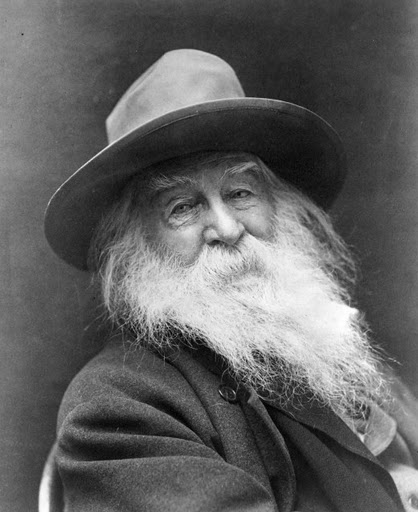
Eakins was profoundly influenced by the ideas of Walt Whitman, with whom he became close friends, after painting his portrait in 1887-1888. Eakins’ carefully composed images of naked youths in arcadian landscape settings (such as The Swimming Hole, 1893-1895) constitute visual equivalents of Whitman’s poems, celebrating male beauty and comradeship. Eakins often painted scenes of all-male athletic activities, such as rowing (for example, The Biglin Brothers Turning the Stake, 1873) and boxing (for example, Counting Out, 1888).

Ode to Walt Whitman
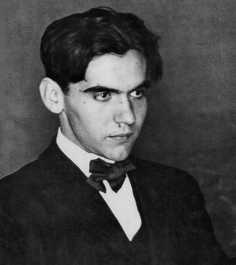
by Federico Garcia Lorca

By the East River and the Bronx
boys were singing, exposing their waists
with the wheel, with oil, leather, and the hammer.
Ninety thousand miners taking silver from the rocks
and children drawing stairs and perspectives.

But none of them could sleep,
none of them wanted to be the river,
none of them loved the huge leaves
or the shoreline’s blue tongue.

By the East River and the Queensboro
boys were battling with industry
and the Jews sold to the river faun
the rose of circumcision,
and over bridges and rooftops, the mouth of the sky emptied
herds of bison driven by the wind.

But none of them paused,
none of them wanted to be a cloud,
none of them looked for ferns
or the yellow wheel of a tambourine.

As soon as the moon rises
the pulleys will spin to alter the sky;
a border of needles will besiege memory
and the coffins will bear away those who don’t work.

New York, mire,
New York, mire and death.
What angel is hidden in your cheek?
Whose perfect voice will sing the truths of wheat?
Who, the terrible dream of your stained anemones?

Not for a moment, Walt Whitman, lovely old man,
have I failed to see your beard full of butterflies,
nor your corduroy shoulders frayed by the moon,
nor your thighs pure as Apollo’s,
nor your voice like a column of ash,
old man, beautiful as the mist,
you moaned like a bird
with its sex pierced by a needle.
Enemy of the satyr,
enemy of the vine,
and lover of bodies beneath rough cloth…

Not for a moment, virile beauty,
who among mountains of coal, billboards, and railroads,
dreamed of becoming a river and sleeping like a river
with that comrade who would place in your breast
the small ache of an ignorant leopard.

Not for a moment, Adam of blood, Macho,
man alone at sea, Walt Whitman, lovely old man,
because on penthouse roofs,
gathered at bars,
emerging in bunches from the sewers,
trembling between the legs of chauffeurs,
or spinning on dance floors wet with absinthe,
the faggots, Walt Whitman, point you out.

He’s one, too! That’s right! And they land
on your luminous chaste beard,
blonds from the north, blacks from the sands,
crowds of howls and gestures,
like cats or like snakes,
the faggots, Walt Whitman, the faggots,
clouded with tears, flesh for the whip,
the boot, or the teeth of the lion tamers.

He’s one, too! That’s right! Stained fingers
point to the shore of your dream
when a friend eats your apple
with a slight taste of gasoline
and the sun sings in the navels
of boys who play under bridges.

But you didn’t look for scratched eyes,
nor the darkest swamp where someone submerges children,
nor frozen saliva,
nor the curves slit open like a toad’s belly
that the faggots wear in cars and on terraces
while the moon lashes them on the street corners of terror.

You looked for a naked body like a river.
Bull and dream who would join wheel with seaweed,
father of your agony, camellia of your death,
who would groan in the blaze of your hidden equator.

Because it’s all right if a man doesn’t look for his delight
in tomorrow morning’s jungle of blood.
The sky has shores where life is avoided
and there are bodies that shouldn’t repeat themselves in the dawn.

Agony, agony, dream, ferment, and dream.
This is the world, my friend, agony, agony.
Bodies decompose beneath the city clocks,
war passes by in tears, followed by a million gray rats,
the rich give their mistresses
small illuminated dying things,
and life is neither noble, nor good, nor sacred.

Man is able, if he wishes, to guide his desire
through a vein of coral or a heavenly naked body.
Tomorrow, loves will become stones, and Time
a breeze that drowses in the branches.

That’s why I don’t raise my voice, old Walt Whitman,
against the little boy who writes
the name of a girl on his pillow,
nor against the boy who dresses as a bride
in the darkness of the wardrobe,
nor against the solitary men in casinos
who drink prostitution’s water with revulsion,
nor against the men with that green look in their eyes
who love other men and burn their lips in silence.

But yes against you, urban faggots,
tumescent flesh and unclean thoughts.
Mothers of mud. Harpies. Sleepless enemies
of the love that bestows crowns of joy.

Always against you, who give boys
drops of foul death with bitter poison.
Always against you,
Fairies of North America,
Pájaros of Havana,
Jotos of Mexico,
Sarasas of Cádiz,
Apios of Seville,
Cancos of Madrid,
Floras of Alicante,
Adelaidas of Portugal.

Faggots of the world, murderers of doves!
Slaves of women. Their bedroom bitches.
Opening in public squares like feverish fans
or ambushed in rigid hemlock landscapes.

No quarter given! Death
spills from your eyes
and gathers gray flowers at the mire’s edge.
No quarter given! Attention!
Let the confused, the pure,
the classical, the celebrated, the supplicants
close the doors of the bacchanal to you.

And you, lovely Walt Whitman, stay asleep on the Hudson’s banks
with your beard toward the pole, openhanded.
Soft clay or snow, your tongue calls for
comrades to keep watch over your unbodied gazelle.

Sleep on, nothing remains.
Dancing walls stir the prairies
and America drowns itself in machinery and lament.
I want the powerful air from the deepest night
to blow away flowers and inscriptions from the arch where you sleep,
and a black child to inform the gold-craving whites
that the kingdom of grain has arrived.

For more information and analysis of this poem, take a look at “Lorca’s Homographic Poetics of Nationalism” by Frederick Luis Aldama

Also see:

I would not consider this one of my favorite poems, but it is interesting in its own way. John K. Walsh speculates in his essay “Lorca’s Ode to Walt Whitman” that Lorca’s Cuban hiatus marked his “open passage into a homosexual mien, and the acknowledgment of his proclivities.”  As with most poetic coming outs, this is bold and expressive.

Autumn Fires

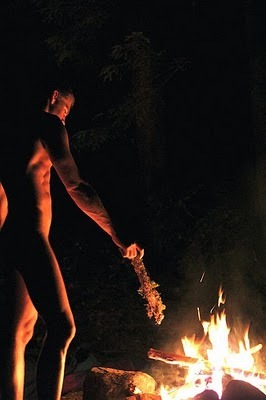
Bonfires always remind me of fall: the big bonfire before the homecoming game, sitting around a bonfire telling stories, ghost stories around the campfire. All these things remind me of autumn.

In some parts of the world, bonfires are identified, not with autumn, but with the summer solstice. In Latvia, Midsummer is called Jāņi . It is a national holiday celebrated on a large scale by almost everyone in Latvia and by people of Latvian origin abroad. Celebrations consist of a lot of traditional elements – eating Jāņu cheese, drinking beer, singing hundreds of Latvian folk songs dedicated to Jāņi, burning bonfire to keep light all through the night and jumping over it, wearing wreaths of flowers (for the women) and leaves (for the men) together with modern commercial products and ideas. Oak wreaths are worn by men named Jānis in honor of their name day. Small oak branches with leaves are attached to cars in Latvia during the festivity.

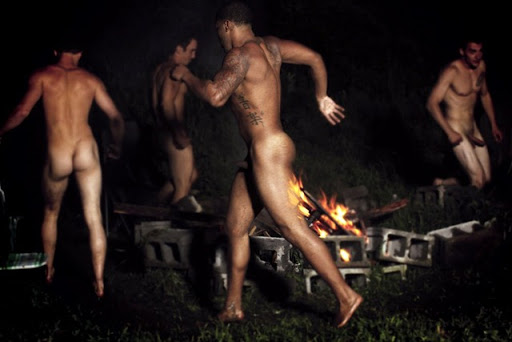
In the western town of Kuldīga, revellers mark the holiday by running naked through the town at three in the morning. The event has taken place for the past seven years. Runners are rewarded with beer, and police are on hand in case any “puritans” attempt to interfere with the naked run.

I just never got the chance to run around them naked, what about you? Do bonfires remind you of autumn? Have you ever run around one naked.

Just as I think of bonfires and autumn together, the following poem by Robert Louis Stevenson is not what I usually associate with Stevenson. I usually associate stories of pirates and life at sea. However, this poem shows that there was much more to Robert Louis Stevenson.

Autumn Fires
Robert Louis Stevenson (1913)

In the other gardens
And all up the vale,
From the autumn bonfires
See the smoke trail!
Pleasant summer over
And all the summer flowers,
The red fire blazes,
The gray smoke towers.
Sing a song of seasons!
Something bright in all!
Flowers in the summer,
Fires in the fall!

More about Robert Louis Stevenson after the jump.

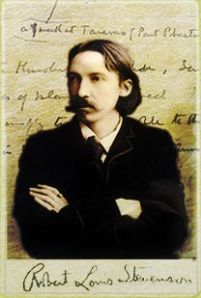
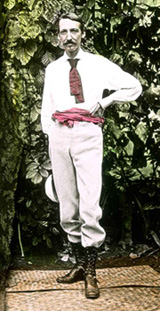
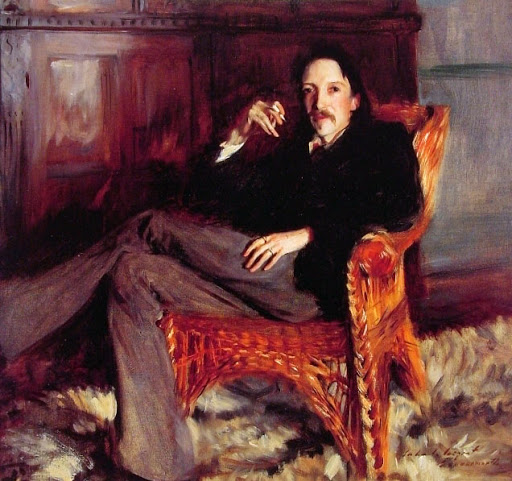
Robert Louis Stevenson
The Scottish novelist, essayist, and poet Robert Louis Stevenson (1850-1894) was one of the most popular and highly regarded British writers of the end of the 19th century. He played a significant part in the revival of the novel of romance.

During Robert Louis Stevenson’s youth the romantic novels of Sir Walter Scott and his followers had been eclipsed by the realism of William Makepeace Thackeray and Anthony Trollope. Writing in conscious opposition to this trend, Stevenson formulated his theoretical position in his essays “A Gossip on Romance” (1882), “A Humble Remonstrance” (1884), and “The Lantern-bearers” (1888). Romance, he wrote, is not concerned with objective truth but rather with things as they appear to the subjective imagination, with the “poetry of circumstance.” Romance, according to Stevenson, avoids complications of character and morality and dwells on action and adventure.

Stevenson was born on Nov. 13, 1850, in Edinburgh, the son of a noted lighthouse builder and harbor engineer. Though robust and healthy at birth, Stevenson soon became a victim of constant respiratory ailments that later developed into tuberculosis and made him skeletally thin and frail most of his life. By the time he entered Edinburgh University at the age of 16, ostensibly to study engineering, Stevenson had fallen under the spell of language and had begun to write. For several years he attended classes irregularly, cultivating a bohemian existence complete with long hair and velvet jackets and acquainting himself with Edinburgh’s lower depths.

Early Works

When he was 21 years old, Stevenson openly declared his intention of becoming a writer against the strong opposition of his father. Agreeing to study law as a compromise, Stevenson was admitted to the Scottish bar in 1875. Having traveled to the Continent several times for health and pleasure, he now swung back and forth between Scotland and a growing circle of artistic and literary friends in London and Paris. Stevenson’s first book, An Inland Voyage (1878), related his adventures during a canoe trip on the canals of Belgium and France.

In 1876 in France, Stevenson had met an American woman named Fanny Osbourne. Separated from her husband, she was 11 years older than Stevenson and had two children. Two years later Stevenson and Osbourne became lovers. In 1878 Osbourne returned to California to arrange a divorce, and a year later Stevenson followed her. After traveling across America in an emigrant train, Stevenson arrived in Monterey in poor health. After his marriage, a stay in an abandoned mining camp, later recounted in The Silverado Squatters (1883), restored his health. A year after setting out for the United States, Stevenson was back in Scotland. But the climate there proved impossible, and for the next 4 years he and his wife lived in Switzerland and in the south of France.

Despite ill health these years were productive. In his collections Virginibus puerisque (1881) and Familiar Studies of Men and Books (1882) Stevenson arrived at maturity as an essayist. Addressing his readers with confidential ease, he reflected on the common beliefs and incidents of life with a mild iconoclasm, a middling disillusionment.

The stories Stevenson collected in The New Arabian Nights (1883) and The Merry Men (1887) range from detective stories to Scottish dialect tales. The evocation of mood and setting that he practiced in his travel essays was used to great effect here. Despite his theory of romance, he was unable entirely to keep away from moral issues in these stories, but he was rarely successful in integrating moral viewpoint with action and scene.

Early Novels

Treasure Island (1881, 1883), first published as a serial in a children’s magazine, ranks as Stevenson’s first popular book, and it established his fame. A perfect romance according to Stevenson’s formula, the novel – riding over all the problems of morality and character that might have arisen – recounts a boy’s involvement with murderous pirates. Kidnapped (1886), set in Scotland shortly after the abortive Jacobite rebellion of 1745, has the same charm. In its sequel, David Balfour (1893), Stevenson could not avoid psychological and moral problems without marked strain. In The Strange Case of Dr. Jekyll and Mr. Hyde (1886) he dealt directly with the nature of evil in man and the hideous effects of a hypocrisy that seeks to deny it. This work pointed the way toward Stevenson’s more serious later novels. During this same period he published a very popular collection of poetry, A Child’s Garden of Verses (1885).

After the death of his father in 1887, Stevenson again traveled to the United States, this time for his health. He lived for a year at Saranac Lake, N.Y., in the Adirondacks. In 1889 Stevenson and his family set out on a cruise of the South Sea Islands. When it became clear that only there could he live in relative good health, he settled on the island of Upolu in Samoa. He bought a plantation (Vailima), built a house, and gained influence with the natives, who called him Tusifala (“teller of tales”). By the time of his death on Dec. 3, 1894, Stevenson had become a significant figure in island affairs. His observations on Samoan life were published in the collection In the South Seas (1896) and in A Footnote to History (1892). Of the stories written in these years, “The Beach of Falesá” in Island Nights’ Entertainments (1893) remains particularly interesting as an exploration of the confrontation between European and native ways of life.

Later Novels

The Master of Ballantrae (1889), set in the same period as Kidnapped, showed a new sophistication in Stevenson’s use of the elements of romance. Its basic theme involved complexities of character that his earlier romances had deliberately avoided. In the more advanced Weir of Hermiston, the legends of the romantic Scottish past saturate the setting and serve as a symbolic background for a tragic conflict between the primitive energies of a father and his sensitive, effete son. Left unfinished at his death, this novel would have ranked as Stevenson’s greatest work. While living in the South Pacific, Stevenson also collaborated on three novels with his stepson Lloyd Osbourne.

Further Reading

The best biographies of Stevenson are David Daiches, Robert Louis Stevenson (1947), and Joseph C. Furnas, Voyage to Windward: The Life of Robert Louis Stevenson (1951). Recommended critical studies include David Daiches, Stevenson and the Art of Fiction (1951); Robert Kiely, Robert Louis Stevenson and the Fiction of Adventure (1964), and Edwin M. Eigner, Robert Louis Stevenson and Romantic Tradition (1966).

Additional Sources

  • Bell, Ian, Dreams of exile: Robert Louis Stevenson, a biography, New York: H. Holt, 1993.
  • Hammond, J. R. (John R.), A Robert Louis Stevenson chronology, New York: St. Martin’s Press, 1996.
  • McLynn, F. J., Robert Louis Stevenson: a biography, New York:Random House, 1994.

Read more: http://www.answers.com/topic/robert-louis-stevenson#ixzz1Z0zi30n4