What sorts of things did gay men get up to in the past, and how much did these differ from what we get up to today? Does gay sex have a history, or do the forms of pleasure remain the same across centuries? Have some tastes declined, and new tastes arisen?
Some things, like cruising and cottaging, have been popular for centuries. Public latrines and baths or “stews” were good pick-up spots in the late Middle Ages. Dutch gay men in the early 18th century coined the word “kruisen”, and their favourite cruising grounds were the quays along the waterfront. In Amsterdam in the 1760s many sodomites were arrested in the public toilets built next to the city’s numerous bridges; favourite toilets were given nicknames, such as The Old Lady and The Long Lady. In 18th-century London, gay men were regularly arrested in the Lincoln’s Inn bog house, on the east side of New Square, Lincoln’s Inn Fields. The Savoy bog house was used so regularly by gay men that members of the Society for the Reformation of Manners often posted themselves outside and could be sure of making an arrest there. And in the Temple bog house in 1707 a hole had been deliberately cut in the partition wall between two stalls – making it the first recorded glory hole.
 In 18th-century England, what gay men called “picking up trade” was common in the covered arcades of the Royal Exchange and Covent Garden, where they competed with Women of Pleasure. In 1718 a watchman caught sight of two people shagging while leaning against the rails of Covent Garden Church, not an unusual sight, but when he realised they were both men he started calling them filthy sodomites. One of these men, whose breeches were down around his ankles, replied “Sirrah! what’s that to you, can’t I make use of my own Body? I have done nothing but what I will do again.”
Public parks and open fields were popular resorts for gay sex. The path that ran across the middle of Moorfields, the large fields just north of the City walls, was called the “Sodomites’ Walk”. The basic pick-up technique was to stand up against a wall and pretend to be making water, and to wait until someone expressed some interest. The best area for male prostitution was Bird Cage Alley in St James’s Park. There, Guardsmen regularly offered themselves for sex and then blackmailed their tricks. A soldier named James Brown and his brother claimed that they had picked up and then blackmailed five hundred gentlemen in Bird Cage Alley in the late 1750s. Another soldier, John Mitchell, who bragged that his penis was nine inches long, said, “When I wanted Money, I took a Walk in the Park, and got 4 or 5 Guineas a-Night of Gentlemen, because they would not be expos’d.”
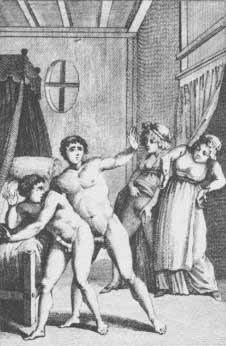 Contrary to the view that gays in the past took strictly “active” or “passive” roles, eighteenth-century trials (our best source for details about sex) show that most gay men took turn and turn about, and enjoyed reciprocal sex. A single sexual encounter often covered a broad range of activity. An illustration of this is the case of two men who were prosecuted in 1772 for buggering one another in the toilet of the Red Lion pub in Moorfields. Robert Crook, a 19-year-old man who was sharing a drink with Charles Gibson, said: “I went into the yard to make water, he came into the yard while I was making water, took hold of my yard, and began to work it with his hand; he said ‘It was a very good one, and he liked it very well’; he then asked me to go down to the vault [i.e. the bog-house] with him, which I did. There he said ‘Did not you know Dick that lived in this house? He had a fine tool, almost as big as my wrist, you are just such a lad as he was, let’s see if your’s is as big as his.’ Then he worked my yard till he made it spend in his hand. Then he pushed me back upon the vault, and worked me in the same manner on the seat of the vault till I did it in his hand; after that he kissed me very heartily; then he unbuttoned his own breeches, put my hand to his private parts, and kept tickling me about ten minutes; he kissed it and rubbed it, then he said ‘Now it will do’; he then turned round, and put his naked breech into my lap, and put his hand behind him, laid hold of my yard, and pushed it into his backside, twice or three times, I am not sure which.” After they were finished, Gibson wanted to change positions and bugger Crook. Crook claimed he was drunk and had been forced to take part in sex. But others had seen them kissing in the pub, and it transpired that this was not the only time both men had been to the vault together.
In this incident Gibson kissed Crook’s “yard”. But there are only half a dozen references to sucking between men in 18th-century English trials. In the Dutch Republic it was also rare, and considered a special treat. In 1730 a wealthy patrician was prosecuted for sucking his servants; one of the things he liked to do was spit their semen into a glass of wine and drink it. In 1765 a pedler was tried in Amsterdam for sucking a friend. He claimed he had learned the practice from a physician, who on one occasion said “Oh boy, I swallowed it.”
Cock-sucking is mentioned, usually as an insult, in Ancient Classical literature, but the practice nearly disappeared between then and modern times. In late medieval Florence, it is mentioned in 12 per cent of the legal records concerning sex between men. In German lands in the 1530s there are cases of men approaching other men in public latrines and offering to “suck out the nature” from them. There are allusions to oral sex in Richard Barnfield’s poem The Affectionate Shepherd, Containing the Complaint of Daphnis for the love of Ganymede, which was published in 1594, e.g.:
If it be sinne to loue a louely Lad:
Oh then sinne I, for whom my soule is sad.
. . . . . .
O would to God (so I might have my fee)
My lips were honey, and thy mouth a Bee.
Then shouldst thou sucke my sweete and my faire flower
That now is ripe, and full of honey-berries.
 “Fee” is a common Elizabethan pun for sexual intercourse. Elsewhere in the poem Barnfield hopes his beloved will “suck my Coyne” (“coin” is a common Elizabethan metaphor for semen), and he also uses puns such as “stones” (meaning testicles) and “purses” (meaning scrotum). However, although Barnfield’s homoeroticism is clear, and was recognized by his contemporaries, it has to be acknowledged that any claim that he deals with fellatio depends upon our interpretation of metaphors and puns. Less metaphorical descriptions of oral sex feature in some late 18th-century French erotica, especially by the Marquis de Sade, and there are prints illustrating it. But in real life, hardly anyone in the 17th or 18th centuries, male or female, prostitute or otherwise, gay or straight, ever engaged in oral sex.
Some historians of sexuality argue that oral sex between men and women wasn’t common until the early twentieth century. For example, it wasn’t treated favourably in marriage manuals until the late 1920s. For gay men, the taste for oral sex has grown over the years. In Havelock Ellis’s book Sexual Inversion, published in 1897, nine of the gay men in his case studies preferred anal sex, compared to only three who preferred oral sex. In America, in the late nineteenth century some laws for the first time specifically prohibited oral sex between men, which might indicate that it was a newly popular practice. Herman Melville in his novel Redburn, published in 1849, refers obliquely to oral sex between sailors. It seems possible that oral sex became popular among gay men first in America and was then imported into Europe. Gay Swedish men working on the liners sailing between Gothenburg and New York in the 1930s reported that they got lots of oral sex in New York, while the main sex act in Gothenburg was mutual masturbation. The slang terms “blow” and “blow job” originated in 1930s America. Even in the 1960s and 1970s, it was generally believed that oral sex was more common between American men, while anal sex was more common between British men, and these national preferences are reflected in the pornography of the time.
The changing taste for oral sex is one area where there is a sharp break between the past and the present. Some historians argue that in the past oral sex was disagreeable to people becasue their personal hygiene left something to be desired. That argument isn’t entirely convincing. For one thing, people did in fact wash themselves using a hand basin and water jug even though they didn’t take baths or showers (and they did go to saunas and “stews” or public baths every so often, where lots of non-oral sex was enjoyed). For another, dental hygiene wasn’t too great either — most people had rotten teeth and stinking breath — but that didn’t prevent them from enjoying a good long kiss now and then.
There is probably a strong taboo concerning semen, which gay men overcame earlier than straight men and women. Though semen has no procreative value in sex between men, it nevertheless has a magical value. In some cultures, notably Melanesia, the ingestion of semen features in “coming-of-age” initiation rituals, whereby masculinity is transferred to young men. The two Victorian pioneers of gay liberation, Edward Carpenter and John Addington Symonds, felt that their personal experience confirmed this. Symonds wrote to Carpenter in December 1892: “I have no doubt myself that the absorption of semen implies a real modification of the physique of the person who absorbs it, & that the most beneficent results, as regards health and nervous energy, accrue from the sexual relations between men.”
Volcanic jets of the liquid erupt in gay pornography, as in the Victorian pornographic novel Teleny (1893), which was probably written by a group of men under the direction of Oscar Wilde: “my breath came thickly; I panted, I sighed, I groaned. The thick burning fluid was spouted out slowly and at long intervals. As I rubbed myself against him, he underwent all the sensations I was feeling; for I was hardly drained of the last drop before I was likewise bathed in his own seething sperm.” A lot of “rubbing” takes place in this novel, as well as sodomy. The most common forms of sex between men during Victorian times seem to have been mutual tossing off or between-thigh fucking. Oscar Wilde didn’t much care for anal intercourse, but preferred to have one of his “panthers” or rough trade sit in his lap while he “played” with him. Then Wilde would mount his partner face-to-face to enjoy “spending on his belly”. But sexual tastes vary according to temperament as well as historical period. For example, Oscar Wilde’s lover Lord Alfred Douglas preferred to bugger young schoolboys, while Wilde preferred “rough” older lads. Neither Wilde nor Douglas would seek sex with an obviously effeminate “pouf”.
Times have changed. Some marked changes in gay sexuality have occurred especially since the 1950s and 1960s. Fisting, for example, has no historical precedent — although impalement features in some early gay fantasies. In Teleny, a man who is not satisfied by a dildo bleeds to death after a large glass vase inserted into his anus breaks. Surveys of diaries, news reports, and the gay media have established that fisting was invented in the summer of 1971, in the “backroom” of a gay bar in New York City. The practice quickly spread to the backroom bars of San Francisco, and was exported thence to Japan and Europe. The pent-up libido that was released in the Swinging Sixties has blossomed in a garden of special interests, notably fetishistic sex games ranging from mild bondage and discipline to the extremes of sadomasochism.
To see how things have changed, we can compare the original 1881 edition of The Sins of the Cities of the Plain: Or, The Recollections of a Mary-Anne, with an edition published in 1992 by Badboy Books, New York. This Victorian gay pornography is the genuine (albeit semi-fictionalised) autobiography of a male prostitute, or “Mary-Ann”, named John Saul, aka Dublin Jack, and it probably contain an accurate account of what gay men did in the 1870s. Saul was game for anything, and his memoirs contain plenty of descriptions of between-thigh rubbing, “bottom-fucking” (often by sitting in someone’s lap), rimming preparatory to buggering, fingering ditto, cock-sucking and sixty-nining. But the 1992 “reprint” added several totally new scenes catering for the modern S/M market. In a long episode not in the original, a wicked voluptuary seizes a large candle from a table laid for a banquet and drips molten wax over Jack’s flesh, before stuffing him like a turkey with the said candle. Another important change is that the 1881 original had several heterosexual sex scenes, while the 1992 “reprint” changed the gender pronouns in these scenes, thus making the book exclusively homosexual throughout.
Such alterations suggest that over the course of a century there has been a historical shift in gay self-identity, and a more masculine gay self-image. Alternatively, the changes in the two versions of may simply represent the fact that the modern market for pornography has become much more rigidly segregated between gay and straight than it was a century ago. Nevertheless, in this novel and in other sources we see that the “Mary-Anns” or gay prostitutes in Victorian times often dressed up as women, or at least wore make-up and presented an effeminate appearance. The most famous in real life were Ernest Boulton and Frederick William Park, aka Lady Stella and Miss Fanny. When they were arrested in the Burlington Arcade in 1869 Boulton was wearing a cherry-coloured silk evening dress, trimmed with white lace, and Park was wearing a green satin dress trimmed with black lace. In the 1920s male prostitutes often wore make-up and, like Quentin Crisp, presented an “effeminate” appearance. Today, although male prostitutes often wear distinctive “costumes”, they generally present a macho appearance, echoing the “physique” magazines since the 1950s, when photographers such as Bob Mizer had their models pose as bikers and leathermen, construction workers and sailors of the rougher sort. The “effeminate” model of sexually available young men or “lady-boys” is still common, however, in places such as Thailand and other countries frequented by sexual tourists, and prostitution is the main form of employment of the self-castrated hijras of India. Even in the West, transsexuals form a large percentage of prostitutes, and “chicks with dicks” are an intriguing sub-section on gay porn sites on the web.
However, some things never change. Trial records for all periods turn up cases of men who lived together in “sodomitical sin” that included intimacy and tenderness. Several men investigated by the Paris police in the 1740s claimed that they sought “a relationship which might last”. According to one police report, two men had lived and slept together intimately for two years: “It was even almost always necessary for Duquesnel to have his arm extended along the headboard, under Dumaine’s head. Without that Dumaine could not rest.”
Copyright © 2005, 2006 Rictor Norton.
CITATION: Rictor Norton, “A History of Gay Sex”, Gay History and Literature, 24 November 2006 <http://rictornorton.co.uk/gaysex.htm>

 One of the most influential Victorian poems, Alfred Lord Tennyson’s In Memoriam (1850) is actually 133 poetic fragments or sections that differ in theme, tone, and presentation, but are all unified by the poetic persona’s grief, doubt, and search for faith. The composition of In Memoriam was initiated by Tennyson’s deep suffering at the loss of his brilliant young friend, the promising poet and scholar Arthur Henry Hallam, who died suddenly in 1833 at the age of twenty-two. Although many of the sections were written in the three years following Hallam’s death, when Tennyson’s grief was most acute, he continued adding to and rearranging his long poem as science and religion shook traditional beliefs in God and Christianity. Finally, in 1850, Tennyson published his lyrical elegy. Immediately well-received, it brought Tennyson considerable fame and was undoubtedly influential in the decision to appoint Tennyson as William Wordsworth’s successor as British poet laureate.
  was an eager participant in the ongoing debates on gender roles and the place of emotion and commitment in a society that seemed obsessed with technological progress and the accumulation of wealth.


 Though, to all appearances, George was of an almost exclusively homoerotic inclination, there is no indication that he ever went beyond the Platonic concept of spiritual guidance and aesthetic contemplation – to which he adhered doubtless partly out of mere social convention, but also for artistic discipline. Nevertheless, sometimes the strong emotions George displayed in his relationships to young men could be disturbing to them, as it is documented in the case of Hugo von Hofmannsthal. George was himself only 23 when he met the still younger but precocious Austrian poet, who was 17 then. It is not really clear what happened, but evidently their relations were troubled, though they kept up a correspondence for some years. Also another friendship of George that had been initially more successful ended in dissonance, when the
  Germanist Friedrich Gundolf whom George had mentored as a teenager, and who had become his most ardent apostle, as a man in his late thirties insisted on marrying despite George’s disapproval.
 Klaus Mann (born in 1906), who remembered later that “my admiration for him was boundless. I saw him as the leader and prophet, the Caesarean priestly figure as he presented himself. Amidst a rotten and barbarous civilization, he embodied human and artistic dignity, uniting discipline and passion, grace and majesty. Each of his gestures was of an exemplary, programmatic character. He stylized his own biography like a myth: his romance, the boy Maximin, was the core of a philosophy that was a revelation to the circle of disciples. — The reunification of morals and beauty seemed to have been realized in the mystery of Maximin. Here I found the reconciliation of Hellenic and Christian ethos. Stefan George’s ordering mind had – or so did I believe – solved the fundamental conflict that Heinrich Heine analyses with intuition and perspicacity, that reigns as tragic leitmotiv over the works of Friedrich Nietzsche. — My youth venerated in Stefan George the Templar whose mission and deed is described in his poem. When the black wave of nihilism was threatening to devour our culture, he arrived, the militant seer and inspired knight.”
 program of a hierarchic reformation based upon a new aristocracy of mind and spirit, and the ideologies of the fascist movements as they were beginning to flourish in several European countries during the nineteen-twenties. Though to him, for his attitude and sentiments, it was impossible to identify his cause with the Nazism that was to take over Germany, the ambiguity became clear in 1933, when some of his followers embraced the upheaval wholeheartedly, while others, like his oldest companion, the Jewish poet Karl Wolfskehl, were forced to emigrate. George himself, who was already fatally ill, declined all honors by which the new rulers tried to gain his support, and, silent but demonstrative, left Germany to end his life elsewhere. He died on the 4th of December 1933, in Locarno, Ticino, Switzerland.




 Joe
Joe




 The Closet Professor