Category Archives: Poetry

Nothing Gold Can Stay

BOTD-103110-003Nothing Gold Can Stay by Robert Frost (1923)

Nature’s first green is gold,
Her hardest hue to hold.
Her early leaf’s a flower;
But only so an hour.
Then leaf subsides to leaf.
So Eden sank to grief,
So dawn goes down to day.
Nothing gold can stay.

I don’t have a lot to write about, but I love the poetry of Robert Frost.  I hope that you enjoy this Autumn themed poem.  I will get a little more inspiration later, until them, enjoy this short bit of poetry. –JB


The First Amendment and Book Burning

They came first for the Communists,
and I didn’t speak up because I wasn’t a Communist.

Then they came for the trade unionists,
and I didn’t speak up because I wasn’t a trade unionist.

Then they came for the Jews,
and I didn’t speak up because I wasn’t a Jew.

Then they came for me
and by that time no one was left to speak up.

Martin Niemöller (1892–1984)

The above poem was featured on my friend crothdiver’s blog Anything Male, the other day in a post he wrote about the recent controversy surrounding a pastor in Florida who was planning on burning the Qur’an. The whole subject has had my riled up for days and has had me thinking of American’s First Amendment rights, censorship rights, and the ignorance of book burning. So I thought I would address these three ideas from my own perspective.

First of all, who was Martin Niemöller? German theologian and war hero as a submarine commander in World War I, he became a minister in 1924. When the Nazis came to power in 1933, he was originally a supporter of the Nazi party, but later he protested their interference in church affairs and helped combat discrimination against Christians of Jewish background. As founder of the anti-Nazi Confessing Church, he worked to oppose Adolf Hitler. Arrested in 1937, he was interned until 1945. After the war he helped rebuild the Evangelical Church. Increasingly disillusioned with prospects for demilitarization, he became a controversial pacifist; for his efforts to extend friendship ties to Soviet-bloc countries, he received the Lenin Peace Prize (1967) and West Germany’s Grand Cross of Merit (1971).

The First Amendment

Congress shall make no law respecting an establishment of religion, or prohibiting the free exercise thereof; or abridging the freedom of speech, or of the press; or the right of the people peaceably to assemble, and to petition the Government for a redress of grievances.

image

I agree with the President on this issue. Mr. Jones may have the right to speak out against Islam and may technically have the right to burn books. However, by burning the Qur’an, Mr. Jones has incited riots and hatred toward Americans around the world, when we are currently at war with religious extremists, he is attempting to burn their word of God. The Qur’an is literally the word of Allah, as spoken through his messenger, the Archangel Gabriel, and memorized and recited by the prophet Muhammad. Quite honestly, I can see 100 percent why this would upset even the most peaceful Muslims in the world. This act also puts our soldiers overseas at an even greater risk. In Afghanistan, we are dealing with people who need only the slightest provocation to seek retribution. The act of burning the Qur’an is more than just the slightest provocation. The Taliban used the natural disaster of the floods in Pakistan to attack innocent people, they have no morals. These are not true believers, if they were, they would honor Allah, not desecrate his name. Why fuel the fires of average Muslims with the burning of their holy book. By even the threat, Mr. Jones has aided Al Qaeda and the Taliban in their methods of recruitment. He has put the national security of America and the security of American citizens and soldiers abroad at risk. It has been a long standing tradition and backed by laws in America that using the excuse of freedom of speech is not legal if you are inciting danger. Just as you are not able to yell fire in a crowded building when there is not a fire, you also cannot incite world wide riots for your own publicity seeking exploits as Mr. Jones has done.

Book Burning

image First, let me say that I am a total and complete bibliophile. I love and cherish books. Some of my most prized possessions are books. I find the written and printed word to be sacred. To burn a book is one of the most destructive and horrific events that can one can do to an inanimate object.

Book burning, biblioclasm or libricide is the practice of destroying, often ceremoniously, books or other written material and media. In modern times, other forms of media, such as phonograph records, video tapes, and CDs have also been ceremoniously burned, torched, or shredded. The practice, usually carried out in public, is generally motivated by moral, religious, or political objections to the material.

Some particular cases of book burning are long and traumatically remembered – because the books destroyed were irreplaceable and their loss constituted a severe damage to cultural heritage, and/or because this instance of book burning has become emblematic of a harsh and oppressive regime. Such were the destruction of the Library of Alexandria, the obliteration of the Library of Baghdad, the burning of books and burying of scholars under China’s Qin Dynasty, the destruction of Mayan codices by Spanish conquistadors and priests, and some seem more for publicity for a cause such as Nazi book burnings, the burning of Beatles records after a remark by John Lennon concerning Jesus Christ, and the destruction of the Sarajevo National Library.

image There have been many religious leaders in history who have burned books that they found offensive. In 1497, followers of the Italian priest Girolamo Savonarola collected and publicly burned pornography, lewd pictures, pagan books, gaming tables, cosmetics, copies of Boccaccio’s Decameron, and all the works of Ovid which could be found in Florence. Savonarola’s dictatorship in Florence also led to the persecution of homosexuals, as did nearly every other existence of extreme dictatorships and book burnings. That is why I find the poem at the beginning of this post to be so poignant.

In my opinion, whether it is an off-the-wall extremist minister in Florida, a crazy monk in medieval Florence, or a ruthless anti-Semitic leader in 1930s and 1940s Germany, it is a very dangerous first step to the destruction of all that America holds sacred. Book burning is symbolic and pure censorship and only leads to extremism.


Alfred Lord Tennyson’s In Memoriam

clip_image002One of the most influential Victorian poems, Alfred Lord Tennyson’s In Memoriam (1850) is actually 133 poetic fragments or sections that differ in theme, tone, and presentation, but are all unified by the poetic persona’s grief, doubt, and search for faith. The composition of In Memoriam was initiated by Tennyson’s deep suffering at the loss of his brilliant young friend, the promising poet and scholar Arthur Henry Hallam, who died suddenly in 1833 at the age of twenty-two. Although many of the sections were written in the three years following Hallam’s death, when Tennyson’s grief was most acute, he continued adding to and rearranging his long poem as science and religion shook traditional beliefs in God and Christianity. Finally, in 1850, Tennyson published his lyrical elegy. Immediately well-received, it brought Tennyson considerable fame and was undoubtedly influential in the decision to appoint Tennyson as William Wordsworth’s successor as British poet laureate.

Tennyson clearly does not fit into convenient categories such as “radical” or even “progressive”; rather, he, like so many of his contemporaries, clip_image004was an eager participant in the ongoing debates on gender roles and the place of emotion and commitment in a society that seemed obsessed with technological progress and the accumulation of wealth.

As part of his explorations of alternative forms for social organization and moral engagement, he looked to homosocial bonding as one source for positive (in the case of men) or negative (in the case of women) emotional ties that might have an effect upon the fragmentation that he saw around him.

But homosocial and homosexual desire are not always easily distinguishable, and certainly in In Memoriam the boundary between platonic and actively erotic forms of love seems fuzzy.

In this way, Tennyson challenges are our own ability to classify writers as “gay” and “straight.” Though heterosexual, Tennyson wrote poetry dealing with love between men that is still capable of evoking a profound response from gay audiences today and that has an important place in any consideration of gay literary history.

Selections from In Memoriam:

XXVI.


Still onward winds the dreary way;

          I with it; for I long to prove

          No lapse of moons can canker Love,

Whatever fickle tongues may say.


And if that eye which watches guilt

          And goodness, and hath power to see

          Within the green the moulder’d tree,

And towers fall’n as soon as built–


Oh, if indeed that eye foresee

          Or see (in Him is no before)

          In more of life true life no more

And Love the indifference to be,


Then might I find, ere yet the morn

          Breaks hither over Indian seas,

          That Shadow waiting with the keys,

To shroud me from my proper scorn.

XXVII.

I envy not in any moods

          The captive void of noble rage,

          The linnet born within the cage,

That never knew the summer woods:


I envy not the beast that takes

          His license in the field of time,

          Unfetter’d by the sense of crime,

To whom a conscience never wakes;


Nor, what may count itself as blest,

          The heart that never plighted troth

          But stagnates in the weeds of sloth;

Nor any want-begotten rest.


I hold it true, whate’er befall;

          I feel it, when I sorrow most;

          ’Tis better to have loved and lost

Than never to have loved at all.


A History of Gay Sex

What sorts of things did gay men get up to in the past, and how much did these differ from what we get up to today? Does gay sex have a history, or do the forms of pleasure remain the same across centuries? Have some tastes declined, and new tastes arisen?

Some things, like cruising and cottaging, have been popular for centuries. Public latrines and baths or “stews” were good pick-up spots in the late Middle Ages. Dutch gay men in the early 18th century coined the word “kruisen”, and their favourite cruising grounds were the quays along the waterfront. In Amsterdam in the 1760s many sodomites were arrested in the public toilets built next to the city’s numerous bridges; favourite toilets were given nicknames, such as The Old Lady and The Long Lady. In 18th-century London, gay men were regularly arrested in the Lincoln’s Inn bog house, on the east side of New Square, Lincoln’s Inn Fields. The Savoy bog house was used so regularly by gay men that members of the Society for the Reformation of Manners often posted themselves outside and could be sure of making an arrest there. And in the Temple bog house in 1707 a hole had been deliberately cut in the partition wall between two stalls – making it the first recorded glory hole.

In 18th-century England, what gay men called “picking up trade” was common in the covered arcades of the Royal Exchange and Covent Garden, where they competed with Women of Pleasure. In 1718 a watchman caught sight of two people shagging while leaning against the rails of Covent Garden Church, not an unusual sight, but when he realised they were both men he started calling them filthy sodomites. One of these men, whose breeches were down around his ankles, replied “Sirrah! what’s that to you, can’t I make use of my own Body? I have done nothing but what I will do again.”

Public parks and open fields were popular resorts for gay sex. The path that ran across the middle of Moorfields, the large fields just north of the City walls, was called the “Sodomites’ Walk”. The basic pick-up technique was to stand up against a wall and pretend to be making water, and to wait until someone expressed some interest. The best area for male prostitution was Bird Cage Alley in St James’s Park. There, Guardsmen regularly offered themselves for sex and then blackmailed their tricks. A soldier named James Brown and his brother claimed that they had picked up and then blackmailed five hundred gentlemen in Bird Cage Alley in the late 1750s. Another soldier, John Mitchell, who bragged that his penis was nine inches long, said, “When I wanted Money, I took a Walk in the Park, and got 4 or 5 Guineas a-Night of Gentlemen, because they would not be expos’d.”
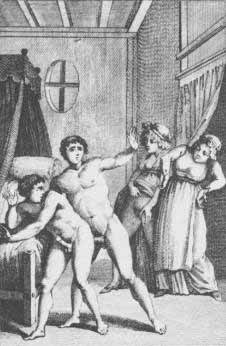
Contrary to the view that gays in the past took strictly “active” or “passive” roles, eighteenth-century trials (our best source for details about sex) show that most gay men took turn and turn about, and enjoyed reciprocal sex. A single sexual encounter often covered a broad range of activity. An illustration of this is the case of two men who were prosecuted in 1772 for buggering one another in the toilet of the Red Lion pub in Moorfields. Robert Crook, a 19-year-old man who was sharing a drink with Charles Gibson, said: “I went into the yard to make water, he came into the yard while I was making water, took hold of my yard, and began to work it with his hand; he said ‘It was a very good one, and he liked it very well’; he then asked me to go down to the vault [i.e. the bog-house] with him, which I did. There he said ‘Did not you know Dick that lived in this house? He had a fine tool, almost as big as my wrist, you are just such a lad as he was, let’s see if your’s is as big as his.’ Then he worked my yard till he made it spend in his hand. Then he pushed me back upon the vault, and worked me in the same manner on the seat of the vault till I did it in his hand; after that he kissed me very heartily; then he unbuttoned his own breeches, put my hand to his private parts, and kept tickling me about ten minutes; he kissed it and rubbed it, then he said ‘Now it will do’; he then turned round, and put his naked breech into my lap, and put his hand behind him, laid hold of my yard, and pushed it into his backside, twice or three times, I am not sure which.” After they were finished, Gibson wanted to change positions and bugger Crook. Crook claimed he was drunk and had been forced to take part in sex. But others had seen them kissing in the pub, and it transpired that this was not the only time both men had been to the vault together.

In this incident Gibson kissed Crook’s “yard”. But there are only half a dozen references to sucking between men in 18th-century English trials. In the Dutch Republic it was also rare, and considered a special treat. In 1730 a wealthy patrician was prosecuted for sucking his servants; one of the things he liked to do was spit their semen into a glass of wine and drink it. In 1765 a pedler was tried in Amsterdam for sucking a friend. He claimed he had learned the practice from a physician, who on one occasion said “Oh boy, I swallowed it.”

Cock-sucking is mentioned, usually as an insult, in Ancient Classical literature, but the practice nearly disappeared between then and modern times. In late medieval Florence, it is mentioned in 12 per cent of the legal records concerning sex between men. In German lands in the 1530s there are cases of men approaching other men in public latrines and offering to “suck out the nature” from them. There are allusions to oral sex in Richard Barnfield’s poem The Affectionate Shepherd, Containing the Complaint of Daphnis for the love of Ganymede, which was published in 1594, e.g.:

If it be sinne to loue a louely Lad:
Oh then sinne I, for whom my soule is sad.
                              . . . . . .
O would to God (so I might have my fee)
My lips were honey, and thy mouth a Bee.
Then shouldst thou sucke my sweete and my faire flower
That now is ripe, and full of honey-berries.

“Fee” is a common Elizabethan pun for sexual intercourse. Elsewhere in the poem Barnfield hopes his beloved will “suck my Coyne” (“coin” is a common Elizabethan metaphor for semen), and he also uses puns such as “stones” (meaning testicles) and “purses” (meaning scrotum). However, although Barnfield’s homoeroticism is clear, and was recognized by his contemporaries, it has to be acknowledged that any claim that he deals with fellatio depends upon our interpretation of metaphors and puns. Less metaphorical descriptions of oral sex feature in some late 18th-century French erotica, especially by the Marquis de Sade, and there are prints illustrating it. But in real life, hardly anyone in the 17th or 18th centuries, male or female, prostitute or otherwise, gay or straight, ever engaged in oral sex.

Some historians of sexuality argue that oral sex between men and women wasn’t common until the early twentieth century. For example, it wasn’t treated favourably in marriage manuals until the late 1920s. For gay men, the taste for oral sex has grown over the years. In Havelock Ellis’s book Sexual Inversion, published in 1897, nine of the gay men in his case studies preferred anal sex, compared to only three who preferred oral sex. In America, in the late nineteenth century some laws for the first time specifically prohibited oral sex between men, which might indicate that it was a newly popular practice. Herman Melville in his novel Redburn, published in 1849, refers obliquely to oral sex between sailors. It seems possible that oral sex became popular among gay men first in America and was then imported into Europe. Gay Swedish men working on the liners sailing between Gothenburg and New York in the 1930s reported that they got lots of oral sex in New York, while the main sex act in Gothenburg was mutual masturbation. The slang terms “blow” and “blow job” originated in 1930s America. Even in the 1960s and 1970s, it was generally believed that oral sex was more common between American men, while anal sex was more common between British men, and these national preferences are reflected in the pornography of the time.

The changing taste for oral sex is one area where there is a sharp break between the past and the present. Some historians argue that in the past oral sex was disagreeable to people becasue their personal hygiene left something to be desired. That argument isn’t entirely convincing. For one thing, people did in fact wash themselves using a hand basin and water jug even though they didn’t take baths or showers (and they did go to saunas and “stews” or public baths every so often, where lots of non-oral sex was enjoyed). For another, dental hygiene wasn’t too great either — most people had rotten teeth and stinking breath — but that didn’t prevent them from enjoying a good long kiss now and then.

There is probably a strong taboo concerning semen, which gay men overcame earlier than straight men and women. Though semen has no procreative value in sex between men, it nevertheless has a magical value. In some cultures, notably Melanesia, the ingestion of semen features in “coming-of-age” initiation rituals, whereby masculinity is transferred to young men. The two Victorian pioneers of gay liberation, Edward Carpenter and John Addington Symonds, felt that their personal experience confirmed this. Symonds wrote to Carpenter in December 1892: “I have no doubt myself that the absorption of semen implies a real modification of the physique of the person who absorbs it, & that the most beneficent results, as regards health and nervous energy, accrue from the sexual relations between men.”

Volcanic jets of the liquid erupt in gay pornography, as in the Victorian pornographic novel Teleny (1893), which was probably written by a group of men under the direction of Oscar Wilde: “my breath came thickly; I panted, I sighed, I groaned. The thick burning fluid was spouted out slowly and at long intervals. As I rubbed myself against him, he underwent all the sensations I was feeling; for I was hardly drained of the last drop before I was likewise bathed in his own seething sperm.” A lot of “rubbing” takes place in this novel, as well as sodomy. The most common forms of sex between men during Victorian times seem to have been mutual tossing off or between-thigh fucking. Oscar Wilde didn’t much care for anal intercourse, but preferred to have one of his “panthers” or rough trade sit in his lap while he “played” with him. Then Wilde would mount his partner face-to-face to enjoy “spending on his belly”. But sexual tastes vary according to temperament as well as historical period. For example, Oscar Wilde’s lover Lord Alfred Douglas preferred to bugger young schoolboys, while Wilde preferred “rough” older lads. Neither Wilde nor Douglas would seek sex with an obviously effeminate “pouf”.

Times have changed. Some marked changes in gay sexuality have occurred especially since the 1950s and 1960s. Fisting, for example, has no historical precedent — although impalement features in some early gay fantasies. In Teleny, a man who is not satisfied by a dildo bleeds to death after a large glass vase inserted into his anus breaks. Surveys of diaries, news reports, and the gay media have established that fisting was invented in the summer of 1971, in the “backroom” of a gay bar in New York City. The practice quickly spread to the backroom bars of San Francisco, and was exported thence to Japan and Europe. The pent-up libido that was released in the Swinging Sixties has blossomed in a garden of special interests, notably fetishistic sex games ranging from mild bondage and discipline to the extremes of sadomasochism.

To see how things have changed, we can compare the original 1881 edition of The Sins of the Cities of the Plain: Or, The Recollections of a Mary-Anne, with an edition published in 1992 by Badboy Books, New York. This Victorian gay pornography is the genuine (albeit semi-fictionalised) autobiography of a male prostitute, or “Mary-Ann”, named John Saul, aka Dublin Jack, and it probably contain an accurate account of what gay men did in the 1870s. Saul was game for anything, and his memoirs contain plenty of descriptions of between-thigh rubbing, “bottom-fucking” (often by sitting in someone’s lap), rimming preparatory to buggering, fingering ditto, cock-sucking and sixty-nining. But the 1992 “reprint” added several totally new scenes catering for the modern S/M market. In a long episode not in the original, a wicked voluptuary seizes a large candle from a table laid for a banquet and drips molten wax over Jack’s flesh, before stuffing him like a turkey with the said candle. Another important change is that the 1881 original had several heterosexual sex scenes, while the 1992 “reprint” changed the gender pronouns in these scenes, thus making the book exclusively homosexual throughout.

Such alterations suggest that over the course of a century there has been a historical shift in gay self-identity, and a more masculine gay self-image. Alternatively, the changes in the two versions of may simply represent the fact that the modern market for pornography has become much more rigidly segregated between gay and straight than it was a century ago. Nevertheless, in this novel and in other sources we see that the “Mary-Anns” or gay prostitutes in Victorian times often dressed up as women, or at least wore make-up and presented an effeminate appearance. The most famous in real life were Ernest Boulton and Frederick William Park, aka Lady Stella and Miss Fanny. When they were arrested in the Burlington Arcade in 1869 Boulton was wearing a cherry-coloured silk evening dress, trimmed with white lace, and Park was wearing a green satin dress trimmed with black lace. In the 1920s male prostitutes often wore make-up and, like Quentin Crisp, presented an “effeminate” appearance. Today, although male prostitutes often wear distinctive “costumes”, they generally present a macho appearance, echoing the “physique” magazines since the 1950s, when photographers such as Bob Mizer had their models pose as bikers and leathermen, construction workers and sailors of the rougher sort. The “effeminate” model of sexually available young men or “lady-boys” is still common, however, in places such as Thailand and other countries frequented by sexual tourists, and prostitution is the main form of employment of the self-castrated hijras of India. Even in the West, transsexuals form a large percentage of prostitutes, and “chicks with dicks” are an intriguing sub-section on gay porn sites on the web.

However, some things never change. Trial records for all periods turn up cases of men who lived together in “sodomitical sin” that included intimacy and tenderness. Several men investigated by the Paris police in the 1740s claimed that they sought “a relationship which might last”. According to one police report, two men had lived and slept together intimately for two years: “It was even almost always necessary for Duquesnel to have his arm extended along the headboard, under Dumaine’s head. Without that Dumaine could not rest.”


Copyright © 2005, 2006 Rictor Norton.


CITATION: Rictor Norton, “A History of Gay Sex”, Gay History and Literature, 24 November 2006 <http://rictornorton.co.uk/gaysex.htm&gt;


Coming Out: The Urges

Once I admitted to myself that I was gay, I decided that I had to come to terms with it more than just admitting it. I was lonely and wanted to find a boyfriend. This search still continues. Here is the last of the poems I wrote during this period.

The Urges

My heart aches,
My stomach churns,
My loins burn,
My head spins.
What are these symptoms of?
I have an itch
That cannot be scratched
If I only knew what was wrong
It happens when I see the beauty.
I either go mute or return to a stutter.
I tremble and quake and my nerves are shot to hell.

The agony of it.

I guess when I look back on retrospect, I was just horny as hell.

I apologize to all my readers for the lack of posts this week. I have been incredibly busy with my new job. That will probably continue for the next few weeks, but I will try to at least post once a day. I still have a few more in the coming out series that I will attempt to post in the next few days. Then we will be back to history, culture, art, and politics. Please stay tuned.


Coming Out: Acceptance

As I struggled with my sexuality, I did the only thing I could think to do. I did what I had been taught to do in times of trouble and decision (not that it really was a decision). I prayed and meditated. For months on end (and even years), I had sleepless nights as I prayed and meditated for guidance. Finally, the answer came. From that answer came this poem, the third in the series.

Acceptance

I am who I am, that cannot change.
I do what I do, only I can decide.
I ask for guidance, God guides me.
I pray for a path, that is what I follow.
I hate no one, but I do not love all.
The path tells me who I am;
The path shows me what to do;
The path guides me in the shadows.
The wide path is hatred;
The narrow leads to love.
I pray and the path is cleared.

As I was unpacking after my move to my new house, I found a sort of diary that I wrote several years ago. Inside were three poems that I wrote about my feelings concerning coming out. A commenter on Cocks, Asses, and More the other day said that he would like to hear more about me and my coming out. I responded that I planned on doing that on this blog. When I began writing these blog posts, I was originally going to give an introduction to one of those poems, but it grew more into a personal history of my struggle with my sexuality. Also, I decided to let the words speak for themselves. So these four or five coming out posts will not contain any pictures or images (at least that is the plan at this point).


Coming Out: “Feelings of Betrayal”

This is the second poem in this series. This poem was written near the point in my journey when I was finally beginning to come out to myself but was still struggling, trying not to admit that I was gay.

Feelings of Betrayal

Betrayal,
The mind so often does
It thinks the sinful thoughts
It wanders to the forbidden world
The world I cannot have
It fails me at times
The times I need it most
The thoughts ache
But can bring such pleasure
Betrayal, Betrayal.

Betrayal,
My hear has betrayed so many
It has been betrayed by many
The prayers for the betrayals to end
The mind is the most sinful of the organs
Mind and manhood,
Heart and appendage
Betrayal, Betrayal.

Betrayal,
The organ of pleasure
I had not yet failed
One day to agony it may
Youth and vigor keep it alive
Heart and soul,
Mind and man,
Betrayal, Betrayal.

Betrayal,
Eruptions of enjoyment
A sin in itself
Spilling the seed to prevent a sin
The agony of not acting on readiness
To stop one
Begin an unfair sin
Betrayal, Betrayal.

Betrayal, Betrayal.
Ultimate Betrayal
Forgiven Betrayal
Uncontrollable Betrayal
Aching Betrayal
Pleasurable Betrayal
Unfair Betrayal Betrayal one in all
Betrayal all in one
Life’s many betrayals
Betray, betray
The Betrayal of Life.

As I was unpacking after my move to my new house, I found a sort of diary that I wrote several years ago. Inside were three poems that I wrote about my feelings concerning coming out. A commenter on Cocks, Asses, and More the other day said that he would like to hear more about me and my coming out. I responded that I planned on doing that on this blog. When I began writing these blog posts, I was originally going to give an introduction to one of those poems, but it grew more into a personal history of my struggle with my sexuality. Also, I decided to let the words speak for themselves. So these four or five coming out posts will not contain any pictures or images (at least that is the plan at this point).


Coming Out: “Am I, or Am I Not?”

This is the first of the poems I wrote as a way to figure out my sexuality. A warning, I am not a great poet, but it does represent my feelings at the time before I came out even to myself.

Am I, or Am I Not?

I love to look,
I love to watch
But it is forbidden.
I have never acted.
Acting would mean banishment
A loss of all that I know and love
I would feel so safe, but
Yet I would feel such danger.
The eminent danger of a slow agonizing death.

What should I do?
I leave that to God.
Yet he forbids it most according to St. Paul.
I have acted in the opposite,
But that too is sin.

What can I do?
No one can answer.
I live a lie, but both must not be an option.
The curves, the beauty, the caress.

Am I acting or another?
Which can it be?
Who can I trust?
Only intoxication allows trust.
The agony of decision.
To forever e damned by what
I love for who I love.

Oh, how I ache.
Praying for an answer
I already know
Praying for forgiveness of urges
Prayers to move toward the light.

What shall I do?
I love all
I fear all
This cannot be
Though it is
Purification, meditation, prayer,
Purity, harmony, peace,
Hypocrisy, prudence, piety.

The church is the one true love
That beckons without remorse.
Can I follow that path and not be a heretic?
I doubt it,
I don’t know.
Where are the answers?
Where is the happiness?
God, please, guide me.
Show me the righteous way.

As I was unpacking after my move to my new house, I found a sort of diary that I wrote several years ago. Inside were three poems that I wrote about my feelings concerning coming out. A commenter on Cocks, Asses, and More the other day said that he would like to hear more about me and my coming out. I responded that I planned on doing that on this blog. When I began writing these blog posts, I was originally going to give an introduction to one of those poems, but it grew more into a personal history of my struggle with my sexuality. Also, I decided to let the words speak for themselves. So these four or five coming out posts will not contain any pictures or images (at least that is the plan at this point).


A Midsummer Night’s Dream

image
Puck’s soliloquy from the last lines of A Midsummer Night’s Dream, a comedy by William Shakespeare, is one of my favorite lines from any of Shakespeare’s plays.

If we shadows have offended,
Think but this, and all is mended,
imageThat you have but slumber’d here
While these visions did appear.
And this weak and idle theme,
No more yielding but a dream,
Gentles, do not reprehend:
if you pardon, we will mend:
And, as I am an honest Puck,
If we have unearned luck
Now to ‘scape the serpent’s tongue,
We will make amends ere long;
Else the Puck a liar call;
So, good night unto you all.
Give me your hands, if we be friends,
And Robin shall restore amends.

image In his essay “Preposterous Pleasures, Queer Theories and A Midsummer Night’s Dream“, Douglas E. Green explores possible interpretations of alternative sexuality that he finds within the text of the play, in juxtaposition to the proscribed social mores of the culture at the time the play was written. He writes that his essay “does not (seek to) rewrite A Midsummer Night’s Dream as a gay play but rather explores some of its ‘homoerotic significations’ … moments of ‘queer’ disruption and eruption in this Shakespearean comedy”. Green states that he does not consider Shakspeare to have been a “sexual radical”, but that the play represented a “topsy-turvy world” or “temporary holiday”image that mediates or negotiates the “discontents of civilization”, which while resolved neatly in the story’s conclusion, do not resolve so neatly in real life. Green writes that the “sodomitical elements”, “homoeroticism”, “lesbianism”, and even “compulsory heterosexuality” in the story must be considered in the context of the “culture of early modern England” as a commentary on the “aesthetic rigidities of comic form and political ideologies of the prevailing order”. Aspects of ambiguous sexuality and gender conflict in the story are also addressed in essays by Shirley Garner and William W.E. Slights (see citations below).

Garner, Shirley Nelson. “Jack Shall Have Jill;/ Nought Shall Go Ill“. A Midsummer Night’s Dream Critical Essays. Ed. Dorothea Kehler. New York: Garland Publishing Inc., 1998. 127–144
Slights, William W. E. “The Changeling in A Dream”. Studies in English Literature, 1500–1900. Rice University Press, 1998. 259–272.

If you love a good gay movie, musicals, cute guys, and/or Shakespeare, here is a suggestion for you. Indie movies are definitely not for everyone. In other words, specific movies tend to appeal to specific groups. Were the World Mine will obviously appeal to a gay audience, but also to people who are into Shakespeare, as it is fun and often ridiculous – just like the Bard’s play.

What Is It About?

image Were the World Mine was based on a short film entitled Fairies. The movie’s protagonist is Timothy (played by Tanner Cohen), a gay outcast at a prep school in a small town somewhere in America. He loves to daydream, and his daydreams always feature musical sequences and beautiful scenery. The object of his daydreams is Jonathan (played by Nathaniel David Becker), the star jock of the school. It is not long before Timothy gets involved into a school drama project, starts exploring Shakespeare and finds a recipe for the magical love potion in A Midsummer Night’s Dream – which allows him to turn the entire town gay.
Read more at Suite101: Were the World Mine Movie Review: An Indie Retelling of Shakespeare’s A Midsummer Night’s Dream.
Cupid’s Love Spell from A Midsummer Night’s Dream
OBERON

That very time I saw, but thou couldst not,
Flying between the cold moon and the earth,
Cupid all arm’d: a certain aim he took
At a fair vestal throned by the west,
And loosed his love-shaft smartly from his bow,
image As it should pierce a hundred thousand hearts;
But I might see young Cupid’s fiery shaft
Quench’d in the chaste beams of the watery moon,
And the imperial votaress passed on,
In maiden meditation, fancy-free.
Yet mark’d I where the bolt of Cupid fell:
It fell upon a little western flower,
Before milk-white, now purple with love’s wound,
And maidens call it love-in-idleness.
Fetch me that flower; the herb I shew’d thee once:
The juice of it on sleeping eye-lids laid
Will make or man or woman madly dote
Upon the next live creature that it sees.
Fetch me this herb; and be thou here again
Ere the leviathan can swim a league.

PUCK

I’ll put a girdle round about the earth
In forty minutes.

OBERON

Having once this juice,
I’ll watch Titania when she is asleep,
image And drop the liquor of it in her eyes.
The next thing then she waking looks upon,
Be it on lion, bear, or wolf, or bull,
On meddling monkey, or on busy ape,
She shall pursue it with the soul of love:
And ere I take this charm from off her sight,
As I can take it with another herb,
I’ll make her render up her page to me.
But who comes here? I am invisible;
And I will overhear their conference.

If you could have potion that could turn someone you have a crush on or are in love with gay, would you use it? Seriously, now. I am not talking about just on a whim. You would be changing this person’s life. Would you do it to satisfy your own happiness, even though it might not satisfy their own?


Stefan George

Stefan George

Stefan George (1868-1933)

The German poet Stefan George was born in 1868 in the village of Büdesheim near Bingen, a small but ancient town on the Rhine. In 1873 his family moved to Bingen, where his father, who had first been an inn-keeper, became a successful wine-merchant. From 1882 to 1888 George attended the grammar school in Darmstadt. During the following two years, his first journeys abroad led him to London, Italy and most notably to Paris, were he met the poets of the French symbolism, above all Stéphane Mallarmé, who became the model for the beginning of George’s literary career. The literary situation in Germany at the time was dominated on the one hand by a shallow classicism, on the other hand by a gross naturalism, both of which were equally repelling to George. Mallarmé’s programme of pure poetry’ without any social relevance, his conviction that the Orphic interpretation of the earth is the only task of the poet’ and that everything that is sacred and wants to stay sacred veils itself into mysteries’, was like a revelation and quite appealing to the young George. From 1889 on he was registered for three terms at the University of Berlin, but attended only a few lectures. By the time of the publication of his first volume of poems in 1890 he had already assumed the life style that he was to keep up until his end. Never living in a home of his own – not because he could not have afforded it, as he had inherited a sufficient fortune from his parents, but because of the way he saw himself – he would stay as a guest of his friends and admirers in Berlin, Munich, Heidelberg, Basel, or else traveled abroad, mostly in Italy and in Paris. He avoided all publicity, and his books were only privately published. Moreover, he underlined the esoteric character of his writings by certain orthographic peculiarities and a special ornamental typography.

George’s subsequently famous Kreis (Circle) of like-minded friends was beginning to rally about the same time. Still it consisted mostly of fellows of about his own age treated as equals, as distinguished from the later situation, when George was the august master venerated by much younger disciples.

Hugo von HofmannsthalThough, to all appearances, George was of an almost exclusively homoerotic inclination, there is no indication that he ever went beyond the Platonic concept of spiritual guidance and aesthetic contemplation – to which he adhered doubtless partly out of mere social convention, but also for artistic discipline. Nevertheless, sometimes the strong emotions George displayed in his relationships to young men could be disturbing to them, as it is documented in the case of Hugo von Hofmannsthal. George was himself only 23 when he met the still younger but precocious Austrian poet, who was 17 then. It is not really clear what happened, but evidently their relations were troubled, though they kept up a correspondence for some years. Also another friendship of George that had been initially more successful ended in dissonance, when the Friedrich GundolfGermanist Friedrich Gundolf whom George had mentored as a teenager, and who had become his most ardent apostle, as a man in his late thirties insisted on marrying despite George’s disapproval.
What proved to be George’s most passionate, most ill-fated and poetically most fruitful love affair began in 1902, when he approached a boy in a street of Munich: Max Kronberger, a 14-year-old grammar-school student, felt flattered when a man he had noted before asked his permission to sketch his ‘interesting’ head. On the next day George succeeded in taking a photograph of the boy, but it seems that thereupon George’s courage failed him, as he did not try to meet the boy again for almost a year. At the time of their next accidental meeting in the street, Kronberger found out that George was a poet and, since his respectable parents agreed, they saw each other regularly from then on, in a relationship not always free from tension. However, Kronberger died of an acute disease on the day after his sixteenth birthday. What followed was a poetical glorification which was sometimes compared to the literary monument erected by Dante for Beatrice, but resembles rather the deification bestowed by Hadrian on Antinous, in a somewhat different way owing to the difference of times and circumstances, of course.

Your eyes were dim with distant dreams, you tended
No more with care the holy fief and knew
in every space the breath of living ended –
Now lift your head for joy has come to you.

The cold and dragging year that was your share,
A vernal tide of dawning wonders bore,
With blooming hand, with shimmers in his hair
A god appeared and stepped within your door.

Unite in gladness, now no longer darkened
and blushing for an age whose gold is flown:
The calling of a god you too have hearkened,
It was a god whose mouth has kissed your own.

You also were elect – no longer mourn
For all your days in unfulfilment sheathed…
Praise to your city where a god was born!
Praise to your age in which a god has breathed!

This forced gesture and overdone interpretation twisted everything George wrote looking back on his love for Maximin. His spontaneous feelings for an adolescent are better expressed in the verses that he, again in love, in 1905 addressed to the 14-year-old Hugo Zernik:

My child came home
The sea-wind tangled in his hair,
His gait still rocks
With conquered fears and young desires for quest.

The salty spray
Still tans and burns the bloom upon his cheek:
Fruit swiftly ripe
In savage scent and flame of alien suns.

His eyes are grave
With secrets now, that I shall never learn,
And faintly veiled,Since from a spring he came into our frost.

So wide the bud
That almost shyly I withdrew my gaze,
And I abstained
From lips that had already chosen lips.

My arm enclasps
One who unmoved by me, grew up and bloomed
To other worlds –
My own and yet, how very far from me!

George not only turned Maximin into a myth, but also used him as figurehead for his new aims, as expressed in his most ambitious poetry, contained in the volume Der Siebente Ring, (The Seventh Ring) of 1907. Now George’s programme was no longer art for art’s sake, but a political vision formed in opposition to a time and society he considered vile and decayed, a spiritually void world of mean commercial utilitarianism and brutal power-politics garnished with decorative phrases.

George, who had been opposed to the reality of the Prussian-dominated German Empire, as contrasted with his idea of Germany, was not carried away by the storm of enthusiasm at the outbreak of the First World War in 1914, and felt rather confirmed by the defeat of 1918. In the turmoil of the post-war years, George became the lodestar of the most idealistic part of the young generation, as represented by Klaus MannKlaus Mann (born in 1906), who remembered later that “my admiration for him was boundless. I saw him as the leader and prophet, the Caesarean priestly figure as he presented himself. Amidst a rotten and barbarous civilization, he embodied human and artistic dignity, uniting discipline and passion, grace and majesty. Each of his gestures was of an exemplary, programmatic character. He stylized his own biography like a myth: his romance, the boy Maximin, was the core of a philosophy that was a revelation to the circle of disciples. — The reunification of morals and beauty seemed to have been realized in the mystery of Maximin. Here I found the reconciliation of Hellenic and Christian ethos. Stefan George’s ordering mind had – or so did I believe – solved the fundamental conflict that Heinrich Heine analyses with intuition and perspicacity, that reigns as tragic leitmotiv over the works of Friedrich Nietzsche. — My youth venerated in Stefan George the Templar whose mission and deed is described in his poem. When the black wave of nihilism was threatening to devour our culture, he arrived, the militant seer and inspired knight.”
At the surface, there were doubtless some similarities between George’s Maximinprogram of a hierarchic reformation based upon a new aristocracy of mind and spirit, and the ideologies of the fascist movements as they were beginning to flourish in several European countries during the nineteen-twenties. Though to him, for his attitude and sentiments, it was impossible to identify his cause with the Nazism that was to take over Germany, the ambiguity became clear in 1933, when some of his followers embraced the upheaval wholeheartedly, while others, like his oldest companion, the Jewish poet Karl Wolfskehl, were forced to emigrate. George himself, who was already fatally ill, declined all honors by which the new rulers tried to gain his support, and, silent but demonstrative, left Germany to end his life elsewhere. He died on the 4th of December 1933, in Locarno, Ticino, Switzerland.


Editorial Board, World History of Male Love, “Famous Homosexuals”, Stefan George, 2000 <http://www.gay-art-history.org/gay-history/gay-literature/famous-homosexuals/stefan-george-gay/stefan-george-gay.html>