Category Archives: Politics

Happy Independence Day

Today is the 4th of July, the day that the United States of America declared its independence from Great Britain.  Happy 235th birthday America!!!

The Declaration of Independence , was the statement agreed by the Continental Congress on 4 July 1776 proclaiming the freedom and independence of thirteen British colonies in North America and announcing the creation of the United States of America. The Declaration can be divided into four parts. It begins with a preamble revealing that the statement’s primary purpose is to provide a justification for dissolving the ties binding the colonies to Britain. The second part claims that people are duty bound to throw off governments that fail to meet the requirements of that theory. Part three is a catalogue of grievances against George III prior to a concluding section asserting that the former colonies were now ‘free and independent states; that they are Absolved from all Allegiance to the British Crown, and that all political connection between them and the State of Great Britain, is and ought to be, totally dissolved’.

I have to point out a major problem with July 4th being Independence Day in America: For Americans, the Declaration of Independence, authored primarily by Thomas Jefferson, is second only to the US Constitution as a hallowed document symbolizing the founding of the nation. However, Congress actually announced the independence of the colonies on 2 July, two days before the Declaration of Independence was agreed. Furthermore many of the grievances listed in the Declaration are of dubious validity, but even if they are accepted they do not support the sweeping allegations of absolute despotism and tyranny ‘with circumstances of cruelty and perfidy, scarcely paralleled in the most barbarous ages’. George III and his ministers were insensitive, short-sighted, and incompetent, but hardly tyrants.
The most enduring and universally significant part of the Declaration of Independence is to be found in its second paragraph: 

‘We hold these truths to be self-evident: that all men are created equal; that they are endowed, by their Creator, with certain unalienable rights; that among these are life, liberty and the pursuit of happiness. That to secure these rights, governments are instituted among men, deriving their just powers from the consent of the governed; that when any form of government becomes destructive of these ends, it is the right of the people to alter or abolish it, and to institute a new government…. The history of the present King of Great Britain is a history of repeated injuries and usurpations, all having in direct object the establishment of an absolute tyranny over these states.’ 

This famous passage encapsulates several of the canons of liberal democracy including the principle of equality, natural rights, government by consent and limited government. The influence of John Locke on Jefferson and his colleagues has been widely noted and it is evident that the Declaration states briefly many of the themes developed at greater length in Locke’s Second Treatise of Government.
Hopefully as gay and bisexual men, we realize that on today of all days, we still have a long way to go in America before all men are treated equally in the United States of America.  Our rights as citizens are constantly infringed upon because we are gay.  One of the things our current president, Barack Obama, campaigned on and received many LGBT votes because of his stance on bringing equality to gay Americans.  Though he has made a few steps in that direction, but he has not gone nearly far enough.  He needs to continue the good fight.  He needs to be as decisive on these issues and put as much pressure on Congress to repeal these issues as he did for Health Care Reform.  Health Care Reform was not popular amongst many of Americans (and I think that it could have been done far better), but he pushed it through anyway.  MR. OBAMA DO THE SAME THING FOR LGBT RIGHTS.  You need to work harder now than ever with a Republican Congress in control. I for one will not take no for an answer.

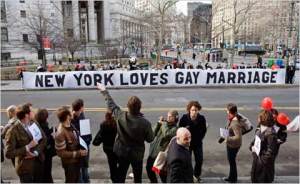
Breaking News!!! Gay Marriage Approved in N.Y.

In a historic vote just moments ago, the New York Senate passed a bill securing the freedom to marry for all committed and loving couples. Governor Andrew Cuomo, who championed the bill, will sign the bill into law. 

The New York Times

Gay Marriage Approved by N.Y. Senate

By  and 

ALBANY — Lawmakers voted late Friday to legalize same-sex marriage, making New York the largest state where gay and lesbian couples can wed, and giving the national gay-rights movement new momentum from the state where it was born.
The same-sex marriage bill was approved on a 33 to 29 vote, as four Republican state senators joined 29 Democrats in voting for the bill. The Senate galleries were so packed with supporters and opponents that the fire marshals closed them off. And along the Great Western Staircase, outside the Senate chamber, about 100 demonstrators chanted and waved placards throughout the night — separated by a generation, a phalanx of state troopers and 10 feet of red marble.
“Support traditional marriage,” read signs held by opponents. “Love is love, Vote Yes,” declared those in the hands of the far more youthful group of people who supported it.
Senate approval was the final hurdle for the same-sex marriage legislation, which is strongly supported by Gov. Andrew M. Cuomo and was approved last week by the Assembly. Mr. Cuomo is expected to sign the measure soon, and the law will go into effect 30 days later, meaning that same-sex couples could begin marrying in New York by midsummer.
Passage of same-sex marriage here followed a daunting run of defeats in other states where voters barred same-sex marriage by legislative action, constitutional amendment or referendum. Just five states currently permit same-sex marriage: Connecticut, Iowa, Massachusetts, New Hampshire and Vermont, as well as the District of Columbia.
The approval of same-sex marriage represented a reversal of fortune for gay-rights advocates, who just two years ago suffered a humiliating, and unexpected, defeat when a same-sex marriage bill was easily defeated in the Senate, which was then controlled by Democrats. This year, with the Senate controlled by Republicans, the odds against passage of same-sex marriage appeared long.
But the unexpected victory had an unlikely champion: Mr. Cuomo, a Democrat who pledged last year to support same-sex marriage but whose early months in office were dominated by intense battles with lawmakers and some labor unions over spending cuts.
Mr. Cuomo made same-sex marriage one of his top priorities for the year and deployed his top aide to coordinate the efforts of a half-dozen local gay-rights organizations whose feuding and disorganization had in part been blamed for the 2009 defeat. The new coalition of same-sex marriage supporters also brought in one of Mr. Cuomo’s trusted campaign operatives to supervise a $3 million television and radio campaign aimed at persuading a handful of Republican and Democratic senators to drop their opposition and support same-sex marriage.For Senate Republicans, even bringing the measure to the floor was a freighted decision. Most of the Republicans firmly oppose same-sex marriage on moral grounds, and many of them also had political concerns, fearing that allowing same-sex marriage to pass on their watch would embitter conservative voters and cost the Republican Party its one-seat majority in the Senate. Leaders of the state’s Conservative Party — the support of which many Republican lawmakers depend on to win election — warned that they would oppose in legislative elections next year any Republican senator who voted for same-sex marriage.
But after days of agonized discussion capped by a marathon nine-hour, closed-door debate on Friday, Republicans came to a fateful decision. The full Senate would be allowed to vote on same-sex marriage, the majority leader, Dean G. Skelos, said Friday afternoon, and each member would be left to vote according to his conscience.
“The days of just bottling up things, and using these as excuses not to have votes — as far as I’m concerned as leader, its over with,” said Mr. Skelos, a Long Island Republican.
Several senators delivered impassioned speeches about the vote.
The lone Democratic opponent, Senator Ruben Diaz of the Bronx, said it was “unbelievable” that the Republican Party, “the party that always defended family values,” had allowed same-sex marriage to pass.
“God, not Albany, has settled the definition of marriage, a long time ago,” he said.
But Mark Grisanti, a Buffalo Republican who opposed gay marriage when he ran for election last year, said he had studied the issue closely, agonized over his responsibility as a lawmaker, and concluded he could not vote against the bill. Mr. Grisanti voted yes.
“A man can be wiser today than yesterday, but there can be no respect for that man if he has failed to do his duty,” Mr. Grisanti told his colleagues.
The tide of change in Albany began as Mr. Cuomo relentlessly pressed lawmakers in a series of phone calls and sit-down meetings, advocates also tried to demonstrate shifting public opinion, citing polls that showed a majority of New York voters supporting same-sex marriage, and releasing almost daily written or videotaped expressions of support from celebrities as well as professional athletes, business leaders, and political figures.
The legalization of same-sex marriage in the United States is a relatively recent goal of the gay-rights movement, but over the last few years, gay-rights organizers have placed it at the center of their agenda, steering money and muscle into dozens of state capitals in an often uphill effort to persuade lawmakers.
In New York, passage of the bill reflects rapidly evolving sentiment about same-sex unions. In 2004, according to the Quinnipiac poll, 37 percent of the state’s residents supported allowing same-sex couples to wed. This year, 58 percent of them did. Advocates moved aggressively this year to capitalize on that shift, flooding the district offices of wavering lawmakers with phone calls, e-mails and signed postcards from constituents who favored same-sex marriage, sometimes in bundles that numbered in the thousands.
Dozens more states have laws or constitutional amendments banning same-sex marriage, many of them approved in the last few years, as same-sex marriage moved to the front line of the culture war and politicians deployed the issue as a tool for energizing their base.
But New York could be a shift: It is now by far the largest state to grant legal recognition to same-sex weddings, and one that is home to a large, visible and politically influential gay community. Supporters of the measure described the victory in New York as especially symbolic — and poignant — because of its rich place in the history of gay rights: the movement’s foundational moment, in June of 1969, was a riot against police inside the Stonewall Inn, a bar in the West Village.
     On Friday night, as the Senate voted, a crowd jammed into the Stonewall Inn, where televisions were tuned to the Senate hours before the vote began.  Danny Garvin, 62, said he had been at the bar the night of the riot, and came back to watch the Senate debate Friday. On the streets where police beat gay men in 1969, on Friday crowds cheered, as police quietly stood watch. Bernie Janelle, 53, turned to her partner of 16 years, Cindy Hearing, and said, “I’m going to propose to her on Sunday.”
Just before the Senate’s marriage vote, lawmakers in the Senate and Assembly also approved a broad package of major legislation that constituted the remainder of their agenda for the year. The bills included a cap on local property tax increases, and a strengthening of New York’s rent regulation laws, as well as a five-year tuition increase at the State University of New York and the City University of New York.
After passing the marriage measure, the Legislature was expected to adjourn its annual legislative session, which had been scheduled to end June 20.

Danny Hakim and Thomas Kaplan contributed.

UPDATES: The Empire State Building goes rainbow to celebrate New York passing gay marriage bill.


The Gay Marriage Debate

I wanted to share with you parts of an article from the Chronicle of Higher Education that I found very interesting.  This article comes from their blog “Brainstorm: The Chronicle Review’s Blog on Ideas and Culture” and concerns the upcoming gay marriage vote in the New York Legislature.

Gay Marriage: A Plea to the Legislators of New York

June 19, 2011, By Michael Ruse
In 1887 Marian (“Mady”) Collier, daughter of Darwin’s “bulldog” Thomas Henry Huxley, died at the age of 38.  She had long been plagued by depressions and had verged right over into madness, but it seems that it was pneumonia that struck the final blow.  Her distraught husband, the painter John Collier, found support and consolation within his wife’s family and two years later married Marian’s younger sister Ethel.  However, to do so, it was necessary for the couple to travel to Norway.  In Britain, at that time, a man was not allowed to marry the sister of a dead wife.  It was thought that the possibility would lead to too many temptations, not all of which would be resisted.
The moral I want to draw from this story is that marriage as a social custom is not something like a 3, 4, 5 triangle.  They are all right angled, and no non-right angled triangle is 3, 4, 5, and that is the end of the matter.  What a marriage is and who is allowed to marry whom is not written in stone or reflection of a Platonic Form or whatever.  We allow someone to marry the sister of a dead wife.  The Victorians did not.  (There is a joke about this in Iolanthe, the opera by Gilbert and Sullivan.  “He shall prick that annual blister.  Marriage with the deceased wife’s sister.”  The prohibition was lifted in 1907.)
Charles Darwin married his first cousin Emma.  Some societies allow this, almost insist on it.  Others, prohibit it.  (Texas added the prohibition in 2005.)  Some societies allow men to marry more than one wife (and, rarely, the other way around).  Others prohibit it.  Some societies allow people of two different racial backgrounds to marry.  Others prohibit it.  And so forth.  And the bible is not an awful lot of help.  Think David.  Think Solomon.  Then think Saint Paul, who thought that marriage was always second best.  Really, you should not get into it at all.
Marriage itself is not just one thing and it certainly is not just a religious thing.  Charles and Emma married for a number of reasons.  The first is that Charles was pretty randy (one suspects Emma too, although there is less written evidence).  The second is that they were lonely and looking for mates. The third was certainly religious in Emma’s case although less so in Charles.  This is not to say that he would ever have thought of living in a relationship without the formality of marriage.  He was not George Eliot.  The fourth, and this was overwhelmingly important, is that by Charles and Emma marrying, the very substantial family fortune—they were both grandchildren of Josiah Wedgwood the potter—would remain a very substantial family fortune. Since Charles returned from the Beagle voyage in 1836, more than one mama with marriageable daughters had been inviting him to supper and picnics and more.
As it happens, Charles and Emma had a wonderful marriage, raising many children and being loving companions for over 40 years.  But all of this reinforces the point that marriage is not, as I have said, a 3, 4, 5 triangle.  It is partly biological.  It is partly social and cultural.  Sometimes it is a good thing.  Sometimes it is not.  (Said he, with much experience.)  But overall it is a very human thing and, frankly if two people want to get married, then that should be their business and not ours.  (As a professional philosopher, I am only too aware that one can think up counter-examples to this general rule, but let us take those as given.) To read the rest of this article, Click Here.
Michael Ruse directs the program in history and philosophy of science at Florida State University. His forthcoming book is Science and Spirituality: Making Room for Faith in the Age of Science.

I recently received an email asking if I would promote a blog post about the Gay Marriage Debate. Donna Cullen who sent the email to me, thought that my readers and I would appreciate taking a look at the blogs listed. I have checked out several of the blogs mentioned, and they do seem very interesting, so I hope you will go check out this post: “Yay or Nay: Top 20 Blogs Debating Gay Marriage.

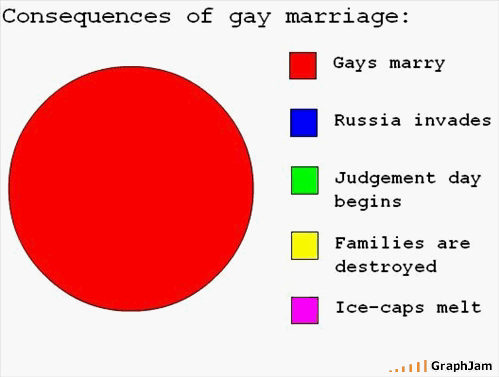
I personally, agree with the picture above.  The main thing that will happen if gays are allowed to marry is that gay people will get married.  Besides, I have always thought it would be a great boost to the economy.  Think about it:  
  • Who will throw the most fabulous weddings? Gay men. 
  • Who will register for beautiful (and probably expensive gifts)? Gay men.
  • Who will buy those gifts? The friends and family of gay men.
How could that not be great for the economy?  Weddings are expensive, let gay men and women do it with style.

Click “Read More” to see the list of the Gay Marriage Supporters from Yay or Nay: Top 20 Blogs Debating Gay Marriage.

Gay Marriage Supporters

  1. The Gay Marriage Blog – This is an Australian blog that covers the gay marriage debate in a very global manner, providing news updates from many different countries.
  2. Gay.AmericaBlog – Since this is one of the top gay rights advocacy blogs, gay marriage is certainly one of its top topics.
  3. 365 Gay – The blog for this website provides continual updates on news items related to gay issues, gay marriage, of course, being one of them.
  4. Good As You – Legalization of gay marriage is being promoted in a big way on this blog that is unapologetic in its stand on homosexuality.
  5. Beyond (Straight and Gay) Marriage – This blog, by the author of a book by the same title, takes the debate a step beyond gay rights and argues for rights of all and any type of family unit.
  6. LGBT Minute – Activism and news for the entire LBBT community is promoted on this blog. The gay marriage rights debate continues to be a hot issue.
  7. Believe Out Loud – This site is a gathering spot for Christians that support gay marriage and greater acceptance of gays within Christian churches.
  8. Straight Not Narrow – A uniquely, evangelical Christian voice in support of gay rights and gay marriage.
  9. Gay Politics – There are few items more central to the topic of gay politics than gay marriage rights, so you will find it to be a central theme on this blog.
  10. Out Front – Discussions on all LGBT issues are covered on this blog. Gay marriage is certainly not left out.
(Check out the blog post, Yay or Nay: Top 20 Blogs Debating Gay Marriage, for those who are against)

Update

letterhead

On an update to my post Call to Action, believe it or not, I did actually hear back from my Congresswoman (on another matter that I wrote to her about a few months ago), and the letter was somewhat more personalized than I expected, which gives me hope.  

US-Capitol-Building

She’s still a Republican, which takes away a lot of that hope, but you never know.  I just have a hard time trusting these Tea Partiers, which she is loosely associated with and how she got elected.  She spent the whole campaign going on and on and on and on about the evils of Nancy Pelosi.  It was her only platform, and most of the stuff she had quoted was wrong, yet the people of my district still elected her.  Is there no hope for us living in the Conservative Bible-Belt of the South?

I will move on to other stuff. 

Enough about politics.


Call to Action

US-Capitol-Building
Urge your member of Congress to save Teaching American History Grants and many other vital education programs:
Legislation has been introduced in the House of Representatives that would eliminate the Teaching American History (TAH) grants program at the U.S. Department of Education.  We urge you to contact your Member of Congress immediately to oppose this bill. The bill (H.R. 1891), the “Setting New Priorities in Education Spending Act,” would terminate 43 K-12 federal education programs.  Click on the link for a PDF that outlines those cuts.
The President’s fiscal year 2012 budget request for the Department of Education would eliminate Teaching American History grants (TAH) as a separately funded program.  However, the Administration proposed consolidating history education into a new program called Effective Teaching and Learning for a Well-Rounded Education. This reflects the President’s Elementary and Secondary Education Act (ESEA) reauthorization proposal, the Blueprint for Reform that was released in March 2010.
Teaching American History grants is the only federal program that funds K-12 history education.  Its elimination would exacerbate the problem of local school districts deemphasizing history in their curriculum because it is not the focus of high-stakes testing.
The House Education and the Workforce Committee is expected to consider H.R. 1891 at any time. It is important that you contact your Member of the House of Representatives TODAY, to urge them to oppose this bill.
The Alliance has set up a template message for you to customize. We strongly encourage you to personalize this message by telling Congress why TAH programs are important to you, your institution, your field, your state, and/or district. Take Action
There are many other programs listed that do not need to be cut.  With the economy and cuts in education on the state level, why would the federal government do more to damage American education.  We are already behind many other nations in education.  We need to find a program that works to enhance education, not defund it.  I am not the first to admit that “No Child Left Behind”  (NCLB) is a total failure, but something needs to be done.  The government states that the “OMB’s 2004 PART evaluation found no demonstrated results from the program” which I don’t believe.  When I was in graduate school, this grant funded a lot of great programs for teacher education, National History Day, etc.  These were programs that promoted history education.  What results were they looking for?  I can’t answer that, and more than likely, neither can they.
The TAH program is designed to raise student achievement by improving teachers’ knowledge and understanding of and appreciation for U.S. history. The purpose of these grants is to promote the teaching of traditional American history in elementary and secondary schools as a separate academic subject.
us_capitol_dc_daguerreotype_1846_poster-p228586855391669200t5wm_400

A daguerreotype of the US Capitol, Washington DC, taken in 1846

Many important subjects, such as history, civics, geography, and foreign languages have received less classroom time.  As a result, our children are growing up with diminished knowledge and understanding of our nation’s history. To fulfill its obligations and take advantages of its privileges, citizenship requires knowledge of America’s past. As a nation, we cannot afford to ignore our responsibility to provide high-quality history education to all our students. 
By eliminating the Teaching American History grants program, Congress will be repeating the mistakes of NCLB and cutting off the only federal funding for K-12 history education.  The program works: evaluations of TAH programs show a clear increase in participating teachers’ content knowledge and skill in teaching history.
By the way, this is on a side note to this, but have you seen this story: Meet Amy Myers.  I think it is great that students are taking a keen interest in politics, civics, and US history I do have one problem with this young girl, and that is I do not like it when kids think they are smarter than adults.  I have a couple of students who like to challenge me in class, now it is one thing to do so in the pursuit of knowledge, it is another to try an show off your intellect at the expense of others.  I have never actually had a student that I wasn’t able to show that I was right and though much of history is about interpretation, they are not looking at the full picture.  Teenagers often don’t know the vast extent of what they don’t know.  Now saying that, Amy Myers probably can beat Michelle Bachmann in a debate or history quiz, to me it is still a little presumptuous of her and somewhat disrespectful.  I also have a suspicion that this was not her idea and that she was put up to it by an adult with a particular political agenda.  Then again, that is my opinion. 
Now the reason I brought this up is because Miss Myers wrote to Congresswoman Bachmann and did not get a response.  I have written to my Representatives before and though I always get a response from my senior Senator,  I only occasionally get a response from my junior Senator.  However, I have yet to ever get a response from my Representative in the House, no matter who it was or what his/her political affiliation was.  I just wonder if it is common not to hear form your congressional representatives?  Do any of you write to your representatives in Congress?  Do you get a response?  Does it have to do with staff size, or what?  I would love to hear your input on this.


NPR

I am writing this to urge you to contact your Senators and ask them not to vote in favor of prohibiting Federal funding of National Public Radio and the use of Federal funds to acquire radio content.   I also hope that if you are representative in Congress is one of the ones listed below that you will write to them about your displeasure at their vote in favor of HR 1076.  Here are the Members of the House of Representatives (mostly Republicans) who voted in favor of this bill:

Adams
Aderholt
Akin
Alexander
Austria
Bachmann
Bachus
Barletta
Bartlett
Barton (TX)
Bass (NH)
Benishek
Berg
Biggert
Bilbray
Bilirakis
Bishop (UT)
Black
Blackburn
Bonner
Bono Mack
Boustany
Brady (TX)
Brooks
Broun (GA)
Buchanan
Bucshon
Buerkle
Burgess
Burton (IN)
Calvert
Camp
Campbell
Canseco
Cantor
Capito
Carter
Cassidy
Chabot
Chaffetz
Coble
Coffman (CO)
Cole
Conaway
Cravaack
Crawford
Crenshaw
Culberson
Davis (KY)
Denham
Dent
DesJarlais
Diaz-Balart
Dold
Dreier
Duncan (SC)
Duncan (TN)
Ellmers
Emerson
Farenthold
Fincher
Fitzpatrick
Flake
Fleischmann
Fleming
Flores
Forbes
Fortenberry
Foxx
Franks (AZ)
Frelinghuysen
Gallegly
Gardner
Garrett
Gerlach
Gibbs
Gingrey (GA)
Gohmert
Goodlatte
Gosar
Gowdy
Granger
Graves (GA)
Graves (MO)
Griffin (AR)
Griffith (VA)
Grimm
Guinta
Guthrie
Hall
Harper
Harris
Hartzler
Hastings (WA)
Hayworth
Heck
Heller
Hensarling
Herger
Herrera Beutler
Huelskamp
Huizenga (MI)
Hultgren
Hunter
Hurt
Issa
Jenkins
Johnson (IL)
Johnson (OH)
Johnson, Sam
Jones
Kelly
King (IA)
King (NY)
Kingston
Kinzinger (IL)
Kline
Lamborn
Lance
Landry
Lankford
Latham
Latta
Lewis (CA)
LoBiondo
Long
Lucas
Luetkemeyer
Lummis
Lungren, Daniel E.
Mack
Manzullo
Marchant
Marino
McCarthy (CA)
McCaul
McClintock
McCotter
McHenry
McKeon
McKinley
McMorris Rodgers
Meehan
Mica
Miller (FL)
Miller (MI)
Miller, Gary
Mulvaney
Murphy (PA)
Myrick
Neugebauer
Noem
Nugent
Nunes
Nunnelee
Olson
Palazzo
Paul
Paulsen
Pearce
Petri
Pitts
Platts
Poe (TX)
Pompeo
Posey
Price (GA)
Quayle
Reed
Rehberg
Renacci
Ribble
Rigell
Rivera
Roby
Roe (TN)
Rogers (AL)
Rogers (KY)
Rogers (MI)
Rohrabacher
Rokita
Rooney
Ros-Lehtinen
Roskam
Ross (FL)
Royce
Runyan
Ryan (WI)
Scalise
Schilling
Schmidt
Schock
Schweikert
Scott (SC)
Scott, Austin
Sensenbrenner
Sessions
Shimkus
Shuster
Simpson
Smith (NE)
Smith (NJ)
Smith (TX)
Southerland
Stearns
Stivers
Stutzman
Sullivan
Terry
Thompson (PA)
Thornberry
Tipton
Turner
Upton
Walberg
Walden
Walsh (IL)
Webster
West
Westmoreland
Whitfield
Wilson (SC)
Wittman
Wolf
Womack
Yoder
Young (FL)
Young (IN)

NPR is a wonderful source of news and in several instances has been a life-saving source of information. I have lived though three hurricanes while living in the proximity of the Gulf of Mexico. During each of these natural disasters, it was NPR radio stations that kept citizens informed about issues involving the storms. The NPR stations were most often the only radio station operating during the storms and in the aftermath. It was the NPR stations that we depended on for the vital information necessary to survive these disasters. Without electricity, we were forced to rely on battery-powered radios. Public Radio stations were the only source of information during these tragedies. Without federal funding, these radio stations would be hard pressed to provide that vital information.

Furthermore, as an educator, I spend the majority of my time working to enrich the lives of my students. I teach both high school and college, and due to my busy schedule, my main news source is often the local public radio stations. Public Radio keeps me informed of the vital issues of the day. I listen to it each morning and afternoon on my way to and from school. Without that morning and afternoon commute listening to my public radio station, the time and effort I put into educating my students would be diminished. Therefore, I feel that public radio serves as a vital part of my job. As a teacher, I know the importance of keeping informed about the national and international news. Public radio allows me to keep informed for my students.

I feel that the federal funding received by public radio stations is far too vital to be cut or eliminated. Public radio serves an important part of the news and information available in America, especially rural America, and it would be a travesty if their budget were cut.

Thank you for reading.


Geraldine Ferraro: 1935-2011

tumblr_lip1zorbka1qaqcoao1_400

Geraldine Ferraro Dead: First Female Vice Presidential Candidate Dies At 75

Geraldine Ferraro, a Democrat and the first major female vice presidential candidate, passed away on Saturday.

Jeff Zeleny at the New York Times reports that at the age of 75, Ferraro died of complications from blood cancer at Massachusetts General Hospital.

Ferraro was the first woman and first Italian-American to run on a major party national ticket. According to a statement released by her family, she died surrounded by her loved ones after battling multiple myeloma for twelve years. Her family said of the loss:

“Geraldine Anne Ferraro Zaccaro was widely known as a leader, a fighter for justice, and a tireless advocate for those without a voice. To us, she was a wife, mother, grandmother and aunt, a woman devoted to and deeply loved by her family. Her courage and generosity of spirit throughout her life waging battles big and small, public and personal, will never be forgotten and will be sorely missed.”

After first being elected to the U.S. House of Representatives in 1978, she went on to serve New York’s ninth congressional district for three terms. Ferraro ran as Walter Mondale’s running mate in the 1984 presidential election.

Delegates in San Francisco erupted in cheers at the first line of her speech accepting the vice-presidential nomination.

“My name is Geraldine Ferraro,” she declared. “I stand before you to proclaim tonight: America is the land where dreams can come true for all of us.”

Her acceptance speech launched eight minutes of cheers, foot-stamping and tears.


Rainbow State Now The 7th State

Hawaii, the Rainbow State, officially became the 7th state to legalize civil unions for gay couples. I now, more than ever, want to go to Hawaii to get married on the beach.  All that is lacking is the husband.

Hawaii now seventh state to legalize civil unions

By B.J. Reyes From the Honolulu Star Advertiser

Less than a year after seeing the push for civil unions vetoed, gay rights advocates cheered as Gov. Neil Abercrombie signed into law a bill legalizing civil unions and making Hawaii the seventh state to grant such privileges to same-sex couples.

Abercrombie signed the legislation at a ceremony today at historic Washington Place.

“E Komo Mai: It means all are welcome,” Abercrombie said in remarks before signing the bill into law. “This signing today of this measure says to all of the world that they are welcome. That everyone is a brother or sister here in paradise.”

“The legalization of civil unions in Hawaii represents in my mind equal rights for all people,” he said.

The ceremony was broadcast live on television and the Internet as Abercrombie, a Democrat who campaigned on a promise to sign the bill if it reached his desk, reversed the decision made by his Republican predecessor.

Not everyone was thrilled with the new law. 

“It’s a sad day for the people of Hawaii,” said Sen. Mike Gabbard. “Politicians have shown that they just don’t care about the views and values of the majority of Hawaii’s residents.”

The Hawaii Catholic Conference issued a statement expressing disappointment. “Passage of this legislation is just a step towards the legalization of same-sex marriage,” read the statement.

Gov. Linda Lingle had characterized it as same-sex marriage by another name, which she opposed, saying the issue was too important for government to decide and should be put to the people for a vote.

She vetoed the proposal in July.

But advocates, buoyed by the results of the 2010 elections which saw civil union opponents fail in their attempts to unseat supportive lawmakers, brought the issue back under a more favorable climate.

With support in both chambers, lawmakers sought to take advantage of the all-around consensus and fast-track the bill.

Rep. Blake Oshiro, the House majority leader and primary sponsor, said he was proud of the accomplishment, but the passage only means that the Legislature can move on to more important matters such as the budget.

“So we have one big thing down and now we move on to the next fight, the next battle, the next big issue,” said Oshiro (D, Aiea-Halawa).

Senate Bill 232 allows all couples — same-sex and heterosexual — to enter into a civil union, a legal status with all the rights, benefits, protections and responsibilities as traditional marriage.

It is largely similar to the bill vetoed by Lingle, but contains specific provisions aimed at clarifying implementation for the state Department of Health.

Couples would be allowed to start entering into a civil union on Jan. 1.

“This bill has been a long time coming for committed couples in Hawaii who have been denied the basic right to take care of their families,” said Laurie Temple, a staff attorney for the American Civil Liberties Union of Hawaii.

Approval of the bill also brings an end to a lawsuit filed by gay couples against the state last year after Lingle’s veto, the ACLU said.

Gay rights advocacy group Lambda Legal and ACLU sued on behalf of six gay couples, alleging the state failed to provide equal rights to gays and lesbians short of marriage. 

Opponents have held prayer vigils at the Capitol this week in advance of the bill signing. 

Many have repeated Lingle’s call for a vote and said the measure would lead to gay lifestyles being taught in public schools. Opponents also have called civil unions a gateway to the acceptance of same-sex marriage.

Hawaii has figured prominently in the national gay rights movement’s efforts since the early 1990s, when the state Supreme Court nearly legalized gay marriage.

The 1993 ruling would have made Hawaii the first state to allow same-sex couples to wed, but it did not take effect while voters were given a chance to decide the matter. They responded in 1998 by overwhelmingly approving the nation’s first “defense of marriage” state constitutional amendment, giving the Legislature the authority to define marriage as between one man and one woman but leaving the door open for civil unions.

Final approval of Hawaii’s civil unions law came the same day as the Obama administration reversed its previous position and said it no longer would defend the constitutionality of the federal law banning recognition of same-sex marriage.

U.S. Attorney General Eric Holder said President Barack Obama has concluded that the administration cannot defend the federal law that defines marriage as only between a man and a woman. He noted that the congressional debate during passage of the Defense of Marriage Act “contains numerous expressions reflecting moral disapproval of gays and lesbians and their intimate and family relationships — precisely the kind of stereotype-based thinking and animus” the Constitution is designed to guard against.

___

The Associated Press contributed to this report.


Hawaii Legislature Approves Civil Unions

From the Honolulu Star Advertiser, By B.J. Reyes

The Hawaii Senate took its final step in clearing the way to grant same-sex couples virtually the same rights and privileges of traditional marriage, giving approval today to a bill legalizing civil unions.

Senate Bill 232 was approved by a 18-5 vote.

It now goes to Gov. Neil Abercrombie, who supports civil unions and has promised to sign the bill into law.

“I have always believed that civil unions respect our diversity, protect people’s privacy, and reinforce our core values of equality and aloha,” Abercrombie said in a statement after the vote. 

“I appreciate all the time and effort invested by those who shared their thoughts and concerns regarding civil unions in Hawaii. This has been an emotional process for everyone involved, but that process is now ended.  Everyone has been heard; all points of view respected. 

“For me, this bill represents equal rights for all the people of Hawaii,” Abercrombie said.

Hawaii becomes the seventh state to grant civil unions to same-sex couples without authorizing marriage itself. Five states and Washington, D.C., permit same-sex marriage.

“Today is a momentous day,” said Sen. Clayton Hee. “There is no denying that by this action Hawaii takes a significant step towards true equality.”

Senate Bill 232 allows all couples — same-sex and heterosexual — to enter into a civil union, a legal status with all the rights, benefits, protections and responsibilities as traditional marriage.

It is largely similar to a bill passed by the Legislature last year but vetoed by then-Gov. Linda Lingle, a Republican who characterized civil unions as same-sex marriage by another name, which she opposed.

With support for the bill in both chambers again this year, lawmakers sought to take advantage of the consensus and fast-track the bill to the governor and move on to more pressing matters.

In addition, Hawaii also made another historic move today.  Moments before the historic vote was taken on civil unions, state senators confirmed Circuit Judge Sabrina McKenna’s appointment to a 10-year term on the Hawaii Supreme Court.


Why DADT’s Repeal is Not the Brown v Board of Ed for Gay Rights

The following is a blog entry by by Ben Adler on December 18, 2010, for Newsweek’s Blog.  After reading it, I really have to agree with Adler.  Yes, the repeal of DADT is a victory.  Yes, it was a long time in coming.  However, it is only a step in the right direction.  We still have to continue to fight for our rights.  One day, we won’t have to hide who we are.  We can be open and honest to everyone, but that day is still a work in progress.
 

image
Michael Reynolds / EPA-Landov
Democratic Senator Kirsten Gillibrand (C) of New York delivers remarks during a press conference after the Senate passed a bill to repeal the Don’t Ask Don’t Tell (DADT) policy

With the timely reversal of a handful of Senate Republicans, a bill to repeal the ban on gays and lesbians serving openly in the armed forces passed the super-majority threshold to defeat a filibuster. The measure then passed the Senate by a 65-31 vote. Having already passed the House of Representatives by a 250-175 and President Obama is certain to sign it.

Gay rights supporters are, naturally, elated. The National Gay and Lesbian Taskforce issued a statement saying, “We celebrate this important victory and thank all the senators who supported fairness today. We are on the brink of making history.”

It will indeed be historic when Obama signs the bill. But it probably won’t be a watershed moment for gay rights like the Civil Rights Act or the Americans with Disabilities Act. New York Times columnist Nicholas Kristof tweeted, “Repeal of ‘Don’t Ask, Don’t Tell’ will be a civil rights milestone. This may be the Brown v. Board of gay rights.” In Brown, in 1954, the Supreme Court ruled racial segregation in schools to be unconstitutional.

Unfortunately for gay rights activists, this development is no equivalent of that. Brown was a unanimous decision that overturned the infamous Plessy v Ferguson precedent which had found “separate but equal” facilities to be constitutionally permissible. Thus, the Court imposed integration in the most sensitive sphere in the public realm — elementary schools — and offered no dissenting opinion to justify opposition. By contrast, this bill passed with significant opposition from Republicans. (Democratic Senator Joe Manchin of West Virginia who had said he opposes letting gays serve openly skipped the vote, but all other Democrats voted for it). It does not establish a constitutional or legal principle that all discrimination on the basis of sexual orientation is unacceptable which can be applied in court rulings to other venues. And it does not allow transgendered individuals to serve.

None of that should diminish the drama or importance of Saturday’s vote: had Democrats failed to pass this measure before the end of the session it would have been doomed by the ascension of Republicans to the majority in the House and a larger caucus in the Senate in the next Congress. Many observers, present company included, had not expected Don’t Ask Don’t Tell repeal to happen in this Congress. And the perennially dissatisfied liberals who fretted that Obama’s refusal to integrate gays and lesbians into the military through an executive order or a choice not to appeal a recent federal court decision that Don’t Ask Don’t Tell is unconstitutional should recognize that Obama has been vindicated. The policy change he promised is coming, and it is coming through the democratic process, so Republicans cannot carp about “activist judges making law.”

And that distinction — judicial versus legislative action — is the reason that today is simultaneously a bigger and smaller victory for civil rights than the day Brown was decided. Bigger in that it shows social progress can be made by the people’s elected representatives, and smaller in that such progress is necessarily more incremental.