Last Week after the election, Tucker Carlson of Faux News was spouting his usual drivel by claiming the “Democratic Party controlled media” cost Republicans the red wave they were sure was coming. My friend Susan sent me a post from Joe.My.God that had the quote by Carlson. She said, rather facetiously, she had “Not one freaking clue what information this jackass (Carlson) is trying to impart.” Here is what Carlson said, then I’ll translate.
“In some cases, candidate quality is not actually the most important thing. What is? Well, the mechanics of an election. They matter. In fact, they matter sometimes more than any individual running in the election.
“The way people vote makes a big difference to the outcome and so, by the way, does access to channels of communication. Why does that matter? Well, because you can say whatever you want, but if no one hears you, you’re not really speaking.
“And that’s the case for Republicans so often, as if Republicans can communicate their message unencumbered on a single cable television channel and a handful of relatively low-traffic websites. That’s it.
“The rest of the American media amounts to a gigantic filter designed to distort what Republicans are saying.
“It’s a campaign apparatus and only the Democrats have it. Now you can whine about that – ‘the media are liberal!’ – but it’s not about liberal or conservative.
“It’s about winning elections and Democrats can win because they have that. If Republicans want to win elections, too, they might spend some money to fix that, to achieve parity.”
Translation: “Republican candidates are stupid, ignorant fools who shouldn’t be elected, but we (Faux News) lie to you about them so you’ll vote for them anyway because more important than anything is that you vote Republican so we can make more money. Intelligent people actually watch real news channels that tell the truth, but we prefer stupid people who we can manipulate.”
She thanked me for the translation and said, “He just didn’t use the right words.” I responded, “He’s a Republican. If he used the right words some might notice that the man behind the curtain is a fraud.”
In yesterday’s post, I quoted Proverbs 1:7, which said, “But fools despise wisdom and instruction.” Carlson and others at Faux News constantly prove my point about how true this really is. It’s a perfect description of the Republican Party and those who support it. If you look at the “Don’t Say Gay” bills, the banning of books in libraries, dictating to teachers what they can and cannot teach, etc., there is no question that they “despise wisdom and instruction.” Even God says they are “fools.” But as James 1:5 tells us, “If any of you lacks wisdom, let him ask of God, who gives to all liberally and without reproach, and it will be given to him.” All we have to do is be open to the truth. The Republican Party is no longer open to the truth. It has become a party of lies based on the myth of a stolen election (not to mention a Lost Cause).
Nazi propaganda chief Joseph Goebbels is often credited with a quote that seems to be the current strategy of the Republican Party when he said:
“If you tell a lie big enough and keep repeating it, people will eventually come to believe it. The lie can be maintained only for such time as the State can shield the people from the political, economic and/or military consequences of the lie. It thus becomes vitally important for the State to use all of its powers to repress dissent, for the truth is the mortal enemy of the lie, and thus by extension, the truth is the greatest enemy of the State.”
It is an excellent definition of the “Big Lie;” however, there seems to be no evidence that it was used by Goebbels.
The World War II American intelligence agency, the OSS, described Hitler’s use of the big lie in his psychological profile:
“His primary rules were: never allow the public to cool off; never admit a fault or wrong; never concede that there may be some good in your enemy; never leave room for alternatives; never accept blame; concentrate on one enemy at a time and blame him for everything that goes wrong; people will believe a big lie sooner than a little one; and if you repeat it frequently enough people will sooner or later believe it.”
If the Republican Party hasn’t already become a fascist political party, it is quickly becoming one under the leadership of TFG. The common themes among fascist movements include authoritarianism, nationalism (including racial nationalism), hierarchy and elitism, and militarism characterized by a dictatorial leader, centralized autocracy, militarism, forcible suppression of opposition, belief in a natural social hierarchy, subordination of individual interests for the perceived good of the nation and race, and strong regimentation of society and the economy.
The “red wave” was more “like a light pink puddle,” as one friend of mine put it. The Republicans may still take the House, but if they do, it will be a very slim majority, yet enough to be annoying in their quest for revenge. The Senate will remain in the hands of the Democrats with the possibility of gaining one seat. It just shows how important it is to go out and vote.
Yesterday was the Vermont primary. It was my first time voting in my new town. The funny thing is that I was confused when I changed my voter registration to my new address (the confusion happened with the power company too). You see, my apartment complex sits at the junction of three towns. My address is one town, because my mailbox is on that side of the line. My apartment, however, is in another town. So, when I registered to vote here, I thought I was signing up for the town that is my address, but it turns out that I had to register for the town where my apartment actually sits, even though my mailbox is only about ten or twenty yards away from my apartment. Vermont is a strange little place. Half the people in my apartment complex vote in one town, and the other half vote in the other town. None of the apartments are in the third town, you drive through it while driving down the driveway of my apartment complex. It’s quite confusing. The way I initially found out that my physical address and my mailing address are in separate towns was when I called the electric company to set up that account. My physical and mailing address are different for them too.
Anyway, this was actually a pretty exciting primary for Vermont. With Patrick Leary’s retirement, his Senate seat is open, so our Representative Peter Welch is running for that seat. As I am writing this, 27 percent of the vote is reporting and Welch is winning with 86 percent of the vote. The AP has already declared him the winner, and he will likely win the general election, as well. This is Vermont after all, the home of Bernie Sanders. In the Republican primary, the front runner had been Christina Nolan, who is a lesbian. However, the hate group National Organization for Marriage, better known as NOM, came out against her solely because she is a lesbian. Gerald Malloy, a West Point graduate and businessman who has only lived in Vermont for two years, seems to have gotten a boost because of NOM and is leading the race with 43 percent to Nolan’s 37.5 percent. The other candidate has just over 19 percent of the vote.
The more interesting race is to fill Peter Welch’s soon to be vacant seat. Honestly, the Republicans in that race don’t matter. It’s the Democratic primary that everyone is watching. Three candidates are vying for the nomination. Becca Balint is a long-time Vermont legislator who is currently president pro tempore of the Vermont Senate. She is a former social studies teacher and the first lesbian to lead the senate. Her main rival is the current Lieutenant Governor Molly Gray, whose only political experience is two years as lieutenant governor and working in the congressional offices of Welch and Leahy, who both endorsed her. Bernie endorsed Balint. The third candidate is Dr. Louis Meyers, whose main campaign issue is that Vermonters care about the issues not sending their first woman to Congress. It was not a winning strategy for Meyers, who at the time of writing this had 1.5 percent of the vote. The AP called the race for Balint, who with nearly 40 percent of the vote reporting had over 61 percent of the vote and over a thousand more votes than Gray.
There are also a number of other statewide races up for grabs. With Gray running for Congress, the lieutenant governor office is up for election. The two front runners there were David Zuckerman, the lieutenant governor before Gray who stepped down to run for governor and Kitty Toll who was endorsed by Howard Dean and has had the most television ads.. I personally don’t like Zuckerman, so I voted for Toll, but it appears that Zuckerman May win as he has 45 percent of the vote to Toll’s 38 percent with 43 percent reporting. The other recently vacant state offices were for attorney general and Secretary of State. Both candidates I voted for in these two races are trailing in the reported results.
I’m most happy about Balint’s win. The others were not very important for me. I think we need more good social studies teachers in Congress. The good ones who teach civics and government know what really goes on in politics. They also tend to know the history of the American political systems and the ups and downs of American History. We also need more LGBTQ politicians.
I try to write something every day. On Sundays, it’s my devotional. On Mondays, it’s whatever comes to mind, if anything. Tuesdays are almost always a poem that I want to share. Wednesdays, Thursdays, and Fridays are again, whatever comes to mind, if anything. On Saturdays, I usually take a break from writing and post my “Moment of Zen,” which is occasionally accompanied by a short explanation, though most are self-explanatory. Each night, I post a Pic of the Day, which is always whatever picture strikes my fancy for that day. I have kept to this schedule for most of the twelve years I’ve posted to this blog. There are days, though, when I just don’t know what to write. Today is one of those days. It’s days like today that I just ramble about different stuff.
I’m just glad that the week is half over. It’s been a hot week, and that’s not likely to change. Vermont has been lucky so far this summer. Most of our days have been in the 60s or 70s F (or about 15-25 C). It’s been pleasant, but like what seems like the rest of the world, our temperature is up this week. We are expecting near 90 degree high temperatures for the five days. I’m ready for it to be back in the mid-70s.
Yesterday, the U.S. House of Representatives voted in favor of the ‘Respect for Marriage Act,’ a major step toward protecting the rights of married couples who could face future threats from discriminatory forces eager to overturn U.S. Supreme Court precedent on the freedom to marry for same-sex couples and interracial couples. Only 47 of the 211 Republican Representatives votes with the Democrats to pass the legislation. It now goes to the Senate, where its prospects are uncertain, as it requires at least 10 Republican votes to defeat a filibuster. So far the same-sex marriage protections have only one GOP backer: Sen. Susan Collins of Maine. The puts GOP senators in a bind, caught between their minority culturally conservative base, which opposes same-sex marriage, and a large majority of the country that wants it to remain legal.
He who is without sin among you, let him throw a stone at her first.
—John 8:7
Religion fanaticism fueled by hatred and hatred fueled by ignorance is destroying the United States. Fascist politicians are using hatred, just as they did in the 1920s and 1930s to further their power-hungry ambitions. All across the world, there are politicians who are either fighting against democracy or strengthening their existing authoritarian rule. Conservatives, whether Republican, Fascist, Nazi, etc., have used religious fanaticism to take away the rights of people. Religion was used to justify slavery, subjugate women, kill or imprison LGBTQ+ individuals, and any number of horrible inhumane actions.
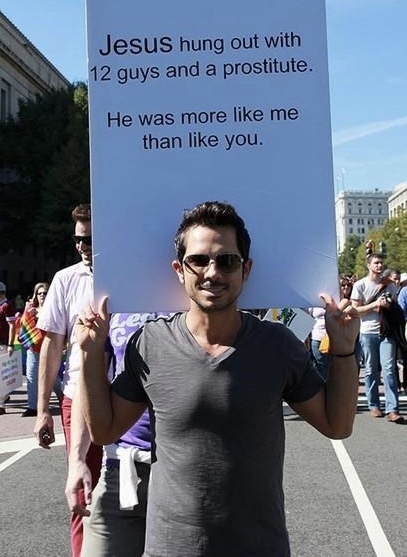
For those who claim they are Christian and vote and support hatred-fueled religious fanaticism, they do not follow the teachings of Jesus. Jesus taught love, hope, charity, mercy, and acceptance. In John 4:3–39, Jesus was headed to Galilee from Judea. This was early in His ministry. He stopped to rest and refresh Himself at a well in Samaria during one of His journeys. A woman came to the well to draw water, and the Savior engaged her in conversation. She was astonished that He would speak with her, “for the Jews have no dealings with the Samaritans.” But He overlooked the traditions that devalued her in others’ eyes. He taught her about the living water of the gospel, and He testified to her, “I who speak to you am [the Messiah].”
Jesus did not teach hatred and discrimination like many modern Christians. Instead, he taught acceptance. There are two remarkable stories showing how Jesus cared for all types of people. The religious fanatics of his time called the Pharisees were offended because in their view God loved only the righteous who kept the law as they interpreted them. They, therefore, distanced themselves from so-called ‘unclean’ sinners in their delusions of self-righteousness. But Jesus was often eating and drinking with those the Pharisees deemed disreputable sinners. He met people where they were and healed them. He protected those who committed adultery and prostitutes. Jesus proclaimed that both law-keepers and law-breakers are sinners in need of forgiveness. In John 8:7, Jesus told the Pharisees who wanted to stone a woman to death for committing adultery, “He who is without sin among you, let him throw a stone at her first.” In Matthew 7:1-3, Jesus warned, “Judge not, that you be not judged. For with what judgment you judge, you will be judged; and with the measure you use, it will be measured back to you. And why do you look at the speck in your brother’s eye, but do not consider the plank in your own eye?”
A day of reckoning will come for those who use the name of God to further their hatred and claim that they do so in Jesus’s name. We can start by going to the polls in November and voting out the hypocrites and modern-day Pharisees. We need to vote in such great numbers that we make the elections of 1932 a minor Democratic victory. For anyone who is not familiar with the 1932 elections, Democratic New York Governor Franklin D. Roosevelt defeated Republican incumbent president Herbert Hoover in a landslide, with Hoover winning only six Northeastern states. In addition to Hoover’s defeat, the Republicans also suffered crushing defeats in both congressional chambers: they lost 101 seats in the House of Representatives, with the Democrats expanding their House majority to a supermajority (a gain of 97 seats), and also lost twelve seats in the Senate, giving Democrats a total of 58 out of 96 seats in the Senate (Alaska and Hawaii were not yet states). The other Senator, Henrik Shipstead of Minnesota, was a member of the Farmer-Labor Party before switching back to being a Republican in 1940. (He’d been a Republican prior to 1923.) This landslide election was the last time that an incumbent president lost re-election and his party lost control of both chambers of Congress in a single term until 2020.
If we don’t keep a majority in the House and gain at least 2 seats in the Senate (to counteract Manchin and Sinema) and do away with the filibuster, hate has won. Furthermore, we must expand the Supreme Court and institute ethics reforms in the federal government including SCOTUS. If you live in a state with a Republican majority, work as hard as you can to change that. We have to have election reforms and protections. We need stronger and sensible gun laws. We need meaningful reforms to healthcare and student loans. Most importantly we must preserve equality in the United States. We can no longer allow religious fanatics to have sway in this country. Republicans have pushed for overturning Roe v. Wade, and now they’ve done it. This will only empower conservatives and religious fanatics to push forward with taking away marriage equality, access to birth control, the right to privacy, and due process. In his concurring opinion, Justice Clarence Thomas wrote that the justices “should reconsider all of this Court’s substantive due process precedents, including Griswold, Lawrence, and Obergefell” — referring to three cases having to do with Americans’ fundamental privacy, due process, and equal protection rights. Anyone who did not see this coming with the overturning or Roe was incredibly naïve. I beg of you not only to vote but encourage all those who are sympathetic to equality to also vote. If someone needs a ride to the polls, give it to them. If someone is not registered to vote, get them registered.
I don’t think that the majority of people who claim to be Christian would follow Jesus if the Second Coming happened today. They set aside all of their values and beliefs to elect Donald Trump. They sold their souls to make sure that Roe was overturned. Now, we must come out fighting (peacefully, of course). Vote! Vote! Vote! Let’s take back our country and make it a country in which we can be proud to live.
Prayer for Pride 🙏🏻🏳️🌈
“And when you pray, you shall not be like the hypocrites. For they love to pray standing in the synagogues and on the corners of the streets, that they may be seen by men. Assuredly, I say to you, they have their reward. But you, when you pray, go into your room, and when you have shut your door, pray to your Father who is in the secret place; and your Father who sees in secret will reward you openly. And when you pray, do not use vain repetitions as the heathen do. For they think that they will be heard for their many words. Therefore, do not be like them. For your Father knows the things you have need of before you ask Him.”1
—Matthew 6:5-8
I love Pride because it shows the diversity of our communities. Different skin colors, different body types, different genders (and even more gender expressions!) From promiscuous to monogamous married couples, from kinky to vanilla, and everything in between. The LGBTQ+ community is varied and beautiful, and that’s what makes us such a fabulous community.
Recently, I received an email form Queer Theology which shared a wonderful prayer for Pride. I have adapted it a little to fit my situation better, and I encourage you to do the same. (My edits with notes are in parentheses.) So, I give you a Prayer for Pride:
There was a time when I prayed asking you to help me become straight. Thank you for ignoring that prayer. Or rather, for answering it differently than I expected:
“I will help you become more fully you.”
Thank you for the gift of queerness, for the liberation it has sparked in my own life (and in the lives of my family2).
Thank you for this body and for the courage to explore all the ways I can use it to make myself and others feel good, connected, healed, whole. (And let’s not forget sexy and desired.3)
Though my journey here has not been easy, I am grateful for it. Let the shame I felt with my body, with my desires, with my love, with myself, be a reminder to do everything I can to not contribute to another’s shame but to instead support them in their own self-love and self- determination.
I pray for those still living with shame, help them to shake it off; and embolden me to work to create a world which breeds pride, not shame.
I pray for those who, knowingly and unknowingly, fed my own shame. May they have everything they need in their lives and if they seek forgiveness, help them to know that they are forgiven.
And I pray for those in the in-between spaces–myself included, if I’m honest–give us strength to continue the journey, to lean into the tender places, to do the work, and to celebrate the victories.
Thank you for the victories. Though the Kingdom of Heaven is still not fully realized on earth, let us be glad in all the ways in which it is alive and present, here, and now.
In Christ’s name we pray,
Amen.
________________
Notes:
1. One of my greatest pet peeves is when people make a huge deal about praying in public. My sister’s in-laws always insisted on holding hands and praying when at a restaurant. And often, when people pray in church, they drone on and on. A simple prayer is always best, and in my opinion, it is much better to pray alone and in private. Prayer should be between you and God. It need not be with anyone else.
2. I hope that it has made positive changes in your family. Mine is still a work in progress.
3. This one I leave up to you.
I had planned on only posting the “Prayer for Pride” but with the SCOTUS news on Friday, I wanted to say more.
I think President Biden said what all sane people are thinking. When is it going to end? When is enough, enough? In God’s name, when will Republicans wake up and realize that sensible gun laws are not going to take away their right to own a gun?
Sen. Ted Cruz, R-Texas, in response to a question from NBC News, immediately dismissed the prospect of new efforts to pursue gun control measures. “That doesn’t work. It’s not effective. It doesn’t prevent crime,” said Cruz, who instead said it would be better to go “after felons and fugitives and those with serious mental illness, arresting them, prosecuting them when they try to illegally buy firearms.” If sensible gun control measures don’t work, why is the United States the only country in the world to have so many mass shootings? The answer is simple. It’s because other countries have sensible gun laws. They have the same criminals and mentally ill, but most also have better prisons and healthcare.
Cruz’s remarks sparked a sharp rebuke from Sen. Chris Murphy, D-Conn., who was elected to the Senate just weeks before the 2012 mass shooting at Sandy Hook Elementary School in his state. “Spare me the bullshit about mental illness. We don’t have any more mental illness than any other country in the world,” Murphy told reporters. He also urged Congress to act.
Rep. Ruben Gallego, D-Ariz., also lashed out at Cruz. “F— you @tedcruz,” Gallego tweeted, “you care about a fetus but you will let our children get slaughtered. Just get your ass to Cancun. You are useless.” Gallego appeared to be referring to Cruz’s opposition to abortion rights and his trip to Mexico last year as Texas faced a crippling winter storm.
Fuck you @tedcruz you care about a fetus but you will let our children get slaughtered. Just get your ass to Cancun. You are useless. https://t.co/0tArGHosep
House Speaker Nancy Pelosi, D-Calif., called the shooting a cold-blooded massacre. “For too long, some in Congress have offered hollow words after these shootings while opposing all efforts to save lives,” she said in a statement. “It is time for all in Congress to heed the will of the American people and join in enacting the House-passed bipartisan, commonsense, life-saving legislation into law.”
There are two Senator's blocking Democrats from passing ANYTHING on gun control. Their names are @Sen_JoeManchin and @SenatorSinema. At this point they are BOTH nothing more than Accessories To Murder pic.twitter.com/r0ymMvJzvf
— Back2Stonewall.com – Will Kohler (@BACK2STONEWALL) May 25, 2022
A major news story broke Monday night. It is not something I would usually talk about on my blog, but the seriousness of the issue is frightening to me for many reasons. The online news media site, Politico, obtained what it calls a draft of a majority opinion written by Justice Samuel Alito that would strike down Roe v. Wade. For those of you who may not be in the United States or may not know what the 1973 Supreme Court case is about, Roe v. Wadewas a landmark decision of the U.S. Supreme Court in which the Court ruled that the Constitution of the United States protects a pregnant woman’s liberty to choose to have an abortion without excessive government restriction. What Politico released is only a draft. The final opinion has not been released, and votes and language can change before opinions are formally released. The opinion in this case is not expected to be published until late June. However, Republicans have been pushing to pack the Court with conservative justices who want to overturn Roe v. Wade for many years, and they finally succeeded under the twice-impeached, previous loser president.
Prior to the Senate confirmation of the very conservative and young Amy Coney Barrett to the Supreme Court, Chief Justice John Roberts had served as a swing vote and attempted to balance the Court between liberal and conservative justices. If this draft is accurate, Roberts voted against overturning Roe v. Wade. Overturning it would be unprecedented (as far as I am aware) in that it would be the first Supreme Court case to overturn a major precedent that granted rights. Most, if not all, overturned decisions have been done so to correct cases where the Supreme Court took away rights, such as Brown v. Board of Education (1954). Brownended racial segregation in schools and overturned Plessy v. Ferguson (1896) in which the Court had ruled that racial segregation laws did not violate the U.S. Constitution if the facilities for each race were equal in quality, a doctrine that came to be known as “separate but equal.” Other examples exist, but this is by far the most famous. However, with some recent decisions by the Supreme Court, Brown v. Board of Education is slowly being chipped away. The same is happening regarding the constitutionality of key provisions of the Voting Rights Act of 1965. But I am going down a rabbit hole. The fact is, the Supreme Court for the past seven decades has expanded rights of individuals not taken them away. This is beginning to change under the new make-up of the Court. Overturning Roe v. Wade may be the most dramatic of what may become a series of setbacks for civil rights.
I am not going to debate the rights and wrongs of abortions, but I am going to give a little history lesson on abortions for those who think that abortions have always been illegal in America. (Here, I am speaking of the Americas, including colonial times, not just the United States.) In colonial America, abortion was dealt with in a manner according to English common law. Abortion was typically only frowned upon if anyone even thought of it at all. If abortion was penalized, it occurred after “quickening,”—when a woman felt fetal movement—because it suggested that the fetus had manifested into its separate being. Quickening could vary from woman to woman, and sometimes went as late as four months. And, it was only penalized when it was typically seen as a cover-up for improper sexual relations. Also, abortions were much more common than believed and usually performed by midwives, not doctors. (Midwives were always much safer than doctors for pregnant women.)
States did not begin to draft abortion legislation until the first half of the 19th century; by 1880, every state had an abortion statute. These abortion statutes were not passed because of a belief that the fetus was a living being. Children were not seen as fully humans until they reached adulthood. Most of these early abortion statutes were designed to protect women from medical quacks far from the established centers of American medicine—Philadelphia, New York, and Boston, for example. These early statutes (for the most part) punished only the provider of the abortion, not the woman, and either did not apply to physicians or did not apply if the abortion was necessary to preserve the life of the woman.
Not until late 19th century did Americans—writers, journalists, preachers, and physicians—began to describe abortion with moral absolutism that had never existed before. In the late 19th century, targeting abortions and abortion providers—like midwives and “irregulars”—occurred within the context of the professionalization of the medical field. Doctors attempted to legitimize themselves as professional medical men, and they did so at others’ expense largely because women knew having your baby delivered by a midwife was much safer. (Midwives sterilized their hands and equipment, whereas male doctors, and nearly all doctors were male, did not believe in sterilization and did not understand germ theory.) In claiming that pregnancy and childbirth were not natural events, where women and midwives could maintain authority, they argued that pregnancy and childbirth were medical conditions requiring physician intervention.
Abortions were dangerous in the early 20th century, but by the 1920s and 1930s, sterilization of equipment, specialization, and, later, antibiotics, all worked together to decrease mortality. But the laws and the changed view of the morality of abortions had made getting an abortion from anyone, even doctors, illegal. By the 1970s, illegal back-alley abortions were again very dangerous affairs, so when the case of Roe v. Wade came before the courts in 1973, some states were already moving toward allowing abortions so they could be legally and safely obtained.
That was a lot to read, and I hope you are still with me. I mention all this because of a flaw in Justice Samuel Alito’s draft opinion overturning Roe v. Wade. The conservative justice attached to his draft a 31-page appendix listing laws passed to criminalize abortion during that period. Alito claims “an unbroken tradition of prohibiting abortion on pain of criminal punishment…from the earliest days of the common law until 1973.” This is just not true. It is not until the 19th century, 300 years after the first English settlement establishing common law in the Americas, that abortions started to become illegal, and only then to protect a women’s health. Abortions are much safer now, which makes citing those laws illegitimate.
What worries me is if the Supreme Court begins overturning precedents that established rights for certain groups of people, especially those despised by Republicans, what is going to be next? Alito’s draft misleadingly argues that rights protected by the Constitution but not explicitly mentioned in it—so-called unenumerated rights—must be strongly rooted in U.S. history and tradition. That form of analysis seems at odds with several of the Court’s recent decisions, including many of its rulings backing gay rights. Liberal justices seem likely to take issue with Alito’s assertion in the draft opinion that overturning Roe would not jeopardize other rights the courts have grounded in privacy such as the right to contraception, to engage in private consensual sexual activity, and to marry someone of the same sex.
Alito explicitly denies that the Court will overturn any other precedents when he says in the opinion, “We emphasize that our decision concerns the constitutional right to abortion and no other right. Nothing in this opinion should be understood to cast doubt on precedents that do not concern abortion.” However, how can we believe him? Conservatives in the United States have increasingly made lying a part of their everyday life. Just look at the claims of voter fraud in the 2020 election. The only voter fraud that has been found was committed by Republicans and did not change the outcome of the election to re-elect their twice-impeached loser candidate. They also have consistently denied there was an insurrection at the Capitol on January 6, 2021, aimed at stopping the certification of Joe Biden’s presidency. Therefore, I cannot feel safe that Obergefell v. Hodges which granted the right for same-sex couples to marry or Lawrence v. Texas which struck down sodomy laws in the U.S. are not next on the Supreme Court’s chopping block.
I fear with a conservative majority on the Supreme Court and the fascist leanings of the current Republican Party which remains loyal to a lying, idiotic, twice-impeached, orange menace, we are looking at even darker days in the future of the United States and the world. Conservative backlash is not limited to the United States. Authoritarianism is on the rise, and it is not being kept in check by democratic institutions. I encourage all Americans, and people who read this blog in other parts of the world, to back liberal candidates who believe in fundamental human rights and decency. If the Democratic majority in Congress is lost, we are looking at a minimum of two years of intense gridlock; if Republicans win in 2024, we are looking at a wholesale rollback on human rights. Democrats not only need to retain a majority in Congress, but need to gain a filibuster-proof majority in the Senate. We must fight, and we must vote for candidates who will protect our rights. If we don’t, we are surely doomed to lose many of our civil rights as U.S. citizens. Backlash against LGBTQ+ rights are already infiltrating even liberal and LGBTQ+-friendly states like Vermont. In the last few weeks, a trans woman was murdered in a hate crime in Vermont, someone vandalized the offices of the Pride Center of Vermont, and a pride flag was stolen from a flagpole at Northern Vermont University in Lyndon, Vermont. Since I moved to Vermont, I have rarely faced any type of hate or discrimination, but hate is on the rise everywhere.
With all of this said, I must admit, I also find it disturbing that this draft opinion was leaked to the press. I’m glad it was, but I still find it disturbing. The Supreme Court remains one of Washington’s most secretive institutions, priding itself on protecting the confidentiality of its internal deliberations. It is one of the hallmarks of the Supreme Court which allows for deliberation of cases before the Court to happen without intense media scrutiny. Ruth Bader Ginsburg was fond of saying, “At the Supreme Court, those who know don’t talk, and those who talk don’t know.”
And a final word that I couldn’t have said better myself to anyone who wants to make one of the stupid, hateful, and misleading arguments made by Republicans:
For generations, millions of Americans have answered the call to serve — taking the sacred oath to defend and preserve our Nation’s ideals of liberty and democracy. These patriots represent the best of us. On Veterans Day, we honor their service, dedication, and valor and are forever grateful for their sacrifice.
Our Nation has only one truly sacred obligation: to properly prepare and equip our service members when we send them into harm’s way and to care for them and their families when they return home. For our 19 million veterans, that means ensuring that they have access to the support and resources for a future of security, opportunity, and dignity. This is even more important as we continue to recover from the global COVID-19 pandemic.
Our obligation to support our Nation’s veterans and their families is personal for me and the entire Biden family, and I remain committed to ensuring that every veteran receives the care and support they have earned. The recently passed bipartisan Infrastructure Investment and Jobs Act will create millions of good jobs for veterans and grow opportunities for veteran-owned businesses. My Build Back Better framework also prioritizes improvements to VA health care, ensuring that every veteran — including our often-underserved female and LGBTQ+ veterans — receives competent, world-class health care through the Department of Veterans Affairs. Last month, the White House Gender Policy Council released the first-ever United States Strategy for Gender Equity and Equality, which included the unique needs and contributions of women service members and veterans. And the Department of Veterans Affairs is also working to get every eligible veteran the information and opportunity they need to register and vote, protecting their voice in the democracy they fought to preserve.
Ensuring veterans have timely access to services and benefits is at the center of my Administration’s commitment to fulfilling our sacred obligation. This includes addressing the adverse health effects of service-related exposures. In August, the Department of Veterans Affairs announced it will begin processing disability claims for respiratory conditions connected to exposure during military service in Southwest Asia and other areas. My Administration also added three conditions to the list of those presumptively associated with exposure to Agent Orange, ending the long wait for disability benefits for many Vietnam era veterans. In the coming months, we are committed to taking additional action to address potential adverse health effects associated with military environmental exposures.
So many of our veterans carry the scars from their service — both visible and invisible — and it is our Nation’s responsibility to help them heal. Too many veterans and service members have considered suicide or taken their own lives, and addressing this tragedy is a national responsibility. That is why I have made military and veteran suicide prevention a top priority, and earlier this month, I released a new comprehensive, cross-sector public health strategy to reduce military and veteran suicide. Implementing this approach will unite us around a common mission and accelerate meaningful improvements in suicide prevention programs, helping us live up to our sacred obligation to those who have served in our Nation’s Armed Forces.
Fulfilling our Nation’s promise to our veterans and military families, caregivers, and survivors is not only a moral imperative — it is crucial to our national security and to maintaining the finest military the world has ever known. We are a Nation that keeps our promises. That is why my Administration is dedicated to a whole-of-government approach in responding to the needs of our veterans and their families, caregivers, and survivors.
Through the First Lady’s work with Joining Forces — the White House initiative to support veteran and military families, caregivers, and survivors — my Administration is addressing employment and entrepreneurship, military and veteran child education, and health and well-being for veteran families. Earlier this year, the First Lady met with military and veteran families to learn how we can better support and prioritize their needs, and in September, Joining Forces and the National Security Council released a report outlining the first round of Administration-wide commitments and proposals that support veteran and military families, caregivers, and survivors. These efforts will honor our sacred obligation to support our veteran families and ensure they receive the resources they need to thrive.
On Veterans Day, we honor our Nation’s veterans, who have given so much to protect our freedoms and the freedom of others around the globe. They represent the highest ideals of our country. While we can never fully repay the debt we owe these heroes, we will honor their service and provide them the care and support they deserve. We also salute and show gratitude for all who ensure our Armed Forces remain strong, united, and unmatched.
In respect and recognition of the contributions our veterans and their families, caregivers, and survivors have made to the cause of peace and freedom around the world, the Congress has provided (5 U.S.C. 6103(a)) that November 11 of each year shall be set aside as a legal public holiday to honor our Nation’s veterans.
NOW, THEREFORE, I, JOSEPH R. BIDEN JR., President of the United States of America, do hereby proclaim November 11, 2021, as Veterans Day. I encourage all Americans to recognize the valor, courage, and sacrifice of our veterans through appropriate ceremonies and private prayers. I call upon Federal, State, and local officials to display the flag of the United States of America and to participate in patriotic activities in their communities. And I call on all Americans, including civic and fraternal organizations, places of worship, schools, and communities, to support this day with commemorative expressions and programs.
IN WITNESS WHEREOF, I have hereunto set my hand this ninth day of November, in the year of our Lord two thousand twenty-one, and of the Independence of the United States of America the two hundred and forty-sixth.
This past Pride month, as revelers hit the streets to celebrate LGBTQ+ history, Republican state legislatures were hard at work trying to erase it. And it’s not just momentous events like the Stonewall riots or towering figures like Harvey Milk that could be wiped from classroom instruction. In public schools in Tennessee, Arkansas, and Montana, it may soon become illegal even to mention Bayard Rustin, the openly gay co-organizer of the 1963 March on Washington, or educate kids about the AIDS crisis. Republicans don’t want our nation’s children to know that a gay black man organized one of the most pivotal events in the Civil Rights Movement, and they still insist that AIDS is the result of/punishment for immoral behavior.
In May, Tennessee became the first state to pass what queer-rights advocates have branded as “Don’t Say Gay” laws, which either forbid the teaching of LGBTQ+ history in K-12 schools outright or allow parents to choose whether their children participate in lessons that include it. Within days, Montana followed suit. Yet another bill in Arkansas awaits the signature of the state’s Republican governor. Similar bills have been considered in West Virginia, Iowa, and Missouri. Red-state legislatures are introducing more proposals to hinder education.
Akin to bans on the teaching of critical race theory (If you are not familiar with what critical race theory means [check out the link above and see note below*]. It’s been around for forty years and is merely teaching history as it should be taught.), these laws seek to preserve the myth that the story of America is one of destined progress and unblemished virtue. These laws claim that we stand exceptional among nations as the gleaming embodiment of democracy and, in turn, imply that a significant number of us do not matter. In particular, legislation forbidding the teaching of LGBTQ+ history aims to solidify what remains of society’s moral disapproval of LGBTQ+ people and endangers LGBTQ+ youth who are most susceptible to suicide.
The Republican efforts are a false representation of the past. They want to pretend that LGBTQ+ people have never even existed. They do not want students to question their Pollyanna view of American history. They do not want to open up questions about the failures of the past to allow students to question whether the United States is living up to the goals of the republic—”We the People of the United States, in Order to form a more perfect Union, establish Justice, insure domestic Tranquility, provide for the common defence, promote the general Welfare, and secure the Blessings of Liberty to ourselves and our Posterity.” This whitewashing of history is less about the past than about not wanting to change the present, to hold in place the status quo, and not allow for genuine moments of debate and change. I have always believed that education is more about teaching students how to think critically than it is about memorization.
The Organization of American Historians and the American Historical Association released a joint statement in May condemning the recent spate of “Don’t Say Gay” bills, which the organizations say perpetuate homophobia, distort the historical record, and deprive students—LGBTQ+ and not—of a complete education. Among the many dangers of these laws is that they will create a two-tiered system that will harm students by keeping them from learning about the complexity of our larger society and their place in it, depriving them of a fully rounded education. Maybe if I and those of my generation had been taught just a little LGBTQ+ history, we would not have spent so much of our lives questioning our sexuality or hating ourselves for the way we were born. Teaching tolerance raises self-esteem, and if our sexualities were not constantly demonized, then maybe, just maybe, there would be fewer suicides by LGBTQ+ youths.
Politically, the bills reflect the resurgence of culture-war politics at the state level now that Republicans are out of power in Congress and the White House and the religious right’s expanding moral panic over the advancement of LGBTQ+ rights. As with the bill in Arkansas, the laws in Tennessee and Montana are in one sense narrow—designed, it seems, to invite legal challenges when an overwhelmingly conservative Supreme Court is inclined to grant religious exemptions. In Tennessee, parents must now be given thirty days’ notice to examine any curriculum materials related to sexual orientation or gender identity. They can request their children be pulled from such instruction. Montana gives parents forty-eight hours to “withdraw the child from a course of instruction, a class period, an assembly, an organized school function regarding human sexuality.” A similar notification law in Arkansas requires school districts to tell parents in writing about “instruction of any kind” about “sex education, sexual orientation, and gender identity.”
The emphasis on telling teachers what they can and cannot teach is totalitarianism at its worse. What will happen when a student asks a teacher about Bayard Rustin, Harvey Milk, the Stonewall Riots, AIDS, etc.? Will that teacher have to say, “The law does not allow us to discuss this in class without your parents’ prior permission”? Critical thinking, along with intellectualism, is the enemy of conservatives and the religious right. Just think of Christianity before the Reformation and the Catholic Church’s fear of translations of the Bible in the vernacular, especially as literacy become more common between 1500 and 1800. Conservatives have often feared education throughout history. The elite could be educated, but everyone else was discouraged from education. Conservatives realized that expanded educational opportunities led to greater knowledge and could lead to the questioning of authority. Now conservatives often fear that knowledge could lead to equality and greater power in the hands of the masses. Republicans in the United States know that if more people have access to voting, they stand a lesser chance of winning elections.
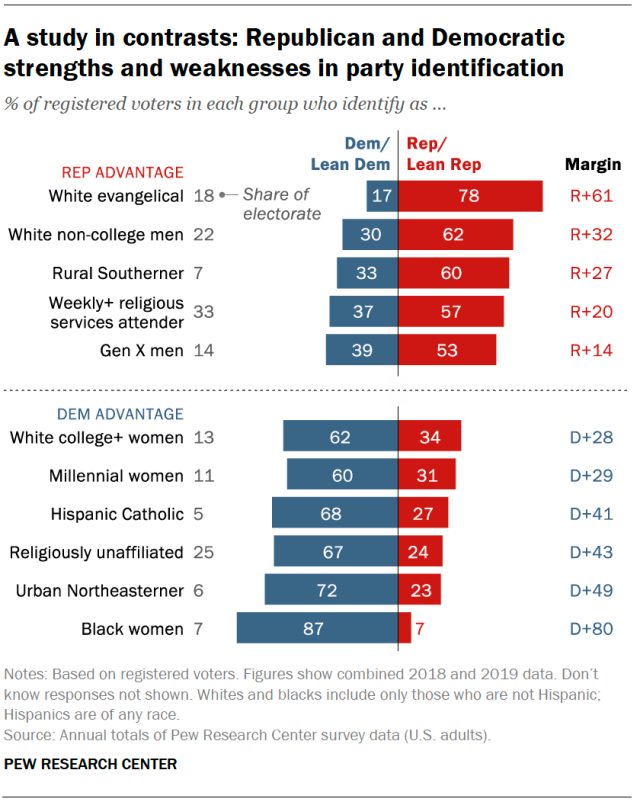
According to the Pew Research Center, Democrats hold advantages in party identification among blacks, Asians, Hispanics, well-educated adults, and Millennials. Republicans have leads among whites – particularly white men, those with less education, and evangelical Protestants – as well as members of the Silent Generation. Just 36 percent of registered voters have a four-year college degree or more education; a sizable majority (64 percent) have not completed college. Democrats increasingly dominate in party identification among white college graduates – and maintain wide and long-standing advantages among black, Hispanic, and Asian American voters. Republicans increasingly dominate party affiliation among white non-college voters, who continue to make up a majority (57 percent) of all GOP voters.
*Here is one example of critical race theory: the Servicemen’s Readjustment Act of 1944, a.k.a. the G.I. Bill. African American veterans benefited less than others from the G.I. Bill, and it was designed that way. The G.I. Bill aimed to help American World War II veterans adjust to civilian life by providing them with benefits including low-cost mortgages, low-interest loans, and financial support. African Americans did not benefit nearly as much as White Americans. The law was deliberately designed to accommodate Jim Crow laws. Banks and mortgage agencies refused loans to blacks, making the G.I. Bill even less effective for non-whites. Once they returned from the war, blacks faced discrimination and poverty, which represented a barrier to harnessing the mortgage and educational benefits of the G.I. Bill, because labor and income were immediately needed at home. Most southern universities refused to admit blacks until the Civil Rights revolution. Colleges accepting blacks in the South (numbering about 100) were of lower quality, with 28 classified as sub-baccalaureate. Only seven states offered post-baccalaureate training, while no accredited engineering or doctoral programs were available for blacks. By 1946, only one-fifth of the 100,000 blacks who had applied for educational benefits had been registered in college. Furthermore, historically black colleges and universities (HBCUs) came under increased pressure as rising enrollments and strained resources forced them to turn away an estimated 20,000 veterans. Though blacks encountered many obstacles in their pursuit of G.I. benefits, the bill greatly expanded the population of African Americans attending college and graduate school. In 1940, enrollment at Black colleges was 1.08 percent of total U.S. college enrollment. By 1950 it had increased to 3.6 percent. However, these gains were limited almost exclusively to Northern states, and the educational and economic gap between white and black nationally widened under the effects of the G.I. Bill. With 79 percent of the black population living in southern states, educational gains were limited to a small part of black America.
Did any of you learn this in school? Is there harm in teaching failures in history? If we do not know about the failure to live up to the ideals of the Declaration of Independence or the Constitution, then how can we begin to correct these mistakes and move forward? And this fear, my friends, is what the Republicans (and conservatives throughout history) fear the most: progress and equality.
For you, brethren, have been called to liberty; only do not use liberty as an opportunity for the flesh, but through love serve one another.
—Galatians 5:13
Today is the 245th anniversary of the Declaration of Independence. Churches across America will likely sing “God Bless America,” “America the Beautiful,” and “The Battle Hymn of the Republic.” The songbook from my church did not have the “patriotic songs” section found in the Baptists, Methodist, or Presbyterian hymnals of my youth, so we never sang these songs in my church. We only sang very traditional hymns, like “Rock of Ages,” “Amazing Grace,” etc. Nothing adorned the knotty pine walls of the small church I grew up in. The only decoration in the church was a side table with a large Bible on a lower shelf and a vase of flowers on top. Two very plain simple cane bottomed deacon chairs sat behind the pulpit. It was the only church I knew with such simple décor. The Southern Baptist church where I was forced to attend vacation Bible school every summer was far more elaborate. Behind the pulpit stood the Christian flag and the American flag. The same was true of the Presbyterian church where I had piano recitals and the Pentecostal church my best friend attended.
Politics or patriotism rarely made an appearance in my church, but it did in many other churches across the country. In many churches, patriotism and religion have been interwoven into their theology. These churches believe in a Christian faithfulness where God desires America to do great, to be great, has ordained America to be at the top, and that America has been baptized by the Church. While this is not something I was taught or ever believed, it’s unrealistic for us not to realize that in the United States, Christianity and patriotism are seemingly inextricably woven together. As the world changes and equality and acceptance grows, the United States will no longer be able to claim (whether it was ever true or not) that America is a beacon of freedom, “the land of the free and the home of the brave.” If we do not either follow the ethical tenets of most religions, including the teachings of Christ or throw off the chains of the uniquely American version of Christianity, then America will fall further and further behind the quest for human rights for all.
Even though the First Amendment of the U.S. Constitution says, “Congress shall make no law respecting an establishment of religion, or prohibiting the free exercise thereof,” religion has been intricately laced in with American history. In 1630, the first ships of the Great Puritan Migration sailed to the New World, led by John Winthrop. During the crossing, Winthrop preached a sermon entitled “A Model of Christian Charity.” He told his followers that they had entered a covenant with God according to which he would cause them to prosper if they maintained their commitment to God. In doing so, their new colony would become a “City upon a Hill,” meaning that they would be a model to all the nations of Europe as to what a properly reformed Christian commonwealth should look like. Since then, politicians have used the “city upon a hill” analogy for political purposes to push for American exceptionalism.
“A Model of Christian Charity” serves as an important text in United States history, conveying the optimistic, confident, community-focused mindset in which the New England colonies were founded. Perry Miller, a historian considered one of the founders of American Studies, wrote that the sermon “stands at the beginning of [the] consciousness” of the American mind. Several figures in U.S. politics—beginning as early as John Adams—have referenced this text in public speeches when trying to convey themes of unity and idealism, most often citing the symbol of “a city upon a hill.” In his 1980 Election Eve speech, Ronald Reagan asserted his belief that “Americans…are every bit as committed to that vision of a shining city on a hill, as were those long-ago settlers.” More recently, public figures have utilized the sermon to argue how far the United States has strayed from its values. In his blistering critique of the then-presidential candidate and future twice impeached and disgraced former president, 2012 Republican presidential nominee Mitt Romney posited that “[Hair Führer’s] personal qualities would mean that America would cease to be a shining city on a hill.” The disgraced former president tried his hardest to destroy the United States, ironically, with the help of American evangelicals.
However, most politicians do not pay attention to the rest of Winthrop’s sermon. They focus on the “city upon a hill,” but not on the rest of the message. Winthrop used logical reasoning combined with a sympathetic nature to make his point to the new Puritan settlers. To remove this work’s central arguments about love and relationships is to lose the sense of the whole completely. The Governor laid out his argument for charity and decent human behavior in the community. While exceptionalism was one of the sermon’s themes, Winthrop explained how God chose the few people on the boats to go to America to carry out their mission. He also mentioned how the rest of the world would watch them. This is the part that politicians have always latched onto, but they often ignore the other main points of the sermon. Winthrop believed that charity, giving to others who need help—not only the poor but also the community—would make the new lands the “city upon a hill” in his view of exceptionalism. Winthrop also believed that communalism reflected the Puritan ideals of “love, unity, and charity.” He mentioned that people have different things to offer each other, and this induced a need for each other, helping the community. He also said that different types of people were on the ship during the sermon but had the same goal of serving God. This was also represented by people being different parts of one body. Through his use of language connected to women’s work, such as “knit,” Winthrop suggests the importance of women in holding the community together. It’s amazing how much is forgotten by the politicians who use a small part of the sermon for their purposes.
Many patriotic evangelical Christians use the Bible to defend their ideas that God is pro-government (or, more specifically, He favors their preferred brand of government). They often use Matthew 22:21, in which Jesus says, “Render therefore to Caesar the things that are Caesar’s, and to God the things that are God’s.” It’s a radical statement publicly declaring that Caesar and Rome weren’t God. Most Roman emperors advocated the belief that they were gods and should be worshiped. In this passage, Jesus is warning us to avoid such thinking.
Romans 13:1 is also often used by people to defend their political allegiances: Let every soul be subject to the governing authorities. For there is no authority except from God, and the authorities that exist are appointed by God. But these texts have a significant caveat, where the authors presuppose that this “submitting” is coinciding—and never contradicting—the supreme call to love God and love others. This becomes obvious when looking at other passages that explicitly say so, such as Matthew 22: 36-40:
“Teacher, which is the great commandment in the law?” Jesus said to him, “‘You shall love the Lord your God with all your heart, with all your soul, and with all your mind.’ This is the first and great commandment. And the second is like it: ‘You shall love your neighbor as yourself.’ On these two commandments hang all the Law and the Prophets.”
Christians using Romans 13 as a defense to support various political viewpoints at the expense of loving others are also ignoring the words of Peter in Acts 5:29 when he tells the apostles, “We must obey God rather than men” and the teachings of Jesus himself when he proclaimed in Matthew 6:24, “no one can serve two masters.” Separating patriotism and Christianity is difficult for many modern American Christians to comprehend because they often incorporate nationalism and patriotism into much of their religious expression and even their faith. Churches celebrating the Fourth of July by adorning their sanctuaries with American flags and incorporating America and American nationalism into songs of worship would have been alarming and even considered blasphemous for the very first followers of Jesus.
The challenge for Christians is to simultaneously honor the virtues of sacrifice, service, and freedom without idolizing American exceptionalism and Christian nationalism, celebrating bravery without romanticizing violence, and realizing that our salvation comes from the sacrifices of Jesus and not the wars of men. For those raised in churches that interwove Christianity with patriotism, it may not seem a big deal that our country’s flag stands alongside a pastor onstage but try to imagine the apostle Paul and the earliest churches pledging their allegiance to Caesar and the conquering legions who were slaughtering anybody who stood in their way. As citizens of the United States, we’re trying to follow Christ within a similar context as the earliest Christians—living within a powerful empire and susceptible to state-sponsored religion, where it’s socially, politically, and economically advantageous to adhere to certain political beliefs and leaders—even to the point of becoming a pseudo-theocracy.
Unfortunately, Christians have been historically gullible to nationalistic “Christianity.” They often treat our faith as a civic religion to establish a voting bloc and create enough influence to legislate laws, gain wealth, and consolidate power rather than sacrificially serve and love others. The American version of Christianity often perverts the life and mission of Jesus because instead of forgiving enemies, the state spends billions of dollars to kill them, instead of caring for the poor, we villainize them, instead of accepting the foreigner we ban them, and instead of helping the oppressed we further alienate them. While it’s clearly possible to be both an American and a Christian, we must realize that the goals of our country’s government and those of Christ are rarely the same and often directly contradict each other, especially under Republican administrations.
Many right-wing politicians and evangelicals Christians are terrified of the phrase “separation of church and state.” The problem with the comingling of church and state is that only one brand of religion gets instituted for all people in the country. In America, it is often the perverted version of American Christianity that tries to legislate our morals and bodies. Suppose American Christianity had latched onto the charity, communalism, and unity in Winthrop’s “A Model of Christian Charity” instead of American exceptionalism. In that case, the link between religion and politics might not be so bad, and that’s why the First Amendment of the U.S. Constitution says, “Congress shall make no law respecting an establishment of religion, or prohibiting the free exercise thereof.” The Founding Fathers knew that when it came to church and state if you gave an inch, religious leaders would take a mile. There had to be a clear separation of church and state.
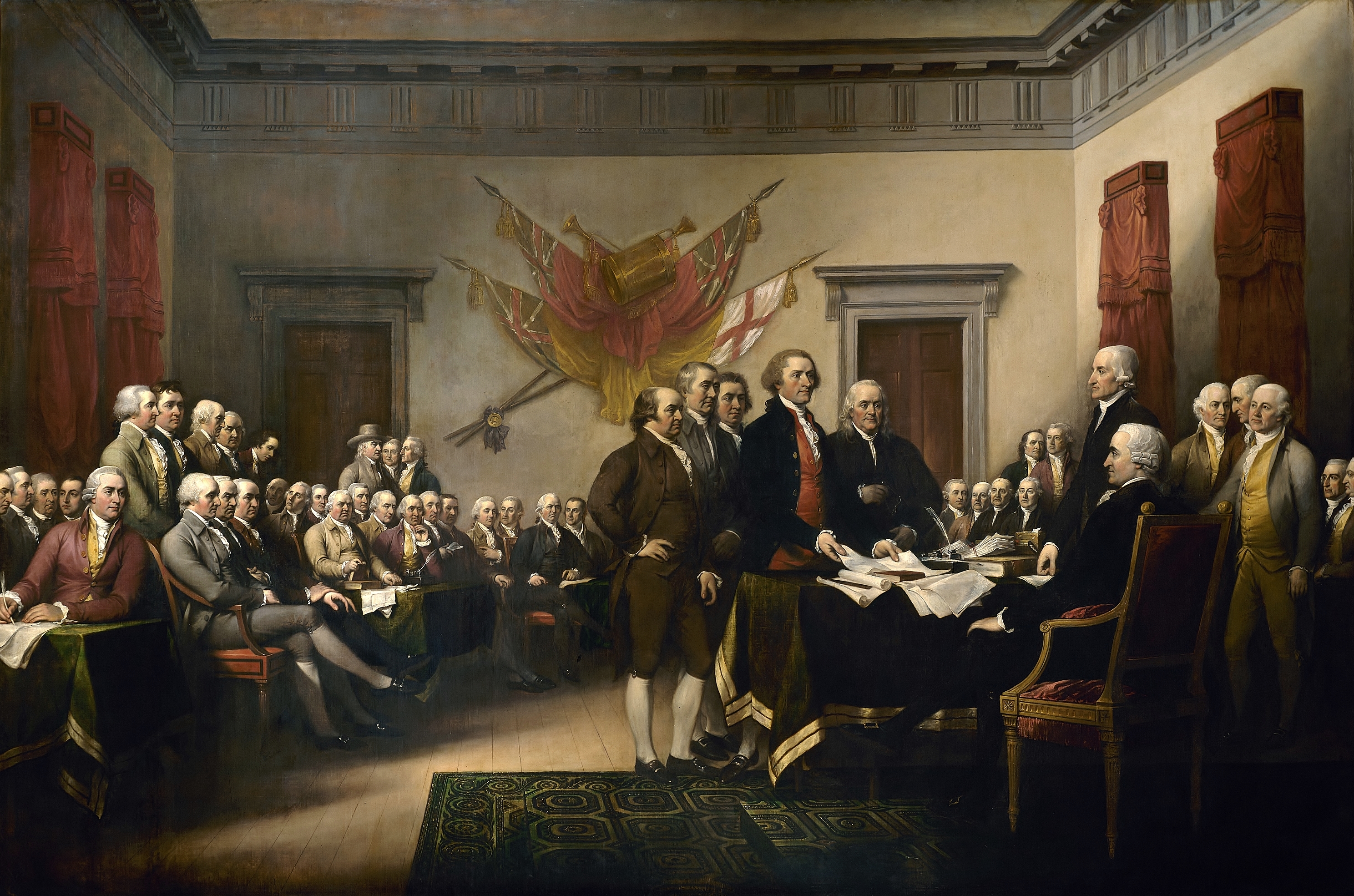
Two hundred forty-five years ago today, fifty-six delegates to the Second Continental Congress put their signature to the following words:
When in the Course of human events, it becomes necessary for one people to dissolve the political bands which have connected them with another, and to assume among the powers of the earth, the separate and equal station to which the Laws of Nature and of Nature’s God entitle them, a decent respect to the opinions of mankind requires that they should declare the causes which impel them to the separation.
We hold these truths to be self-evident, that all men are created equal, that they are endowed by their Creator with certain unalienable Rights, that among these are Life, Liberty and the pursuit of Happiness.–That to secure these rights, Governments are instituted among Men, deriving their just powers from the consent of the governed, –That whenever any Form of Government becomes destructive of these ends, it is the Right of the People to alter or to abolish it, and to institute new Government, laying its foundation on such principles and organizing its powers in such form, as to them shall seem most likely to effect their Safety and Happiness. Prudence, indeed, will dictate that Governments long established should not be changed for light and transient causes; and accordingly all experience hath shewn, that mankind are more disposed to suffer, while evils are sufferable, than to right themselves by abolishing the forms to which they are accustomed. But when a long train of abuses and usurpations, pursuing invariably the same Object evinces a design to reduce them under absolute Despotism, it is their right, it is their duty, to throw off such Government, and to provide new Guards for their future security.–Such has been the patient sufferance of these Colonies; and such is now the necessity which constrains them to alter their former Systems of Government. The history of the present King of Great Britain is a history of repeated injuries and usurpations, all having in direct object the establishment of an absolute Tyranny over these States. To prove this, let Facts be submitted to a candid world.
The White House has installed an exhibit dedicated to “celebrating LGBTQ+ Pride Month 2021” on the Ground Floor Corridor. The exhibit is the first physical display of historical items dedicated to the LGBTQ+ community. The items were borrowed from the Smithsonian Institution and in partnership with the Smithsonian’s National Museum on American History.
The exhibit features artifacts from historic LGBTQ+ community figures like Harvey Milk, Marsha P. Johnson, and Jerame Davis, the former executive director of National Stonewall Democrats. Another figure highlighted in the exhibit is Rose Cleveland, who was the sister of the 23rd and 25th President, Grover Cleveland.
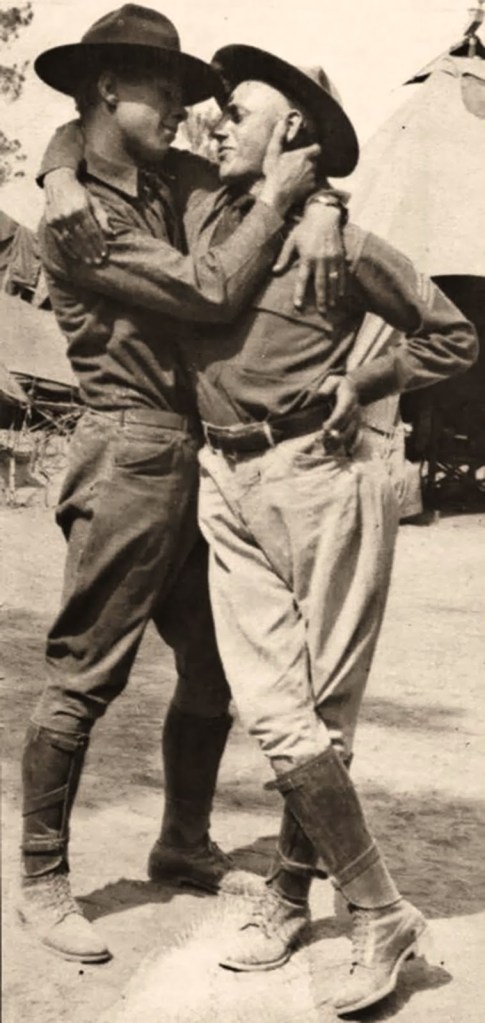
“Rose Cleveland, President Grover Cleveland’s sister, served in the role of White House hostess until his marriage in 1886,” the exhibit reads. “For almost 30 years, Rose Cleveland maintained a romantic relationship with Evangeline Marrs Simpson Whipple. The women lived together in Italy from 1910, until Rose’s death from the Spanish flu in 1918.” The exhibit notes that Rose and Evangeline rest “side by side” in Italy today. Correspondence between them was published in 2019 by the Whipple Collection from the Minnesota Historical Society, where they are housed today.
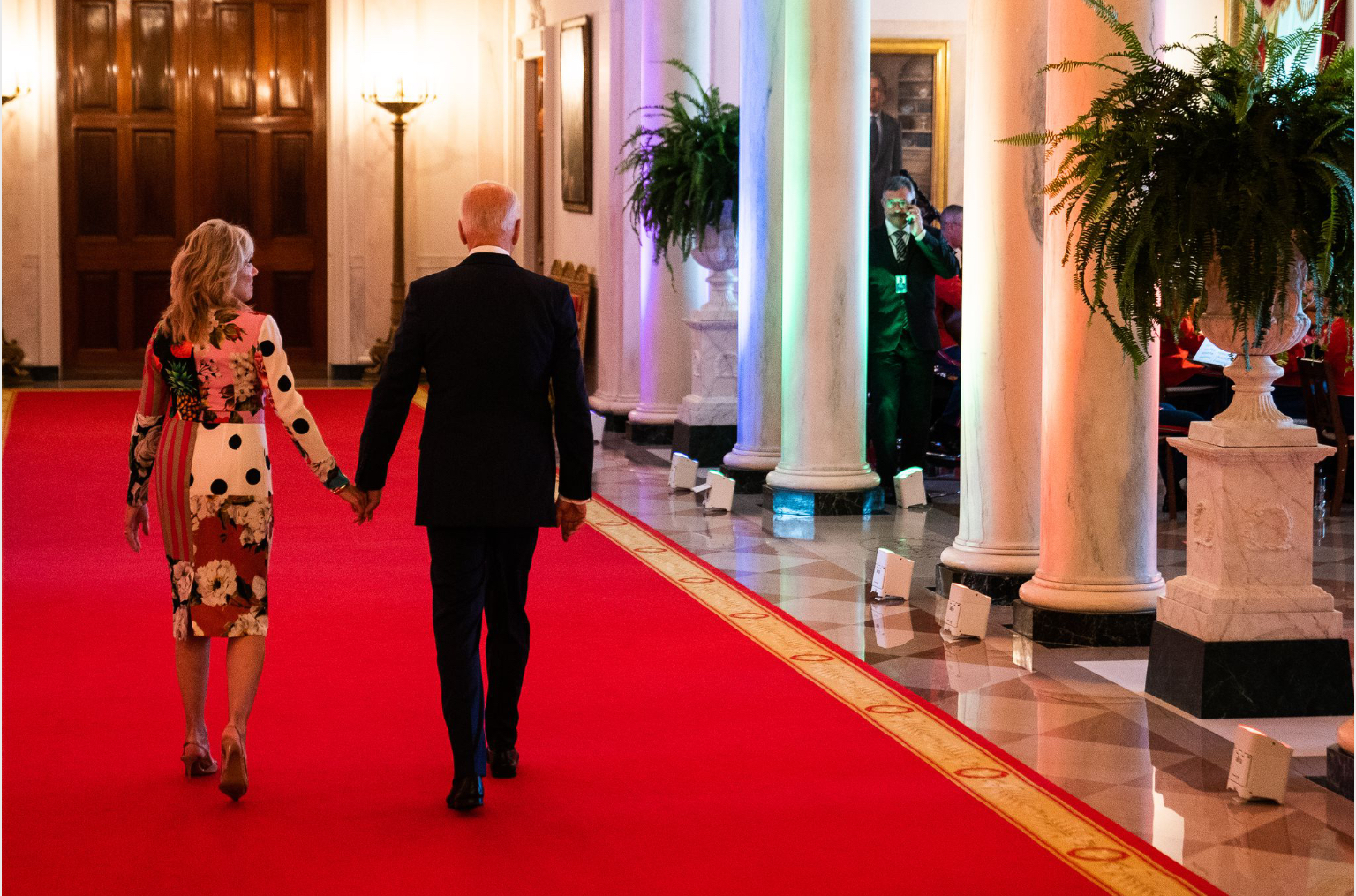
There are artifacts describing major events in LGBTQ+ history such as the Stonewall Riots and the beginning of the AIDS epidemic. Photos shared online show the corridor illuminated in Pride colors, the first known time in history, the Advocate reports.
LGBTQ+ activist, columnist and Philadelphia Gay News founder Mark Segal reported that upon visiting the National Museum this week, personal artifacts of his “from that first Pride in 1970, which we called Christopher Street Liberation Day March” were among those included in a series of items shared with the White House. The items included a flyer given out over 50 years ago promoting the march and Segal’s marshal badge worn that day. “That 18-year-old boy at Stonewall never expected that not only would he be asked to dance with his husband at the White House, but that one of his personal artifacts would be on display there,” Segal wrote. “Fifty-two years ago that was inconceivable to me. Now, it’s a joyous reality.”
The exhibit is curated from the LGBT Pride exhibits currently at the Smithsonian’s American History Museum. One is the “Illegal to be You: Gay History Beyond Stonewall” exhibition on display at the museum since 2019, and planned to close on July 6, 2021. The items I took he ongoing Smithsonian exhibit showcase different aspects of LGBTQ+ American history, activism and the “everyday experience of being queer,” according to curator Katherine Ott. The display includes knives used to lobotomize gay men during the ’70s, lab equipment from 1980s HIV researcher Jay Levy, a full figure skating costume from gay Olympian Brian Boitano, shoes from trans tennis player Renée Richards and cosmetics used by irreverent gay director John Waters.
LGBTQ+ Pride Month was established by President Bill Clinton in June 1999, though back then it was called Gay and Lesbian Pride Month. Clinton said at the time that he signed the 1998 executive order that made it possible for people of any sexual orientation to work in the federal government and to receive security clearances. “Today, more openly gay and lesbian individuals serve in senior posts throughout the Federal Government than during any other Administration,” Clinton’s June 2000 proclamation stated.
The previous twice impeached, traitor’s administration did not even acknowledge Pride Month until 2019, and only half-heartedly then. In the first two and a half years of that administration, the former president took numerous steps to curtail LGBTQ+ rights, from nominating judges aligned with anti-gay hate groups to banning transgender people from the military. George W. Bush declined to recognize June as Pride Month during his eight year administration.
President Barack Obama issued a proclamation every year he was in office. “All people deserve to live with dignity and respect, free from fear and violence, and protected against discrimination, regardless of their gender identity or sexual orientation,” Obama’s June 2015 proclamation read. “During Lesbian, Gay, Bisexual, and Transgender Pride Month, we celebrate the proud legacy LGBT individuals have woven into the fabric of our Nation, we honor those who have fought to perfect our Union, and we continue our work to build a society where every child grows up knowing that their country supports them, is proud of them, and has a place for them exactly as they are.”
On June 25, President Biden declared “pride is back at the White House,” delivering remarks in a day of events intended to mark the contributions of LGBTQ+ Americans. He spoke after signing H.R. 49, which designates the site of the 2016 Pulse Nightclub shooting as the “National Pulse Memorial.” Biden recognized that much work remains to be done to give equal rights and protections to LGBTQ Americans. The president invoked Harvey Milk, the first openly gay elected official in California, and said he was right when he said it “takes no compromise to give people their rights.” He called on the Senate to pass the Equality Act to protect the rights of LGBTQ+ people.
“When a same-sex couple can be married in the morning but denied a lease in the afternoon for being gay, something’s still wrong,” Biden said. “Over half of our states — in over half of our states, LBGTQ+ Americans still lack explicit state-level civil rights protections to shield them from discrimination. As I said as a presidential candidate and in my first joint address to Congress, it’s time for the United States Senate to pass the Equality Act and put the legislation on my desk. On my desk.”
Transportation Secretary Pete Buttigieg spoke before the president was introduced, and both the secretary and Biden gave a shout-out to Buttigieg’s husband, Chasten. “Us even being here proves how much change is possible in America,” Buttigieg said. Also at the Friday afternoon ceremony were members of the Congressional Equality Congress, including Senator Tammy Baldwin and Congressman David Cicilline; one of the highest-ranking openly trans service members, Lieutenant-Colonel Bree Fram; and state legislators.









 Joe
Joe





 The Closet Professor