


Today is Flag Day. It commemorates the adoption of the flag of the United States on June 14, 1777, by resolution of the Second Continental Congress. The Flag Resolution, passed on June 14, 1777, stated: “Resolved, That the flag of the thirteen United States be thirteen stripes, alternate red and white; that the union be thirteen stars, white in a blue field, representing a new constellation.” But June is also Pride Month, so I thought I’d do a post about the Pride Flag. Flags are symbols of community membership, unity, and visibility. A country’s flag shows a sense of citizenship and national pride. Likewise, the Pride Flag was created as a symbol of community membership, unity, and visibility.
In the late 1970s, Harvey Milk, a member of the San Francisco Board of Supervisors and the first openly gay man elected to public office, asked his friend Gilbert Baker to design a symbol to represent (what was then referred to as) the gay community. Baker collaborated with his friend Lynn Segerblom (also known as Faerie Argyle Rainbow) to design the rainbow-striped flag with eight colors:
Baker and Segerblom’s flag debuted at the Gay Freedom Day Parade in SF in 1978. Each of the original eight colors had their own unique symbolism. With the help of close to 30 volunteers working in the attic of the Gay Community Center in San Francisco, Baker was able to construct the first draft of the now world-renowned rainbow flag. It was first showcased at San Francisco’s Gay Freedom Day Parade on June 25, 1978.
After the design was unveiled, participants of the parade proudly waved the new symbol in solidarity. Baker then took the design to Paramount Flag Company, which sold a version of the flag without hot pink and turquoise, which were replaced with blue for practicality purposes. After the assassination of Harvey Milk on November 27, 1978, demand for the rainbow banner only increased. Popularity spiked again a decade later when a West Hollywood resident sued his landlord over the right to hang his flag outside his residence.

Despite their outsized global impact, the two original flags were thought to be lost for more than four decades. One flag was stolen from a community center and never recovered. But Baker managed to quietly rescue a 10- by 28-foot segment of the second flag, which had been placed in storage after sustaining water damage. Baker took the item with him when he moved to New York City in 1994. After Baker’s death in 2017, the flag and his other belongings were shipped to his sister, who later passed the fragment along to Charley Beal, president of the Gilbert Baker Foundation. Beal did not realize he was in possession of the original 1978 banner until early 2020, when a vexillologist (or flag expert) examined the item firsthand and confirmed its provenance. In June 2021, the GLBT Historical Society Museum unveiled a glass case containing this rare artifact: a segment of the original rainbow gay pride flag, its colors as vibrant as ever.
The iconic rainbow design has succeeded in part because it conveys a bright, hopeful message. In the years since it debuted, the rainbow flag has only grown in popularity and is now seen around the globe as a positive representation of the LGBTQ+ community. A mile-long version of the flag was created to celebrate the 25th anniversaries of two landmark events; the Stonewall Riots and Baker’s creation of the flag itself.
Baker died on March 31, 2017, at the age of 65, just two years after the legalization of same-sex marriage throughout the U.S. His legacy lives on in the six-colored flag that flies proudly every Gay Pride month, recognizing the lives, and loves, of LGBTQ+ people worldwide.
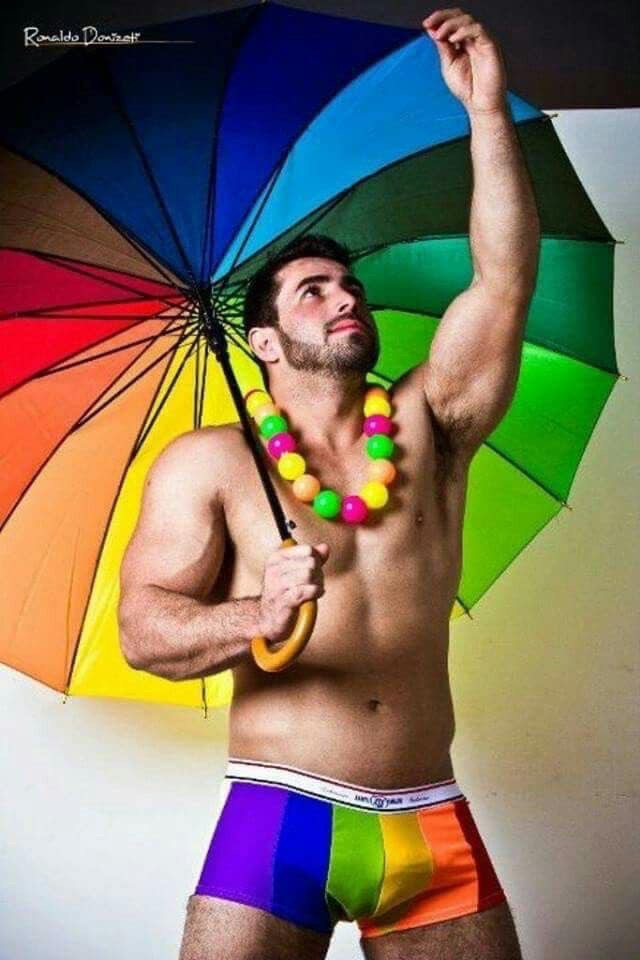
It almost did rain on our Pride parade, and it did a little bit. We got an outside table at one of the restaurants on the parade route. As we were waiting for the parade to start, it rained slightly off an on, but the rain stopped once the parade started and held off until just after the parade finished passing us by. Then, it began to rain in earnest. My back was just outside the umbrella above our table. I was getting soaked as we waited for our waiter to bring us the check. By the time we paid, I was wet enough that I could feel the cold rain water runny through the crack of my ass. The back of my shirt and shorts were soaked. We decided that with the rain, we would not be going to any of the post parade festivities since they were all scheduled to be outside.
Even with the rain, the parade was as fun as always. Vermont’s sole congressman, Peter Welch, who’s running for Patrick Leahy’s Senate seat, marched in the parade as did the Democratic nominees for governor, lieutenant governor, and the open House of Representatives seat. All of the local television stations had a contingent along with numerous LGBTQ+ organizations. Actor and comedian Alec Mapa was the grand marshal. Saint Michael’s College (Vermont’s only Catholic college) and Champlain College had large groups marching in the parade. While the University of Vermont may have been represented, I did not see them. Saint Michael’s is run by the Society of Saint Edmund, aka the Edmundites, one of the smallest (24 members) and most liberal Catholic orders. The Edmundites are only found in Colchester and Swanton, Vermont and Selma, Alabama. Saint Michael’s is always the largest group of marchers in the parade, which includes the men’s and women’s hockey teams.
The first pride parade I ever attended was in Paris in 2005 while I was on a study abroad trip. The only other pride parades I have attended have been in Burlington. When I was growing up, there were no pride parades nearby. I don’t think I could have ever imagined being able to attend a pride parade. Because of this, pride parades always make me a little emotional. I get a little choked up watching the parade go by. My life has come a long way since that first pride parade seventeen years ago, especially since I moved to Vermont seven years ago. I know a lot of people may take pride parades for granted, but for me, they give me hope for a better future for LGBTQ+ people everywhere.
Thou shalt not bear false witness against thy neighbor.
— Exodus 20:16
I was trying to come up with an LGBTQ+ Pride topic for this week’s Sunday post. I decided to write about being our “authentic self.” Isn’t that a large part of coming out? We want to be true to ourselves and to stop lying to others about who we really are. “Thou shalt not bear false witness against thy neighbor” is the ninth commandment (the designation varies between religions) of the Ten Commandments. According to the New Testament, Jesus explains that obedience to the prohibition against false testimony from the ten commandments is a requirement for eternal life. According to Jesus, false testimony comes from the sinful desires of the heart and makes people unclean.
However, when I googled “the bible and authentic self” most articles are about how Christians should resist being their authentic selves. One piece said, “To those who are of the world, ‘be yourself’ means speak your mind, don’t hold anything back, love yourself more than anyone else, and openly reject anyone you just don’t like. The advice to ‘be yourself’ can quickly turn into an excuse to be unfriendly and overly blunt.” The problem with this is that this statement is only valid if you are a terrible person. “Love yourself more than anyone else, and openly reject anyone you just don’t like.” While that sounds like a lot of Christians I know today who reject those who aren’t like themselves, it is certainly not in the spirit of the Bible. Another article Sue Bohlin, a speaker/writer and “webmistress” for Probe Ministries, lays out precisely why so many Christians fear authenticity, “In today’s culture, coming out and admitting you’re gay is applauded as ‘being authentic.’ Claiming you are a man trapped in a woman’s body, or vice versa, is ‘being authentic.’ But refusing to accept such labels means you’re inauthentic.” The Bohlin goes on to say:
More and more Christians are throwing in the towel in their fight against unholy sexual and relational temptations, claiming to follow their “authentic self.” Even worse, a growing number of churches are doing something similar by embracing same-sex marriage. I have a question for them. If God really created them to be gay and blesses that identity today, what will happen a hundred years from today? Will there be homosexuality in heaven? There will be no sex in heaven because the only marriage will be between the Church and the Lamb, the Lord Jesus Christ. If one’s identity is wrapped up in same-sex attractions, as it is by those claiming to be “gay Christians,” who will they be when all sexual and relational brokenness is a thing of the past, a mere memory of earthly life?
I suggest that a believer’s true and real and lasting “authentic self” is all wrapped up in not who we say we are, but who God says we are: His beloved child, redeemed and purified and made holy as He is holy. Chosen, accepted, and included a citizen of heaven and a member of God’s household. Belonging to Jesus because He bought us with His very lifeblood. Sealed with the Spirit, made brand new from the inside out.
There is a MAJOR flaw to her argument. When she says, “A believer’s true and real and lasting “authentic self” is all wrapped up in not who we say we are, but who God says we are,” is her fatal flaw. Our authentic self is who God says we are. Genesis 1:27 says, “So God created man in his own image.” John 1:3 says, “All things were made by him; and without him was not any thing made that was made.” God made us. He made us in his image. Therefore, if we are gay, God is also gay. God is also straight, bisexual, transgender, asexual, etc. He represents all things because he created everything; therefore, he is every part of every aspect of the spectrum of sexuality.
The most significant issue is that most Christians are closed-minded and narrowly focused on their beliefs. They pick and choose what Bible verses they want to follow and ignore those inconvenient for them. For example, they condemn LGBTQ+ people, but they do not condemn divorce of which Jesus does condemn in the Sermon on the Mount. Yet, what is most curious is that if homosexuality was so wrong (an abomination), why did Jesus never mention it, not even once? Furthermore, LGBTQ+ issues are not discussed anywhere by any of the New Testament authors. Yes, there is a verse that is often misinterpreted in Leviticus to condemn homosexuality, but if Christians follow that one verse from Leviticus, then shouldn’t they also follow all of the other prohibitions from Leviticus?
Leviticus 18:22 prohibits male same-sex intercourse, and Leviticus 20:13 prescribes the death penalty for violators. But Christians have never lived under the Old Testament law. The Old Testament contains 613 commandments for God’s people to follow. Leviticus includes rules about offerings, clean and unclean foods, diseases, bodily discharges, sexual taboos, and priestly conduct. But the New Testament teaches that Christ’s death and resurrection fulfilled the law, which is why its many rules and regulations have never applied to Christians. Romans 10:4 says, “For Christ is the end of the law for righteousness to every one that believeth.” Colossians 2:13-14 says, “And you, being dead in your sins and the uncircumcision of your flesh, hath he quickened together with him, having forgiven you all trespasses; Blotting out the handwriting of ordinances that was against us, which was contrary to us, and took it out of the way, nailing it to his cross.” Hebrews 8:13 says, “In that he saith, A new covenant [New Testament/Jesus’s Teachings]*, he hath made the first old [Old Testament/Laws of Moses]*. Now that which decayeth and waxeth old is ready to vanish away.”
Even greater than cherry-picking verses from the Bible, many heterosexual Christians often still claim that sexuality is a choice. Because of their close-mindedness, they cannot understand that LGBTQ+ individuals are born this way. They were created by God in his image, in all the various degrees of sexuality. They are often so small-minded that they cannot imagine being born anyway other than cisgender heterosexuals. They do not want to open their minds to God’s true words because then they may have to look at themselves and see their own flaws. The only choice we have about our sexuality is whether or not we choose to be our authentic selves the way God created us.
As members of the LGBTQ+ community, so many of us for so long have been taught to be ashamed of who we are because we do not fit the predominant image and standard profile of acceptable persons. We have been taught to look at ourselves through lenses that cannot see our true beauty and essence as citizens in society, as people of God, and as children of the greater universe. When we look at ourselves, we must try as best we can to see everything there, but this is sometimes hard to do without a genuine desire to take a hard look and see what’s there, to view ourselves clearly, squarely, and freely. The beauty and goodness of what we see sometimes give way to the not so beautiful things that we see, say, and do. We must cast aside all fear in taking that honest look if we are to grow into a greater awareness of who we really are and what we can ultimately become as genuine persons of promise and value.
*Added for clarification.
This post is a repost from June 2021. I’m reposting it today because today is Vermont Pride.


I’m really looking forward to the Vermont Pride Parade this Sunday. After all of the classes I’ve taught the last two weeks along with the rest of my work responsibilities, I need some relaxation. Some of my friends and I are going to get an outdoor table at one of the restaurants on the parade route, have lunch and a few drinks, and just have a good time as the parade goes by. At least, that’s the plan. I need a drink after last week and this week.
By the way, I did not ask the hot professor out for coffee or tea, but I did offer him a behind the scenes tour of the museum’s storage. That might sound boring, but he had said he wanted to come back and check out the museum some more, so, when I emailed him back with some information he had asked for, I also invited him to come back for a tour. It’s up to him whether he wants to take me up on the offer, but if he’s the least bit interested in me or just the museum, he can let me me know he wants the tour. It would give us some time to talk and learn a little more about each other. We’ll see.
He who is without sin among you, let him throw a stone at her first.
—John 8:7
Religion fanaticism fueled by hatred and hatred fueled by ignorance is destroying the United States. Fascist politicians are using hatred, just as they did in the 1920s and 1930s to further their power-hungry ambitions. All across the world, there are politicians who are either fighting against democracy or strengthening their existing authoritarian rule. Conservatives, whether Republican, Fascist, Nazi, etc., have used religious fanaticism to take away the rights of people. Religion was used to justify slavery, subjugate women, kill or imprison LGBTQ+ individuals, and any number of horrible inhumane actions.
For those who claim they are Christian and vote and support hatred-fueled religious fanaticism, they do not follow the teachings of Jesus. Jesus taught love, hope, charity, mercy, and acceptance. In John 4:3–39, Jesus was headed to Galilee from Judea. This was early in His ministry. He stopped to rest and refresh Himself at a well in Samaria during one of His journeys. A woman came to the well to draw water, and the Savior engaged her in conversation. She was astonished that He would speak with her, “for the Jews have no dealings with the Samaritans.” But He overlooked the traditions that devalued her in others’ eyes. He taught her about the living water of the gospel, and He testified to her, “I who speak to you am [the Messiah].”
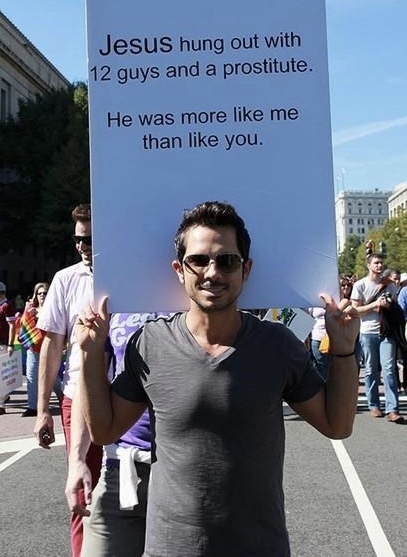
Jesus did not teach hatred and discrimination like many modern Christians. Instead, he taught acceptance. There are two remarkable stories showing how Jesus cared for all types of people. The religious fanatics of his time called the Pharisees were offended because in their view God loved only the righteous who kept the law as they interpreted them. They, therefore, distanced themselves from so-called ‘unclean’ sinners in their delusions of self-righteousness. But Jesus was often eating and drinking with those the Pharisees deemed disreputable sinners. He met people where they were and healed them. He protected those who committed adultery and prostitutes. Jesus proclaimed that both law-keepers and law-breakers are sinners in need of forgiveness. In John 8:7, Jesus told the Pharisees who wanted to stone a woman to death for committing adultery, “He who is without sin among you, let him throw a stone at her first.” In Matthew 7:1-3, Jesus warned, “Judge not, that you be not judged. For with what judgment you judge, you will be judged; and with the measure you use, it will be measured back to you. And why do you look at the speck in your brother’s eye, but do not consider the plank in your own eye?”
A day of reckoning will come for those who use the name of God to further their hatred and claim that they do so in Jesus’s name. We can start by going to the polls in November and voting out the hypocrites and modern-day Pharisees. We need to vote in such great numbers that we make the elections of 1932 a minor Democratic victory. For anyone who is not familiar with the 1932 elections, Democratic New York Governor Franklin D. Roosevelt defeated Republican incumbent president Herbert Hoover in a landslide, with Hoover winning only six Northeastern states. In addition to Hoover’s defeat, the Republicans also suffered crushing defeats in both congressional chambers: they lost 101 seats in the House of Representatives, with the Democrats expanding their House majority to a supermajority (a gain of 97 seats), and also lost twelve seats in the Senate, giving Democrats a total of 58 out of 96 seats in the Senate (Alaska and Hawaii were not yet states). The other Senator, Henrik Shipstead of Minnesota, was a member of the Farmer-Labor Party before switching back to being a Republican in 1940. (He’d been a Republican prior to 1923.) This landslide election was the last time that an incumbent president lost re-election and his party lost control of both chambers of Congress in a single term until 2020.
If we don’t keep a majority in the House and gain at least 2 seats in the Senate (to counteract Manchin and Sinema) and do away with the filibuster, hate has won. Furthermore, we must expand the Supreme Court and institute ethics reforms in the federal government including SCOTUS. If you live in a state with a Republican majority, work as hard as you can to change that. We have to have election reforms and protections. We need stronger and sensible gun laws. We need meaningful reforms to healthcare and student loans. Most importantly we must preserve equality in the United States. We can no longer allow religious fanatics to have sway in this country. Republicans have pushed for overturning Roe v. Wade, and now they’ve done it. This will only empower conservatives and religious fanatics to push forward with taking away marriage equality, access to birth control, the right to privacy, and due process. In his concurring opinion, Justice Clarence Thomas wrote that the justices “should reconsider all of this Court’s substantive due process precedents, including Griswold, Lawrence, and Obergefell” — referring to three cases having to do with Americans’ fundamental privacy, due process, and equal protection rights. Anyone who did not see this coming with the overturning or Roe was incredibly naïve. I beg of you not only to vote but encourage all those who are sympathetic to equality to also vote. If someone needs a ride to the polls, give it to them. If someone is not registered to vote, get them registered.
I don’t think that the majority of people who claim to be Christian would follow Jesus if the Second Coming happened today. They set aside all of their values and beliefs to elect Donald Trump. They sold their souls to make sure that Roe was overturned. Now, we must come out fighting (peacefully, of course). Vote! Vote! Vote! Let’s take back our country and make it a country in which we can be proud to live.

“And when you pray, you shall not be like the hypocrites. For they love to pray standing in the synagogues and on the corners of the streets, that they may be seen by men. Assuredly, I say to you, they have their reward. But you, when you pray, go into your room, and when you have shut your door, pray to your Father who is in the secret place; and your Father who sees in secret will reward you openly. And when you pray, do not use vain repetitions as the heathen do. For they think that they will be heard for their many words. Therefore, do not be like them. For your Father knows the things you have need of before you ask Him.”1
—Matthew 6:5-8
I love Pride because it shows the diversity of our communities. Different skin colors, different body types, different genders (and even more gender expressions!) From promiscuous to monogamous married couples, from kinky to vanilla, and everything in between. The LGBTQ+ community is varied and beautiful, and that’s what makes us such a fabulous community.
Recently, I received an email form Queer Theology which shared a wonderful prayer for Pride. I have adapted it a little to fit my situation better, and I encourage you to do the same. (My edits with notes are in parentheses.) So, I give you a Prayer for Pride:
There was a time when I prayed asking you to help me become straight. Thank you for ignoring that prayer. Or rather, for answering it differently than I expected:
“I will help you become more fully you.”
Thank you for the gift of queerness, for the liberation it has sparked in my own life (and in the lives of my family2).
Thank you for this body and for the courage to explore all the ways I can use it to make myself and others feel good, connected, healed, whole. (And let’s not forget sexy and desired.3)
Though my journey here has not been easy, I am grateful for it. Let the shame I felt with my body, with my desires, with my love, with myself, be a reminder to do everything I can to not contribute to another’s shame but to instead support them in their own self-love and self- determination.
I pray for those still living with shame, help them to shake it off; and embolden me to work to create a world which breeds pride, not shame.
I pray for those who, knowingly and unknowingly, fed my own shame. May they have everything they need in their lives and if they seek forgiveness, help them to know that they are forgiven.
And I pray for those in the in-between spaces–myself included, if I’m honest–give us strength to continue the journey, to lean into the tender places, to do the work, and to celebrate the victories.
Thank you for the victories. Though the Kingdom of Heaven is still not fully realized on earth, let us be glad in all the ways in which it is alive and present, here, and now.
In Christ’s name we pray,
Amen.
________________
Notes:
1. One of my greatest pet peeves is when people make a huge deal about praying in public. My sister’s in-laws always insisted on holding hands and praying when at a restaurant. And often, when people pray in church, they drone on and on. A simple prayer is always best, and in my opinion, it is much better to pray alone and in private. Prayer should be between you and God. It need not be with anyone else.
2. I hope that it has made positive changes in your family. Mine is still a work in progress.
3. This one I leave up to you.
I had planned on only posting the “Prayer for Pride” but with the SCOTUS news on Friday, I wanted to say more.
Today marks the beginning of Montpelier Pride Fest here in central Vermont. Since I moved to Vermont in 2015, Vermont Pride celebrations have usually been held in Burlington in September. That’s when the “big” parade is. Beginning last year, several towns had pride celebrations of their own, but in June. I believe Bennington and Rutland had pride festivities last year in June, and Montpelier had one in October. This year, Montpelier (and Central Vermont) are getting into the spirit during the traditional pride month in June. There will be festivities this weekend and next in Montpelier, Plainfield, and Barre.
I actually don’t plan to attend a lot of the pride festivities this year, but tonight I am going to see a play called Shakesqueer. From the description, which they just put up this week, it is a lesbian retelling of Romeo and Juliet set in Verona – “an apocalyptic late-stage capitalistic hellscape.” It’s Vermont, so the odds of it being a bit weird are high. Montpelier Pride Fest has a high probability of being an odd celebration. They don’t call Montpelier Mont-Peculiar for nothing.
Anyway, a friend of mine is coming with me. We’ll go out to dinner and then see the show. She thinks the description sounds fantastic. I’m remaining skeptical. We’ll see.
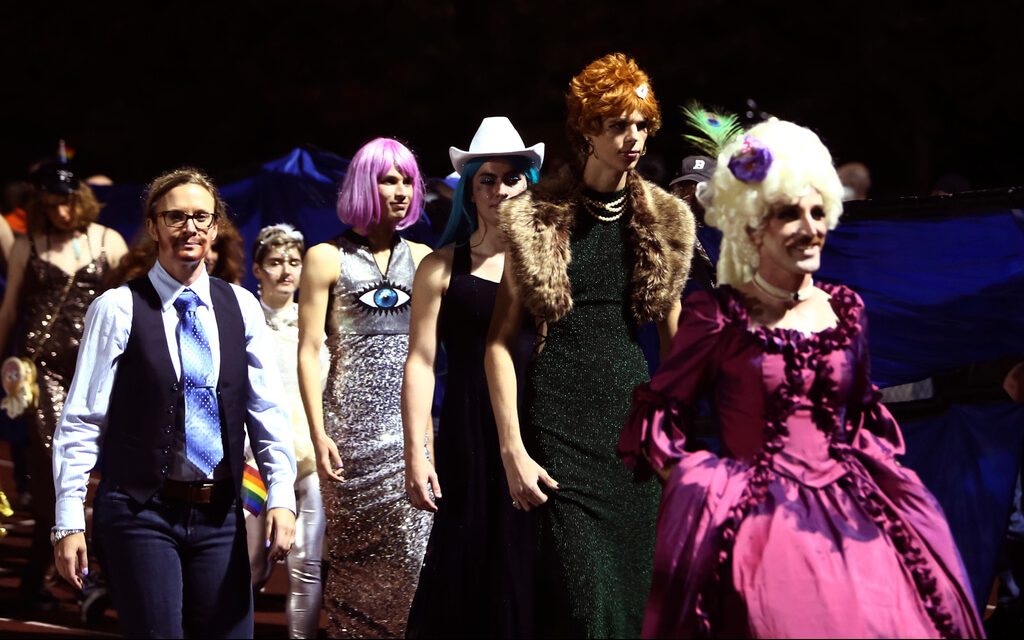
I often say, “Only in Vermont,” and when I say it, I am often rolling my eyes. While I said it this time, it was a very good and heartwarming statement. Vermont is a unique place. The state is 49th in population among the 50 states and ranks below Puerto Rico and the District of Columbia. It only beats out Wyoming among the states and the territories of Guam, U.S. Virgin Islands, Northern Mariana Islands, and American Samoa among the territories. The state has the smallest state capital, Montpelier. While it may have a small population, it’s a very vocal population who loves a good cause to get behind. The state also loves its eccentricities, which is evident by the number of “Keep Vermont Weird” bumper stickers you see on cars. While the state ranks third in the largest percentage of LGBTQ+ adults at 5.3 percent (higher than the national average of 4.5 percent), there are no gay bars in Vermont, though there are plenty of gay-friendly establishments.
So, it is not surprising that a crowd went wild at a Vermont high school homecoming football game as they cheered on a halftime show that transformed the field into a fabulous drag ball. Both faculty and students from Burlington High School strutted across the field as drag queens and kings. They wore colorful wigs, sparkly ensembles, feather boas, knee-high boots, and more. For the highly anticipated event (it was all over the news in Vermont), the spectators packed into the stands were dressed head to toe in rainbows and waved Pride flags as they excitedly chanted, “Drag Ball.”
Each of the approximately 30 performers had their moment to spin and twirl for the crowd. The group also performed a lip sync to “Rainbow Reign” by Todrick Hall. “Things went amazing,” Ezra Totten, student leader of the Gender-Sexuality Alliance, told The Associated Press. “The stands were completely packed. … It was just so heartwarming to see.” The drag ball was the brainchild of English teacher Andrew LeValley, an adviser to the Gender-Sexuality Alliance.
“I was just really hoping to give our students — who are both out and the students that were in the stands who are not out — a moment to shine and feel loved and know that there is a place for them in public schools,” LeValley said. LeValley felt it was important to hold the event at a football game to send the message that everyone should be welcome in all types of spaces. “We have to assume that there are LGBTQ folks everywhere, which include[s] really masculine spaces,” LeValley told local Vermont publication Seven Days. “Why does this space have to be one way or the other? It can be both, and there’s beauty and benefits in having it be both.”
Adalee Leddy, a student at Burlington High School who attended the game, told Seven Days the show was “absolutely amazing.” Totten added that now that they have seen the joy it brought, the group hopes the drag ball will happen annually. “It shows the Burlington community is there for each other,” Totten said.
Vermont loves their drag shows, as evident by the number of people who pack in to attend the annual Winter Is a Drag Ball. The Drag Ball is the social highlight event of the winter season. Bringing in drag queens and kings, musicians, dancers, and performance artists together raising hundreds of thousands of dollars to support local HIV/AIDS-related organizations. Though it was virtual in 2021, a lot of Vermonters are hoping it will be back in-person in 2022. Until then, I was happy to see that Burlington High School put on their own successful Drag Ball. I’m happy that I live in a state where a Homecoming football game featured a much appreciated Drag Ball, and that the highlight of the winter social season is also a Drag Ball. Let’s not forget, the Burlington area also elected one of its most popular drag queens, Nikki Champagne, aka Taylor Small, to the state legislature where she has done a remarkable job representing all of Vermont.


 | noisilycool3bc985058… on Pic of the Day |
 | iameverywhere1 on Not Quite as Planned |
| iameverywhere1 on Pic of the Day |
| noisilycool3bc985058… on Not Quite as Planned |
 | Joe on Pic of the Day |



As an Amazon Associate I earn from qualifying purchases. So, if you click on a link that takes you to Amazon.com, I may earn a commission.
Trust me, it isn’t much, but every little bit helps.



 The Closet Professor