Therefore, humble yourselves under the mighty hand of God, that He may exalt you in due time, casting all your care upon Him, for He cares for you.
—1 Peter 5:6-7
One of my favorite hymns begins with, “What a friend we have in Jesus/All our sins and griefs to bear/What a privilege to carry/Everything to God in prayer.” I can remember my mother playing this on the piano when I was growing up. It was her favorite to play, and it would reverberate through the house when she was playing it. I love the simple message in the song. The hymn was originally written by preacher Joseph M. Scriven as a poem in 1855 to comfort his mother, who was living in Ireland while he was in Canada. It has also provided me, and many others, with comfort over the years.
We worry too much. We are always afraid of what the future holds. Even the most level-headed of people have worries, whether they outwardly show it or not. The American actress and comedian, Gilda Radner, who died of cancer in 1989, is quoted as saying, “I wanted a perfect ending. Now I’ve learned, the hard way, that some poems don’t rhyme, and some stories don’t have a clear beginning, middle, and end. Life is about not knowing, having to change, taking the moment and making the best of it, without knowing what’s going to happen next. Delicious Ambiguity.”
Trusting in God plan for us is what makes the unknown, as Radner called it, “Delicious Ambiguity.” Numbers 6:24-26 God told Moses to tell the Israelites, “The Lord blesses you and keeps you; the Lord makes His face shines upon you and is gracious to you; the Lord looks upon you with favor and gives you peace.” When we have anxiety and doubt, remember Galatians 5:22-23, “But the fruit of the Spirit is love, joy, peace, longsuffering, kindness, goodness, faithfulness, gentleness, self-control. Against such there is no law.”
Then King David went in and sat before the Lord; and he said: “Who am I, O Lord God? And what is my house, that You have brought me this far? And yet this was a small thing in Your sight, O God; and You have also spoken of Your servant’s house for a great while to come, and have regarded me according to the rank of a man of high degree, O Lord God.
—1 Chronicles 17:16-17
It’s been quite a while since I used a hymn as my Sunday devotional. During my high school and college years, I was the song leader at the small country church I grew up attending. Half the people at that church were like family to me, and the other half were my family. The song leader I grew up with became unable to lead the singing, so he asked me if I would it. I had taken piano lessons when I was younger, so I had a little musical ability, i.e. I could almost carry a tune. I was never a very good song leader, and I only knew about two dozen or so songs well enough to be able to lead the congregation in singing.
If you don’t know, I was raised in the church of Christ (by the way, it is customary to not capitalize “church” in the name of the denomination, though churches of Christ do not believe they are a denomination nor Protestant, but a restoration of the original church). The churches of Christ have no musical instruments, though some of the more liberal ones today do. The churches of Christ believe that if it is not in the bible, then it should not be part of the religious service. So, the inspiration for a capella singing comes from Ephesians 5:19, “Speaking to one another in psalms and hymns and spiritual songs, singing and making melody in your heart to the Lord.” Being a song leader in a church of Christ is not the easiest task. There are no musical instruments to carry the tune. It is completely up to the song leader to do so. All I can say is, that I tried my best. I was never very good at it, and quite honestly, even after doing it for years, I was never comfortable at it. When I went away to graduate school, they found someone else to take over. I was so relieved.
I had a few favorite song: “When the Roll Is Called up Yonder,” “Send the Light,” “Shall We Gather at the River?,” “The Old Rugged Cross,” and a few others. “Amazing Grace” was always a favorite of mine. The service always began with two songs sung while seated before the main prayer. Then, we would stand for the third song just before the preacher got up to give his sermon, and I often sang “Amazing Grace” for this song. After the sermon, we would sing the invitational, a call for those who wanted to join the church and be baptized. After the invitational, we served communion. Communion, or the Lord’s Supper, is served every Sunday in the church of Christ. After communion, we sang the closing song, my favorite being “I Know That My Redeemer Lives” and “Unclouded Day.” The latter begins with “O they tell me of a home far beyond the skies,” and as long as I could get out the “O” in the right key, this one always went smoothly because someone else would pick it up and keep it going in tune.
Amazing Grace By John Newton
Amazing grace! how sweet the sound, that saved a wretch like me! I once was lost, but now am found, was blind, but now I see.
‘Twas grace that taught my heart to fear, and grace my fears relieved; how precious did that grace appear the hour I first believed!
Through many dangers, toils and snares I have already come: ’tis grace has brought me safe thus far, and grace will lead me home.
When we’ve been there ten thousand years, Bright shining as the sun, We’ve no less days to sing God’s praise Than when we first begun.
“Amazing Grace” is one of the best-loved and most often sung hymns in North America. It expresses John Newton’s personal experience of conversion from sin as an act of God’s grace. At the end of his life, Newton (1725-1807) said, “There are two things I’ll never forget: that I was a great sinner, and that Jesus Christ is a greater Savior!” This hymn is Newton’s spiritual autobiography, but the truth it affirms—that we are saved by grace alone—is one that all Christians may confess with joy and gratitude. I, however, believe that it takes faith and good works. James 2:26 says, “For as the body without the spirit is dead, so faith without works is dead also.” Now, back to Newton’s story.
Newton was born into a Christian home, but his godly mother died when he was seven, and he joined his father at sea when he was eleven. His licentious and tumultuous sailing life included a flogging for attempted desertion from the Royal Navy and captivity by a slave trader in West Africa. After his escape, he himself became the captain of a slave ship. Several factors contributed to Newton’s conversion: a near-drowning in 1748, the piety of his friend Mary Catlett (whom he married in 1750), and his reading of Thomas à Kempis’s Imitation of Christ.
In 1754 he gave up the slave trade and, in association with William Wilberforce, eventually became an ardent abolitionist. After becoming a tide-surveyor (customs inspector) in Liverpool, England, Newton came under the influence of George Whitefield and John and Charles Wesley and began to study for the ministry. He was ordained in the Church of England and served in Olney (1764-1780) and St. Mary Woolnoth, London (1780-1807). His legacy to the Christian church includes his hymns as well as his collaboration with William Cowper in publishing Olney Hymns (1779), to which Newton contributed 280 hymns, including “Amazing Grace.”
Newton wrote “Amazing Grace” to illustrate a sermon on New Year’s Day of 1773. It is unknown if there was any music accompanying the verses; it may have been chanted by the congregation. It debuted in print in 1779 in Newton and Cowper’s Olney Hymns. “Amazing Grace” was published in six stanzas with the heading “1 Chronicles 17:16-17, Faith’s review and expectation.” After being published, the hymn settled into relative obscurity in England.
In the United States, “Amazing Grace” became a popular song used by Baptist and Methodist preachers as part of their evangelizing, especially in the South, during the Second Great Awakening of the early 19th century. It has been associated with more than twenty melodies. In 1835, American composer William Walker set it to the tune known as “New Britain” in a shape note format; this is the version most frequently sung today.
With the message that forgiveness and redemption are possible regardless of sins committed and that the soul can be delivered from despair through the mercy of God, “Amazing Grace” is one of the most recognizable songs in the English-speaking world.
“Beware of false prophets, who come to you in sheep’s clothing, but inwardly they are ravenous wolves. You will know them by their fruits. Do men gather grapes from thornbushes or figs from thistles? Even so, every good tree bears good fruit, but a bad tree bears bad fruit. A good tree cannot bear bad fruit, nor can a bad tree bear good fruit. Every tree that does not bear good fruit is cut down and thrown into the fire. Therefore by their fruits you will know them.”
—Matthew 7:15-20
For the time will come when they will not endure sound doctrine, but according to their own desires, because they have itching ears, they will heap up for themselves teachers; and they will turn their ears away from the truth, and be turned aside to fables.
—2 Timothy 4:3-4
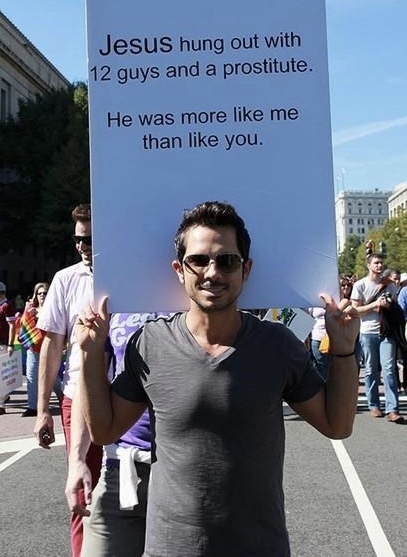
I don’t normally do a Sunday post like this, but I had a migraine yesterday and took my medicine. I was fine for a few hours and then I just could not stay awake long enough to write a Sunday post. However, I’d seen the above cartoon sometime last week, and I thought of these Bible verses that I thought would be a perfect accompaniment.
“I have fought the good fight, I have finished the race, I have kept the faith.”
—2 Timothy 4:7
One of my favorite Bible verses is 2 Timothy 4:7, which says, “I have fought the good fight, I have finished the race, I have kept the faith.” When I pass on from this world, I would like the epitaph on my tombstone to simply be: 2 Timothy 4:7. I hope that’s a long time in coming, but I want to live this life in a way that when I “finish the race” people can say that I fought the good fight and kept the faith. Even if people don’t think it when I am gone, I hope I will leave this world believing that.
When I come up against people who disagree with my way of life, ethics, philosophy, and faith, I think of Matthew 7:13-14, “Enter by the narrow gate; for wide is the gate and broad is the way that leads to destruction, and there are many who go in by it. Because narrow is the gate and difficult is the way which leads to life, and there are few who find it.” I know that I have not always fit into the crowd, and quite honestly, it’s alright as long as I remain faithful to who I am and have remained on the narrow path. remained on the narrow path.
I spent many years of my life hiding who I was. I hid in the closet because that was the path of least resistance, and I was trying to be part of the crowd and fit in. However, over the years, I have learned that accepting and loving myself is far more important than being accepted and loved by everyone. The Dutch writer and theologian Henri J.M. Nouwen said, “You don’t think your way into a new kind of living. You live your way into a new kind of thinking.”
In Star Trek, Spock was always fond of saying the Vulcan philosophy, “Logic clearly dictates that the needs of the many outweigh the needs of the few.” However, minority rights would always be trampled upon if this were true. Under this philosophy, we would be forced to remain in the closet because the beliefs (which some people confuse with needs) of the many would outweigh the few. This week, I watched the Star Trek homage, The Orville, and Dolly Parton made a guest appearance. In the episode, one of the characters knows that if she does one thing to save the life of another, then a great many people will suffer. Dolly gives her some advice (and I am paraphrasing), “If you do the right thing now, the rest will sort itself out later.”
Matthew 5:12 says, “Rejoice and be exceedingly glad, for great is your reward in heaven, for so they persecuted the prophets who were before you.” If we do the right thing now, no matter how unpopular or misunderstood it may be, we will receive our reward, and if we continually do the right thing, then we will have earned the epitaph, “2 Timothy 4:7.”
And the light shines in the darkness, and the darkness did not overcome it.
—John 1:5
American author, professor, and philosopher Sam Keen wrote, “Burnout is what happens when you try to avoid being human for too long.” Sometimes, we want to do it all. We’ve probably all heard, “If you want something done, do it yourself.” This quote is sometimes attributed to emperor Napoléon Bonaparte or dramatist Charles-Guillaume Étienne, a contemporary of Napoléon. I’ve said it myself more than once, especially after delegating a task to someone who did it subpar. But doing everything yourself is not practical. So the next best alternative is learning to trust others better and empower people. We will burn ourselves out if we try to do everything in pursuit of perfection.
We also have to allow others to shine; it is better to help them shine than to be the only beacon of light. There are times when it is necessary for us to take the credit for a job well done or even demand the recognition we deserve and let our own light shine, but there are also times when it can be much more rewarding to see others succeed because you helped them. The 13th-century Persian poet Rumi wrote, “A candle never loses any of its light while lighting up another candle.” I like this quote, but I think it can condition behavior that ironically negates its truth. It can cause us to overextend ourselves, helping others without tending to our own needs, subsequently causing our personal “light” to dim. So, don’t give another person your light; let your light ignite them.
God expects us to be the light that will guide others. He does not expect us to give away our light but to share it. In Matthew 5:15-16, Jesus says, “Nor do they light a lamp and put it under a basket, but on a lampstand, and it gives light to all who are in the house. Let your light so shine before men, that they may see your good works and glorify your Father in heaven.” Jesus tells the parable of the lamp on the stand to encourage his followers to stand out, to be an example, and not to hide away. The message in this parable would have been challenging for the first Christians, who were cruelly persecuted. They may have hidden their faith as they did not want to be tortured, imprisoned, or killed because of it. Jesus is saying that for the Christian message to spread and develop, followers must proclaim and show their faith.
As LGBTQ+ Christians, we may often find ourselves playing down our faith because many in the LGBTQ+ community disdain religion. I understand being hurt by religion and turning away from it. I don’t like most evangelical Christians, but that is because they are often hypocrites who want to impose their narrow beliefs on everyone. These same Christians pervert the words of the Bible to suit their selfish ways. They teach many LGBTQ+ Christians to hate themselves and the LGBTQ+ community. We cannot allow self-hatred because of sexuality. Self-hatred is one of our greatest enemies within the LGBTQ+ community. We have to love ourselves before we can show our love for others. We have to accept that we are God’s children, and He loves all of us just the way He created us. After all, He created us in His image.
I have always believed it was better to spread the goodness and love that God gives us instead of trying to impose my beliefs on others. If we live by example and bring to light the instances when religious individuals turn to hate instead of love, we can be that lamp on the lampstand that sheds light on the truth that God loves all of us. As LGBTQ+ Christians (or any LGBTQ+ individual with faith in a higher good), we must shine a light on the hypocrisy prevalent in so many religious individuals today. In Matthew 7:15-20, Jesus tells us:
“Beware of false prophets, who come to you in sheep’s clothing, but inwardly they are ravenous wolves. You will know them by their fruits. Do men gather grapes from thornbushes or figs from thistles? Even so, every good tree bears good fruit, but a bad tree bears bad fruit. A good tree cannot bear bad fruit, nor can a bad tree bear good fruit. Every tree that does not bear good fruit is cut down and thrown into the fire. Therefore by their fruits you will know them.”
We have an obligation to point out the bad fruit, those who teach a false Biblical hate. Hypocrites must be exposed for their hypocrisy, and not let them destroy our faith with their false faith.
I cannot accomplish this alone, and neither can you. We need to spread the light that is our faith: our faith in God, our faith in goodness, and our faith in love. We need to help others shine so we can show the way to living the life God wants for us. We must live by example and shine our light around the room so that others can see. And finally, we need to call out the bad fruit for the harm they are doing. Too often, people become stubborn in their beliefs. They see what they are doing is wrong, but they are too hardheaded to change their ways. Others are too arrogant to realize that they are wrong. We need the be the light that can guide the way.
For I know the thoughts that I think toward you, says the Lord, thoughts of peace and not of evil, to give you a future and a hope.
— Jeremiah 29:11
I think a lot of people, especially those who are left-leaning, worry about what the future holds. They see a segment of the U.S. population who are fueled by greed, hate, and fear. They don’t want the less fortunate to be helped with food, shelter, or healthcare. Yet, they call themselves Christian though in Matthew 25:31-46, one of the most vivid parables Jesus ever spoke, tells us that God will judge us in accordance with our reaction to human needs. They hate simple things like equality, truth, love, and happiness. They fear all those who are not like themselves. It’s a scary time because the political and religious rights have become more emboldened by the Supreme Court, conservative news channels, and loudmouth politicians with no substance.
But as J.R.R. Tolkien wrote, “In this hour, I do not believe that any darkness will endure.” There is hope for a better future. Jeremiah 29:11 tells us, “For I know the thoughts that I think toward you, says the Lord, thoughts of peace and not of evil, to give you a future and a hope.” Though things may look bleak, we can change that outcome, but we must be diligent. We can’t sit back and let our ideals and freedoms be trampled upon. The Brazilian novelist Paulo Coelho wrote, “None of us knows what might happen even the next minute, yet still, we go forward. Because we trust. Because we have Faith.” Faith in democracy and faith in God will get us through these dark times.
In a world of over seven billion people, it’s easy to feel small—to feel as if our day-to-day lives aren’t worth much, especially when we’re drowning in a sea of the mundane. It may feel like no matter what we do, we cannot change things for the good. If you look at some of the close elections in 2020, there is one thing we learned, every vote counts and each vote can make a difference. We have to have faith that good will win over evil. Ralph Waldo Emerson wrote, “All I have seen teaches me to trust the Creator for all I have not seen.”
God has a purpose and a plan for each and every one of us. We all have unique gifts and talents. Dante Alighieri wrote, “Do not be afraid; our fate Cannot be taken from us; it is a gift. ” We all have unique perspectives, certain friend groups, and various workplaces. God uses this rich diversity to carry out his will, and his plans are always bigger, bolder, and better than anything we could ever imagine.
Therefore comfort each other and edify one another, just as you also are doing.
—1 Thessalonians 5:11
American journalist, author, and photographer Jon Katz wrote, “I think if I’ve learned anything about friendship, it’s to hang in, stay connected, fight for them, and let them fight for you. Don’t walk away, don’t be distracted, don’t be too busy or tired, don’t take them for granted. Friends are part of the glue that holds life and faith together. Powerful stuff.”
Each one of us longs to be connected. We can achieve that through our friends. The theme of friendship weaves throughout the Bible, with Jesus promising to be our eternal friend because He is with us always. Jesus is there to be our friend and to listen to our needs. Some Christians may hesitate to call Jesus a friend, but Jesus has never been hesitant about considering us His friend. It matters to Him that we embrace this. He invites us to understand our relationship in terms of friendship. Jesus gives all who trust Him the privilege of being His friends. In John 15:14–15, Jesus says, “You are My friends if you do whatever I command you. No longer do I call you servants, for a servant does not know what his master is doing; but I have called you friends, for all things that I heard from My Father I have made known to you.”
What a friend we have in Jesus, All our sins and griefs to bear! What a privilege to carry Everything to God in prayer! O what peace we often forfeit, O what needless pain we bear, All because we do not carry Everything to God in prayer!
I have found a friend in Jesus- He’s ev’rything to me, He’s the fairest of ten thousand to my soul; The Lily of the Valley- in Him alone I see All I need to cleanse and make me fully whole. In sorrow He’s my comfort, in trouble He’s my stay, He tells me ev’ry care on Him to roll; He’s the Lily of the Valley, the Bright and Morning Star, He’s the greatest of ten thousand to my soul.
How wonderful it is that we have a true friend in Jesus! I hope most of us are fortunate to also have true friends in our lives here on earth. I have had a few great friends in my life. Some I speak to almost every day. Others I speak to a few times a week. Then there are those I speak to less frequently, but I know that I can count on them when I need them the most. There are also those who are no longer with us, but I know that they are with my heavenly friend, Jesus.
Not only does the Bible describe how Jesus is our friend, but it also gives us the practical wisdom we need to cultivate friendships well. From the moment God created man, He knew man should not be alone. Throughout the creation of the universe, God said that everything was “good.” But then once he created Adam, he doesn’t say “it was good.” Instead, He says, “It is not good that man should be alone; I will make him a helper comparable to him.” God realized that Adam was not yet complete; he needed a community. Humanity’s first problem was social isolation. Even today, in a world filled with society, Proverbs 18:1 warns that “A man who isolates himself seeks his own desire; he rages against all wise judgment.”
Proverbs gives us wisdom for navigating the complexities of our relationships. And it doesn’t just address relationships in general, but also friendships. For example, it teaches us what to look for in finding true friends. Proverbs 13:20 says, “He who walks with wise men will be wise, but the companion of fools will be destroyed.” Likewise, Proverbs 22:24-25 warns us, “Make no friendship with an angry man, and with a furious man do not go, lest you learn his ways and set a snare for your soul.” God shows us why loyalty is so important for cultivating friendship. First Peter 4:8-10 says, “And above all things have fervent love for one another, for ‘love will cover a multitude of sins.’ Be hospitable to one another without grumbling. As each one has received a gift, minister it to one another, as good stewards of the manifold grace of God.”
Invariably, we meet people who we think are friends, but who are really there merely to use and manipulate us. They are not true friends, but sometimes, this is hard to spot before it’s too late. We have something that others want, so they offer their friendship until they get the whatever it is that they want, then, if we are lucky, they leave and we learn a lesson. Proverbs 19:6 tells us, “Many entreat the favor of the nobility, and every man is a friend to one who gives gifts.” False and transactional friendships can make finding true friends difficult, but if we follow God’s advice, we can find those true friendships. But the Bible shows us that real friendship is more of an agreement than an obligation. Proverbs 18:24 teaches us that “A man who has friends must himself be friendly, but there is a friend who sticks closer than a brother.” Proverbs 27:10 commands us, “Do not forsake your friend.” Galatians 6:2 says, “Bear one another’s burdens, and so fulfill the law of Christ.”
Our greatest joy is found in our fellowship with God and one another. The theologian Jonathan Edwards said that friendship is “the highest happiness of moral agents.” According to the Bible, our chief happiness is in fellowship with God and all who trust Him. God’s guidance gives us everything we need to recover a greater vision of true friendship. It shows us even our feeblest efforts at forging friendships echo a more glorious reality—every friendship is a small and imperfect echo of God, who made us in His image to enjoy friendship forever. Friendship didn’t come from us; it came from God. And he gives us everything we need—through His word and his Spirit—to cultivate it well.
Be ever thankful for your true friends. A true friend will be there when you need them, and likewise, you will be there when they need you. Nothing on this earth is more important than our friendships. If you are lucky enough to have a romantic partner, husband or wife, boyfriend or girlfriend, in this life, I hope that they are your best friend. There is no greater love than that of friendship.
He who is without sin among you, let him throw a stone at her first.
—John 8:7
Religion fanaticism fueled by hatred and hatred fueled by ignorance is destroying the United States. Fascist politicians are using hatred, just as they did in the 1920s and 1930s to further their power-hungry ambitions. All across the world, there are politicians who are either fighting against democracy or strengthening their existing authoritarian rule. Conservatives, whether Republican, Fascist, Nazi, etc., have used religious fanaticism to take away the rights of people. Religion was used to justify slavery, subjugate women, kill or imprison LGBTQ+ individuals, and any number of horrible inhumane actions.
For those who claim they are Christian and vote and support hatred-fueled religious fanaticism, they do not follow the teachings of Jesus. Jesus taught love, hope, charity, mercy, and acceptance. In John 4:3–39, Jesus was headed to Galilee from Judea. This was early in His ministry. He stopped to rest and refresh Himself at a well in Samaria during one of His journeys. A woman came to the well to draw water, and the Savior engaged her in conversation. She was astonished that He would speak with her, “for the Jews have no dealings with the Samaritans.” But He overlooked the traditions that devalued her in others’ eyes. He taught her about the living water of the gospel, and He testified to her, “I who speak to you am [the Messiah].”
Jesus did not teach hatred and discrimination like many modern Christians. Instead, he taught acceptance. There are two remarkable stories showing how Jesus cared for all types of people. The religious fanatics of his time called the Pharisees were offended because in their view God loved only the righteous who kept the law as they interpreted them. They, therefore, distanced themselves from so-called ‘unclean’ sinners in their delusions of self-righteousness. But Jesus was often eating and drinking with those the Pharisees deemed disreputable sinners. He met people where they were and healed them. He protected those who committed adultery and prostitutes. Jesus proclaimed that both law-keepers and law-breakers are sinners in need of forgiveness. In John 8:7, Jesus told the Pharisees who wanted to stone a woman to death for committing adultery, “He who is without sin among you, let him throw a stone at her first.” In Matthew 7:1-3, Jesus warned, “Judge not, that you be not judged. For with what judgment you judge, you will be judged; and with the measure you use, it will be measured back to you. And why do you look at the speck in your brother’s eye, but do not consider the plank in your own eye?”
A day of reckoning will come for those who use the name of God to further their hatred and claim that they do so in Jesus’s name. We can start by going to the polls in November and voting out the hypocrites and modern-day Pharisees. We need to vote in such great numbers that we make the elections of 1932 a minor Democratic victory. For anyone who is not familiar with the 1932 elections, Democratic New York Governor Franklin D. Roosevelt defeated Republican incumbent president Herbert Hoover in a landslide, with Hoover winning only six Northeastern states. In addition to Hoover’s defeat, the Republicans also suffered crushing defeats in both congressional chambers: they lost 101 seats in the House of Representatives, with the Democrats expanding their House majority to a supermajority (a gain of 97 seats), and also lost twelve seats in the Senate, giving Democrats a total of 58 out of 96 seats in the Senate (Alaska and Hawaii were not yet states). The other Senator, Henrik Shipstead of Minnesota, was a member of the Farmer-Labor Party before switching back to being a Republican in 1940. (He’d been a Republican prior to 1923.) This landslide election was the last time that an incumbent president lost re-election and his party lost control of both chambers of Congress in a single term until 2020.
If we don’t keep a majority in the House and gain at least 2 seats in the Senate (to counteract Manchin and Sinema) and do away with the filibuster, hate has won. Furthermore, we must expand the Supreme Court and institute ethics reforms in the federal government including SCOTUS. If you live in a state with a Republican majority, work as hard as you can to change that. We have to have election reforms and protections. We need stronger and sensible gun laws. We need meaningful reforms to healthcare and student loans. Most importantly we must preserve equality in the United States. We can no longer allow religious fanatics to have sway in this country. Republicans have pushed for overturning Roe v. Wade, and now they’ve done it. This will only empower conservatives and religious fanatics to push forward with taking away marriage equality, access to birth control, the right to privacy, and due process. In his concurring opinion, Justice Clarence Thomas wrote that the justices “should reconsider all of this Court’s substantive due process precedents, including Griswold, Lawrence, and Obergefell” — referring to three cases having to do with Americans’ fundamental privacy, due process, and equal protection rights. Anyone who did not see this coming with the overturning or Roe was incredibly naïve. I beg of you not only to vote but encourage all those who are sympathetic to equality to also vote. If someone needs a ride to the polls, give it to them. If someone is not registered to vote, get them registered.
I don’t think that the majority of people who claim to be Christian would follow Jesus if the Second Coming happened today. They set aside all of their values and beliefs to elect Donald Trump. They sold their souls to make sure that Roe was overturned. Now, we must come out fighting (peacefully, of course). Vote! Vote! Vote! Let’s take back our country and make it a country in which we can be proud to live.
Prayer for Pride 🙏🏻🏳️🌈
“And when you pray, you shall not be like the hypocrites. For they love to pray standing in the synagogues and on the corners of the streets, that they may be seen by men. Assuredly, I say to you, they have their reward. But you, when you pray, go into your room, and when you have shut your door, pray to your Father who is in the secret place; and your Father who sees in secret will reward you openly. And when you pray, do not use vain repetitions as the heathen do. For they think that they will be heard for their many words. Therefore, do not be like them. For your Father knows the things you have need of before you ask Him.”1
—Matthew 6:5-8
I love Pride because it shows the diversity of our communities. Different skin colors, different body types, different genders (and even more gender expressions!) From promiscuous to monogamous married couples, from kinky to vanilla, and everything in between. The LGBTQ+ community is varied and beautiful, and that’s what makes us such a fabulous community.
Recently, I received an email form Queer Theology which shared a wonderful prayer for Pride. I have adapted it a little to fit my situation better, and I encourage you to do the same. (My edits with notes are in parentheses.) So, I give you a Prayer for Pride:
There was a time when I prayed asking you to help me become straight. Thank you for ignoring that prayer. Or rather, for answering it differently than I expected:
“I will help you become more fully you.”
Thank you for the gift of queerness, for the liberation it has sparked in my own life (and in the lives of my family2).
Thank you for this body and for the courage to explore all the ways I can use it to make myself and others feel good, connected, healed, whole. (And let’s not forget sexy and desired.3)
Though my journey here has not been easy, I am grateful for it. Let the shame I felt with my body, with my desires, with my love, with myself, be a reminder to do everything I can to not contribute to another’s shame but to instead support them in their own self-love and self- determination.
I pray for those still living with shame, help them to shake it off; and embolden me to work to create a world which breeds pride, not shame.
I pray for those who, knowingly and unknowingly, fed my own shame. May they have everything they need in their lives and if they seek forgiveness, help them to know that they are forgiven.
And I pray for those in the in-between spaces–myself included, if I’m honest–give us strength to continue the journey, to lean into the tender places, to do the work, and to celebrate the victories.
Thank you for the victories. Though the Kingdom of Heaven is still not fully realized on earth, let us be glad in all the ways in which it is alive and present, here, and now.
In Christ’s name we pray,
Amen.
________________
Notes:
1. One of my greatest pet peeves is when people make a huge deal about praying in public. My sister’s in-laws always insisted on holding hands and praying when at a restaurant. And often, when people pray in church, they drone on and on. A simple prayer is always best, and in my opinion, it is much better to pray alone and in private. Prayer should be between you and God. It need not be with anyone else.
2. I hope that it has made positive changes in your family. Mine is still a work in progress.
3. This one I leave up to you.
I had planned on only posting the “Prayer for Pride” but with the SCOTUS news on Friday, I wanted to say more.
And you, fathers, do not provoke your children to wrath, but bring them up in the training and admonition of the Lord.
—Ephesians 6:4
As much as my father and I have argued, I wish he had known this verse better. He used to provoke me to anger (wrath) constantly, and often, he still does. I know there are at least a few dads out there who read my blog, maybe even two gay dads out there raising a son(s) and/or daughter(s), and I want to wish you a very Happy Father’s Day and tell you a little about my father. Just like mothers, fathers can drive us crazy. Most of us may not have been as close to our fathers as maybe we should have been or should be, but all of us have a father somewhere.
We are very different in so many ways. He is very outdoorsy: he hunts, fishes, and constantly works outdoors. I was always a bookworm, who liked books better than sports. I’ve learned to like the outdoors: I walk nature trails, I like to hike, and I even like to fish occasionally. Whereas my father worked outside all his life, I prefer to work inside, research, writing, teaching, etc. There are a lot of other differences as well. We can generally have a conversation for about 15-20 minutes before we get into some type of argument. My father has never felt I was right about anything. I can be agreeing with him, and he will argue with me for agreeing with him. No matter what I say, he will say the opposite. One example is that I once made a remark about a house being painted white (it used to be gray), he argued with me that the house was painted gray, just a lighter shade. Everyone else I know says the house is white, but he still says that it is gray. Once, he even told me I was a very unpleasant person to be around. It’s odd because as far as I know, he’s the only person I know who feels that way. It’s that sort of thing that drives me crazy. Needless to say, we barely get along. I love him nonetheless, I just don’t like him sometimes. He can be very cruel and frustrating.
To switch gears a little bit, I want to tell you also how great my father can be, without me even knowing it. This is part of the reason that I forgive so much of the misery he causes me. When my parents found out I was gay, it was a very traumatic experTo switch gears a little bit, I want to tell you also how great my father can be, without me even knowing it. This is part of the reason that I forgive so much of the misery he causes me. When my parents found out I was gay, it was a very traumatic experience for all concerned. My mother had suspected for quite a while and was being very nosy. She checked my email. She didn’t like some of the emails that she saw. Most of them, if not all, were fairly innocent, but there were some like an ad from Showtime about “Queer as Folk” and maybe another one from gay.com (back when that was a thing). I was over at my grandmother’s checking on her, when my mother called me and confronted me about it. I was tired of denying it. All of my friends knew, so why shouldn’t she. I knew she wouldn’t like it. She had confronted me several years before about it, and I denied it then. I wasn’t ready, and to make sure that I never was, my mother told me, “If you would rather have a dick up my ass, then be part of this family, then leave. We will have nothing more to do with you.” When this time came around, we got into a huge argument. I yelled, she yelled, and I left. I was still dependent on them for some things, but I could live without them. My mother went to bed and cried for the next two weeks. By the way, this all happened two days before Christmas, while I was home on Christmas break. My mother did get up and do the family things the holiday required, and I did go back after a lot of begging from my sister, who knew nothing about what was going on. But, my mother was very cold toward me the whole time. When my father got home, he asked my mother what was wrong with her. She told him. She tells him everything. This was one of the times when he sided with me.
He told my mother, that I was their child. She could not stop loving me, just because she did not agree with my lifestyle. He would continue to love me, and she would have to do the same. No matter what his children did, they would still love them (it may have helped that my sister married a complete and total jackass, who doesn’t physically abuse her but abuses her mentally). Then he came and talked with me. He told me that he didn’t care what I told my mother, but to tell her something or she would die in that bed there (you don’t know my mother, but she would have). Then he told me what surprised me the most, “I should have taught you how to fight the urges. I am sorry that I failed you.” It is the only time my father ever apologized to me for anything. I never asked about the urges, but I am pretty sure I know what he was talking about. He knew exactly how I felt. He had been there himself, but he had chosen a different path. Maybe that is why they still believe it is a choice. But I see the misery in him almost every day. I went to my parents and told them both that I was celibate and would remain that way, and I had never acted on my sexuality (yes it was a lie, but it was one I think was for the better, even though I hate lying more than anything). They made me promise that I would not tell anyone else in the family, and I have agreed to that, though I recently told my niece when she came out as transgender. Our family has become a “Don’t ask, don’t tell, don’t discuss” zone. It is not my preference but it is what I must deal with for the time being. If I ever find a man to live my life with, I will deal with the other consequences then. I don’t think I could hide from my family the love of my life (if he ever comes along). My mother continues to be the queen of denial and believes I will find the right girl and get married someday, but she seems to be beginning to crack. I think being away from them during the whole of the pandemic has made her see what it would be like if she loses me because of her own backward hatred.
They still consider my being gay a lifestyle choice, but I never will. I would have never chosen this myself. I am glad I live in an area where I can be out and be myself. Twelve hundred miles makes a difference.
Some of you may have read this post before. I not only used it for my Father’s Day post for the last three years, with a few modifications, but I plan to use it each Father’s Day (though I haven’t always remembered to do so) for as long as this blog is published.
So God created man in His own image; in the image of God He created him; male and female He created them.
—Genesis 1:27
I think all of us have heard more than once that we chose to be gay, but I, and I think most of not all gay people, know that this was not a choice for us. The only choice is to accept who we are or hide who we are. I guess there is also a third option: accept who we are but also hide who we are. The truth is “God created man (and woman) in His own image.” God is all things to all people. He’s every race, every gender, and every sexuality. He has to be, since we were created “in His own image.” Genesis 1:31 says “Then God saw everything that He had made, and indeed it was very good.” God was happy with His creation, and He took pride in his work. In the same way, we should recognize that the way God made us “was very good,” and we should be proud of how God created us. It is His gift to us.
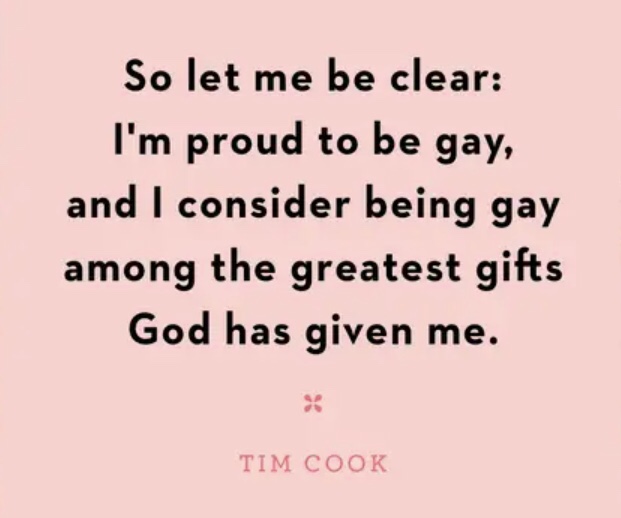
My friend Rob sent me some quotations for Pride Month. My favorite is from Apple CEO Tim Cook:
Cook is right. We should be proud of being gay. We should be proud of all the gifts God has given us, including that we are gay. Once we accept that God is proud of his creation, that God created us in His image, and that God created us to be gay, then we can celebrate God’s gift to us. We all have talents and gifts bestowed upon us by God.
I believe that God created gay people to make the world a better place. If you look throughout history, you’ll see that some of the most talented people who ever live were gay. How dull and drab would this world be if there were no gay people in it? This month, and every month, we need to celebrate all of the wonderful things that LGBTQ+ people have created, and it’s all because God created us “in His own image.”













 Joe
Joe





 The Closet Professor